Exhibition | Jean-Etienne Liotard
On this summer at the Scottish National Gallery (more information to come in the spring). . .
Jean-Etienne Liotard
Scottish National Gallery, Edinburgh, 4 July — 13 September 2015
Royal Academy, London, 24 October 2015 — 31 January 2016
Curated by MaryAnne Stevens, William Hauptman, and Christopher Baker

Jean Étienne Liotard, Laura Tarsi, ‘A Grecian Lady’, watercolour and bodycolour on ivory, ca 1745–49 (Cambridge: Fitzwilliam Museum)
A stunning exhibition celebrating one of the greatest artists of the eighteenth century. The work of Jean- Étienne Liotard (1702–89) has been rarely exhibited, and this is the first time it will be comprehensively celebrated in Britain.
Liotard enjoyed a long career, and his finest portraits display an astonishing hyper-realism achieved through a combination of incredible, intense observation and remarkable technical skills. He excelled at the delicate art of pastel, but also drew, painted in oil, created enamels, and was a refined miniaturist and printmaker. His activity was prodigious: Liotard wrote a treatise on painting, was a collector, a dealer, a traveller and an artistic innovator. In the age of Mozart and Casanova, he was a key international figure whose achievement deserves to be better known. Highlights of this important show include famous portraits, startling self-portraits, and brilliant experiments with genre and still-life subjects from the end of his career.
◊ ◊ ◊ ◊ ◊
Update (added 5 July 2015) — From the press release:
The National Galleries of Scotland is delighted to announce a major exhibition in the summer of 2015 celebrating one of the greatest yet little- known artists of the eighteenth century. The work of Jean-Étienne Liotard (1702–1789) has rarely been exhibited and this is the first time it will be comprehensively celebrated in Britain. Liotard enjoyed a long career and his finest portraits display an astonishing hyper-realism achieved through a combination of incredible, intense observation and remarkable technical skills.
Liotard was one of the most sophisticated artists of eighteenth-century Europe; a brilliant, witty portraitist, he excelled at the delicate art of pastel, but also drew, painted in oil, created enamels and was a refined miniaturist and printmaker. According to his contemporary Horace Walpole “Truth prevailed in all his works.” In some respects he also displayed striking modernity as a highly accomplished self-publicist, formulating a powerful ‘eastern’ image of himself following his period in Constantinople, by wearing exotic clothes and growing a long beard, which became as much a focus of curiosity as his portraits. His activity was prodigious: Liotard wrote a treatise on painting, was a collector, a dealer, a traveller and an artistic innovator. In the age of Mozart and Casanova, he was a key international figure, whose achievement deserves to be better known.
Born in Geneva, he travelled extensively, working in Amsterdam, The Hague, Venice, Rome and Naples. He spent four years in Constantinople depicting foreign residents in the city and developed a fascination with near- eastern fashions and customs. His career also took him to the courts of Vienna, Paris and London, where he portrayed the families of Empress Maria Theresa, King Louis XV and Augusta, Princess of Wales, creating images of great candour and charm.
Christopher Baker, Director of the Scottish National Portrait Gallery, and one of the exhibition’s curators commented: “This exhibition will be a revelation to many visitors who are unfamiliar with Liotard’s dazzling achievement. He was undoubtedly one of the most remarkable and idiosyncratic artists of the eighteenth century, and his work and career are fascinating, as they touch on themes such a travel, orientalism, court art, fashion and technical experimentation.”
Liotard depicted a number of important British patrons, in addition to members of the Royal family, such as the actor David Garrick, and some of his key works remain in U.K. public and private collections. Highlights of the exhibition will also include a selection of his startling self-portraits and brilliant experiments with genre and still life subjects that date from late in his career.
◊ ◊ ◊ ◊ ◊
Christopher Baker, Duncan Bull, Marc Fehlmann, William Hauptman, Neil Jeffares, Aileen Ribeiro, MaryAnne Stevens, Jean-Etienne Liotard (London: Royal Academy Publications, 2015), 224 pages, ISBN: 978-1907533990, £35.
 Renowned during the eighteenth century for his exquisite portraits and works in pastel, not to mention his outlandish Orientalist outfits, Jean-Etienne Liotard (1702–1789) painted some of the most significant rulers and aristocrats in Europe, including the entire British Royal Family. A peripatetic artist who worked in the Near East as well as in major European capitals, Liotard was born in Geneva and studied in Paris, before travelling to Italy and then on to Constantinople, in the company of Lord Duncannon. While there he painted the local residents as well as the British community, and adopted the eccentric style of dress that, when he later visited London, saw him become known as ‘The Turk’. This volume, accompanying the first exhibition of his works to be shown in the United Kingdom, illuminates the career of this unique artist, showcasing a variety of his extraordinary works, including portraits, drawings
and enamels.
Christopher Baker is Director of the Scottish National Portrait Gallery.
Duncan Bull is Curator of Foreign Paintings at Rijksmuseum, Amsterdam.
Marc Fehlmann is Associate Professor of Archaeology and Art History at Eastern Mediterranean University, Northern Cyprus.
William Hauptman is an independent scholar.
Neil Jeffares is an art historian with a particular interest in eighteenth-century pastels.
Aileen Ribeiro is Emeritus Professor at the Courtauld Institute of Art.
Mary-Anne Stevens, an independent curator, worked as Director of Academic Affairs at the Royal Academy for 29 years.
◊ ◊ ◊ ◊ ◊
Note (added 17 January 2016) — Neil Jeffares has compiled an extensive errata for the catalogue, available at his website.
Exhibition | China: Through the Looking Glass
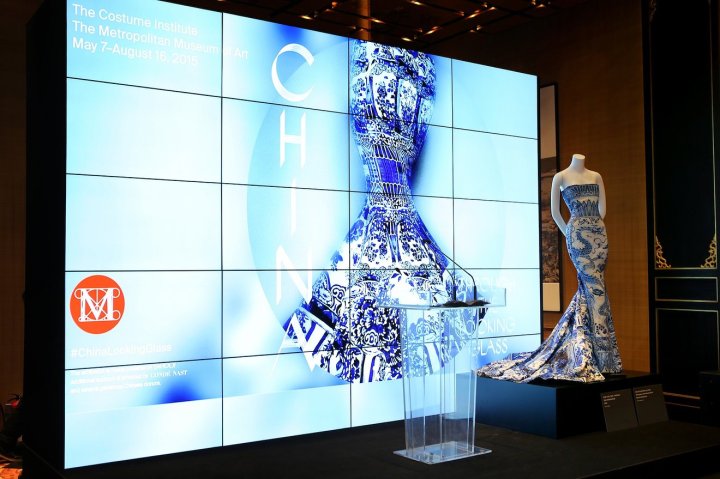
Evening dress by Roberto Cavalli, 2005
Photo: The Metropolitan Museum of Art
◊ ◊ ◊ ◊ ◊
Press release (23 December 2014) from The Met:
China: Through the Looking Glass
The Metropolitan Museum of Art, New York City, 7 May — 16 August 2015
Curated by Andrew Bolton with Harold Koda, Maxwell Hearn, Denise Patry Leidy, and Zhixin Jason Sun
The Costume Institute’s spring 2015 exhibition, China: Through the Looking Glass, will be on view at The Metropolitan Museum of Art from May 7 through August 16, 2015 (preceded on May 4 by The Costume Institute Benefit). Presented in the Museum’s Chinese Galleries and Anna Wintour Costume Center, the exhibition will explore how China has fueled the fashionable imagination for centuries, resulting in highly creative distortions of cultural realities and mythologies. In this collaboration between The Costume Institute and the Department of Asian Art, high fashion will be juxtaposed with Chinese costumes, paintings, porcelains, and other art, as well as films, to reveal enchanting reflections of Chinese imagery.
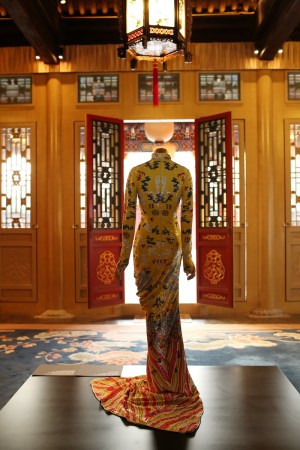
Yves Saint Laurent by Tom Ford, 2004
Photo: Courtesy of The Metropolitan Museum of A
“I am excited about this partnership between these two forward-thinking departments which will undoubtedly reveal provocative new insights into the West’s fascination with China,” said Thomas P. Campbell, Director and CEO of the Met. “The artistic direction of acclaimed filmmaker Wong Kar Wai will take visitors on a cinematic journey through our galleries, where high fashion will be shown alongside masterworks of Chinese art.”
In celebration of the exhibition opening, the Museum’s Costume Institute Benefit will take place on Monday, May 4, 2015. Silas Chou will serve as Honorary Chair. The evening’s co-chairs will be Jennifer Lawrence, Gong Li, Marissa Mayer, Wendi Murdoch, and Anna Wintour. This event is The Costume Institute’s main source of annual funding for exhibitions, publications, acquisitions, and capital improvements.
“From the earliest period of European contact with China in the 16th century, the West has been enchanted with enigmatic objects and imagery from the East, providing inspiration for fashion designers from Paul Poiret to Yves Saint Laurent, whose fashions are infused at every turn with romance, nostalgia, and make-believe,” said Andrew Bolton, Curator in The Costume Institute. “Through the looking glass of fashion, designers conjoin disparate stylistic references into a fantastic pastiche of Chinese aesthetic and cultural traditions.”
Exhibition Overview

Chanel by Karl Lagerfeld, 1984
Photo: The Metropolitan Museum of Art
This is The Costume Institute’s first collaboration with another curatorial department since AngloMania: Tradition and Transgression in British Fashion in 2006, a partnership with the Department of European Sculpture and Decorative Arts. China: Through the Looking Glass will feature more than 130 examples of haute couture and avant-garde ready-to-wear alongside masterpieces of Chinese art. Filmic representations of China will be incorporated to reveal how our visions of China are shaped by narratives that draw upon popular culture, and to recognize the importance of cinema as a medium through which we understand Chinese history.
The Anna Wintour Costume Center’s Lizzie and Jonathan Tisch Gallery will present a series of ‘mirrored reflections’ through time and space, focusing on Imperial China; the Republic of China, especially Shanghai in the 1920s, 1930s and 1940s; and the People’s Republic of China. These reflections, as well as others in the exhibition, will be illustrated with scenes from films by such groundbreaking Chinese directors as Zhang Yimou, Chen Kaige, Ang Lee, and Wong Kar Wai. Distinct vignettes will be devoted to ‘women of style’, including Oei Huilan (the former Madame Wellington Koo), Soong May-Ling (Madame Chiang Kai-shek), and Empress Dowager Cixi.
Directly above the Anna Wintour Costume Center, the Chinese Galleries on the second floor will showcase fashion from the 1700s to the present, juxtaposed with decorative arts from Imperial China, including jade, lacquer, cloisonné, and blue-and-white porcelain, mostly drawn from the Met’s collection. The Astor Court will feature a thematic vignette dedicated to Chinese opera, focusing on the celebrated performer Mei Lanfang, who inspired John Galliano’s spring 2003 Christian Dior Haute Couture Collection, ensembles from which will be showcased alongside Mr. Mei’s original opera costumes.
Designers in the exhibition will include Giorgio Armani, Vitaldi Babani, Cristobal Balenciaga, Sarah Burton for Alexander McQueen, Callot Soeurs, Roberto Cavalli, Coco Chanel, Christian Dior, Domenico Dolce and Stefano Gabbana, Peter Dundas for Emilio Pucci, Tom Ford for Yves Saint Laurent, John Galliano for Christian Dior, Jean Paul Gaultier, Valentino Garavani, Nicolas Ghesquière for Balenciaga, Maria Grazia Chiuri and Pierpaolo Picciolo for Valentino, Craig Green, Madame Grès, Ground-Zero, Guo Pei, Adrian Hailwood, Marc Jacobs for Louis Vuitton, Charles James, Charles Jourdan, Mary Katrantzou, Karl Lagerfeld for Chanel, Jeanne Lanvin, Ralph Lauren, Judith Leiber, Ma Ke, Mainbocher, Martin Margiela, Alexander McQueen, Alexander McQueen for Givenchy, Missoni, Edward Molyneux, Kate and Laura Mulleavy, Dries van Noten, Jean Patou, Paul Poiret, Oscar de la Renta for Balmain, Ralph Rucci, Yves Saint Laurent, Paul Smith, Anna Sui, Vivienne Tam, Isabel Toledo, Giambattista Valli, Vivienne Westwood, Jason Wu, Laurence Xu, and others.
The exhibition, a collaboration between The Costume Institute and the Department of Asian Art, coincides with the Museum’s year-long centennial celebration of the Asian Art Department, which was created as a separate curatorial department in 1915. China: Through the Looking Glass is organized by Andrew Bolton, Curator, with the support of Harold Koda, Curator in Charge, both of The Costume Institute. Additional support is provided by Maxwell Hearn, Douglas Dillon Chairman; Denise Patry Leidy, Curator; and Zhixin Jason Sun, Curator, all of the Department of Asian Art.
Internationally renowned filmmaker Wong Kar Wai will be the exhibition’s artistic director working with his longtime collaborator William Chang, who will supervise styling. Nathan Crowley will serve as production designer for the exhibition-he has worked on three previous Costume Institute exhibitions including Superheroes: Fashion and Fantasy (2008), American Woman: Fashioning a National Identity (2010), and Schiaparelli and Prada: Impossible Conversations (2012). The design for the 2015 Costume Institute Gala Benefit will be created by Wong Kar Wai and William Chang with 59 Productions, and Raul Avila, who has produced the Benefit décor since 2007.
“William Chang and I are pleased to be working in collaboration with The Costume Institute and the Asian Art Department of The Metropolitan Museum of Art on this exciting cross-cultural show,” said Wong. “Historically, there have been many cases of being ‘lost in translation’–with good and revealing results. As Chinese filmmakers we hope to create a show that is an Empire of Signs–filled with meaning for both East and West to discover and decipher.”
The exhibition is made possible by Yahoo. Additional support is provided by Condé Nast and several generous Chinese donors.
◊ ◊ ◊ ◊ ◊
The accompanying publication will be distributed by Yale UP:
Andrew Bolton, with Adam Geczy, Maxwell K. Hearn, Homay King, Harold Koda, Mei Mei Rado, Wong Kar Wai, and John Galliano, with photography by Platon, China: Through the Looking Glass (New York: The Metropolitan Museum of Art, 2015), 256 pages, ISBN: 978-0300211122, $45.
For centuries, China’s export arts—jade, silks, porcelains, and, more recently, cinema—have fueled Western fantasies of an exotic East and served as enduring sources of inspiration for fashion. This stunning publication explores the influence of Chinese aesthetics on designers, including Giorgio Armani, Christian Dior, Jean Paul Gaultier, Karl Lagerfeld, Ralph Lauren, Alexander McQueen, and Yves Saint Laurent. Drawing upon Chinese decorative arts, cinema, and costume—notably imperial court robes, the close-fitting cheongsam, and the unisex Mao suit—their designs are fantastical pastiches of anachronistic motifs. As in the game of “telephone,” the process of cultural translation transforms the source material into ingeniously original fashions that are products solely of the designers’ imaginations.
In a similar way, contemporary Chinese film directors render fanciful, highly stylized evocations of various epochs in China’s history—demonstrating that China’s imagery is equally seductive to artists in the East and further inspiring today’s designers. Juxtaposing modern fashions and film stills with their forebears in fine and decorative arts and historical dress, this book reveals the rich and ongoing creative dialogue between East and West, past and present.
Andrew Bolton is curator in the Costume Institute, The Metropolitan Museum of Art.
Exhibition | Goya: The Portraits
Looking ahead to the fall at The National Gallery in London:
Goya: The Portraits
The National Gallery, London, 7 October 2015 — 10 January 2016
Curated by Xavier Bray

Francisco de Goya, Self Portrait in His Studio, 1793–95 (Madrid: Museo de la Real Academia de Bellas Artes de San Fernando)
Francisco de Goya (1746–1828) is one of Spain’s most celebrated artists. He was considered a supremely gifted portrait painter and an excellent social commentator who took the genre of portraiture to new heights through his ability to reveal the psychology of his sitter. This landmark exhibition—the first ever focusing solely on his portraits—will re-appraise Goya’s genius as a portraitist and provide a penetrating insight into both public and private aspects of his life. It will explore Goya’s ambitions and development as a painter, and his innovative and unconventional approach to portraiture which often broke traditional boundaries.
The exhibition will trace Goya’s career from his early beginnings at the court of Charles III in Madrid to his appointment as First Court Painter to Charles IV, through the difficult period under Joseph Bonaparte and then Ferdinand VII, which nevertheless saw some of his finest work, and then his final years in France. By bringing together more than 50 of his most outstanding portraits from around the world, including drawings and miniatures, and organising them in a chronological and thematic sequence, the show will enable viewers to engage for the first time with the full range of Goya’s technical, stylistic and psychological development as a portraitist.
◊ ◊ ◊ ◊ ◊
Note (added 4 August 2015) — The full press release is available here.
The catalogue is distributed by Yale UP:
Xavier Bray, with Manuela Mena Marqués and Thomas Gayford, Goya: The Portraits (London: The National Gallery, 2015), 272 pages, ISBN: 978-1857095739, $60.
 Francisco de Goya y Lucientes (1746–1828) was one of the greatest portraitists of his time. The first large-scale book devoted to the topic, this handsome volume features portraits that shed light on Goya and his subjects, as well as on the politically turbulent and culturally dynamic era in which they lived. Whether portraying royalty, philosophers, military men, or friends, these works are memorable both for the insight they provide into the relationship between artist and sitter, and for their penetrating psychological depth.
Xavier Bray traces Goya’s career from his beginnings at the Madrid court of Charles III to his final years in Bordeaux, played out against the backdrop of war with France and the social, political, and cultural shift of the Enlightenment. More than 60 remarkable portraits, including drawings and miniatures, reveal the full range of Goya’s technical and stylistic achievements, while also depicting sitters with a previously unparalleled humanity. His break with traditional, late-18th-century conventions allowed him to achieve a new modernity in portraiture that paved the way for artists such as Matisse and Picasso.
Xavier Bray is chief curator at Dulwich Picture Gallery. Manuela Mena Marqués is chief curator of 18th-century paintings at the Museo del Prado, Madrid. Thomas Gayford is a former research assistant at Dulwich Picture Gallery.
New Book | 1715: La France et la Monde
From Perrin:
Thierry Sarmant, 1715: La France et la Monde (Paris: Éditions Perrin, 2014), 400 pages, ISBN: 978-2262033316, 24€.
 Versailles, 1 er septembre 1715. Après une longue agonie, Louis XIV s’éteint “comme une chandelle que l’on souffle”. Ainsi finit le “Grand Siècle” (XVIIe) et commence le “siècle des Lumières” (XVIIIe). À ces expressions est d’ordinaire attachée l’idée d’une prépondérance française, politique et militaire d’abord, culturelle et intellectuelle ensuite. Qu’en est-il réellement ?
En observant les relations que tisse la France avec le monde, en questionnant sa place et son rôle autour de l’année charnière 1715, Thierry Sarmant éclaire l’un des phénomènes les plus saisissants de l’histoire humaine : l’essor de l’Occident vers une hégémonie mondiale. Alors que la question du déclin de la France et de l’Europe est omniprésente, quoi de plus pertinent que de s’interroger sur les ressorts cachés de l’expansion et du déclin ? C’est le pari de ce livre, qui entraine le lecteur de Versailles à Moscou, d’Istanbul à Stockholm et de Pékin à Delhi.
Archiviste-paléographe, Docteur habilité de l’université de Paris-I, Thierry Sarmant est conservateur en chef au musée Carnavalet. Historien de l’Ancien Régime, il a publié en dernier lieu Régner et gouverner : Louis XIV et ses ministres (en collaboration, 2010) et Louis XIV. Homme et roi (2012).
New Book | Le Luxe, les Lumières et la Révolution
From Les Éditions Champ Vallon:
Audrey Provost, Le Luxe, les Lumières et la Révolution (Seyssel: Éditions Champ Vallon, 2014), 272 pages, ISBN: 978-2876739796, 25€.
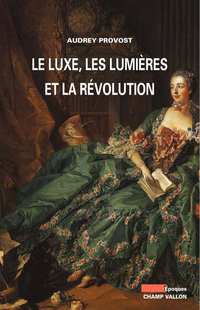 De sa réhabilitation par Voltaire dans son scandaleux poème du Mondain à son utilisation dans les pamphlets prérévolutionaires, le luxe est l’un des sujets les plus brûlants, les plus débattus du siècle des Lumières. D’innombrables auteurs, petits ou grands, se sont interrogés sur cet objet futile et sulfureux qui leur permet de parler de tout : des arts et des sciences, des femmes et de la confusion sociale, du bonheur et des inégalités, du progrès ou du déclin de l’esprit humain.
Alors que la monarchie a cessé d’édicter des lois somptuaires, alors que le discours de l’Église est marginalisé, des écrivains s’érigent en juges, en avocats et en législateurs de la « culture des apparences ». Ce faisant, ils s’adressent à l’opinion publique et proclament haut et fort les nouveaux pouvoirs de l’écriture : l’affrontement autour du luxe met en jeu les compétences et la légitimité des hommes de lettres à fixer des valeurs communes, en concurrence directe avec le pouvoir royal.
Au cœur de cette effervescence polémique, nous croisons les figures attachantes de ces petits polygraphes, ces « Rousseau des ruisseaux » qui tentent de prendre place dans la République des lettres ; nous faisons connaissance du « serial publicateur » que fut le chevalier du Coudray ; nous apprenons comment écrire un livre sur le luxe, à la manière d’un Rabelleau ; nous suivons la lutte entre Butel-Dumont et ses contradicteurs pour changer le sens du mot, et inventer des adjectifs et des étymologies transformées en autant de munitions dans cette guerre de libelles et de pamphlets.
À la fin des années 1780, les fastes de la monarchie ont cessé d’éblouir et le luxe de Marie-Antoinette, « l’Autrichienne » est devenu, sous la plume acérée des pamphlétaires, une arme politique redoutable, car ce débat foisonnant a aussi contribué au changement de culture politique qui mène à la Révolution.
Née en 1970, ancienne élève de l’ENS (Ulm), Audrey Provost est agrégée d’histoire.
◊ ◊ ◊ ◊ ◊
From its vindication in Voltaire’s scandalous poem Le Mondain, to its strategic use in pre-revolutionary pamphlets, luxury figures as the subject of some of the most heated debates of the eighteenth century. Innumerable authors, canonical and non, raised questions about this frivolous and yet fiery topic that allowed them to speak about everything and anything: of the arts and sciences, of women and social confusion, of happiness and inequality, of the progress or decline of the human spirit.
As the monarchy stopped issuing sumptuary laws, as the Church’s discourse was marginalized, writers presented themselves as judges, defenders, and legislators of the “culture of appearances.” In the process they addressed themselves to public opinion, and loudly proclaimed the new powers of writing: indeed, the debates about luxury put into play the competence and legitimacy of men of letters as they established a common set of values in a direct challenge of royal authority.
At the heart of these polemics, we find the touching figures of small polygraphs, those “Rousseau des ruisseaux” who tried to establish a place for themselves in the Republic of Letters. We meet a “serial publisher” in the figure of the chevalier du Coudray; we learn how to write a book on luxury according to Rabelleau; we follow the competition between Butel-Dumont and his opponents as they sought to change the meaning of the word “luxury,” and to invent adjectives and etymologies that became ammunition in this war of libels and pamphlets.
At the end of the 1780s, the fasts of the monarchy ceased to dazzle, and the luxury of Marie-Antoinette the “Austrian” became a considerable political weapon under the pen of pamphleteers. The ensuing debate contributed to a change in political culture, which eventually would lead to the Revolution.
Exhibition | Wellington: Triumphs, Politics and Passions
Press release (29 October 2014) from the NPG:
Wellington: Triumphs, Politics and Passions
National Portrait Gallery, London, 12 March — 7 June 2015
Curated by Paul Cox with Lucy Peltz

Sir Thomas Lawrence, Portrait of Arthur Wellesley, 1st Duke of Wellington, 1815–16. (London: Wellington Collection, Apsley House, English Heritage).
The first gallery exhibition devoted to the Duke of Wellington will open at the National Portrait Gallery, to mark the 200th anniversary year of the Battle of Waterloo in 2015. Wellington: Triumphs, Politics and Passions will explore not only the political and military career of the victor of this great battle—but also his personal life through portraits of his family and friends.
Highlights include Goya’s portrait of Wellington started in 1812 after his entry into Madrid and later modified twice to recognise further battle honours and awards; and from Wellington’s London home, Apsley House, Thomas Lawrence’s famous 1815 portrait painted in the same year as the Battle of Waterloo. This iconic military image of Wellington was used as the basis of the design of the British five pound note from 1971 to 1991.
Drawn from museums and private collections including that of the present Duke of Wellington, the exhibition of 59 portraits and other art works has the support of the Marquess of Douro, and includes rarely-seen loans from the family including a portrait by John Hoppner of the Duke as a youthful soldier and a daguerreotype portrait by Antoine Claudet, in the new medium of photography, taken on Wellington’s 75th birthday in 1844. The family has also loaned Thomas Lawrence’s beautiful drawing of Wellington’s wife, Kitty (née Pakenham).
The real experience of soldiers fighting in Wellington’s armies will be explored through eyewitness accounts, including prints based on sketches by serving soldiers and the illustrated diary of a young officer, Edmund Wheatley written, in a lively style, with the intention of it being read by his sweetheart.

Francisco de Goya, Portrait of Arthur Wellesley, 1st Duke of Wellington, 1812–14 (London: The National Gallery).
Wellington: Triumphs, Politics and Passions considers the attempts of the art world to celebrate the Duke of Wellington’s military successes. Commemorative objects on display will range from royal commissions by Europe’s foremost artists and manufacturers to more modest souvenirs aimed at the domestic market. Wellington’s eventful and often difficult political career will be illustrated by examples of the many satirical prints published in the 1820s and 1830s and the exhibition will also examine the reappraisal of Wellington’s life that took place at his death and on the occasion of his lavish state funeral.
The Duke of Wellington’s long life (1769–1852) spanned the eighteenth and nineteenth centuries. Most famous for his victory over Napoleon at the battle of Waterloo, he later entered politics, serving twice as Prime Minister. Wellington: Triumphs, Politics and Passions will explore the role of visual culture in creating the hero, the legacy of heroism and the role of the portrait in Wellington’s own public and personal self-representation.
Curated by Paul Cox, Associate Curator, National Portrait Gallery, with close support from Dr Lucy Peltz, Curator of Eighteenth-Century Portraits, National Portrait Gallery, this biographical exhibition will use portraits and objects to explore Wellington’s military career and his sometimes controversial political and personal life.
Paul Cox, Associate Curator, National Portrait Gallery, London, says: “The Duke of Wellington’s victory over Napoleon at Waterloo is well known. This exhibition provides the opportunity to examine less familiar aspects of his life, including the long political career during which he saw through important forward-looking legislation, but suffered a dramatic loss of popularity. I hope that visitors to the exhibition will gain a fuller picture of Wellington as a man, rather than simply as a hero.”
The exhibition is part of the Battle of Waterloo 200th Anniversary Commemorations, the national partnership of commemorative events.
◊ ◊ ◊ ◊ ◊
Paul Cox, with a foreword by William Hague, Wellington: Triumphs, Politics and Passions (London: National Portrait Gallery, 2015), 128 pages, ISBN: 978-1855144996, £15.
This new book about the 1st Duke of Wellington provides a novel take on the traditional biography in that it explores the life of this complex man through portraits of Wellington himself, his friends, family and associates, as well as his political and military allies and opponents. There are examples of painted portraits by Goya and Thomas Lawrence, several caricatures that illustrate Wellingtons political career, and a watercolour by George Chinnery that shows the future duke as a young Major-General at the Chepauk Palace, Madras being received by Azim al-Daula, Nawab of the Carnatic, in February 1805. Also reproduced is a rare photograph, a Daguerreotype, made by Antoine Claudet on the occasion of Wellingtons seventy-fifth birthday in 1844, and sections of a sixty-six-foot roll from the Collection of the National Portrait Gallery depicting his entire funeral procession. Paul Cox explores Wellingtons military career and the battle of Waterloo, which remain central to his story, but also examines his personal relationships, his legacy and his enduring place in the popular imagination. Finally, a narrative chronology presents a useful overview of Wellingtons life and times.
New Book | Memoirs of the Court of George III
From Pickering & Chatto:
Michael Kassler, Lorna Clark, Alain Kerhervé, and Peter Sabor, eds., Memoirs of the Court of George III, 4 vols., (London: Pickering & Chatto, 2015), c.1600 pages, ISBN: 978-1848934696, £350 / $625.
 George III was one of the longest reigning British monarchs, ruling over most of the English-speaking world from 1760 to 1820. Despite his longevity, George’s reign was one of turmoil. Britain lost its colonies in the War of American Independence and the European political system changed dramatically in the wake of the French Revolution. Closer to home, problems with the King’s health led to a constitutional crisis. Charlotte Papendiek’s memoirs cover the first thirty years of George III’s reign, while Mary Delany’s letters provide a vivid portrait of her years at Windsor. Lucy Kennedy was another long-serving member of court whose previously unpublished diary provides a great deal of new detail about the King’s illness. Finally, the Queen herself provides further insights in the only two extant volumes of her diaries, published here for the first time.
The edition will be invaluable to scholars of Georgian England as well as those researching the French and American Revolutions and the history and politics of the Regency period more widely. It will complement the ongoing project, The Court Journals and Letters of Frances Burney (OUP).
• All texts are first-hand accounts from those close to George III and relate information on important events, including the American and French Revolutions and the King’s ‘madness’
• Two volumes are editions of previously unpublished manuscripts
• All the texts are rare and Queen Charlotte’s diaries are newly transcribed from the Royal Archives at Windsor Castle
• Editorial apparatus includes a general introduction, volume introductions, headnotes, footnotes and indexes to the texts
General Editor: Michael Kassler, Independent scholar
Volume Editor: Lorna J Clark, Carleton University
Volume Editor: Alain Kerhervé, University of Western Brittany
Consultant Editor: Peter Sabor, McGill University
Volume 1
The Memoirs of Charlotte Papendiek (1765–1840): Court, Musical and Artistic Life in the Time of King George III
Mrs Papendiek’s Memoirs record events at court from 1761—when the future Queen Charlotte came to England to marry King George—until 1792. The Papendieks knew many musicians, including John Christian Bach (son of Johann Sebastian), William Herschel (who became an astronomer) and Haydn. The memoirs also record meetings with artists of the day, such as Thomas Lawrence and Thomas Gainsborough. They are a unique resource, recording significant information about living conditions, dress, education and Anglo-German relations.
Volume 2
Mary Delany (1700–1788) and the Court of George III
Though she failed to become a handmaiden to Queen Anne, Mary Delany went on to become a figure at Court, eventually lodging at Windsor. This new edition of her correspondence during her years at Windsor presents previously unpublished letters as well as applying modern standards of editorial principles to her correspondence. The letters show the daily rituals of living at Court, document the first social steps of Fanny Burney and Mary Georgina Port, and supply new information on the family life of the royal family – including material on the assassination attempt against George III by Margaret Nicholson.
Volume 3
The Diary of Lucy Kennedy (1793–1816)
Lucy Kennedy (c.1731–1826), had an insider’s view of life in Windsor castle and of members of the Royal Family for fifty-three years. Her diary, preserved in the Royal Library, Windsor Castle, has never before been published. In it she writes a moving account of the death of Princess Amelia which precipitated the final illness of George III and the Regency. Her observations of his symptoms are relevant for modern-day diagnoses of his malady.
Volume 4
The Diary of Queen Charlotte, 1789 and 1794
Queen Charlotte kept a diary in which she recorded her daily activities as well as those of George III and other members of the royal family. Only her volumes for 1789 and 1794 survive, in the Royal Archives at Windsor Castle. Her 1789 diary shows how the king’s illness and recovery impacted upon their lives. Both diary volumes provide hitherto unpublished information about court life and the royal family.
New Book | The Visual Culture of Catholic Enlightenment
From Penn State UP:
Christopher M. S. Johns, The Visual Culture of Catholic Enlightenment (University Park: Penn State University Press, 2014), 440 pages, ISBN: 978-0271062082, $90.
 Until relatively recently, most scholars considered the notion of a Catholic enlightenment either oxymoronic or even illusory, since the received wisdom was that the Catholic Church was a tireless and indefatigable enemy of modernist progress. According to Christopher Johns, however, the eighteenth-century papacy recognized the advantages of engaging with certain aspects of enlightenment thinking, and many in the ecclesiastical hierarchy, both in Italy and abroad, were sincerely interested in making the Church more relevant in the modern world and, above all, in reforming the various institutions that governed society. Johns presents the visual culture of papal Rome as a major change agent in the cause of Catholic enlightenment while assessing its continuing links to tradition. The Visual Culture of Catholic Enlightenment sheds substantial light on the relationship between eighteenth-century Roman society and visual culture and the role of religion in both.
New Book | Ladies of the Grand Tour in Naples and Environs
Published by Grimaldi and available from ArtBooks.com: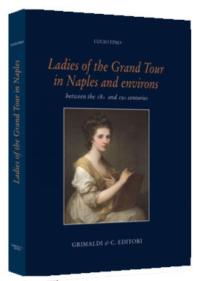
Lucio Fino, Ladies of the Grand Tour in Naples and Environs between the 18th and 19th Centuries (Naples: Grimaldi, 2014), 197 pages, ISBN: 978-8898199211, 95€ / $150.
Large volume with 145 color plates, many of which are full-paged reproductions—some previously unpublished—of prints, drawings, paintings, and watercolours from public and private collections. English text.
Exhibition | Eighteenth-Century Fans from the Lázaro Collection
◊ ◊ ◊ ◊ ◊
Thanks to Pierre-Henri Biger for noting this exhibition now on view at the Fundación Lázaro Galdiano:
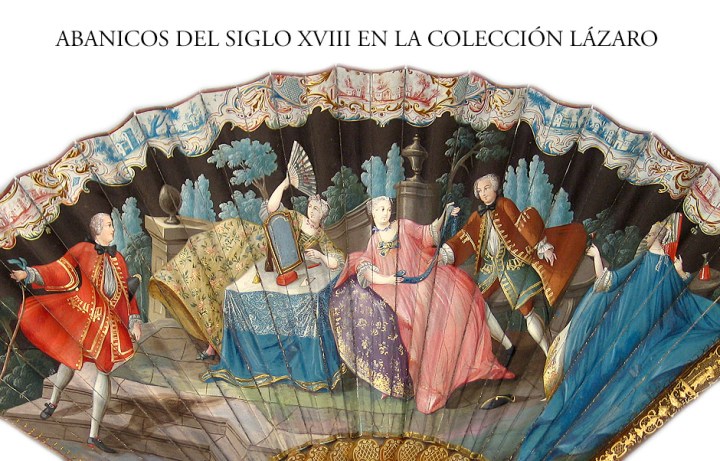
Abanicos del Siglo XVIII en la Colección Lázaro
Museo Lázaro Galdiano, Madrid, 10 October 2014 — 26 January 2015
Curated by Carmen Espinosa
La exposición Abanicos del siglo XVIII en la Colección Lázaro, comisariada por Carmen Espinosa, conservadora jefe del Museo Lázaro Galdiano, se compone de una cuidada selección de 24 piezas correspondientes a la edad de oro del abanico, elemento fundamental del adorno personal femenino, signo de distinción y de lujo. La gran variedad de abanicos que atesoró José Lázaro es muestra de su incansable búsqueda como coleccionista, de meses e incluso años, para encontrar piezas con las que obsequiar a su esposa, Paula Florido, desde que la conoció en 1901.
Los ejemplares expuestos en Abanicos del siglo XVIII en la Colección Lázaro constituyen un excelente repertorio que permite al visitante apreciar la evolución de este complemento femenino. Se muestran obras tempranas, del primer tercio del siglo XVIII, donde las referencias al barroco clasicista son evidentes; piezas en las que vemos cómo se va fraguando el gusto rococó que dio lugar al abanico galante, fiel reflejo de la vida refinada y placentera de los nobles y burgueses europeos del segundo tercio de la centuria; y otras de estructura sencilla, pero de calidad, que nos adentran en el estilo neoclásico y la moda Imperio.
Las pinturas de los países están realizadas sobre papel o vitela -piel de vaca o ternera, adobada y pulida-, materiales que permiten el plegado, y están inspiradas en asuntos mitológicos, históricos, galantes y pastorales. Los poemas homéricos de la Iliada y la Odisea, unidos a la Eneida de Virgilio y Las Metamorfosis de Ovidio, fueron una fuente inagotable para los pintores de abanicos junto a las gestas de Alejandro Magno cuya figura encarnó los ideales de valor, poder y nobleza. La pintura de los abanicos de estilo Luis XV, identificados con el rococó, refleja la creciente hegemonía de la mujer en la vida social, protagonista indiscutible reflejada en la diosa Venus, personificación del amor, la belleza y la fertilidad; en Juno, diosa del matrimonio y protectora de la mujer; o en Onfalia que hizo que Hércules olvidará su valentía abandonándose a los placeres del amor. De la historia religiosa, habitual en abanicos del primer tercio del siglo, se escogieron relatos del Antiguo Testamento, aquellos donde la mujer desempeñó un papel fundamental como Sansón y Dalila, Salomé, Betsabé o la reina de Saba. A partir de 1750, a la literatura se unen, como fuente de inspiración para los pintores, el teatro, la ópera y el ballet.
Las pinturas de Antoine Coypel, Charles Le Brun y sobre todo las de Jean Antoine Watteau y François Boucher, creadores de la fiesta galante y de la pintura pastoral, son otro gran referente para la decoración de los abanicos dieciochescos. Esta riqueza iconográfica se muestra en los abanicos de la Colección Lázaro y queda patente en esta exposición.
Variedad y calidad están presentes en los abanicos de esta muestra, citemos como ejemplo uno francés con la representación de la Alegoría de las Artes o el italiano con una escena de toilette, que figuran entre las más ostentosas de la colección. También podemos deleitarnos con los elegantes varillajes realizados en marfil o carey con trabajo de piqué -técnica italiana adoptada en Francia e Inglaterra que consiste en la incrustación de pequeños fragmentos de oro y plata-, tallados y calados en forma de rejilla o puntos -grillé / pointillé-, a los que se añaden pequeñas láminas de madreperla, plata dorada o corlada, nácar y, en ocasiones, piedras preciosas en el adorno de las palas y en el clavillo -pasador que sujeta las varillas, las fuentes y palas, del abanico-.
La colección de abanicos, compuesta por noventa piezas, es un caso especial entre todas las que conforman la Colección Lázaro. Sus obras, nos explica Carmen Espinosa, son algo más que objetos de colección, fueron testigos mudos de una relación personal, la de los coleccionistas José Lázaro y Paula Florido: desde que se conocieron, en 1901, y hasta la muerte de Paula en 1932, Lázaro regaló a su esposa abanicos en dos fechas muy señaladas: el 15 de enero, día de su cumpleaños, y el 29 de junio, en que celebraba su onomástica. Estos abanicos responden al gusto de Lázaro que se esforzó por encontrar las piezas con las que agasajar a su esposa aunque, evidentemente, existió cierta complicidad pues conocía su preferencia por la época de Luis XV y Luis XVI. Los abanicos del XVIII estaban considerados, a comienzos del siglo XX y aún hoy, como verdaderas joyas, muy buscadas y de gran valor.
◊ ◊ ◊ ◊ ◊
From La Tienda de Los Museos Online:
Este catálogo recoge la colección completa de abanicos (casi un centenar) en la que están incluidas las 24 piezas de la exposición.
Arte, Lujo y Sociabilidad: La Colección de Abanicos de Paula Florido (Año Edición, 2009), 134 pages, ISBN: 978-8496411906, 12€.
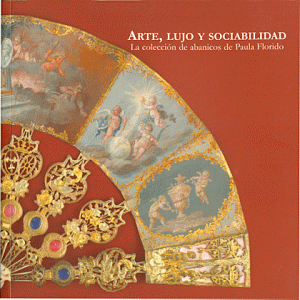 Se trata de una muestra de abanicos de elite, con materiales en su mayoría nobles de textiles, metales, brillantes, países y varillaje bien hecho y torneado, en madera de peral o de carey, con ejemplares muy selectos que abarcan los siglos XVIII y XIX.
Entre los abanicos expuestos también se encontraban cocardas (tipo paipai redondeado y recogido) o pericones, de mayor tamaño, así como abanicos de baraja. En su mayoría abanicos franceses, italianos e ingleses, con escenas bíblicas, mitológicas, heroicas, galantes, de la Comedia del arte y muy pocos con motivos políticos como el del matrimonio de doña Isabel II. En el abanico elegante se buscaban brillos y destellos de luz para impactar en sociedad.
Un bello cuadro de Luis Paret y Alcazar La Tienda (1772), perteneciente al mismo museo, ilustra sobre el modo en que un caballero y una dama adquieren ejemplares de abanico o miniaturas en aquel colmado ilustrado.
Se añaden algunos grabados de Goya que también dan cuenta del uso del abanico en Los Caprichos, objeto de indumentaria de lujo en principio, que paulatinamente se fue popularizando. El abanico era una pieza utilizada por el hombre o la mujer indistintamente, aunque era la mujer la que ofrecía con él todo un código de señales de sociabilidad.










 Enfilade
leave a comment