New Book | The Drawing Room: English Country House Decoration
From Rizzoli:
Jeremy Musson, foreword by Julian Fellowes with photographs by Paul Barker, The Drawing Room: English Country House Decoration (New York: Rizzoli, 2014), 272 pages, ISBN: 978-0847843336, $60.
 A highly detailed look at the most accomplished English country house interiors, exemplifying English decorating at its best. The English drawing room, a formal place within a house of status where family and honored guests could retire from the more public arena, is one of the most important rooms in an English country house, and thus great attention has been paid to preserving the decoration of this most elegant of spaces: the center of life in the English countryside and the epitome of English country house decoration. This book offers privileged access to fifty of the finest drawing rooms of country houses and historic townhouses—many still in private hands—including Althorp, Attingham, and Knepp Castle. Through these sumptuous rooms, readers experience a history of English decorating from the sixteenth century to the present day, including the work of design legends such as David Hicks, Nancy Lancaster, John Fowler, and David Mlinaric. Specially commissioned photographs capture the entirety of each room, as well as details of furniture, architectural elements, artwork, collections, and textiles, creating a visually seductive book that will inspire interior designers and homeowners interested in the widely popular classic English look.
Jeremy Musson is the former architectural editor of Country Life, the cowriter and presenter of the BBC television series The Curious House Guest, and the author of many books, including English Country House Interiors, The English Manor House, How to Read a Country House, and The Country Houses of Sir John Vanbrugh. Paul Barker is one of England’s premier interior and architectural photographers, whose books include English Country House Interiors, England’s Thousand Best Churches, and English Ruins. Julian Fellowes is the creator of the hit series Downton Abbey.
Albertine Books Opens in New York

◊ ◊ ◊ ◊ ◊
It’s an intriguing model for a what bookstore might be, a model that underscores the cultural and ideological work such a store can do, and this at a time when we seem to hear only about the economics of bookstores. William Grimes covers the story for The New York Times (9 October 2014). The next step will be getting the store to host an eighteenth-century festival. –CH
From the Albertine:
The Cultural Services of the French Embassy in New York is pleased to announce the opening of Albertine Books in French and English, the new reading room and bookshop devoted to works in French and in translation on Saturday September 27, 2014. Named after the beautiful, omnipresent and unknowable female character in Marcel Proust’s classic In Search of Lost Time, Albertine will offer the most comprehensive selection of French-language books and English translations in New York, with over 14,000 contemporary and classic titles from 30 French-speaking countries in genres including novels, non-fiction, art, comic, or children’s books.
Housed in one of the few remaining iconic Stanford White-designed mansions on Fifth Avenue, Albertine was designed and fashioned by French architect Jacques Garcia, in the model of a grand private French library. The two-floor space includes a reading room and inviting nooks furnished with lush sofas and armchairs.
Albertine will also be a venue for French-American and European-American debates and discussions on subjects varying from politics to economics to art, literature or sciences and will explore classical culture through a modern and global lens. To highlight its role as an exciting new hub for intellectual debate in New York City, Albertine will present a six-night festival from October 14–19, curated by cultural critic and author Greil Marcus, featuring French and American artists and thinkers.
The Albertine team looks forward to welcoming you to our bookshop!
Spread the word to all your francophile and francophone friends.
Albertine
972 Fifth Avenue (between 78th & 79th street)
Opening Hours
Monday to Thursday and Saturday: 11–7
Friday: 11–10
Sunday: 11–6
Follow Albertine on Facebook, Twitter and Instagram: @albertinebooks
Exhibition | Sade: Marquis of Shadows, Prince of the Enlightenment
To the d’Orsay’s exhibition on the Marquis de Sade we can add this one now on view at the Institut des Lettres et Manuscrits:
Sade: Marquis of Shadows, Prince of the Enlightenment
The Spectrum of Libertinism from the 16th to the 20th Century
Institut des Lettres et Manuscrits, Paris, 26 September 2014 — 18 January 2015
Curated by Pascal Fulacher and Jean-Pierre Guéno
Yes, I am a libertine, I admit it freely. I have dreamed of doing everything that it is possible to dream of in that line. But I have certainly not done all the things I have dreamt of and never shall. Libertine I may be, but I am not a criminal, I am not a murderer. –Donatien Alphonse François de Sade
Sade and the Spectrum of Libertinism
Donatien Alphonse François de Sade was doubly a man of letters: a great novelist, a great letter writer, but above all a victim of the very special letters that were the lettres de cachet, often commissioned from monarchs or their ministers by the families of those who wanted to have troublesome offspring removed from the public sphere. Even more than the Marquis of Shadows, even more than his escapades and fantasies of debauchery, it was the Prince of the Enlightenment who never ceased to embarrass both his family, who continually persecuted him, his social caste, and the leading figures of his time, to the point where this troublemaker became a kind of literary man in an iron mask who spent more than half his adult life in prison before dying there. Apart from the fact that he was sentenced to life imprisonment in 1768, and twice to death in 1772 and in 1794, De Sade spent nearly twenty-eight years in prison between 1763 and 1814, between the age of 23 and his death at age 74, and this under three different regimes: the Monarchy, the Republic and the Empire. From the tower at Vincennes to Charenton insane asylum, despite the material means he had to improve his everyday life, he lived mostly in “execrable slums,” in a dozen jails including those of Saumur castle, Pierre-Encise citadel in Lyon, For-l’Eveque prison in Paris, Miolans fort in Savoy, the Bastille fortress, Sainte-Pélagie prison and Bicêtre prison in Paris, not forgetting the gaols of the Revolution. During the seventy-four years and six months of his life as in the two centuries that separate us from his death, it may seem paradoxical that we have demonised the Marquis de Sade to such an extent, and that we have for so long mixed the man with his work, to the point of confusing the man and the novelist with the criminal characters in his fiction.
 Certainly he was a libertine who indulged in licentious and dissolute sexual practices, but the man who lent his name to today’s definition of the word Sadism, “the tendency to derive pleasure from physical or emotional pain intentionally inflicted on others” would have been just one more profligate among the aristocrats of his time, had he not been primarily the eye of a kind of consciousness that managed to convey not just the pain of living, but the “pain of the century” (“mal du siècle”) as defined by Musset in the 19th century: through his escapades and provocations, then through his political writings, as through his philosophical writings, letters and novels, but also by example, or by the counterexample of his life, did Sade ever cease to express the evil that devours men, mostly from the Renaissance to modern times, that is to say, during the second half of the second millennium?
For the last four centuries, are those who call themselves libertines actually Epicureans, delinquents or hyper-aware individuals? Bon vivants, criminals or cursed existentialists? From the Marquis de Sade to Dominique Aury (aka Pauline Réage), author of Histoire d’O (The Story of O), to Théophile de Viau, Crébillon, Choderlos de Laclos and his Liaisons Dangereuses (Dangerous Liaisons), Mirabeau, Casanova, the Chevalier d’Eon, Musset, Maupassant, Baudelaire, Rimbaud, Verlaine, Pierre Louÿs and Joë Bousquet, the great figures of literature, poetry and thought have never ceased to celebrate the cannibalistic wedding of vice and virtue. Vice that feeds on virtue when it transgresses and deflowers it. Virtue that feeds on vice when it denounces and demonises it.
At the boundaries of fantasy, revolution, transgression, emancipation and moral suicide, between the realities of purgatory, the fantasised or dreaded delights of hell and the mythical nostalgia for paradise lost, between cynicism, pragmatism and hope, between Epicureanism and cruelty, between enlightenment and barbarism, between the obsession with God and its denial, do the case studies that adorn the spectrum of libertinism not illustrate the entire tragedy of the human condition, and do they not resemble in this respect all the major intellectual earthquakes of the 19th and 20th centuries, from romanticism to existentialism through surrealism?
The Exhibition
 Long before becoming a moral emancipation movement, libertinism was a terribly subversive spiritual liberation movement, since it questioned the existence of God, the legitimacy of kings’ rule by divine right, and all the dogmas of religion, morals and absolute power. From the outset, the exhibition reveals “The spectrum of libertinism,” leading the visitor from “libertinism of the spirit to libertinism of morals” through a set of subversive texts including the Decameron by Boccaccio, Pensées (Thoughts) by Pascal, Dom Juan by Molière, Contes et nouvelles (Tales and Novels) by La Fontaine, Les Lettres persanes (Persian Letters) by Montesquieu and La Nouvelle Héloïse (The New Heloise) by J.-J. Rousseau. Libertinage in the time of De Sade is also discussed in the letters and works of Crébillon, Casanova, the Chevalier d’Eon, Restif de la Bretonne, Choderlos de Laclos, Mirabeau and more.
Then, pride of place is given to the Marquis de Sade and his masterpiece, Les 120 journées de Sodome ou l’École du libertinage (The 120 Days of Sodom, of the School of Libertinism): the handwritten scroll on which this still-scandalous novel was written is on display here for the first time ever in France. Several letters by De Sade, to his wife, his mother-in-law, his lawyer, an actress, etc. are also displayed around the scroll, and give a better understanding of this enigmatic and highly controversial figure.
The last two parts of the exhibition shed light on the rehabilitation of the Marquis de Sade and his work, as well as the development of libertinism in the 19th and 20th centuries, from romanticism to surrealism through existentialism. The exhibition Sade: Marquis de l’ombre, prince des Lumières, L’éventail des libertinages du XVIe au XXe siècle also features over 120 exceptional pieces, letters and autograph manuscripts, first editions and rare, valuable illustrated books, drawings, photographs, etc.
◊ ◊ ◊ ◊ ◊
From Flammarion:
Gonzague Saint Bris and Marie-Claire Doumerg-Grellier, Sade: Marquis de L’Ombre, Prince des Lumières, L’Eventail des Libertinages (Paris: Flammarion, 2014), 176 pages, ISBN: 978-2081353817, 29€.
Consacré à l’histoire du libertinage, cet album en lien avec l’exposition du même titre, rassemble et présente lettres, manuscrits, livres rares et précieux, portraits et dessins érotiques consacrés aux «Cent vingt journées de Sodome» du marquis de Sade.
Exhibition | The Hours of Night and Day: Bronze Reliefs
From the MIA:
The Hours of Night and Day: A Rediscovered Cycle of Bronze
Reliefs by Giovanni Casini and Pietro Cipriani
Minneapolis Institute of Arts, 13 September 2014 — 4 January 2015

Giovanni Casini and Pietro Cipriani, Apollo Descending (Evening), ca. 1720, bronze, 11 x 15 inches (on loan to the Minneapolis Institute of Arts)
The rediscovery of six bronze reliefs allegorically representing the Hours of Night and Day by Giovanni Casini and Pietro Cipriani is the largest and most important ensemble of Florentine bronze sculpture to come to light in a century. This unusual ensemble refers to Michelangelo’s cycle in the New Sacristy of San Lorenzo, and to several other painted and sculpted masterworks of the Baroque period. It demonstrates that Florentine bronze sculpture did not end with Giovanni Battista Foggini, Massimiliano Soldani Benzi, and Antonio Montauti. It reveals Pietro Cipriano as the last master of European rank and influence active in this field. The six reliefs were celebrated at the time of their creation, as attested, for instance, by copies in Doccia porcelain.
◊ ◊ ◊ ◊ ◊
From ACC Distribution:
Eike D. Schmidt, David Ekserdjian, Rita Balleri, and Monica Rumsey. The Hours of Night and Day: A Rediscovered Cycle of Bronze Reliefs by Giovanni Casini and Pietro Cipriani (Minneapolis: Books & Projects and th Minneapolis Institute of Arts, 2014), 208 pages, ISBN: 978-0989371858, $40.
 In this book’s breathtaking images, extensive documentation, and incisive analysis, a cycle of six highly important bronze reliefs representing The Hours of Night and Day is being published for the first time. Made in Florence at the beginning of the eighteenth century, these bronzes epitomize pre-modern notions about time, which are visualized through an elaborate array of mythological and allegorical components. In describing and deciphering the meanings and traditions of the scenes represented in these bronzes, the authors unveil a multi-faceted concept of time that is based upon the human perception of the Hours, while also pointing toward their otherworldly, magical dimension.
The Hours of Night and Day, a celebrated masterwork in its own time, is the result of a fortuitous collaboration between the painter and modeler Giovanni Casini and the bronze sculptor Pietro Cipriani. With the discovery of these long-forgotten bronzes, and of bronze versions after Greco-Roman statuary—most notably the Venus de’ Medici and the Dancing Faun now at the J. Paul Getty Museum, Los Angeles—it becomes apparent that Cipriani was one of the foremost bronze sculptors of his age. Finally, this book documents the legacy of these bronze reliefs in derivative works created for subsequent generations. As further testimony to the enduring appeal of Casini and Cipriani’s extraordinary creation, variations of the reliefs from The Hours of Night and Day became popular as decorations on vases and as porcelain reliefs throughout the eighteenth and nineteenth centuries, and on to the present day.
Eike D. Schmidt is the James Ford Bell Curator of Decorative Arts and Sculpture, and Head of the Department of Decorative Arts, Textiles, and Sculpture at the Minneapolis Institute of Arts. He is the author of numerous books and articles on Renaissance, Baroque, and Neoclassical sculpture. David Ekserdjian is Professor of Art History and the Head of the Department of the History of Art and Film at the University of Leicester, England. He has published extensively on bronze sculpture, the history of collecting, and Renaissance painting, prints, and drawings, with a particular specialisation in the artists Correggio and Parmigianino. Rita Balleri is a research associate at the University of Florence. She has published several articles and catalogue entries on Doccia porcelain and has collaborated with the Doccia Museum in Florence on various research projects and exhibitions. Her doctoral dissertation on the models for Doccia porcelain (2011) was the basis for her recent monograph, Modelli della Manifattura Ginori di Doccia: Settecento e gusto antiquario (2014).
C O N T E N T S
• Eike D. Schmidt, “Sparkles in the Twilight of the Medici: Allegories of the Hours of Night and Day by Giovanni Casini and Pietro Cipriani”
• David Ekserdjan, “Pietro Cipriani’s Venus de’ Medici and Dancing Faun and the Classical Tradition”
• Rita Balleri, “Bronze into Porcelain: The Enduring Legacy of Giovanni Casini’s Reliefs in the Manifattura Ginori di Doccia”
New Book | Modelli della Manifattura Ginori di Doccia
Available from Artbooks.com:
Rita Balleri, Modelli della Manifattura Ginori di Doccia: Settecento e Gusto Antiquario (Roma: L’Erma di Bretschneider, 2014), 512 pages, ISBN: 978-8891304667, €290 / $425.
 Alla metà degli anni Cinquanta del Novecento, le indagini condotte dal marchese Leonardo Ginori Lisci nell’ archivio di famiglia e sfociate nel suo pionieristico volume Le porcellane di Doccia (1963), diedero avvio agli studi sulla Manifattura di Doccia rivelando un particolare interesse per l’ aspetto scultoreo Venendo nello specifico delle mie ricerche, vorrei precisare che nella Manifattura di Doccia con il termine modello’ si intende un soggetto che viene impiegato per la realizzazione delle forme in gesso a tasselli’ necessarie alla sua traduzione in porcellana. Esso è caratterizzato da rotture’ volontarie delle quali tratteremo nel paragrafo dedicato ai modelli e può essere stato acquisito dalla manifattura oppure realizzato al suo interno. Lo stesso termine, però, viene utilizzato negli inventari dei modelli di Doccia, per descrivere sculture che servono come modello’ da copiare. Se ne deduce che nella manifattura non esista una distinzione tra i modelli’ , dai quali si sono originate le forme, e gli archetipi’ , che sono stati impiegati come fonte d’ ispirazione.
Rita Balleri is a research associate at the University of Florence. She has published several articles and catalogue entries on Doccia porcelain and has collaborated with the Doccia Museum in Florence on various research projects and exhibitions. She completed her doctoral dissertation on the models for Doccia porcelain in 2011.
A preview of the first 20 pages is available as a PDF file here»
Exhibition | Germany: Memories of a Nation

Johann Tischbein, Goethe in the Roman Compagna, 1787,
(Frankfurt: Städelshes Kunstinstitut)
◊ ◊ ◊ ◊ ◊
From The British Museum:
Germany: Memories of a Nation—A 600-Year History in Objects
The British Museum, London, 16 October 2014 – 25 January 2015
Curated by Barrie Cook
This exhibition will examine elements of German history from the past 600 years in the context of the fall of the Berlin Wall 25 years ago. From the Renaissance to reunification and beyond, the show will use objects to investigate the complexities of addressing a German history which is full of both triumphs and tragedies. Navigate through Germany’s many political changes—from the Holy Roman Empire through unification in the 1870s and the troubled 20th century to today’s economic powerhouse at the centre of Europe. Explore art by Dürer, Holbein and Richter, and marvel at technological achievements through the ages which gave the world Gutenberg’s printing press, Meissen porcelain, the Bauhaus movement and modern design icon the VW Beetle.
◊ ◊ ◊ ◊ ◊
From BBC’s Media Centre:
 Details of a brand new Radio 4 series, Germany: Memories of a Nation, were announced today (Thursday 11 September) at an event hosted by Neil MacGregor, Director of the British Museum and writer and presenter of the series, and the BBC’s Director-General Tony Hall. The series will once again place objects at the heart of the story, letting the memories they evoke tell a fascinating and complex history, this time of Germany. Looking back from the fall of the Berlin Wall 25 years ago, Germany: Memories of a Nation will explore 600 years of the country’s history, over six weeks, in a 30-part Radio 4 series.
From the Brandenburg Gate to Bavarian bratwurst and the Gutenberg Bible, via Volkswagen engineering, fairy tales and degenerate pottery, the series—which begins on BBC Radio 4 on Monday 29 September—will ask how much of what we think about Germany coincides with how Germans see themselves and what touchstones of national identity shape the relatively recently reunited country.
Germany has been in the public consciousness this summer with the centenary of the First World War and the memories of D-Day veterans—and, of course, the World Cup. This series—which will be available online in perpetuity, both on BBC iPlayer Radio and as a download—will examine the key moments that have defined Germany’s past, its great, world-changing achievements and the catastrophes of the 20th century, and explore the profound influence that Germany’s history, culture and inventiveness have had across Europe. Themes covered will include the country’s historical divisions and shifting frontiers, the forging of a national identity and now facing the legacy of a turbulent history.
The series is inspired by an accompanying exhibition at the British Museum: Germany: Memories of a Nation, which will open on the 16 October. The exhibition will include most of the objects featured in the series, alongside many others; objects that tell diverse and fascinating stories which embody the memories shared by all Germans. Important loans from Germany, many of which have been lent for the first time, will augment objects from the British Museum and other UK collections. . .
The full announcement is available here»
◊ ◊ ◊ ◊ ◊
Scheduled for a November publication from Allen Lane:
Neil MacGregor, Germany: Memories of a Nation (London: Allen Lane, 2014), 512 pages, ISBN: 978-0241008331, £25.
 From Neil MacGregor, the author of A History of the World in 100 Objects, this is a view of Germany like no other. Today, as the dominant economic force in Europe, Germany looms as large as ever over world affairs. But how much do we really understand about it, and how do its people understand themselves? In this enthralling new book, Neil MacGregor guides us through the complex history, culture and identity of this most mercurial of countries by telling the stories behind 30 objects in his uniquely magical way. Beginning with the fifteenth-century invention of the Gutenberg press, MacGregor ventures beyond the usual sticking point of the Second World War to get to the heart of a nation that has given us Luther and Hitler, the Beetle and Brecht—and remade our world again and again. This is a view of Germany like no other.
Neil MacGregor has been Director of the British Museum since August 2002. He was Director of the National Gallery in London from 1987 to 2002. His celebrated books include A History of the World in 100 Objects, now translated into more than a dozen languages and one of the top-selling titles ever published by Penguin Press, and Shakespeare’s Restless World.
Exhibition | Porcelain from the Collection of Marino Nani Mocenigo

◊ ◊ ◊ ◊ ◊
From Ca’ Rezzonico:
Porcelain from the Collection of Marino Nani Mocenigo
Ca’ Rezzonico, Venice, 14 June — 30 November 2014
Curated by Marcella Ansaldi and Alberto Craievich
In 1936, Nino Barbantini presented an exhibition at Ca’ Rezzonico dedicated to the porcelain of Venice and Nove to document an aspect that of 18th-century Venetian Art that had hitherto been largely overlooked. The works displayed came above all from Venice’s civic collections and from museums and private collections throughout Italy. The most generous lender however, was a Venetian, Conte Marino Nani Mocenigo, an emblematic collector who had dedicated his existence to forming a collection of porcelain. Such was his obsession that he was given the affectionate nickname of ‘Conte Cicara’ (‘Count Cup’) by his fellow citizens. Following his death, his wife decided to form a memorial to the husband by making accessible the collection he had formed with such passion. The objects were put on display at Ca’ del Duca, a tiny but excellent museum developed, but which it has been impossible to visit for a long time.
On this occasion, by request of the family, the porcelain collection of Marino Nani Mocenigo will be displayed in the rooms of Ca’ Rezzonico. The exhibition will present 338 pieces produced by the most important manufactures of Europe, with a predominant focus on about 100 Venetian articles—including some splendid examples by Vezzi, two very rare coffee-pots by Hewelcke, almost all the figural groups made by Pasquale Antonibon at Nove and Geminiano Cozzi in Venice—constituting the most conspicuous and important part of the exhibition. Perhaps the most famous work in the collection is a delightful Geographer by Geminiano Cozzi.
 Visitors can also admire some of the most famous works to have been produced by the Meissen factory, modelled by Johann Joachim Kändler and by Peter Reinicke, such as The Polish Kiss, The Chinese Girl, and The Hunter, together with some astonishing dinner services, also from Meissen, dating from the early 18th century: one of these with gold decorations and another in white porcelain with still lifes of fruit.
The exhibition will also display examples of fine porcelain production from other German-speaking centres: a rare part of a Chinoiserie dinner service made in Vienna by Claudius Innocentius Du Paquier and articles from Ludwigsburg, Frankenthal, Höchst, and Berlin. The exhibition closes with a large selection of cups and saucers by the imperial manufacture of Vienna dating from the Sorgenthal period (1784–1805), all characterised by an astonishing use of colour and bold combination of ornamental motifs.
The exhibition is accompanied by a catalogue published by Scripta Editore – Verona, and produced thanks to a contribution from the Venice International Foundation.
◊ ◊ ◊ ◊ ◊
From Scripta Editore:
Marcella Ansaldi and Alberto Craievich, Le Porcellane di Marino Nani Mocenigo (Verona: Scripta Editore, 2014), 144 pages, ISBN: 978-8898877010, €35.
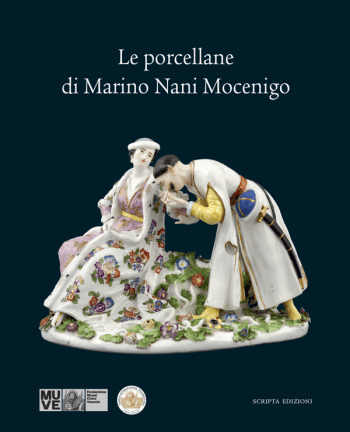 All’inizio del Settecento Cina e Giappone detenevano il segreto della produzione della porcellana, sancendo un monopolio di fatto del loro commercio verso l’Europa. Al commercio di oggetti di porcellana, con il consumo di tè e caffè che andava sempre più sviluppandosi in tutto l’Occidente, si sviluppò parallelamente la richiesta di vasellame, tazze, tazzine, diventando un interesse economico sempre maggiore negli scambi economici dell’epoca.
In tutta Europa si cercò sin dal tardo Cinquecento di scoprire il segreto della produzione della porcellana, il cosiddetto ‘arcano’. E i primi a riuscirci nel 1710 furono i sassoni di Meissen che grazie, anche alla padronanza del complesso processo produttivo, crearono la prima manifattura funzionante. Avendo rotto il monopolio orientale, i sassoni si tennero stretto il segreto facendo nascere una prospera industria che esportò la sua porcellana in tutta Europa.
New Book | World Antiquarianism: Comparative Perspectives
This collection of essays (published by The Getty in February) includes a chapter by Giovanna Ceserani on “Antiquarian Transformations in Eighteenth-Century Europe,” pp. 317–42.
Alain Schnapp with Lothar von Falkenhausen, Peter N. Miller, and Tim Murray, eds., World Antiquarianism: Comparative Perspectives (Los Angeles: Getty Publications, 2014), 464 pages, ISBN: 978-1606061480, $60.
 The term antiquarianism refers to engagement with the material heritage of the past—an engagement that preceded the modern academic discipline of archaeology. Antiquarian activities result in the elaboration of particular social behaviors and the production of tools for exploring the collective memory. This book is the first to compare antiquarianism in a global context, examining its roots in the ancient Near East, its flourishing in early modern Europe and East Asia, and its manifestations in nonliterate societies of Melanesia and Polynesia. By establishing wide-reaching geographical and historical perspectives, the essays reveal the universality of antiquarianism as an embodiment of the human mind and open new avenues for understanding the representation of the past, from ancient societies to the present.
Alain Schnapp is professor of classical archaeology at the Université Paris I–Panthéon-Sorbonne and director of the Institut d’études avancées (IEA-Paris). Lothar von Falkenhausen is professor of Chinese archaeology at the University of California, Los Angeles. Peter N. Miller is professor of modern history and dean of the Bard Graduate Center for Decorative Arts, Design History, and Material Culture, New York. Tim Murray is professor of archaeology and dean of the faculty of humanities and social sciences at La Trobe University, Melbourne.
◊ ◊ ◊ ◊ ◊
From the Department of Classics at Stanford University:
Giovanna Ceserani works on the classical tradition with an emphasis on the intellectual history of classical scholarship, historiography and archaeology from the eighteenth century onwards. She is interested in the role that Hellenism and Classics played in the shaping of modernity and, in turn, in how the questions we ask of the classical past originate in specific modern cultural, social and political contexts.
Her book Italy’s Lost Greece: Magna Graecia and the Making of Modern Archaeology appeared from Oxford University Press in 2012. Her current book project concerns the emergence of modern histories of ancient Greece; she is now also writing on the transformations of antiquarianism in the eighteenth century and on modern travels to ancient lands. Her interest in travel is engaging new digital approaches with a focus on the Grand Tour for the Stanford digital humanities project Mapping the Republic of Letters.
New Book | Mr Kilburn’s Calicos
From WoI:
Ros Byam Shaw, “Mr Kilburn’s Calicos,” The World of Interiors (October 2014): 112–18.
A scuffed little album discovered by Gabriel Sempill among her late mother’s possessions contains exquisite watercolour patterns by the esteemed 18th-century textile designer William Kilburn. Now, a facsimile of this rare find, complete with a variety of juvenilia added by a later hand, plus modern takes on Kilburn’s repeats, is published.
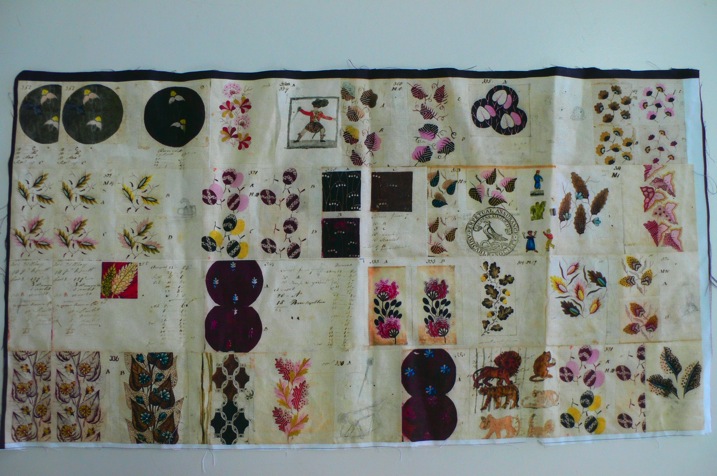
Detailed pattern units from William Kilburn’s
album, as a composite image.
◊ ◊ ◊ ◊ ◊
From Fleece Press:
Gabriel Sempill and Simon Lawrence, Mr Kilburn’s Calicos: William Kilburn’s Fabric Printing Patterns from the Year 1800 (London: Fleece Press, 2014), ISBN: 978-0992741051, £175.
Printed, bound and published at breakneck speed to coincide with The World of Interiors’ extensive feature on this book (October 2014 issue, with five pages reproduced), this is the full reproduction of a very important pocket book once owned by the great fabric designer and printer, William Kilburn (1745–1818). Hitherto known only for his highly elaborate and sumptuous chintz designs which are in the Victoria and Albert Museum, this pocket book includes 62 basic units for patterns which could be built up and repeated on a larger scale for dress material. It is a most exciting find, and Kilburn included notes of variant colourways and orders; the notebook’s subsequent use by a great grandson as a child’s scrapbook ensured its survival.
The book comprises a letterpress introduction, with the entire notebook being reproduced in the second half. There is a separate booklet of 16 patterns printed full-page, made up from Kilburn’s original units by Sholto Drumlanrig, and both the book and booklet are housed in a solander box. There are three variant bindings of quarter cloth with one of three different Kilburn patterned papers over boards.
Pamela Long among the 2014 MacArthur Fellows
I take inordinate pleasure each fall in seeing who’s included among the year’s MacArthur Fellows. It is inevitably a stimulating assortment of individuals producing intriguing work across wide-ranging scholarly, artistic, and cultural fields. I was especially happy to find Pamela Long among the 2014 recipients. I know only her work (particularly Openness, Secrecy, Authorship), but it’s encouraging to see this kind of recognition and substantive financial support go to an independent scholar. To the extent that the MacArthur ‘Genius Awards’ receive mainstream press coverage, one might at least hope that it gives the public a glimpse of another model of what it means to be a scholar (including the challenges). While Long’s current project focuses on the infrastructure of Renaissance Rome, it will, I imagine, be of interest to scholars addressing the Eternal City in the eighteenth-century, too. –CH
From the MacArthur Foundation:
Pamela O. Long is an independent historian of science and technology who is rewriting the history of science, demonstrating how technologies and crafts are deeply enmeshed in the broader cultural fabric. Through meticulous analysis of textual, visual, antiquarian, and archival materials from across Europe, Long investigates how literacy, language, authorship, trade secrecy, and patronage regulated the interactions of scholars, artisans, architects, and engineers of the early modern period.
Her prize-winning book, Openness, Secrecy, Authorship: Technical Arts and the Culture of Knowledge from Antiquity to the Renaissance (2001), presents groundbreaking analysis of the co-evolution of artisans as writers and technological openness as an ideal in scientific inquiry. Long illustrates the complex relationship between authorship and the ownership of intellectual property; the act of authorship simultaneously makes information public—at least to those with access to the text—and asserts the author’s ownership of that information. Her second sole-authored book, Artisan/Practitioners and the Rise of the New Sciences, 1400–1600 (2011), revisits a central issue in the history of science: the influence of artisans, craftsmen, and engineers on the introduction of empirical methodologies into science. Long discards the historical framing of dichotomies—artist or scholar, practice or theory—by identifying arenas of communication and collaboration among individuals arrayed across a continuum from artisan to scholar.
Her work in progress is a cultural history of engineering in Rome between 1557 and 1590. Long connects the humanistic study of ancient texts and artifacts by sixteenth-century Romans to their development of innovative approaches to engineering problems like flood control—a linkage not commonly recognized among historians and philosophers. In works ranging from academic treatises to booklets for a general audience, Long has changed our understanding of the artisanal and intellectual heritage of modern science.
Pamela O. Long received a B.A. (1965), M.A. (1969), and Ph.D. (1979) from the University of Maryland, College Park, and an M.S.W. (1971) from Catholic University of America. She has held a series of fellowships and visiting positions at prestigious institutions, including Princeton University, the Getty Research Institute, the American Academy in Rome, the Folger Shakespeare Library in Washington, D.C., and the National Humanities Center.










 Enfilade
leave a comment