The Burlington Magazine, July 2014
The eighteenth century in The Burlington:
The Burlington Magazine 156 (July 2014)
 A R T I C L E S
• Conor Lucey, “Bas-reliefs after Angelica Kauffman,” pp. 440–44.
Plaster reliefs for interiors in Ireland based on designs of the 1770s by Angelica Kaufmann.
• Paul Hetherington and Jane Bradney, “The Architect and the Philhellene: Newly Discovered Designs by John Nash for Frederick North’s London House,” pp. 445–52.
John Nash’s designs (c.1813) for Frederick North’s unrealised house on what is now Waterloo Place, London, are published here for the first time.
R E V I E W S
• Todd Longstaffe-Gowan, Review of Elizabeth McKellar, Landscapes of London: The City, the Country, and the Suburbs, 1660–1840 (Paul Mellon Centre for Studies in British Art, 2013), pp. 467–68.
• Xavier F. Salomon, Review of Denis Tod, Giambattista Crosato: Pittore del Rococò Europeo (Scripta Edizioni, 2013), pp. 468–69.
• Philippe Malgouyres, Review of Anne-Lise Desmas, Le Ciseau et la Tiare: Les Sculpteurs dans la Rome des Papes, 1724–1758 (Collection de l’Ecole Française de Rome, 2012), p. 469.
• Richard Edgcumbe, Review of Charles Truman, The Wallace Collection: Catalogue of Gold Boxes (Wallace Collection, 2013), p. 470.
Exhibition | Duke Herzog Anton Ulrich, A Collector’s Travels
Founded in 1754, the Herzog Anton Ulrich Museum in Braunschweig explores the origins of its foundation collection on the 300th anniversary of Anton Ulrich’s death:
Fürst von Welt: Herzog Anton Ulrich—Ein Sammler auf Reisen
Herzog Anton Ulrich Museum, Braunschweig, 10 April — 20 July 2014
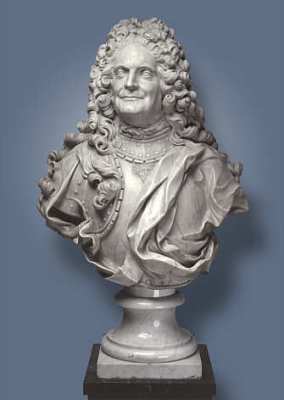
Balthasar Permoser (1651–1732), Bust of Duke Herzog Anton Ulrich (Braunschweig: Anton Ulrich Museum)
Anlässlich des 300. Todestages Anton Ulrichs von Braunschweig-Lüneburg (1633–1714) präsentiert das Herzog Anton Ulrich-Museum die Kabinett-Ausstellung Fürst von Welt. Herzog Anton Ulrich—ein Sammler auf Reisen vom 10. April bis zum 20. Juli 2014 in der Kemenate der Burg Dankwarderode. Die Sonderschau würdigt den vielseitig begabten Herzog, der angeregt durch seine Liebe zur Kunst den Grundstein für eine der bedeutendsten Kunstsammlungen Deutschlands legte.
Die Ausstellung in der Burg Dankwarderode führt in sechs Kapiteln die Besucherinnen und Besucher durch die verschiedenen Lebensstationen des schillernden Sammlungsgründers, beginnend mit seinem humanistisch-intellektuell geprägten Elternhaus bis hin zu regelmäßig aufgesuchten Reiseorten in Frankreich, Italien, den Niederlanden und im Deutschen Reich.
Anton Ulrichs Kavalierstour, die fester Bestandteil der Erziehung zukünftiger Monarchen war, führte ihn 1655 nach Paris und gab den Anstoß für seine intensive Sammeltätigkeit. Hier kaufte er erstmalig einige Kunstobjekte wie Gemälde, Kupferstiche und Münzen. Bis an sein Lebensende sollten Anton Ulrichs Reiseunternehmungen von zahlreichen Ankäufen erlesener Kunstwerke geprägt sein.
Die Sonderausstellung zeigt eine Auswahl von rund 40 Kunstwerken aus den Bereichen der Malerei, Skulptur, Grafik und Angewandten Kunst, die entweder von Anton Ulrich selbst angekauft oder durch seine Agenten ausgesucht wurden.
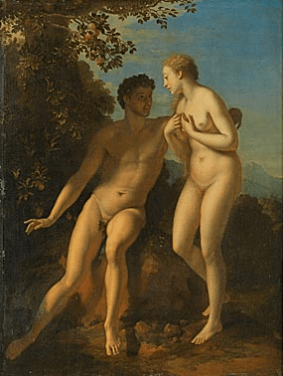
Adriaen van der Werff, Adam and Eve, ca. 1711
(Braunschweig: Anton Ulrich Museum)
Der Welfenherzog, der sich zeitlebens auch als Dichter und Mäzen von Theater- und Opernhäusern einen Namen machte, begeisterte sich im Besonderen für Kunstwerke mit erzählerischen Elementen. Als Beispiel für diesen Umstand gilt das Gemälde Die Auffindung des Moses (1650), ein Spätwerk des neapolitanischen Künstlers Bernardo Cavallino (1616–1656), das Anton Ulrichs Interesse vermutlich vor allem durch seine raffinierte Erzählweise geweckt hat. Der Erwerb der französischen Bronze Diana mit Hirsch (Ende d. 17 Jh.) sowie der römischen Antiken Herakles und Dionysos, die mit neuzeitlichen Ergänzungen bestückt wurden, zeugen vom herzoglichen Interesse für mythologische Geschichten.
Die Präsentation einer virtuellen Rekonstruktion des ehemaligen Lustschlosses Salzdahlum, das Herzog Anton Ulrich nach dem Vorbild niederländischer und italienischer Schloss- und Villenarchitektur erbauen ließ, führt in dreidimensionaler Hinsicht den seit dem 19. Jahrhundert nicht mehr existenten Ausstellungsort für seine Kunstsammlungen vor Augen.
Im Rittersaal der Burg Dankwarderode können im Rahmen der Meisterwerke-Ausstellung Epochal weitere 50 herausragende Kunstobjekte betrachtet werden, die durch Anton Ulrichs Kaufinitiative in seine Sammlung gelangten. Darunter befinden sich neben Ostasiatika auch Objekte aus dem einzigartigen Bestand italienischer Majolika sowie Gemälde von Rubens, Rembrandt und Vermeer, die den exquisiten Geschmack des herzoglichen Sammlers nachdrücklich belegen. Besucherinnen und Besucher können zu ausgewählten Objekten interessante Hintergrundinformationen mit dem eigenen Smartphone abrufen.
◊ ◊ ◊ ◊ ◊
From Michael Imhoff Verlag:
Jochen Luckhardt, „… einer der größten Monarchen Europas“?! Neue Forschungen zu Herzog Anton Ulrich (Petersberg: Michael Imhoff Verlag, 2014), 208 pages, ISBN 978-3731900559, 30€.
 Die Jubiläumspublikation zum 300. Todesjahr des bedeutenden Sammlers und Dichters Herzog Anton Ulrich präsentiert Forschungsergebnisse europäischer Wissenschaftler aus Wien, Paris, Venedig und Amsterdam. Der Welfenherzog aus der Linie Braunschweig-Wolfenbüttel wird hier erstmals aus der Sicht von Außen betrachtet – seine Reisen in europäische Länder stehen dabei ebenso im Fokus wie seine Kunstankäufe und Beziehungen zu tonangebenden Fürstenhäusern. Der Anspruch Anton Ulrichs, sich als Monarch innerhalb der Führungsriege zu positionieren, wird mit den Beiträgen, auch zu Zeremoniell und Geschenkewesen der Barockzeit, verständlich—wenn man diese Ambitionen auch mit dem etwas ironisch klingenden Ausspruch Liselottes von der Pfalz sehen muss: „Wenn Verdienste und Wünsche gelten sollten, so würde der Herzog einer der größten Monarchen seyn.“
Exhibition | Ships, Clocks, and Stars: The Quest for Longitude
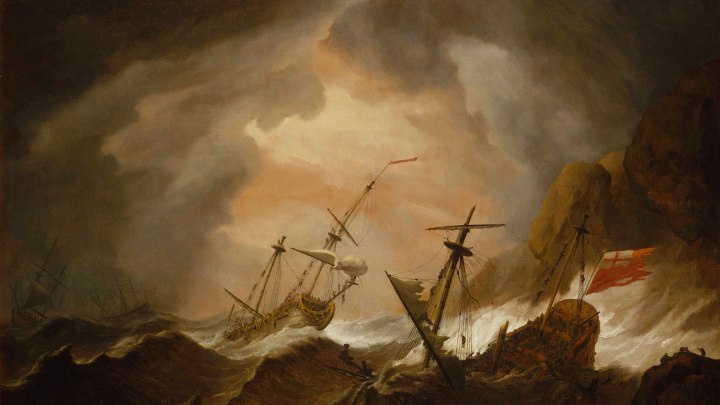
Willem van de Velde, the Younger, Two English Ships
Wrecked in a Storm on a Rocky Coast, ca. 1700
(London: National Maritime Museum)
Press release (21 March 2014) for the current exhibition:
Ships, Clocks, and Stars: The Quest for Longitude
National Maritime Museum, Greenwich, 11 July 2014 — 4 January 2015
Mystic Seaport, Mystic, Connecticut, 19 September 2015 — 28 March 2016
Curated by Richard Dunn and Rebekah Higgitt
To mark the tercentenary of the Longitude Act of 1714, Ships, Clocks, and Stars: The Quest for Longitude, a major new exhibition at the National Maritime Museum, tells the extraordinary story of the race to determine longitude at sea and how one of the greatest technical challenges of the eighteenth and nineteenth centuries was eventually solved. The exhibition draws on the latest research to shed new light on the history of longitude—one of the great achievements of the Georgian age—and how it changed our understanding of the world.

John Harrison, H1 Marine Timekeeper, 1730–35
(London: National Maritime Museum)
In recent years, John Harrison has been cast as the hero of the story, not least in Dava Sobel’s seminal work Longitude: The True Story of a Lone Genius Who Solved the Greatest Scientific Problem of His Time. Ships, Clocks, and Stars provides a new perspective on this famous tale. While John Harrison makes a good story and his marine sea-watch was vital to finally solving the problem of longitude, this was against a backdrop of almost unprecedented collaboration and investment. Famous names such as Galileo, Isaac Newton, James Cook, and William Bligh all feature in this fascinating and complex history. Crucially, it was Astronomer Royal Nevil Maskelyne’s observations at the Royal Observatory in Greenwich, his work on the Nautical Almanac and the Board of Longitude that demonstrated the complementary nature of astronomical and timekeeper methods, ultimately leading to the successful determination of longitude at sea.
Highlights from the exhibition include all five of John Harrison’s famous timekeepers. H1, H2, H3 and H4 will move from the Royal Observatory Greenwich to be displayed in the National Maritime Museum for the first time in nearly 30 years. H5 is being loaned from the Worshipful Company of Clockmakers. Also featured is the original Longitude Act of 1714, which has never been on public display before; an intricate 1747 model of the Centurion, the ship which carried out the first proper sea trial of Harrison’s H1, and the elegant, padded silk ‘observing suit’ worn by Nevil Maskelyne at the Royal Observatory during the 1760s.
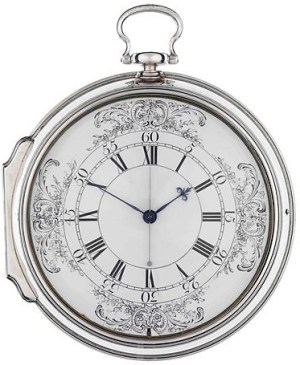
John Harrison, H4 Marine Timekeeper, 1755–59
(London: National Maritime Museum)
Passed by the British government in July 1714, the Longitude Act aimed to solve the problem of determining a ship’s longitude (east-west position) at sea. For a maritime nation such as Britain, investment in long distance trade, outposts and settlements overseas made the ability to determine a ship’s longitude accurately increasingly important. As different nations, including Spain, the Netherlands and France, sought to dominate the world’s oceans, each offered financial rewards for solving the longitude problem. But it was in Britain that the approach paid off. With life-changing sums of money on offer, the challenge became the talk of London’s eighteenth-century coffee-houses and captured the imaginations and talents of astronomers, skilled artisans, politicians, seamen and satirists; many of whom came up with ingenious methods and instruments designed to scoop the Board of Longitude’s tantalising rewards and transform seafaring navigation forever.
The Royal Observatory in Greenwich was founded in 1675 specifically to carry out observations ‘to find out the so much desired longitude of places for the perfecting of the art of navigation’. Under the 1714 Longitude Act, successive Astronomers Royal became leading voices on the Board of Longitude, judging proposals and encouraging promising developments.
As solutions were developed, the Royal Observatory also became a testing site for marine timekeepers and the place at which the astronomical observations needed for navigational tables were made. The significance of this work eventually lead to Greenwich becoming the home of the world’s Prime Meridian in 1884.
◊ ◊ ◊ ◊ ◊
The catalogue is published by Harper Collins:
Richard Dunn and Rebekah Higgitt, Ships, Clocks, and Stars: The Quest for Longitude (London: Collins, 2014), 256 pages, softcover ISBN: 978-0007940523, £15 / hardcover, ISBN: 978-0062353566, $75.
 A tale of eighteenth-century invention and competition, commerce and conflict, this is a lively, illustrated, and accurate chronicle of the search to solve ‘the longitude problem’, the question of how to determine a ship’s position at sea—and one that changed the history of mankind.
Ships, Clocks, and Stars brings into focus one of our greatest scientific stories: the search to accurately measure a ship’s position at sea. The incredible, illustrated volume reveals why longitude mattered to seafaring nations, illuminates the various solutions that were proposed and tested, and explores the invention that revolutionized human history and the man behind it, John Harrison. Here, too, are the voyages of Captain Cook that put these revolutionary navigational methods to the test.
Filled with astronomers, inventors, politicians, seamen, and satirists, Ships, Clocks, and Stars explores the scientific, political, and commercial battles of the age, as well as the sailors, ships, and voyages that made it legend—from Matthew Flinders and George Vancouver to the voyages of The Bounty and The Beagle. Featuring more than 150 photographs specially commissioned from Britain’s National Maritime Museum, this evocative, detailed, and thoroughly fascinating history brings this age of exploration and enlightenment vividly to life.
Richard Dunn is Senior Curator and Head of Science and Technology at Royal Museums Greenwich. Rebekah Higgitt is Lecturer in History of Science at the University of Kent.
◊ ◊ ◊ ◊ ◊
Note (added a few hours after the original posting appeared) — I should have noted that Jeremy Wear plans to chair a session on the theme of longitude at the 2015 ASECS conference in Los Angeles. –CH
(more…)
New Book | Meissen Snuffboxes of the Eighteenth Century
Published by Hirmer and distributed The University of Chicago Press:
Gerhard Röbbig, ed., Meissen Snuffboxes of the Eighteenth Century (Munich: Hirmer Verlag, 2014), 350 pages, ISBN: 978-3777421377, $65.
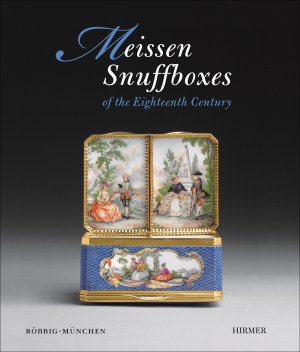 Originally praised for its medicinal purposes, powdered tobacco emerged as a fashionable stimulant among Europe’s high-society during the eighteenth century. To accommodate this novel pastime, elegant ladies and gentleman of the era sought to complete their look with tabatières, or elaborately painted porcelain snuffboxes.
Meissen Snuffboxes presents more than one hundred of the finest snuffboxes produced by the European porcelain manufacturer Meissen throughout the eighteenth century. Among the first manufacturers to cater to the rapidly growing demand for these tiny treasures, Meissen developed a wide range of snuffboxes, each fastidiously painted by the company’s most adept painters and incorporating motifs from the entire Meissen repertoire. In addition to 250 full-color photographs, this comprehensive catalog includes detailed descriptions of each item by eminent scholars in the field, as well as contributions that discuss current scholarship. Beautifully illustrated, Meissen Snuffboxes offers an incredible amount of information and shows how these tiny containers provide some of the most intimate insight available into the courtly life of the eighteenth century.
◊ ◊ ◊ ◊ ◊
C O N T E N T S
Essays
• Barbara Beaucamp-Markowsky, Porcelain Snuffboxes of the Eighteenth Century: An Introduction
• Hans Ottomeyer, Snuffboxes and the Taking of Snuff: On the Purpose of Luxury
• Lorenz Seelig, Precious Snuffboxes in Princely Collections of the Eighteenth Century
• Heike Zech, Pleasure and Principle: Collecting Snuffboxes from 1800 Onwards
• Ulrich Pietsch, Eighteenth-Century Meissen Porcelain Snuffboxes
• Sarah-Katharina Acevedo, Image and Symbol: On the Use and Meaning of the Snuffbox as Reflected by Meissen Figures of the Eighteenth Century
Catalogue
Appendix: The Work Reports of Meissen Modellers and Decorators Concerning Snuffboxes, selected and transcribed by Ulrich Pietsch
Literature
Index
Exhibition | The Art of Golf: The Story of Scotland’s National Sport
Press release (11 July 2014) for the current exhibition:
The Art of Golf: The Story of Scotland’s National Sport
The Scottish National Gallery, Edinburgh, 12 July — 26 October 2014

David Allan, William Inglis (ca. 1712–1792), Surgeon and Captain of the Honourable Company of Edinburgh Golfers (Scottish National Gallery)
The Scottish National Gallery is delighted to take part in the sporting celebrations taking place this summer in Scotland with The Art of Golf: The Story of Scotland’s National Sport. The exhibition will overlap with two important events: the Commonwealth Games, Glasgow (23 July–3 August) and the Ryder Cup, Gleneagles (23–28 September), the biennial competition played between teams of professional golfers representing the United States and Europe. The Art of Golf explores golf as a subject of fascination for artists from the seventeenth century to the present day, with a particular emphasis on the emergence of the sport in Scotland.
The Art of Golf will bring together around 60 paintings and photographs—as well as a selection of historic golfing equipment—with works by artists such as Rembrandt van Rijn (1606–1669), Sir Henry Raeburn (1756–1823), Hendrick Avercamp (1585–1634) and Paul Sandby (1731–1809) illustrating the origins of the game. Other highlights will include Sir John Lavery’s (1846–1951) beautiful 1920s paintings of the golf course at North Berwick, a coastal resort 25 miles east of Edinburgh, and colourful railway posters for popular destinations such as Gleneagles, which illustrate the boom in golfing tourism in the inter-war years. Stunning images of golf courses from Brora to the Isle of Harris by contemporary photographer Glyn Satterly and spectacular aerial shots by artist and aviator Patricia Macdonald will bring the exhibition up to present day. Generous loans from a number of famous Scottish golf clubs, the British Golf Museum in St Andrews and private collectors have been secured for this exhibition.
The centrepiece of the show will be the greatest golfing painting in the world, Charles Lees’s 1847 masterpiece The Golfers. This commemorates a match played on the Old Course at the Royal and Ancient Golf Club, St Andrews, by Sir David Baird and Sir Ralph Anstruther, against Major Hugh Lyon Playfair and John Campbell of Saddell. It represents a veritable ‘who’s who’ of Scottish golf at that time and was famously reproduced in a fine engraving which sold in great quantities. Lees (1800–80) made use of photography, at a time when it was in its infancy, to help him design the painting’s overall composition. The image in question, taken by photography pioneers D O Hill & Robert Adamson, will be included in the show and Lees’s preparatory drawings and oil sketches will also be displayed alongside the finished painting to offer visitors further insight into the creation of this great work. Impressions of The Golfers are now in many of the greatest golf clubhouses around the world. The painting is jointly owned by the National Galleries of Scotland and the Royal and Ancient Golf Club of St Andrews.

David Allan, The Prize of the Silver Golf: Officer Carrying a Decorated Golf Club, Two Soldiers with Drums behind Him, ca. 1785 (Scottish National Gallery)
Golf has been played in Scotland since at least the fifteenth century. Whilst its origins are obscure, it is undoubtedly close to the Netherlandish game of ‘colf’, which was played over rough ground or on frozen waterways, and involved hitting a ball to a target stick fixed in the ground or the ice. ‘Colvers’ playing on the frozen canals are seen in Dutch seventeenth-century paintings which form the earliest part of the show. In Scotland the game is often played over ‘links’ courses, originally rough common ground where the land meets the sea. The majority of Scotland’s famous old courses, such as St Andrews or North Berwick, are links courses. In Edinburgh, the early links courses of Bruntsfield, Leith and Musselburgh are shown in works by Sandby and Raeburn.
Michael Clarke, Director of the Scottish National Gallery, said: “This show is designed to be fun and to bring together two publics, lovers of art and lovers of golf. Where better to do this than in this world-class gallery, with its great Old master and Scottish paintings, which is situated in Scotland’s beautiful capital city of Edinburgh, and through which so many golfers pass on their way to our internationally renowned courses.”
◊ ◊ ◊ ◊ ◊
From ACC Distribution:
Michael Clarke and Kenneth McConkey, The Art of Golf (Woodbridge: Antique Collectors Club, 2014), 72 pages, ISBN: 978-1906270674, £13.
 The Art of Golf illustrates how the noble game has been depicted in European art from the seventeenth century to the present day. This fascinating story is told by images in a variety of media, from paintings and prints to photographs and posters. The centrepiece is Charles Lees’s The Golfers, 1847, which depicts a match played on the Old Course at St Andrews in 1847, and is one greatest golfing painting in the world. In his essay Michael Clarke, director of the Scottish National Gallery, outlines the story behind the development of the game, while art historian Kenneth McConkey discusses the series of paintings of golf at North Berwick made by Sir John Lavery in the years following the Great War.
Michael Clarke is Director of the Scottish National Gallery in Edinburgh. He has published widely, including books on English watercolours, the landscape painter Camille Corot, and his second, revised edition of The Oxford Concise Dictionary of Art Terms was published in 2010. Most recently he co-curated the international exhibition Impressionist Gardens (2010–11) and wrote the exhibition catalogue of French Drawings in the Scottish National Gallery (2011). Kenneth McConkey is Professor of Art History and Dean of the Faculty of Arts and Design, the University of Northumbria at Newcastle. He has written extensively about late Victorian and Edwardian painting.
◊ ◊ ◊ ◊ ◊
The politics of gender, golf, and Scottish identity will soon go to the polls. On September 18 (the same day, Scots vote to stay or secede from Britain), members of the Royal and Ancient Golf Club (roughly 2500 men) will vote on the question of whether women may be admitted. As reported by The New York Times, for Louise Richardson, the principal of the University of St. Andrews, the discriminatory policy is also a “workplace hurdle.” Karen Crouse’s article, “In St. Andrews, a Heavy Knock on a Neighbor’s Door: First Female President of University of St. Andrews Fights for Admittance at Royal and Ancient Golf Club,” appeared in the paper on 11 July 2014.
Update (added 22 September 2014) — As Crouse reports in The New York Times (18 September 2014). . .
The Royal and Ancient Golf Club voted overwhelmingly to admit its first female members. . . . Peter Dawson, the secretary of the club, announced the results of a postal balloting of the club’s 2,400 male members, many of whom were on site in matching blue jackets and patterned blue ties. About three-quarters of the members participated in the voting, he said, with 85 percent of them opting to accept women. . .
New Book | The Gods Want Blood
A new English translation of the 1912 novel, published last year and recently released in paperback from Alma Classics:
Anatole France, The Gods Want Blood, translated by Douglas Parmée (Richmond, Alma Classics, 2013), 256 pages, ISBN: 978-1847493194, $15.
 Set in Paris during the years of the Reign of Terror, The Gods Want Blood centres on the rise to power of the Jacobin sympathizer Évariste Gamelin, a young painter who becomes a juror on a local Revolutionary tribunal. Caught up in the bloodthirsty madness surrounding him, he helps to dispense cruel justice in the name of his ideals, while at the same time succumbing to his own petty instincts of revenge when he jealously pursues a rival for the affections of his lover Élodie.
Benefiting from Anatole France’s meticulous historical research, this fascinating and timeless novel sheds light on a complex world of rival factions and institutions of state terror and vividly portrays the lives and psyches of ordinary people who are complicit in acts of public barbarity.
◊ ◊ ◊ ◊ ◊
From The TLS Blog:
Adrian Tahourdin, “Anatole France and Proust,” The TLS Blog (19 September 2013).
A new translation of Anatole France’s novel Les Dieux ont soif is being published next month by Alma Classics, as The Gods Want Blood. First published in 1912, the book is set during the Terror of 1793–4 and features, fleetingly, both Marat and Robespierre. As its translator Douglas Parmée writes in his introduction, the novel has contemporary resonance: its main character, the mediocre painter (pupil of Jacques-Louis David) and revolutionary fanatic Évariste Gamelin “would surely make a first-rate suicide bomber.” France did his research thoroughly, with the result that his novel, in Parmée’s words, “bears throughout the stamp of historical authenticity.” . . .
The full posting is available here»
New Book | How to Ruin a Queen
From John Murray (a publishing house with its own eighteenth-century history: founded in 1768, the company remained under the Murray family’s control until 2002). . .
Jonathan Beckman, How to Ruin a Queen: Marie Antoinette and the Diamond Necklace Affair (John Murray, 2014), 400 pages, ISBN: 978-1848549982.
 A tale of greed, lust, deceit, theft on an extraordinary scale, charlatanry, kidnapping, assassination and escape from prison.
On 5 September 1785, a trial began in Paris that would divide the country, captivate Europe and send the French monarchy tumbling down the slope towards the Revolution. Cardinal Louis de Rohan, scion of one of the most ancient and distinguished families in France, stood accused of forging Marie Antoinette’s signature to fraudulently obtain the most expensive piece of jewellery in Europe—a 2,400-carat necklace worth 1.6 million francs. Where were the diamonds now? Was Rohan entirely innocent? Was, for that matter, the queen? What was the role of the charismatic magus, the comte de Cagliostro, who was rumoured to be two-thousand-years old and capable of transforming metal into gold?
This is a tale of political machinations and extravagance on an enormous scale; of kidnappings, prison breaks and assassination attempts; of hapless French police disguised as colliers, reams of lesbian pornography and a duel fought with poisoned pigs. It is a detective story, a courtroom drama, a tragicomic farce, and a study of credulity and self-deception in the Age of Enlightenment.
Jonathan Beckman is senior editor of Literary Review. He has degrees in English from the University of Cambridge and Intellectual and Cultural History from Queen Mary, University of London. In 2010, he won the Royal Society of Literature Jerwood Award for Non-Fiction.
New Book | Donatien Alphonse Francois de Sade
From Assouline:
Jean-Pascal Hesse, Donatien Alphonse Francois de Sade (Paris: Assouline, 2014), 192 pages, ISBN: 978-1614282020, $75.
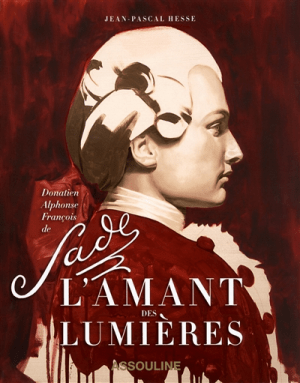 Man of letters, philosopher, and politician, the Marquis de Sade is one of the most controversial figures since the eighteenth century, but recently psychology, theater, cinema, and literary criticism have shed new light on his life and works. Lacoste Castle in the South of France, one of the properties of the Sade family, became the refuge of the Marquis between periods of incarceration. Thanks to the Sade family opening its archives for the first time, historian Jean-Pascal Hesse examines Sade’s story through previously unpublished documents and imagery and walks in the Marquis’ footsteps in his beloved château.
Originally from the region of Lacoste, historian Jean-Pascal Hesse is the author of a number of books, including Pierre Cardin: 60 Years of Innovation (2010), Maxim’s: Mirror of Parisian Life (2011), and The Palais Bulles (2012), all in close collaboration with Pierre Cardin and published by Assouline. He also serves on the Paris city council, and directs cultural events for the mayor of the 16th arrondissement.
New Book | The Cobbe Cabinet of Curiosities
From The Paul Mellon Centre and Yale UP:
Arthur MacGregor ed., The Cobbe Cabinet of Curiosities: An Anglo-Irish Country House Museum (London: The Paul Mellon Centre for British Studies, 2014), 480 pages, ISBN: 978-0300204353, $125 / £75.
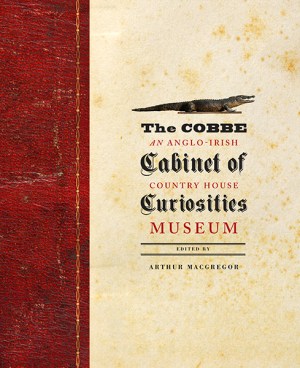 This lavishly produced volume presents a survey and analysis of a fascinating cabinet of curiosities established around 1750 by the Cobbe family in Ireland and added to over a period of 100 years. Although such collections were common in British country houses during the 18th and 19th centuries, the Cobbe museum, still largely intact and housed in its original cabinets, now forms a unique survivor of this type of private collection from the Age of Enlightenment.
A detailed catalogue of the objects and specimens is accompanied by beautiful, specially commissioned photographs that showcase the cabinet’s component elements. Reproductions of portraits from the extensive collection of the Cobbe family bring immediacy to the narrative by illustrating the personalities involved in the collection’s development. Scholars contribute commentary on the significance of the objects to their collectors; also included are essays outlining, among other topics, the place of the cabinet of curiosities in Enlightenment society and the history of the Cobbe family. Extracts from the extensive family archive place the collection in its social context.
Arthur MacGregor is a former senior assistant keeper in the Department of Antiquities at the Ashmolean Museum, Oxford.
New Book | Visions of Britain, 1730–1830
From Palgrave Macmillan:
Sebastian Mitchell, Visions of Britain, 1730–1830: Anglo-Scottish Writing and Representation (Basingstoke: Palgrave Macmillan, 2013), 304 pages, ISBN: 978-1137290106, $90.
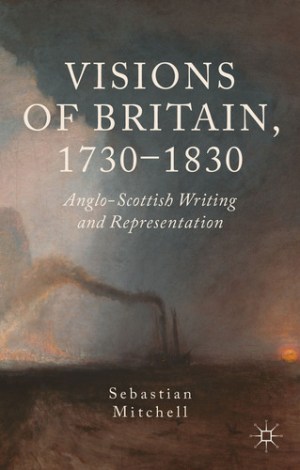 Visions of Britain is an inquiry into the literary and visual representation of Great Britain in the eighteenth century and early nineteenth century. The book considers the inter-relationship of text and image for the purposes of national projection. It analyses an extensive range of poems, novels, journals, drawings, satirical prints, portraits, landscapes, and history paintings. The study follows recent discussions of Anglo-Scottish writing in this period in the attempt to determine the salient characteristics of the imaginative depiction of the Kingdom of Britain, but challenges their more confident claims for the development of a progressive integrated nationhood. It argues instead that the most engaging literary and visual accounts of Britain in this era subject their imagery to extensive artistic pressure, threatening to dismantle the national vision at the moment of its construction.
Sebastian Mitchell is Lecturer in English Literature at the University or Birmingham.
◊ ◊ ◊ ◊ ◊
C O N T E N T S
List of Illustrations
Acknowledgments
1. Introduction
2. Thomson’s Vision of Britannia
3. Smollett and Dialectical Nationalism
4. Ramsay, Hume, and British Portraiture
5. Ossian, Wolfe, and the Death of Heroism
6. Boswell: Self, Text, Nation
7. Scott, Turner, and the Vision of North Britain
Bibliography
Index










 Enfilade
leave a comment