New Book | Ways of Making and Knowing
From the University of Michigan Press (with an excerpt and more information available at the website for the series, The Bard Graduate Center Cultural Histories of the Material World) . . .
Pamela H. Smith, Amy R. W. Meyers, and Harold J. Cook, eds., Ways of Making and Knowing: The Material Culture of Empirical Knowledge (Ann Arbor: University of Michigan Press, 2014), 448 pages, ISBN: 978-0472119271, $60.
 “Making” and “knowing” have generally been viewed as belonging to different types and orders of knowledge. “Craft” and “making” have been associated with how-to information, oriented to a particular situation or product, often informal and tacit, while “knowing” has been related to theoretical, propositional, and abstract knowledge including natural science. Although craftspeople and artists have worked with natural materials and sometimes have been viewed as experts in the behavior of matter, the notion that making art can constitute a means of knowing nature is a novel one.
This volume, with contributions from historians of science, medicine, art, and material culture, shows that the histories of science and art are not simply histories of concepts or styles, or at least not that alone, but histories of the making and using of objects to understand the world. The common view of craftspeople more or less mindlessly following a collection of recipes or rules—which are said to be fundamentally different from “science” and “art”—has greatly distorted our understanding of the growth of natural knowledge in the early modern period. More intensive examination of material practices makes it clear that the methods of the artisan represent a process of knowledge-making that involved extensive experimentation and observation, in addition to generalizations about matter and nature. As increasing numbers of people came to be immersed in such activities, whether as craftspeople, medical practitioners, merchants, nobles, magistrates, reformers, collectors, or even scholars, the attributes of “nature” were not only articulated in a variety of ways, and not only seen as a resource for human use, but came to be identified with a variety of “goods.” Knowing nature could of course lead to material betterment but for many, living according to nature’s dictates also led to the development of personal ethics and the public good. As natural knowledge became increasingly important in society in these various ways, it forged new connections among groups, helped create new identities, brought about new kinds of claims to authority and intellectual legitimacy, and gave rise to new ways of thinking about the senses, certainty, and epistemology. None of this could have happened without the conversations and controversies that enabled the assessment of objects in novel ways.
◊ ◊ ◊ ◊ ◊
C O N T E N T S
Introduction: Making and Knowing
Harold J. Cook, Pamela H. Smith, and Amy R.W. Meyers
1. Making as Knowing: Craft as Natural Philosophy
Pamela H. Smith
2. From Skills to Wisdom: Making, Knowing and the Arts
Suzanne B. Butters
3. Between Trade and Science: Dyeing and Knowing in the Long Eighteenth Century
Alicia Weisberg-Roberts
4. How to Cure the Golden Vein: Medical Remedies as Wissenschaft in Renaissance Germany
Alisha Rankin
5. Evidence, Artisan Experience and Authority in Early Modern England
Patrick Wallis and Catherine Wright
6. American Roots: Technologies of Plant Transportation and Cultivation in the Early Atlantic World
Mark Laird and Karen Bridgman
7. Inside the Box: John Bartram and the Science and Commerce of the Transatlantic Plant Trade
Joel Fry
8. From Plant to Page: Aesthetics and Objectivity in a Nineteenth-Century Book of Trees
Lisa Ford
9. The Labor of Division: Cabinetmaking and the Production of Knowledge
Glenn Adamson
10. Making Lists: Social and Material Technologies in the Making of Seventeenth-Century British Natural History
Elizabeth Yale
11. The Preservation of Specimens and the Take-Off in Anatomical Knowledge in the Early Modern Period
Harold J. Cook
12. Conrad Gessner on an ‘ad vivum’ image
Sachiko Kusukawa
13. Corals versus Trees: Charles Darwin’s Early Sketches of Evolution
Horst Bredekamp
14. Decaying Objects and the Making of Meaning in Museums
Mary M. Brooks
Epilogue
Malcolm Baker
Study Day | Fame and Friendship: Pope, Roubiliac and the Portrait Bust
The exhibition Fame and Friendship: Pope, Roubiliac and the Portrait Bust (recently closed at YCBA) opens June 18 at Waddesdon Manor in Buckinghamshire (where it will be on display until 26 October 2014). In connection, Malcolm Baker will lead a special interest day on Thursday, 10 July.
From Waddesdon Manor:
Study Day | Fame and Friendship: Pope, Roubiliac and the Portrait Bust
Waddesdon Manor and Stowe Landscape Gardens, 10 July 2014
 Led by Professor Malcolm Baker, the curator of the exhibition, this day will begin with an in-depth look at Fame and Friendship: Pope, Roubiliac and the Portrait Bust, followed by lunch in the Manor Restaurant. In the afternoon, participants will travel to nearby Stowe Landscape Gardens to see the famous Temple of British Worthies and to explore the central role of the sculpture portrait bust in the creation and celebration of fame and friendship. The day will end with tea at Stowe. The price of your ticket (£70) includes coach travel from Waddesdon to Stowe and return to your car at Waddesdon; normal admissions charges apply to both Waddesdon and Stowe.
Malcolm Baker is Distinguished Professor of the History of Art, University of California, Riverside, and Honorary Senior Research Fellow at the Victoria and Albert Museum.
◊ ◊ ◊ ◊ ◊
In addition to The Marble Index: Roubiliac and Sculptural Portraiture in Eighteenth-Century Britain, Malcolm Baker’s major publication related to the exhibition and due out later this year from Yale University Press, a more tightly focused catalogue will be published by Paul Holberton:
Malcolm Baker, Fame and Friendship: Pope, Roubiliac and the Portrait Bust (London: Paul Holberton Publishing, 2014), 128 pages, ISBN: 978-0954731052, £15 / $25.
 No literary figure of the eighteenth century was more esteemed than the poet Alexander Pope, and his sculpted portraits exemplify the celebration of literary fame at a period when authorship was being newly conceived and the portrait bust was enjoying new popularity. Accompanying an exhibition at Waddesdon Manor (The Rothschild Collection), this publication explores the convergence between authorship, portraiture, and the sculpted image in particular, by bringing together a wide range of works that foreground Pope’s celebrity status.
Pope took great pains over how he was represented and carefully fashioned his public persona through images, published letters and the printed editions of his works. Alongside some of the most celebrated painted portraits of the poet will be a selection of the printed texts which Pope planned with meticulous care. The publication focuses on eight versions of the same portrait bust by the leading sculptor of the period, Louis François Roubiliac.
The marble bust had long been seen as a form appropriate for the celebration of literary fame and Pope’s bust in part imitates those of classical authors whose works he both translated and consciously imitated in his own poems. More than any other sculptor, Roubiliac reworked the conventions of the bust, transforming it into a genre that was considered worthy of close and sustained attention. Nowhere is this seen more tellingly than in his compelling and intense portraits of Pope. Based on a vividly modelled clay original, the variant marble versions were carved with arresting virtuosity, recalling Pope’s own phrase, “Marble, soften’d into Life.” At the same time, the image was reproduced by both the sculptor himself and by others, in a variety of materials.
Multiplied and reproduced throughout the eighteenth century, Pope’s bust was the most familiar and visible sign of his authorial fame. At the same time, it was also used as a way of articulating friendship—a constant theme in Pope’s verse—and all the early versions of Roubiliac’s bust were probably executed for Pope’s closest friends. By bringing together the eight versions thought to have been executed by Roubiliac and his studio, and a number of other copies in marble, plaster and ceramic, this publication will offer the opportunity to explore not only the complex relationship between these various versions but the hitherto little understood processes of sculptural production and replication in eighteenth-century Britain.
Exhibition | Royal Spectacle at the French Court

C.-N. Cochin père, after C.-N. Cochin fils, Décoration du Bal Masqué donné par le Roy, plate 7 of Recueil des Festes, Feux d’Artifice, et Pompes Funèbres (Paris: Ballard, 1756). National Trust / Waddesdon Manor, 3176. Photo by Mike Fear. Depiction of the ball given by Louis XV in February 1745, on the occasion of the marriage of the Dauphin to Marie Thérèse Raphaëlle of Spain. Click here for a higher resolution image.
◊ ◊ ◊ ◊ ◊
From Waddesdon Manor:
Royal Spectacle: Ceremonial and Festivities at the French Court
Waddesdon Manor, Buckinghamshire, 26 March — 26 October 2014
Curated by Selma Schwartz and Rachel Jacobs
This exhibition marks the publication of the Catalogue of Printed Books and Bookbinding: The James A. de Rothschild Bequest at Waddesdon Manor (2013), highlighting illustrated books published on the occasion of court festivities, celebrations and spectacles. Lavishly illustrated books, with engravings of the largest format, document the many extravagant festivities and ceremonies staged for the French court during the 17th and 18th centuries to mark the life cycle of births, marriages and deaths. Fanciful theatrical stage settings are the backdrop for richly costumed processions, equestrian tournaments, theatre performances, church ceremonies and spectacular firework displays. The books themselves are often bound in exquisite bindings intended for the royal family and aristocracy. While focusing on France, the exhibition also includes some comparative material from other European courts.
Tours of the exhibition with one of the curators will take place on Friday 30 May, 11 July and 26 September. For more information on how to book, please click here.
◊ ◊ ◊ ◊ ◊
Note (added 18 June 2014) — A 45-page, illustrated checklist with details on the 58 exhibited works is available for download as a PDF file at the Waddesdon website.
Exhibition | China at Versailles: Art and Diplomacy in the 18th Century
From the Château de Versailles:
China at Versailles: Art and Diplomacy in the 18th Century
Château de Versailles, 27 May — 26 October 2014

Audience granted to the King of Siam’s ambassadors, 1 September 1686, at the Palace of Versailles, Etching on copper in black and burin At Pie. Landry rue St. Jacques at St. François de Sales, Almanac for the year 1687 (Paris, Bibliothèque nationale de France)
The Palace of Versailles presents China at Versailles: Art and Diplomacy in the 18th Century, organised for the 50th anniversary of the establishment of diplomatic relations between France and China. The exhibition follows the history of political and artistic exchanges between China and France during the 18th century. The paintings, furniture, lacquerware, porcelains and tapestries exhibited bear testimony to the extreme luxury of their time and are very rare today. The approximately 150 works gathered together for the exhibition illustrate France’s taste for Chinese artistic productions and reveal the interest among Europeans for descriptions of China throughout the 18th century.
A Political and Cultural Dialogue
In 1688, Louis XIV undertook a diplomatic policy that was to lead to high-level scientific and intellectual exchanges between France and China. By sending French Jesuits to the court in Beijing, the Sun King developed privileged, lasting relations with the Kangxi Emperor, his contemporary. Correspondence and exchanges intensified under the reigns of Louis XV and Louis XVI. The two countries developed unique diplomatic relations. The political and intellectual ties that were forged between France and China led to a veritable golden age of diplomatic relations between the two countries up to the French Revolution.

Claude-Louis Châtelet, View of the Chinese Ring Game; drawing in black chalk, watercolour and gouache; excerpt from Recueil des vues et plans du Petit Trianon à Versailles, under the direction of Richard Miquet, 1786.
Chinese Art at Versailles
Porcelains, wallpaper, lacquerware, fabrics and silks: Chinese artistic productions aroused a great deal of interest in France starting in the 18th century. Under the reign of Louis XIV, France’s taste for ‘lachine’ or ‘lachinage’ was attributed to the gifts brought from the Far East by the King of Siam’s ambassadors in 1686. This appetite for Chinese art can also be seen in what was later to be called ‘la chinoiserie’, a trend in tastes that took on various forms:
• imitations of Chinese art,
• influence of Chinese art on French art,
• adaptation of oriental materials to French tastes,
• but also the creation of an imaginary, peaceful China.
Although the French sovereigns, protectors of the arts, could not openly display their taste for China in the royal apartments, many pieces of Chinese artwork decorated their private apartments at Versailles and Trianon.
◊ ◊ ◊ ◊ ◊
Published by Somogy, the catalogue as described at the Château de Versailles:
Marie-Laure de Rochebrune, Anne-Cécile Sourisseau, and Vincent Bastien, eds., La Chine à Versailles: Art et Diplomatie au XVIIIe Siècle (Paris: Somogy éditions d’Art, 2014), 280 pages, ISBN: 978-2757208137, 39€.
 L’exposition La Chine à Versailles: Art et diplomatie au XVIIIe siècle retrace l’histoire des échanges politiques, scientifiques et artistiques entre la France et la Chine au siècle des Lumières.
Peintures, meubles, laques, gravures, porcelaines, livres précieux, tapisseries… les chefs-d’oeuvre exposés au château de Versailles témoignent du luxe raffiné de leur époque. Ils illustrent, dès le règne de Louis XIV, le goût français pour les productions artistiques chinoises. Ils révèlent aussi l’intérêt de la cour de Versailles pour l’Extrême-Orient, suscité par les descriptions que les jésuites envoyés en Chine rédigèrent dès la fin du XVIIe siècle.
Les cent cinquante oeuvres rassemblées dans cette exposition ‘évènement’ proviennent des plus grandes institutions françaises (musée du Louvre, musée Guimet, Bibliothèque nationale, etc.) et étrangères (collections royales anglaises, musée de l’Ermitage à Saint-Pétersbourg, etc.) ainsi que de collections particulières.
More information about the catalogue (in French) is available as PDF file here»
Exhibition | Exposed: A History of Lingerie
Press release (2 April 2014) from The Museum at FIT:
Exposed: A History of Lingerie
Museum at FIT, New York, 3 June — 15 November 2014
Curated by Colleen Hill
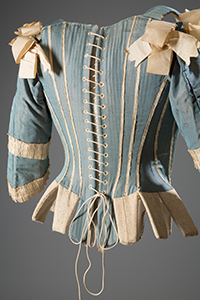
Corset (stay), silk, silk ribbon, whalebone, ca. 1770, possibly Europe
(New York: Museum at FIT)
The Museum at FIT presents Exposed: A History of Lingerie, an exhibition that traces developments in intimate apparel from the 18th century to the present. Exposed features over 70 of the most delicate, luxurious, and immaculately crafted objects from the museum’s permanent collection, many of which have never before been shown. Each piece illustrates key developments in fashion, such as changes in silhouette, shifting ideals of propriety, and advancements in technology.
The concept of underwear-as-outerwear is most commonly associated with the 1980s, but the look of lingerie has long served as inspiration for fashion garments. Exposed opens with several pairings of objects that underscore that connection. For example, a 1950s nylon nightgown, made by the upscale lingerie label Iris, is shown alongside an evening gown by Claire McCardell, also a 1950s garment, created in a similar fabric and silhouette. McCardell was one of the first designers to use nylon—a material typically marketed for lingerie—for eveningwear. A 2007 evening dress by Peter Soronen features a corset bodice, the construction of which is highlighted with bright blue topstitching. It is flanked by two 19th-century corsets, one made from bright red silk, the other from peacock blue silk.
The exhibition then continues chronologically. The earliest object on view is a sleeved corset (then called stays), circa 1770, made from sky-blue silk with decorative ivory ribbons that crisscross over the stomach. Stiffened with whalebone, 18th-century corsets straightened the back and enhanced the breasts by pushing them up and together. While they were essential to maintaining both a woman’s figure and her modesty, corsets also held an erotic allure.
Women’s undergarments were generally modest in the first half of the 19th century. This is exemplified by a dressing gown from circa 1840, made from white cotton. Although the dressing gown was simply designed and meant to be worn within the privacy of a woman’s boudoir, its full sleeves and smocked, pointed waistline mimic fashionable dress styles of the era. (more…)
Exhibition | ‘Of Green Leaf, Bird, and Flower’: Artists’ Books
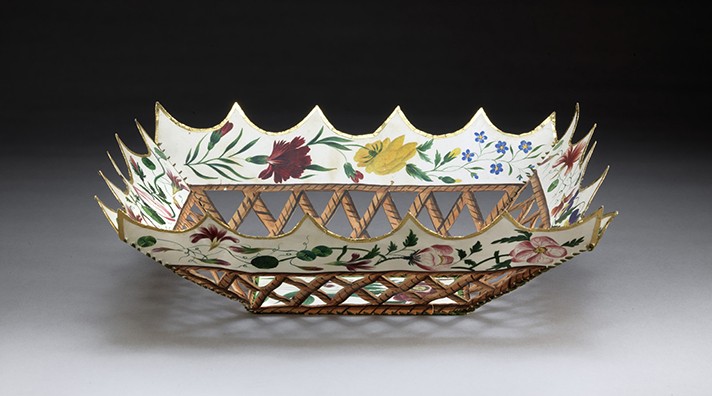
Unknown maker, Basket, ca. 1820, silk thread, cut paper, and watercolor,
(Yale Center for British Art, Paul Mellon Fund)
◊ ◊ ◊ ◊ ◊
From the exhibition press release:
‘Of Green Leaf, Bird, and Flower’: Artists’ Books and the Natural World
Yale Center for British Art, New Haven, 15 May — 10 August 2014
Curated by Elisabeth Fairman
This spring, the Yale Center for British Art presents ‘Of Green Leaf, Bird, and Flower’: Artists’ Books and the Natural World, an exhibition examining the intersections of artistic and scientific interest in the natural world from the sixteenth century to the present. On view from May 15 through August 10, 2014, the exhibition explores depictions of Britain’s countryside and its native plant and animal life through more than two hundred objects drawn primarily from the Center’s collections, ranging from centuries-old manuscripts to contemporary artists’ books.
 The exhibition highlights the scientific pursuits in the eighteenth and nineteenth centuries that resulted in the collecting and cataloging of the natural world. Also explored are the aesthetically oriented activities of self-taught naturalists during the Victorian era, particularly those of women who collected and drew specimens of butterflies, ferns, grasses, feathers, seaweed, and shells, and assembled them into albums and commonplace books. Examples of twentieth- and twenty-first-century artists’ books, including those of Eileen Hogan, Mandy Bonnell, Tracey Bush, John Dilnot, Sarah Morpeth, and Helen Douglas, broaden the vision of the natural world to incorporate its interaction with consumer culture and with modern technologies. Work by contemporary artists in the exhibition reveal a shared inspiration to record, interpret, and celebrate nature as in the work of their predecessors.
‘Of Green Leaf, Bird, and Flower’ features traditional bound books, drawings, and prints, as well as a range of more experimental media incorporating cut paper, wood, stone, natural specimens, sound, video, and interactive multimedia. Historical works are also on loan from the Beinecke Rare Book and Manuscript Library and the Lentz Collection at the Yale Peabody Museum of Natural History, including examples of early microscopes used by natural historians.
◊ ◊ ◊ ◊ ◊
From Yale UP:
Elisabeth Fairman, ed., with essays by David Burnett, Molly Duggins, Elisabeth Fairman, and Robert McCracken Peck, Of Green Leaf, Bird, and Flower: Artists’ Books and the Natural World (New Haven: Yale University Press, 2014), 248 pages, ISBN: 978-0300204247, $70.
Highlighting an enduring interest in natural history from the 16th century to the present, this gorgeous book explores depictions of the natural world, from centuries-old manuscripts to contemporary artists’ books. It examines the scientific pursuits in the 18th and 19th centuries that resulted in the collecting and cataloguing of the natural world. It also investigates the aesthetically oriented activities of self-taught naturalists in the 19th century, who gathered flowers, ferns, seaweed, feathers, and other naturalia into albums. Examples of 20th- and 21st-century artists’ books, including those of Eileen Hogan, Mandy Bonnell, and Tracey Bush, broaden the vision of the natural world to incorporate its interaction with consumer culture and with modern technologies. Featuring dazzling illustrations, the book itself is designed by Miko McGinty to evoke a fieldwork notebook, and features a collection pocket and ribbon markers.
Elisabeth Fairman is senior curator of rare books and manuscripts at the Yale Center for British Art.
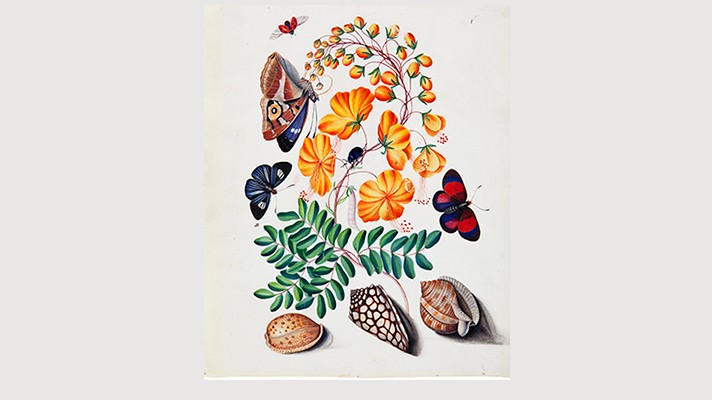
James Bolton, one of twenty drawings depicting specimens from the natural history cabinet of Anna Blackburne, ca. 1768, Yale Center for British Art, Paul Mellon Fund, in honor of Jane and Richard C. Levin, President of Yale University (1993–2013).
New Book | Chinoiserie in Eighteenth-Century Britain
From Manchester University Press:
Stacey Sloboda, Chinoiserie: Commerce and Critical Ornament in Eighteenth-Century Britain (Manchester: Manchester University Press, 2014), 272 pages, ISBN: 978-0719089459, £70 / $105.
 In a critical reassessment of chinoiserie, a style both praised and derided for its triviality, prettiness and ornamental excesses, Stacey Sloboda argues that chinoiserie was no mute participant in eighteenth-century global consumer culture, but was instead a critical commentator on that culture. Analysing ceramics, wallpaper, furniture, garden architecture and other significant examples of British and Chinese design, this book takes an object-focused approach to studying the cultural phenomenon of the ‘Chinese taste’ in eighteenth-century Britain. It is essential reading for anyone interested in the critical history of design and the decorative arts in the period, and students and scholars of art history, material culture, eighteenth-century studies and British history will find a novel approach to studying the decorative arts and a forceful argument for their critical capacities.
Stacey Sloboda is Associate Professor of Art History at Southern Illinois University.
C O N T E N T S
Introduction: Reassessing Chinoiserie
1. Making China: Circulation, Imitation and Innovation
2. Buying China: Commerce, Taste and Materialism
3. Commerce in the Bedroom: Sex, Gender and Social Status
4. Commerce in the Garden: Nature, Art and Authority
Conclusion: Style and the Global Marketplace
Bibliography
Index
New Book | The Site of Rome, 1400–1750
From L’Erma di Bretschneider (and available from artbooks.com) . . .
David R. Marshall, ed., The Site of Rome: Studies in the Art and Topography of Rome 1400–1750 (Melbourne Art Journal 13) (Rome: L’Erma di Bretschneider, 2014), 264 pages, ISBN: 978-8891306661, €160 / $235 / Digital Version €128.
 This volume, number 13 in the Melbourne Art Journal series, brings together nine scholars who each explore an aspect of the art and architecture of Rome situated within the topography—or map—of Rome in the Renaissance and Early Modern periods, with several studies focusing on the eighteenth century. These are studies of sight and site: about how the appearance of different regions or aspects of the city intersect with complex systems of political, economic, social and artistic institutions and customs.
David R. Marshall is Principal Fellow, Art History, School of Culture and Communication, The University of Melbourne
A preview is available here»
◊ ◊ ◊ ◊ ◊
C O N T E N T S
1. Julie Rowe (La Trobe University), Rome’s Mediaeval Fish Market at S. Angelo in Pescheria
2. Joan Barclay Lloyd (La Trobe University), Memory, Myth and Meaning in the Via Appia from Piazza di Porta Capena to Porta S. Sebastiano
3. Louis Cellauro (Deutsches Studienzentrum, Venice), Roma Antiqva Restored: The Renaissance Archaeological Plan
4. Donato Esposito (Metropolitan Museum, New York), The Virtual Rome of Sir Joshua Reynolds
5. Lisa Beaven (University of Sydney), Claude Lorrain and La Crescenza: The Tiber Valley in the Seventeenth Century
6. David R. Marshall (University of Melbourne), The Campo Vaccino: Order and the Fragment from Palladio to Piranesi
7. Arno Witte (University of Amsterdam), Architecture and Bureaucracy: The Quirinal as an Expression of Papal Absolutism
8. Tommaso Manfredi (University ‘Mediterranea’, Reggio Calabria), Arcadia at Trinità dei Monti: The Urban Theatre of Maria Casimira and Alexander Sobieski in Rome
9. John Weretka (University of Melbourne), The ‘Non-aedicular Style’ and the Roman Church Façade of the Early Eighteenth Century
Exhibition | Coypel’s Don Quixote Tapestries
Next February at The Frick:
Coypel’s Don Quixote Tapestries: Illustrating a Spanish Novel in Eighteenth-Century France
The Frick Collection, New York, 24 February — 17 May 2015
Curated by Charlotte Vignon
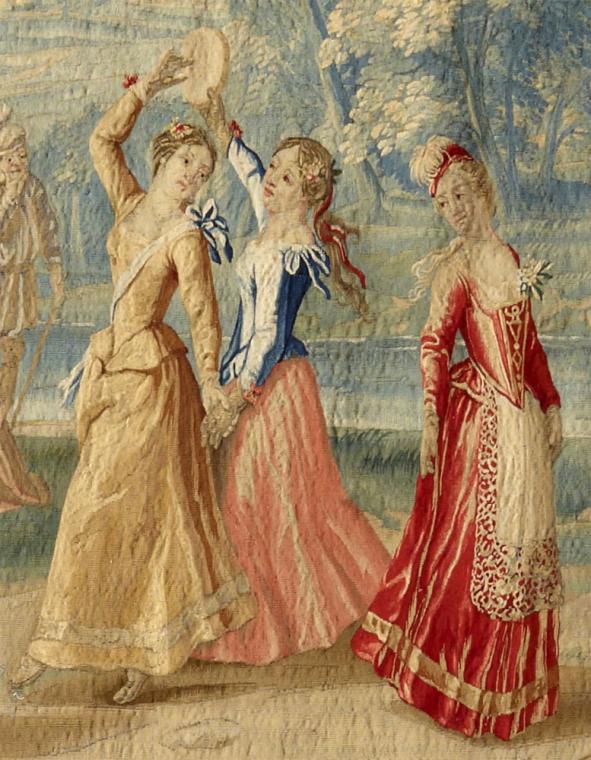
Peter Van den Hecke, The Arrival of Dancers at the Wedding of Camacho (detail), Brussels, ca. 1730s–40s. Tapestry,
123 x 219 inches (New York: The Frick Collection).
Photo by Michael Bodycomb.
A masterpiece of comic fiction, Cervantes’s Don Quixote (fully titled The Ingenious Gentleman Don Quixote of La Mancha) enjoyed great popularity from the moment it was published, in two volumes, in 1605 and 1615, respectively. Reprints and translations spread across Europe, captivating the continental imagination with the escapades of the knight Don Quixote and his companion, Sancho Panza. The novel’s most celebrated episodes inspired a multitude of paintings, prints, and interiors. Most notably, Charles-Antoine Coypel (1694–1752), painter to Louis XV, created a series of twenty-eight cartoons to be produced by the Gobelins tapestry manufactory in Paris. Twenty-seven were painted between 1714 and 1734, with the last scene realized just before Coypel’s death in 1751. In 2015 (the four-hundredth anniversary of the publication of the second volume of Don Quixote), the Frick will bring together a complete series of Coypel’s scenes, which will be shown in the Frick’s Oval Room and East Gallery. The exhibition with include the Frick’s two large tapestries inspired by Coypel—which have not been shown for more than ten years—and twenty-five other eighteenth-century paintings, prints, and tapestries from Coypel’s designs.
The accompanying publication will explore Coypel’s role in illustrating Don Quixote and the circumstances of his designs becoming the most renowned pictorial interpretations of the novel. It will also map the production of Coypel’s Don Quixote tapestries, from cartoons and engravings to looms in Paris and Brussels. The Frick will offer rich education programs that will include a series of lectures on eighteenth-century French and Flemish tapestries and on the illustration of Don Quixote over the centuries. Further programs will explore the history of the novel and its influence on artists working in a variety of media, including film, ballet, and opera. The exhibition is organized by the Frick’s Associate Curator of Decorative Arts, Charlotte Vignon.
Exhibition | Catching Sight: The World of the British Sporting Print
From the VMFA:
Catching Sight: The World of the British Sporting Print
Virginia Museum of Fine Arts, Richmond, 31 August 2013 — 13 July 2014
 This exhibition sheds new light on a common, but often overlooked aspect of British art: the British sporting print. Highly sought after during the 18th and 19th centuries, these prints endure as symbols of English culture. Featuring more than 100 prints, Catching Sight demonstrates the aesthetic sophistication and accomplishments of the genre. The exhibition takes an innovative approach, examining these works of art from an art historical perspective rather than simply as documents of the history of sport and rural culture. Catching Sight demonstrates the qualities of directness, vividness, and even wit for which the genre was prized by both the larger public and artists such as Degas and Géricault, who borrowed extensively from its artistic vocabulary.
Mitchell Merling, with Malcolm Cormack and Corey Piper, Catching Sight: The World of the British Sporting Print (Richmond: Virginia Museum of Fine
Arts, 2013), 112 pages, ISBN: 978-1934351031, $36.
The exhibition is accompanied by an illustrated catalogue by Mitchell Merling, Paul Mellon Curator, with contributions from Malcolm Cormack, Paul Mellon Curator Emeritus, and Corey Piper, former Curatorial Associate for the Mellon Collection.
Catalogue cover: Isaac Cruikshank, London Sportsmen Shooting Flying [from a set of four], ca. 1800, hand-colored etching (VMFA: Paul Mellon Collection, 85.1282.2)










 Enfilade
leave a comment