New Book | The Concept of the ‘Master’ in Art Education
From Ashgate:
Matthew Potter, ed., The Concept of the ‘Master’ in Art Education in Britain and Ireland, 1770 to the Present (Aldershot: Ashgate, 2013), 312 pages, ISBN: 978-1409435556, £70.
 A novel investigation into art pedagogy and constructions of national identities in Britain and Ireland, this collection explores the student-master relationship in case studies ranging chronologically from 1770 to 2013, and geographically over the national art schools of England, Ireland, Scotland and Wales. Essays explore the manner in which the Old Masters were deployed in education; fuelled the individual creativity of art teachers and students; were used as a rhetorical tool for promoting cultural projects in the core and periphery of the British Isles; and united as well as divided opinions in response to changing expectations in discourse on art and education.
Case studies examined in this book include the sophisticated tradition of ‘academic’ inquiry of establishment figures, like Joshua Reynolds and Frederic Leighton, as well as examples of radical reform undertaken by key individuals in the history of art education, such as Edward Poynter and William Coldstream. The role of ‘Modern Masters’ (like William Orpen, Augustus John, Gwen John and Jeff Wall) is also discussed along with the need for students and teachers to master the realm of art theory in their studio-based learning environments, and the ultimate
pedagogical repercussions of postmodern assaults on the
academic bastions of the Old Masters.
Matthew C. Potter is a Senior Lecturer in Art and Design History at Northumbria University, UK. His research interests include national identity in British art and the history of art education.
◊ ◊ ◊ ◊ ◊
C O N T E N T S
Learning from the masters: An introduction, Matthew C. Potter
1. Naturalising tradition: Why learning from the masters?, Iris Wien
2. A free market in mastery: Re-imagining Rembrandt and Raphael from Hogarth to Millais, Paul Barlow
3. The John Frederick Lewis Collection at the Royal Scottish Academy: Watercolour copies of old masters as teaching aids, Joanna Soden
4. British art students and German masters: W.B. Spence and the reform of German art academies, Saskia Pütz
5. Standing in Reynolds’ shadow: The academic discourses of Frederic Leighton and the legacy of the first President of the Royal Academy, Matthew C. Potter
6. Opening doors: The entry of women artists into British art schools, 1871–1930, Alice Strickland
7. Struggling with the Welsh masters, 1880–1914, Matthew C. Potter
8. Emulation and legacy: The master-pupil relationship between William Orpen and Seán Keating, Éimear O’Connor
9. Prototype and perception: Art history and observation at the Slade in the 1950s, Emma Chambers
10. The pedagogy of capital: Art history and art school knowledge, Malcolm Quinn
11. Study the masters? On the ambivalent status of art history within the contemporary art school, Katerina Reed-Tsocha
12. ‘Without a master’: Learning art through an open curriculum, Joanne Lee
Bibliography
Index
New Book | Matthew Boulton: Enterprising Industrialist
From Ashgate:
Kenneth Quickenden, Sally Baggott, and Malcolm Dick, eds., Matthew Boulton: Enterprising Industrialist of the Enlightenment (Aldershote: Ashgate, 2014), 312 pages, ISBN: 978-1409422181, £75 / $124.
 Matthew Boulton was a leading industrialist, entrepreneur, and Enlightenment figure. Often overshadowed through his association with James Watt, his Soho manufactories put Birmingham at the centre of what has recently been termed ‘The Industrial Enlightenment’.
Exploring his many activities and manufactures—and the regional, national and international context in which he operated—this publication provides a valuable index to the current state of Boulton studies.
Combining original contributions from social, economic, and cultural historians, with those of historians of science, technology, and art, archaeologists and heritage professionals, the book sheds new light on the general culture of the eighteenth century, including patterns of work, production, and consumption of the products of art and industry. The book also extends and enhances knowledge of the Enlightenment, industrialization, and the processes of globalization in the eighteenth century.
Kenneth Quickenden is Research Professor at Birmingham Institute of Art and Design, Birmingham City University. Sally Baggott was Librarian and Curator at The Birmingham Assay Office and is now Research Facilitator, College of Arts and Law, University of Birmingham. Malcolm Dick is Director of the Centre for West Midlands History, University of Birmingham.
◊ ◊ ◊ ◊ ◊
C O N T E N T S
1. Introduction: Matthew Boulton — Enterprising industrialist of the Enlightenment, Kenneth Quickenden, Malcolm Dick, and Sally Baggott
2. Matthew Boulton, Birmingham, and the Enlightenment, Peter M. Jones
3. Matthew Boulton: Innovator, Jennifer Tann
4. Was Matthew Boulton a scientist? Operating between the abstract and the entrepreneurial, David Philip Miller
5. The origins of the Soho Manufactory and its layout, George Demidowicz
6. Boulton, Watt and Wilkinson: The birth of the improved steam engine, Jim Andrew
7. Matthew Boulton’s copper, Peter Northover and Nick Wilcox
8. The mechanical paintings of Matthew Boulton and Francis Eginton, Barbara Fogarty
9. Samuel Garbett and early Boulton and Fothergill assay silver, Kenneth Quickenden
10. Hegemony and hallmarking: Matthew Boulton and the battle for the Birmingham Assay Office, Sally Baggott
11. Dark Satanic millwrights? Forging foremanship in the industrial revolution: Matthew Boulton and the leading hands of Boulton and Watt, Joseph Melling
12. Workers at the Soho Mint, (1788–1809), Sue Tungate
13. Matthew Boulton’s Jewish partners between France and England: Innovative networks and merchant enlightenment, Liliane Hilaire-Pérez and Bernard Vaisbrot
14. Enlightened entrepreneurs versus ‘philosophical pirate’, (1788–1809): Two faces of the Enlightenment, Irina Gouzévitch
15. Creating an image: portrait prints of Matthew Boulton, Val Loggie
16. The death of Matthew Boulton 1809: Ceremony, controversy and commemoration, Malcolm Dick
Appendix
Select bibliography
Index
New Book | Soul Food
The 2014 James Beard Awards were announced this week, with Adrian Miller’s Soul Food taking top honors for Reference and Scholarship. (Also nominated was William Sitwell’s A History of Food in 100 Recipes, which, while employing a much larger scope, may also appeal to Enfilade readers; 7 of the recipes date from the eighteenth century). From UNC Press:
Adrian Miller, Soul Food: The Surprising Story of an American Cuisine, One Plate at a Time (Chapel Hill: The University of North Carolina Press, 2013), 352 pages, ISBN 978-1469607627, $30.
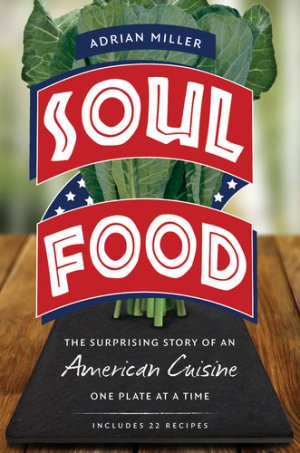 In this insightful and eclectic history, Adrian Miller delves into the influences, ingredients, and innovations that make up the soul food tradition. Focusing each chapter on the culinary and social history of one dish—such as fried chicken, chitlins, yams, greens, and ‘red drinks’—Miller uncovers how it got on the soul food plate and what it means for African American culture and identity.
Miller argues that the story is more complex and surprising than commonly thought. Four centuries in the making, and fusing European, Native American, and West African cuisines, soul food—in all its fried, pork-infused, and sugary glory—is but one aspect of African American culinary heritage. Miller discusses how soul food has become incorporated into American culture and explores its connections to identity politics, bad health raps, and healthier alternatives. This refreshing look at one of America’s most celebrated, mythologized, and maligned cuisines is enriched by spirited sidebars, photographs, and 22 recipes.
Adrian Miller is a writer, attorney, and certified barbecue judge who lives in Denver, Colorado. He has served as a special assistant to President Bill Clinton, a senior policy analyst for Colorado Governor Bill Ritter Jr., and a Southern Foodways Alliance board member.
New Book | The Gardener of Versailles
From Rizzoli:
Alain Baraton, The Gardener of Versailles: My Life in the World’s Grandest Garden, translated by Christopher Brent Murray (New York: Rizzoli, 2014), 296 pages, ISBN: 978-0847842681, $27.
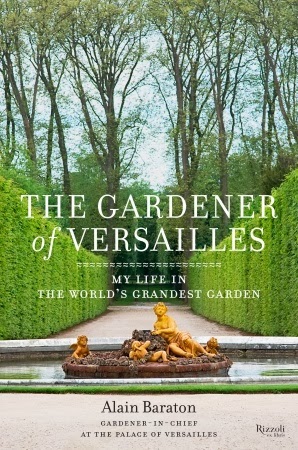 For gardening aficionados and Francophiles, a love letter to the Versailles Palace and grounds, from the man who knows them best. In Alain Baraton’s Versailles, every grove tells a story. As the gardener-in-chief, Baraton lives on its grounds, and since 1982 he has devoted his life to the gardens, orchards, and fields that were loved by France’s kings and queens as much as the palace itself. His memoir captures the essence of the connection between gardeners and the earth they tend, no matter how humble or grand.
With the charm of a natural storyteller, Baraton weaves his own path as a gardener with the life of the Versailles grounds, and his role overseeing its team of eighty gardeners tending to 350,000 trees and thirty miles of walkways on 2,100 acres. He richly evokes this legendary place and the history it has witnessed but also its quieter side that he feels privileged to know. The same gardens that hosted the lavish lawn parties of Louis XIV and the momentous meeting between Marie Antoinette and the Cardinal de Rohan remain enchanted, private places where visitors try to get themselves locked in at night, lovers go looking for secluded hideaways, and elegant grandmothers secretly make cuttings to take back to their own gardens. A tremendous best seller in France, The Gardener of Versailles gives an unprecedentedly intimate view of one of the grandest places on earth.
Alain Baraton is the best-selling author of many books on gardening and the host of weekly gardening programs on French radio and television.
New Book | The Gardens of Venice and the Veneto
The particular appeal of this book lies in the fact that the gardens included are accessible to the public. From Frances Lincoln:
Jenny Condie, with photographs by Alex Ramsay, The Gardens of Venice and the Veneto (London: Frances Lincoln, 2013), 224 pages, ISBN: 978-0711234048, £35 / $60.
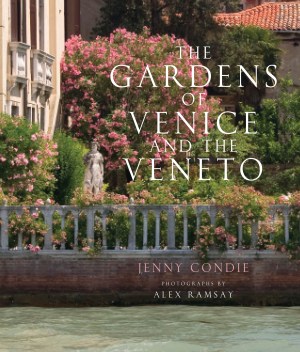 The Gardens of Venice and the Veneto draws together an amazing variety of 22 spellbinding garden retreats, from monastery gardens quietly cultivated in the islands of the lagoon to magnificent villas on the Brenta Canal, and baroque masterpieces in the hills beyond. Highlights include an eerie Masonic garden complete with gothic chapel and cavernous grottoes, a pleasure garden made for his workers by a benevolent nineteenth-century industrialist, and a flower-filled delight by the banks of the Grand Canal.
This is a book of ravishing images and intriguing stories. The garden behind Henry James’s Aspern Papers is here, along with the garden which so beguiled Margaret Symonds, the young English author of Days Spent on a Doge’s Farm. With an emphasis on gardens that can be visited, longtime resident Jenny Condie elucidates the dynastic triumphs, the reversals of fortune, and the shifts in taste and influence which have shaped these
extraordinary places.
Jenny Condie was born in Edinburgh and took a degree in Italian and History of Art at UCL. She has translated a number of substantial works in the area of art and literary history and criticism, and she has also written in Italian as a journalist. More recently she has worked with the Fondazione di Venezia to originate and run workshops on English Literature for children in local schools. Jenny Condie has lived in Venice since 2002 with her husband, the novelist Enrico Palandri, and their three children.
Alex Ramsay lives in the Welsh Marches. He is a photographer of international repute whose work has appeared in many books published by Frances Lincoln, including Italian Gardens: A Cultural History (recently reissued in paperback) and Italy’s Private Gardens: An Inside View, both written by his wife, the garden historian Helena Attlee.
◊ ◊ ◊ ◊ ◊
C O N T E N T S
 The Gardens of Venice
Island gardens
• The Giudecca
Religious gardens
• San Francesco della Vigna
• Ca’ Morosini del Giardin
Palazzi gardens
• Ca’ Rezzonico
• Ca’ Tron
• Ca’ Zenobio
• Palazzo Cappello Malipiero Barnabò
• Palazzo Contarini Dal Zaffo
• Palazzo Rizzo Patarol
• Palazzo Soranzo Cappello
• Querini Stampaglia
The Gardens of the Brenta Canal
•Villa Brusoni Scalella, Dolo
• Villa Pisani, Stra
The Gardens of Padua
• Orto botanico, Padua
• Ca’ Marcello, Levada di Piombino Dese
• Villa Barbarigo Pizzoni-Ardemani, Valsanzibio
• Villa Ca’ Dolfin, Marchiori, Lendinara s
• Villa Emo, Rivella di Monselice
• Villa Pisani Bolognesi Scalabrin, Vescovana
• Villa Valmarana a Citadella Vigodarzere, Saonara
The Gardens of Treviso
• Villa Barbaro di Maser
The Gardens of Verona
• Giardino Giusti, Verona
• Giardino di Pojega, Villa Rizzardi, Negrar
• Villa Allegri Arvedi, Cuzzano s
• Villa della Torre, Fumane
• Villa Trissino Marzotto, Trissino
The Gardens of Vicenza
• Villa Fracanzan Piovene, Orgiana
• Villa Godi Malinverni and Villa Piovene Porto-Godi, Lonedo di Lugo Vicentino
• Villa da Schio , Costozza
• Villa Valmarana ai Nani
Visiting the gardens
Books to read
A. Boogert’s 1692 Treatise on Colors

The Leiden-based, medieval book historian Erik Kwakkel posted notice of this 1692 manuscript at his blog, which was then picked up by Colossal and Gizmodo. From Colossal (5 May 2014):
A. Boogert, Traité des couleurs servant à la peinture à l’eau, Aix-en-Provence, Bibliothèque municipale/Bibliothèque Méjanes, MS 1389 (1228). The entire book can be viewed here, in hi-resolution, zoomable images.
In 1692 an artist known only as “A. Boogert” sat down to write a book in Dutch about mixing watercolors. Not only would he begin the book with a bit about the use of color in painting, but would go on to explain how to create certain hues and change the tone by adding one, two, or three parts of water. The premise sounds simple enough, but the final product is almost unfathomable in its detail and scope.
Spanning nearly 800 completely handwritten (and painted) pages, Traité des couleurs servant à la peinture à l’eau, was probably the most comprehensive guide to paint and color of its time. According to Medieval book historian Erik Kwakkel who translated part of the introduction, the color book was intended as an educational guide. The irony being there was only a single copy that was probably seen by very few eyes. . .
The full posting is available here»

◊ ◊ ◊ ◊ ◊
Kwakkel followed up with this note:
Full disclosure (6 May, 2014): While this colourful book is first presented to a larger audience in this post and there are no Dutch publications devoted to it, I have since posting discovered that it is known by at least one other Dutch scholar. It is currently being studied and will be included in a PhD study to be completed in 2015 at the University of Amsterdam. While it is great that blogs such as The Colossal (here) and Gizmodo (here) have picked it up, it is important to know that I was not the one “discovering” the manuscript. I merely put it on the bigger podium it deserves, via this blog.
New Book | Chinese Wallpaper in National Trust Houses
I’m republishing this posting, which first appeared in March, since copies are now available from the National Trust website. -CH
From The East India Company at Home, 1757–1857 Newsletter (March 2014); note that the booklet is available for free download as a PDF file.
Emile de Bruijn, Andrew Bush, and Helen Clifford, Chinese Wallpaper in National Trust Houses (Newcastle upon Tyne: National Trust, 2014), 50 pages, ISBN: 978-0707804286, £10.
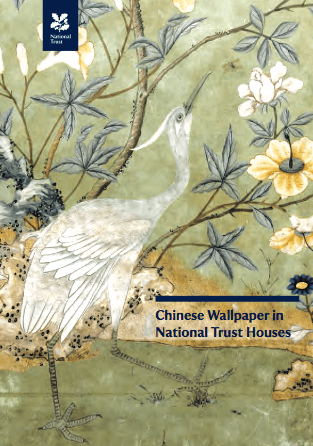 On the evening of 20 March Emile de Bruijn, Andrew Bush and Helen Clifford were delighted to celebrate the publication of Chinese Wallpaper in National Trust Houses, at the China Tang Suite at the Dorchester Hotel, London, providing the opportunity to thank the contributing team of collaborators including curators, conservators, entrepreneurs and scholars. Special thanks go to the hosts who made this venue possible. Copies of the National Trust’s catalogue of a group of historic Chinese wallpapers based on the latest research and conservation can be bought from Shop.nationaltrust.org.uk. The 50-page booklet is entitled Chinese Wallpapers in National Trust Houses and includes nearly 50 colour pictures, introductory essay, location map of sites including non-NT examples and a bibliography.
The booklet is also available as a PDF file.
More information about the The East India Company at Home Project is available here»
New Book | Architecture, Art, and Identity in Venice
From Ashgate:
Nebahat Avcioglu and Emma Jones, eds., Architecture, Art, and Identity in Venice and its Territories, 1450–1750 (Aldershot: Ashgate, 2013), 326 pages, ISBN: 978-1472410825, £70.
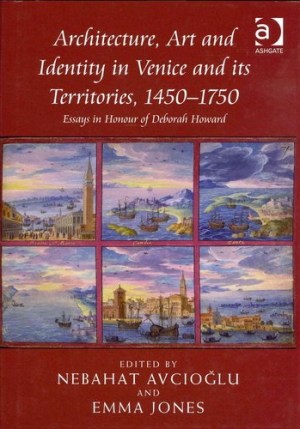 Cities are shaped as much by a repertoire of buildings, works and objects, as by cultural institutions, ideas and interactions between forms and practices entangled in identity formations. This is particularly true when seen through a city as forceful and splendid as Venice. The essays in this volume investigate these connections between art and identity, through discussions of patronage, space and the dissemination of architectural models and knowledge in Venice, its territories and beyond. They celebrate Professor Deborah Howard’s leading role in fostering a historically grounded and interdisciplinary approach to the art and architecture of Venice.
Based on an examination and re-interpretation of a wide range of archival material and primary sources, the contributing authors approach the notion of identity in its many guises: as self-representation, as strong sub-currents of spatial strategies, as visual and semantic discourses, and as political and imperial aspirations. Employing interdisciplinary modes of interpretation, these studies offer ground-breaking analyses of canonical sites and works of art, diverse groups of patrons, as well as the life and oeuvre of leading architects such as Jacopo Sansovino and Andrea Palladio. In so doing, they link together citizens and nobles, past and present, the real and the symbolic, space and sound, religion and power, the city and its parts, Venice and the Stato da Mar, the Serenissima and the Sublime Port.
Nebahat Avcioglu is Associate Professor of Art History at Hunter College, CUNY. Emma Jones is a PhD Candidate in the Department of History of Art at the University of Cambridge.
◊ ◊ ◊ ◊ ◊
C O N T E N T S
Introduction, Nebahat Avcioglu and Emma Jones
Section 1: Identity, Space and the City
1. ‘Soli deo honor et gloria’? Cittadino lay procurator patronage and the art of identity formation in Renaissance Venice, Allison Sherman
2. The Sisters Sagredo: Passion and patronage in eighteenth-century Venice, Esther Gabel
Section 2: Drawing, Mapping and Translating Venice
3. The early history of Jacopo Sansovino’s scheme for Piazza San Marco: A proposal, Paul Davies
4. Venice 1557: Sabbadino’s city plan, Elena Svalduz
5. Translatio Longhena Salute: Drawings and patrons in pilgrimage between Venice, Rome, and Gostyn, Andrew Hopkins
Section 3: Palladio’s Creations and Creating Palladio
6. The twin sacristy arrangement of Palladio’s Venice: origins and adaptations, Lydia Hamlett
7. Palladio’s patrons and music: Connections between cultural interests and architecture: The Villa Pisani at Bagnolo, Laura Moretti
8. How Palladio became famous: Paolo Gualdo and the Republic of Letters, Tracy E. Cooper
Section 4: The Production of Sacred Space
9. The seventeenth-century project for the church of San Nicolò del Lido in Venice: Liturgical problems and new architectural models in the counter-Reformation, Massimo Bisson
10. Innovation or afterthought? Dating the San Giobbe retrochoir, Joanne Allen
11. Venice’s cathedral of San Pietro di Castello, 1451–1630, Gianmario Guidarelli
Section 5: Time and Place in the Stato da Mar
12. The topography of antiquity in descriptions of Venetian Crete, Johanna D. Heinrichs
13. Jacopo Foscarini, Francesco Barozzi and the oracles of Leo the Wise, Blake de Maria
14. Becoming a man of empire: The construction of patrician identity in a republic of equals, Patricia Fortini Brown
Exhibition | Goya and the Altamira Family
Press release (10 April 2014) from The Met:
Goya and the Altamira Family
The Metropolitan Museum of Art, New York, 22 April — 3 August 2014
Curated by y Xavier F. Salomon
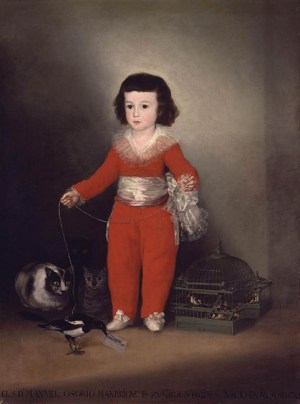
Goya, Manuel Osorio Manrique de Zuñiga, 1787–88
50 x 40 inches (NY: The Metropolitan Museum of Art)
By special arrangement with the Banco de España, from April 22 through August 3, The Metropolitan Museum of Art will reunite for the first time four portraits painted by Francisco de Goya (1746–1828) that were commissioned by the Count of Altamira, who was a director of the bank. Goya and the Altamira Family will consist of
• Banco de España’s Portrait of the Count of Altamira
• the Metropolitan’s beloved Manuel Osorio Manrique de Zuñiga, the so-called ‘Red Boy’
• the beautiful portrait of Manuel’s mother and sister, Condesa de Altamira and Her Daughter, María Agustina, from the Metropolitan Museum’s Robert Lehman Collection
• and a portrait of Manuel Osorio’s brother Vicente Joaquin de Toledo, from a private collection.
All four portraits were painted between 1786 and 1788 when Goya was beginning to experiment with aristocratic portraiture. A fifth portrait depicting Count Altamira’s middle son, Juan María Osorio, was painted around the same time by Agustín Esteve, one of Goya’s pupils, and will be lent by the Cleveland Museum of Art.
The Banco de San Carlos (the present-day Banco de España) commissioned Goya to create a series of portraits of the directors of the bank in Madrid, including the full-length depiction of Vicente Joaquín Osorio Moscoso y Guzmán, Count of Altamira. It was the success of this portrait that led to the subsequent commission to Goya for three portraits of members of the count’s family.
The exhibition is organized by Xavier F. Salomon, Peter Jay Sharp Chief Curator, The Frick Collection, New York. The exhibition is made possible by the Placido Arango Fund. It was organized by The Metropolitan Museum of Art with the assistance of the Consulate of Spain in New York.
◊ ◊ ◊ ◊ ◊
From the museum’s shop:
Xavier F. Salomon, Goya and the Altamira Family, Metropolitan Museum of Art Bulletin (Spring 2014), 48 pages, $15.
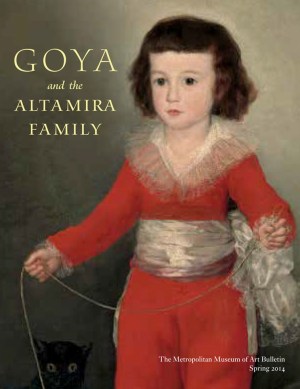 Ever since its arrival at the Metropolitan as part of the outstanding collection of Old Master paintings bequeathed by New York financier and philanthropist Jules Bache, Goya’s portrait of Don Manuel Osorio, the three- or four-year-old son of the conde de Altamira, has ranked as one of the museum’s most popular paintings. In celebration of the reinstallation of the Metropolitan’s European Paintings galleries, inaugurated last May, the condesa de Altamira and her son have been temporarily reunited in a gallery devoted to Goya and his contemporaries in Spain. But from the outset this move was planned as just the first stage of a more eventful family reunion that would also include Don Manuel’s older brother, Vicente Osorio, and their father, Vicente Joaquín Osorio de Moscoso y Guzmán, conde de Altamira: all four pictures outstanding works by Goya.
The publication is made possible through the generosity of the Lila Acheson Wallace Fund for The Metropolitan Museum of Art, established by the cofounder of Reader’s Digest.
New Book | Spanish Drawings in the Princeton University Art Museum
This critical catalogue of Princeton’s Spanish drawings was reviewed by Zahira Véliz Bomford for The Burlington Magazine 156 (April 2014): 244–45. From Yale UP:
Lisa A. Banner with contributions by Jonathan Brown, Robert S. Lubar, and Pierre Rosenberg, Spanish Drawings in the Princeton University Art Museum (New Haven: Yale University Press, 2013), 192 pages, ISBN: 978-0300149319, $40.
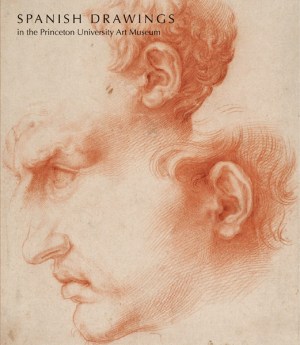 The Princeton University Art Museum’s collection of Spanish drawings includes masterworks by artists such as Jusepe de Ribera (1591–1652), Bartolomé Esteban Murillo (1617–1682), Francisco Goya (1746–1828), Pablo Picasso (1881–1973), and Salvador Dalí (1904–1989). Although many of the drawings in the collection relate to celebrated paintings, commissions, and other works by these artists, they remain largely unknown. Most have not been published previously and many are attributed here for the first time.
In Spanish Drawings in the Princeton University Art Museum, preeminent scholars enrich the growing corpus of work on Spanish drawings with original research. Each of the 95 drawings is reproduced in color, often accompanied by comparative illustrations. Watermarks have been documented with beta radiography and are included in an appendix. Provenances and
artist biographies round out this detailed record of one of the
most important collections of its kind.
Lisa A. Banner has written extensively on Spanish baroque art and has contributed to exhibition catalogues, symposia, and conferences throughout the world, most recently co-curating The Spanish Manner at The Frick Collection (2010–11).










 Enfilade
leave a comment