New Book | Eighteenth-Century Thing Theory in a Global Context
Due out this month from Ashgate:
Ileana Baird and Christina Ionescu, eds., Eighteenth-Century Thing Theory in a Global Context: From Consumerism to Celebrity Culture (Aldershot: Ashgate, 2014), 386 pages, ISBN: 978-1472413307, $130.
 Exploring Enlightenment attitudes toward things and their relation to human subjects, this collection offers a geographically wide-ranging perspective on what the eighteenth century looked like beyond British or British-colonial borders. To highlight trends, fashions, and cultural imports of truly global significance, the contributors draw their case studies from Western Europe, Russia, Africa, Latin America, and Oceania. This survey underscores the multifarious ways in which new theoretical approaches, such as thing theory or material and visual culture studies, revise our understanding of the people and objects that inhabit the phenomenological spaces of the eighteenth century. Rather than focusing on a particular geographical area, or on the global as a juxtaposition of regions with a distinctive cultural footprint, this collection draws attention to the unforeseen relational maps drawn by things in their global peregrinations, celebrating the logic of serendipity that transforms the object into some-thing else when it is placed in a new locale.
Ileana Baird is a Postdoctoral Preceptorship Fellow at the University of Virginia, and Christina Ionescu is an Associate Professor of French Studies at Mount Allison
University in Canada.
C O N T E N T S
Introduction
• Peregrine things: rethinking the global in 18th-century studies, Ileana Baird
• Through the prism of thing theory: new approaches to the 18th-century world of objects, Christina Ionescu
I. Western European Fads: Porcelain, Fetishes, Museum Objects, Antiques
• Caution, contents may be hot: a cultural anatomy of the tasse trembleuse, Christine A. Jones
• Cultural currency: Chrysal, or The Adventures of a Guinea and the material shape of 18th-century celebrity, Kevin Bourque
• Feather cloaks and English collectors: Cook’s voyages and the objects of the museum, Sophie Thomas
• Imagining Ancient Egypt as the idealized self in 18th-century Europe, Kevin M. McGeough
II. Under Eastern Eyes: Garments, Portraits, Books
• Frills and perils of fashion: politics and culture of the 18th-century Russian court through the eyes of La Mode, Victoria Ivleva
• From Russia with love: souvenirs and political alliance in Martha Wilmot’s The Russian Journals, Pamela Buck
• ‘The battle of the books’ in Catherine the Great’s Russia: from a jousting tournament to a tavern brawl, Rimma Garn
III. Latin American Encounters: Coins, Food, Accessories, Maps
• From Peruvian gold to British Guinea: tropicopolitanism and myths of origin in Charles Johnstone’s Chrysal, Mauricio E. Martinez
• Eating turtle, eating the world: comestible things in the 18th century, Krystal McMillen
• The fur parasol: masculine dress, prosthetic skins, and the making of the English umbrella in Robinson Crusoe, Irene Fizer
• Terra Incognita on maps of 18th-century Spanish America: commodification, consumption and the transition from inaccessible to public space, Lauren Beck
IV. Imagining Other Spaces: Trinkets, Collectibles, Ethnographic Artifacts, Scientific Objects
• (Re-)appropriating trinkets: how to civilize Polynesia with a jack-in-the-box, Laure Marcellesi
• Images of exotic objects in the Abbé Prévost’s Histoire Générale des Voyages, Antoine Eche
• Souvenirs of the South Seas: objects of imperial critique in Jonathan Swift’s Gulliver’s Travels, Jessica Durgan
Select Bibliography and Index
New Book | Early Modern Things: Objects and their Histories
Collected here are papers that originated from the Early Modern Things Workshop (Stanford, 29–30 January 2010). From Routledge:
Paula Findlen, ed., Early Modern Things: Objects and their Histories, 1500–1800 (New York: Routledge, 2013), 392 pages, ISBN: 978-0415520508 (hardcover), $160 / ISBN: 978-0415520515 (paperback), $45.
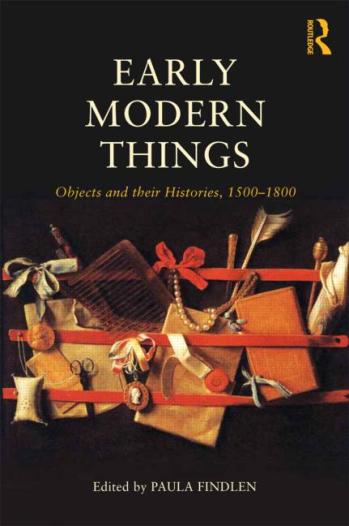 What can we learn about the past by studying things? How does the meaning of things, and our relationship to them, change over time? This fascinating collection taps a rich vein of recent scholarship to explore a variety of approaches to the material culture of the early modern world (c.1500–1800).
Divided into six parts, this book explores the ambiguity of things, representing things, making things, empires of things, consuming things, and lastly the power of things. Spanning across the early modern world, from Ming dynasty China to Georgian England, and from Ottoman Egypt to Spanish America, the authors provide a generous set of examples in how to study the circulation, use, consumption and, most fundamentally, the nature of things themselves.
Drawing on a broad range of disciplinary perspectives and lavishly illustrated, Early Modern Things supplies fresh and provocative insights into how objects—ordinary and extraordinary, secular and sacred, natural and man-made—came to define some of the key developments of the early modern world.
C O N T E N T S
Paula Findlen, Introduction: Early Modern Things: Setting Objects in Motion, 1500–1800
Part One: The Ambiguity of Things
1. Carla Nappi, Surface Tension: Objectifying Ginseng in Chinese Early Modernity
2. Marcy Norton, Going to the Birds: Animals as Things and Beings in Early Modernity
3. Jessica Riskin, The Restless Clock
Part Two: Representing Things
4. Julie Hochstrasser, ‘Stil-staende dingen’: Picturing Objects in the Dutch Golden Age
5. Giorgio Riello, ‘Things Seen and Unseen’: The Material Culture of Early Modern Inventories and Their Representation of Domestic Interiors
6. Chandra Mukerji, Costume and Character in the Ottoman Empire: Dress as Social Agent in Nicolay’s Navigations
Part Three: Making Things
7. Pamela H. Smith, Making Things: Techniques and Books in Early Modern Europe
8. Corey Tazzara, Capricious Demands: Artisanal Goods, Business Strategies, and Consumer Behavior in Seventeenth-Century Florence
Part Four: Empires of Things
9. Erika Monahan, Locating Rhubarb: Early Modern Russia’s Relevant Obscurity
10. Mark A. Peterson, The World in a Shilling: Silver Coins and the Challenge of Political Economy in the Early Modern Atlantic World
11. Alan Mikhail, Anatolian Timber and Egyptian Grain: Things That Made the Ottoman Empire
Part Five: Consuming Things
12. Morgan Pitelka, The Tokugawa Storehouse: Ieyasu’s Encounters with Things
13. Anne E.C. McCants, Porcelain for the Poor: The Material Culture of Tea and Coffee Consumption in Eighteenth-Century Amsterdam
14. Amanda Vickery, Fashioning Difference in Georgian England: Furniture for Him and for Her
Epilogue: The Power of Things
15. Renata Ago, Denaturalizing Things: A Comment
16. Timothy Brook, Something New: A Comment
17. Erin K. Lichtenstein, Identities through Things: A Comment
Historic Heston / Jas. Townsend & Son
This discussion with Heston Blumenthal, Ivan Day, and Bee Wilson is one of the events I would have most liked to have attended in 2013 (I’m a huge Bee Wilson fan). Alas, Blumenthal’s tome is available for purchase. Paula Forbes provides a thorough review at Eater (16 October 2013), with this brilliant summary: “if Willy Wonka ran Hogwarts, Historic Heston would be the history textbook.” -CH
As noted by Barley Blyton at the British Library’s Social Science Blog, “Historic Heston at the British Library” (29 November 2013) . . .
[On November 8] as part of the Georgians Revealed exhibition, the British Library hosted a discussion between Heston Blumenthal—one of Britain’s most acclaimed chefs and exponent of the egg and bacon ice-cream—and Ivan Day—food historian, broadcaster, writer and confectioner. Centring on Heston’s new book and using the Georgian period as the frame for their discussion, Blumenthal and Day wound their way through history and their own pasts, expertly guided by food writer and historian Bee Wilson as Chair. . .
◊ ◊ ◊ ◊ ◊
Heston Blumenthal, Historic Heston (London: Bloomsbury, 2013), 432 pages, ISBN: 978-1620402344, £125 / $200 (currently discounted to $125 on Amazon).
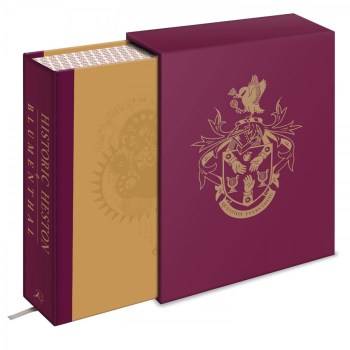 British gastronomy has a grand old tradition that has been lost over time. Now England’s most inventive chef is out to reclaim it. Heston Blumenthal, whose name is synonymous with cutting-edge cuisine, nonetheless finds his greatest source of inspiration in the unique and delicious food that the sceptered isle once produced. This has been the secret to his success at world-famous restaurants The Fat Duck and Dinner, where a contrast between old and new, modern and historic, is key.
Historic Heston charts a quest for identity through the best of British cooking that stretches from medieval to late-Victorian recipes. Start with thirty historic dishes, take them apart, put them together again, and what have you got? A sublime twenty-first-century take on delicacies including meat fruit (1500), quaking pudding (1660), and mock-turtle soup (1892). Heston examines the history behind each one’s invention and the science that makes it work. He puts these dishes in their social context and follows obscure culinary trails, ferreting out such curious sources as The Queen-like Closet from 1672 (which offers an excellent method for drying goose). What it adds up to is an idiosyncratic culinary history of Britain.
This glorious tome also gives a unique insight into the way that Heston works, with signature dishes from both The Fat Duck and Dinner. Illustrated by Dave McKean and with some of the most superb food photography you’ll ever see, Historic Heston is a book to treasure. You think you know about British cooking? Think again.
◊ ◊ ◊ ◊ ◊
If any of this gets you in the mood for exploring eighteenth-century food, you might also be interested in the blog Savoring the Past along with the accompanying video series 18th-Century Cooking with Jas. Townsend & Son. Both are connected to the Indiana-based, online retailer Jas. Townsend & Son. With food goods comprising only a portion of the company’s business, the store, has “helped historical reenactors, movie makers, theatrical companies, pirates, and regular people find items including clothing, tents, books, knives, tomahawks, oak barrels, and lots of other goods appropriate for 1750 to 1840,” for over 35 years. Perhaps just the thing as you get ready for ASECS in Williamsburg . . .
Here Jonathan Townsend makes mushroom ketchup:
Year-End Book Ideas
Having taken off a week, I return just barely in time to offer a few year-end suggestions, books that may not focus on the eighteenth century—but books many of you will find interesting and perhaps just the thing for any bookstore gift cards you may have received over the holidays.
Thanks for your continued support and happy new year. All the best for 2014! -CH
P.S. Now is the perfect time to join HECAA or renew your membership; rates go up next week.
◊ ◊ ◊ ◊ ◊
From the University of Chicago Press:
James W. P. Campbell with photographs by Will Pryce, The Library: A World History (Chicago: University of Chicago Press, 2013), 320 pages, ISBN: 978-0226092812, $75.
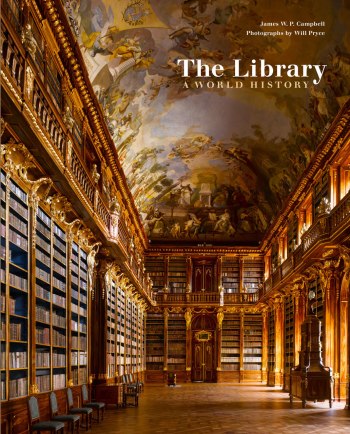 A library is not just a collection of books, but also the buildings that house them. As varied and inventive as the volumes they hold, such buildings can be much more than the dusty, dark wooden shelves found in mystery stories or the catacombs of stacks in the basements of academia. From the great dome of the Library of Congress, to the white façade of the Seinäjoki Library in Finland, to the ancient ruins of the library of Pergamum in modern Turkey, the architecture of a library is a symbol of its time as well as of its builders’ wealth, culture, and learning.
Architectural historian James Campbell and photographer Will Pryce traveled the globe together, visiting and documenting over eighty libraries that exemplify the many different approaches to thinking about and designing libraries. The result of their travels, The Library: A World History is one of the first books to tell the story of library architecture around the world and through time in a single volume, from ancient Mesopotamia to modern China and from the beginnings of writing to the present day. As these beautiful and striking photos reveal, each age and culture has reinvented the library, molding it to reflect their priorities and preoccupations—and in turn mirroring the history of civilization itself. Campbell’s authoritative yet readable text recounts the history of these libraries, while Pryce’s stunning photographs vividly capture each building’s structure and atmosphere. Together, Campbell and Pryce have produced a landmark book—the definitive photographic history of the library and one that will be essential for the home libraries of book lovers and architecture devotees alike.
James W. P. Campbell is Fellow in Architecture and History of Art, Queens’ College, Cambridge.
His most recent books include Building St Paul’s and Brick: A World History, also with Will Pryce.
Will Pryce is an award-winning photographer of international acclaim. His previous titles include Architecture in Wood: A World History, Brick: A World History and World Architecture: The Masterworks.
◊ ◊ ◊ ◊ ◊
From the Vendome Press:
Oscar Tusquets Blanca, Martine Diot, Adelaïde de Savray, Jérôme Coignard, and Jean Dethier, Staircases: The Architecture of Ascent (New York: Vendome Press, 2013), 240 pages, ISBN: 978-0865653092, $75.
 The essential purpose of a staircase is utilitarian: to facilitate ascent and descent. Yet the design of even the simplest stair is complex, requiring great knowledge, skill, and ingenuity. This volume showcases the astonishing diversity of staircases over the centuries, from the stepped pyramids of the Maya to the exquisitely proportioned stairs of the Renaissance, to the elaborate balustraded confections of the Baroque period, to the virtuosic, computer-aided designs of today. Among the scores of featured staircases are Michelangelo’s double stair at the Palazzo dei Senatori on the Capitoline Hill in Rome; the double-spiral stair at Château de Chambord in France’s Loire Valley; the entrance stair in the Winter Palace (now the Hermitage) in St. Petersburg; the radical spiral ramp of Frank Lloyd Wright’s Guggenheim Museum; and the exterior stair at the Pompidou Center in Paris. Architectural tours de force all, often charged with religious, mystical, and hierarchical meaning, these staircases are inherently dynamic, as is every page of this fascinating and beautifully illustrated book.
◊ ◊ ◊ ◊ ◊
From English Heritage:
Philip Davies with photographs by Derek Kendall, London: Hidden Interiors (London: Atlantic, 2012), 448 pages, ISBN: 978-0956864246, £40.
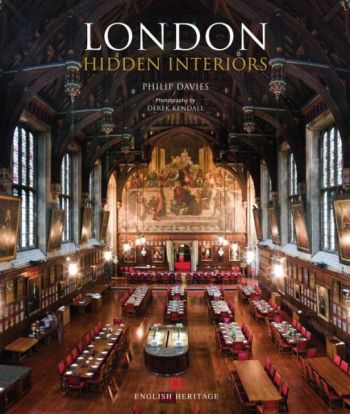 Following his successes with revealing London’s vanished architectural heritage in Lost London and Panoramas of Lost London, Philip Davies now turns his attention to 180 of London’s best conserved and least known interiors, revealed in over 1200 spectacular photographs—most taken specially for this book and not previously published. . . . The most exciting new book about London in generations. . . presents an expert introductory essay followed by the most extraordinary collection of contemporary photographs of London’s historic interiors ever published.
The increasing popularity of Open City has stimulated the curiosity of local Londoners and visitors from afar, awakening renewed interest and comprehension of London’s success in preserving amazing interiors, from private salons to traditional public houses, from ornate churches to industrial plants. London: Hidden Interiors has one hundred and eighty examples which have been selected from a complete range of building types to convey the richness and diversity of London’s architectural heritage and the secrets that lie within. It concentrates generally on the buildings and interiors that are lesser known and to which the public are not normally allowed the hidden and the unusual, the quirky and the eccentric, although there is space too for some of the better known. The careful composition, superb lighting and exposure of the images featured in this book are themselves a lesson in conservation, capturing the sense of these unique spaces whilst at the same time revealing the important architectural detail; Derek Kendall’s photographs, perfectly reproduced, make this book a visual delight and a major contribution to the architectural history of London.
To learn more, please visit the London Hidden Interiors website.
◊ ◊ ◊ ◊ ◊
From Thames & Hudson:
James Peill with photographs by James Fennell and a foreword by Julian Fellowes, The English Country House (London: Thames & Hudson, 2013), 224 pages, ISBN 978-0500517079, £28 / $55.
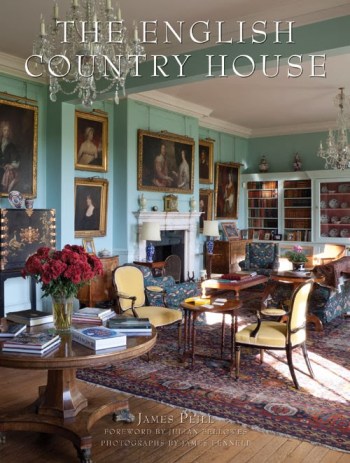 The houses range from Kentchurch Court, a fortified medieval manor house that has been the seat of the Scudamore family for nearly 1,000 years, to a delightful Strawberry Hill-style Gothic house in rural Cornwall, the ducal palace of Badminton in Gloucestershire, and Goodwood House, England’s greatest sporting estate. Many of the houses remain closed to the public—and some have never been featured in a book before.
James Peill recounts the ups and downs of such deeprooted dynasties as the Cracrofts, whose late 18th-century Hackthorn Hall is a perfect example of the kind of house Jane Austen describes in her novels (indeed, she appears on their family tree), as well as the Biddulphs, who constructed the Arts and Crafts masterpiece Rodmarton in the first decades of the last century. James Fennell provides superb photographs of a wealth of gardens, charming interiors, bygone sporting trophies, fine art collections and evocative family memorabilia. A stirring source of inspiration for all those concerned with living traditions and classic interiors, here
is a proud celebration of England’s country house heritage.
James Peill is the curator of Goodwood House in West Sussex. Formerly a director of Christie’s, where he was a specialist in the Furniture Department, he is the co-author (with the late Desmond FitzGerald, Knight of Glin) of The Irish Country House and Irish Furniture.
James Fennell specializes in interior, architectural, portrait, fashion and travel photography. His work has been published in Condé Nast Traveller, World of Interiors, Elle Décor and Architectural Digest. His books include The Irish Country House, The Scottish Country House and The Irish Pub, all of which are published by Thames & Hudson.
Julian Fellowes is the creator of the hugely successful period drama Downton Abbey.
Exhibition | Houghton Hall: Portrait of an English Country House
As Courtney Barnes noted back in November at Style Court, America’s fascination with England’s country houses will continue into the new year (and 2015). While Houghton Revisited, which brought dozens of paintings back to the house from Russia for display this summer and fall, was awarded Apollo Magazine’s 2013 Exhibition of the Year, pictures and objects still in the Houghton Hall collection will travel to Houston, San Francisco, and Nashville. From the MFAH press release (22 November 2013). . .
Houghton Hall: Portrait of an English Country House
Museum of Fine Arts, Houston, 22 June — 22 September 2013
Legion of Honor, San Francisco, 18 October 2014 — 18 January 2015
Frist Center for the Visual Arts, Nashville, 13 February — 10 May 2015
Curated by Gary Tinterow and Christine Gervais with David Cholmondeley

William Hogarth, The Cholmondeley Family, 1732
(Marquess of Cholmondeley, Houghton Hall)
◊ ◊ ◊ ◊ ◊
Family portraits by Hogarth and Sargent, exquisite examples of Sèvres porcelain, and unique pieces of William Kent furniture from this aristocratic English family chronicle three centuries of art, history, and politics.
Museum of Fine Arts, Houston, Director Gary Tinterow today announced an unprecedented exhibition: Houghton Hall: Portrait of an English Country House, which will be on view at the Museum from June 22 to September 22, 2014. The exhibition marks the first time the renowned collection of the Marquesses of Cholmondeley, housed at Houghton Hall, the family estate in Norfolk, will travel outside of England.

Houghton Hall (Photo: Nick McCann)
The house and much of its collection were built in the early 1700s by Sir Robert Walpole—England’s first prime minister and the ancestor of the current marquess. Renowned as one of the finest Palladian houses and one of the most extensive art collections in Britain, Houghton became notorious when Sir Robert’s collection of Old Master paintings was sold by his grandson to Catherine the Great, in 1779. But the house and all of its furnishings, considered to comprise William Kent’s Georgian masterpiece, remained intact; Walpole’s descendants added considerably to the collection of paintings. From great family portraits by William Hogarth, Joshua Reynolds, and John Singer Sargent, to exquisite examples of Sèvres porcelain, rare pieces of R. J. & S. Garrard silver, and unique furniture by William Kent, the exhibition vividly evokes the fascinating story of art, history, and politics through the collections of this aristocratic English family over three centuries.
Organized by Tinterow; Christine Gervais, associate curator; and Lord Cholmondeley, the exhibition will tour nationally after the Houston presentation, beginning with the Legion of Honor of the Fine Arts Museums of San Francisco (October 18, 2014–January 18, 2015) and the Frist Center for the Visual Arts in Nashville (February 13–May 10, 2015).
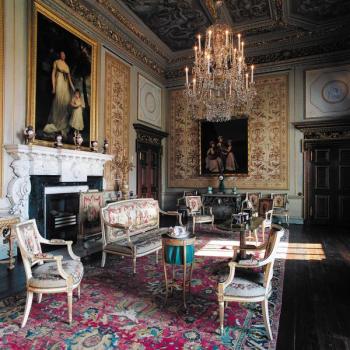
The White Drawing Room at Houghton Hall, with paintings by John Hoppner and George James (Photo: Nick McCann)
“Houghton Hall and its superb collections epitomize the historic legacy of art, architecture, and patronage among the great families and country houses of England,” commented Tinterow. “I am delighted to partner with David Cholmondeley to bring this extraordinary heritage to American audiences. Given our fascination with Downton Abbey and its similar story of a great English house and its family, I know this exhibition will be highly anticipated.”
“I was enormously gratified by the response to Houghton Revisited, the exhibition in which we reunited the paintings sold to Catherine the Great with their home at Houghton Hall,” commented David Cholmondeley on the success of that recent project. “I look forward to working with Gary Tinterow and his colleagues at the Museum of Fine Arts, Houston, to share Houghton Hall and our family’s history with visitors in Houston, San Francisco, and Nashville.”
About Portrait of an English Country House
Houghton Hall: Portrait of an English Country House will assemble more than 100 objects in settings that combine paintings, porcelain, sculpture, costume, metalwork, and furniture to evoke the stunning rooms at Houghton Hall. Bought or commissioned by eight generations of descendants of Sir Robert Walpole, together these objects comprise a fascinating chronicle. (more…)
New Title | Landscapes of London
From Yale UP:
Elizabeth McKellar, Landscapes of London: The City, the Country, and the Suburbs, 1660–1840 (London: Paul Mellon Centre for Studies in British Art, 2013), 276 pages, ISBN: 978-0300109139, $85.
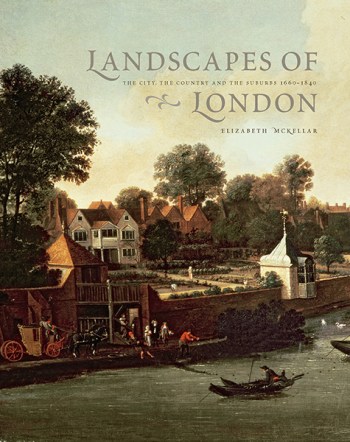 The idea of a “Greater London” emerged in the 18th century with the expansion of the city’s suburbs. In Landscapes of London, Elizabeth McKellar traces this growth back to the 17th century, when domestic retreats were established in outlying areas. This transitional zone was occupied and shaped by the urban middle class as much as by the elite who built villas there. McKellar provides the first major interdisciplinary cultural history of this area, analyzing it in relation to key architectural and planning debates and to concepts of national, social, and gender identities. She draws on a wide range of source materials, including prints, paintings, maps, poetry, songs, newspapers, guidebooks, and other popular literature, as well as buildings and landscapes. The author suggests that these suburban landscapes—the first in the world—were a new environment, but one in which the vernacular, the rustic, and the historic played a substantial part. This fascinating investigation shows London as the forerunner of the complex, multifaceted modern cities of today.
Elizabeth McKellar is senior lecturer and staff tutor in the
history of art, Open University.
Exhibition | Vincoli d’Amore: Spose in Casa Gonzaga
From the Palazzo Ducale in Mantova:
Vincoli d’Amore: Spose in casa Gonzaga tra XV e XVIII secolo
Museo di Palazzo Ducale, Mantua, 18 October 2013 — 6 January 2014
Curated by Paola Venturelli and Daniela Ferrari
 Si inaugura venerdì 18 ottobre alle ore 16.30 nell’Atrio degli Arcieri la mostra Vincoli d’Amore. Spose in casa Gonzaga tra XV e XVIII secolo, a cura di Paola Venturelli e Daniela Ferrari e promossa dall’Archivio di Stato di Mantova in collaborazione con la Soprintendenza BSAE di Mantova. Insieme alle curatrici intervengono Giovanna Paolozzi Strozzi, Soprintendente e Direttore del Museo di Palazzo Ducale, Francesca Zaltieri, Assessore alla Cultura della Provincia di Mantova e Renata Casarin Presidente del Soroptimist International Club di Mantova.
Spose di casa Gonzaga o spose giunte in casa Gonzaga lungo un arco di tempo che coincide con gli anni del dominio di questa grande dinastia, dagli inizi del XV secolo all’aprirsi del XVIII. Solo di alcune conosciamo le fattezze. Di poche gli interessi, i pensieri e le attitudini, rimanendo la maggior parte quasi priva di spessore storico e relegata nello sfondo della Grande Storia. Pedine, le cui mosse, abilmente studiate, porteranno tuttavia a costruire la Grande Storia dei Gonzaga. I loro matrimoni, voluti per allacciare vincoli di parentela con i principali casati, italiani o d’Oltralpe, erano infatti il frutto di oculate strategie dinastiche. Vincoli, qualche volta “d’amore”, anche spirituale – sull’imitazione del matrimonio mistico di Santa Caterina -, che cambiarono il panorama esistenziale delle nostre protagoniste.
La mostra è allestita negli ambienti in cui alcune delle protagoniste di questa esposizione hanno mosso i primi passi della loro vita coniugale. Presenti le duchesse Eleonora d’Asburgo ed Eleonora de’ Medici, ritratte nella supersite porzione della pala della Santissima Trinità, eseguita da Pieter Paul Rubens (ca. 1605), che domina la Sala degli Arcieri.
Oxford Art Journal, December 2013
From the latest issue of the Oxford Art Journal:
 • Tim Ingold, “Lines in Time / Review of Daniel Rosenberg and Anthony Grafton, Cartographies of Time: A History of the Timeline (2010),” Oxford Art Journal 36 (December 2013): 463–64.
• Mechthild Fend, “Allegory and Fantasy: Portraiture Beyond Resemblance / Review of Sarah Betzer, Ingres and the Studio: Women, Painting, and History (2012) and Melissa Percival, Fragonard and the Fantasy Figure: Painting and Imagination (2012),” Oxford Art Journal 36 (December 2013): 465–67
• Richard Taws, “Ruins and Reputations / Review of Nina Dubin, Futures and Ruins: Eighteenth-Century Paris and the Art of Hubert Robert (2010) and Elizabeth Mansfield, The Perfect Foil: François-André Vincent and the Revolution in French Painting (2012),” Oxford Art Journal 36 (December 2013): 467–70.
The Burlington Magazine, December 2013
The (long) eighteenth century in The Burlington:
The Burlington Magazine 155 (December 2013)
E D I T O R I A L
• Richard Shone, “Home is Where the Art Is,” p. 807.
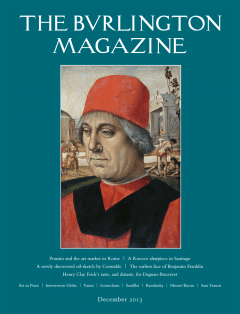 Houses once occupied by distinguished residents are a special strand of the heritage industry that increasingly dominates a nation in thrall to all aspects of the past. We are constantly being exhorted to save and preserve this or that—a factory, a view, a manor house, a pier, a site of outstanding natural beauty, the historic habitat of wildlife, or, indeed, of the famous dead. Some of the shrines we visit are more larded with authenticity than others. Inevitably, the further back in time the illustrious lives were lived, the fewer objects there are likely to be which were familiar to the inhabitants. Was this her chair; was this really his easel? The aspic of preservation continually wobbles between the authentic and the fake. We do not always know—are not always told—whether something is ‘of the same period’ or ‘similar to’ or a ‘replica of’ what may or may not have been originally there, under the eye, the hand, the bottom or the feet of the presiding genius. Much depends on the piety of heirs and descendants, the
changing ownership of the house and the fluctuating stakes of fame. . . .
The latest appeal for an artist’s house has much to recommend it and should attract supporters beyond British shores. It concerns the restoration and preservation of J.M.W. Turner’s rural retreat at Twickenham, west London. This is an exceptional project and not simply a matter of tidying up and putting a blue plaque on the front. Turner designed this house himself, and plans for it abound in sketchbooks of c.1810–12, after he had purchased two plots of land near the Thames. The intention is to remove later additions (not serious) and reveal its compact interior, obviously influenced by his friend John Soane’s house in Lincoln’s Inn Fields. For Turner, Sandycombe Lodge was for rest and recreation such as fishing (when he could ‘angle out the day’) and hosting friends on excursions for picnics, rather than for long residence and staying guests. Turner sold the house in 1826 and the adjoining meadow in 1848 (to the Windsor, Staines and South Western Railway). Under the auspices of the Turner’s House Trust, the appeal for £2 million is well underway, with support already assured from the Heritage Lottery Fund, among many other organisations and private donors, although further funding is still needed.2 It is expected that the public will be able to visit in 2016.
2. For an entertaining and informative account of the house, see C. Parry-Wingfield, with Foreword by A. Wilton: J.M.W. Turner. The Artist and his House at Twickenham, London 2012. Donations can be sent to the Trust at 11 Montpelier Row, Twickenham, tw1 2nq, or at www.turnerintwickenham.org.uk.
The full editorial is available here»
A R T I C L E S
• Gauvin Alexander Bailey and Fernando Guzmán, “The Rococo Altarpiece of St Ignatius: Chile’s Grandest Colonial Retable Rediscovered,” pp. 815–20.
An examination of the Rococo altarpiece of St Ignatius in Santiago, Chile, and of the European influences on this great retablo.
• David Pullins, “Dating and Attributing the Earliest Portrait of Benjamin Franklin,” pp. 821–22.
A re-evaluation of a painting now found to be the earliest known portrait of Benjamin Franklin, added to an earlier figure of a man by Robert Feke (c.1746–48).
R E V I E W S
• Elizabeth Goldring, Review of Laura Houliston, ed., The Suffolk Collection: A Catalogue of Paintings (English Heritage, 2012), p. 835.
• Michael Rosenthal, Review of Leo Costello, J.M.W. Turner and the Subject of History (Ashgate, 2012), p. 836.
• Basile Baudez, Review of the exhibition Soufflot: Un architecte dans la lumière, pp. 850–51.
• Xavier F. Salomon, Review of the exhibition Il Gran Principe Ferdinando de’ Medici (1663–1713) collezionista e mecenate, pp. 851–53.
• Angela Delaforce, Review of the exhibition Da Patriarcal à Capela Real de São João Baptista, pp. 855–56.
• Jamie Mulherron, Review of the exhibition Interwoven Globe: The Worldwide Textile Trade, 1500–1800, pp. 856–58.
Exhibition | Grand Prince Ferdinando de’ Medici, 1663–1713
From the Uffizi:
The Grand Prince Ferdinando de’ Medici (1663–1713): Collector and Patron of the Arts
Uffizi Gallery, Florence, 26 June — 3 November 2013, extended until 6 January 2014
Curated by Riccardo Spinelli

◊ ◊ ◊ ◊ ◊
To mark the 300th anniversary of the death of Grand Prince Ferdinando de’ Medici (1663–1713), the Galleria degli Uffizi is planning to devote a celebratory exhibition to this key figure who was one of the most important collectors and patrons of the arts in the entire history of the Medici Grand Dukes of Tuscany. The son of Cosimo III and of Marguerite-Louise d’Orléans, Ferdinando nurtured two overriding interests, in the theatre and music and in the figurative arts, from a very early age. The exhibition sets out to convey the complexity of his interests and the innovative nature of his approach which drew the leading artists of the era (musicians, instrumentalists, painters and sculptors) to Florence between the end of the 17th century and the first decade of the 18th. The exhibition is broken down into sections illustrating the complex issues surrounding the prince’s cultural inclinations, while also presenting the buildings in which his patronage was played out.
An introductory iconographic section displays likenesses of the prince and of his family, with works by Giovan Battista Foggini, Justus Suttermans and Anton Domenico Gabbiani.
This is followed by a second section illustrating the early years of Ferdinando’s art collecting and patronage which focused in particular on his beloved villa at Pratolino where, alongside musicians, singers, costumiers and composers, he also hosted the Bibbiena family from Bologna, masters in the art of stage design. At the same time, the residence was being transformed in its interior decor and embellished with the work of Ferdinando’s favourite painters at the time, including Livio Mehus, Pier Dandini and Domenico Tempesti, all of whom were Tuscans, but also such “foreigners” as Crescenzio Onofri from Rome or Cristoforo Munari from northern Italy, all of them engaged in producing works closely linked to the villa and to the performances and other leisure activities that were held in it.
The third section is devoted to the renovation of Palazzo Pitti, of the Pergola Theatre and of the cathedral of Florence on the occasion of Ferdinando’s wedding to Princess Violante Beatrix of Bavaria in 1689. The ducal palace underwent radical transformation in its piano nobile, in the bridal couple’s apartments and in the mezzanines above, which were renovated in a spectacularly imaginative way, evinced in the exhibition by the memoirs and preparatory drawings of the artists who executed in the work (Luca Giordano, Diacinto Maria Marmi, Alessandro Gherardini, Giovan Battista Foggini and Anton Domenico Gabbiani). At the same time, the section also explores the ceremonies and festivities held in Florence to mark the prince’s wedding, using drawings and documents for the purpose.
The fourth section illustrates the prince’s growing interest in the figurative arts, both in contemporary sculpture and in painting, with the leading artists active at the time, many of whom were experts in such ‘modern’ late 17th-century genres of as still-life and portraiture. Thus this part of the exhibition contains both religious and secular works (by Carlo Dolci, Carlo Loth, Baldassarre Franceschini and Il Volterrano) and examples of ‘painted nature’ (by Jacopo Ligozzi, Bartolomeo Bimbi, Margherita Caffi, Fardella, Houbracken and Michelangelo Pace da Campidoglio). Of equal interest in the section is the presence of sumptuary objects, pieces of furniture and everyday items testifying to Ferdinando’s sophisticated tastes, with works by the leading engravers, marquetry inlayers and silversmiths then active at court.
The highly significant fifth section explores the tastes of the Grand Prince as collector, with some of the 16th- to 18th-century paintings removed from churches in Tuscany and elsewhere, including Andrea del Sarto’s Madonna of the Harpies, Lanfranco’s Ectasy of St. Margaret of Cortona, Annibale Carracci’s Farnese Altarpiece, and lastly, the Madonna of the Long Neck by Parmigianino, one of Fernando’s most prestigious acquisitions in the field of Renaissance art as the 17th century drew to a close.
The sixth section is devoted to the grand prince’s favourite villa of all, Poggio a Caiano, whose decoration he renovated with the greatest magnificence. He chose a room on its piano nobile to house one of his most original collections comprising ‘works in miniature’, which is eloquently recreated in the exhibition through a selection paintings that once formed part of it, illustrating the prince’s catholic tastes in collecting.
The seventh section of the exhibition illustrates the prince’s taste for major Florentine statuary at the close of the 17th century, while in the sphere of painting it looks at the change in Ferdinando’s taste in favour of ‘foreign’ schools—far more modern than anything local artists could produce—such as the Venetian school (of which he was enamoured in his youth), the Bolognese school and the Ligurian school (with work by Crespi, Cassana, Fumiani, Sebastiano and Marco Ricci, Magnasco and Peruzzini) whose leading painters were summoned to Florence, where they produced some of their masterpieces specifically for the prince.
The final section is devoted to the last years of Ferdinando’s life, exploring the results and repercussions of his art patronage and collecting, and displaying the drawings for a celebratory monument that it was planned to erect in his memory, the sketches for that project, and material relating to his funeral.
Available from Artbooks.com:
Riccardo Spinelli, ed., Il gran principe Ferdinando de’ Medici (1663–1713) Collezionista e Mecenate (Firenze: Giunti, 2013 ), 430 pages, ISBN: 978-8809786103, $77.50.
◊ ◊ ◊ ◊ ◊
This smaller exhibition was on view until recently at the Villa of Poggio a Caiano:
For the Grand Prince Ferdinando:
Still lifes, vedute, bambocciate and caramogi from the Medici Collections
Medici Villa of Poggio a Caiano, 5 July — 5 November 2013
Curated by Maria Matilde Simari

◊ ◊ ◊ ◊ ◊
The Villa of Poggio a Caiano was one of the favourite residences of the Grand Prince Ferdinando de’ Medici (1663–1713), son of the Grand Duke Cosimo III and destined to succeed his father in the government of Tuscany. In concomitance with the major exhibition devoted to the Grand Prince in the Uffizi Gallery, the idea is to recall the figure of Ferdinando in the site of his favourite villa, too. It was here that Ferdinando spent the spring and autumn, riding his Berber horses, attending sophisticated concerts and operas performed in the theatre of the villa and devoting himself to the organisation of his own particular collection of miniature paintings, the so-called ‘Gabinetto di opere in piccolo’ which went on to become a famous example of a late seventeenth-century collection.
Significant evidence of Ferdinando’s commissions for the Villa of Poggio has fortunately survived in the large fresco dating to 1698 by Anton Domenico Gabbiani showing Cosimo de’ Medici being presented to Jupiter by Florence, which can be seen on the ceiling of the dining room on the first floor. This painting shows the celebratory and official side of court taste, but other aspects of the personality of Ferdinando, who was a curious man, interested in a wide range of artistic genres, also deserve to be explored.
An itinerary extending through fourteen rooms of the Still Life Museum is devoted to the Grand Prince as a collector of still lifes, highlighting the works that were certainly part of his collection. At the end of this itinerary is a room devoted to two different aspects of his tastes as a collector: the miniatures and the genre paintings, comprising in the latter group the views, the bambocciate and the grotesque and humorous paintings portraying pygmies and dwarves, or the whimsical caramogi.
The Grand Prince Ferdinando was attracted not only by great figure painting and by the works of the most famous painters of the sixteenth and seventeenth centuries (Titian, Parmigianino and Sebastiano Ricci) but also by artists engaged in collateral aspects and genres that can certainly not be defined as minor, since they made a very particular and novel impression on seventeenth-century taste: the flower painters, the painters of vedute, the Dutch petits maîtres, the bamboccianti painters of everyday life and the caricaturists.
The inventory of the assets of the Grand Prince drawn up at his death in 1713 records no less than sixteen paintings depicting caramogi (deformed, dwarf-like figures) intent upon various games and activities, for one of which the author’s name is specifically mentioned: the Brescia artist Faustino Bocchi, a renowned specialist in ‘the painting of pygmies’ who appears to have sojourned at the grand ducal court, and whom Ferdinando may in any case have met during a trip to Veneto and Lombardy in 1688. His interest in this particular grotesque genre can be linked to the recollections of Ferdinando as a passionate lover of amusing sonnets, ‘burlette burlesche’, of poets in ottava rima, comedians and ham actors.
The small collection of works displayed in the room dedicated to the Grand Prince Ferdinando in the Still Life Museum of the Villa of Poggio a Caiano offers a synthetic overview of the vedute, the bambocciate and the caramogi that he loved, displaying works not normally visible to the public since they are conserved in the repositories of the Florentine Galleries and of other institutions. Also on display is an as yet unpublished painting by Bartolomeo Ligozzi on which the date and signature have been discovered.
The show is rounded off by a selection of ancient manuscripts and printed books connected with the eclectic personality of Ferdinando: a cultured, passionate and curious collector who is also remembered as a cordial and affable man with a great sense of humour. As one of the manuscript memoirs recalls: “With his departure, spirit and joy too took their leave of Florence and Tuscany.”










 Enfilade
leave a comment