New Book | Travel, Collecting, and Museums of Asian Art
While addressing the nineteenth century, Ting Chang’s new book will be of interest to many dix-huitièmistes, particularly in connection with Edmond de Goncourt; in chapter four, Chang explores how Goncourt’s collection of Asian art and his writings on the subject supported his larger vision of an eighteenth-century revival. It’s part of Ashgate’s series on the Histories of Material Culture and Collecting, 1700–1950:
Ting Chang, Travel, Collecting, and Museums of Asian Art in Nineteenth-Century Paris (Aldershot: Ashgate, 2013), 210 pages, ISBN: 978-1409437765, $100 / £55.
 Travel, Collecting, and Museums of Asian Art in Nineteenth-Century Paris book examines a history of contact between modern Europe and East Asia through three collectors: Henri Cernuschi, Emile Guimet, and Edmond de Goncourt. Drawing on a wealth of material including European travelogues of the East and Asian reports of the West, Ting Chang explores the politics of mobility and cross-cultural encounter in the nineteenth century. This book takes a new approach to museum studies and institutional critique by highlighting what is missing from the existing scholarship — the foreign labours, social relations, and somatic experiences of travel that are constitutive of museums yet left out of their histories. The author explores how global trade and monetary theory shaped Cernuschi’s collection of archaic Chinese bronze. Exchange systems, both material and immaterial, determined Guimet’s museum of religious objects and Goncourt’s private collection of Asian art. Bronze, porcelain, and prints articulated the shifting relations and frameworks of understanding between France, Japan, and China in a time of profound transformation. Travel, Collecting, and Museums of Asian Art in Nineteenth-Century Paris thus looks at what Asian art was imagined to do for Europe. This book will be of interest to scholars and students interested in art history, travel imagery, museum studies, cross-cultural encounters, and modern transnational histories.
Ting Chang teaches art history at the University of Nottingham. She has published in The Art Bulletin, Oxford Art Journal, and Les Cahiers Edmond et Jules de Goncourt.
C O N T E N T S
Introduction
1: The historical terms of Euro-Asian object acquisition
2: Gold, silver, and bronze: Cernuschi’s collection and re-appraisals of Europe and Asia
3: The labour of travel: Guimet and Régamey in Asia
4: Equivalence and inversion: France, Japan and China in Goncourt’s cabinet
Conclusion
Bibliography
Index
Exhibition | The Nude Male in Art
Press release masculin (1 July 2013) from the Musée d’Orsay:
Masculin / Masculin: L’homme nu dans l’art de 1800 à nos jours
Musée d’Orsay, Paris, 24 September 2013 — 2 January 2014
Curated by Ophélie Ferlier, Xavier Rey, Ulrich Pohlmann, and Tobias G. Natter

Pierre et Gilles, Mercury, 2001 © Pierre et Gilles (Courtesy Galerie Jérôme de Noirmont, Paris)
Jean-Baptiste Frédéric Desmarais, The Shepherd Paris, 1787 (Ottawa, National Gallery of Canada)
While it has been quite natural for the female nude to be regularly exhibited, the male nude has not been accorded the same treatment. It is highly significant that until the show at the Leopold Museum in Vienna in the autumn of 2012, no exhibition had opted to take a fresh approach, over a long historical perspective, to the representation of the male nude. However, male nudity was for a long time, from the 17th to 19th centuries, the basis of traditional Academic art training and a key element in Western creative art. Therefore when presenting the exhibition Masculine / Masculine, the Musée d’Orsay, drawing on the wealth of its own collections (with several hitherto unknown sculptures) and on other French public collections, aims to take an interpretive, playful, sociological and philosophical approach to exploring all aspects and meanings of the male nude in art. Given that the 19th century took its inspiration from 18th-century classical art and that this influence still resonates today, the Musée d’Orsay is extending its traditional historical range in order to draw a continuous arc of creation through two centuries down to the present day. The exhibition will include the whole range of techniques: painting, sculpture, graphic arts and, of course, photography, which will have an equal place in the exhibition.
To convey the specifically masculine nature of the body, the exhibition, in preference to a dull chronological presentation, takes the visitor on a journey through a succession of thematic focuses, including the aesthetic canons inherited from Antiquity, their reinterpretation in the Neo-Classical, Symbolist and contemporary eras where the hero is increasingly glorified, the Realist fascination for truthful representation of the body, nudity as the body’s natural state, the suffering of the body and the expression of pain, and finally its eroticisation. The aim is to establish a genuine dialogue between different eras in order to reveal how certain artists have been prompted to reinterpret earlier works. In the mid-18th century, Winckelmann examined the legacy of the divine proporzioni of the body inherited from Antiquity, which, in spite of radical challenges, still apply today having mysteriously come down through the history of art as the accepted definition of beauty. From Jacques-Louis David to George Platt-Lynes, LaChapelle and Pierre et Gilles, and including Gustave Moreau, a whole series of connections is revealed, based around issues of power, censorship, modesty, the boundaries of public expectation and changes in social mores.
Winckelmann’s glorification of Greek beauty reveals an implicit carnal desire, relating to men as well as women, which certainly comes down through two centuries from the “Barbus” group and from David’s studio, to David Hockney and the film director James Bidgood. This sensibility also permeates the turn of the 19th and 20th centuries as it questions its own identity, as we see in the extraordinary painting École de Platon [School of Plato], inexplicably purchased by the French state in 1912 from the Belgian artist Delville. Similarly, the exhibition will reveal other visual and intellectual relationships through the works of artists as renowned as Georges de La Tour, Pierre Puget, Abilgaard, Paul Flandrin, Bouguereau, Hodler, Schiele, Munch, Picasso, Bacon, Mapplethorpe, Freud and Mueck, while lining up some surprises like the Mexican Angel Zarraga’s Saint Sébastien [Saint Sebastian], De Chirico’s Les Bains mystérieux [Mysterious Baths] and the erotica of Americans Charles Demuth and Paul Cadmus.
This autumn therefore, the Musée d’Orsay will invite the visitor to an exhibition that challenges the continuity of a theme that has always interested artists, through unexpected yet productive confrontations between the various revivals of the nude man in art. The exhibition has been organised by the Musée d’Orsay in collaboration with the Leopold Museum in Vienna.
◊ ◊ ◊ ◊ ◊
The catalogue is published jointly by by the Musée d’Orsay and Flammarion:
Guy Cogeval, Claude Arnaud, Philippe Comar, Damien Delille, Ophélie Ferlier, Ulrich Pohlmann, Xavier Rey, Masculin / Masculin: L’homme nu dans l’art de 1800 à nos jours (Paris: Musée d’Orsay / Flammarion, 2013), 304 pages, ISBN: 978-2081310094, 40€.
 Masculin/Masculin montre combien les professions de foi esthétiques, dogmes et prises de position plastiques du XIXe siècle en matière de nudité masculine puisent leurs origines au classicisme du XVIIIe siècle et demeurent encore présents aujourd’hui. Les oeuvres y sont envisagées sous l’angle de l’histoire sociale et culturelle, ou des enjeux de politique actuelle concernant la redéfinition de la perception du corps, la permissivité dans sa représentation et son usage, son pouvoir et son intimité, ou encore du rapport entre les sexes et de l’évolution de la masculinité.
Véritable dialogue entre peintures, sculptures, arts graphiques et photographies, le catalogue tisse des liens entre les époques grâce à d’inattendues et fécondes confrontations, les oeuvres contemporaines apportant un éclairage nouveau sur les siècles précédents. L’éclectisme revendiqué dans le choix des oeuvres, sans pour autant occulter les représentations les plus douloureuses de l’homme nu, aboutit à une célébration de la beauté qui ne dissimule pas sa joie et à un plaisir trop longtemps passé sous silence alors même qu’il est indissociable du genre. L’originalité n’est donc pas recherchée pour elle-même, mais davantage érigée en sésame ouvrant à un renouvellement du regard porté sur des oeuvres parfois extrêmement célèbres, visant à bousculer des lectures et à créer des correspondances.
◊ ◊ ◊ ◊ ◊
Note (added 12 October 2013) — Doreen Carvajal, “With Money Tight, Museums Embrace Nudes,” The New York Times (11 October 2013).
. . . the crowds are coming [to the Musée d’Orsay], averaging more than 4,500 people a day, triple the amount for a show at the same time last year, according to museum figures. The exhibition — which includes works by Picasso and Edvard Munch as well as more contemporary nudes by David Hockney, Andy Warhol and Robert Mapplethorpe — has provoked a wide range of responses inside and outside France. “A confused show” the French daily newspaper Le Monde weighed in, “devoid of any historical reflection.” But the show still was the buzz of Paris Fashion Week. And Marie Claire, a women’s beauty magazine, anointed it the “hottest event” of autumn. And sizzle is what a number of major European institutions seek this fall, hoping that a focus on sex will entice visitors and broaden their appeal to younger generations and a demographic who are more likely to read Marie Claire than Le Monde. . .
The full article is available here»
New Book | Life in an Eighteenth-Century Country House
From Amberley:
Peter and Carolyn Hammond, Life in an Eighteenth-Century Country House (Stroud,
Gloucestershire: Amberley, 2012) 160 pages, ISBN 978-1445608655, £13.
 Grove House and its extensive estate in Chiswick were owned in the eighteenth century by Humphrey Morice, a not very successful politician and an animal lover. The story of the house has been reconstructed by Carolyn and Peter Hammond who have studied the country home for almost a decade.
A wealth of period detail comes from the rare survival of letters written by the head groom to the lord of the house while he was in Italy for his health. They are a window into the daily life on the estate, describing the rather turbulent relationships between the servants in the house and the sometimes exciting events from the outside world. There was an attempted armed robbery, the theft of the walnut crop and the arrival of the Poor Law officers from a neighbouring parish to attempt to force one of the stable lads to pay for an illegitimate child he had apparently fathered…
Here is real life in the country house during the period of English history, immortalized by the fiction of Jane Austen.
Forthcoming Book | The Pantheon: From Antiquity to the Present
Due next year from Cambridge UP:
Tod A. Marder and Mark Wilson Jones, eds., The Pantheon: From Antiquity to the Present (New York: Cambridge University Press, 2014), 350 pages, ISBN: 978-0521006361, $120.
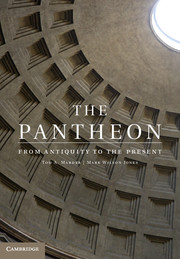 The Pantheon is one of the most important architectural monuments of all time. Thought to have been built by Emperor Hadrian in approximately 125 AD on the site of an earlier, Agrippan-era monument, it brilliantly displays the spatial pyrotechnics emblematic of Roman architecture and engineering. The Pantheon gives an up-to-date account of recent research on the best preserved building in the corpus of ancient Roman architecture from the time of its construction to the twenty-first century. Each chapter addresses a specific fundamental issue or period pertaining to the building; together, the essays in this volume shed light on all aspects of the Pantheon’s creation, and establish the importance of the history of the building to an understanding of its ancient fabric and heritage, its present state, and its special role in the survival and evolution of ancient architecture in modern Rome.
C O N T E N T S
1. Introduction, Tod A. Marder and Mark Wilson Jones
2. Agrippa’s Pantheon and its origin, Eugenio La Rocca
3. Dating the Pantheon, Lise M. Hetland
4. The conception and construction of drum and dome, Giangiacomo Martines
5. Sources and parallels for the design and construction of the Pantheon, Gene Waddell
6. The Pantheon builders: estimating manpower for construction, Janet DeLaine and Christina Triantafillou
7. Building on adversity: the Pantheon and problems with its construction, Mark Wilson Jones
8. The Pantheon in the Middle Ages, Erik Thunø
9. Impressions of the Pantheon in the Renaissance, Arnold Nesselrath
10. The Pantheon in the seventeenth century, Tod A. Marder
11. Neo-classical remodelling and reconception, 1700–1820, Susanna Pasquali
12. A nineteenth-century monument for the state, Robin B. Williams
13. The Pantheon in the modern age, Richard Etlin
Call for Nominations | 2014 Charles C. Eldredge Prize
2014 Charles C. Eldredge Prize
Nominations due by 1 December 2013
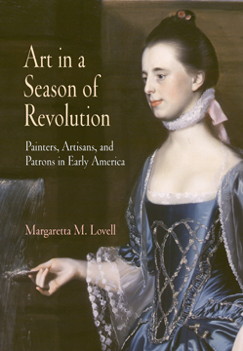
Winner of the 2006 Charles C. Eldredge Prize: Margaretta Lovell, Art in a Season of Revolution: Painters, Artisans, and Patrons in Early America (University of Pennsylvania Press, 2005).
The Smithsonian American Art Museum invites nominations for the 2014 Charles C. Eldredge Prize, an annual award for outstanding scholarship in American art history. Single-author books devoted to any aspect of the visual arts of the United States and published in the three previous calendar years are eligible. To nominate a book, send a letter explaining the work’s significance to the field of American art history and discussing the quality of the author’s scholarship and methodology. Self-nominations and nominations by publishers are not permitted. The deadline for nominations is December 1, 2013.
Funding for the Charles C. Eldredge Prize is provided by the American Art Forum, a patrons’ support organization of the Smithsonian American Art Museum. The prize was instituted to honor Charles C. Eldredge, who founded the American Art Forum in 1986 during his tenure as director of the museum.
New Book | Learning to Paint: The Private Studios of Paris
From Presse Universitaire François Rabelais, as noted at Le Blog de L’ApAhAu:
France Nerlich et d’Alain Bonnet, eds., Apprendre à peindre : les ateliers privés à Paris, 1780-1863 (Tours: Presse Universitaire François Rabelais, 2013), 432 pages, ISBN : 978-2869062979, 35€.
 Où apprenait-on à peindre à Paris au XIXe siècle ? Cette question pourtant cruciale n’a jusqu’à maintenant guère été approfondie par les historiens de l’art dont l’attention était surtout tournée vers le fonctionnement de l’École des beaux-arts. Or les classes de peinture n’y furent introduites qu’en 1863. De la fin du XVIIIe siècle à 1863, c’est dans l’espace hybride des ateliers privés d’enseignement, entre ancienne cellule artisanale et structure académique, que s’inventent et se développent de nouvelles approches du métier de peintre. Au-delà des aspects techniques et esthétiques, c’est le statut même des artistes qui se redéfinit à l’aune d’une autonomie inédite. Le caractère professionnel des formations se précise, tandis que la relation entre le maître et l’élève gagne en complexité.
Si la nostalgie du lien intime entre patron et apprenti de l’Ancien Régime apparaît comme un leitmotiv de la réflexion artistique, la situation nouvelle des ateliers privés favorise l’émancipation des jeunes peintres par rapport à l’autorité du maître. La liberté nouvelle face aux modèles, à la fois source d’angoisse et d’enthousiasme, transforme ainsi les ateliers privés en laboratoires expérimentaux de la modernité.
◊ ◊ ◊ ◊ ◊
Sébastien Allard : Préface
Avant-propos et remerciements
France Nerlich : Ateliers privés – enjeux et problématiques
Art et métier – structures et réseaux de la formation artistique
• Alain Bonnet : La formation pratique dans les ateliers d’artistes au XIXe siècle
• Séverine Sofio : « Mon élève que je regarde comme l’un de mes meilleurs ouvrages ». Former les jeunes filles à la peinture dans la première moitié du XIXe siècle
• Noémie Étienne : De l’atelier privé à l’atelier de restauration. La formation professionnelle des restaurateurs autour de 1800
• Cyril Lécosse : Devenir peintre en miniature : la professionnalisation des formations à la fin du XVIIIe siècle et au début du XIXe siècle
Partage et diffusion – réinventer les pratiques de l’enseignement artistique
• Nina Struckmeyer : « C’est seul que je vaux une académie ». Dans l’atelier des élèves de Jacques-Louis David
• Sidonie Lemeux-Fraitot : Les ateliers de Girodet
• Frauke Josenhans : La nature conçue depuis l’atelier : la formation dans les ateliers de peintres de paysage à Paris au début du XIXe siècle
• Armelle Jacquinot : Copier le moderne. Les marchands d’art et la location de tableaux dans la pratique de l’étude, 1820-1850
• Christian Omodeo : L’apprentissage par la copie : l’atelier de Vincenzo Camuccini à Rome
École et réseaux : les ateliers de Paul Delaroche et Léon Cogniet
• Clémentine Garcia : David, Gros, Delaroche et Gleyre. Une généalogie d’ateliers ?
• Lisa Hackmann : Les élèves allemands dans l’atelier de Paul Delaroche
• Cédric Lesec : Delaroche et ses élèves. L’atelier et ses « affinités électives »
• Michaël Vottero : Les ateliers de Léon Cogniet
• Beata Studziżba Kubalska : Le rôle de l’atelier de Léon Cogniet pour l’histoire de la peinture polonaise
• Kamila Kłudkiewicz : Un parcours transnational et privilégié. Henryk Rodakowski dans l’atelier de Léon Cogniet
Mission et subversion : les ateliers privés comme foyers d’une pensée alternative
• Hélène Jagot : Une académie dissidente. La formation des néo-grecs dans l’atelier de Delaroche et de Gleyre
• Margot Renard : Une « école de peinture nationale ». L’atelier privé de Thomas Couture
• Camille Mathieu : Du dessin dans l’enseignement de Thomas Couture
• Martin Schieder : « Ne fais pas ce que je fais ». Dans l’atelier de Gustave Courbet
• France Lechleiter : Paris – Rome – Tanger : formation, itinéraire et parcours des grands prix de Rome de peinture 1863-1872
Exhibition | American Adversaries: West and Copley
Press release (19 June 2013) from the MFAH:
American Adversaries: West and Copley in a Transatlantic World
Museum of Fine Art, Houston, 6 October 2013 — 5 January 2014
 This October, the Museum of Fine Arts, Houston, presents American Adversaries: West and Copley in a Transatlantic World, an extensive exhibition charting the rise and spectacular success of contemporary history painting in the 18th century through the lives and experiences of two colonial American innovators: Benjamin West (1738–1820) and John Singleton Copley (1738–1815). West and Copley—initially friends and eventually bitter rivals—gained phenomenal fame from their theatrical paintings that romanticized current events and captured the imaginations of the art-viewing public. American Adversaries is on view from October 6, 2013, to January 20, 2014.
American Adversaries: West and Copley in a Transatlantic World traces the ambitious, competitive and highly successful lives of West and Copley through oil paintings, works on paper, sculptures and artifacts. At the core of the exhibition are two paintings that catapulted West and Copley into international fame: West’s The Death of General Wolfe (1770; 1779 version) and Copley’s Watson and the Shark (1778). The paintings have not been presented together in more than 60 years and never before in this context.
“This is a remarkable opportunity for Museum visitors to see in the same exhibition these two iconic paintings in the history of art, The Death of General Wolfe and Watson and the Shark,” said MFAH director Gary Tinterow. “Painted nearly 250 years ago and considered strikingly modern in their day, the issues addressed with such dramatic flair have the power to still resonate with viewers today.”
“Long before Jackson Pollock drew international acclaim for his innovative Abstract Expressionist paintings in the mid-twentieth century, West and Copley held center stage in the international art world of the 18th century centered in London,” said Emily Ballew Neff, MFAH curator of American painting and sculpture. “The exhibition addresses how it is that these two colonial artists on the margins of empire come to have such phenomenal success.”
Both born in the same year (1738) in the American Colonies of Pennsylvania and Massachusetts, Benjamin West and John Singleton Copley crossed the Atlantic in pursuit of international fame and fortune. London, the cultural and political capital of the empire, attracted and swayed both artists to stay to develop their careers as history painters and neither returned home to America.
West and Copley established a new genre of painting known as contemporary history painting with The Death of General Wolfe and Watson and the Shark. These dramatic large-scale canvases featured compositional elements derived from antique and Old Master sources, yet instead of portraying biblical, mythological or literary heroes, they depicted real people from contemporary life. This exhibition examines these paintings and the period in which they were painted to animate a past that is unfamiliar to many today. It restores the dynamism and modernity of this particular artistic moment as it happened, rather than through the lens of what we later have come to know. These works point to a world informed by the powerful agency of the Iroquois (Haudenosaunee) Confederacy in the Great Lakes region; the scientific and imperial exploration of the seas; the rising role of the media and its relationship to history painting; and the stagecraft involved in managing the perception of a successful artistic career in 18th-century London. In the exhibition, the two key paintings are joined by works of art from all over the Atlantic World, which give them greater context and meaning.
A fully illustrated catalogue, published by the Museum of Fine Arts, Houston, distributed by Yale University Press and designed by Studio Blue, accompanies the exhibition and features essays by international scholars. The catalogue for this exhibition receives generous funding from Furthermore: a program of the J. M. Kaplan Fund.
American Adversaries: West and Copley in a Transatlantic World is organized by the Museum of Fine Arts, Houston. An indemnity has been granted by the Federal Council on the Arts and the Humanities. The exhibition is made possible through support from the Terra Foundation for American Art.
◊ ◊ ◊ ◊ ◊
38th Annual Ruth K. Shartle Symposium
American Adversaries: West and Copley in a Transatlantic World
Museum of Fine Art, Houston, 5 October 2013
This one-day symposium includes talks by prominent scholars addressing themes developed in the exhibition. Following the symposium, guests are invited to a reception and a viewing of the exhibition. More information is forthcoming. Visit www.mfah.org/calendar for updates.
◊ ◊ ◊ ◊ ◊
From Yale UP:
Emily Ballew Neff with Kaylin H. Weber, American Adversaries: West and Copley in a Transatlantic World (New Haven: Yale University Press, 2013), 272 pages, ISBN: 978-0300196467, $75.
American artists and innovators Benjamin West (1738–1820) and John Singleton Copley (1738–1815) changed the way history was recorded in the 18th century and became America’s first transatlantic art superstars. Initially friends but eventually bitter rivals, the artists painted contemporary events as they happened, illustrating the transformation of imperial power through diplomacy between British Americans and the Iroquois, and through transatlantic trade, exploration, and the natural history of the West Indies.
Focusing on two iconic works, West’s The Death of General Wolfe (1770) and Copley’s Watson and the Shark (1778), American Adversaries charts the rise of contemporary history painting, and offers a compelling examination of American history and New World exploration. Featuring more than two hundred color reproductions of paintings, works on paper, and objects that informed the artists, this handsome volume also includes essays that shed new light on, among other subjects, West and Copley within the context of the Royal Academy and the use of Western and Native American objects in cultural diplomacy.
Emily Ballew Neff is curator of American painting and sculpture, and Kaylin H. Weber is assistant curator of American painting and sculpture, both at the Museum of Fine Arts, Houston.
New Book | Portrayal and the Search for Identity
Published last December by Reaktion and distributed by the University of Chicago Press:
Marica Pointon, Portrayal and the Search for Identity (London: Reaktion Books, 2012), 272 pages, ISBN: 978-1780230412, £25 / $40.
 We are surrounded by portraits: from the cipher-like portrait of a queen on a banknote to security pass photos; from images of politicians in the media to Facebook; from galleries exhibiting Titian or Leonardo to contemporary art featuring the self-image, as with Jeff Koons or Cindy Sherman. In Antiquity portraiture was of major importance in the exercise of power. Today it remains not only a component of everyday life but also a crucial way for artists to define themselves in relation to their environment and their contemporaries.
In Portrayal and the Search for Identity, Marcia Pointon investigates how we view and understand portraiture as a genre, and how portraits function as artworks within social and political networks. Likeness is never a straightforward matter as we rarely have the subject of a portrait as a point of comparison. Featuring familiar canonical portraits as well as little-known works, Portrayal seeks to unsettle notions of portraiture as an art of convention, a reassuring reflection of social realities. Readers are instead invited to consider how identity is produced pictorially, and where likeness is registered apart from in a face. In exploring these issues, the author addresses wide-ranging challenges, such as the construction of masculinity in dress, representations of slaves, and self-portraiture in relation to mortality.
Marcia Pointon is an independent scholar and research consultant; she is Professor Emeritus of History of Art at the University of Manchester and Honorary Research Fellow at the Courtauld Institute of Art, London. She is author of Brilliant Effects: A Cultural History of Gem Stones and Jewellery and Hanging the Head: Portraiture and Social Formation in Eighteenth-century England.
C O N T E N T S
Introduction
1. Portrait, Fact and Fiction
2. Slavery and the Possibilities of Portraiture
3. Adolescence, Sexuality and Colour in Portraiture: Sir Thomas Lawrence
4. Accessories in Portraits: Stockings, Buttons and the Construction of Masculinity in the Eighteenth Century
5. The Skull in the Studio
References
Select Bibliography
Acknowledgements
Photo Acknowledgements
Index
New Book | The Portuguese Synagogue in Amsterdam
For all those observing Rosh Hashana, may the new year bring blessings. -CH . . . From ACC Distribution:
Pieter Vlaardingerbroek, ed., The Portuguese Synagogue in Amsterdam (Zwolle: W Books, 2013), 208 pages, ISBN: 978-9040007989, $32.50.
 The Portuguese Synagogue, or Snoge, was the largest Sephardi synagogue in the world when it was built, between 1671 and 1675. The fact that Amsterdam’s Sephardim were permitted to erect this grand structure attests to the relative freedom of Jews in this part of Western Europe, at a time when Jews elsewhere were confined to ghettos and subject to restrictions. Through the centuries, foreign tourists have been amazed by the beauty and scale of the complex. This volume examines the many aspects of this glorious synagogue, which has been preserved almost perfectly in its seventeenth-century state.
Pieter Vlaardingerbroek is an architectural historian at the Office of Monuments and Archaeology, Amsterdam.
◊ ◊ ◊ ◊ ◊
C O N T E N T S
The Portuguese Jewish Community in Amsterdam
Elias Bouman (1635–1686), The Architect of the Snoge
The Snoge: A Jewish Building in a Dutch Architectural Style
Construction and Maintenance (1671–2000)
Restoring the Past, Creating Room for the Future
The Festive Inauguration of the Esnoga in 1675
The Esnoga and the Snogeiros: The Interior Function of the Synagogue and its Annexes
The Ceremonial Art Treasures of the Esnoga
New Book | Turner and the Sea
The exhibition opens at the National Maritime Museum in November; proposals for the related conference are due by September 6.
Christine Riding and Richard Johns, Turner and the Sea (London: Thames & Hudson, 2013), 288 pages, ISBN: 978-0500239056, $60.
 This is the first publication to focus on J. M. W. Turner’s lifelong fascination with the sea, from his Royal Academy debut in 1796, Fishermen at Sea, to his iconic maritime subjects of the 1830s and 1840s such as Staffa, Fingal’s Cave. It places Turner and his work firmly in the broader field of maritime painting that flourished in nineteenth-century Britain, France, Germany, Holland, and America.
The majority of the works illustrated here—paintings, watercolors, sketches, sketchbooks, and engravings—are by Turner, but there are also comparative works by some forty other artists including Winslow Homer, James McNeill Whistler, John Constable, Benjamin West, and Gustave Courbet. The book is organized thematically and chronologically, and the subjects range from “Contested Waters,” which examines what was at stake for marine painting during the Napoleonic Wars, to “New Wave,” an exploration of Turner’s international and often surprising legacy for the art of the sea.
Christine Riding is senior curator of paintings and head of the arts department at the National Maritime Museum. Richard Johns is curator of prints and drawings at the National Maritime Museum.










 Enfilade
leave a comment