Exhibition | The Art of Dining: Food Culture in the Islamic World
I saw the exhibition last weekend at the DIA: so many amazing objects, especially from the Middle Ages, but also plenty of 18th-century treats (with a stunning catalogue). –CH
The Art of Dining: Food Culture in the Islamic World
LACMA, Los Angeles, 17 December 2023 — 4 August 2024
Detroit Institute of Arts, 22 September 2024 — 5 January 2025
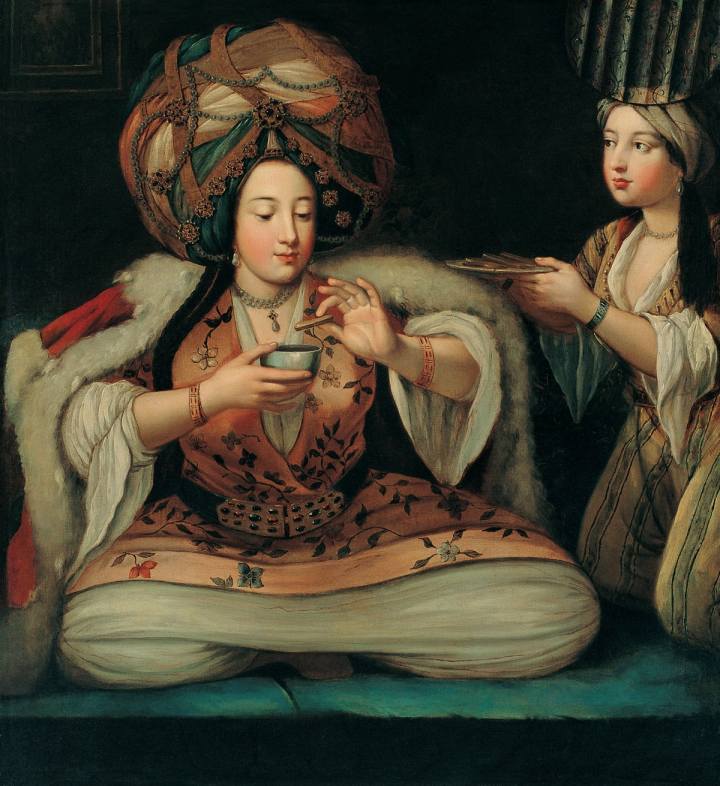
Unknown painter (French School), Enjoying Coffee, Turkey, first half of the 18th century (Istanbul: Pera Museum).
The Art of Dining brings together more than 200 works from the Middle East, Egypt, Central and South Asia, and beyond to explore connections between art and cuisine from ancient times to the present day. Paintings of elaborate feasts, sumptuous vessels for food and drink, and historical cookbooks show how culinary cultures have thrived in the Islamic world for centuries. Highlighting the relationship of these works to preparing, serving, and enjoying food, the exhibition engages multiple senses and invites us to appreciate the pleasures of sharing a meal.
Originally organized by the Los Angeles County Museum of Art (LACMA), the exhibition includes works from 30 public and private collections from across the U.S., Europe, and the Middle East, and 16 from the DIA’s collection.
Linda Komaroff, ed., Dining with the Sultan: The Fine Art of Feasting (DelMonico Books, 2023), 375 pages, ISBN: 978-1636810881, $85.
New Book | Goethe, His Faustian Life
From Bloomsbury:
A. N. Wilson, Goethe, His Faustian Life: The Extraordinary Story of Modern Germany, a Troubled Genius, and the Poem that Made Our World (London: Bloomsbury Continuum, 2024), 416 pages, ISBN: 978-1472994868, $35.
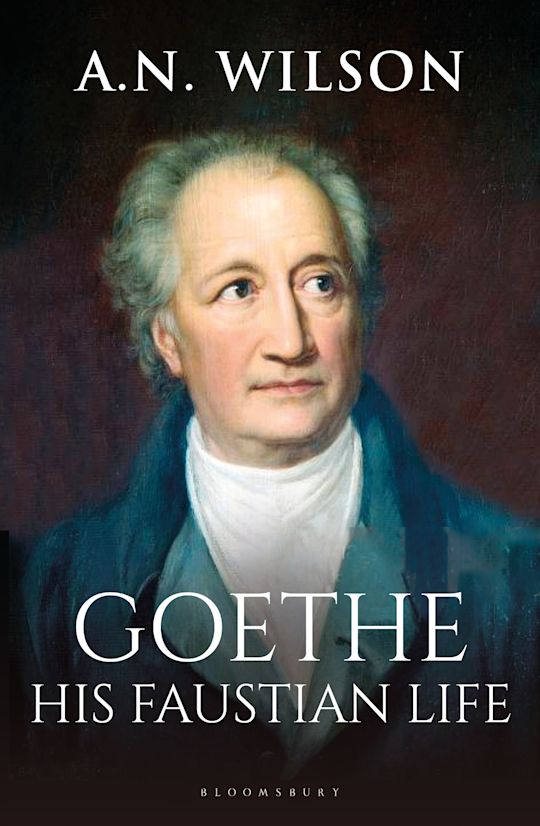 Goethe was the inventor of the psychological novel, a pioneer scientist, great man of the theatre, and a leading politician. As A. N. Wilson argues in this groundbreaking biography, it was his genius and insatiable curiosity that helped catapult the Western world into the modern era. Wilson tackles the life of Goethe with characteristic wit and verve. From his youth as a wild literary prodigy to his later years as Germany’s most respected elder statesman, Wilson hones in on Goethe’s undying obsession with the work he would spend his entire life writing—Faust. Goethe spent over 60 years writing his retelling of Faust, a strange and powerful work that absorbed all the philosophical questions of his time as well as the revolutions and empires that came and went. It is his greatest work, but as Wilson explores, it is also something much more—it is the myth of how we came to be modern.
A. N. Wilson is a Fellow of the Royal Society of Literature and holds a prominent position in the world of literature and journalism. He is a prolific and award-winning biographer and celebrated novelist, having written biographies of Tolstoy, C. S. Lewis, Milton, and Hilarire Belloc. In 2007, Wilson’s novel, Winnie and Wolf, was longlisted for the Man Booker Prize, and in 2020 The Mystery of Charles Dickens was published to great critical acclaim. He lives in North London.
New Book | A Life of Leibniz in Seven Pivotal Days
From Norton, a translation of the original German, Die beste aller möglichen Welten: Gottfried Wilhelm Leibniz in seiner Zeit, which appeared in 2022:
Michael Kempe, The Best of All Possible Worlds: A Life of Leibniz in Seven Pivotal Days, translated by Marshall Yarbrough (New York: Norton & Co., 2024), 304 pages, ISBN: 978-1324093947, $32.
 A biography of the polymath Gottfried Wilhelm Leibniz told through seven critical days spanning his life and revealing his contributions to our modern world.
Gottfried Wilhelm Leibniz (1646–1716) was the Benjamin Franklin of Europe, a ‘universal genius’ who ranged across many fields and made breakthroughs in most of them. Leibniz invented calculus (independently from Isaac Newton), conceptualized the modern computer, and developed the famous thesis that the existing world is the best that God could have created.
In The Best of All Possible Worlds, historian and Leibniz expert Michael Kempe takes us on a journey into the mind and inventions of a man whose contributions are perhaps without parallel in human history. Structured around seven crucial days in Leibniz’s life, Kempe’s account allows us to observe him in the act of thinking and creating, and gives us a deeper understanding of his broad-reaching intellectual endeavors. On 29 October 1675, we find him in Paris, diligently working from his bed amid a sea of notes, and committing the integral symbol—the basis of his calculus—to paper. On 17 April 1703, Leibniz is in Berlin, writing a letter reporting that a Jesuit priest living in China has discovered how to use Leibniz’s binary number system to decipher an ancient Chinese system of writing. One day in August 1714, Leibniz enjoys a Viennese coffee while drawing new connections among ontology and biology and mathematics. The Best of All Possible Worlds transports us to an age defined by rational optimism and a belief in progress, and will endure as one of the few authoritative accounts of Leibniz’s life available in English.
Michael Kempe is the director of the Leibniz Research Center and the Leibniz-Archiv in Hannover and teaches early modern history at the University of Konstanz.
Marshall Yarbrough is a writer, musician, and German-to-English translator. He lives in Brooklyn, New York.
New Book | John Locke’s Impact on Literature and Pictorial Art
From Krysman Press:
Joachim Möller and Bernd Krysmanski, eds., Creative Reception: John Locke’s Impact on Literature and Pictorial Art (Dinslaken: Krysman Press, 2024), 384 pages, ISBN: 978-3000555626, €30.
 The authors of this volume—all of them recognized representatives of a wide range of academic disciplines—agree that Locke’s work must have had a considerable influence both on English and German literature and the visual arts of Great Britain, especially in the eighteenth and nineteenth centuries. From the perspective of interdisciplinarity and intertextuality, the essays presented here deal with Locke as a source of ideas for Archibald Alison, John Constable, Daniel Defoe, Henry Fielding, Oliver Goldsmith, Johann Timotheus Hermes, William Hogarth, Immanuel Kant, Martin Knutzen, Gottfried Wilhelm von Leibniz, Gotthold Ephraim Lessing, George Lillo, Edward Moore, Johann Gottwerth Müller, Joshua Reynolds, Samuel Richardson, John Ruskin, Joseph Spence, Laurence Sterne, J. M. W. Turner, and Thomas Whately, among others.
The Burlington Magazine, November 2024
The long 18th century in the November issue of The Burlington:
The Burlington Magazine 166 (November 2024)
e d i t o r i a l
 “The Life Cycle of Art History,” p. 1099.
Art history is withering. Art history is flourishing. Which of these statements is true? Very mixed impressions can be gathered from across the United Kingdom, where the future health and reach of the academic discipline is far from clear. Amid all this uncertainty, however, there are some inspiring developments that should be applauded.
a r t i c l e s
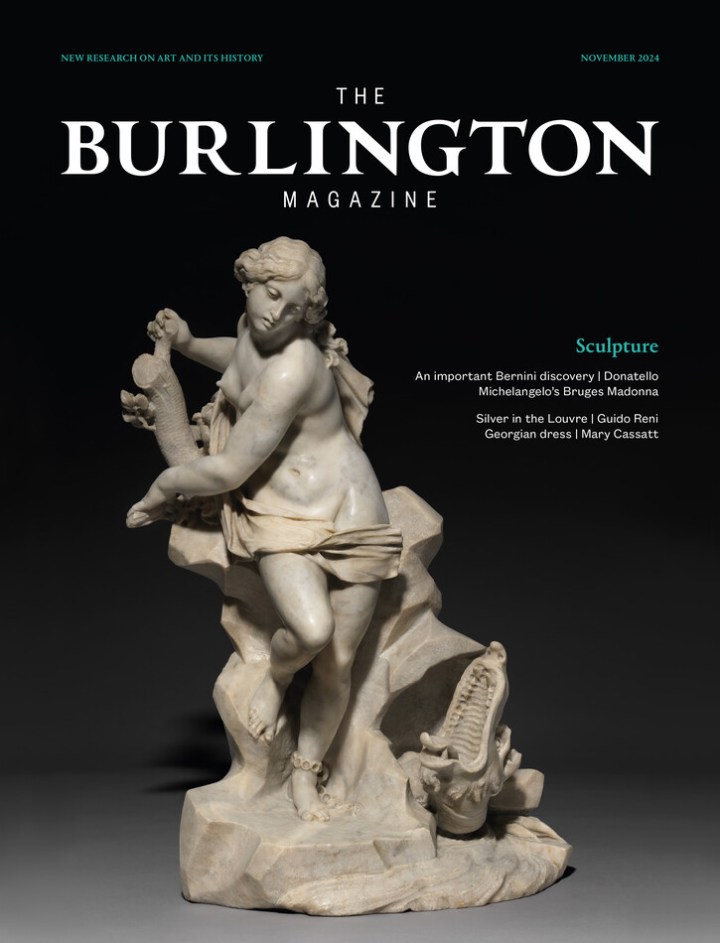
• Maichol Clemente, “‘Une pièce fort singulière’: The Rediscovery of Gian Lorenzo Bernini’s Andromeda and the Sea Monster,” pp. 1100–22.
An important early sculpture by Gian Lorenzo Bernini, Andromeda and the Sea Monster, is here attributed to him and published for the first time. It displays all the finesse and invention that characterises the work of his youth and is also notable for having been offered to Jean-Baptiste Colbert, First Minister of Louis XIV, before forming part of the collection of the Prince of Soubise [in the eighteenth century.]
r e v i e w s
• William Barcham, Review of the exhibition catalogue, Les Tiepolo: Invention et Virtuosité à Venise, edited by Hélène Gasnault with Giulia Longo and a contribution by Catherine Loisel (Beaux-Arts de Paris, 2024), pp. 1176–78.
• Erin Griffey, Review of the exhibition catalogue, Style & Society: Dressing the Georgians, by Anna Reynolds (Royal Collection Trust, 2023), pp. 1178–80.
• Philippa Glanville, Review of the catalogue of the Louvre’s silverware, Orfèvrerie de la Renaissance et des temps modernes: XVIe, XVIIe et XVIIIe siècles: La Collection du Musée du Louvre, by Michèle Bimbenet-Privat, Florian Doux, and Catherine Gougeon, with Philippe Palasi, 3 volumes (Éditions Faton, 2022), pp. 1186–87.
• Giulio Dalvit, Review of the catalogue, Galleria Borghese: Catalogo Generale I: Scultura Moderna, edited by Anna Coliva with Vittoria Brunetti (Officina Libraria, 2022), pp. 1192–93.
• Gauvin Alexander Bailey, Collective Creativity and Artistic Agency in Colonial Latin America, edited by Maya Stanfield-Mazzi and Margarita Vargas-Betancourt (University of Florida Press, 2023), pp. 1193–94.
• Charles Avery, Review of Die Bronzen des Massimiliano Soldani Benzi (1656–1740): Representationsstrategien des europäischen Adels um 1700, by Carina Weißmann (De Gruyter, 2022), p. 1195.
• Pierre Rosenberg, Review of the catalogue, French Paintings 1500–1900: National Galleries of Scotland, by Michael Clarke and Frances Fowle, 2 volumes (National Galleries of Scotland, 2023), pp. 1196–97.
Exhibition | The Art of French Wallpaper Design

Installation view of the exhibition The Art of French Wallpaper Design at the RISD Museum, November 2024.
◊ ◊ ◊ ◊ ◊
The exhibition is accompanied by an online publication:
The Art of French Wallpaper Design
RISD Museum, Providence, 16 November 2024 — 11 May 2025
The Art of French Wallpaper Design explores the vibrant, surprising designs that adorned walls in the 1700s and 1800s. Featuring more than 100 rare samples of salvaged wallpapers, borders, fragments, and design drawings, this exhibition reveals the creative process and showcases the extraordinary technical skills involved in producing these works, presenting an invaluable resource for artists and enthusiasts alike. This exhibition celebrates the vision and generosity of collectors Charles and Frances Wilson Huard, whose remarkable collection, assembled in the 1920s and ’30s, is now in the care of the RISD Museum. Accompanied by a comprehensive digital publication, The Art of French Wallpaper Design invites you to explore the remarkable innovation and craftsmanship of these historic pieces.
◊ ◊ ◊ ◊ ◊
Lyra Smith, ed., with contributions by Emily Banas, Brianna Turner, and Andrew Raftery, The Art of French Wallpaper Design (Providence: Rhode Island School of Design Museum, 2024), available online»
The vibrant designs of French papier peint (literally meaning painted paper) that adorned walls in the 1700s and 1800s were collected and donated to the museum by French artist Charles Huard and his wife, American writer Frances Wilson Huard. The Huard Collection is a rare resource due to the fragile and ephemeral nature of wallpapers. This free online publication explains the preservation methods used to take care of the wallpapers along with components made in the process, such as design drawings and woodblocks. The attentive care taken to preserve the materials made during each phase of the design process make the Huard Collection an ideal teaching collection.
Essays
• Introduction to French Wallpaper — Emily Banas
• About the Huard Collection — Emily Banas
• Conservation and the Huard Collection: Preserving the Processes of Making — Brianna Turner
• Printing Matters: Wallpaper in the Context of Printmaking — Andrew Raftery
The Collection
The RISD Museum contains one of the most significant collections of French 18th- and 19th-century wallpapers in the United States with approximately 500 wallpaper panels, borders, fragments, and design drawings. Here, you can browse the wallpapers by their collections, colors, motifs, or time periods.
The Making of Wallpaper
This video provides a guided, in-depth look at seven different wallpapers in the Huard Collection. Watch, listen, and learn about the hidden stories these wallpapers can tell us about their design, making, and use.
New Book | Quatremère de Quincy: Art and Politics
From Oxford UP:
David Gilks, Quatremère de Quincy: Art and Politics during the French Revolution (Oxford: Oxford University Press, 2024), 288 pages, ISBN: 978-0198745563, £90.
 Antoine-Chrysosthôme Quatremère de Quincy (1755–1849) was the most distinguished writer on art and architecture at the end of the enlightenment. However, as David Gilks shows, he was never simply an esoteric antiquarian and theoretician; he was also a zealous functionary and skilled publicist whose writings on the arts often served political purposes.
Quatremère de Quincy: Art and Politics during the French Revolution demonstrates how Quatremère’s early writings on art and antiquity formed the foundation for a politics grounded in faith, authority, and hierarchy that favoured gradual social and political evolution over destruction and experimentation. Gilks then traces how Quatremère set aside his antiquarian research and became a royalist politician and publicist during the revolutionary decade. Quatremère feared that the Revolution would destroy the cosmopolitan republic of letters that had flourished when states across Europe supported the papacy’s rediscovery of the past, restoration of taste and, revival of learning. Yet Gilks reveals that Quatremère was also a resourceful and an opportunistic political actor who deployed his opponents’ language for strategic reasons. Gilks therefore reinterprets Quatremère’s interventions by situating them in their polemical contexts and treating them as contributions to debates and quarrels, by locating his sources and reconstructing his social and political networks. The resulting study revises our understanding of Quatremère’s famous reflections on the Academy of Painting and Sculpture, the Panthéon, art plunder, and museums, but it also discovers and sheds light on previously ignored writings. Although the study focuses on the period between 1789 and 1799, it examines the second half of Quatremère’s life to substantiate his commitment to crown and altar and show how he fought against the Revolution’s legacy of godless materialism and calculation that was inimical to the arts.
This is a thoroughly researched and richly detailed contextual study of the most eventful period in Quatremère’s life, offering an original and unfamiliar history of the French Revolution. Gilks integrates the study of political power with the history of ideas and art history and provides a window into institutional and legal reforms and debates about cultural patronage and education.
David Gilks was educated at Trinity College, Cambridge, and then won a Henry Fellowship to Harvard. After returning to Cambridge for his doctoral thesis, he was a Junior Research Fellow at Christ Church, Oxford, and a Leverhulme Early Career Fellow at Queen Mary University London. He is currently Lecturer in Modern European History at the University of East Anglia. His research has been published in The Historical Journal, French Historical Studies, and Urban History. He is the first English-language translator of Quatremère de Quincy’s Letters on the Plan to Abduct Monuments of Art from Italy.
c o n t e n t s
Abbreviations
Note on Names and and Language
Biographical and Political Chronology
Introduction: An Unconventional History of the Revolution
1 The Making of a Missionary of Antiquity, 1755–85
2 The Friend of the Arts, 1785–89
3 Art in a Regenerated Nation, 1789–91
4 The Nation’s Temple, 1791
5 Devoted to the King, 1791–92
6 Republicanising the Pantheon, 1792–94
7 Standing for the Counter-Revolution, 1794–96
8 Justice to the Papacy, 1796
9 The Mask of Constitutionalism, 1796–99
Conclusion
Maps
Bibliography
Index
New Book | British Portrait Miniatures from the Thomson Collection
From Ad Ilissvm, an imprint of Paul Hoberton Publishing and also distributed by The University of Chicago Press (the Thomson Collection is now part of the Art Gallery of Ontario in Toronto):
Susan Sloman, British Portrait Miniatures from the Thomson Collection (London: Ad Ilissvm, 2024), 320 pages, ISBN: 978-1915401120, £80 / $100.
 Portrait miniatures were highly prized in Europe for nearly four hundred years; and, unusually, artists based in Britain were the acknowledged masters of this specialised field. Many of the best painters are represented in this remarkable but relatively little-known collection. As is illustrated and described in this book, miniatures were frequently made as tokens of love or memorials of loved ones; part-likeness, part-reliquary and part-jewel, they might be wearable in a locket, on a bracelet, or even on a finger ring, but their portability also made them desirable as gifts.
Styles, techniques, and modes of presentation naturally evolved between 1560 (the date of the first miniature in the catalogue) and around 1900. Some changes happened rapidly; in England, for example, the foundation of exhibiting societies in 1760s created a demand for larger miniatures that could hang on the wall alongside full-sized portraits. The Thomson collection includes fine examples of the work of Nicholas Hilliard (from the Elizabethan period) and John Smart (from the eighteenth century) as well as notable portraits by less familiar names such as Jacob Van Doordt and James Scouler. It is apparent from the scope and character of his acquisitions that Ken Thomson never planned an encyclopaedic collection. Reacting to miniatures that spoke most eloquently to him when held in the hand, or examined under a glass, he developed over time a fondness for particular artists and had no qualms about omitting others altogether.
Using this collection housed at the Art Gallery of Ontario as a case study, the catalogue discusses the function of miniatures, their material presence, the circumstances in which they were made, and aspects of their later history. The homes and studios of the most successful painters, as sumptuous as those occupied by oil painters, often passed from one generation to another: here, one key property in Covent Garden is described and illustrated. In this book, for the first time, a number of specialist artists’ suppliers are identified, showing where ivory could be obtained and enamel plates prepared and fired. The links between enamelling for clock and watch faces and enamelling for miniatures are demonstrated. The illicit practice within the late nineteenth and early twentieth century art trade of duplicating old miniatures, a topic generally avoided in the literature, is addressed here. Miniatures are difficult to display in museums, but recently-developed photographic methods of identifying pigments are also proving to be a way of introducing a new audience to this multi-layered subject. Eighteen years after Ken Thomson’s death, there could not be a more opportune moment to highlight his collection.
Susan Sloman has written extensively on British art, her most recent book being Gainsborough in London (2021). She has a longstanding interest in studio practice and artists’ premises and a record of unearthing fresh documentation on the lives of artists.
PMC Book Night | Esther Chadwick, Ian Dudley, and Mark Laird

Coming up at the Mellon Centre:
Book Night with Esther Chadwick, Ian Dudley, Mark Laird
Paul Mellon Centre, London, 11 December 2024
Please join us for Book Night at the Paul Mellon Centre, where we will celebrate some of our latest publications by asking authors to discuss their research and answer questions about their books. Each author will give a short talk discussing the research behind their book. Afterwards, there will be drinks, canapes, and a chance to meet the authors.
• Esther Chadwick, The Radical Print: Arts and Politics in Late Eighteenth-Centry Britain
• Ian Dudley, Aubrey Williams: Art, Histories, Futures
• Mark Laird, The Dominion of Flowers: Botanical Art & Global Plant Relations (remoting in)
Book tickets here»
Esther Chadwick is a lecturer in art history at the Courtauld, where she specialises in eighteenth-century British art. She studied art history at the University of Cambridge and completed her doctorate at Yale University in 2016. Before joining the Courtauld, she was a curator in the Department of Prints and Drawings at the British Museum. Esther’s research addresses the materiality and agency of printed images, the role of art in the age of revolutions and the visual culture of the circum-Atlantic world. She is working on a book that examines the formative role of printmaking in the work of British artists of the late eighteenth century. Exhibition projects have included Figures of Empire: Slavery and Portraiture in Eighteenth-Century Atlantic Britain (Yale Center for British Art, 2014) and A Revolutionary Legacy: Haiti and Toussaint Louverture (British Museum, 2018).
Ian Dudley is a Visiting Fellow in Art History at the University of Essex. His research focuses on relationships between histories of art and empire from the early modern period to the present. Recent work includes a study of Olmec colossal heads in the paintings of Aubrey Williams, published in Art History, and an examination of slavery visualisation in the sculpture of Stanley Greaves, published in Third Text. His 2017 doctoral thesis investigated Edward Goodall’s Sketches in British Guiana within the context of colonial geography and anthropology during the 1830–40s. He also curated the exhibition Southern Press: Prints from Brazil, Paraguay and Chile with the Essex Collection of Art from Latin America (ESCALA) at Firstsite gallery, Colchester.
Mark Laird is professor emeritus at the University of Toronto and former faculty member at Harvard University. He is the author of The Flowering of the Landscape Garden and A Natural History of English Gardening—recipient of an Elisabeth Blair MacDougall Award. He has been historic planting consultant to Painshill Park Trust, English Heritage and Strawberry Hill Trust.
New Book | Blenheim: 300 Years of Life in a Palace
From Rizzoli:
Henrietta Spencer-Churchill, with photography by Hugo Rittson-Thomas, Blenheim: 300 Years of Life in a Palace (New York: Rizzoli, 2024), 360 pages, ISBN: 978-0847833504, $75.
 The most important, most visited, and most renowned of all of Britain’s stately homes, Blenheim has been home to the Churchill family for more than 300 years.
Regarded as perhaps the greatest of the stately homes and the finest example of baroque architecture in Great Britain, Blenheim is a treasure of English heritage. In this stunning volume, Lady Henrietta Spencer-Churchill, the twelfth generation of the family, takes us on a privileged tour of the palace.
Designed by John Vanbrugh and Nicholas Hawksmoor (a protégé of Christopher Wren) in the early 1700s; with stonework, furniture, and tapestries crafted by the best talents of the age; and art and statuary by such notable artists as John Singer Sargent and Joshua Reynolds, Blenheim is filled with artistic commissions that provide a window into the history of England. In addition to the gilded staterooms and acres of landscaped gardens, Spencer-Churchill shows us the family’s private apartments, with their secret corridors and history of illustrious guests, as well as the ‘downstairs’ staff area with its iconic bell system. With beautiful photography of the magnificent interiors and priceless collections, and Spencer-Churchill’s fascinating text, this volume illuminates Blenheim as it’s never been seen before.
Lady Henrietta Spencer-Churchill is an interior designer, founder of Woodstock Designs, and author of multiple Rizzoli books on design and historic styles, including The Life of the House, Blenheim and the Churchill Family, and Classic English Interiors. She lectures widely on design and design history in the US and the UK.
Hugo Rittson-Thomas is a portrait photographer of many high-profile subjects, including the British royal family. His work has been published in Romantics and Classics, Secret Gardens of the Cotswolds, and Great Gardens of London.










 Enfilade
leave a comment