Exhibition | ‘Canaletto in Venice’ at the Musée Maillol
It’s a busy autumn for eighteenth-century Venice — whether you’re in Venice or Paris. Along with the exhibition at the Musée Jacquemart-André, Canaletto–Guardi: The Two Masters of Venice, museum-goers in Paris can also see Canaletto in Venice at the Musée Maillol. The latter is loosely connected with the Guardi exhibition, opening in Venice at the Correr Museum on September 28. Continuing this theme of pairs, Canaletto in Venice will include the Venetian Notebook, shown earlier this year at the Palazzo Grimani. Thanks to Pierre-Henri Biger for pointing out this latest Parisian offering. The full press release is available as a PDF file here.
◊ ◊ ◊ ◊ ◊
Canaletto in Venice
Musée Maillol, Paris, 19 September 2012 — 10 February 2013
Curated by Annalisa Scarpa
 The Musée Maillol pays homage to Venice with the first exhibition devoted exclusively to Canaletto’s Venetian works. The exhibition will be presented in partnership with the Foundation of Venice Civic Museums which is preparing to put on a Francesco Guardi retrospective at the Correr Museum in Venice to mark the 300th anniversary of that Venetian painter’s birth. Canaletto in Venice will be an exclusive occasion for visitors to enjoy the master’s vision of his city, brought to life through his paintbrush. Along the canals we discover places, islands, squares and monuments, views of a city that still retains its 18th-century charm. The Venetian painter certainly didn’t invent the veduta, or detailed cityscape, a genre that has ancient origins, but he helped to develop it by giving his paintings a modernity that allowed him to overtake his masters.
Canaletto (1697-1768) is the most famous of the Venetian vedutisti of the 18th century. Over the centuries Antonio Canal has never fallen from favour; his works have always been eagerly sought after by collectors. They seem to have an endless charm, unaffected by trends. Canaletto has the crystal clarity of a man who was faithful to the spirit of the Enlightenment, with a very personal vision of reality. His painting manages to capture the very essence of the light; it conveys a unique and sensual shimmering.
The exhibition will bring together more than 50 carefully selected works, from the greatest museums and some historic private collections. On display too will be his drawings and also the famous sketchbook from about 1731, a rare loan by the Gabinetto dei Disegni e Stampe Gallerie the Cabinet of Prints and Drawings of the Accademia Gallery in Venice, which will be displayed open but which can be fully explored on computers.
Visitors will also be able to see a copy, made by Venetian master craftsmen, of the optical chamber used by Canaletto to make his drawings, thanks to a partnership with the superintendence of the Polo Museale of the City of Venice and the research of Dario Maran. It is taken from Canaletto’s original device, which was often used on a boat, made with carefully placed lenses that offered highly precise images that were unique at that time. Visitors will be able to see for themselves just how effective it was.
In recent times Canaletto has had a central role in a series of ground-breaking exhibitions about the vedutisti, including the one in Rome curated by the much-missed Alessandro Bettagno with Bozena Anna Kowalczyk; The Splendours of Venice in Treviso in 2009, by Giuseppe Pavanello and Alberto Craievich; and more recently the outstanding shows in London and Washington, curated by Charles Beddington. The exhibition at the Musée Maillol aims to be the last in this decade-long cycle by allowing Canaletto alone to lead the spectator around his city through his view paintings. The works on display will show how the artist developed his style. The juxtapositioning of his paintings of the same view will show how his early style, heavily influenced by the artist Marco Ricci and also by his training as a theatrical scenery painter, gradually evolved into interpretations of reality. These were imbued with an atmosphere that was both subtle and sublime, paving the way for painting that was to conquer Europe.
◊ ◊ ◊ ◊ ◊
Annalisa Scarpa specialises in Venetian painting of the 18th century and Venetian view painting. After teaching at the University of Ca’ Foscari in Venice, alongside authorities on Venetian art such as Pietro Zampetti, Alessandro Brettagno and especially Terisio Pignatti, she spent many years studying Canaletto’s graphic art. With Ludovico Mucchi she published Nella Profondità dei Dipinti: La Radiografia nell’indagine Pittorica (The Profundity of Painting: Radiography in Art Research), analyzing more than 200 Venetian view paintings using radiography. She is the author of important works on 18th-century Venetian art, Marco Ricci, Sebastiano Ricci and Jacopo Amigoni. She has curated a number of major recent exhibitions: Settecento Veneciano at the Academia of San Fernando in Madrid and at the Museo ode Bellas Artes in Seville, as well as From Canaletto to Tiepolo at the Palazzo Reale in Milan. She is the curator of the Fondazione A. F. Terruzzi in Milan.
S C I E N T I F I C C O M M I T T E E
• Irina Artemieva, Curator of Venetian painting, the State Hermitage Museum, St Petersburg
• Charles Beddington, Art historian who was curator of two of the most recent and important exhibitions dedicated to Canaletto: Canaletto in England: A Venetian Artist Abroad 1746-1755 at Yale Centre for British Art, New Haven, 2006, and the Dulwich Picture Gallery, London, 2007; as well as Venice: Canaletto and His Rivals at the National Gallery in London, 2010 and the National Gallery of Art in Washington, D.C. in 2011.
• Alberto Craievich, Curator, Museo del Settecento Veneziano, Ca’ Rezzonico, Venice, and Professore Emerito of the University of Ca’ Foscari
• Alastair Laing, Curator of Paintings and Sculpture, the National Trust, London
• Filippo Pedrocco, Director, Museo del Settecento Veneziano, Ca’ Rezzonico, Venice
• Lionello Puppi, President of the Centro Studi Tiziano e Cadore, Pieve di Cadore
• Alain Tapié, Chief Curator of Cultural Heritage
New Title | Invaluable Trees: Cultures of Nature, 1660-1830
Just out from SVEC (formerly Studies on Voltaire and the Eighteenth Century), available from the Voltaire Foundation:
Laura Auricchio, Elizabeth Heckendorn Cook and Giulia Pacini, eds., Invaluable Trees: Cultures of Nature, 1660-1830 — SVEC 2012:08 (Oxford: Voltaire Foundation, 2012), 360 pages, ISBN 9780729410489, £65 / €95 / $110.
 Trees and tree products have long been central to human life and culture, taking on intensified significance during the long eighteenth century. In this interdisciplinary volume, contributors trace changes in early modern theories of resource management and ecology across European and North American landscapes, and show how different and sometimes contradictory practices were caught up in shifting conceptions of nature, social identity, physical health and moral wellbeing.
◊ ◊ ◊ ◊ ◊
C O N T E N T S
Introduction
• Laura Auricchio — Elizabeth Heckendorn Cook and Giulia Pacini, Invaluable trees
I. Arboreal Lives
• Hamish Graham — ‘Alone in the forest’? Trees, charcoal and charcoal burners in eighteenth-century France
• J. L. Caradonna — Conservationism avant la lettre,? Public essay competitions on forestry and deforestation in eighteenth-century France
• Paula Young Lee — Land, logs and liberty: the Revolutionary expansion of the Muséum d’histoire naturelle during the Terror
• Peter Mcphee — ‘Cette anarchie dévastatrice’: the légende noire of the French Revolution
• Paul Elliott — Erasmus Darwin’s trees
• Giulia Pacini — At home with their trees: arboreal beings in the eighteenth-century French imaginary
II. Strategic Trees
• Elizabeth Heckendorn Cook — The vocal stump: the politics of tree-felling in Swift’s ‘On cutting down the old thorn at Market Hill’
• Michael Guenther — Tapping nature’s bounty: science and sugar maples in the age of improvement
• Meredith Martin — Bourbon renewal at Rambouillet
• Susan Taylor-Leduc — Assessing the value of fruit trees in the marquis de Fontanes’s poem Le Verger
• Elizabeth Hyde — Arboreal negotiations, or William Livingston’s American perspective on the cultural politics of trees in the Atlantic world
• Lisa Ford — The ‘naturalisation’ of François André Michaux’s North American sylva: patriotism in early American natural history
III. Arboreal Enlightenments
• Tom Williamson — The management of trees and woods in eighteenth-century England
• Steven King — The healing tree
• Nicolle Jordan — ‘I writ these lines on the body of the tree’: Jane Barker’s arboreal poetics
• Waltraud Maierhofer — Goethe and forestry
• Paula R. Backscheider — Disputed value: women and the trees they loved
• Aaron S. Allen — ‘Fatto di Fiemme’: Stradivari’s violins and the musical trees of the Paneveggio
Summaries
Bibliography
Index
◊ ◊ ◊ ◊ ◊
Laura Auricchio is Associate Professor of Art History and Chair of Humanities at The New School in New York. Her current research addresses Franco-American cultural exchanges in the Age of Revolution.
Elizabeth Heckendorn Cook is Associate Professor of English at the University of California, Santa Barbara. She studies the history of environmental ethics and early modern representations of trees and forests.
Giulia Pacini is Associate Professor of French at The College of William & Mary. Her current research focuses on the political and material significance of trees in early modern France.
Exhibition | The Princely Furniture of the Roentgens
Press release (15 August 2012) for the upcoming exhibition at The Met:
Extravagant Inventions: The Princely Furniture of the Roentgens
The Metropolitan Museum of Art, New York, 30 October 2012 — 27 January 2013
Curated by Wolfram Koeppe
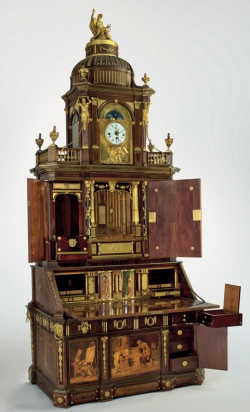
David Roentgen, Berlin Secretary Cabinet, ca. 1778–79. 11 ft. 9 in. (Kunstgewerbemuseum, Staatliche Museen zu Berlin)
Extravagant Inventions: The Princely Furniture of the Roentgens will be the first comprehensive survey of the Roentgen family’s cabinetmaking firm from 1742 to its closing in the early 1800s. Some 60 pieces of furniture, many of which have never before been lent outside Europe, and several clocks will be complemented by paintings, including portraits of the Roentgen family, and prints that depict the masterpieces of furniture in contemporary interiors. The exhibition and catalogue are made possible by the Anna-Maria and Stephen Kellen Foundation.
The meteoric rise of the workshop of Abraham Roentgen (1711-93) and his son David (1743-1807) is the most spectacular chapter in the history of innovative 18th–century Continental furniture-making. Their original designs, combined with their use of intriguing mechanical devices, revolutionized traditional French and English furniture types. From its base in Germany, the workshop served an international clientele. The Roentgens utilized a sophisticated business model, combined with intensive research on potential patrons’ personal taste and forward-looking marketing and production techniques.
In 1742 Abraham Roentgen opened a cabinetmaker’s workshop in the tiny village of Herrnhaag, in the Wetterau region near Frankfurt am Main. With only one journeyman on staff, the shop was concerned principally with the production of furniture for daily use. Abraham distinguished himself by adhering to the highest standards of quality, and soon he was producing veneered show-off pieces in the English Queen Anne style, which he had learned during his years as a journeyman in the Netherlands and England. The local nobility recognized the furnishings’ unusual appearance and quality. Abraham’s progressive designs and types, such as his fashionable tea chest and multi-functional table, were novelties in Germany and were an immediate success. Following his move to Neuwied-at-the-Rhine in 1750, Abraham took his innovative designs even further by adapting elegant French-inspired outlines that, combined with superb marquetry, fine carving, intricate gilded bronze mounts, and multiple mechanical devices, came to be recognized by contemporaries as hallmarks of the Roentgen brand. Roentgen’s playful and perfectly executed inventions became a favored status symbol in princely interiors throughout Europe.
Abraham’s son, David Roentgen, graduated quickly from his apprenticeship in his father’s workshop and eventually took over the enterprise between 1765 and 1768. He perfected the sophisticated structure and intricate marquetry designs of the furniture, and was appointed Ebéniste-Méchanicien du Roi et de la Reine at the court of Queen Marie Antoinette and King Louis XVI at Versailles in 1779. Having conquered the Western market, David revised his designs and reinvented his product line’s appearance as he looked eastward. Focusing on his new target, the Imperial residences of Catherine the Great in St. Petersburg, David Roentgen developed specific models catering to Russian taste. He caught the fancy of the Empress herself with his Apollo Desk (1783-84), which depicted her favorite dog as a gilded mount, and which David produced on pure speculation. After Catherine the Great paid a huge sum for the piece, Russian nobility hurried to catch up with its sovereign, ordering examples of ‘Neuwied Furniture’ by the dozens.
Abraham and David Roentgen’s story is a tale of international success, fame, luxury, and high honor but, in the case of David, it is also the tragedy of a deeply pious man who struggled to balance his ambitions and his glorious achievements with the regulations of his religious community, the Moravian brotherhood. At the pinnacle of David’s career, the workshop employed more than 130 specialists and the annual production amounted to that of the famous Meissen porcelain factory. His fortune shifted dramatically with the progress of the French Revolution, as Europe’s nobility struggled to stay afloat, and the market for luxurious furnishings collapsed.
Many of the works in Extravagant Inventions will be lent from distinguished international museums and royal collections. Six pieces from the Metropolitan Museum’s own collection of Roentgen furniture will be featured, in addition to two that are on long-term loan to the Museum. The exhibition will showcase many outstanding pieces, including a Writing Desk (ca. 1758-62) designed by Abraham Roentgen and considered to be one of the finest creations of his workshop; a spectacular Automaton of Queen Marie Antoinette (1784), a likeness of the queen at a clavichord that still functions and will be played at select times during the exhibition; and six intriguing objects from the Berlin Kunstgewerbe Museum that have never before traveled, most notably a mechanical Secretary Cabinet (1779) made for King Friedrich Wilhelm II of Prussia that is one of the most complex pieces of royal furniture ever produced.
The most complicated mechanical devices in the exhibition will be illustrated through virtual video animations. Additionally, working drawings and portraits of the cabinetmakers, their family, and important patrons—as well as a series of documents owned by the Metropolitan Museum that originated from the Roentgen estate—will underline the long-overlooked significance and legacy of the Roentgens as Europe’s principal cabinetmakers of the ancien régime.
◊ ◊ ◊ ◊ ◊
From Yale UP:
Wolfram Koeppe, ed., Extravagant Inventions: The Princely Furniture of the Roentgens (New Haven: Yale University Press, 2012), 304 pages, ISBN: 9780300185027, $75.
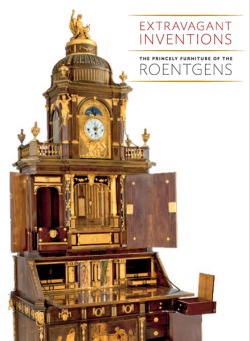 During the second half of the 18th century, the German workshop of Abraham and David Roentgen was among Europe’s most successful cabinetmaking enterprises. The Roentgens’ pieces combined innovative designs with intriguing mechanical devices that revolutionized traditional types of European furniture. An important key to their success was the pairing of the skilled craftsman Abraham with his brashly entrepreneurial son David, whose clients included Louis XVI and Marie Antoinette of France as well as Catherine the Great of Russia. This landmark publication is the first comprehensive survey, in nearly four decades, of the firm from its founding in about 1742 to its closing in the late 1790s.
The Roentgen workshop perfected the practice of adapting prefabricated elements according to the specifications of the customers. Detailed discussions of these extraordinary pieces are complemented by illustrations showing them in their contemporary interiors, design drawings, portraits, and previously unpublished historical documents from the Roentgen estate. This fascinating book provides an essential contribution to the study of European furniture.
Wolfram Koeppe is the Marina Kellen French Curator in the Department of European Sculpture and Decorative Arts at The Metropolitan Museum of Art.
◊ ◊ ◊ ◊ ◊
Lecture | The Legacy of David Roentgen
The Metropolitan Museum of Art, New York, 15 November 2012
David Linley (Chairman, Christie’s, UK), and Charles Cator (Deputy Chairman, Christie’s International)
David Roentgen (1743–1807) was known throughout Europe for his inventive and ingenious mechanical furniture, which found favor in the courts of France and Russia through the patronage of Marie Antoinette and Catherine the Great respectively. He was also famed for pioneering a new method of marquetry, created to give the impression of pietra dura. To mark the occasion of an extensive exhibition of Roentgen’s work, David Linley will share personal insights into Roentgen’s influence on his own furniture designs and his enduring influence on furniture makers today. Charles Cator will examine the collectors’ market for Roentgen from his rediscovery in the nineteenth century to today.
Reviewed | Orientialism in Louis XIV’s France
 Appearing some time ago, Nicholas Dew’s Orientialism in Louis XIV’s France is reviewed in the current issue of French History (by way of reminder of the upcoming ASECS deadline, it’s worth noting that at least three proposed panels at the 2013 conference relate to the theme of Europe’s engagement with Asia). As Julia Landweber notes in her review of Dew’s book for H-France Review 10 (July 2010): 437-40, readers should also consult Ina McCabe’s Orientalism in Early Modern France (Berg, 2008). Landweber writes: “McCabe aimed for an almost encyclopedic gathering of information, bringing in figures great and small alike for brief cameos,whereas Dew chose to focus his research on the deep analysis of a much narrower set of individuals. By happy fortune, Dew’s subjects barely overlap with McCabe’s; in consequence, the two works complement each other nicely. Read together, their theses essentially reinforce one another, and indicate that a consensus has been reached in terms of a new post-Saidian interpretation of ‘baroque Orientalism'” (439). -CH
◊ ◊ ◊ ◊ ◊
French History 26 (September 2012): 403-04.
Review of Nicholas Dew, Orientalism in Louis XIV’s France (Oxford: Oxford University Press, 2009), 301 pages, ISBN: 9780199234844. $120.
Reviewed by Diane C. Margolf; posted online 28 July 2012
Historians of Europe’s Republic of Letters during the late seventeenth and early eighteenth centuries will welcome this book as a valuable addition to the field. Focusing on what he calls ‘baroque Orientalism’, Nicholas Dew explores the ways in which a small group of French scholars produced knowledge about China, India, and the Ottoman Empire before the Enlightenment of the later eighteenth century and the European empires of the modern era. Although the scholars’ research and publication efforts were often unsuccessful and always fraught with delays and complications, Dew’s analysis of the process they followed further enriches our understanding of intellectual and cultural activity in France under Louis XIV. . .
The full review is available here» (subscription required)
New Title | Inganno – The Art of Deception
To judge from the table of contents, I think this is really a collection of essays on the sixteenth century, though it does conclude with an eighteenth-century piece by Kristin Campbell, “‘Such is Picture Dealing’: Noel Joseph Desenfans (1745-1807) and the Perils of Purchasing in 18th-Century London.” -CH
◊ ◊ ◊ ◊ ◊
From Ashgate:
Sharon Gregory and Sally Anne Hickson, eds., Inganno – The Art of Deception: Imitation, Reception, and Deceit in Early Modern Art (Aldershot: Ashgate, 2012), 216 pages, 9781409431497, $105.
 The essays contained in this volume address issues surrounding the use, dissemination, and reception of copies and even deliberate forgeries within the history of art, focusing on paintings, prints and sculptures created and sold from the sixteenth century to the eighteenth century. The essays also probe contemporary sensibilities about the art of inganno, or deception, sometimes even viewed as pleasurable deception, in the making and viewing of copies among artists and their audiences.
Through specific case studies, the contributors explore the fine line between imitations and fakes, distinctions between the practice of copying as a discipline within the workshop and the willful misrepresentation of such copies on the part of artists, agents and experts in the evolving art market. They attempt to address the notion of when a copy becomes a fake and when thoughtful repetition of a model, emulation through imitation, becomes deliberate fraud. The essays also document developing taxonomies of professionals within the growth of the “business of art” from the workshops of the Renaissance to the salons and galleries of eighteenth-century London. As a whole, this volume opens up a new branch of art historical research concerned with the history and purpose of the copy.
Roundtable Discussion for New Book on Court Funerals
As noted at L’ApAhAu, in Paris on Thursday, 20 September 2012, at 6pm, the Fondation Maison des Sciences de l’Homme, in conjunction with the Centre de Recherche du Château de Versailles, will host a roundtable discussion with the authors of this new book on the role of court funerals in early modern Europe. The invitation (as a PDF) is available here»
◊ ◊ ◊ ◊ ◊
Juliusz A. Chrościcki, Mark Hengerer, Gérard Sabatier, Les funérailles princières en Europe, XVIe-XVIIIe siècle — Volume I : Le grand théâtre de la mort (Paris: Éditions de la Maison des sciences de l’homme, 2012), ISBN: 9782735114269, 47€. [Publication issue du colloque international des 14-16 octobre 2007 à Cracovie]
 Depuis une trentaine d’années, les historiens ont exploré la problématique de la « genèse de l’État moderne » en Europe entre le XVIe et le XVIIIe siècle, et son corollaire, la place centrale tenue par les cours princières dans le processus. L’objectif de ce livre est de s’interroger sur la part qu’ont pu y prendre les stratégies funéraires des familles souveraines. Ce livre propose une approche différente des travaux consacrés jusqu’à présent aux rituels funéraires princiers où l’histoire de l’art y est prépondérante. Les funérailles princières sont étudiées en terme de stratégies de la part des monarchies, comme rituel interne de transmission du pouvoir, mais aussi dans le cadre de leurs relations entre dynasties, et de leurs rapports tant avec leurs opinions publiques propres qu’avec une opinion européenne en formation.
Premier des trois volumes consacrés aux funérailles princières, l’ouvrage s’intéresse au déroulement des cérémonies en relation avec les institutions propres, la conjoncture, les traditions particulières, les rapports de force internes, l’insertion dans le jeu politique européen.
Forthcoming | From Books to Bezoars: Sloane and His Collections
Due in November from the University of Chicago Press:
Michael Hunter, Alison Walker, and Arthur MacGregor, eds., From Books to Bezoars: Sir Hans Sloane and His Collections (Chicago: University of Chicago Press, 2012), 296 pages, ISBN: 9780712358804, $60.
 This well-illustrated volume offers fresh perspectives on the great eighteenth-century physician, naturalist, and collector Sir Hans Sloane (1660–1753), whose extensive holdings formed the basis of the British Museum and its offspring, the Natural History Museum and the British Library. The colonial milieu within which Sloane operated gets prominence here, particularly the time he spent in Jamaica. Attention is paid to his enormous network of acquaintances and correspondents throughout the world as well as to the way his collecting activities permeated every aspect of his life. Other essays consider the museum specimens accumulated by Sloane—both natural and man-made—shedding new light on his aims for acquiring and organizing them. A fascinating look at the man behind three of the United Kingdom’s most famous museums, From Books to Bezoars will appeal to students and scholars of eighteenth century studies, early modern science, and the history of the book.
Exhibition | Fables and Magic: The Guidobono Brothers
From Cultura Italia:
Fables and Magic: The Guidobono Brothers, Painters of the Baroque
Palazzo Madama, Turin, 29 May — 2 September 2012
Curated by Mary Newcome Schleier, Giovanni Romano, and Gelsomina Spione
 From 29 May to 2 September, Palazzo Madama in Turin hosts Fables and Magic: The Guidobono Brothers, Painters of the Baroque, an exhibition focusing on the life and work of the two artists, Bartolomeo and Domenico Guidobono, best known for decorating the ceiling of Palazzo Madama, along with an extensive series of paintings on canvas held in the most prestigious European and American museums.
The Savona-born painters Bartolomeo and Domenico Guidobono were not well-known in Piedmont. Nevertheless, between the end of the 17th century and the beginning of the 18th, they were entrusted with several important commissions in Turin. Following in the footsteps of their father, the painter and ceramic artist Giovanni Antonio, who drew a salary from Victor Amadeus II, the two brothers introduced to Turin the light and festive decorative style typical of Genoese residences, with its emphasis on light effects and elements drawn from nature. Both lived in Turin twice, more precisely between 1685 and 1690, and again from 1702 to 1726, when they painted the frescoes decorating the vault ceiling of the apartments of the second Madama Reale, Marie Jeanne of Savoy.
Their work is illustrated by paintings, drawings, and engravings that highlight their meticulous approach to depicting the details of their subjects, which ranged from mythology to Biblical stories, sacred subjects, still lifes, and magic scenes. Flowers, fruits, birds, animals, objects, and details of still lifes are painted with a refined, light touch and ooze seductive mystery.
The exhibition is arranged chronologically and begins with the work of the older of the two brothers, Bartolomeo Guidobono (Savona 1654 – Turin 1709). During his first sojourn in Turin, he painted the frescoes of the presbytery of the Casanova abbey near Carmagnola and a painting for Palazzo Madama, which was originally located in the former apartments of the Madama Reale and is now lost. During his second sojourn, from 1702 to 1709, Bartolomeo decorated both the residences of the Savoy court and church altars in Turin and the Duchy of Savoy. It is in this context that his Genoese-inspired decorations were made, such as those of the convent of San Francesco da Paola and the Pilone cupola, the ceiling in the hall currently known as the Madama Felicita apartment in Palazzo Reale, which are featured in the exhibition thanks to video images.
Domenico’s style began to emerge more forcefully after his brother’s death in 1709. The artist, who maintained a close relationship with the Madama Reale Maria Giovanna Battista, became the undisputed protagonist of the decorations of the halls on the first floor of Palazzo Madama, known as the Guidobono halls – the Madama Reale’s Chamber, the Chinese Cabinet, and the Southern Veranda – which were decorated on the orders of the Duchess orders between 1708 ad 1721. Domenico Guidobono was active in Turin and the rest of the Duchy until the ascent of Filippo Juvara, who eventually marginalized him and caused him to return to Genoa and subsequently to Naples, where he died in 1746. The exhibition delves into the life and work of Domenico Guidobono through recently discovered documents and artwork. The history of his art can be traced thanks to a dowry inventory put together by his daughter Maria Beatrice in 1720, which lists the works from her father’s Turin workshop. Today, most of these works are held in foreign museums, including the Louvre in Paris and the Metropolitan Museum in New York City.
The exhibition is enhanced by works by Genoese masters and other artists who were crucial influences on the Guidobono brothers, such as Domenico Piola, Gregorio De Ferrari, and Daniel Seyter. There is also a selection of engravings by Rembrandt and Castiglione, the stylistic points of reference underlying Genoese painting, followed by a section on project planning with preparatory sketches by Piola and De Ferrari from the Cabinet of Drawings and Paintings in Genoa’s Palazzo Rosso.
◊ ◊ ◊ ◊ ◊
From Artbooks.com:
Catalogue: Clelia Arnaldi di Balme, Giovanni Romano, Mary Newcome Schleier, and Gelsomina Spione, Favole e Magie: I Guidobono, Pittori del Barocco (Milano: Silvana, 2012), 128 pages, ISBN: 9788836623952, $33.
Ai fratelli Bartolomeo e Domenico Guidobono, attivi tra la fine del Seicento e l’inizio del Settecento in Liguria e in Piemonte, è dedicato questo volume, che offre una retrospettiva completa e aggiornata sulla loro carriera di pittori, costellata di successi in vita, ma poco considerata dalla critica nei secoli successivi. I due fratelli, originari di Savona, hanno lasciato il segno della loro ispirazione più alta nei soffitti di Palazzo Madama a Torino, ma si deve a loro anche una vasta produzione di quadri da cavalletto, ora in gran parte dispersa in musei e collezioni private d’Europa e d’America. Giunti a Torino a seguito del padre – pittore e ceramista stipendiato da Vittorio Amedeo II –, introducono in Piemonte i caratteri leggeri e festosi della grande decorazione barocca genovese, che trae i suoi spunti dall’osservazione della natura e dallo studio degli effetti della luce. Favole mitologiche, storie bibliche e soggetti sacri, nature morte e scene di magia si accompagnano alla descrizione precisa di fiori, frutti, uccelli, animali, oggetti e brani di natura morta, con esiti di raffinata leggerezza e talvolta di seducente mistero. Il volume, che nel ricostruire la loro attività permette di fare il punto sulla fortuna critica e sugli studi svolti intorno ai due pittori, presenta, accanto alle opere dei Guidobono, anche quelle di altri artisti che rappresentarono un punto di riferimento per la loro formazione, come Domenico Piola, Gregorio De Ferrari e Daniel Seyter. Il volume è completato da una bibliografia.
Exhibition | John Clerk of Eldin (1728-1812)
From Edinburgh’s City Art Centre:
John Clerk of Eldin (1728-1812)
Edinburgh City Art Centre, 3 November 2012 — 3 February 2013
Curated by Geoffrey Bertram
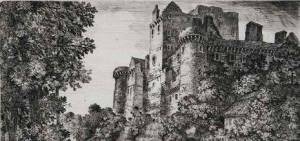
John Clerk of Eldin, Craigmillar Castle from the South-East, detail
John Clerk of Eldin is well known to historians of 18th-century British art, and he is often included in exhibitions and publications relating to the work of other 18th-century figures, namely Robert Adam, the architect, and of Paul Sandby, the well respected English painter and printmaker. In addition, his geological drawings are highly valued by geologists as the illustrations provided for Dr James Hutton’s seminal 1790s publication ‘A Theory of the Earth’. However Clerk’s etchings have never received a major overview, which the exhibition aims to redress. This anniversary year provides a perfect opportunity to highlight the prints of this remarkable man.
The exhibition is being organised and curated by Geoffrey Bertram. The main part of the exhibition is being lent by the Clerk family, supplemented with additional etchings to be borrowed from the National Gallery of Scotland. The etchings presented will range from some of the earliest efforts to those finest, with some related drawings that show his working method. These will be supplemented by sketchbooks, geological drawings and copies of the 1855 compendium of etchings published by the Bannatyne Club, Edinburgh, as well as other items relating to his life and work.
For more information, see the exhibition website»
◊ ◊ ◊ ◊ ◊
Catalogue: Geoffrey Bertram et al, The Etchings of John Clerk of Eldin (Enterprise Editions, 2012), 180 pages, ISBN 9780957190405, £35.
Published to commemorate the 200th anniversary of Clerk’s death, the book catalogues all of Clerk’s etchings and examines his etching technique and the influences on his style. It also includes essays by Iain Gordon Brown “John Clerk of Eldin and ‘The Virtuoso Genius of the Family'” and Duncan Macmillan “Scottish Printmakers in the Eighteenth Century.” Copies are available from Bertram Enterprises, 1 Knutscroft Lane, Thurloxton, Somerset TA2 8RL email: geoffrey@clerkofeldin.com
Reviewed | Dubin’s ‘Futures and Ruins’
Recently added to caa.reviews:
Nina L. Dubin, Futures and Ruins: Eighteenth-Century Paris and the Art of Hubert Robert (Los Angeles: Getty Research Institute, 2010), 210 pages, ISBN: 9781606060230, $50.
Reviewed by Frédérique Baumgartner, Mellon Postdoctoral Fellow, Columbia University; posted 27 July 2012.
In an article entitled “Les musées ne sont pas à vendre” (“Museums Are Not For Sale”) published on December 12, 2006, in the daily French paper ‘Le Monde’, the art historians Françoise Cachin, Jean Clair, and Roland Recht strongly denounced the increasing commercialization of the national patrimony, epitomized by the Louvre’s plan to rent out part of its collection to a branch established in Abu Dhabi. The authors warned the French administration against the incoherence of its cultural policy: claiming to protect the nation’s artistic treasures, while at the same time using those treasures as commodities.
The controversy over the Louvre Abu Dhabi is one of the many contemporary resonances that Nina Dubin’s book, ‘Futures and Ruins: Eighteenth-Century Paris and the Art of Hubert Robert’, holds for its reader. A meticulously researched study examining Robert’s paintings of Parisian ruins in light of the new financial interests and related economic and cultural risks that defined the city’s urban and patrimonial policies in the 1770s–1790s, ‘Futures and Ruins’ will prompt readers to consider the origins of the economic and cultural precariousness of today’s world. As such, the book is both historically stimulating and morally engaging.
At the center of ‘Futures and Ruins’ lies the following historical claim: in the course of the eighteenth century, Paris, in the grip of the forces of early capitalism, became the terrain of intense real estate speculation. It was enabled by the introduction of paper money in 1716, as the greater capacity for circulation of paper money precipitated transactions and engendered prospects of hastily accumulated wealth. At the same time, the reliance of the real estate market on the expansion of credit raised the specter of bankruptcy. As Dubin underscores, in agreement with the historian Michael Sonenscher, the nature of credit was characterized by “the ease with which it enabled economic prosperity, while at the same time catalyzing the potential for expansive debt” (Michael Sonenscher, ‘Before the Deluge: Public Debt, Inequality, and the Intellectual Origins of the French Revolution‘, Princeton: Princeton University Press, 2007, 91).
These economic phenomena, Dubin argues, found their aesthetic counterpart in pictures of ruins—a genre in which Robert (1733–1808), received as Peintre d’architecture at the Royal Academy of Painting and Sculpture in 1776, excelled. . .
The full review is available here» (CAA membership required)










 Enfilade
leave a comment