New Title | Treasures of Chinese Export Ceramics
From Yale UP:
William R. Sargent, with an essay by Rose Kerr, Treasures of Chinese Export Ceramics from the Peabody Essex Museum (New Haven: Yale University Press), 568 pages, ISBN: 9780300169751, $65.
 Beginning in the sixteenth century when Portuguese traders started importing blue and white porcelain to Europe, Chinese ceramics manufacturers produced goods specifically for export to the West. The industry flourished through the early twentieth century as the market for fine porcelain expanded in Europe and the Americas. Among the Peabody Essex Museum’s founders in 1799 were sea captains and supercargoes involved in extensive trade with Asia, and many of the remarkable examples of export wares they brought back provided a foundation for the Museum’s world-renowned collection of Chinese export ceramics.
Written by William R. Sargent, a leading expert in the field, Treasures of Chinese Export Ceramics is one of the most authoritative sources on this topic. Its scholarly entries on 287 representative objects that date from the fifteenth to the twentieth century are divided into sections by type of ware. Although these examples only hint at the Museum’s vast holding, together they encompass its broad range of Chinese export ceramics. An essay on Jingdezhen, the “Porcelain City,” by Rose Kerr, a glossary of ceramics terminology, and appendix on armorials, and an extensive bibliography all contribute to making this an invaluable resource.
William R. Sargent is the former H. A. Crosby Forbes Curator of Asian Export Art at the Peabody Essex Museum. Rose Kerr is Curator Emeritus of the Far Eastern Collection of Chinese Ceramics at the Victoria and Albert Museum, London.
Exhibition | Napoleon: Revolution to Empire
Press release from the NGV:
Napoleon: Revolution to Empire
National Gallery of Victoria, Melbourne, 2 June — 7 October 2012
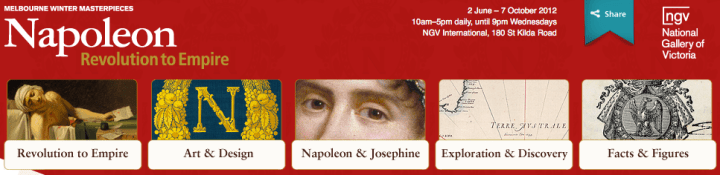
On 2 June 2012 the National Gallery of Victoria will opened this year’s spectacular Melbourne Winter Masterpieces exhibition, Napoleon: Revolution to Empire, examining French art, culture, and life from the 1770s to the 1820s. Its story runs from the first French voyages of discovery to Australia during the reign of Louis XV to the end of Napoleon’s transforming leadership as first Emperor of France.
Premier and Minister for the Arts Ted Baillieu said, “Now a well-established highlight of our major events calendar, the Melbourne Winter Masterpieces series has set the benchmark for blockbuster exhibitions in this country. I’m pleased to welcome the latest installment, Napoleon: Revolution to Empire. Through hundreds of priceless treasures, never before seen in Australia, this exhibition brings to life the legend one of history’s most extraordinary and complex figures. It’s another great Melbourne exclusive, another tourism drawcard for Victoria and another stunning exhibition for the NGV.”
This panoramic exhibition features nearly 300 works, dating from the 1770s to the 1820s, objects of breathtaking opulence and luxury – from paintings, drawings, engravings, sculpture, furniture, militaria, textiles, porcelain, gold and silver, fashion and jewellery.
Dr Gerard Vaughan, Director NGV, said, “Napoleon: Revolution to Empire continues the tradition of spectacular NGV exhibitions which have become a winter highlight in Victoria’s cultural calendar. This year visitors will be intrigued by the life of Napoleon, a man who held the world captive to his ambition. He had a vision of a united Europe, but a Europe controlled by France and united through conquest. Napoleon is well known as a master military strategist; this exhibition reveals that he was also a passionate lover and dedicated patron of the arts, sciences and literature.”
Napoleon: Revolution to Empire explores, amongst other themes, the stormy period of social change forced upon France through the outbreak of the French Revolution, the execution of Louis XVI and Marie-Antoinette, and the rise to power of the young Napoleon Bonaparte and his new wife Josephine, as the couple worked to cement their place as France’s new political and social leaders.
Ted Gott, Senior Curator International Art, NGV said, “World leaders in the Age of Exploration, Napoleon and Josephine were a true power couple- famous and stylish. The stunning artworks and objects in this exhibition illustrate their belief that the advancement of knowledge was integral to social order; they welcomed scientists and artists to receptions and dinners where world affairs were reshaped under their rule.”
Personal items will give visitors a glimpse into an extravagant private world of the couple. Jewels owned by Josephine, Napoleon’s personal weapons, lavish furniture from private residences and a lock of Napoleon’s hair feature alongside spectacular decorative objects, bejewelled gifts given to dignitaries, military uniforms and a beautiful court dress- the only surviving garment worn at Napoleon’s coronation ceremony in 1804.
Napoleon: Revolution to Empire also considers the enormous cultural and scientific contact between Australia and France from the 1770s to the 1820s. This is a story that is not often told. Both Napoleon and Josephine were captivated by Australia, which had newly entered the world’s imagination following the publication of Captain Cook’s travels. The exhibition tells the story of how this fascination spurred Napoleon to fund a voyage in 1805 that collected information about the continent and produced the first map of the southern Australian coastline with the land we now know as Victoria, but which was at the time first named Terre Napoléon (Napoleon Land). French voyages to Australia returned with collection’s of Australian flora and fauna, much specifically earmarked for the hothouses and enclosures of Napoleon and Josephine’s country residence Malmaison. Captivating works in the exhibition show kangaroos, black swans and a range of native Australian plants in the grounds of this quintessentially French estate.
Organised in partnership with the Fondation Napoléon in Paris, who are lending many of their greatest works, the exhibition also features incomparable treasures drawn from Europe’s most important Revolutionary and Napoleonic collections, including the Château de Malmaison, Château de Versailles, Musée Carnavalet and Musée de l’Armée in France, the Napoleonmuseum Thurgau in Switzerland, and the Museo Napoleonico in Rome.
More information is available at the exhibition website.
◊ ◊ ◊ ◊ ◊
From the NGV:
Catalogue: Ted Gott and Karine Huguenaud with contributing authors, Napoleon: Revolution to Empire (Melbourne: National Gallery of Victoria, 2012), 336 pages, ISBN: 9780724103560 (hardback) /978072410355-3 (paperback).
 This panoramic volume tells the story of French art, culture and life from the 1770s to the 1820s: the first French voyages of discovery to Australia, the stormy period of social change with the outbreak of the French Revolution, and the rise to power of the young Napoleon Bonaparte and his wife Josephine. Together the couple defined taste for a new century, and in the age of exploration developed a particular fascination for Australia. As well as telling the remarkable story of France’s close involvement with Australia in the early 1800s, Napoleon: Revolution to Empire showcases hundreds of works of breathtaking opulence and luxury. Featuring insightful writing by world-renowned historians of Napoleonic art and design, this authoritative publication celebrates the vital contributions to the visual arts made by Napoleon as first Emperor of France.
New Title | ‘Don’t Ask for the Mona Lisa’
This small book looks useful not only for those new to working on exhibitions but also as a model for how a conference session with real-world application could be shaped into a publication and made available to a larger audience through print-on-demand (POD) services like Lulu.com. –CH
◊ ◊ ◊ ◊ ◊
From the AAH:
Heather Birchall and Amelia Yeates, Don’t Ask for the Mona Lisa: Guidelines for Academics on How to Propose, Prepare, and Organise an Exhibition (London: Association of Art Historians, 2012), 36 pages, ISBN: 9780957147706, £5 (hardcopy) / £3 (PDF download), available at Lulu.com.
36 pages, ISBN: 9780957147706
The writing and publication of these guidelines was prompted by an event held by the Committee of the Museums & Exhibition Members Group of the Association of Art Historians (AAH), at the AAH Annual Conference at Manchester Metropolitan University in 2009. The session, entitled Curators Don’t Bite, attracted a large crowd of academics and museum professionals eager to hear about the experiences, both positive and negative, of other academics and curators who had organised exhibitions. Following the event, it was clear that there was a demand for some advice on how to propose exhibitions and, once a show had been agreed, the practicalities of working with curators and other museum staff. This publication therefore aims to provide an introduction to key aspects of exhibition curation, from the early planning stages to the design and opening of the show.
Of course, every exhibition is different and, whilst this document cannot cover every aspect of exhibition planning, it does provide assistance to those organising both small-scale and large exhibitions, as well as offering guidance on working with paintings, sculptures, and contemporary installations. Whether your exhibition is to be held at a large venue, such as Tate Britain, with a team of curators, conservators, and technicians, or a smaller institution with only one or two members of staff, the intention of the authors has been to outline the possible eventualities and responsibilities associated with exhibition planning.
The first part of this publication gives guidance on why and how to propose an exhibition, and offers general advice on exhibition planning and installation. It describes the roles performed by certain staff members in galleries and museums, and the responsibilities they carry when an exhibition is being put together. Some technical terms are highlighted in bold in the main text, and defined in the
margin.
The second part comprises case studies by academics who have worked on exhibitions for both large organisations, such as Birmingham Museum and Art Gallery, and small venues, including the Henry Moore Institute. This section also includes an interview with an exhibition designer that sets out some of the demands of fitting the design around the show’s theme, and sheds light on how to create a space that doesn’t overwhelm the exhibits.
At a time when museums and galleries are constantly tightening their budgets, a page at the end of this publication includes a list of funders to be approached if the museum’s budget cannot cover all the costs associated with the show, such as producing a catalogue or organising an associated study day or conference. Although the publication is primarily aimed at academics, and also freelances and students who may be considering putting together an exhibition proposal, we hope that it will also be useful for curators in the early stages of their careers working in a museum or gallery.
Information on ordering a copy is available here»
Forthcoming | ‘London: A Social and Cultural History’
Robert Bucholz, Professor of History at Loyola University Chicago, has been teaching a thematic course on London for years (a version is available at The Great Courses). Long dissatisfied with the available options for texts, he finally decided — with his co-author Joseph Ward — to write one. With its emphasis on the experience of living in early modern London and the varied lives of the city’s residents, the book is good news for anyone trying to fit the city into a semester. -CH
◊ ◊ ◊ ◊ ◊
From Cambridge UP:
Robert O. Bucholz and Joseph P. Ward, London: A Social and Cultural History, 1550–1750 (New York: Cambridge University Press, 2012), 415 pages, ISBN: 9780521896528, $28.
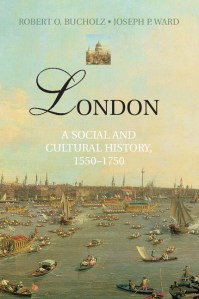 Between 1550 and 1750 London became the greatest city in Europe and one of the most vibrant economic and cultural centres in the world. This book is a history of London during this crucial period of its rise to world-wide prominence, during which it dominated the economic, political, social and cultural life of the British Isles, as never before nor since. London incorporates the best recent work in urban history, contemporary accounts from Londoners and tourists, and fictional works featuring the city in order to trace London’s rise and explore its role as a harbinger of modernity, while examining how its citizens coped with those achievements. London covers the full range of life in London, from the splendid galleries of Whitehall to the damp and sooty alleyways of the East End. Readers will brave the dangers of plague and fire, witness the spectacles of the Lord Mayor’s Pageant and the hangings at Tyburn, and take refreshment in the city’s pleasure-gardens, coffee-houses and taverns.
Contents
Introduction: London’s Importance
1. London in 1550
2. The Socioeconomic Base
3. Royal and Civic London
4. Fine and Performing Arts
5. The Public Sphere and Popular Culture
6. The People on the Margins
7. Riot and Rebellion
8. Plague and Fire
Conclusion: London in 1750
New Title | ‘London in the Eighteenth Century’
From the Random House Group:
Jerry White, London in the Eighteenth Century: ‘A Great and Monstrous Thing’ (London: Bodley Head, 2012), 704 pages, 9781847921802, £25.
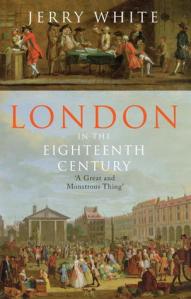 London in the eighteenth century was very much a new city, risen from the ashes of the Great Fire. With thousands of homes and many landmark buildings destroyed, it had been brought to the brink. But the following century was a period of vigorous expansion, of scientific and artistic genius, of blossoming reason, civility, elegance and manners. It was also an age of extremes: of starving poverty and exquisite fashion, of joy and despair, of sentiment and cruelty. Society was fractured by geography, politics, religion and history. And everything was complicated by class. As Daniel Defoe put it, London really was a ‘great and monstrous Thing’.
Jerry White’s tremendous portrait of this turbulent century explores how and to what extent Londoners negotiated and repaired these open wounds. We see them going about their business as bankers or beggars, revelling in an enlarging world of public pleasures, indulging in crimes both great and small – amidst the tightening sinews of power and regulation, and the hesitant beginnings of London democracy.
In the long-awaited finale to his acclaimed history of London over 300 years, Jerry White introduces us to shopkeepers and prostitutes, men and women of fashion and genius, street-robbers and thief-takers, as they play out the astonishing drama of life in eighteenth-century London.
Forthcoming | Hanneke Grootenboer’s ‘Treasuring the Gaze’
As noted in Heidi Strobel’s review of The Look of Love from yesterday, Hanneke Grootenboer’s book on eye miniatures is scheduled for release in November. Here’s the description from the University of Chicago Press:
◊ ◊ ◊ ◊ ◊
Hanneke Grootenboer, Treasuring the Gaze: Intimate Vision in Late Eighteenth-Century Eye Miniatures (Chicago: University of Chicago Press, 2012), ISBN: 9780226309668, $45.
 The end of the eighteenth century saw the start of a new craze in Europe: tiny portraits of single eyes that were exchanged by lovers or family members. Worn as brooches or pendants, these minuscule eyes served the same emotional need as more conventional mementoes, such as lockets containing a coil of a loved one’s hair. The fashion lasted only a few decades, and by the early 1800s eye miniatures had faded into oblivion. Unearthing these portraits in Treasuring the Gaze, Hanneke Grootenboer proposes that the rage for eye miniatures—and their abrupt disappearance—reveals a knot in the unfolding of the history of vision.
Drawing on Alois Riegl, Jean-Luc Nancy, Marcia Pointon, Melanie Klein, and others, Grootenboer unravels this knot, discovering previously unseen patterns of looking and strategies for showing. She shows that eye miniatures portray the subject’s gaze rather than his or her eye, making the recipient of the keepsake an exclusive beholder who is perpetually watched. These treasured portraits always return the looks they receive and, as such, they create a reciprocal mode of viewing that Grootenboer calls intimate vision. Recounting stories about eye miniatures—including the role one played in the scandalous affair of Mrs. Fitzherbert and the Prince of Wales, a portrait of the mesmerizing eye of Lord Byron, and the loss and longing incorporated in crying eye miniatures—Grootenboer shows that intimate vision brings the gaze of another deep into the heart of private experience.
With a host of fascinating imagery from this eccentric and mostly forgotten yet deeply private keepsake, Treasuring the Gaze provides new insights into the art of miniature painting and the genre of portraiture.
Reviewed | Heidi Strobel on ‘The Look of Love’
Graham Boettcher, ed., with essays by Graham Boettcher, Elle Shushan, and Jo Manning, The Look of Love: Eye Miniatures from the Skier Collection (London: D. Giles Limited in association with the Birmingham Museum of Art, Birmingham, Alabama, 2012), 208 pages, ISBN: 9781907804014, $35.
Reviewed for Enfilade by Heidi Strobel
Drink to me only with thine eyes,
And I will pledge with mine.
– Ben Jonson, “Song to Celia” (1616)
 In the sumptuously illustrated catalogue for The Look of Love: Eye Miniatures from the Skier Collection (on at the Birmingham Museum of Art from 7 February to 10 June 2012 ), Graham Boettcher, Elle Shushan, and Jo Manning highlight the world’s largest collection of eye pictures: small, often jewel-encrusted, paintings of individual eyes of lovers or beloved family members. These synecdochal portraits enjoyed a brief heydey between 1790 and 1850, in large part due to the patronage of the Prince of Wales (later George IV) who famously commissioned several lover’s eye portraits for his forbidden amour, Maria Fitzherbert. Although the best known of such commissions, these were not the first. In antiquity, the Romans and Etruscans produced similar images and, more recently, according to Horace Walpole, the French did so in the eighteenth century (18).
In “The Artist’s Eye,” Elle Shushan describes the evolution of the eye miniature and introduces its practitioners, portraitists such as Richard Cosway, who produced the aforementioned miniatures in his role as Miniature Painter to the Prince of Wales, and George Engleheart, Miniature Painter to the prince’s father, George III. In addition to the latter’s prolific output (4853 portrait miniatures between 1775 and 1813), Engleheart trained several relatives to paint eye miniatures, including his cousin Thomas Richmond and nephew John Cox Dillman Engleheart, whose work is also included in the catalogue. Shushan explains the initial modern popularity of the genre (in England and on the Continent) and describes patrons who later resuscitated the genre, including Queen Victoria who requested eye pictures of her closest friends and relatives from her Royal Miniaturist, Sir William Charles Ross. In closing, Shushan attributes the genre’s demise to its hybrid status — “part portrait, part jewelry, and part decoration” (27).
In “Symbol & Sentiment: Lover’s Eyes and the Language of Gemstones,” Graham Boettcher demonstrates how the jewels that often surrounded an eye portrait provided additional information about the qualities and features of the sitter and its wearer. Since many of these portraits were memorials to a deceased loved one, Boettcher’s discussion of these items as mourning jewelry is particularly useful.
In the third section of the catalogue, Jo Manning contributes five fictional vignettes inspired by items in the Skier Collection, an inclusion stimulated by the lost identities of most of the sitters and artists. Interspersed amid the catalogue entries are brief biographies of specialists George Engleheart and his family protégés, Cosway, Richmond, William Grimaldi, as well as George IV. Some of the entries also supply information about inscriptions and particular sitters.
Although most recent publications on miniatures include a section on eye miniatures, The Look of Love is the first publication devoted to this fleeting genre. While the liminal status of the eye miniature as part jewelry, part decoration, and part portrait may have contributed to the genre’s transience, we might ask whether such images should be considered portraits at all, a point made by Hanneke Grootenboer in her 2006 Art Bulletin article, “Treasuring the Gaze: Eye Miniature Portraits and the Intimacy of Vision.”[1] Perhaps it would be more accurate to describe these small paintings as ‘eye pictures’ (rather than portraits) since they work so differently from traditional portrait conventions grounded in personal identification. And, given that more typical portrait miniatures were also commonly hybrids (part portrait, part jewelry, and part decoration), why was their popularity more enduring than that of the eye pictures? Were eye pictures – often profusely decorated – more expensive than standard portrait miniatures? And if so, did this factor contribute to the genre’s demise?
Notwithstanding such questions, this generously illustrated catalogue marks a significant addition to the study of miniatures and should appeal to a broad audience with its combination of scholarly scrutiny and fictional narratives.
[1] Hanneke Grootenboer, “Treasuring the Gaze: Eye Miniature Portraits and the Intimacy of Vision,” The Art Bulletin 88 (September 2006): 496-507; also see her forthcoming book from the University of Chicago Press, Treasuring the Gaze: Intimate Vision in Late Eighteenth-Century Eye Miniatures (November 2012).
◊ ◊ ◊ ◊ ◊
Heidi Strobel is Associate Professor of Art History at the University of Evansville, in Indiana. Her dissertation research, focused on the promotion of eighteenth-century female artists by female patrons such as Charlotte, wife of King George III of England, is published as The Artistic Matronage of Queen Charlotte (1744-1818) (Edwin Mellen Press, 2011). Other recent publications include articles on twentieth-century topics such as British sculptor Barbara Hepworth, American folklore artist Howard Finster, World War II icon Rosie the Riveter, and women’s scholarship on women.
Reviewed | Davis’s ‘A General Theory of Visual Culture’
Recently added to caa.reviews:
Whitney Davis, A General Theory of Visual Culture (Princeton: Princeton University Press, 2011), 432 pages, ISBN: 9780691147659, $55.
Reviewed by James Elkins, School of the Art Institute of Chicago; posted 18 May 2012.
Along with David Summers’s ‘Real Spaces: World Art History and the Rise of Western Modernism’ (New York: Phaidon, 2003) (click here for review), Whitney Davis’s ‘A General Theory of Visual Culture’ is one of the most ambitious and potentially foundational books on art history in recent decades. It is unusually dense in logical argumentation, so it is more than a convention to say that it cannot helpfully be summarized. Because longer reviews will be needed to assess the book’s arguments, I want to use the generally shorter review length here in caa.reviews to raise two points about the book as a whole. But first I will evoke, as succinctly as possible, the book’s content, purpose, and significance.
Davis’s book ranges widely across the central examples of art-historical methodology, from Heinrich Wölfflin to Michael Baxandall, including discussions of writers as different as T. J. Clark, Arthur Danto, Ernst Cassirer, Nelson Goodman, and Giovanni Morelli. There are extended readings of texts by Erwin Panofsky, Richard Wollheim, E. H. Gombrich, and Ludwig Wittgenstein, and critiques of formal analysis (chapter 3), style analysis (chapter 4), and iconography (chapter 7). The book’s visual examples range from prehistory to Renaissance art to modernism and Warhol.
Davis’s principal purpose is to provide a “general theory of visual culture,” by which he means an account of the relation between what is cultural about vision, and what is visual about culture. He has many ways of putting this difference, and the variety is itself significant. (More on that later.) To ask about what is cultural about vision is to note that “styles of depiction . . . have materially affected human vision,” and to ask about what is visual about culture entails the possibility that “some things,” but not all, “are visual in culture, or visible as culture” (6; see also p. 8).
As a conceptual reorganization of art history’s fundamental terms of engagement with objects, the book is exemplary, and it is difficult to imagine a reader who is engaged with the discipline for whom this book is optional reading. . .
The full review is available here» (CAA membership required)
Forthcoming | ‘The Materiality of Color’
From Ashgate this fall:
Andrea Feeser, Maureen Daly Goggin, and Beth Fowkes Tobin, eds., The Materiality of Color: The Production, Circulation, and Application of Dyes and Pigments, 1400-1800 (Aldershot: Ashgate, 2012), 350 pages, ISBN: 9781409429159, £65.
Although much has been written on the aesthetic value of color, there are other values that adhere to it with economic and social values among them. Through case studies of particular colors and colored objects, this volume demonstrates just how complex the history of color is by focusing onthe diverse social and cultural meanings of color; the trouble, pain, and suffering behind theproduction and application of these colors;the difficult technical processes for making and applying color; and the intricacy of commercial exchanges and knowledge transfers as commodities and techniques moved from one region toanother. By emphasizing color’s materiality, the way in which it was produced, exchanged, and used by artisans, artists, and craftspersons, contributors draw attention to the disjuncture between the beauty of color and the blood, sweat, and tears that went into its production, circulation, and application as well as to the complicated and varied social meanings attached to color within specific historical and social contexts.
This book captures color’s global history with chapters on indigo plantations in India and the American South, cochineal production in colonial Oaxaca, the taste for brightly colored Chinese objects in Europe, and the thriving trade in vermilion between Europeans and Native Americans. To underscore the complexity of the technical knowledge behind color production, there are chapters on the ‘discovery’ of Prussian blue, Brazilian feather techné, and wallpaper production. To sound the depths of color’s capacity for social and cultural meaning-making, there are chapters that explore the significance of black ink in Shakespeare’s sonnets, red threads in women’s needlework samplers, blues in Mayan sacred statuary, and greens and yellows in colored glass bracelets that were traded across the Arabian desert in the late Middle Ages.
The purpose of this book is to recover color’s complex–and sometimes morally troubling–past, and in doing so, to restore a sense of wonder and appreciation for our colorful world. With its nuanced and complex depiction of how color operated within local contexts and moved across the globe, this book will appeal to art historians, social and cultural historians, museum curators, literary scholars, rhetoric scholars, and historians of science and technology.
◊ ◊ ◊ ◊ ◊
C O N T E N T S
Andrea Feeser, Maureen Daly Goggin, and Beth Fowkes Tobin — Introduction: The Value of Color
Part I: Color’s Social and Cultural Meanings
Jason LaFountain — Colorizing New England’s Burying Grounds
Maureen Daly Goggin — The Extraordinary Powers of Red in 18- and 19th-Century English Needlework
Molly H. Basset and Jeanette Favrot Peterson — Coloring the Sacred in 16th-Century Central Mexico
Mitchell Harris — The Expense of Ink and Wastes of Shame: Poetic Generation, Black Ink, and Material Waste in Shakespeare’s Sonnets
Vanessa Alayrac-Fielding — ‘Luscious Colors and Glossy Paint’: The Taste for China and the Consumption of Colors in 18th-Century England
Part II: Producing and Exchanging Pigments and Dyes
Jeremy Baskes — Seeking Red: The Production and Trade of Cochineal Dye in Oaxaca, Mexico, 1750–1821
J.-F. Lozier — Red Ochre, Vermilion and the Transatlantic Cosmetic Encounter
Padmini Tolat Balaram — Indian Indigo
Andrea Feeser — The Exceptional and the Expected: Red, White, and Black Made Blue in Colonial South Carolina
Sarah Lowengard — Prussian Blue: Transfers and Trials
Part III: Making Colored Objects
Stéphanie Karine Boulogne — Glass Bracelets in the Medieval and Early Modern Middle East: Design and Color as Identity Markers
Éva Deák — The Colorful Court of Gabriel Bethlen and Catherine of Brandenburg
Richard Blunt — The Evolution of Blackface Cosmetics on the Early Modern Stage
Amy Buono — Crafts of Color: Tupi Tapirage in Early Colonial Brazil
Elaine Gibbs — Colors and Techniques of 18th-Century Chinese Wallpaper: Blair House as Case Study
Beth Fowkes Tobin — Butterflies, Spiders, and Shells: Coloring Natural History Illustrations in Late 18th-Century Britain
Bibliography and Index
◊ ◊ ◊ ◊ ◊
Editors: Andrea Feeser is Associate Professor of Modern and Contemporary Art, Theory, and Criticism at Clemson University. Maureen Daly Goggin is Associate Chair in the Department of English, Arizona State University. Beth Fowkes Tobin is Professor of English and Women’s Studies at the University of Georgia.
Exhibition | ‘Fashioning Fashion’
This exhibition from LACMA (on display there from 2 October 2010 to 6 March 2011) is currently on view in Berlin and will travel to Paris in the fall. From the German Historical Museum:
Fashioning Fashion: European Dress in Detail, 1700-1915
Deutsches Historisches Museum, Berlin, 27 April — 29 July 2012
Musée des Arts Décoratifs, Paris, 13 December 2012 — 14 April 2013
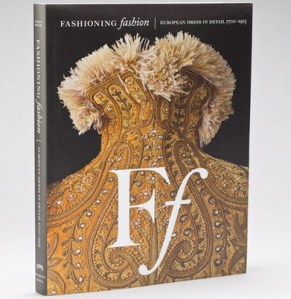 With Fashioning Fashion: European Dress in Detail, 1700-1915 the German Historical Museum is presenting – exclusively in Germany – a unique collection of historical garments and accessories from the Los Angeles County Museum of Art. More than 200 years of European fashion history are on display. The renowned Belgian scenographer Bob Verhelst has specially designed the exhibition architecture for Berlin. Glamorous women’s costumes and elegant men’s suits are adorned with elaborately fashioned trimmings. Luxurious clothing of the wealthy haute-bourgeoisie and nobility are shown, including such highlights as the gold-embroidered dress of a Portuguese queen and the turban of the designer Paul Poiret. Fascinating fabrics, exquisitely tailored raiments and precious décor are all to be seen in the museum’s show.
This spectacular exhibition takes us through four chapters focusing on the aesthetic and technical developments of fashion history:
Timeline shows in chronological sequence the changes in the silhouette of women’s dresses and the evolution of men’s suits from brightly coloured to their traditional dark hue.
Textiles informs us about the variety of surfaces that come about through complex weaving, colouring and printing techniques.
Tailoring deals with the process of turning plain material into clothing, with special emphasis on forming, bracing and constricting techniques.
Trim presents the finery of fashionable clothes: delicate laces, magnificent fine-wire embroidery, artful silk trimmings and colourfully patterned and sequined accessories.










 Enfilade
leave a comment