Exhibition | 1740, Un Abrégé du Monde
On at the INHA in Paris this summer, as noted by Hélène Bremer:
1740, Un Abrégé du Monde: Savoirs et Collections autour de Dezallier d’Argenville
Institut National d’Histoire de l’Art, Paris, 4 May — 27 July 2012
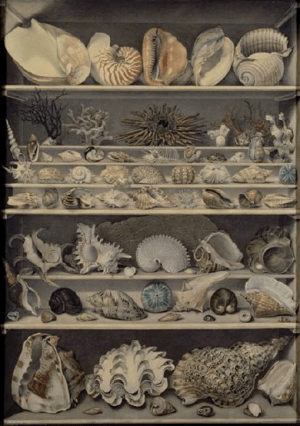
Alexandre Isidore Leroyde Barde (1777-1828), Choix de coquillages, encre noire et gouache, 125cm × 90cm (Paris: Musée du Louvre)
Naturaliste et historien de l’art, Antoine-Joseph Dezallier d’Argenville (1680-1765) fut membre de nombreuses académies scientifiques, auteur d’une théorie du jardinage, de traités sur les pierres et les coquillages (1742), et de l’Abrégé de la vie des plus fameux peintres de toutes les écoles… (1745-1752). Il fut aussi un grand collectionneur qui possédait plus de cinq cents dessins et de rares spécimens naturels. Pour interroger cette figure symptomatique de la dynamique entre arts et savoirs au XVIIIe siècle, l’Institut national d’histoire de l’art a voulu retrouver la fonction première de l’un des espaces-clefs de la Galerie Colbert, une ancienne boutique, car les savants-collectionneurs du siècle des Lumières étaient étroitement liés aux marchés de l’art et des curiosités naturelles.
L’exposition s’organise donc autour d’un comptoir qui évoque non seulement le long meuble à surface plane sur lequel les marchands échangeaient coquillages, estampes, tableaux et dessins, mais aussi les implantations commerciales sur les côtes des colonies d’où provenaient ces étranges objets naturels, lesquels manifestaient à la fois la soif de découverte du monde et l’ambition encyclopédique de ces amateurs.
Les curieux français du XVIIIe siècle furent avant tout des collectionneurs d’objets, que leur goût portait indistinctement sur les produits de l’Art ou de la Nature. Ils prêtaient également une attention remarquable à l’arrangement, la disposition dans l’espace des choses naturelles et artificielles constituant leurs cabinets. À cet égard, il faut noter que Dezallier fut l’un des premiers auteurs français à théoriser, dans un article de 1727, l’arrangement idéal d’un cabinet de curiosités, tout comme il fut le premier à employer en français le terme muséographie, en 1742.
Les années 1740 sont celles de la métamorphose des lieux de savoirs, puisque l’on passe alors des salles dédiées, dans les demeures privées, à la présentation d’objets de collection, à la création de musées, autrement dit de salles publiques d’exposition, où les visiteurs sont invités à s’instruire. C’est aussi l’époque de la mutation des savoirs livresques, dont les formes et les structures sont alors repensées dans le but de dresser des inventaires totalisants, comme l’Encyclopédie ou les catalogues raisonnés illustrés.
The exhibition press release is available (as a PDF) here»
◊ ◊ ◊ ◊ ◊
From Fage éditions:
Anne Lafont, ed., 1740, Un Abrégé du Monde: Savoirs et Collections autour de Dezallier d’Argenville (Paris: Fage éditions) 304 pages, ISBN: 9782849752609, 35€.
Contributeurs: Nebahat Avcioglu, Lise Bicart-Sée, Sarah Boyer, Sabine Cartuyvels, Pascal Dubourg Glatigny, Jennifer Ferng, Isabelle Flour, Catherine Girard, Martial Guédron, Charlotte Guichard, Pierre-Yves Lacour, Anne Lafont, Gaëtane Maës, Marie-Pauline Martin, Dominique Morelon, Aline Pelletier, Jessica Priebe, Chiara Savettieri, Anke Te Heesen, Isabelle Tillerot
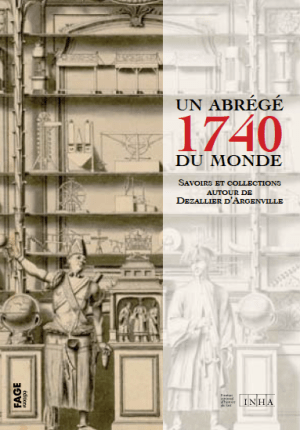 1740 un abrégé du monde traite des modalités de présentation des objets naturels et artificiels au sein des cabinets de curiosités, des relations entre les marchands et les collectionneurs de coquillages, estampes, tableaux, dessins, et des systèmes de classification en vigueur au temps de l’Encyclopédie et de Linné…
Rédigé par vingt spécialistes sous la direction d’Anne Lafont, conseillère scientifique à l’INHA, l’ouvrage gravite autour de la figure du naturaliste, historien de l’art et collectionneur français Dezallier d’Argenville (1685-1765), pivot de la dynamique nature/culture au XVIIIe siècle.
Il est organisé sous la forme d’un abécédaire de vingt-sept articles illustrés abordant des concepts qui sont au cœur de cette enquête sur les arts et les savoirs naturalistes : Abrégé, Amateur, Basseporte, Cabinet, Dessein, École, Fossiles, Grotesque, Histoire naturelle, Illustration, Jardin, Kiosque, Laboratoire, Manière, Numérotation, Ornement, Parterre, Plume, Quartz, Rocaille, Système, Table, Unique, Vernis, Vie, Watteau, Zoomorphose.
New Title | ‘Japanned Papier Mâché and Tinware c.1740-1940’
From the Antique Collector’ Club:
Yvonne Jones, Japanned Papier Mâché and Tinware c.1740-1940 (Woodbridge: Antique Collectors’ Club, 2012), 336 pages, ISBN: 9781851496860, £45.
 As one of the few decorative arts about which little has been written, japanning is today fraught with misunderstandings. And yet, in its heyday, the japanning industry attracted important commissions from prestigious designers such as Robert Adam, and orders from fashionable society across Europe and beyond.
This book is a long overdue history of the industry which centred on three towns in the English midlands: Birmingham, Wolverhampton and Bilston. It is as much about the workers, their skills, and the factories and workshops in which they laboured, as it is about the goods they made. It tells of matters of taste and criticism, and of how an industry which continued to rely so heavily upon hand labour in the machine age reached its natural end in the 1880s with a few factories lingering into the late 1930s. Richly illustrated, it includes photographs of mostly marked, or well-documented, examples of japanned tin and papier mâché against which readers may compare – and perhaps identify – unmarked specimens.
Japanned Papier Mâché and Tinware draws predominantly upon contemporary sources: printed, manuscript and typescript documents, and, for the period leading up to the closure of the last factories in the 1930s, the author was able to draw on verbal accounts of eyewitnesses. With a chapter on japanners in London, other European centres, and in the United States, together with a directory of japan artists and decorators, this closely researched and comprehensive book is the reference work for collectors, dealers and enthusiasts alike.
Contents
From Imitation to Innovation; Enter the Dragon!; The Lion of the District; Japanning & Decorating; Not a Bed of Roses!; Clever Accidents?; Decline of the Midlands Japanning Industry; The Birmingham Japanners; The Wolverhampton Japanners; The Bilston Japanners; Japanners in London and Oxford; Products; Other Western Japanning Centres; Appendices.
◊ ◊ ◊ ◊ ◊
With a degree in Fine Art, Yvonne Jones taught art in schools and colleges before joining Wolverhampton Art Galleries and Museums in 1971, serving first as Keeper of Applied Art, and then as Head of Arts & Museums. Researching, documenting and extending the town’s collection of japanned papier mâché and tinware, she became aware of the breadth and importance of this field in the decorative arts. She left her post in 1994 to concentrate on a programme of original research, and is now an international authority on the subject and continues to lecture widely in both Britain and the United States.
Exhibition | Gold, Jasper, and Carnelian: Johann Christian Neuber
From The Frick:
Gold, Jasper, and Carnelian: Johann Christian Neuber at the Saxon Court
Grünes Gewölbe, Dresden, 3 March — 2 May 2012
The Frick Collection, New York, 30 May — 19 August 2012
Galerie J. Kugel, Paris, 12 September — 10 November 2012
Coordinated by Dirk Syndram, Jutta Kappel, Ian Wardropper, and Charlotte Vignon

Johann Christian Neuber, Breteuil Table, Dresden, 1779–80, wood, gilded bronze, semiprecious stones, faux-pearls, and Meissen porcelain plaques, H: 32 inches, collection of the Marquis de Breteuil, Chäteau de Breteuil (Choisel/Chevreuse); photo: © Georges Fessy
Johann Christian Neuber was one of Dresden’s most famous goldsmiths. Sometime before 1775 he was named court jeweler to Friedrich Augustus III, elector of Saxony, and in 1785 he was appointed Curator of the Grünes Gewölbe (Green Vault), the magnificent royal collection of Augustus the Strong, the founder of the Meissen Porcelain Manufactory. For more than thirty years, Neuber created small gold boxes, chatelaines, and watchcases decorated with local semiprecious stones such as agate, jasper, and carnelian. He fashioned enchanting landscapes, complex floral designs, and geometric patterns with tiny cut stones, often incorporating Meissen porcelain plaques, cameos, and miniatures. These one-of-a-kind objects, which reflect the Saxon court’s interest in both luxury items and the natural sciences, remain prized treasures today, but have never before been shown together in a monographic exhibition.
In 2012, the public will have their first comprehensive introduction to this master craftsman’s oeuvre through a traveling exhibition that is accompanied by a lavishly illustrated publication (Paul Holberton publishing, London, and Editions d’Art Monelle Hayot, under the direction of Alexis Kugel). The exhibition began in Dresden at the Grünes Gewölbe on March 3, remaining there through May 2, 2012, when it travels to the United Sates for an exclusive engagement at The Frick Collection (May 30 through August 19, 2012). It concludes at Galerie J. Kugel in Paris in the fall (September 12 through November 10, 2012).
Gold, Jasper, and Carnelian: Johann Christian Neuber at the Saxon Court includes some thirty-five boxes and other decorative objects from the Grünes Gewölbe and the Porcelain Collection of the Staatliche Kunstsammlungen Dresden, The Metropolitan Museum of Art, and private collections in Europe and the United States. The exhibition also features Neuber’s masterpiece, the Breteuil Table. This small table is regarded as one of the most extraordinary pieces of eighteenth-century furniture ever made, distinguished not only by the materials used in its construction and for the remarkable skill of its creator, but also for its prestigious history. It was presented in 1781 by Friedrich Augustus III to Baron de Breteuil, a French diplomat, as recognition for the role Breteuil played in the negotiation of the Treaty of Teschen, which officially ended the war of Bavarian Succession fought between the Habsburg monarchy and a Saxon-Prussian alliance to prevent the Habsburg acquisition of the Duchy of Bavaria. The table features a mosaic top of 128 semiprecious stones and Meissen porcelain plaques. Still owned by the family who received it nearly 250 years ago, this stunning object has almost never been exhibited outside the Château de Breteuil (some twenty-five miles west of Paris) and has never before crossed the Atlantic. The Frick exhibition also reunites for the first time two bases designed and crafted by Neuber for the display of Meissen porcelain groups. One is now in the collection of the Walters Art Museum, Baltimore, while the other is from a private collection in Paris. These bases were part of a much larger diplomatic gift from Friedrich Augustus III to Nicolai Wasilijewitsch Repnin, the Russian emissary who helped to negotiate the Treaty of Teschen. The gift originally included a Meissen porcelain service and an enormous centerpiece composed of seven stands of varying heights, each supporting an allegorical group made of Meissen porcelain. Of this extravagant gift, only these two bases have been definitively identified.
The exhibition is co-organized by the Grünes Gewölbe, Staatliche Kunstsammlungen Dresden, The Frick Collection, and Galerie J. Kugel, Paris. The exhibition in Dresden will be shown in a slightly different form as Johann Christian “Neuber à Dresde”: Schatzkunst des Klassizismus für den Adel Europas. It is coordinated by Dirk Syndram, Director of the Grünes Gewölbe and the Armoury, and Jutta Kappel, Senior Curator of the Grünes Gewölbe. The presentation of the exhibition at The Frick Collection is coordinated by Director Ian Wardropper and Charlotte Vignon, Associate Curator of Decorative Arts.
◊ ◊ ◊ ◊ ◊
From Paul Holberton Publishing:
Alexis Kugel, ed., Gold, Jasper and Carnelian: Johann Christian Neuber at the Saxon Court (London: Paul Holberton, 2012), 400 pages, ISBN: 9781907372360, £100.
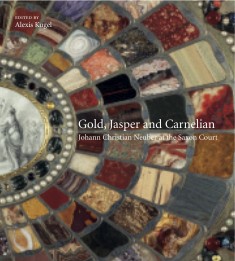 Johann Christian Neuber (1736–1808) was a goldsmith and mineralogist at the Saxon Court. In 1769 he became director of the Grünes Gewölbe, the magnificent State Treasury, and was appointed court jeweler in 1775. He specialized in creating small gold boxes, chatelaines and watchcases decorated with semiprecious stones, such as agate, jasper and carnelian. Neuber fashioned enchanting landscapes, complex floral designs and geometric patterns out of tiny cut stones, often incorporating Meissen porcelain plaques, cameos and miniatures. These one-of-a-kind objects are treasured in public and private collections all over the world today, but have never been brought together.
This book is the first comprehensive introduction to this master craftsman’s oeuvre, presenting boxes and other decorative objects from the Grünes Gewölbe, the Metropolitan Museum of Art as well as public and private collections in Germany, France and New York. One of its highlights is the ‘Breteuil Table’, still owned by the family for which it was made as a diplomatic gift nearly 250 years ago.
Beautiful photographs of all Neuber’s creations adorn this extraordinary book – well over 500 in number. The context and history of the growing interest in mineralogy and its celebration in these works of art are fully investigated. Its distinguished authors include Dr Jutta Kappel, Head of Conservation at Grünes Gewölbe, Dresden; art historians and specialists Sophie Mouquin and Philippe Poindront; marquis de Breteuil, Henri-François Le Tonnelier; and the editor of the book, Alexis Kugel, of the famous Parisian gallery.
There is also a French edition of this book: Le luxe, le goût, la science: Neuber, orfèvre minéarologiste à la cour de Saxe (ISBN 9782903824808).
New Title | Quatremère de Quincy’s ‘Letters to Miranda and Canova’
From The Getty:
Antoine Quatremère de Quincy, introduction by Dominique Poulot, translation by Chris Miller and David Gilks, Letters to Miranda and Canova on the Abduction of Antiquities from Rome and Athens (Los Angeles: Getty Publications, 2012), 208 pages, ISBN: 9781606060995, $50.
 In the 1790s and early 1800s, the art world experienced two big events: First came the military confiscation of masterpieces from Italy and northern Europe in order to build a universal museum in Paris’s Louvre. Then famous marble sculptures were prised from the Parthenon and sent to London. These events provoked reactions ranging from enthusiastic applause to enraged condemnation.
The French art critic, architectural theoretician, and political conservative Quatremère de Quincy was at the center of the European debates. In his pamphlet Letters to Miranda, he condemns the revolutionary hubris of putting “Rome in Paris” and urges the return of the works. In the Letters to Canova, however, Quatremère celebrates the British Museum for making the Parthenon sculptures accessible. Quatremère’s writing was highly controversial in its time. This book offers the first English translation of the two series of letters, as well as a new critical introduction.
Antoine Quatremère de Quincy (1755–1849) was a French archaeologist, architectural theoretician, arts administrator, and influential writer. Dominique Poulot is professor of the history of art at the Université Paris 1 Panthéon-Sorbonne. Chris Miller is a translator specializing in the fine arts. David Gilks is a Leverhulme Early Career Fellow at Queen Mary, University of London.
New Title | ‘The Goldfish in the Chandelier’
From The Getty:
Casie Kesterson with illustrations by Gary Hovland, The Goldfish in the Chandelier (Los Angeles: Getty Publications, 2012), 32 pages, ISBN 9781606060940, $18.
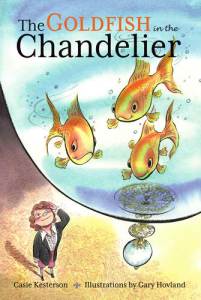 A different kind of adventure story, The Goldfish in the Chandelier takes place just outside of Paris in the early 1800s. Uncle Henri is stuck. He has been commissioned to design a chandelier for a great house in Paris, but he can’t figure out what form it will take. His young nephew, Louis Alexandre, comes to the rescue with some dazzling ideas—inspired by Alexander the Great and the first hot-air balloon flights over Paris—that surprise them both. Together, they use a lot of imagination to create something that never existed before—something new, unexpected, and very beautiful.
This delightful story was inspired by the Gérard-Jean Galle chandelier, one of the most popular pieces in the J. Paul Getty Museum’s impressive collection of French decorative arts. An information page about the chandelier is included in the back of the book. For children ages 7 to 10.

Gérard-Jean Galle, ca. 1818 (Los Angeles: The J. Paul Getty Museum)
Formerly on staff at the Getty Research Institute, Casie Kesterson currently is a consultant specializing in matters relating to the history of collecting art. Gary Hovland’s illustrations have appeared in such nationally and internationally known publications as the New Yorker, the Wall Street Journal, and the New York Times. His illustrations for If the Walls Could Talk: Family Life at the White House (Simon & Schuster, 2004) won a Toy Portfolio Platinum Book Award in 2005.
Autumn Exhibition in Venice | Francesco Guardi
From the Correr:
Francesco Guardi, 1712-1793
Museo Correr, Venice, 28 September 2012 — 6 January 2013
Curated by Alberto Craievich and Filippo Pedrocco

Francesco Gurdi, The Parlour of the Nuns at San Zaccaria
ca. 1750 (Venice: Ca’ Rezzonico), Photo: Wikimedia Commons
◊ ◊ ◊ ◊ ◊
In the third centenary of the birth of Francesco Guardi, the last great landscape artist of the 18th century, the monographic exhibition promoted by the Fondazione dei Musei Civici di Venezia aims to highlight his complex artistic production, from the lesser-known figure paintings of his youth to the ‘interior scenes’, concluding with the splendid views of Venice and his fabulous capriccios, painted in his maturity and old age. The exhibition at the Museo Correr will illustrate the various phases in Guardi’s development thanks to a series of major loans of works never before made to Venice.
It is known that Francesco Guardi’s training took place within a modest family workshop in which everyone was a painter, from his father, Domenico, to his brothers, Nicolò and Antonio. None of them in life was able to attain a certain degree of prosperity, let alone success. After his death in 1793, Francesco Guardi was forgotten. His rediscovery is the merit of 20th-century criticism, and attained a high point in the fine exhibition curated by Pietro Zampetti, held in Palazzo Grassi in 1965.
The first part of the exhibition will focus on the production of works of a prevalently everyday life subject inspired by genre painting of costume painting, one dominated by Pietro Longhi. The exhibition will present two masterpieces from this period: The Ridotto and The Parlour of the Nuns at San Zaccaria, now in Ca’ Rezzonico. A little later, Francesco Guardi began his production of the views, capriccios and fantastic landscapes that underpin his fame today. It is not certain when exactly he began working as a landscape painter; perhaps it was around 1755, when the painter was over 40 years old and had a less than exhilarating career as a figure painter behind him. His first works echoed the compositions of Canaletto and Marieschi, with fluid, controlled brushstrokes, still a long way from the bubbling, shorthand manner that would make him famous. But his unique style does already emerge in some of these works from the first period, including in the St. Mark’s Square belonging to the National Gallery in London, in which the figures, painted by frothy little impastos of colour, reveal a lively chromatic touch. His period of greatest success was between the 1760s and 1770s and it was in this period that he painted the 12 canvases of the Ducal celebrations adapted from Canaletto’s own models and engraved by Giambattista Brustolon. Guardi based his paintings, today in the Louvre, on these prints; the result is truly astonishing and reveals the artist’s transfiguring, fantastic skill.
The picture showing the Bucentaur at San Nicolò on the Lido is exemplary: although faithful to its model, it creates an image of unmatched appeal. The gondolas and Bucentaur used for special occasions seem to shimmer on the water; a myriad of reflections sparkle on the slightly choppy sea, while tiny figures resembling Oriental ideograms bustle in the vessels. In 1782, Guardi was commissioned to paint four pictures to commemorate the visit of Pope Pius VI to Venice. For the 70-year-old artist, here at last was an official commission, and it was followed by the celebratory paintings of the incognito visit to Venice of the Russian archdukes, who travelled under the name of the Counts of the Nort
Over time, his highly personal style became increasingly free and allusive; the proportions between the various elements were freely modified, the perspective framework became elastic and was deformed, losing all association with reality. And finally, the figures became simply splashes of colour, a rapid white scribble or black dot traced out with a trembling movement.
Apart from a number of airy capriccios, he also painted some splendid pictures of villas half-hidden in the green Veneto countryside, and alongside traditional views of Venice he added others of the lagoon, broadening the horizons of 18th-century Venetian landscape and dissolving it in wide stretches of water and sky.
The exhibition will present a total of over 100 paintings and drawings from leading Italian and foreign institutions, including the Musée du Louvre in Paris, the Metropolitan Museum of Art of New York, the National Gallery of Washington, the National Gallery in London, the Gemäldegalerie in Berlin, the Alte Pinakothek of Munich, the Gulbenkian Foundation of Lisbon, the Hermitage of Saint Petersburg, the Fine Art Museum of Boston, the Accademia Carrara in Bergamo and the Poldi Pezzoli of Milan. The exhibition can boast an academic committee formed of the leading international scholars of 18th-century Venetian painting, and will be accompanied by a comprehensive, well-illustrated catalogue edited by Alberto Craievich and Filippo Pedrocco, and published by Skira, containing the latest studies concerning the artist.
Curators: Alberto Craievich and Filippo Pedrocco
Academic Committee: Giuseppe Pavanello, Charles Beddington, Catherine Whistler, Keith Cristiansen, Stephane Loire, Andrew Robison, Irina Artemieva, Lino Moretti
Scientific Director: Gabriella Belli
◊ ◊ ◊ ◊ ◊
Catalogue: Alberto Craievich and Filippo Pedrocco, eds., Francesco Guardi, 1712-1793 (Milan: Skira, 2012), ISBN: 9788857214818, $90. Available October 2012
New Title | ‘Debates in the Digital Humanities’
My sense is that Art History is by and large (and yes I’m generalizing), a few steps behind other disciplines in terms of the digital humanities (in contrast, for instance, to the large umbrella of eighteenth-century studies). One might explain the lag (if I’m even correct in characterizing it as such) in terms of the differences between texts and images. I suspect, however, that the limitations of working with large numbers of images in terms of searches and quantification will soon begin to recede. -CH
◊ ◊ ◊ ◊ ◊
From the U of Minnesota Press:
Matthew K. Gold, ed., Debates in the Digital Humanities (Minneapolis: University of Minnesota Press, 2012), 532 pages, ISBN 9780816677955 ($35) / ISBN 9780816677948 ($105).
 Debates in the Digital Humanities brings together leading figures in the field to explore its theories, methods, and practices and to clarify its multiple possibilities and tensions. Together, the essays—which will be published later as an ongoing, open-access website—suggest that the digital humanities is uniquely positioned to contribute to the revival of the humanities and academic life.
Encompassing new technologies, research methods, and opportunities for collaborative scholarship and open-source peer review, as well as innovative ways of sharing knowledge and teaching, the digital humanities promises to transform the liberal arts—and perhaps the university itself. Indeed, at a time when many academic institutions are facing austerity budgets, digital humanities programs have been able to hire new faculty, establish new centers and initiatives, and attract multimillion-dollar grants.
Clearly the digital humanities has reached a significant moment in its brief history. But what sort of moment is it? Debates in the Digital Humanities brings together leading figures in the field to explore its theories, methods, and practices and to clarify its multiple possibilities and tensions. From defining what a digital humanist is and determining whether the field has (or needs) theoretical grounding, to discussions of coding as scholarship and trends in data-driven research, this cutting-edge volume delineates the current state of the digital humanities and envisions potential futures and challenges. At the same time, several essays aim pointed critiques at the field for its lack of attention to race, gender, class, and sexuality; the inadequate level of diversity among its practitioners; its absence of political commitment; and its preference for research over teaching.
Together, the essays in Debates in the Digital Humanities—which will be published both as a printed book and later as an ongoing, open-access website—suggest that the digital humanities is uniquely positioned to contribute to the revival of the humanities and academic life.
New Title | ‘Knowing Nature: Art and Science in Philadelphia’
From Yale UP:
Amy R. W. Meyers and Lisa L. Ford, eds., Knowing Nature: Art and Science in Philadelphia, 1740-1840 (New Haven: Yale University Press, 2012), 424 pages, ISBN: 9780300111040, $65.
 Philadelphia developed the most active scientific community in early America, fostering an influential group of naturalist-artists, including William Bartram, Charles Willson Peale, Alexander Wilson and John James Audubon, whose work has been addressed by many monographic studies. However, as the groundbreaking essays in Knowing Nature demonstrate, the examination of nature stimulated not only forms of artistic production traditionally associated with scientific practice of the day, but processes of making not ordinarily linked to science.
The often surprisingly intimate connections between and among these creative activities and the objects they engendered are explored through the essays in this book, challenging the hierarchy that is generally assumed to have been at play in the study of nature, from the natural sciences through the fine and decorative arts, and, ultimately, popular and material culture. Indeed, the many ways in which the means of knowing nature were reversed – in which artistic and artisanal culture informed scientific interpretations of the natural world – forms a central theme of this pioneering publication.
Exhibition | Gainsborough’s Landscapes
From the Holburne Museum in Bath . . .
Gainsborough’s Landscapes: Themes and Variations
Holburne Museum, Bath, 24 September 2011 — 22 January 2012
Compton Verney, Warwickshire, 11 February — 10 June 2012

Thomas Gainsborough, Landscape with a View of a Distant
Village, ca. 1750 (Edinburgh: National Gallery of Scotland)
◊ ◊ ◊ ◊ ◊
Gainsborough’s Landscapes: Themes and Variations is the first exhibition in fifty years devoted solely to his landscape paintings and drawings, bringing together remarkable works from public and private collections, many of them little known and some not previously exhibited. For Gainsborough, if portraiture was his business, landscape painting was his pleasure, and his landscape paintings and drawings reveal his mind at work, the extraordinary breadth of his invention and the dazzling quality of his technique.
Thomas Gainsborough (1727-1788) sold relatively few of his landscape paintings, and none of his drawings, but he regarded them as his most important work. His paintings do not represent real views, but are creations ‘of his own Brain’, as he put it. A limited number of rural subjects exercised his imagination from one decade to the next, changing as he developed an increasingly energetic ‘hand’, or manner of painting, and becoming ever grander in conception.
The exhibition includes some of his most famous and popular works including The Watering Place from the National Gallery (the most famous of all his landscape compositions in his life-time) and less well-known works such as the little-seen but ravishing Haymaking from Woburn. The paintings have been selected to represent six landscape themes; the remarkable drawings and prints show Gainsborough returning to these themes and demonstrate the longevity of each theme and the degree of experimentation that was involved in the search for the perfect composition.
The evolution of Gainsborough’s style is traced from early naturalistic landscapes in the Dutch manner, enlivened with small figures (pictured above), to grand scenery that is dramatically lit and obviously imaginary, such as the Romantic Landscape from the Royal Academy of Arts. In the Girl with Pigs, from the Castle Howard Collection, a rustic figure takes centre stage: fancy figures of this kind are, in Gainsborough’s art, closely integrated with his landscape practice.
◊ ◊ ◊ ◊ ◊
Accompanying publication: Susan Sloman, Gainsborough’s Landscapes: Themes and Variations (London: Philip Wilson Publishers, 2011), ISBN: 9780856676970, £14.99
New Title | James Wyatt, 1746-1813: Architect to George III
From Yale UP:
John Martin Robinson, James Wyatt, 1746-1813: Architect to George III (London: Paul Mellon Centre for Studies in British Art, 2012), 400 pages, ISBN: 9780300176902, $75.
 James Wyatt (1746–1813) is widely recognized as the most celebrated and prolific English architect of the 18th century. At the start of his lengthy career, Wyatt worked on designs for the Oxford Street Pantheon’s neo-Classical interior as well as Dodington, the Graeco-Roman house that served as the model for the Regency country house. Wyatt was the first truly eclectic and historicist architect, employing several versions of Classical and Gothic styles with great facility while also experimenting in Egyptian, Tudor, Turkish, and Saxon modes. His pioneering Modern Gothic marked him as an innovator, and his unique neo-Classical designs were influenced by his links with the Midlands Industrial Revolution and his Grand Tour education.
This groundbreaking book sheds new light on modern architectural and design history by interweaving studies of Wyatt’s most famous works with his fascinating life narrative. This masterly presentation covers the complex connections formed by his web of wealthy patrons and his influence on both
his contemporaries and successors.
John Martin Robinson is an independent architectural historian. He is a partner in Historic Buildings Consultants, Librarian to the Duke of Norfolk, Maltravers Herald Extraordinary and Vice Chairman of the Georgian Group. He is a regular architectural contributor to Country Life and the author of numerous books.










 Enfilade
leave a comment