Reviewed | Charlotte Yeldham’s ‘Maria Spilsbury’
Recently added to caa.reviews:
Charlotte Yeldham, Maria Spilsbury (1776–1820): Artist and Evangelical (Burlington: Ashgate, 2010). 230 pages, ISBN: 9780754669913, $125.
Reviewed by Jonathan Rinck, Spring Arbor University; posted 22 March 2012.
In her short biographical work ‘Father and Daughter: Jonathan and Maria Spilsbury’ (London: Epworth, 1952), Ruth Young, a descendant of Maria Spilsbury (Spilsbury-Taylor, after her marriage in 1808), recounts a delightful anecdote in which the future King George IV visited Spilsbury’s studio on St. George’s Row, London. Impatient with how slowly work was progressing on his commission which, to his judgment, seemed complete, he exclaimed, ‘Really, Mrs. Taylor, I swear that you can do no more to that! You’ve finished it and a damned good picture it is’. Unconvinced, Spilsbury sought a second opinion from her maid. Upon close inspection, the maid astutely pointed out that, distressingly, the woman sewing in the painting still lacked a thimble. At this, the exasperated prince, Young writes, chased the maid out of the room, ‘her cap-strings flying’ (32). Any other artist might have obligingly yielded to the prince, but such was Spilsbury’s notoriety that visits from the Prince Regent, her chief patron, were merely commonplace.
In spite of her success and popularity, astonishingly little scholarly attention has been given to Spilsbury. Redressing this problem, Charlotte Yeldham’s ‘Maria Spilsbury (1776–1820): Artist and Evangelical’ fills a void that has remained embarrassingly vacant for too long. Additionally, Yeldham offers special attention to the influence of the Evangelical faith upon Spilsbury’s art, a topic which has also been largely ignored, not merely in the life of Spilsbury, but in the larger context of late eighteenth-century artists in general. On both fronts, this book will prove to be an invaluable and authoritative contribution to Spilsbury scholarship.
In the introduction, Yeldham writes that the intent of her book is to give attention to an artist who exhibited at the Royal Academy at the age of fifteen, was exhibited at the British Institution, is represented in public and private collections in England, Ireland, America, Australia, and New Zealand, and frequently present in auction houses, yet of whom very little is known . . .
The full review is available here» (CAA membership required)
Reviewed | ‘The Culture of Architecture in Enlightenment Rome’
Recently added to caa.reviews:
Heather Hyde Minor, The Culture of Architecture in Enlightenment Rome, Buildings, Landscapes, and Societies, vol. 6 (University Park: Pennsylvania State University Press, 2010), 312 pages, ISBN: 9780271035642, $95.
Reviewed by Richard Wittman, University of California at Santa Barbara; posted 22 March 2012.
The most famous works of eighteenth-century Roman architecture and urbanism, such as the Trevi Fountain or the Spanish Steps, have always seemed more at home at the end of histories of Baroque architecture than at the start of histories of modern architecture; there, one is more likely to encounter Laugier’s hut or Soufflot’s Sainte-Geneviève. The idea that the architectural initiative passed from Rome to the north sometime around 1700 extends back to the eighteenth century itself, and was rarely questioned in the century-long tradition of formalist architectural history inaugurated in the late nineteenth century. But while eighteenth-century Rome has had its apologists who complain that the quality of its architectural output is unfairly overlooked, it was the rise of culturally and socially oriented models of architectural history that really gave eighteenth-century Rome its second chance. These approaches were less concerned with aesthetic distinction or innovation than with interpreting architecture in relation to broader historical transformations. True, Rome had only a tenuous connection to the new master narratives of eighteenth-century scholarship, which center on that world-changing cocktail of Enlightenment ideas mixed with growing middle-class participation in public culture. (Rome had a negligible productive economy, and therefore lacked a bourgeoisie comparable to those of northern cities.) But this is not to say that the new ideas of the century had no impact in the Eternal City. On the contrary; but the impact came strictly within the politically stable limits of clerical culture, where such ideas inspired reformers hoping to re-arm the Church in its battle against the decline of Catholic influence. And it has been by studying how architecture and planning were drawn into these debates—debates local in scope but international in significance—that recent scholars have unlocked the rich interest of Roman architectural culture during this period. Heather Hyde Minor’s informative, wide-ranging, and deeply researched new book follows squarely in that path. . .
The full review is available here» (CAA membership required)
April 2012 Issue of ‘Apollo Magazine’
Eighteenth-century offerings from the latest Apollo Magazine (for the full text of each article, click on the images below). . .
◊ ◊ ◊ ◊ ◊
Anne Kapeller, “A Unique Heritage: Treasures of the Swiss National Museum in Nyon,” Apollo Magazine (April 2012).
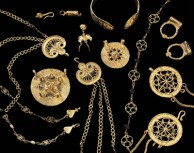 . . . In 1741, the curate Johann Georg Sulzer carried out a series of excavations at Lunnern, in the Reuss Valley near Zurich, leading to the discovery of a Roman temple, baths and a necropolis. On 17 November, he uncovered a hoard consisting of 17 pieces of gold jewellery and 84 silver coins, hidden in a recess. Three days later news of the sensational discovery reached Zurich. The painter Johann Balthasar Bullinger was commissioned to visit the site and produce a picture of the excavations. It was preserved along with the jewels in the art collection of the Wasserkirche in Zurich, before becoming part of the collections of the SNM. . .
◊ ◊ ◊ ◊ ◊
Lucy Davis & Christoph Martin Vogtherr, “A Taste for Blue,” Apollo Magazine (April 2012).
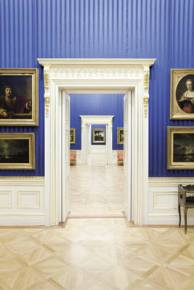 The Wallace Collection is famous for its exceptional group of works from the French 18th century. A smaller collection of around 150 Dutch 17th-century paintings is of equally fine quality, including masterpieces by Frans Hals, Rembrandt, Gerard ter Borch, Pieter de Hooch, Jan Steen, Gabriel Metsu, Caspar Netscher, Jacob van Ruisdael, Nicolaes Berchem, Philips Wouwermans and other leading painters of the Golden Age. It is particularly rich in genre paintings, landscapes by the Dutch Italianates and the work of some outstanding artists – Rembrandt first of all, but also Steen, Metsu, Willem van de Velde, Meindert Hobbema and Willem van Mieris. The resulting view of Dutch art does not provide a systematic overview but follows the personal preferences of the collectors and the typical view of Dutch art during the 18th and early 19th centuries. Artists such as Jan van Goyen, Hercules Seghers and Vermeer, but also the earlier periods before Rembrandt, are hardly represented. They were only admitted to the canon
at a time when the Hertford family had stopped collecting Dutch art. . .
◊ ◊ ◊ ◊ ◊
Juliet Carey, “A House of Cards: Taking Time,” Apollo Magazine (April 2012).
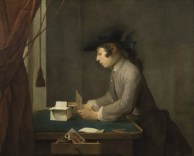 Waddesdon Manor is temporarily home to a small but extraordinarily beautiful group of works by one of the most revered of all French painters. The exhibition Taking Time: Chardin’s ‘Boy Building a House of Cards’ and Other Paintings is prompted by the recent acquisition of one of four works by Jean-Siméon Chardin (1699–1779) of a subject that particularly fascinated him. The last to enter the public domain, the Waddesdon canvas, is united for the first time with three other variations on the theme, on loan from national collections in France, Britain and the United States. . .
◊ ◊ ◊ ◊ ◊
Humphrey Wine, “The Art of a Connoisseur: Review of Pierre Rosenberg and Laure Barthélemy-Labeeuw, Les Dessins de la Collection de Pierre-Jean Mariette (2011),” Apollo Magazine (April 2012).
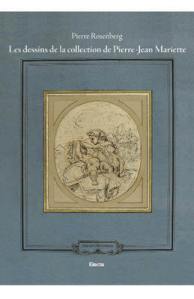 Soon after the death of Pierre-Jean Mariette (1694–1774) his heirs had Pierre François Basan organise a sale of his collection. It included paintings (among them Poussin’s Nurture of Bacchus, c. 1628, now in the National Gallery, London), terracottas, antique marbles, bronzes and engraved gems; the bulk of the sale, however, comprised some 9,000 Italian, Dutch, Flemish and French drawings. It was not only size that distinguished Mariette’s collection of drawings – the earlier collection of Pierre Crozat, built with Mariette’s advice, had been twice as large – but also its quality and comprehensive nature. . . .
Exhibition | The Art of German Stoneware
From the Philadelphia Museum of Art:
The Art of German Stoneware
Philadelphia Museum of Art, 5 May — 5 August 2012
Curated by Jack Hinton

Inkstand and Candleholder with Musicians, Animals, and a Griffin, ca. 1740. German Salt-glazed stoneware with painted decoration, roughly 20 x 10 x 7 in. (Philadelphia Museum of Art)
From the fourteenth through eighteenth centuries, stoneware ceramics from Germanspeaking centers in modern-day Germany and the Low Countries were valued and widely traded throughout northern Europe. In the 1600s—the heyday of stoneware production—they found an enthusiastic market in colonial North America. The medium’s success is due to its stonelike durability and imperviousness to liquid, making it perfect for cooking, storage, and drinking vessels. The social aspect of stoneware ceramics explains the crisp relief decoration on sixteenth- and seventeenth-century pieces, which feature moralizing images or political figures and their coats of arms; later pieces often eschew such ornament for floral or geometric patterns inspired by Far Eastern porcelains imported to Europe. Inkstand and Candleholder with Musicians, Animals, and a Griffindemonstrates the inventiveness and artistry of stoneware potters, even when faced with a dwindling market for their works in the homes of the well-to-do. This exhibition examines German stoneware from its origins to later revivals in the nineteenth-century and celebrates its long-standing relationship with the city of Philadelphia. It features selections from the Museum, seventeenth-century Dutch pictures demonstrating the high status of stoneware, and a generous promised gift of around forty pieces of German
stoneware from Dr. Charles W. Nichols. The exhibition is accompanied by an
illustrated publication by Jack Hinton, Assistant Curator of European Decorative
Arts and Sculpture.
◊ ◊ ◊ ◊ ◊
From Yale UP:
Jack Hinton, The Art of German Stoneware, 1300-1900 From the Charles W. Nichols Collection and the Philadelphia Museum of Art (New Haven: Yale University Press, 2012), 60 pages, ISBN: 9780300179781, $20.
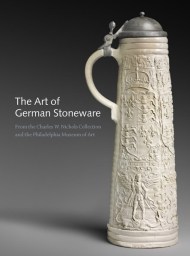 Beautiful and eminently useful, stonewares produced in the German-speaking lands from the Middle Ages onward were highly valued for their durability and suitability for a range of domestic and social uses. Widely traded throughout Europe, they were also among the first European ceramics to reach colonial North America. During the Renaissance the addition of brilliant salt glazes—s well as relief imagery that communicated with the user—raised the status of these wares. Later examples introduced abstract floral or geometric decorations and more unusual, original forms, which retained broad cultural significance.
About ninety fine stoneware pieces from the Philadelphia Museum of Art and a promised private collection testify here to the success, artful decoration, and fascinating variety of this medium. Jack Hinton describes the developments in stoneware through these notable examples, and beautiful color images bring
their details vividly to life.
Coming in May | ‘The London Square: Gardens in the Midst of Town’
From Yale UP:
Todd Longstaffe-Gowan, The London Square: Gardens in the Midst of Town (London: The Paul Mellon Centre for Studies in British Art, 2012), 348 pages, ISBN: 9780300152012, $65.
 Modern-day London abounds with a multitude of gardens, enclosed by railings and surrounded by houses, which attest to the English love of nature. These green enclaves, known as squares, are among the most distinctive and admired features of the metropolis and are England’s greatest contribution to the development of European town planning and urban form. Traditionally, inhabitants who overlooked these gated communal gardens paid for their maintenance and had special access to them. As such, they have long been synonymous with privilege, elegance, and prosperous metropolitan living. They epitomize the classical notion of rus in urbe, the integration of nature within the urban plan—a concept that continues to shape cities to this day.
Todd Longstaffe-Gowan delves into the history, evolution, and social implications of squares, which have been an important element in the planning and expansion of London since the early 17th century. As an amenity that fosters health and well-being and a connection to the natural world, the square has played a crucial role in the development of the English capital.
Todd Longstaffe-Gowan is a landscape architect with an international practice based in London. He is gardens adviser to Hampton Court Palace and is currently redesigning the gardens of Kensington Palace in London.
Exhibition | Animal Beauty in Paris
From the Grand Palais:
Beauté Animale / Animal Beauty
Grand Palais, Galeries Nationales, Paris, 21 March — 16 June 2012
Curated by Emmanuelle Héran
 Ever since the Renaissance, artists and naturalists have observed animals closely and represented them as accurately as they could. Nevertheless, naturalism ends where the norm and morality begin: various ethical and aesthetic criteria were established which influenced the artists’ point of view. There is extraordinary variety in the ways the same animal is represented. They reveal our fascination and curiosity for a world whose diversity is far from fully explored.
Through a set of major works, the exhibition looks at the relationships that artists, often great painters and sculptors, have developed with animals. It shows that there is still a close link between art and science, between our desire to know about animals and our fascination for their beauty. Paintings, drawings, sculptures, photographs, famous or unfamiliar… the exhibition brings together about 130 masterpieces of Western art from the Renaissance to the present day, and takes a radical new approach by choosing works in which the animal is shown on its own and for itself, without any human presence. This marvellous menagerie, laid out in a clear design accessible to all audiences, will mingle wild and domestic beasts, the strange and the familiar.
I. Looking at Animals
Just like human beauty, animal beauty must meet specific criteria, which vary with different periods and milieus. A revolution occurred at the Renaissance: outstanding artists such as Dürer, and then the pioneers of zoology studied animals closely and described them in minute detail. This was also when the discovery of the New World revealed new animals, such as parrots and turkeys. Repertoires were soon built up. As soon as they could study animals, painters kept a record of them in their albums, which they dipped into for motifs which had already inspired other works. They also worked on anatomical studies and tried to analyse motion, such as the movements of a galloping horse. But man was not content to represent animal beauty; he modified it, transforming the animals themselves, with all the means that science put at his disposal. New breeds of cows, dogs and cats appear in works of art. And conversely, paintings show us breeds that have gone out of fashion.
II. Aesthetic and Moral Prejudices (more…)
Reviewed | ‘Revolution! The Atlantic World Reborn’
Thomas Bender, Laurent Dubois, and Richard Rabinowitz, eds. Revolution! The Atlantic World Reborn (London: D. Giles Limited in association with the New-York Historical Society, 2011), 287 pages, ISBN: 9780916141240 (softcover), $45 / ISBN: 9781904832942 (hardcover), $65.
Reviewed for Enfilade by Jason Nguyen (Harvard University)
 In the lavishly illustrated catalogue for Revolution! The Atlantic World Reborn (on view at the New-York Historical Society through April 15, 2012), editors Thomas Bender, Laurent Dubois, and Richard Rabinowitz present a collection of eleven essays on the connections between the American, French, and Haitian Revolutions. Whereas traditional narratives have tended to treat the three events separately, the fourteen contributors to Revolution focus instead on their political, economic, and social junctures. “The point here is not to abandon or dilute national history,” Thomas Bender suggests in the catalogue’s first essay, “but rather to enrich it by revealing the ways in which historical causation operates across space as well as through time” (40).
The chain of political events linking the three revolutions is offered straightaway by Bender (and subsequently evaluated by his fellow contributors). The financial and military support that France provided to the United States in their War for Independence sent the European kingdom into a crippling debt that led to the calling of the Estates General in May of 1789. This event resulted in the establishment of the National Assembly and, consequently, the onset of the French Revolution. The rhetoric of the Revolution, and in particular the Déclaration des droits de l’Homme et du Citoyen (1789), helped to ignite abolitionist discourses and revolutionary fervor in the French colony of Saint-Domingue (present-day Haiti). And the political and military successes by the Haitians in the early years of the nineteenth century resulted in the selling of Louisiana by Napoleon to the United States in 1803, thus providing the young American nation with its first taste of continental expansion.
While each essay addresses at least one component of this transcontinental circuit of events, the scope of the catalogue is hardly limited to the political sphere. Cathy Matson, for example, reveals how the revolutions in France and Haiti nearly destabilized the commercial life among Philadelphia grain merchants in the last two decades of the eighteenth century. And in one of the catalogue’s more emotional contributions, Rebecca J. Scott and Jean M. Hébrard chronicle through a chain of legal documents and personal letters the tumultuous social and family life of Rosalie, an African-born inhabitant of Saint-Domingue who found herself the victim of sexual and racial slavery three times during the course of her life.
Rosalie’s story encapsulates two themes that course through the various essays. First is the focus on the peripheral within the predominant historical narrative, or as Richard Rabinowitz terms it, “history’s silences.” This can be noted by the prominence of the Haitian Revolution in the catalogue, with seven of the eleven contributions centering squarely on the global and local dealings of the Caribbean colony between 1791 and 1804. Of the remaining four essays, two focus on the economic and social situation in America, one addresses the broader global condition linking the revolutionary conflicts in the United States, France, and Haiti, and one presents the aims and intentions of the exhibition. The curatorial decision to cast increased light on the Haitian Revolution serves two purposes. The first concerns the marked absence within the general public consciousness of the social and political insurrections that transformed the former French colony. And the second speaks to its privileged status as the culmination (and, indeed, the ultimate test) of eighteenth-century revolutionary fervor. “As the most thoroughgoing of these upheavals,” Rabinowitz writes in the catalogue’s concluding essay, “at least in its destruction of slavery, imperial dependency, and constitutionally sanctioned inequalities — the Haitian revolution could be viewed as the climax of the entire age of Atlantic revolutions” (255).
The revolutionary quest for “freedom” rarely followed a straight path, however: it is this concern that serves as the second theme of the catalogue. Robin Blackburn, for example, carefully unpacks the means by which the slave uprisings in Saint-Domingue during the early 1790s mobilized the Enlightenment trope of “utility” in order to achieve social and economic liberty. The first clause of the Déclaration des droits de l’Homme et du Citoyen, she notes, clearly stated that, “Men are born, and always continue, free and equal in respect of their rights. Civil distinctions, therefore, can be founded only on public utility” (118). The Haitian rhetoric of freedom, therefore, served an instrumental purpose in broadening the social, cultural, and political conceits that made the revolutionary ideology in France possible in the first place. Laurent Dubois and Julius S. Scott press the significance of figurative speech further, examining how the Haitian revolutionaries deployed a host of linguistic symbols, often in conflict with one another. Sometimes Royalist and sometimes Republican, their words and texts eventually turned toward the possibility of national sovereignty, a declaration ultimately claimed in 1804. Yet, as the early decades of Haiti’s independence reveal, this situation too presented profound struggles, including local forms of political tyranny and crippling trade embargoes by both Napoleon’s French Empire and Jefferson’s United States.
The attention paid to verbal and textual rhetoric, however, marks the limit of the authors’ interest in representation, as the images within the catalogue serve mostly an illustrating function. Yet, as art historical contributions by Tim Barringer, Darcy Grimaldo Grigsby, and Jennifer L. Roberts, among others, have made clear, colonial and revolutionary images are profoundly complex, embodying in their very form the geo-political and ideological rupturing that marked the events of this period. “To paint is, at the most fundamental level, to incorporate,” noted Grigbsy in her groundbreaking 2002 analysis of Anne-Louis Girodet’s Portrait of Jean-Baptiste Belley (1797), which serves as the cover image for the Revolution catalogue. “Formal description reenacts that deceptively transparent act of inclusion … constituting Belley as picturing’s object (paint) and aggrandizing him as social subject (portraiture’s sitter) were deeply bound up with one another …”[1] Dubois and Scott acknowledge (while not specificing by name) contributions by Grigsby and others in their essay, “An African Revolution in the Atlantic World.” For them, however, Girodet’s painting – on loan for the exhibition from the Musée National du Château de Versailles – serves not as a problematic in and of itself. Instead, it stands as an optimistic visual prolepsis, demarcating through imagery a future that was never to be realized fully.
Such a critique should hardly detract from the merits of the catalogue, which lucidly present for a general audience the social, political, and economic connections linking the late eighteenth-century Atlantic world. Timely and provocative, it suggests that the each historical event carries with it profound global ramifications. And by tracing these connections (through texts, objects, and images), we might begin to understand better the universal aspirations for human equality and freedom.
[1] Darcy Grimaldo Grigsby, Painting Empire in Post Revolutionary France (New Haven: Yale University Press, 2002), p. 13.
Exhibition | Treasures of Kenwood House
Press release (9 December 2011) from the MFAH:
Rembrandt, Van Dyck, Gainsborough: The Treasures of Kenwood House, London
Museum of Fine Arts, Houston, 3 June — 3 September 2012
Milwaukee Art Museum, 4 October 2012 — 6 January 2013
Seattle Art Museum, 14 February — 19 May 2013
Arkansas Arts Center, Little Rock, 6 June — 8 September 2013
Curated by Susan Jenkins

Thomas Gainsborough, "Portrait of Mary, Countess Howe," ca. 1764 (London: Kenwood House, English Heritage, Iveagh Bequest)
On June 3, 2012, the Museum of Fine Arts, Houston, will debut the exhibition Rembrandt, Van Dyck, Gainsborough: The Treasures of Kenwood House, London, whose four-venue national tour was announced today by the American Federation of Arts in New York. An exhibition of forty-eight masterpieces, this will be the first tour of this important group of works from the Iveagh Bequest and will provide a unique opportunity to see these superb paintings outside the United Kingdom. Most of these paintings have never traveled to the States before, and many of them have rarely been seen outside Kenwood.
Donated to the nation by Edward Cecil Guinness (1847–1927), 1st Earl of Iveagh and heir to the world’s most successful brewery, the Iveagh Bequest resides at Kenwood House, a neoclassical villa in London that was remodeled by Robert Adam in the eighteenth century. The collection was shaped by the tastes of the Belle Epoque—Europe’s equivalent to America’s Gilded Age—when the earl shared the cultural stage and art market with other industry titans such as the Rothschilds, J. Pierpont Morgan and Henry Clay Frick. Acquired mainly from 1887 to 1891, the earl’s purchases reveal a penchant for the portraiture, landscape and seventeenth-century Dutch and Flemish works typically found in English aristocratic collections. While the majority of the paintings in the exhibition are from the Iveagh Bequest, several are drawn from the works acquired specifically for display at Kenwood. Pauline Willis, AFA’s Director, remarked, “We are extremely proud to be able to give greater exposure to this magnificent selection of paintings while Kenwood undergoes a major refurbishment.” Simon Thurley, Chief Executive for English Heritage, commented, “The collection of works of art on display at Kenwood is one of the most important in England, and we are thrilled that works from this collection will travel across the Atlantic for the first time and find new audiences in the United States.”
The collection is particularly strong in works by such Golden Age eighteenth-century English portraitists as Sir Joshua Reynolds, Thomas Gainsborough and George Romney, whose depictions of society beauties of the Georgian era, also known as England’s “Age of Aristocracy,” held a great appeal for Lord Iveagh. Among the several fine Gainsboroughs in the exhibition is the sumptuous full-length portrait Mary, Countess Howe (c. 1764), an image of both aristocratic elegance and of a landowner among her properties. Such full-length portraits of ladies in nature were very popular during this period, owing to a great admiration for the aristocratic portraits of Van Dyck. Along with such aristocratic women, the collection’s “virtual harem” of English portraits features celebrity demimondes, among them Emma Hart—later Lady Hamilton—who served as Romney’s muse, and Kitty Fisher—one of the most celebrated courtesans in London society. (more…)
New Gallery at Greenwich | Traders: The East India Company and Asia
From the National Maritime Museum:
Traders: the East India Company and Asia
National Maritime Museum, Greenwich, gallery opened in September 2011

◊ ◊ ◊ ◊ ◊
Established by a group of London merchants, the East India Company was given its first royal charter by Elizabeth I. By the time it was abolished 250 years later, Queen Victoria was on the throne. The East India Company took on pirates, princes and rival traders in its pursuit of profit – changing the world in the process. This new gallery at the National Maritime Museum explores the history and continuing relevance of Britain’s trade with Asia, looking at this compelling story through the lens of the East India Company. Traders: the East India Company and Asia examines the commodities that the company traded, the people that shaped its tumultuous career and the conflicts and rebellions that were its ultimate undoing.
The exotic spices the company imported brought exciting flavours to Britain. The calicos, muslins and silks carried on its ships shaped fashions, clothing rich and poor alike. But its greatest success was tea, which it helped transform from an expensive luxury to a national pastime. However, the British cup of tea had a darker side: opium. This illegal drug trade was interwoven with the company’s business, resulting in war with China on two separate occasions.

ISBN: 9781857596755, $60
The company can be seen as a forerunner of the modern multinational. But its power and global reach were unique. At its height, the company minted its own currency and ruled over a sixth of humanity. It had its own navy, the Bombay Marine, and had 250,000 soldiers at its command. Regarded by the British establishment as too big to fail, the Company was repeatedly bailed out and ended its days shrouded in controversy.
Traders: the East India Company and Asia showcases the museum’s world-famous collection of objects relating to Asia and the Indian Ocean, including: Japanese, Chinese and Burmese swords; beautifully crafted ship models and navigational instruments; Nelson’s Japan-pattern breakfast service; Victoria Crosses awarded during the Indian Mutiny; and journals kept by Company sailors.
The gallery also contains portraits of key figures from throughout the East India Company’s history including: Sir James Lancaster, commander of the first Company voyage; Jamsetjee Bomanjee Wadia, master shipbuilder at Bombay Dockyard; the ship-wrecked and imprisoned Robert Knox, said to be the inspiration for Defoe’s Robinson Crusoe; the appropriately named Money brothers, who made their fortunes in Asia; and Commodore Sir William James, a poor Welsh miller’s son who ran away to sea, and rose to become commodore of the Bombay Marine and Chairman of the Company.
To celebrate the opening of Traders the National Maritime Museum staged a festival of events throughout autumn and winter 2011. Traders Unpacked, sponsored by Sharwood’s, explored the complex legacy of the EIC and its contemporary significance though events including a textile-themed walking tour of London’s East End; an alternative East India Company pub quiz; an evening of Japanese psychedelia; Singaporean deep house and sea shanties; the Curry and a Pint nights, which explored the origins of the great British curry; a series of international tea parties; and a night of nautical games for grown-ups.
The gallery is accompanied by an illustrated history of the Company, which draws extensively on the collections of the Museum. Monsoon Traders: the Maritime World of the East India Company is published by Scala and written by Robert J. Blyth and John McAleer, curators of Imperial and Maritime History at the National Maritime Museum and H. V. Bowen, Professor of Modern History, Swansea University.
◊ ◊ ◊ ◊ ◊
Writing for The New York Times (4 November 2011), Roderick Conway Morris provides a review of the exhibition.
Gardening at Monticello
The perfect way to launch a book, and this book, in particular? A garden party at Monticello, of course! From Monticello:
Book Party Launch for ‘A Rich Spot of Earth’: Thomas Jefferson’s Revolutionary Garden
Monticello, 23 April 2012
Celebrate the launch of Peter Hatch’s “A Rich Spot of Earth”: Thomas Jefferson’s Revolutionary Gardenat Monticello. Join us for an elegant garden party with the author as he discusses his pioneering new book. This gorgeous volume tells the history of Jefferson’s unique vegetable garden at Monticello and uncovers his lasting influence on American culinary, garden, and landscape history. The book also showcases the 1980s project that restored the garden to its original glory.
◊ ◊ ◊ ◊ ◊
From Yale UP:
Peter J. Hatch, ‘A Rich Spot of Earth’: Thomas Jefferson’s Revolutionary Garden at Monticello (New Haven: Yale University Press, 2012), 280 pages, ISBN: 9780300171143, $35.

"Peter Hatch’s vibrant and enthusiastic passion for preserving Thomas Jefferson's farming legacy at Monticello reminds us all of the time-tested continuity and historical root of this kind of agriculture." - Alice Waters, from the Foreword
Were Thomas Jefferson to walk the grounds of Monticello today, he would no doubt feel fully at home in the 1,000-foot terraced vegetable garden where the very vegetables and herbs he favored are thriving. Extensively and painstakingly restored under Peter J. Hatch’s brilliant direction, Jefferson’s unique vegetable garden now boasts the same medley of plants he enthusiastically cultivated in the early nineteenth century. The garden is a living expression of Jefferson’s genius and his distinctly American attitudes. Its impact on the culinary, garden, and landscape history of the United States continues to the present day.
Graced with nearly 200 full-color illustrations, “A Rich Spot of Earth” is the first book devoted to all aspects of the Monticello vegetable garden. Hatch guides us from the asparagus and artichokes first planted in 1770 through the horticultural experiments of Jefferson’s retirement years (1809–1826). The author explores topics ranging from labor in the garden, garden pests of the time, and seed saving practices to contemporary African American gardens. He also discusses Jefferson’s favorite vegetables and the hundreds of varieties he grew, the half-Virginian half-French cuisine he developed, and the gardening traditions he adapted from many other countries.
As Director of Gardens and Grounds at Monticello since 1977, Peter J. Hatch has been responsible for the maintenance, interpretation, and restoration of its 2,400-acre landscape. He has written several previous books on Jefferson’s gardens and is an advisor for First Lady Michelle Obama’s White House kitchen garden. He lives in Charlottesville, VA.










 Enfilade
leave a comment