Exhibition | Daily Pleasures: French Ceramics
From LACMA:
Daily Pleasures: French Ceramics from the MaryLou Boone Collection
Los Angeles County Museum of Art, 6 October 2012 — 31 March 2013
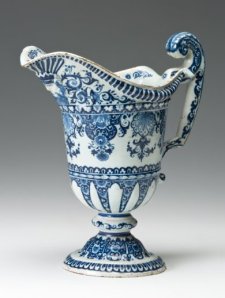
Ewer, c. 1700, Rouen, France, Earthenware with tin glaze and enamel (grand feu faïence), 11 x 11 in. LACMA, Gift of MaryLou and George Boone in honor of the museum’s twenty-fifth anniversary, M.2010.51.1, Photo © Susan Einstein.
Long-time LACMA benefactor MaryLou Boone has amassed the West Coast’s finest collection of French faience and soft-paste porcelain, 25 pieces of which she gave to LACMA in 2010. (Although originally made to emulate hard-paste porcelain imported into Europe from Asia, faience and soft-paste porcelain ultimately became distinctive and sought-after ceramics in their own right.)
The exhibition comprises over 130 pieces from the foremost manufactories of the era, representing myriad aesthetic influences, as well as advances in technology and the rhythms of domestic life. The collection includes wares for dining and taking tea, for storing the many toiletries necessary for a stylish appearance, and for preparing mixtures that comforted in time of sickness. Inextricably intertwined with every day duties and diversions, these objects provide a unique view of French life and culture.
The accompanying exhibition catalogue, Daily Pleasures: French Ceramics from the MaryLou Boone Collection, includes more than 145 entries of French faience and porcelain from the collection, as well as essays about the collector and 17th and 18th-century French ceramics.
◊ ◊ ◊ ◊ ◊
From ACC Distribution:
Elizabeth Williams and Meredith Chilton, Daily Pleasures French Ceramics from the MaryLou Boone Collection (Los Angeles: Los Angeles County Museum of Art, 2012), 392 pages, ISBN: 9780875872155, $75.
 MaryLou Boone’s collection of French ceramics spans the reigns of some of France’s most fascinating kings, from Louis XIII to Louis XVI, yet the collection is not one of royal vases and princely gifts but, rather, of wares for dining and taking tea, of porcelain frivolities, and of ceramics for the sickroom and the pharmacy. Mrs. Boone – a collector, scholar, and donor – has amassed the West Coast’s finest collection of 17th and 18th-century French faience and soft-paste porcelain, objects that provide a unique view of French life and culture. Emphasizing the aesthetics French ceramics and also its functionality, the catalogue comprises over 130 collection entries, as well as essays on the collector, ceramics in 17th-18th century France, French faience and its makers and French porcelain and its makers. Although originally created to emulate Asian porcelain, faïence and soft-paste porcelain ultimately became distinctive and sought-after ceramics in their own right.
C O N T E N T S
• Michael Govan and John Murdoch — Foreword
• Elizabeth Williams — Introduction
• Map of Manufactories
• Victoria Kastner — MaryLou Boone: The Accidental Collector
• Meredith Chilton — The Pleasures of Life: Ceramics in Seventeenth- and Eighteenth-Century France
• Antoinette Faÿ-Hallé — French Faience from Its Origins to the Nineteenth Century
• Antoinette Faÿ-Hallé — Faience Manufactory Histories
• Faience Catalogue
• Meredith Chilton — Porcelain Production in Seventeenth- and Eighteenth-Century France
• Meredith Chilton — Porcelain Manufactory Histories
• Porcelain Catalogue
• Marks Appendix
• Glossary
• Selected Bibliography
• Illustration Credits
• Index
Meredith Chilton is an independent art historian and was the founding curator of the Gardiner Museum of Ceramic Art in Toronto from 1983 to 2004. She has curated many exhibitions, published extensively and lectured internationally. Antoinette Faÿ-Hallé is Conservateur général honoraire du Patrimoine and Ancien directeur du musée national de Céramique, Sèvres where she worked as both a conservator and director. She has organized many ceramic and glass exhibitions and written extensively on the history of ceramics. Catherine Hess is Chief Curator of European Art at The Huntington Art Collections in San Marino, California. She is responsible for a collection particularly strong in Renaissance bronzes, 18th-Century French decorative arts, and 18th-Century British portraiture. Victoria Kastner, the Historian at Hearst Castle, has published several books and holds graduate degrees in architectural history and museum management. Elizabeth A. Williams is the Marilyn B. and Calvin B. Gross Assistant Curator of the Decorative Arts and Design department at the Los Angeles County Museum of Art.
New Title | J. B. Fischer von Erlach: Architecture as Theater
From Yale UP:
Esther Gordon Dotson and Mark Richard Ashton, J. B. Fischer von Erlach: Architecture as Theater in the Baroque Era (New Haven: Yale University Press, 2012), 184 pages, ISBN: 9780300166682, $75.
 Though little known in the English-speaking world, Johann Bernhard Fischer von Erlach (1656-1723) was one of the most important and influential European baroque architects. The buildings that he designed for the emperor of Austria and his courtiers reveal an element of theatricality—an element that author Esther Gordon Dotson probes in this attractive volume.
In his architectural designs, Fischer incorporated devices from ceremonial pageantry and scene design, controlled lighting effects, and a sense of dramatic progression in approaching and moving through a building. Dotson identifies these various elements in her close reading of Fischer’s structures, and splendid new photographs, taken by Mark Richard Ashton, bring them to life on the printed page. The author also delves into Fischer’s past and his writings to explain the impact his awareness of architectural history, his early employment by designers of street-festival pageants and his relationships with others involved in such staged productions had upon his architectural designs. Dotson guides readers in discovering the theatrical qualities in Fischer’s buildings, illuminating their conceptual liveliness, variety, drama, and enduring beauty.
At the time of her death in October 2009, Esther Gordon Dotson was professor emerita in the Department of the History of Art at Cornell University. Mark Richard Ashton is an independent scholar and photographer in Ithaca, New York.
Exhibition | Stories in Sterling: Four Centuries of Silver in New York
From the New-York Historical Society:
Stories in Sterling: Four Centuries of Silver in New York
New-York Historical Society Museum & Library, 4 May — 2 September 2012

Brandywine bowl (brandewijnkom), silver, ca. 1700 (New-York Historical Society) — Brandywine bowls are traditionally associated with the Dutch New York ritual of the kindermaal, a celebratory feast held in honor of a mother and her newborn child within ten days of the birth. The guests, predominantly female, feasted on sweet cakes and communally sipped a potent brew of brandy and raisins from a bowl such as this.
Stories in Sterling: Four Centuries of Silver in New York, highlights the histories of 150 notable examples of silver from the New-York Historical Society’s collection. Made across the span of four centuries, the objects in the exhibition tell a diversity of stories: many speak to individual accomplishment and family pride, while a few have unsettling ties or backgrounds. The silver, ranging from simple spoons to extravagant trophies, culled from a trove of over 3,000 objects, includes powerful eyewitness artifacts linked to significant moments in the history of New York and the United States.
Stories in Sterling interprets these compelling objects within a cultural context, focusing on the men and women that made, used, and treasured these objects. The exhibition is organized thematically and addresses issues of silver patronage, usage of objects, rituals of presentation and the meanings of silver as they evolved over time. The exhibition will be enriched by a judicious selection of paintings, prints, photographs, manuscripts, furniture and other documents that illuminate the silver, help bring to life the individuals who acquired it and illustrate the physical context in which it was used.
Objects in the exhibition span the sixteenth through the twentieth centuries, with a concentration on silver of the eighteenth and nineteenth centuries. While the majority of objects were made in New York, some were crafted as far afield as England, the Netherlands, France, as well as China, Jamaica, and Argentina. All of the silver is firmly connected through its ownership to New York, highlighting the cosmopolitan nature of the city as early as the seventeenth century. For instance, the examples of Dutch silver brought to New York by early settlers, as well as the many imports from England, help chart cultural shifts, taste, and stylistic influence in colonial America and the early years of the nation.
◊ ◊ ◊ ◊ ◊
From the publisher:
Margaret K. Hofer with Debra Schmidt Bach, Stories in Sterling Four Centuries of Silver in New York (London: Giles, 2012), 352 pages, ISBN: 9781904832652, $70.
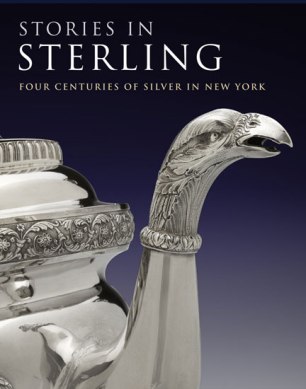 Stories in Sterling is the first comprehensive survey of the New-York Historical Society’s superb collection of early American silver, one of the finest in the United States. It features the full range of silver works, from masterpieces like the 1772 salver by New York City silversmith Lewis Fueter, to the simpler, but no less significant teapot made for the Schuyler family by the Albany silversmith Kiliaen Van Rensselaer in 1695 – one of the earliest teapots made in New York.
Seven chapters consider silver from a range of perspectives: its reflection of the multiethnic character of colonial New York; the impact of industrialization on its manufacture and consumption; its role in honouring public achievement or marking rites of passage; and, finally, its ability to express its owners’ social standing. With a wealth of related objects and original documents, Stories in Sterling is a vital reference tool for for scholars, collectors and enthusiasts of American silver and culture. It features extensive and superbly illustrated entries
with full dimensions, makers’ marks and weights in troy ounces,
and an appendix and checklist.
Margaret K. Hofer is curator of Decorative Arts at the New-York Historical Society, where she has organized numerous exhibitions, including A New Light on Tiffany (2007), which she co-authored. Debra Schmidt Bach, associate curator at the New-York Historical Society organized the exhibition The Grateful Dead: Now Playing at the New-York Historical Society,(2010). Kenneth Ames is professor of American Decorative Arts and Material Culture of the 18th and 19th-centuries at the Bard Graduate Center, New York. His publications include Beyond Necessity: Art in the Folk Tradition; Death in the Dining Room and Other Tales of Victorian Culture (1995). David Barquist is curator of American Decorative Arts at Philadelphia Museum of Art, and a scholar on colonial New York silver. He is the author of Myer Myers Jewish Silversmith in Colonial New York (2001).
Exhibition | Migrations: Journeys into British Art
From Tate Britain:
Migrations: Journeys into British Art
Tate Britain, London, 31 January — 12 August 2012

Benjamin West, Pylades and Orestes Brought as Victims before Iphigenia, 1766 (London: Tate), N00126
This exhibition explores British art through the theme of migration from 1500 to the present day, reflecting the remit of Tate Britain Collection displays. From the sixteenth- and seventeenth-century Flemish and Dutch landscape and still-life painters who came to Britain in search of new patrons, through moments of political and religious unrest, to Britain’s current position within the global landscape, the exhibition reveals how British art has been fundamentally shaped by successive waves of migration. Cutting a swathe through 500 years of history, and tracing not only the movement of artists but also the circulation of visual languages and ideas, this exhibition includes works by artists from Lely, Kneller, Kauffman to Sargent, Epstein, Mondrian, Bomberg, Bowling andthe Black Audio Film Collective as well as recent work by
contemporary artists.
◊ ◊ ◊ ◊ ◊
From the Tate Shop:
Lizzie Carey-Thomas, Migrations: Journeys into British Art (London: Tate, 2012), 128 pages, ISBN: 9781849760072, £15.
 With contributions by John Akomfrah, Tim Batchelor, Sonia Boyce, Emma Chambers, T.J. Demos, Kodwo Eshun, Leyla Fakhr, Paul Goodwin, Nigel Goose, Karen Hearn, David Medalla, Lena Mohamed, Panikos Panayi and Wolfgang Tillmans.
This book offers a unique perspective on the history of British art, charting how it has been shaped by successive waves of migration. It cuts a swathe through five hundred years of history and traces not only the movement of artists themselves, but also the circulation of art and ideas, from the hugely influential arrival of Northern European artists such as Anthony van Dyke in the sixteenth and seventeenth centuries to the influence of Italy and the development of neoclassicism on eighteenth-century artists such as Benjamin West, and on to the broad cultural interchange of the Victorian era. James McNeill Whistler and John Singer Sargent were two of many artists who moved between Britain, France and the United States in the nineteenth century. In the early twentieth century, David Bomberg and Mark Gertler were among the group of second-generation Jewish artists who played a considerable role in the establishment of British modernism. The rise of fascism in the 1930s, causing artists such as Oskar Kokoschka and Kurt Schwitters to flee to Britain, foreshadowed the explosion of a multicultural diaspora. Several generations of artists have since explored what it means to be both ‘black’ and ‘British’, and contemporary artists continue to investigate the meaning of identity today.
Generously illustrated, and including artist interviews and texts by leading curators and art critics, this illuminating book tells a previously hidden but vital story in the shaping of British art and culture.
New Title | The Breathless Zoo
An exceptional title, an exceptional cover. For the latter, credit goes to Karen Knorr; the photograph, “Corridor,” is from her Fables series (2007). From Penn State UP:
◊ ◊ ◊ ◊ ◊
Rachel Poliquin, The Breathless Zoo: Taxidermy and the Cultures of Longing (University Park: Penn State University Press, 2012), 272 pages, ISBN: 9780271053721, $35.
 From sixteenth-century cabinets of wonders to contemporary animal art, The Breathless Zoo: Taxidermy and the Cultures of Longing examines the cultural and poetic history of preserving animals in lively postures. But why would anyone want to preserve an animal, and what is this animal-thing now? Rachel Poliquin suggests that taxidermy is entwined with the enduring human longing to find meaning with and within the natural world. Her study draws out the longings at the heart of taxidermy—the longing for wonder, beauty, spectacle, order, narrative, allegory, and remembrance. In so doing, The Breathless Zooexplores the animal spectacles desired by particular communities, human assumptions of superiority, the yearnings for hidden truths within animal form, and the loneliness and longing that haunt our strange human existence, being both within and apart from nature.
Rachel Poliquin is a writer and curator engaged with the cultural and poetic history of the natural world. She has curated taxidermy exhibits for the Museum of Vancouver and the Beaty Biodiversity Museum at the University of British Columbia. Poliquin is the author of ravishingbeasts.com, a website dedicated to exploring the cultural history of taxidermy.
New Title | Sheltering Art: Collecting and Social Identity
From Penn State University Press:
Rochelle Ziskin, Sheltering Art: Collecting and Social Identity in Early Eighteenth-Century Paris (University Park: Penn State University Press, 2012), 392 pages, ISBN: 9780271037851.
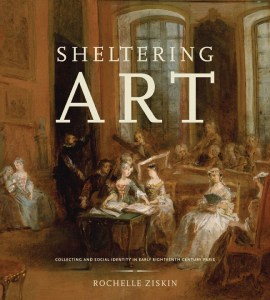 The turn of the eighteenth century was a period of transition in France, a time when new but contested concepts of modernity emerged in virtually every cultural realm. The rigidity of the state’s consolidation of the arts in the late seventeenth century yielded to a more vibrant and diverse cultural life, and Paris became, once again, the social and artistic capital of the wealthiest nation in Europe. In Sheltering Art, Rochelle Ziskin explores private art collecting, a primary facet of that newly decentralized artistic realm and one increasingly embraced by an expanding social elite as the century wore on. During the key period when Paris reclaimed its role as the nexus of cultural and social life, two rival circles of art collectors—with dissonant goals and disparate conceptions of modernity—competed for preeminence. Sheltering Art focuses on these collectors, their motivations for collecting art, and the natures of their collections. An ambitious study, it employs extensive archival research in its examination of the ideologies associated with different strategies of collecting in eighteenth-century Paris and how art collecting was inextricably linked to the shaping of social identities.
Contents
List of Illustrations
Acknowledgments
Abbreviations
Introduction
1 Cultural Geography of the French Capital Circa 1700
2 Cloistered in the Faubourg Saint-Germain
3 The Maison Crozat Transformed
4 A Circle of “Moderns”
5 The Regent and Collecting on the Right Bank
6 Les Anciens and an Expanding Public Realm in the Arts
7 The Circles Converge: Carignan and Jullienne
Conclusion
Note on the Appendixes
Appendixes
1 Maison Crozat, rue de Richelieu, in 1740
2 Hôtel de Verrue, rue du Cherche-Midi, end of 1736
3 Collections of Lériget de La Faye, Glucq de Saint-Port, and Lassay
4 Collections of Nocé and Fonspertuis
5 Hôtel de Morville, rue Plâtrière, in 1732
6 Selections from the Collection of Carignan
Notes
Selected Bibliography
Index
New Title | Slavery and the Culture of Taste
From Princeton UP:
Simon Gikandi, Slavery and the Culture of Taste (Princeton: Princeton University Press, 2011), 386 pages, ISBN: 9780691140667, $45.
 It would be easy to assume that, in the eighteenth century, slavery and the culture of taste–the world of politeness, manners, and aesthetics–existed as separate and unequal domains, unrelated in the spheres of social life. But to the contrary, Slavery and the Culture of Taste demonstrates that these two areas of modernity were surprisingly entwined. Ranging across Britain, the antebellum South, and the West Indies, and examining vast archives, including portraits, period paintings, personal narratives, and diaries, Simon Gikandi illustrates how the violence and ugliness of enslavement actually shaped theories of taste, notions of beauty, and practices of high culture, and how slavery’s impurity informed and haunted the rarified customs of the time.
Gikandi focuses on the ways that the enslavement of Africans and the profits derived from this exploitation enabled the moment of taste in European–mainly British–life, leading to a transformation of bourgeois ideas regarding freedom and selfhood. He explores how these connections played out in the immense fortunes made in the West Indies sugar colonies, supporting the lavish lives of English barons and altering the ideals that defined middle-class subjects. Discussing how the ownership of slaves turned the American planter class into a new aristocracy, Gikandi engages with the slaves’ own response to the strange interplay of modern notions of freedom and the realities of bondage, and he emphasizes the aesthetic and cultural processes developed by slaves to create spaces of freedom outside the regimen of enforced labor and truncated leisure.
Through a close look at the eighteenth century’s many remarkable documents and artworks, Slavery and the Culture of Taste sets forth the tensions and contradictions entangling a brutal practice and the distinctions of civility.
Simon Gikandi is the Robert Schirmer Professor of English at Princeton University.
◊ ◊ ◊ ◊ ◊
July 2012 Issue of the Journal of the History of Collections
The following selection of articles from the current issue address the eighteenth century (access to full texts will require institutional subscriptions).
◊ ◊ ◊ ◊ ◊
Journal of the History of Collections 24 (July 2012)
A R T I C L E S
 Thomas Ketelsen and Christien Melzer, “The Gottfried Wagner Collection in Leipzig: Insights into a Middle-Class Private Collection of c. 1700,” pp. 199-218.
[Abstract] [Full Text] [PDF]
Cristiano Giometti, “‘Per accompagnare l’antico’: The Restoration of Ancient Sculpture in Early Eighteenth-Century Rome,” pp. 219-30.
[Abstract] [Full Text] [PDF]
David A. Wisner, “French Neo-Classical Artists and Their Collections,” pp. 231-42.
[Abstract] [Full Text] [PDF]
B O O K R E V I E W S
Nicholas Tromans, “Review of Spanish Art in Britain and Ireland, 1750-1920: Studies in Reception in Memory of Enriqueta Harris Frankfort, edited by Nigel Glendinning and Hilary Macartney (2010),” pp. 276-77.
[Full Text] [PDF]
Exhibition | Drawings from the Christian and Isabelle Adrien Collection
Didier Rykner reviewed the exhibition for The Art Tribune in May (with an English version available). From the museum’s website:
Une Collection Particulière: Les Dessins de la Collection Christian et Isabelle Adrien
Le Musée des Beaux-Arts de Rennes, 21 March — 26 August 2012
 Le musée des Beaux-Arts de Rennes présentera, à partir du 21 mars, les plus belles feuilles de la collection de dessins de Christian et Isabelle Adrien. Au hasard des rencontres, à la lumière de quelques intuitions fulgurantes, M. Adrien a inlassablement cherché et étudié, tout au long de sa vie, les feuilles dessinées par les grands maîtres du passé. C’est à Rennes que ce collectionneur d’origine bretonne invite aujourd’hui le public à venir partager sa passion pour le dessin ancien. La découverte de près de quatre-vingt dessins français (La Hyre, Poussin, Boucher), italiens (Bandinelli, Salviati, Carraci) et nordiques (Bloemaert, Rubens), dont beaucoup sont encore inédits, marquera l’un des temps fort de la Semaine du dessin 2012 et de la programmation culturelle rennaise du printemps et de l’été prochain. Le catalogue de l’exposition, qui rassemble les notices des plus grands spécialistes de
chaque artiste, est dirigé par Monsieur Rosenberg, de l’Académie française.
◊ ◊ ◊ ◊ ◊
Catalogue: Francis Ribemont and Pierre Rosenberg, Dessins de la collection Christian et Isabelle Adrien (Paris: Editions Chaudun, Musée des beaux-arts de Rennes, 2012), 207 pages, ISBN: 9782350391281, $77.50. [Available from ArtBooks.com]
Exhibition | Messerschmidt and Modernity
Press release (16 April 2012) from The Getty:
◊ ◊ ◊ ◊ ◊
Messerschmidt and Modernity
The J. Paul Getty Museum, Getty Center, Los Angeles, 24 July — 14 October 2012

The Getty Celebrates the Modern and Contemporary Legacy of Franz Xaver Messerschmidt’s Distinctive Character Heads
◊ ◊ ◊ ◊ ◊

Ken Gonzales-Day, Untitled (Franz Xaver Messerschmidt, The Vexed Man, The J. Paul Getty Museum, Los Angeles, CA), 2008. Light jet print. Courtesy of Ken Gonzales-Day and Fred Torres Collaborations, N.Y.C. © Ken Gonzales-Day
The intriguing series of heads that are collectively known as Character Heads, created by the German Baroque artist Franz Xaver Messerschmidt (1736–1783) during the last 13 years of his life, have become increasingly popular with the general public through a series of recent exhibitions and books devoted to these expressive works. Furthermore, the sculptures, depicting various states of emotion and expression, have also captured the imaginations of generations of artists—especially during the 20th and 21st centuries.
Messerschmidt and Modernity, on view at the J. Paul Getty Museum from July 24 through October 14, 2012, is the first exhibition to explore the contemporary legacy of these surprisingly modern-looking sculptures, which were carved in alabaster, or cast in a lead or tin alloy. Along with Messerschmidt’s works, the exhibition will feature a selection of modern and contemporary works of art that testify to the lasting impact of these astonishing heads. Eight Character Heads will be exhibited—among them the Getty’s own Vexed Man— along with a newly discovered reduced variation of a now-lost Character Head known as A Cheeky Nitpicky Mocker, which has never before been exhibited publicly. Contemporary artists featured in the exhibition include Tony Bevan, Tony Cragg, Ken Gonzales-Day, Bruce Nauman, Pierre Picot, Arnulf Rainer, Cindy Sherman, and Emily Young.
“Messerschmidt’s Character Heads have appealed to audiences since they were first produced. They were especially popular in turn-of-the-century Vienna and subsequently inspired modern artists of the 20th century,” explains Antonia Boström, senior curator of sculpture and decorative arts at the J. Paul Getty Museum. “Now, this unparalleled series of sculptures is enjoying a renewed popularity—not only fascinating to museum audiences and scholars, but compelling for contemporary artists.”
The exhibition demonstrates how Messerschmidt’s heads are linked to the 18th and 19th centuries’ fascination with expression and the “passions,” as well as with the pseudosciences of physiognomy and pathognomy. It also traces how this series has influenced the work of artists in fin-de-siècle Vienna and contemporary artists in Austria, Great Britain, and the United States.
Messerschmidt
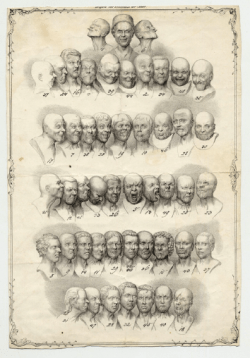
Matthias Rudolph Toma, Messerschmidt’s ‘Character Heads’, 1839. Lithograph. Courtesy of the Museum of Fine Arts, Budapest.
The German-born Messerschmidt led a successful career in Vienna in the mid-18th century, receiving many important commissions from the Habsburg empress Maria Theresa and her consort, Francis Stephen of Lorraine. Messerschmidt’s circumstances changed dramatically around 1770 when he began to show signs of mental instability, leading to the loss of prestigious commissions and conflicts with colleagues and friends. He eventually left Vienna and, in 1777, he settled in Pressburg (now Bratislava), and remained there until his death in 1783, focusing obsessively on the production of the heads as well as more conventional portraits. Messerschmidt called the dozens of heads he created between 1770 and 1783 Kopfstücke (head pieces) and intended them to represent the full range of human expressions, which he believed there are sixty-four. In 1793, ten years after his death, the heads were exhibited at the Citizen’s Hospital in Vienna, when, despite their misrepresentation, they also received the often incongruous titles by which they are still referred to today. They were only referred to as “Character Heads” after Messerschmidt’s death.
Just Rescued from Drowning belongs to a group of alabaster Character Heads probably depicting the same man, but differentiated by the arrangement of the hair. The title suggests that he has just been submerged in water, and his lank hair (or a wig) hangs down over his forehead, but the hairstyle may actually reflect those featured on Gothic sculptures of southern Germany, which would have been familiar to Messerschmidt from his youth.
Another head on view, The Ill-Humored Man, belongs to a group of middle-aged bald men within the series of Character Heads. The man’s tightly squeezed eyes and the flat strip covering his mouth contribute to a strong sense of alienation and interiority and we sense his extreme discomfort. The object covering the mouth may relate to the magnets that the German physician Franz Anton Mesmer (1734–1815) applied to patients during his therapeutic sessions. They formed part of his “animal magnetism” theory that a universal magnetic fluid coursing through the human body could be manipulated by magnets for curative purposes. Mesmer and Messerschmidt were known to be friends and these experimental procedures were of great interest to the artist.
The French artist Joseph Ducreux (1735–1802) was a contemporary of Messerschmidt, and as a painter at the court in Vienna he was probably familiar with his sculpture. Like Messerschmidt, Ducreux was interested in the pseudoscience of physiognomy, and his Self-Portrait, Yawning (by 1783, Getty Museum’s permanent collection) is an example of his experiments with the expressive possibilities of portraiture.
Some forty-nine of the sixty-nine heads Messerschmidt created are accounted for today. A lithograph on view in the exhibition has been a key element in reconstructing the series of Messerschmidt’s heads. Created by Matthias Rudolph Toma after a drawing by Josef Hasslwander, this print (from Budapest) depicts forty-nine of the heads and was made four years after the heads were publicly exhibited in 1835 by their then-owner, Josef Jüttner.
The psychological theme of Messerschmidt’s sculptures and their uncompromising aesthetic colored their public reception in Vienna. After his death and throughout the early 19th century the Character Heads were viewed as oddities and exhibited in Vienna for popular entertainment. Over time, this perception changed and by the end of the 19th century the heads were seen as useful examples of expression and emotion for art students to copy, and for students of anatomy and psychology to study. Some of the heads found their way into art-school storerooms in Vienna, while others were collected both by preeminent medical professionals and by art collectors. By the turn of the century the Character Heads found favor with Vienna’s Jewish cultural elite, which supported avantgarde art movements such as the Viennese Secession and the Wiener Werkstätte, and also had links to Sigmund Freud. Their interests in unconventional contemporary art and the science of psychiatry combined to create a new culture of support for Messerschmidt’s heads in Vienna.
Modernity and Beyond
The works created since 1900 on view in the exhibition represent a wide range of responses to the Character Heads. Modern and contemporary artists have been drawn to Messerschmidt’s heads for their perceived departure from the confines of academic convention. But it is also the combination of a reductive style, refined modeling and carving,
and exaggerated expression that make these sculptures resonate with modern audiences. By the early 20th century, Messerschmidt’s heads were well known in Vienna, and prized by collectors and artists as distinctive and affecting works of art. Anton Josef Trčka’s renowned 1914 portrait photograph of Egon Schiele (1890–1918) reflects the visual and psychological impact of Messerschmidt’s grimacing heads. The camera focuses closely on the artist’s head and hands; his anxious expression and interlocked fingers hint at his angst-ridden mood.
Contemporary artists such as Arnulf Rainer (b. 1929) and Tony Bevan (b. 1951) directly quote Messerschmidt’s sculptures, while others, including Bruce Nauman (b. 1941) and Cindy Sherman (b. 1954), incorporate their body, human expression, and self-portraiture into their work in a way that prompts comparison with Messerschmidt. The sculptures of Tony Cragg (b. 1949) and Emily Young (b. 1951) are more indirectly related, though the sculptors’ grounding in a figurative tradition and their exploration of the material’s expressive potential can be paralleled in Messerschmidt’s works. The juxtaposition of works from different time periods in this section of the exhibition illustrates the psychological power that Messerschmidt’s Character Heads continue to have for the contemporary viewer.
Expression Lab
The final gallery of the exhibition is designed to encourage visitors to consider and respond to Messerschmidt’s sculptures and the contemporary works focused on expression. The gallery is installed with mirrors, art reproductions, and an interactive “photo booth” for those who wish to actively explore and record their own facial expressions. For example, Rainer practiced “pulling faces” in the mirror, performing and documenting a series of contorted expressions as a means of investigating his own image. Using mirrors, visitors will be able to try these exercises themselves. In the photo booth, participants will be invited to replicate the intense facial expression of the Vexed Man or other character heads, or to invent an expression of their own choosing. Visitors may then share their photo on video screens in the gallery. A related video will be shown and reference books will be on hand for those who wish to learn more about Messerschmidt and expression, and about the other artists represented in the exhibition.
An audio tour, narrated by Boström and guest contributor Professor Eric Kandel, a Nobel-prize winning neuroscientist and author of The Age of Insight: The Quest to Understand the Unconscious in Art, Mind, and Brain, from Vienna 1900 to the Present, will accompany the exhibition. Messerschmidt and Modernity will also be accompanied by a richly illustrated book of the same name, written by Antonia Boström and published by Getty Publications.
◊ ◊ ◊ ◊ ◊
From the Getty Store:
Antonia Boström, Messerschmidt and Modernity (Los Angeles: Getty Publications, 2012), 80 pages, ISBN: 9780892369744, $20.
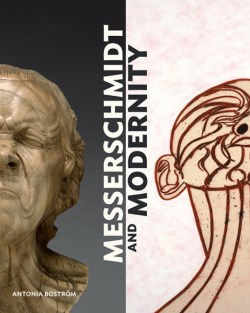 An astonishing group of sixty-nine “Character Heads” by German sculptor Franz Xaver Messerschmidt (1736–1783) has fascinated viewers, artists, and collectors for more than two centuries. The heads, carved in alabaster or cast in lead or tin alloy, were conceived outside the norm of conventional portrait sculpture and explore the furthest limits of human expression. Since their first exposure to the public in 1793, artists, including Egon Schiele (1890–1918), Francis Bacon (1909–1992), Arnulf Rainer (born 1929), and, more recently, Tony Cragg (born 1949) and Tony Bevan (born 1951), have responded to their over- whelming visual power.
Lavishly illustrated, Messerschmidt and Modernity presents remarkable works created by and inspired by Messerschmidt, an artist both of and ahead of his time. The Character Heads situate the artist’s work squarely within the eighteenth-century European Enlightenment, with its focus on expression and emotion. Yet their uncompromising style stands in sharp contrast to the florid Baroque style of Messerschmidt’s earlier sculptures for the court of Empress Maria Theresa of Austria. With their strict frontality and narrow silhouettes, the Character Heads appear to contemporary eyes as having been conceived in a “modern” aesthetic. Their position at the apparent limits of rational art have made them compelling to successive generations of artists working in a variety of media. An exhibition of the same name will be on view at the Getty Center from July 24 through October 14, 2012.
Antonia Boström is senior curator of sculpture and decorative arts at the J. Paul Getty Museum and the editor of The Fran and Ray Stark Collection of 20th-Century Sculpture in the J. Paul Getty Museum (Getty, 2008).










leave a comment