Reviewed: The English Virtuoso
On a personal note, I want to say how much I appreciate Janice Neri’s thoughtful review. Her reading of my book is, I think, careful and fair. More importantly, her questions and criticisms are spot-on. Thanks as well to Laura Auricchio for doing such a terrific job coordinating reviews as the field editor for the eighteenth century! -CH
Recently added to caa.reviews:
Craig Ashley Hanson, The English Virtuoso: Art, Medicine, and Antiquarianism in the Age of Empiricism (Chicago: University of Chicago Press, 2009), 344 pages, ISBN: 9780226315874, $50.
Reviewed by Janice Neri, Boise State University; posted 28 December 2011.
To the modern day reader, hospitals and scientific societies might seem to be unlikely settings for exhibiting and discussing contemporary art. In ‘The English Virtuoso: Art, Medicine, and Antiquarianism in the Age of Empiricism‘, Craig Ashley Hanson shows how it made perfect sense that such venues would foster art theory and practice in seventeenth- and eighteenth-century England. The leading role in this book is played by the figure of the virtuoso, whose eclectic interests were united under the umbrella of curiosity. Encompassing activities as wide ranging as medicine (learned and unlearned), classical studies, and art collecting, patronage, practice, and theory, Hanson’s study of English virtuoso culture makes an important contribution to an understanding of the intellectual foundations of art scholarship and writing. In illuminating the complex world of the virtuoso, this insightful book also shows how early forms of interdisciplinarity actually worked. Drawing connections between the seventeenth and eighteenth centuries, ‘The English Virtuoso’ provides an opportunity to reflect on the ways that boundaries were often blurred between intersecting areas of knowledge. . . .
The full review is available here» (CAA membership required)
Reviewed: Architectural Space in Eighteenth-Century Europe
Recently added to caa.reviews:
Denise Amy Baxter and Meredith Martin, eds., Architectural Space in Eighteenth-Century Europe: Constructing Identities and Interiors (Burlington: Ashgate, 2010), 284 pages, ISBN: 9780754666509), $119.95.
Reviewed by Heather Hyde Minor, University of Illinois, Urbana-Champaign; posted 13 December 2011.
Eighteenth-century Europe was home to a dazzling array of architectural interiors, from priest-holes designed to hide ecclesiastics from Protestant authorities in England to the home theaters of courtesans in Paris. Diverse characters populated these domains. Bluestockings gathered in a Chinoiserie room while guests waited to be served refreshments before taking in Europe’s premier public collection of ancient sculpture.
‘Architectural Space in Eighteenth-Century Europe’ examines all of these environments and personages, exploring the role architecture and interiors played in fashioning identity in the eighteenth century. The ten essays that it gathers together seek to demonstrate that these spaces served to form a sense of self in creative ways. The book’s editors, Denise Amy Baxter and Meredith Martin, are to be commended for addressing this important question, one that spans a range of fields, and for gathering essays written by scholars from a range of disciplines. Contributing to the recent explosion of interest in eighteenth-century interiors, the volume builds on the work of Katie Scott, Mimi Hellman (both of whom are cited in the introduction), and others. . . .
The full review is available here» (CAA membership required)
Exhibition: Royalists to Romantics
The following exhibition soon opens at the National Museum of Women in the Arts (in conjunction, artist-in-residence Celia Reyer will be creating a Brunswick traveling coat inspired by 18th-century fashion). -AH
◊ ◊ ◊ ◊ ◊
Royalists to Romantics: Women Artists from the
Louvre, Versailles, and Other French National Collections
National Museum of Women in the Arts, Washington, D.C., 24 February — 29 July 2012

Rose Adélaïde Ducreux, "Portrait of the Artist," ca. 1799 (Rouen: Musée des beaux-arts)
In keeping with its mission to rediscover and celebrate women artists of the past and demonstrate their continued relevance, the National Museum of Women in Arts (NMWA) presents Royalists to Romantics: Women Artists from the Louvre, Versailles, and Other French National Collections. The exhibition features 77 paintings, prints, and sculptures dating from 1750 to 1850—many of which have never been seen outside of France. To develop the exhibition, NMWA spent months scouring the collections of dozens of French museums and libraries to cull rarely-seen works by women artists. Royalists to Romantics showcases these exceptional works and reveals how the tumultuous period that saw the flowering of the court of Louis XVI and Marie Antoinette, the terrors of the French revolution, the rise and fall of Napoleon, and the restoration of the monarchy affected the lives and careers of women artists.
Featuring 35 artists, including Marguerite Gérard, Antoine Cecile Haudebourt-Lescot, Adélaïde Labille-Guillard, Sophie Rude, Anne Vallayer-Coster, and Élisabeth Louise Vigée-Lebrun, the exhibition explores the political and social dynamics that shaped their world and influenced their work. Some of these artists flourished with support of such aristocratic patrons as Marie Antoinette, who not only appointed her favorite female artists Élisabeth Louise Vigée-LeBrun and Anne Vallayer-Coster to court, but advocated their acceptance into the Académie Royale de peinture et de sculpture. The political upheavals of the French Revolution and the following decades brought a new set of challenges for women artists. Royalists to Romantics explores the complex ways that women negotiated their cultural positions and marketed their reputations in France’s shifting social, political and artistic environment.
Royalists to Romantics: Women Artists from the Louvre, Versailles, and other French National Collections has been organized by the National Museum of Women in the Arts, Washington, D.C., with logistical support from sVo Art, Versailles.
◊ ◊ ◊ ◊ ◊
 Laura Auricchio, Melissa Hyde, and Mary D. Sheriff have contributed essays to the catalogue:
Jordana Pomeroy, ed. Royalists to Romantics: Women Artists from Versailles, the Louvre, and Other French National Collections (New York: Scala Publishers, 2012), 144 pages, ISBN: 9781857597431, $45.
This beautifully illustrated book examines eighteenth-century French theories of sexual difference and their influence on the ‘woman-artist question’; paradoxical Revolutionary attitudes toward women artists, who encountered as many new limitations as opportunities; and the complex ways that women marketed their reputations and managed their cultural positions in France’s intricate social and artistic hierarchy.
Kark Kirk to Head up Getty Publications
Press release (25 January 2012) from the Getty:
 The J. Paul Getty Trust announced today the appointment of Kara Kirk as publisher of Getty Publications, effective April 13. Kirk, who was chosen after an international search, most recently served for six years as associate publisher at The Museum of Modern Art (MoMA) in New York, where she worked on all aspects of the publications process, from editorial development to distribution and sales. In addition, she managed a variety of new media projects and worked as part of a museum-wide team to develop a strategic plan for MoMA’s digital publishing initiatives.
Prior to moving to New York, Kirk served as the Getty’s general manager of publications from 2002–2006. Previously, she was the director of publications and graphic design at the San Francisco Museum of Modern Art. She holds an MLA from Stanford University and a BA from Pomona College.
As publisher, Kara will work to ensure that the Getty is a leader in art publishing in both print and new media. “Our goal is to create a list that reflects the Getty’s current activities and aspirations, one that builds on a record of excellence to achieve real eminence,” said Deborah Marrow, director of the Getty Foundation, who oversees the work of Getty Publications. “We are delighted that Kara will be the one to guide us on this path.”
“I am delighted to be returning to the Getty and to have the chance to work with such a stellar team. It is an interesting moment to be a publisher and I look forward to addressing the many challenges and opportunities afforded by the changing terrain to insure that the Getty continues to make valuable and lasting contributions to art history publishing.
Reviewed: Fordham’s ‘British Art and the Seven Years’ War’
Recently added to caa.reviews:
Douglas Fordham, British Art and the Seven Years’ War: Allegiance and Autonomy (Philadelphia: University of Pennsylvania Press, 2010), 352 pages, ISBN: 9780812242430, $65.
Reviewed by Kay Dian Kriz, Brown University; posted 8 December 2011.
In ‘British Art and the Seven Years’ War: Allegiance and Autonomy’, Douglas Fordham offers an original and provocative re-interpretation of the emergence of public art and art institutions in eighteenth-century Britain. Scholars have long noted that the 1750s and 1760s were marked by increasing concern about the development and institutionalization of a school of British art. “Why,” Fordham asks, “did the visual arts become a pressing national concern at this moment in Britain’s history?” (1) He argues that any answer to such a question must take into account the “transformative place in British culture” (2) occupied by the Seven Years’ War, which was fought in the middle of this time period (1756–63). And indeed, cultural, political, and military history were deeply intertwined at this moment when the British Empire in America was firmly secured through a war that has largely been overlooked by art historians.
Books about art and war usually focus on military painting; Fordham’s book is much more expansive and ambitious, being concerned with the effects of militarism on the development and organization of the arts, as well as on their subject matter. . . .
The full review is available here» (CAA membership required)
Exhibition: Piranesi at the Hermitage
From the Hermitage:
Ruins, Palaces and Prisons: Piranesi and Italian Eighteenth-Century Architectural Fantasies
State Hermitage Museum, St Petersburg, 7 December 2011 — 25 March 2012
Curated by A.V. Ippolitov, M.F. Korshunova, and V.M. Uspenskiy
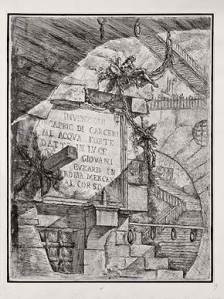
Piranesi, Title page of the 'Carceri' series, 1749-1750
On December 7th, 2011, Saint Catherine’s day, the State Hermitage Museum welcomed an exhibition entitled Ruins, Palaces and Prisons: Giovanni Battista Piranesi and Italian Eighteenth-Century Architectural Fantasies, dedicated to the early period of Piranesi’s work. This exhibit is being held as part of the Year of Italy in Russia and Year of Russia in Italy 2011 program, which continues tradition of partnership and cooperation between the two countries in the fields of art and culture.
This exhibition, presenting about 100 drawings and prints from the collection of the Hermitage, is divided into two parts: the first is dedicated to Piranesi and will present the series entitled Prima Parte (“Prima Parte “), Grotteschi (“Grotesques”) and Carceri (“Dungeons”) in their rare original condition, which have never been published in Russia before. All of them are from the 1750 album Opere Varie, which was acquired by the Empress Catherine the Great in 1768 as part of the collection of Count Bruhl and became the basis of the graphic arts collection of the Hermitage. The Carceri is presented in two conditions; the early one, from the Bruhl
collection, and a later one which was extensively revised. This is the first
time this sort of juxtaposition has been presented in Russia.

Piranesi, "Drawbridge," A page from the 'Carceri' series, 1749-1750
The second part consist of drawings by Italian artists of the 18th century who worked as scene decorators, designers and architects and created the unique genre of imaginative Veduta, which is important for understanding the style of the settecento, as the 18th century is called in Italian, a unique and complex phenomenon. Imaginative Veduta is represented by the work of the Galli Bibiena family, G. Valeriani, Pietro Gonzaga, G. Barbari, G. Mannocchi, many of which are being published for the first time. The phenomenon of Piranesi’ early fantasies is put in the context of a unique genre, and is examined at this exhibit as original sources, as is the influence of the Piranesi phenomenon on the later development of imaginative Veduta.
Giovanni Battista Piranesi (1720-1778) has an enduring place in the history or art as an artist who defined European art in the mid 18th- early 19th century. Piranesi is acknowledged as a reformer of public taste and one of the progenitors of neoclassicism, which might be called the Avant Garde of the 18th century, and as such his name is associated with this movement. However, while the series of etching entitled Carceri (dungeons), a procession of frightening, inexplicable and obscure images was not well known in the artist’s life, was many decades ahead of its time. Carceri become of the works of art most beloved by modernism. This series, which was not particularly popular during Piranesi’s life, a rediscovery of Romanticism attracted writers, architects, directors then and continues to do so now not only with its unusual subject matter, but also with its unusual spatial construction, which reminds one not of real architecture, but of the unreal space of a dream or hallucination. (more…)
Reviewed: Trio of Books on the Dilettanti and Antiquarianism
Recently added to caa.reviews:
Bruce Redford, Dilettanti: The Antic and the Antique in Eighteenth-Century England, exhibition catalogue (Los Angeles: Getty Trust Publications, 2008), 232 pages, ISBN: 9780892369249, $49.95.
Ilaria Bignamini and Clare Hornsby, Digging and Dealing in Eighteenth-Century Rome, 2 volumes (New Haven: Yale University Press, 2010), 622 pages, ISBN: 9780300160437, $85.
Jason M. Kelly, The Society of Dilettanti: Archaeology and Identity in the British Enlightenment (New Haven: Yale University Press, 2010), 366 pages, ISBN: 9780300152197, $75.
Reviewed by Susan Dixon, University of Tulsa; posted 1 December 2011.
These three recent books explore an eighteenth-century British engagement with classical archaeology during a time when the practice was transforming from an early modern antiquarianism into a modern scientific discipline. Two of the books are monographic studies of the Society of the Dilettanti, an organization that became known for its support of unprecedented archaeological activity in Greece, while a third outlines how British subjects, some of whom were Dilettanti, undertook archaeological excavations on Italian soil and refurbished, sold, and bought the antiquities found there. In some measure, all the authors note this engagement as integral to shaping British cultural identity in the eighteenth century, and in this way add to robust scholarship on the issue. . . .
The full review is available here» (CAA membership required)
Submissions for the Oscar Kenshur Book Prize
Oscar Kenshur Book Prize
Applications due by 31 January 2012
The Center for Eighteenth-Century Studies at Indiana University is pleased to announce its annual book prize, to be awarded for an outstanding monograph of interest to eighteenth-century scholars working in a range of disciplines. The prize honors the work of Oscar Kenshur, professor emeritus of comparative literature at Indiana University, a dix-huitièmiste par excellence, and one of the founding members of the Center.
Submissions in English from any discipline are welcome; authors can submit their work irrespective of citizenship. Multi-authored collections of essays and translations, as well as books by members of the Indiana-University-Bloomington faculty, are not eligible. The Kenshur prize of $1000 will be awarded together with an invitation to the Center for Eighteenth-Century Studies for a workshop dedicated to the winning book, in which several colleagues will discuss the book from different disciplinary perspectives. The Center will cover the author’s expenses to attend this event.
To be eligible for this year’s competition, a book must carry a 2011 copyright date. Submissions can be made by the publisher or the author: three copies must be received at the ASECS office by the 31st of January 2012. Please send the books (clearly marked for Kenshur Prize) to ASECS, 2598 Reynolda Rd., Suite C, Winston-Salem, NC 27106. For further inquiries please contact Professor Mary Favret, Director of the Center for Eighteenth-Century Studies at Indiana University (email favretm@indiana.edu).
Reviewed: Meredith Martin’s ‘Dairy Queens’
Recently added to caa.reviews:
Meredith Martin, Dairy Queens: The Politics of Pastoral Architecture from Catherine de’ Medici to Marie-Antoinette, Harvard Historical Studies, vol. 176 (Cambridge: Harvard University Press, 2011), 336 pages, ISBN: 9780674048997, $45.
Reviewed by Jean-François Bédard; posted 3 November 2011.
Among the most fanciful objects commissioned by the French monarchy is a pair of Sèvres porcelain pails designed for Marie-Antoinette’s pleasure dairy at the Château de Rambouillet. They are shaped like tinettes—wooden buckets used on ordinary dairy farms for making fresh cheese—and painted with wood grain to imitate their rustic models. Like Marie-Antoinette’s mock hamlet at Trianon, the Rambouillet pails are outlandish inventions of the pastoral movement in literature and art, which celebrated naturalness with contrived theatricality. As the ill-fated monarch so cruelly experienced, bourgeois sensibilities soon lashed out at this noble ostentation. To pre-Revolutionary critics of the society of orders, a queen masquerading as a dairy maid in a luxurious simulated farm was particularly odious. Marie-Antoinette’s pastoral persona triggered venomous accusations of social irresponsibility, political usurpation, and even sexual deviance that contributed to her downfall and still taint her reputation.
The pastoral has not always elicited such heated reactions. In her amusingly titled book, Meredith Martin sets out to rehabilitate this courtly art form. Looking beyond the alleged frivolity of pastoral art and architecture, Martin emphasizes the crucial role they played in the social and political self-fashioning the French nobility, most notably the queens, forged for itself. Her discussion focuses on the pleasure dairy—known in French as the ‘laiterie d’agrément’, or ‘laiterie de propreté’, to distinguish it from the functioning dairy (laiterie de préparation). . . . Martin makes a convincing case for the importance of pleasure dairies as sites of empowerment for French noblewomen. . . .
The full review is available here» (CAA membership required)
Reviewed: ‘Thomas Lawrence: Regency Power and Brilliance’
Recently added to caa.reviews:
Cassandra Albinson, Peter Funnell, and Lucy Peltz, eds., Thomas Lawrence: Regency Power and Brilliance, exhibition catalogue (New Haven and London: Yale Center for British Art, National Portrait Gallery, London, and Yale University Press, 2011), 280 pages, ISBN: 9780300167184, $70.
Reviewed by Bruce Redford; posted 17 November 2011.
‘How various he is!’ Thomas Gainsborough’s tribute to Joshua Reynolds applies equally well to their successor in grand-manner portraiture. It is one of the signal achievements of ‘Thomas Lawrence: Regency Power and Brilliance’ that it removes any lingering traces of the negative stereotype: Lawrence the slick, formulaic sycophant who prostituted his gifts in the service of a decadent Regency elite. In its place this wide-ranging exhibition and thoughtful catalogue substitute a dynamic, probing, and inventive explorer of human psychology—one who is keenly attentive to the interplay of surface and depth, social mask and private self. Even Lawrence’s most public statements create a form of co-extensive space: not by breaking the picture plane, as in Caravaggio for instance, but by drawing the viewer into an
electric zone of intimacy. . . .
The full review is available here» (CAA membership required)










 Enfilade
leave a comment