November 2011 Issue of ‘Art History’
Eighteenth-century offerings from the November 2011 issue:
Andrei Pop, “Sympathetic Spectators: Henry Fuseli’s Nightmare and Emma Hamilton’s Attitudes,” Art History 34.5 (November 2011): 934-57.
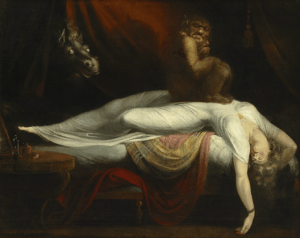
Henry Fuseli, "The Nightmare," 1781, exhibited in 1782 at the Royal Academy of London (Detroit Institute of Arts)
Abstract: Henry Fuseli’s painting The Nightmare (1782), unusual in the artist’s oeuvre and in the painting of its time as the public visualization of a private mental state, can be made sense of in light of late eighteenth-century practices and theories of privacy and of the agency that minds can exert on the world on on each other. By comparison with another dream-like performance, Emma Hamilton’s Attitudes, and informed by David Hume’s theory of sympathy, which was designed to explain the social communicability of mental states, a reading of The Nightmare emerges which shows that it did not aim to make visible dream imagery, but to induce spectators to have or feel as if they had an analogous experience. The painting is thus typical of the formative stage of a modern understanding of public life as a contingent
association of private lives.
Andrei Pop studied art history at Stanford and Harvard Universities and is a postdoctoral fellow at the Universität Berlin. The present essay is part of Neopaganism, a book in progress on the cultural politics of classicism. His article on Fuseli and tragedy will appear in the March 2012 Art Bulletin. His translation, together with Mechtild Widrich, of Karl Rosenkranz’s Aesthetics of Ugliness (1853) is forthcoming.
◊ ◊ ◊ ◊ ◊
Steven Adams, “Amateurs and Revolutionaries in Eighteenth-century France,” Art History 34.5 (November 2011): 1042-46.
 Review of Charlotte Guichard, Les Amateurs d’art à Paris au XVIII siècle (Paris: Champ Vallon, 2008); Laura Auricchio, Adélaïde Labille-Guiard: Artist in the Age of Revolution (Los Angeles: Getty Publications, 2009); and Rolf Reichardt and Hubertus Kohle, Visualizing the Revolution: Politics and the Pictorial Arts in Late Eighteenth-century France (London: Reaktion Books, 2008).
◊ ◊ ◊ ◊ ◊
Marion Endt-Jones, “Commemorative Reconsiderations,” Art History 34.5 (November 2011): 1053-56.
 Review of Diana Donald and Jane Munro, eds., Endless Forms: Charles Darwin, Natural Science, and the Visual Arts (New Haven and London: Yale Center for British Art, 2009); and Andrew Graciano, ed., Visualizing the Unseen: Imagining the Unknown, Perfecting the Natural: Art and Science in the 18th and 19th Centuries (Newcastle: Cambridge Scholars Publishing, 2008).
◊ ◊ ◊ ◊ ◊
Editor’s Note: At February’s CAA meeting in Los Angeles, there is an entire session, sponsored by the Midwest Art History Society, on the subject of The Nightmare. -CH.
Icons of the Midwest: Henry Fuseli’s Nightmare
Wednesday, 22 February, 12:30–2:00
Chairs: Laura Gelfand (Utah State University) and Judith Mann (Saint Louis Art Museum)
• Salvador Salort-Pons (Detroit Institute of the Arts), Living with Fuseli’s Nightmare
• Beth S. Wright (University of Texas at Arlington), ‘As I Was Perpetually Haunted by These
Ideas’: Fuseli’s Influence on Mary Shelley’s Mathilda and Frankenstein
• Scott Bukatman (Stanford University), Dreams, Fiends, and Dream Screens
Exhibition: French Drawings in Grenoble

Jean-François-Pierre Peyron, “Curius Denatus refusant les présents
des ambassadeurs Samnites,” XVIIIe siècle, Musée de Grenoble
◊ ◊ ◊ ◊ ◊
Currently on display at the Musée de Grenoble, as noted by Hélène Bremer . . .
L’idée et la ligne – Dessins français
Musée de Grenoble, 5 November 2011 — 12 February 2012
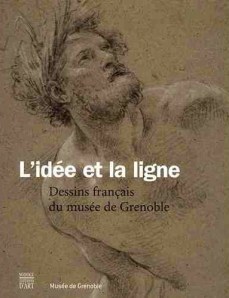 Après la présentation de ses plus belles feuilles italiennes, le musée de Grenoble met en valeur son extraordinaire fonds de dessins français. De la Renaissance à la fin du XVIIIe siècle, les plus grands artistes répondent présents. Nicolo dell’Abate, appelé pour travailler à Fontainebleau, offre une introduction magistrale à un parcours graphique qui puise ses sources en Italie. Laurent de la Hyre, Simon Vouet, Philippe de Champaigne, Patel, Charles Mellin, Charles Alphonse Dufresnoy ou François Perrier illustrent brillament les tendances d’une école française qui s’affirme et prend peu à peu son indépendance face à l’Italie. Le Brun, Noël Coypel, Jean-Baptiste de Champaigne, Louis de Boulogne et Charles de la Fosse poursuivent les avancées sous Louis XIV. La partie la plus riche et paradoxalement la moins connue de cette collection concerne le XVIIIe siècle : Boucher, Pierre ou Huber Robert viennent marquer le triomphe de la couleur et de la nature. Feuillet après feuillet, un pan entier de l’histoire de l’art française se dessine
sous nos yeux.
◊ ◊ ◊ ◊ ◊
Catalogue: Guillaume Kazerouni, Barbara Brejon de Lavergnée, Jérôme Delaplanche and Pierre Rosenberg, L’idée et la ligne: Dessins français du musée de Grenoble, XVIe-XVIIIe siècle (Paris: Somogy éditions d’art, 2011), 240 pages, ISBN: 9782757204818, €35.
Exhibition: Boxes and Objets de Vertu
From the Cognacq-Jay, as noted by Hélène Bremer . . .
Boîtes en or et objets de vertu
Cognacq-Jay Museum, Paris, 21 December 2011 — 6 May 2012
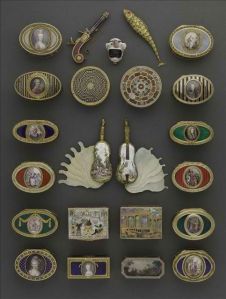 A l’occasion de la parution du Catalogue raisonné des Boîtes en or et objet de vertu, le musée Cognacq-Jay expose cet hiver sa riche collection de boîtes, tabatières, étuis, boîtes à rouge, à mouches, nécessaires de toilette, à écrire… Avec 240 objets, celle-ci est l’une des plus importantes des musées français.
Chefs-d’œuvre de l’orfèvrerie, en or, enrichis de pierres dures ou précieuses, d’émail, de porcelaine, d’ivoire ou de nacre. . . étaient dès le XVIIIe siècle l’objet d’orgueil et de convoitise Leur forme était parfois étrange, prenant l’apparence d’un dromadaire, d’un tatou, d’une jambe, d’une tête, d’un violoncelle. . . Leur usage, participant aux rituels de la vie quotidienne, témoigne des pratiques de la sociabilité au Siècle des Lumières : le tabac, les modes cosmétiques, le jeu. . .
L’exposition mettra exceptionnellement en lumière cette collection, au moyen d’une scénographie originale et surprenante, et en réunissant autour de ces
objets des dessins, des gravures pour mieux comprendre leurs secrets de
fabrication et leur usage.
◊ ◊ ◊ ◊ ◊
Catalogue: Objets de Vertus, Boites, Tabatieres, Etuis et Necessaires Collections D’Orfevrerie (Paris: Paris Musées, 2011), ISBN: 9782759601813, €44.
Holiday Gift Guide, Part 2: Food
By Courtney Barnes and Craig Hanson
Culinary gifts — whether primarily about cooking or eating — regularly appear on holiday wish lists, but how much more fun it could be to give a taste of the eighteenth century.
◊ ◊ ◊ ◊ ◊
1. A Two-Day Historic Food Course with Ivan Day on Georgian Cookery — With forty years of experience cooking period food, Day is well-known for recreating historic tables, particularly in museum contexts. He’s also worked in television and radio and written books and articles on the history of English food. To judge from the website, I think it would be an incredibly fun experience — even better with four or five friends (Day’s blog, Food History Jottings, is also pretty wonderful). From the Historic Food website:
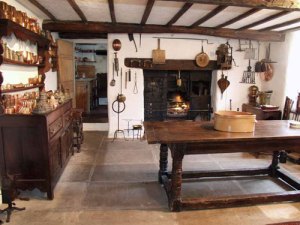
Ivan Day's Historic Food kitchen in Cumbria
We are located at Wreay Farm, a small seventeenth-century farmhouse in Cumbria, on the edge of the Lake District National Park. The farmhouse kitchen (known locally as a firehouse) is equipped with a wide range of antique kitchen utensils and a roasting range complete with clockwork jacks. It has frequently been used as a television kitchen (recently in the US Food Network’s Food Fit for a King and for BBC2 Open University’s Open Minds). We also have a confectionery room and a small bakehouse with wood-fired oven. We limit our group size to six participants per course, which means you get plenty of individual attention. . .
And if this isn’t enough to tempt you, there’s a lovely account of Day’s period sugarworks course at Fiona Leahy Designs (from May 2010).
◊ ◊ ◊ ◊ ◊
2. A Visual Feast at Houston’s Rienzi House — We noted the exhibition back in August here at Enfilade, but a visit to English Taste: The Art of Dining in the Eighteenth Century (organized by the Museum of Fine Arts Houston and installed, incidentally, by Day) would be a lovely way to spend an afternoon during the holidays. From the MFAH website:
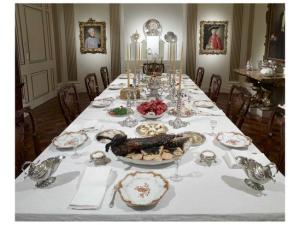 The 18th-century English dinner table was a feast for the eyes. In order to impress their guests and assure them that they were dining amid fashionable people of consequence, hosts served sumptuous dishes, adorned with towering sugar constructions and amusing trompe l’oeil (fool-the-eye) jellies of playing cards or bacon and eggs, all on exquisite silver and porcelain.
Rienzi re-creates this elaborate dining experience in English Taste: The Art of Dining in the Eighteenth Century. The first special exhibition ever held at Rienzi, the MFAH house museum for European decorative arts, English Taste treats you to a dining-room extravaganza typical of a 1760s English country house. Lifelike fish, fowl, and flummeries—complete with lavish, Georgian silver fittings and place settings—grace the table, created with guidance from the influential period cookbook The Experienced English Housekeeper by Elizabeth Raffald, the “Martha Stewart of the 18th century.”
◊ ◊ ◊ ◊ ◊
3. A Taste of Life at Mount Vernon — Stephen McLeod, ed., Dining with the Washingtons: Historic Recipes, Entertaining, and Hospitality from Mount Vernon (Chapel Hill: University of North Carolina, 2011), 224 pages, 9780807835265 $35. From the publisher:
 Combining vivid photography with engaging essays, Dining with the Washingtons explores the menus, diet, and styles of entertaining that characterized the beloved home of the nation’s principal founding father. Compelling accounts, historic artwork, and images of gardens, table settings, prepared food, and objects from the Mount Vernon collection blend to shed fresh light on the daily lives of George and Martha Washington, on their ceaseless stream of household guests and those who served them, and on the ways food and drink reflected the culture of eighteenth-century America. . .
Janet Blyberg provides a fine sampling of the book at her blog, JCB.
◊ ◊ ◊ ◊ ◊
4. A Guide to Kitchens in Eighteenth-Century France — If the food gets you wondering about the cooks who produced it, this new book might be just the thing for a cold winter day, ideally curled up next to a crackling fire. From the Johns Hopkins UP:
Sean Takats, The Expert Cook in Enlightenment France (Baltimore: Johns Hopkins University Press, 2011), 216 pages, 9781421402833, $60.
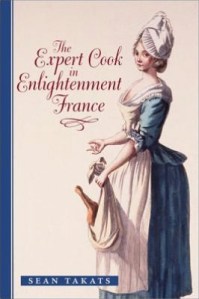 In the eighteenth-century French household, the servant cook held a special place of importance, providing daily meals and managing the kitchen and its finances. In this scrupulously researched and witty history, Sean Takats examines the lives of these cooks as they sought to improve their position in society and reinvent themselves as expert, skilled professionals. Much has been written about the cuisine of the period, but Takats takes readers down into the kitchen and introduces them to the men and women behind the food. It is only in that way, Takats argues, that we can fully recover the scientific and cultural significance of the meals they created, and, more important, the contributions of ordinary workers to eighteenth-century intellectual life. He shows how cooks, along with decorators, architects, and fashion merchants, drove France’s consumer revolution, and how cooks’ knowledge about a healthy diet and the medicinal properties of food advanced their professional status by capitalizing on the Enlightenment’s new concern for bodily and material happiness. The Expert Cook in Enlightenment France explores a unique intersection of cultural history, labor history, and the history of science and medicine. Relying on an unprecedented range of sources, from printed cookbooks and medical texts to building plans and commercial advertisements, Takats reconstructs the evolving role of the cook in Enlightenment France.
◊ ◊ ◊ ◊ ◊
 5. Dinner at Husk or McCrady’s in Charleston, South Carolina — Over the past year, Sean Brock has managed to astound quarters of America’s food establishment that don’t necessarily pay much attention to the South. Writing in The New York Times in February, for instance, Sam Sifton judged the experience “well worth . . . the flight from New York.” In September, Bon Appétit named Husk the year’s Best New Restaurant in America, and Brock has been featured in a dizzying array of publications from Esquire to The New Yorker. In the latter, Burkhard Bilger details what’s driving Brock’s success — an intense commitment to traditional Southern ingredients that have all but disappeared from the American table. There’s nothing purely eighteenth-century going on here, but there is a profound if simple point to be made: without ingredients that were used two or three centuries ago, it’s ultimately impossible to recreate what people ate. We can only hope this is more than just a passing trend and that other regions with rich culinary histories take up the challenge.
Panel Discussion of ‘The Image of the Black in Western Art’
From the National Gallery:
Image of the Black in Western Art, Part II
National Gallery of Art, Washington DC, 11 December 2011
Panel discussion includes David Bindman, emeritus professor of the history of art, University College London; Henry Louis Gates Jr., Alphonse Fletcher University Professor and director of the W. E. B. Du Bois Institute for African and African American Research, Harvard University; and Sharmila Sen, general editor for the humanities, Harvard University Press. Moderated by Faya Causey, head of academic programs, National Gallery of Art. Book signing of The Image of the Black in Western Art (volumes 1-3) follows. Sunday, 11 December 2011, 2:00pm, East Building Concourse, Auditorium.
◊ ◊ ◊ ◊ ◊
David Bindman and Henry Louis Gates, Jr., eds., associate editor Karen C. C. Dalton, The Image of the Black in Western Art Volume III: From the ‘Age of Discovery’ to the Age of Abolition, Part 3: The Eighteenth Century (Cambridge: Harvard University Press, 2011), 400 pages, ISBN 9780674052635, $95.
 In the 1960s, art patron Dominique de Menil founded an image archive showing the ways that people of African descent have been represented in Western art. Highlights from her collection appeared in three large-format volumes that quickly became collector’s items. A half-century later, Harvard University Press and the Du Bois Institute are proud to publish a complete set of ten sumptuous books, including new editions of the original volumes and two additional ones.
The Eighteenth Century features a particularly rich collection of images of Africans representing slavery’s apogee and the beginnings of abolition. Old visual tropes of a master with adoring black slave gave way to depictions of Africans as victims and individuals, while at the same time the intellectual foundations of scientific racism were established.
Exhibition: Winter Tales, from Bruegel to Beuys
From the Kunsthistorisches Museum:
Winter Tales: Depictions of Winter in European Art from Bruegel to Beuys
Kunsthistorisches Museum, Vienna, 18 October 2011 — 8 January 2012
Kunsthaus Zurich, 10 February — 29 April 2012
Curated by Ronald de Leeuw

Joshua Reynolds,"Lady Caroline Scott as Winter," 1776. Collection of the Duke of Buccleuch and Queensberry, Bowhill, Selkirk, Scotland (Photo: Wikimedia Commons)
The creation myths of most great civilizations agree that winter came into the world to punish man, or as a plague. Boreas, the Greek god of the cold north wind, personified winter. In northern mythology three years of frost herald the end of the world.
Large-scale depictions of how Napoleon’s Grande Armée was defeated by the Russian winter are a modern equivalent of these ancient scenarios of the end of the world. The contrary vision comprises serenity and joyous cheer: we gaze at views of a snow-covered countryside with skaters enjoying themselves on frozen ponds and rivers in the distance. The late 18th century sees a revival of long-unfashionable winter landscapes: at first romanticized, they evolve to reflect the palette of winter.
Impressionism, Dutch art and a wealth of landscapes – these were the ingredients of earlier winter exhibitions. The Kunsthistorisches Museum and the Kunsthaus Zurich have expanded this successful trio. Broadening the selection to include many different genres and schools, the two museums present a comprehensive survey comprising over 180 works by west-European artists. Four galleries and nine small rooms of the KHM’s
Picture Gallery form the show’s spectacular setting. The works on show
date from 1450 to the present. In addition to the subjects mentioned
above there are Dutch allegories of the months, depictions of winter
festivities and folk customs, and still lifes; even portraits join in and
present changing winter fashions.
 The paintings are arranged more or less in chronological order; the show’s guest curator, Ronald de Leeuw, was able to augment the selection by including large-scale tapestries and an imperial sleigh as well as cups and goblets, fragile porcelain figures and vessels cut from semi-precious stones. Three years in the making, the exhibition brings together important loans from Amsterdam, Munich, London, Cambridge, Paris, Strasbourg, Rotterdam, Dresden, Zurich, Philadelphia, Darmstadt, Edinburgh, Cologne, The Hague, New York, Gent, Weimar and Boston, to name but a few. However, the unique focal point of any winter exhibition is in the Picture Gallery of the Kunsthistorisches Museum: Pieter Bruegel the elder’s painting “Hunters in the Snow”, perhaps the most famous depiction of winter in European art. The large panel cannot be loaned and will only be on show in Vienna.
In addition to works by Pieter Bruegel the exhibition includes paintings by Jacob van Ruisdael, Hendrick Avercamp, Jan van Goyen, Aert van der Neer, Peter Paul Rubens, Jan Steen, Jacob Jordaens, William Turner, Francisco de Goya, Caspar David Friedrich, Gustave Courbet, Jean-François Millet, Claude Monet, Alfred Sisley, Camille Pissarro, Vincent van Gogh, Giovanni Segantini, Edvard Munch, Joseph Beuys and Anselm Kiefer.
For more information, see the exhibition press release»
◊ ◊ ◊ ◊ ◊
Catalogue: Sabine Haag, Ronald de Lleuw, and Christoph Becker, Wintermärchen: Der Winter in der Kunst von Bruegel bis Beuys (Cologne: DuMont, 2011), 432 pages, ISBN: 9783832193935, €39 / $77.50 [available from artbooks.com]
Exhibition: Duncan Phyfe, Master Cabinetmaker in New York
From The Met:
Duncan Phyfe: Master Cabinetmaker in New York
The Metropolitan Museum of Art, New York, 20 December 2011 — 6 May 2012
Museum of Fine Arts, Houston, 20 June — 11 September 2012
 In the early 1800s, furniture from the workshop of New York City cabinetmaker Duncan Phyfe (1770–1854) was in such demand that he was referred to as the “United States Rage.” This exhibition—the first retrospective on Phyfe in ninety years—will serve to re-introduce this artistic and influential master cabinetmaker to a contemporary audience.
The full chronological sweep of Phyfe’s distinguished career will be featured, including examples of his best-known furniture based on the English Regency designs of Thomas Sheraton, work from the middle and later stages of his career when he adopted the richer “archaeological” antique style of the 1820s, and a highly refined, plain Grecian style based on French Restauration prototypes. The exhibition brings together nearly one hundred works from private and public collections throughout the United States. Highlights of the exhibition include some never-before-seen documented
masterpieces and furniture descended directly in the Phyfe family, as well as
the cabinetmaker’s own tool chest.
Organized chronologically, the exhibition will present the cabinetmaker’s life and work through drawings, documents, personal possession, and furniture. Portraits of his clients and contemporary depictions of New York City street scenes and domestic interiors will provide a glimpse into Phyfe’s milieu.
Read more»
◊ ◊ ◊ ◊ ◊
Catalogue: Peter Kenny, Frances Bretter, Michael Brown, and Matthew Thurlow, Duncan Phyfe: Master Cabinetmaker in New York (New York: Metropolitan Museum of Art, 2011), 352 pages, ISBN: 9780300155112, $65.
Exhibition: The English Prize, The Capture of the Westmorland
From the YCBA:
The English Prize: The Capture of the Westmorland, an Episode of the Grand Tour
The Ashmolean Museum, Oxford, 17 May — 27 August 2012
The Yale Center for British Art, New Haven, 20 September 2012 — 6 January 2013
Curated by Scott Wilcox, Elisabeth Fairman, and María Dolores Sánchez-Jáuregui Alpañés
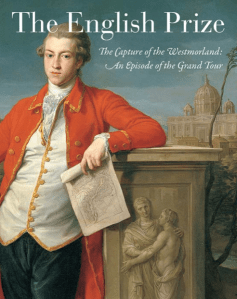 This exhibition tells the extraordinary story of the capture of the Westmorland, a British merchant ship laden with works of art acquired by young British travelers on the Grand Tour in Italy, and the subsequent disposition of its contents. Shortly after sailing from Livorno, Italy, in 1778, the ship was captured by the French navy, which was well aware of its exceptional contents. The Westmorland was escorted to Málaga, in southern Spain, where its contents were inventoried and acquired by agents who in turn sold most of the works of art on board to King Carlos III of Spain. Much of the material was subsequently presented by the king to the Real Academia de Bellas Artes de San Fernando in Madrid. The original inventories, which survive in the Academia’s archives, are remarkably thorough, enabling the identification of many of the items on board the ship when it was captured. Much of the material remains in the Real Academia, but significant works were passed on to the Spanish Royal Collection and are now in the Museo Nacional del Prado or in royal residences in Spain. Because most of these works can be associated with the tourists who were sending them back to Britain, the contents of the Westmorland forms the most complete “cross section” of the Grand Tour discovered to date. The exhibition comes out of a major research project initiated in the late 1990s, led by Professor José María Luzón Nogué, that investigates the story of the Westmorland and its contents. In recent years, with the support of the Paul Mellon Centre for Studies in British Art in London, remarkable progress has been made in identifying and cataloguing these extraordinarily diverse treasures, and this research forms the basis of the exhibition.
◊ ◊ ◊ ◊ ◊
Catalogue: María Dolores Sánchez-Jáuregui Alpañés and Scott Wilcox, eds., The English Prize: The Capture of the Westmorland, an Episode of the Grand Tour (New Haven: Yale University Press, 2012), 400 pages, ISBN: 9780300176056, $75.
◊ ◊ ◊ ◊ ◊
Charlotte Higgins writes about the exhibition for The Guardian (20 November 2011).
Reviewed: ‘Pierre Jacques Volaire (1729-1799)’
Recently added to The Art Tribune:
Emilie Beck Saiello, Pierre Jacques Volaire (1729-1799), dit le Chevalier Volaire (Paris: Arthena, 2010), 486 pages, ISBN: 9782903239435, 119€ / $175.
Reviewed by Bénédicte Bonnet Saint-Georges; posted 31 October 2011.
 He does not lie in the pantheon of great artists and his work does not fall under the genre of grand painting; some would even say that his art is repetitive, a succession of views of Mount Vesuvius meant to sell briskly as souvenirs of the Grand Tour. Emilie Beck Saiello has nevertheless set out to reinstate the artistic legacy of Pierre Jacques Volaire, known as the Chevalier Volaire, by publishing the catalogue raisonné of his works at Arthena Ed. She explains that ‘art history is not made up of only great masters just as history is not made up only of great men and the study of a successful or “commercial” artist might lead us to discover how his work reflected the taste, culture and aesthetics of a certain period and was able to express a moment, a place and a society.’ . . .
The full review is available here»
Exhibition: French Drawings from the Mariette Collection
From the Louvre, as noted by Hélène Bremer:
French Drawings from the Mariette Collection
Musée du Louvre, Paris, 10 November 2011 — 6 February 2012
Curated by Pierre Rosenberg, Laure Barthélemy-Labeeuw, and Bénédicte Gady

Jean-Baptiste Oudry, Egret (Paris: Louvre)
Pierre Jean Mariette (1694–1774) brought together one of the most fascinating collections in the whole of the eighteenth century, with drawings taking pride of place (around ten thousand sheets). Masterpieces by great artists stood alongside pieces of bravura by minor masters, in line with the encyclopedic commitment of this “genius jack-of-all-trades.” A collection of this caliber seemed destined to join those of king and nation. This was the wish of both Mariette and the administration—but, as sometimes happens, the heirs decided otherwise. The auctioning-off lasted for no less than two and a half months, during which time nearly one thousand drawings were nonetheless purchased for the king’s cabinet.
Pierre Rosenberg, of the French Academy, President emeritus of the Musée du Louvre, assisted by Laure Barthélemy-Labeeuw, rose to the dizzying challenge of reconstructing this legendary collection by scouring public and private collections the world over to track down drawings that had once belonged to Mariette. On the occasion of the publication of two initial volumes listing nearly four thousand French drawings, the Musée du Louvre is presenting the survey’s methodological basis and its main findings. On display are around one hundred works, some famous and some recently identified, which went from the collector’s to the museum’s portfolios.
◊ ◊ ◊ ◊ ◊
From Artbooks.com:
Pierre Rosenberg and Laure Barthélemy-Labeeuw, Les Dessins de la Collection de Pierre-Jean Mariette, volumes 1-2 (Milan: Electa, 2011), 704 pages, ISBN: 9788837064273, €600 / $900.
After the reproduction of the complete auction catalogue illustrated by Saint-Aubin and kept in Boston, a necessary tool through which to track down many of the items, the entire drawing collection which belonged to Pierre-Jean Mariette (1694-1774) is now being reproposed. Without any doubt, to use the words of Frederik Johannes “Frits” Lugt, the 20th-century collector, Mariette was the greatest, if not the ‘prince’ in the field of drawing collections. He began his collection during brief sojourns in Italy and, from 1750 onwards, devoted himself exclusively to this pursuit. During his lifetime he put together almost 9,000 items, carefully cataloguing them according to school and type. When he died, they were scattered as a result of 42 auctions (between November 1775 and January 1776).
The incredible task of putting the collection back together was made possible because of the trade-mark (a capital M) which Mariette stamped on every drawing he owned and by the unusual mounting of each drawing on a blue background (‘Mariette blue’) which brought out the best qualities of the drawings. The whole collection will be published in six volumes: the first two are devoted to the French School, three to the Italian school and one to the Dutch, Flemish and German schools. A monumental work of inestimable historical and artistic value. This ambitious publishing project reconstructed the world’s largest-ever collection of drawings. The first volumes focus on the French school: thousands of drawings that were scattered worldwide can now finally be seen at a single glance.
Additional information (in Italian) comes from the Italian bookseller, LibroCo.Italia»
Humphrey Wine provides a review in the April 2012 issue of Apollo Magazine (note added April 2012).










 Enfilade
leave a comment