Exhibition: ‘Capability’ Brown at Compton Verney
From Compton Verney:
‘Capability’ Brown and the Landscapes of Middle England
Compton Verney, Warwickshire, 25 June — 2 October 2011
Curated by Steven Parissien and Tim Mowl
 Set in its own ‘Capability’ Brown landscape, Compton Verney is the ideal location for the first-ever exhibition about internationally-renowned landscape designer Lancelot ‘Capability’ Brown (1716-83). This exhibition brings the man and his genius to life through a series of case studies of ‘Capability’ Brown landscapes from the Midlands. It looks at how Brown designed his natural, neoclassical arcadias; how his landscapes were designed to work in practice; how Brown responded to technological advances in shooting and carriage-making; and how he addressed the enormous task of moving tons of earth and creating hills, vales and lakes in an age before tractors or JCBs.
The focus is on famous ‘Capability’ Brown landscapes in the Midlands region, including Croome, Charlecote Park, Combe Abbey and of course Compton Verney itself. It will showcase the very latest research on the design and use of Georgian landscapes with paintings, maps, accounts, historic guns, manuals and specially-
commissioned photography.
The exhibition is curated by Compton Verney’s Director, Georgian expert Dr Steven Parissien, and Professor Tim Mowl, Director of the Landscape and Garden History Centre at the University of Bristol and founding author of Redcliffe Press’s county guides to the Historic Gardens of Britain.
A 27-page gallery guide is available as a PDF file here»
◊ ◊ ◊ ◊ ◊
Laura Mayer, Capability Brown and the English Landscape Garden (Oxford: Shire Publications, 2011), 64 pages, ISBN: 9780747810490, $12.95.
 Laura Mayer presents a concise and colourful introduction to Brown and other leading landscape gardeners of the eighteenth and early nineteenth centuries, such as William Kent, Richard Payne Knight and Humphry Repton. She explores how competing ideas in garden design were shaped both by changes in prevailing fashion and by the innovations of particular designers, and why Brown’s designs are currently considered to be the epitome of landscape gardening in this period.
Laura Mayer is studying for a Ph.D. in eighteenth-century gardens at the university of Bristol under the supervision of Professor Timothy Mowl. She won the 2010 Garden History Society essay prize and is working, with Mowl, on ‘The Historic Gardens of England: Northumberland’.
Reviewed: ‘Re-Reading Leaonardo’
This terrific collection of essays grew out of the 2001 conference The Fortuna of Leonardo da Vinci’s ‘Trattato della Pittura’, held at the Warburg Institute in London. I count myself lucky to have attended. Held just days after the 9/11 bombings (September 13-14), the conference was, as I recall, however, a strange affair — as so much of life was in those days immediately following the attacks — all the more reason to celebrate this accomplished volume. -CH
Recently added to caa.reviews:
Claire Farago, ed., Re-Reading Leonardo: The ‘Treatise on Painting’ across Europe, 1550–1900 (Burlington, VT: Ashgate, 2009), 652 pages, ISBN: 9780754665328, $124.95.
Reviewed by Ellen Prokop, The Frick Art Reference Library; posted 3 August 2011.
This impressive, generously illustrated collection of essays edited by Claire Farago developed from a symposium held in London in 2001 that focused on the historical reception of Leonardo da Vinci’s Trattato della pittura. Twenty-three studies, including introductory remarks and an annotated bibliography, by twenty authors (three scholars make multiple contributions) examine the transnational fortune of the treatise and consider Leonardo’s influence on the institutionalization of artistic production in early modern Europe. The focus on reception leads to consideration of fundamental issues regarding Leonardo’s legacy, such as the development of the modern conception of artistic genius, as well as broader concerns, such as the disciplinization of art history. By positing Leonardo’s influence instead of his reputation as the “historical phenomena” (3), the essays systematically problematize the constitution of that reputation. As Farago states: “An historical practice that focuses on the author’s identity without attending to the construction of identity per se, is blind to its own modes of knowledge production” (4). . . .
The full review is available here» (CAA membership required)
◊ ◊ ◊ ◊ ◊
While many of the contributions are relevant for the eighteenth century; these essays address the period directly:
•Thomas Willette, “The First Italian Publication of the Treatise on Painting: Book Culture, the History of Art, and the Naples Edition of 1733″
•Thomas Kirchner, “Between Academicism and Its Critics: Leonardo da Vinci’s Traité de la Peinture and 18th-century French Art Theory”
•Javier Navarro de Zuvillaga, “The Trattato in 17th- and 18th-century Spanish Perspective and Art Theory”
•Richard Woodfield, “The 1721 English Treatise of Painting: A Masonic Moment in the Culture of Newtonianism”
•Geoff Quilley, “The Trattato della Pittura and Leonardo’s Reputation in 18th-century British Art and Aesthetics”
New Titles from The Getty
Elena Phipps, Looking at Textiles: A Guide to Technical Terms (Los Angeles: Getty Publications, January 2012), 112 pages, ISBN: 9781606060803, $18.95.
 Textiles have been made and used by every culture throughout history. However diverse—whether an ancient Egyptian mummy wrapping, a Turkish carpet, an Italian velvet, or an American quilt—all textiles have basic elements in common. They are made of fibers, constructed into forms, and patterned and colored in ways that follow certain principles.
Looking at Textiles serves as a guide to the fundamentals of the materials and techniques used to create textiles. The selected technical terms explain what textiles are, how they are made, and what they are made of, and include definitions of terms relating to fibers, dyes, looms and weaving, and patterning processes. The many illustrations, including macro- and microscale photographs of a range of ancient and historic museum textiles, demonstrate the features described in the text.
Elena Phipps was a textile conservator at the Metropolitan Museum of Art for over thirty years. She has published numerous scholarly works on textile materials, techniques, and culture, including The Colonial Andes: Tapestries and Silverwork, 1530–1830 (Metropolitan Museum of Art, 2004), which was awarded both the Alfred H. Barr, Jr., Award (College Art Association) and the Mitchell Prize for best exhibition catalogue.
◊ ◊ ◊ ◊ ◊
Johann Joachim Winckelmann, introduction, translation, and commentary by Carol C. Mattusch, Letter and Report on the Discoveries at Herculaneum (Los Angeles: Getty Publications, January 2011), 240 pages, ISBN: 9781606060896, $50.
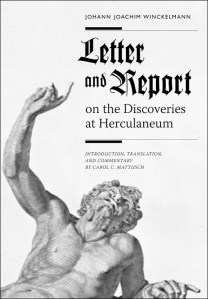 This new translation brings to light early scientific archaeology and the study of Herculaneum and Pompeii as observed by the erudite and acerbic art historian Johann Joachim Winckelmann (1717–1768). His Letter, published in German in 1762, displays his knowledge of geology, ancient literature, and art while offering a scathing critique of the Spanish Bourbon excavations around the Bay of Naples and of the officials involved. He further discusses these topics in his equally controversial Report of 1764.
The introduction describes the context in which these texts were written, identifies various politicians, academics, and collectors, and elucidates topics of particular interest to Winckelmann, from artifacts to local customs to the contents of ancient papyri. The illustrations, particularly those from the Bourbon publication—Le Antichità di Ercolano (1757–92)—illuminate how these monuments influenced contemporary perceptions of the ancient world.
Johann Joachim Winckelmann was a groundbreaking Prussian art historian and author of History of Ancient Art (1764). Carol C. Mattusch is Mathy Professor of Art History at George Mason University in Fairfax, Virginia, and author of The Villa dei Papiri at Herculaneum: Life and Afterlife of a Sculpture Collection (Getty Publications, 2005), which won the Charles Rufus Morey Book Award.
◊ ◊ ◊ ◊ ◊
Lance Mayer and Gay Myers, American Painters on Technique: The Colonial Period to 1860 (Los Angeles: Getty Publications, October 2011), 260 pages, ISBN: 9781606060773, $50.00
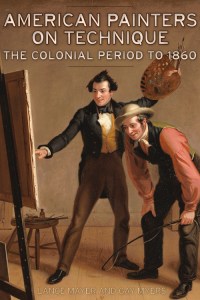 This is the first comprehensive study of an important but largely unknown part of the history of American art: the materials and techniques used by American painters. Based on extensive research, including artists’ recipe books, letters, journals, and painting manuals, much previously unpublished, the authors have also drawn on their many years as conservators of paintings for museums and collectors.
Information is provided on the methods of painters such as Benjamin West, Gilbert Stuart, Washington Allston, Thomas Sully, Thomas Cole, and William Sidney Mount. Topics include the quest for the “secrets” of the Old Masters; how artists saw their paintings changing over time; the application of “toning” layers; and the evolving self-confidence of American experimenters and innovators.
The book will be of interest to curators, art historians, painters, and conservators and will form the basis for future research on American painting techniques. At a time of discovering new approaches to art history, the story of how paintings were made parallels the better known histories about how styles changed and how paintings were commissioned, exhibited, and sold.
Lance Mayer and Gay Myers work at the Lyman Allyn Art Museum in New London, Connecticut, and as independent conservators.
Introducing the ‘Seminal Works Project’: Tim Blanning
As a new, occasional column here at Enfilade, the “Seminal Works Project” aims to identify and describe works that dixhuitièmistes consider to have been especially influential for their academic development. Such a ‘work’ could be a book, exhibition, journal article, even a television program — anything that had a great impact.
In the first installment, Tim Blanning of the University of Cambridge identifies Paul Bekker’s Das deutsche Musikleben [German musical life] as important for his thinking on musical form. Blanning’s research centers on the history of Continental Europe from the seventeenth century to the First World War, with various publications on eighteenth-century cultural history, most recently, The Triumph of Music in the Modern World (2008).
◊ ◊ ◊ ◊ ◊
Seminal Works
Tim Blanning, On Paul Bekker’s Das deutsche Musikleben (1916)
 Among the innumerable books and articles which have influenced me, the one that stands out for its originality is Paul Bekker’s Das deutsche Musikleben [German musical life], first published in 1916. Born in 1882, Bekker began life as a musician – early on at the very highest level indeed, leading the Berlin Philharmonic while still in his twenties. He then progressed briefly to conducting before devoting himself to writing, establishing a reputation as one of the most influential critics in Germany. After the First World War he served successively as artistic director at the state theatres of Kassel and Wiesbaden, while writing numerous books on musical theory and history. Forced into exile in 1933, he died in New York in 1937.
Although he was mainly concerned with contemporary music and the nineteenth century, his views on the interaction between society and music have just as much relevance for the eighteenth century. At the heart of his theory is the axiom that both the musician and society create. It would be wrong to allow the former alone the role of creator and assign to the latter just the role of receiving and performing. Musical form is usually understood as something confined to the sound (Klangbild) as recorded by the composer on the stave; and this sound is seen as the completed work of art. But that is to overlook the fact that such a sound is just inert matter – it acquires form only through perception. That perception can only take place through interaction with the milieu (Umwelt). Form appears only when matter and milieu relate to each other and only when the two of them get together does the finished work of art – the form – appear. The creative musician can be regarded as the creator of the form only in a limited sense: what he does is to set his music down on the stave, but to attain status of sound, it has to be performed, and however faithful the performer, he/she does participate in and add to its creation. That is even more true of the other element in form – perception. Perception is not passive reception but is an active process. By allowing the matter to become form through perception, it introduces a new element to the creative results of the musician: perceiving activity. This means that the milieu wins an independent share in the creation of form. Two separate creative powers enter into an active relationship with each other: the power of the musician, who arranges the matter, and the power of the milieu which perceives it. Although the laws which determine the formation of matter are fixed by the musician at the time of creation and are immutable, the perceptive power of the milieu is very mutable. So the potential for changes in form is as great as the changes in the milieu’s perception. The subject-matter is created by the composer in accordance with his perception of his audience’s ability to receive it. It is not formed as a result of any internal laws. It is the result of interaction with social reception. Consequently sound is not an aesthetic but a sociological construct. Through its particular composition, it is society which provides the foundations, and through its perceptive capacity it provides the preconditions for the formation of the musical subject-matter. There is much more besides in this wonderfully cogent and incisive book.
Tim Blanning
Sidney Sussex College, Cambridge
Exhibition: American Colonial Revival Style in New York
From the Museum of the City of New York:
The American Style: Colonial Revival and the Modern Metropolis
Museum of the City of New York, 14 June — 30 October 2011
Curated by Donald Albrecht and Thomas Mellins
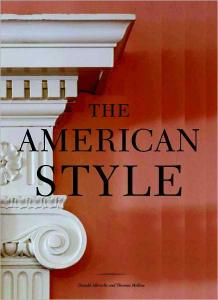 The American Style: Colonial Revival and the Modern Metropolis brings together extraordinary furniture, decorative objects, and photographs to survey, in New York City and beyond, the Colonial Revival movement in the realms of architecture and design. The exhibition covers the fertile period from the 1890s to the present, focusing on the years from 1900 to the 1930s, when New York City, through department stores, museums, and more, was the center for the style’s promotion nationwide.
Exhibition Catalogue: Donald Albrecht and Thomas Mellins, The American Style: Colonial Revival and the Modern Metropolis (New York: Monacelli Press, 2011), 224 pages, ISBN: 9781580932851, $50. Easily the most recognizable architectural style in America, with its brick or shingled facades trimmed in white and ornamented with restrained classical detail, the Colonial Revival emerged in the late nineteenth century and is still the basis for classical
design today. The American Style surveys the evolution of the Colonial Revival from the 1890s to the present, focusing on the period from 1900 to the 1930s when New York City was a major center of architecture and decorative arts. Leading architects, including McKim Mead & White, Delano & Aldrich, and Mott B. Schmidt, used its vocabulary for private residences and clubs as well as institutional buildings—banks, schools, churches, and museums.
◊ ◊ ◊ ◊ ◊
As Edward Rothstein writes in his review for The New York Times (13 June 2011) . . .
National Design That’s Hidden in Plain Sight
One sign of a powerful style is its invisibility. It is so familiar it is scarcely noticed. It is so natural, how could things be otherwise? We don’t really pay attention to the style itself. Instead we notice contrasts, variations, violations.
One of the achievements of the illuminating exhibition “The American Style,” which opens on Tuesday at the Museum of the City of New York, is that it helps make the invisible visible. With photographs of grand mansions and suburban residences; with images of high schools, apartment buildings, town halls and post offices; with examples of mass-market furniture and finely made cabinetry; with pewter candlesticks and pictorial wall murals and floor plans, the exhibition gradually helps us see what is all around us. Its subtitle defines the terrain: “Colonial Revival and the Modern Metropolis.”. . .
The style embraces both authority and intimacy, proclaiming the hopes of ordinary citizens as well as the heritage of those well established.
There is also a historical aspect to its appeal. The revival developed after the nation’s centennial celebrations in 1876, when the scars of the Civil War and the struggles of Reconstruction were salved by these allusions to an almost pastoral colonial past. Reproductions were made of early furniture. Paintings, vases and decorative plates incorporated images of Washington.
On display here is a hand-tinted photograph from the studio of Wallace Nutting, a minister who at the turn of the 20th century became something of a revival missionary, staging domestic tableaus in colonial-era homes and photographing them. The style gained another wave of energy from the renovation of Colonial Williamsburg in the 1930s, which even influenced architects of new urban developments.
The style, as the exhibition shows, eventually evolved into a national style meant “to invoke a national experience and express national values.” When the Metropolitan Museum of Art opened its American Wing in 1924, its first curator, R. T. H. Halsey, said the displays of early decorative arts would counter “the influx of foreign ideas” and present traditions “invaluable in the Americanization of many of our people.” . . .
The full review is available here»
Exhibition: Toile de Jouy, Printed Gardens and Fields
I’m happy to welcome one more addition to the Enfilade team! The Paris-based Ph.D. student Hélène Bremer will be weighing in with occasional contributions. She completed her M.A. in Art History at the University of Leiden in 2000 and is now working on her dissertation (also at Leiden) “Grand Tour, Grand collections: The Influence of the Grand Tour Experience on Collection Display in the Eighteenth Century.” She’ll be reporting not only on events in France but also sharing news from the Netherlands. We start things off with an exhibition sketch in response to the Musée de la Toile de Jouy. -CH
◊ ◊ ◊ ◊ ◊
Parties de Campagne, Jardins et champs dans la toile imprimée XVIIIe-XIXe siècle
Musée de la Toile de Jouy, Jouy-en-Josas, 29 April — 20 November 2011
Exhibition sketch by Hélène Bremer

Founded in 1977, the Musée de la Toile de Jouy moved into its current home, the nineteenth-century Château d'Eglantine in 1991. The museum's holdings include some 5000 objects.
The Musée de la Toile de Jouy at Jouy-en-Josas is an ideal destination for anyone taken with wonderful fabrics and eighteenth-century history. Just a few kilometers from the Château de Versailles (though far from its tourist throngs), the museum is located at the Château d’Eglantine. While this charming setting is alone worth a visit, the museum’s interiors offer lovely rooms full of toile-covered furniture. Not only do you find here a vast collection of Toile de Jouy, the displays explain the industrialization of toile-making, particularly the printing innovations of factory founder Christophe-Philippe Oberkampf, the German immigrant who introduced to Jouy-en-Josas, the use of engraved copper plates (1770) and then copper rollers (1797), replacing the older wood blocks.
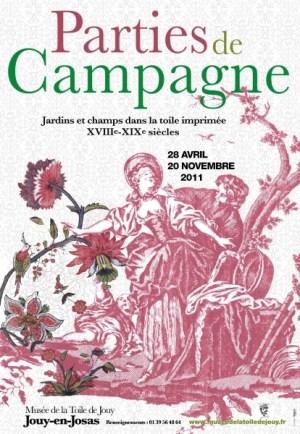 For the spring and summer, the staff of the museum have organized a delightful exhibition, Parties de Campagne, Jardins et champs dans la toile imprimée XVIIIe-XIXe siècles. The curators have assembled over 200 examples of fabrics depicting a wide variety of subjects: the four seasons, workers in the fields, shepherds and hunting scenes, children playing, landscapes with ruins, and fête champêtre motifs. There is also a nice, small fabric-covered balloon — to my mind, just begging to be shown with the fabric, Le Ballon de Gonesse, an example of which can be found nearby in the museum’s permanent display.
The sheer quantity of fabrics on display is impressive, suggesting at times the feel of a densely packed closet. The quantity indicates how much there is to explore on this interesting topic of la vie champêtre and how rich the museum’s holdings are, given that all the material comes from the museum’s own collection.
Having seen the exhibition, I’m curious about the accompanying book, edited by Anne de Thoisy-Dallem, which unfortunately was not yet available when I visited in early May. It promises to be a useful publication with two fully-illustrated volumes, addressing not only the exhibition themes but also outlining new research on rare costumes, the gardens of Toile de Jouy, and precious botanical books that provided inspiration for the pattern designers.
For more information, including terrific images, the press release (in French) is available here»
Speaking of Food in the Eighteenth Century . . .
From the MFAH:
English Taste: The Art of Dining in the Eighteenth Century
Rienzi, The Museum of Fine Arts, Houston, 17 September 2011 — 29 January 2011
Installation by Ivan Day
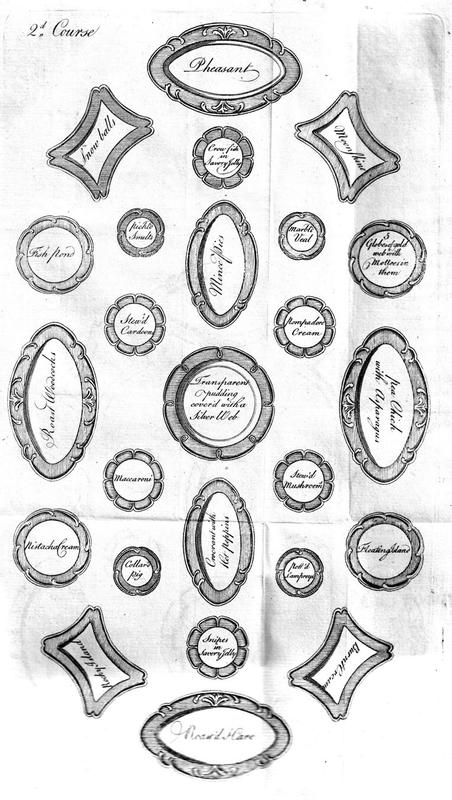
Elizabeth Raffald, "Directions for a Grand Table," illustration from "The Experienced English Housekeeper" (Manchester: Printed by J. Harrep, 1769), p. 361
The 18th-century English dinner table was a feast for the eyes. In order to impress their guests and assure them that they were dining amid fashionable people of consequence, hosts served sumptuous dishes, adorned with towering sugar constructions and amusing trompe l’oeil (fool-the-eye) jellies of playing cards or bacon and eggs, all on exquisite silver and porcelain.
Rienzi re-creates this elaborate dining experience in English Taste: The Art of Dining in the Eighteenth Century. The first special exhibition ever held at Rienzi, the MFAH house museum for European decorative arts, English Taste treats you to a dining-room extravaganza typical of a 1760s English country house. Lifelike fish, fowl, and flummeries—complete with lavish, Georgian silver fittings and place settings—grace the table, created with guidance from the influential period cookbook The Experienced English Housekeeper by Elizabeth Raffald, the “Martha Stewart of the 18th century.”
Eminent English food historian Ivan Day uses Raffald’s recipes to create the faux foods—perhaps shockingly realistic to 21st-century eyes—which include roasted pheasant, beaked snipe, flummery jellies, and a larded hare. The meal also features macaroni and cheese (yes, this dish did exist in the 18th century!) made with imported pasta. Raffald’s illustration “Directions for a Grand Table” from 1769 serves as the design template for the installation.
◊ ◊ ◊ ◊ ◊
More information and terrific images from Raffald’s book are available from Kansas State University Library’s online Cookery Exhibition.
◊ ◊ ◊ ◊ ◊
From the MFAH:
 Rienzi is situated on four acres of wooded gardens, about three miles from downtown Houston in the historic River Oaks neighborhood. Formerly the home of philanthropists Carroll Sterling Masterson and Harris Masterson III, Rienzi was designed by prominent Houston architect John Staub in 1952. Opened to the public in 1999, Rienzi now houses a substantial collection of European decorative arts, including paintings, furnishings, porcelain, and extensive holdings of miniatures. Rienzi welcomes some 8,000 visitors a year for tours, family programs, lectures, concerts, and a variety of special events.
At Fairfax House: Revolutionary Fashion and Georgian Cakes
Revolutionary Fashion 1790-1820
Fairfax House, York, 26 August — 31 December 2011
 Our major new exhibition for the autumn and winter season 2011 at Fairfax House is Revolutionary Fashion 1790-1820. Following on from our acclaimed Dress to Impress exhibition of 2010, which focused on changing fashions during the period 1730-1780, this second exploration of Georgian Fashion takes the story from the revolutionary 1790s to the rakish Regency period. The exhibition opens on Friday 26 August 2011.
Uncovering the revolutionary changes in fashion in the last decade of the eighteenth century and exploring the influence of the French Revolution, Industrial Revolution and Napoleonic Wars, Revolutionary Fashion brings together a unique and lavish selection of the highly elegant clothing of Georgian and Regency polite society. Featuring period gowns, shoes and accessories from collections in Yorkshire and beyond, the exhibition will reveal the styles and showcase the ‘real’ clothes worn by Jane Austen’s heroes and heroines, and place the dazzling kaleidoscope of late Georgian fashions in its social, cultural and historical context.
◊ ◊ ◊ ◊ ◊
 If possible, you might consider visiting the exhibition on September 17:
Georgian Cakes and Baking
Fairfax House, York, 17 September 2011
Join Peter Brears, renowned food historian, in the Fairfax kitchen as he reveals the sophistication of Georgian York’s baking tradition and demonstrates the cakes, biscuits and baked goods that could be enjoyed in the eighteenth-century City. This demonstration day includes a display of Yorkshire Country House baking, and food tastings will be available for all visitors.
A 2007 profile of Brears from the Yorkshire Post is available here, and there’s a fine review of Brears’ 2010 book, Jellies and Their Moulds, at AustenOnly.
Historical Paint, Part III
As we wrap up this small series on historical paint, the following books might be useful for further reading:
◊ ◊ ◊ ◊ ◊
Ian Bristow, Architectural Colour in British Interiors, 1615-1840 (New Haven: Yale University Press, 1996), 288 pages, ISBN: 9780300038668, $150.
 Paint is ephemeral: it fades and discolors and is obliterated by succeeding phases of redecoration. Until recently, this has presented a significant obstacle in researching the architectural colours used in British interiors of earlier centuries but, in this study, Ian C. Bristow combines information from documentary sources with data obtained from the technical investigation of significant interiors by important architects of the period. He has thus been able to establish a coherent outline of true historical practice, which hs here presented for the first time.
Bristow contrasts the noble interiors of Inigo Jones with more intimate spaces of the period. He then sets the succeeding drabness adopted in many rooms in the second half of the seventeenth century against the era’s taste for marbling, graining, and imitation Japan. Moving on to consider the eighteenth century, he shows how the new foundation established by the Palladians came to provide the basis for the lively use of colour by Robert Adam and his contemporaries. Finally he examines how the development of colour theory in the early nineteenth century superseded eighteenth-century ideas and, combined with the Regency taste for the exotic, led to an entirely new outlook, much of which has lasted to the present day. Bristow’s book is an essential complement to more conventional architectural studies of form and space and a key text for students of all aspects of the historic interior.
◊ ◊ ◊ ◊ ◊
Ian Bristow, Interior Housepainting Colours and Technology, 1615-1840 (New Haven: Yale University Press, 1996), 288 pages, ISBN: 9780300038675.
 The study of historic architectural colour is a developing field, with information greatly in demand by all those with an interest in the redecoration of historic interiors. In this volume, Ian C. Bristow describes the techniques and materials used in interiors by early housepainters, providing comprehensive coverage for architects, historians, interior decorators, and others with a more general leaning to the topic.
Bristow points out the differences between painting materials used for fine art as opposed to house painting. Drawing on English and French sources, he discusses the pigments used; the oils, resins, solvents, and water-based media involved; the way these were applied; techniques for imitating various architectural materials in paint; and the mixing of colours. A glossary of contemporary color names is illustrated by samples showing some of the tints obtainable, while marbles and timbers to which references have been found are listed and reproduced. This study will be of interest to all working in the
field of historic paintwork.
Reviewed: ‘Jean de Jullienne et les collectionneurs de son temps’
Isabelle Tillerot, Jean de Jullienne et les collectionneurs de son temps (Paris: Editions Maison des Sciences de L’homme, 2011), 510 pages, ISBN: 9782735112531, €48.
Reviewed for Enfilade by David Pullins
 Between 1726 and 1735, Jean de Jullienne oversaw and financed the publication of some 495 prints in four volumes, all after the work of the recently deceased painter and draftsman, Antoine Watteau. This unprecedented form of commitment to a contemporary artist has rightly secured Jullienne’s fame ever since and earned the complicated publishing venture he spearheaded the unofficial title of the “Recueil Jullienne.” Émile Dacier and Albert Vuaflart’s three-volume Jean de Jullienne et les graveurs de Watteau au XVIIIe siècle (1921–29) remains indispensible for understanding the project, its chronology, and participants. A recent exhibition and catalog from the musée du Louvre, Antoine Watteau et l’art de l’estampe (2010), revisited the history of the publication by attempting to piece together what can be learned by comparing the wide variation between surviving copies. As the consolidation of an artistic personality that took into account all aspects of a single artist’s production, the Recueil Jullienne continues to have much to offer scholars not merely as documentation of lost works by Watteau, but also as a significant moment in the practice of writing and publishing the history of art.
In a substantial new monograph on Jullienne, Isabelle Tillerot deliberately devotes only a few pages directly to the Recueil in order to focus her attention on Julienne as a collector and amateur. While Jullienne no doubt will remain best known for the Recueil bearing his name, Tillerot’s work uncovers the social and commercial networks that he occupied in meticulous detail and plants him firmly in the ground of recent scholarship on the art market, collecting, and the amateur in eighteenth-century France. While consistent in its thoroughness with the monographs that have come out of France in recent years – including the most exhaustive examples, Guillaume Glorieux’s work on the dealer Gersaint (2002) or Christian Michel on Cochin (1993) – Tillerot’s book aims to connect with broader theories on collecting and the status of works of art as physical objects with citations from Maurice Blanchot and Michel Foucault. This framework speaks to a larger ambition for the potential of monographic studies, while at times not feeling entirely integrated with the primary material that is in the end the heart of her project.
For the history of collecting, Jullienne’s singularity is based largely on his social position as a successful dyer and cloth merchant and the survival of an album of watercolors illustrating the hang of his collection at his hôtel in the rue des Gobelins from around 1756 (now owned by the Pierpont Morgan Library). While Dacier and Vuaflart alerted scholars to both of these elements in the 1920s, Tillerot contributes additional archival research (providing more precise documentation of available sources) and then extrapolates from this material in order to argue for why Jullienne is of interest apart from his engagement with Watteau. Jullienne’s self-made status – “I declare that I have not inherited any means either from my father or mother and that all I have comes solely from my own efforts and pains,” he wrote in 1764[i] – and strong mercantile ties make him unusual among French collectors of the first half of the eighteenth century. His patent of nobility, granted in 1736, was in fact based on his success in business; when he met Rosalba Carriera, probably through Pierre Crozat in 1721, he gave her a piece of scarlato, an expensive fabric related to his trade.[ii]
Tillerot highlights Jullienne as an early example of the merchant-collector in France and works through the unlikely but intimate connection of his family to the circle of the comtesse de Verrue, a pioneer in the collecting of Flemish painting, but also a representative of a more conventional, aristocratic model in Tillerot’s account. The illustrated album of Jullienne’s collection – the survival of which is a remarkable piece of historical luck – allows Tillerot to discuss the means through which Jullienne integrated the longstanding French admiration for Italian painting, newly developing taste for Flemish painting, and his own interest in the contemporary French school. By the time of his death in 1766, Jullienne owned a significant group of contemporary French paintings by Watteau, Boucher, Greuze, and de Troy (both father and son). In charting his relationship to the art of his own time, Tillerot works from Colin Bailey’s articulation of a “goût patriotique,” and, again, Jullienne emerges as a particularly early and notable example of a model more familiar later in the century. In dialogue with the recent work of Charlotte Guichard on the institutional framework supporting the amateur in eighteenth-century France, this aspect of Jullienne’s collection returns her to his publishing project and his gift in 1739 of the four volumes after Watteau to the Académie royale, which in turn granted him the title conseiller honoraire et amateur.
The impact of Tillerot’s work is evident already in Christoph Vogtherr and Jennifer Tonkovich’s current exhibition and catalogue for The Wallace Collection, Jean de Julienne: Collector & Connoisseur (2011), which relies heavily on the research presented in Tillerot’s dissertation, completed under Christian Michel in 2005 and on which the present book is closely based. The relevance of Tillerot’s research will continue to be felt with the massive, continued efforts to document the life and work of the collector Jean-Pierre Mariette – who, as Tonkovich has detailed in the Wallace catalogue and related articles, heavily annotated the catalog of Jullienne’s collection when it was sold over fifty-four days in 1767. While the documentary evidence Tillerot provides (including a lengthy index of his painting collection and images from the album) proves an important resource, her shift towards a more integrative approach, taking into account the broader social network in which Jullienne functioned moves her study away from the recent impulse toward the exhaustive monograph and points to the potential for examining the almost maddening interconnectedness that characterizes collecting in eighteenth-century France.










 Enfilade
leave a comment