 Twenty-five years after Captain Cook’s historic voyage, the London Missionary Society sent its first representatives to the South Seas landing on Tahiti in 1797. Their goal was to eradicate heathenism and idolatry but, unwittingly, they became agents for the preservation of Polynesian culture through their diligent recording of language and religious practices.
 Dans toute l’Europe occidentale, du Moyen Âge jusqu’à l’Époque moderne, se sont épanouies des sociétés de cour qui ont accordé au corps une place nouvelle, assurant sa promotion dans le jeu politique et social. Ainsi, les stratégies de son maintien, de son entretien et de son apparence tiennent une place toute particulière au sein de cet univers hiérarchisé. En se fondant sur l’exploitation de sources très variées (littéraires, iconographiques ou comptables) et en s’attachant à décrire non seulement les normes et les représentations de cette culture du corps, mais encore les pratiques et les techniques auxquelles elle a donné naissance – savoir-faire, gestes, accessoires, aménagements spécifiques… –, les contributions rassemblées dans ce volume proposent des éclairages inédits et précis sur les sociétés curiales européennes. Elles traitent aussi bien des usages des parfums et des cosmétiques, ou encore des perruques, que des régimes de santé, des bains thérapeutiques ou de propreté, d’hygiène dentaire ou même des « commodités ».
An 18th-century treatise on the Prince of Orange’s interest in a stuffed hippo will join one of the first modern constitutions and pamphlets on Marie Antoinette as part of an ambitious project to make 250,000 books in the British Library available online for the first time.
The library and Google said they were linking up to digitise out-of-copyright books from the collection, making them available to both specialised researchers and the simply curious.
The library’s chief executive Lynne Brindley called it a “significant partnership” which was part of the institution’s “proud tradition of giving access to anyone, anywhere and at any time.”
The out-of-copyright books from around 1700 to 1870 will be digitised over three years, with the majority being books from continental Europe. The library will not choose the books in forensic fashion, although they will be thematically linked – colonial history, for example. Shelves of books relating to the French revolution will be some of the first packaged up and sent to Google for digitisation
Others which will be digitised include Georges Buffon’s hitherto little-known 1775 work on the natural history of the hippo which also gives an account of the stuffed hippo taking up much of the Prince of Orange’s cabinet of curiosities. . . .
The full article is available here»
◊ ◊ ◊ ◊ ◊
 In the latest issue of Eighteenth-Century Studies 44 (September 2011), Patrick Spedding’s article “‘The New Machine’: Discovering the Limits of ECCO,” pp. 437-53, addresses the difficulties of conducting research with scanned text-bases such as Eighteenth Century Collections Online — in this case, Spedding catalogs some of the ways ECCO fails to turn up texts with references to condoms, even though the texts are available in the database. It will be interesting to see what the results of the BL/Google initiative look like, though if scholars’ reactions to Google Books serves as any guide, there will be plenty of grumbling. -CH.
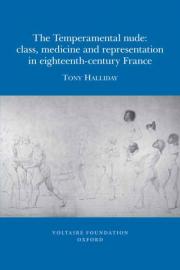 In “The Temperamental Nude: Class, Medicine and Representation in Eighteenth-Century France,” the late Tony Halliday studies a neglected facet of visual representation in Enlightenment culture, namely, the revival and significance of the theory of the temperaments and its impact on the depiction of the human figure, specifically the male figure, in painting, sculpture, and prints. His study focuses principally on mid- to late eighteenth-century France, with particular emphasis on the Revolutionary period. The contested idea of the new citizen (who was male according to French convention and law) and his fluctuating image in the visual arts during the Revolution, Republic, and Directory (1789–99) constitute the principal matter of the book. . . .
 Making History is organized into nine sections. Highlights include antiquities such as a rare Late Bronze Age shield (ca. 1300–1100 BCE) discovered on a farm in Scotland in 1779; an early copy of the Magna Carta (ca. 1225); a medieval processional cross reportedly recovered from the battlefield of Bosworth (1485); the inventory (1550–51) of Henry VIII’s possessions at the time of his death; and a forty-foot-long illuminated “roll chronicle” on parchment detailing the genealogical descent of Henry II from Adam and Eve. Also on display will be an extraordinary collection of English royal portraits painted on panel, from Henry VI to Mary Tudor.












 Enfilade
leave a comment