Reviewed: ‘Thomas Gainsborough and the Modern Woman’
Benedict Leca, Aileen Ribeiro, and Amber Ludwig, Thomas Gainsborough and the Modern Woman, ed. Benedict Leca (London: Giles Limited, 2010) 196 pages, ISBN: 9781904832850, $49.95.
Reviewed for Enfilade by Susan M. Wager
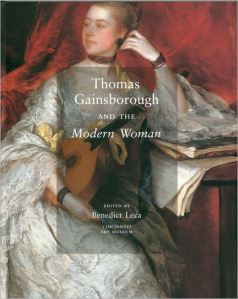 After a visit to Thomas Gainsborough’s studio in October 1760, the socially and culturally accomplished Mary Delany wrote, “There I saw Miss Ford’s picture—a whole length with her guitar, a most extraordinary figure, handsome and bold; but I should be sorry to have any one I loved set forth in such a manner.” The picture in question, Gainsborough’s Ann Ford of 1760, and the ambivalent reactions (like Mrs. Delany’s) it has engendered, is the central focus of Thomas Gainsborough and the Modern Woman. This lavishly illustrated catalogue, published to accompany an exhibition of the same name that originated at the Cincinnati Art Museum in 2010 before traveling to the San Diego Museum of Art earlier this year, was edited by Benedict Leca, Curator of European Painting, Sculpture, and Drawings at the Cincinnati Art Museum.
The portrait of Ann Ford—an eighteenth-century woman who garnered an ambiguous reputation by daring to organize public performances of her talent at the viola da gamba (unusual for a woman at the time)—was acquired by the Cincinnati Art Museum in 1927 and remains a highlight of the Museum’s collection. Leca has cleverly constructed an exhibition around the portrait, enriching our understanding of it through the juxtaposition of several well-selected loans. These include some of Gainsborough’s portraits of other “demireps”—women whose “social and sexual assertiveness combined with their flair for personal style and public exposure ran counter to propriety,” as defined by Leca. The catalogue’s three essays—by Leca, Aileen Ribeiro, and Amber Ludwig—all seem to be underpinned, implicitly, by the question: to what extent were these “demireps” in control of the constructed identities mediated through their painted portraits?
Leca’s approach to this question is decidedly optimistic. Drawing on compelling evidence such as Ann Ford’s published writings on the merits of the female sex, Leca argues that Gainsborough and Ford, in addition to some of his other female sitters, were equal partners in the production of images that challenged circumscribed gender codes and asserted female liberation from masculine control. Leca reads the correlation of Gainsborough’s signature loose brushwork—deemed “feminine” by his contemporaries—with painted passages of conventionally feminine accessories adorning sexually assertive women as the artist’s ironic and progressive rejection of masculinist norms. As Leca writes, Gainsborough’s portraits present “provocative women provocatively painted.”
Ribeiro’s essay considers how the costumes worn by Gainsborough’s demireps participated in the negotiation of reputation, class, and status. Ribeiro subtly complicates Leca’s reading of Ann Ford by evoking scholars who have suggested that paintings of accomplished women like Ford could be seen as relatively traditional presentations of ideal and precious objects of beauty, served up for the viewer’s delectation. Although Ribeiro ultimately disagrees with these readings, her essay nonetheless gestures toward the plurality of interpretations that can be gleaned from images of demireps.
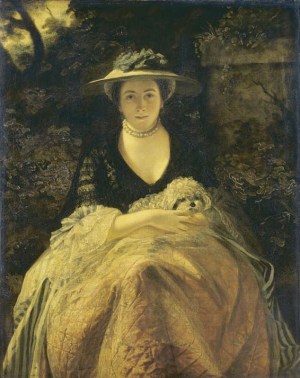
Joshua Reynolds, "Portrait of Nelly O'Brien," ca. 1762-64 (London: Wallace Collection)
Leca and Ribeiro mobilize two different portraits by Joshua Reynolds of the courtesan Nelly O’Brien to make divergent points about Ann Ford. Leca emphasizes the “subversive femininity” and “suggestiveness” of Ford’s pose by contrasting it to Reynolds’s 1762-4 portrait of O’Brien (The Wallace Collection). Whereas Reynolds dissembles the unsavory profession of O’Brien through the imposition of a pyramidal, closed, Marian pose onto her body, Gainsborough flaunts the immodesty and impropriety of Ford’s dynamic, crossed-leg attitude. Ribeiro, however, juxtaposes Ann Ford with a 1763-7 Reynolds portrait of O’Brien (The Hunterian Museum & Art Gallery, University of Glasgow) in order to underscore the formality of Ford’s dress in contrast to O’Brien’s “loose bed-gown.” The latter is far more scandalous than Ford’s costume, which would have been chosen precisely to shore up Ford’s ambiguous reputation. Conflicting readings like these do not detract from the overall thrust of the book; instead, they strengthen it, attesting to the complexity of the images under examination.

Joshua Reynolds, "Portrait of Nelly O'Brien," ca. 1763-67 (Glasgow: Hunterian Museum)
Indeed, complexity characterizes the images addressed by Amber Ludwig in her essay on how portraiture could attach the appearance of virtue to women with dubious reputations. Addressing pictures of Emma Hamilton, she underscores, for instance, tensions between the desires and personality of the sitter and the desires for propriety imposed by her husband or lover.
Thomas Gainsborough and the Modern Woman would be a welcome addition to the libraries of scholars and general readers alike. The catalogue’s clear prose is supplemented by sumptuous, full-color plates and extraordinarily high-resolution details, offering a worthy substitute for individuals who did not see the exhibition, or a handsome aide-mémoire for those who did.
◊ ◊ ◊ ◊ ◊
Susan M. Wager is a Ph.D. candidate in Art History & Archaeology at Columbia University. Her research examines eighteenth-century reproductions after François Boucher in the mediums of gems, porcelain, and tapestries at the intersection of consumer culture, natural history, antiquarianism and connoisseurship, and global exchange.
Forthcoming Title: Geoff Quilley, ‘Empire to Nation’
Geoff Quilley, Empire to Nation: Art, History and the Visualization of Maritime Britain, 1768-1829 (London: Paul Mellon Centre for Studies in British Art, 2011), 304 pages, ISBN: 9780300175684, $80.
 Empire to Nation offers a new consideration of the image of the sea in British visual culture during a critical period for both the rise of the visual arts in Britain and the expansion of the nation’s imperial power. It argues that maritime imagery was central to cultivating a sense of nationhood in relation to rapidly expanding geographical knowledge and burgeoning imperial ambition. At the same time, the growth of the maritime empire presented new opportunities for artistic enterprise.
Taking as its starting point the year 1768, which marks the foundation of the Royal Academy and the launch of Captain Cook’s first circumnavigation, it asserts that this was not just an interesting coincidence but symptomatic of the relationship between art and empire. This relationship was officially sanctioned in the establishment of the Naval Gallery at Greenwich Hospital and the installation there of J. M. W. Turner’s great Battle of Trafalgar in
1829, the year that closes this study. Between these two poles, the book
traces a changing historical discourse that informed visual representation
of maritime subjects.
Geoff Quilley is senior lecturer in art history at the University of Sussex. He
was formerly curator of fine art at the National Maritime Museum, Greenwich,
London.
ECCO Texts and Print-on-Demand Possibilities
While working on an article related to William Cowper’s Myotomia Reformata, I recently discovered that I could purchase a paperback copy for less than $25 at Amazon or Alibris. I was surprised but guessed that these copies were the remainders from a recent printing of the 1724 text. In fact, however, they are the result of a print-on-demand initiative. Here’s the description from Alibris:
◊ ◊ ◊ ◊ ◊

As noted at EMOB, the covers of these new paperbacks do not come from the original books, and in this instance, the selection is hardly ideal. I'm not sure if the editor, Dr. Richard Mead, would be angry, appalled, or merely amused.
The 18th century was a wealth of knowledge, exploration and rapidly growing technology and expanding record-keeping made possible by advances in the printing press. In its determination to preserve the century of revolution, Gale initiated a revolution of its own: digitization of epic proportions to preserve these invaluable works in the largest archive of its kind. Now for the first time these high-quality digital copies of original 18th century manuscripts are available in print, making them highly accessible to libraries, undergraduate students, and independent scholars. Medical theory and practice of the 1700s developed rapidly, as is evidenced by the extensive collection, which includes descriptions of diseases, their conditions, and treatments. Books on science and technology, agriculture, military technology, natural philosophy, even cookbooks, are all contained here.++++The below data was compiled from various identification fields in the bibliographic record of this title. This data is provided as an additional tool in helping to insure edition identification: ++++British LibraryT132919Titlepage in red and black. Edited by Richard Mead, assisted by Joseph Tanner, James Jurin and Henry Pemberton. Large paper issue.London: printed for Robert Knaplock, and William and John Innys; and Jacob Tonson, 1724. [12],
lxxvii, [1],194p., plates: ill.; 2.
Condition: New
Publisher: Gale Ecco, Print Editions
Date published: 2010
ISBN-13: 9781140985778
ISBN: 1140985779
◊ ◊ ◊ ◊ ◊
An online search quickly turned up a fine discussion of the issue — not surprisingly — at Early Modern Online Bibliography. Eleanor Shevlin wrote a thoughtful posting on the subject last August, which has thus far occasioned 27 responses. The posting nicely lays out the potential advantages and drawbacks. Most objections relate to concerns over bibliographic completeness and uniformity. I’ve not yet looked to see what the art offerings might look like, but for anyone looking to incorporate primary sources into the classroom, this could be useful. I’ve included below a comment on the posting from Scott Dawson (24 August 2010) that clarifies some of these issues, but by all means have a look at the full discussion at EMOB. -CH. (more…)
The Prado Publishes New Acquisitions Catalogue *Only* Online — It’s Free
Is this the future or just an experiment along the way? From the Prado’s website:
José Manuel Matilla, ed., No solo Goya: Adquisiciones para el Gabinete de Dibujos y Estampas del Museo del Prado 1997-2010, exhibition catalogue (Madrid: Prado, 2011), 383 pages, ISBN: 9788484802204.
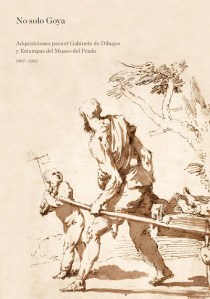 For the first time in the Museum’s history the catalogue has only been published in on-line format. An innovative new format has been designed that combines the benefits of the traditional printed book with the new possibilities offered by digital formats, such as links, attached archives, image enlargement, bibliographies and automatic searches.
The catalogue offers detailed descriptions and reproductions of the 111 works in the exhibition. The texts are written by curators at the Museum and by outside experts with whom the Museum is working on various projects that are currently in progress.
2011 Berger Prize for British Art History
This year’s long list for the Berger Prize includes several HECAA members. Bravo! From The British Art Blog:
Berger Prize 2011 Long List
Books published 1 January-31 December 2010
The Short List of six will be announced in mid-June 2011, and the Award of the William MB Berger Prize for British Art History (worth £5000 to the winner) will be awarded by A.N. Wilson at a ceremony in London UK on the evening of 5 July 2011.
Assessors Timothy J. Standring, Gates Foundation Curator of Painting & Sculpture, Denver Art Museum; Robin Simon, Editor, The British Art Journal; Katharine Eustace, Editor, Sculpture Journal; Rosemary Hill, Fellow, All Souls’ College, Oxford; Desmond Shawe-Taylor, Surveyor of The Queen’s Pictures; Angus Trumble, Senior Curator of Paintings and Sculpture, Yale Center for British Art
◊ ◊ ◊ ◊ ◊
Of the 38 titles on the long list, here’s an assortment of those dealing with the eighteenth century:
 • David Nolan and Carolyn Starren, On Public View – A Journey around the Sculptures in the Royal Borough of Kensington and Chelsea, NOTE published online. Please visit www.rbkc.gov.uk/onpublicview; Chapters download as pdfs with a video introduction to watch on the site
• Celina Fox, The Arts of Industry In the Age of Enlightenment, [2009] 18 February 2010, YUP, ISBN: 9780300160420, £50, pp576, 200 bw, 60 col
• Cherry Ann Knott, George Vernon 1636-1702 ‘Who built this House’. Sudbury Hall Derbyshire, 1 June 2010 Tun House Publishing, ISBN: 9780956524003, £75 (signed limited edition of 500), pp782, illus bw & col
• Katharine Baetjer, British Paintings in the Metropolitan Museum of Art, 1575-1875, 30 March 2010 Metropolitan Museum/YUP, ISBN: 9781588393487 (Met Mus), ISBN: 9780300155099 (YUP), £55, pp308, 215 bw, 140 col
 • John Ingamells, National Portrait Gallery. Later Stuart Portraits 1685-1714, 8 February 2010 National Portrait Gallery, ISBN: 9781855144101, £125, pp460, 358 bw, 305 col
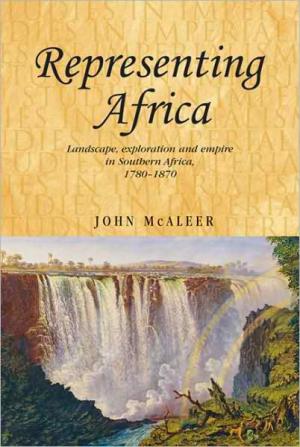
• John McAleer, Representing Africa: Landscape, Exploration and Empire in Southern Africa, 1780-1870, 1 March 2010 Manchester University Press, ISBN: 9780719081040, £60pp, 241, 16 bw, 9 col
• Cassandra Albinson, Peter Funnell & Lucy Peltz, eds, Thomas Lawrence: Regency Power and Brilliance, Exh cat. 21 October 10 YUP, ISBN: 9780300167184, £40, pp280, 20 bw, 160 col
• Cecilia Powell & Stephen Hebron, Savage Grandeur & Noblest Thoughts: Discovering the Lake District 1750-1820, Exh cat. 2010 Wordsworth Trust, ISBN: 9781905256426, £19.95, many illus in colour
 • Mireille Galinou, Cottages & Villas: The Birth of the Garden Suburb, 19 October 2010 YUP, ISBN: 9780300167269, £40, pp480, 55 bw, col 250
• Douglas Fordham, British Art and the Seven Years’ War: Allegiance and Autonomy, 2010 University of Pennsylvania Press, ISBN: 9780812242430, £42.50, pp334, 87 bw
• Charlotte Yeldham, Maria Spilsbury (1776-1820), Artist and Evangelical, 1 February 2010 Ashgate, ISBN: 9780754669913, £65, pp230, 73 bw,
• Bernd W Krysmanski, Hogarth’s Hidden Parts, Georg Holms Verlag, Hildesheim, ISBN: 9783487144719, Euros 48, pp514, 304 bw
• Elisabeth Soulier Detis, Guess at the Rest: Cracking the Hogarth Code, 27 May 2010 James Clarke & Co Ltd, ISBN: 139780718892159, £35, 183 bw, pp233
 • Jason Kelly, The Society of Dilettanti: Archaeology and Identity in the British Enlightenment, [2009] 28 January 2010 YUP, ISBN: 9780300152197, £40, pp366, 100 bw, 20 col
• Julian Mitchell, The Wye Tour and its Artists, Exh cat. 2010 Logaston Press, ISBN: 9781906663322, £12.95, pp168, illus bw & col
• Jennifer Scott, The Royal Portrait. Image and Impact, 2010 Royal Collection Enterprises, ISBN: 9781905686131, £19.95, pp200, 157 col
• Ilaria Bignamini and Clare Hornsby, Digging and Dealing in Eighteenth-century Rome, 25 February 2010 YUP, ISBN: 9780300160437, £45, 2 vols, pp630, 200 bw, 50 col
◊ ◊ ◊ ◊ ◊
Update (added 14 July 2011) — As announced on July 5, this year’s winner is
• Charlotte Gere and Judy Rudoe, Jewellery in the Age of Queen Victoria: A Mirror to the World (London: British Museum Press), 552 pages, ISBN 978-0714128191, £50.
The short list of six titles included these eighteenth-century offerings:
• Celina Fox, The Arts of Industry In the Age of Enlightenment (New Haven: Yale University Press, 2010), ISBN: 9780300160420, £50.
• Cecilia Powell & Stephen Hebron, Savage Grandeur & Noblest Thoughts: Discovering the Lake District 1750-1820 (Wordsworth Trust, 2010), ISBN: 9781905256426, £19.95
• Ilaria Bignamini and Clare Hornsby, Digging and Dealing in Eighteenth-century Rome (New Haven: Yale University Press, 2010), ISBN: 9780300160437, £45.
This Week’s Romantic Objects Seminar in London: Blake and Varley
Philippa Simpson and Sibylle Erle, Varley’s Visionary Heads and Blake’s The Ghost of a Flea
Institute of English Studies, University of London, 15 June 2011

William Blake, "The Ghost of a Flea," ca. 1819-20, tempera heightened with gold on mahogany support (London: Tate Britain)
Romantic Objects is a seminar series that runs over two terms (Spring and Summer) on Wednesdays 5:30-7:30, as part of the inter-university seminar in Romantic Studies at Senate House, co-organized by Birkbeck and the Open University at the Institute of English Studies. This series of seminars will rethink Romantic period material culture in the tension between Romantic attempts to recenter aesthetic experience as subjective just as a new culture of exhibitions, viewing, and collecting practices defines the centrality of objects. The aim is to provide a forum for graduate students, scholars, and curators working in the period 1750-1850 or on questions relating to objects, exhibitions, material culture.
This week’s seminar features Dr Philippa Simpson (Tate Britain) and Dr Sibylle Erle (Bishop Grosseteste College, Lincoln) on John Varley’s Visionary Heads and William Blake’s The Ghost of a Flea. Erle and Simpson curated the current display of Blake and Physiognomy at Tate Britain. Erle is the author of Blake, Lavater and Physiognomy (2010). Simpson, an expert in late eighteenth-century exhibition culture and the
reception of the old masters, co-curated the exhibition Turner and the
Masters. The seminar takes place Wednesday, 15 June, 17:30-19:30, in
STB8 Stewart House, basement, 32 Russell Square. All are welcome!
Reading:
Alexander Gilchrist, Life of Blake (1863), pp. 249-57, (via Googlebooks)
◊ ◊ ◊ ◊ ◊
Sibylle Erle, Blake, Lavater, and Physiognomy (Oxford: Legenda, 2010), 244 pages, ISBN: 9781906540692, $89.

ISBN: 9781906540692
William Blake never travelled to the continent, and yet his creation myth is far more European than has so far been acknowledged. His early illuminated books, of the 1790s, run alongside his professional work as a copy-engraver on Henry Hunter’s translation of Johann Caspar Lavater’s Essays on Physiognomy (1789-98) — work in which Blake helped to make a likeness of a book about likenesses. For Blake, as for Lavater, Henry Fuseli, Joshua Reynolds, and others of his age, the art of the portrait was to find the right balance between likeness and type. Blake, Lavater, and Physiognomy demonstrates how the problems occurring during the production of the Hunter translation resonate in Blake’s treatment of the Genesis story. Blake takes us back to the creation of the human body, and interrogates the idea that ‘God created man after his own likeness’. He introduces the ‘Net of Religion’, a device which presses the human form into material shape, giving it personality and identity. As Erle shows, Blake’s startlingly original take on the creation myth is informed by Lavater’s pursuit of physiognomy: the search for divine likeness, traced in the faces of their contemporary men.
◊ ◊ ◊ ◊ ◊
Blake and Physiognomy
Tate Britain, London, 8 November 2010 — 17 April 2011
Curated by Philippa Simpson and Sibylle Erle
[There is] not a man who does not judge of all things…by their physiognomy;
that is, of their internal worth by their external appearance.
–Johann Caspar Lavater
Johann Caspar Lavater’s Essays on Physiognomy, translated into English in 1789, catalysed a vogue for the theory that people’s characters could be read in their features. Although this would seem to serve as a model of detached observation and scientific classification, Lavater saw these judgements as stemming from an instinctive understanding of expression and appearance. At the heart of his work was a strongly-held Christian belief, according to which all forms were divinely created, and derived from the one perfect God. Lavater’s ideas were also informed by eighteenth-century codes of racial stereotyping that are deeply troubling to the modern reader.
Many British artists, including William Blake, experimented with physiognomic systems in their work. Blake’s involvement, though, was closer than most. He not only engraved illustrations for the 1789 translation of Lavater’s book but, over thirty years later collaborated with his friend, artist and astrologer John Varley, on a publication entitled Zodiacal Physiognomy. This book sought to attribute character according to time of birth, and Varley used prints after Blake’s works to illustrate different star signs. These enterprises suggest that Blake’s visual language, which often seems highly innovative – even idiosyncratic – may be read in the context of broader pseudo-scientific and artistic trends.
Exhibition: ‘The First Actresses’ in London
Press release rom the NPG:
The First Actresses: Nell Gwyn to Sarah Siddons
National Portrait Gallery, London, 20 October 2011 — 8 January 2012
Curated by Gill Perry, supported by Lucy Peltz

John Hoppner, "Mrs. Robinson as 'Perdita'," 1782 © Chawton House Library, Hampshire
The first exhibition to explore art and theatre in eighteenth-century England through portraits of women will open at the National Portrait Gallery in October 2011. With 53 portraits, some brought together for the first time and others not previously seen in public, the exhibition will show the remarkable popularity of actress-portraits and provide a vivid spectacle of eighteenth-century femininity, fashion and theatricality. The First Actresses: Nell Gwyn to Sarah Siddons will show large paintings of actresses in their celebrated stage roles, intimate and sensual off-stage portraits and mass-produced caricatures and prints, and explore how they contributed to the growing reputation and professional status of leading female performers.
The exhibition will combine much-loved works by artists such as Joshua Reynolds, Thomas Gainsborough, John Hoppner, Thomas Lawrence, Johann Zoffany and James Gillray, with some newly discovered works such as the National Portrait Gallery’s new acquisition of the Three Witches from Macbeth by Daniel Gardner.
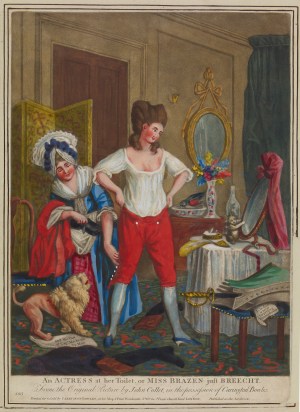
After John Collett, "An Actress at Her Toilet or Miss Brazen just Breecht," ca. 1779
Actresses featured in the exhibition include Nell Gwyn, Kitty Clive, Hester Booth, Lavinia Fenton, Peg Woffington, Sarah Siddons, Mary Robinson, Dorothy Jordan, Elizabeth Farren, Giovanna Baccelli and Elizabeth Linley. Highlights include a little known version of Reynolds’s famous portrait of Sarah Siddons as the Tragic Muse, Hogarth’s The Beggar’s Opera, Gainsborough’s portraits of Giovanna Bacelli and Elizabeth Linley. Important loans include works from the Garrick Club Library, the Royal Shakespeare Company, the National Gallery of Art, Washington, The Fitzwilliam Museum, Cambridge, Tate Britain, the V&A, as well as Petworth, Kenwood and Longleat Houses.
Starting with the emergence of the actress’s profession in the late seventeenth century, The First Actresses: Nell Gwyn to Sarah Siddons will show how women performers, in drama, as well as music and dance, were key figures within a spectacular celebrity culture. Fuelled by gossipy theatre and art reviews, satirical prints and the growing taste for biography, eighteenth-century society engaged in heated debate about the moral and sexual decorum of women on stage and revelled in the traditional association between actress and prostitute, or ‘whores and divines’. The exhibition will also reveal the many ways in which women performers stimulated artistic innovation and creativity and provoked intellectual debate.
As well as focusing on the eighteenth-century actress as a glamorous subject of high art portraits, and the ‘feminine face’ of eighteenth century celebrity culture, the exhibition will look at the resonances with modern celebrity culture and the enduring notion of the actress as fashion icon. As a counterpoint to the exhibition, an accompanying display will show photographic and painted portraits, drawn from the Gallery’s permanent collections, of some of today’s actresses, some of whom have agreed to be the exhibition’s ‘Actress Ambassadors’. A full list will be published prior to opening.
◊ ◊ ◊ ◊ ◊
An exhibition conference will take place on Friday, 11 November 2011.
Exhibition catalogue: Gill Perry with Joseph Roach and Shearer West, The First Actresses: Nell Gwyn to Sarah Siddons (London: National Portrait Gallery, 2011), 160 pages, ISBN: 9781855144118, £30.
Eighteenth-Century Maps: A Fair, a Lecture, and a New Reference Book
Press release from The London Map Fair:
2011 London Antique Map Fair
Royal Geographic Society, London, 11-12 June 2011

Johann Baptist Homann. "Sphærarum Artificialium Typica..." Nuremberg, ca.1730.
The 2011 London Map Fair, taking place in the historic surroundings of the Royal Geographical Society, is the most established and largest antiquarian map fair in Europe: over forty of the leading national and international specialist map dealers will be exhibiting in June. Visitors to the fair will discover a vast selection of original antique maps covering the whole world and printed between the 15th and 19th centuries. Highlights include a map of the universe by seventeenth-century Venetian cartographer Coronelli, revealing the Nine Circles of Hell as described in Dante’s Divine Comedy, as well as a 19th-century curiosity map of Europe depicting each country in the form of a caricature: the United Kingdom
figures as an old crone.
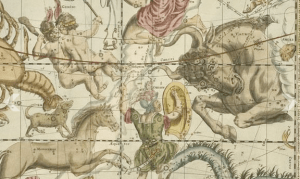
Johann Gabriel Doppelmayr, "Globi Coelestis," 1 of 6 Celestial Charts, Nuremberg, Homann, 1742
Other fine maps offered this year will include: an example of Ogilby’s innovative and incredibly detailed, 17th-century road map, marking all inns, churches and other landmarks on the road from London to Portsmouth – the course of the modern A3; an impression of Braun and Hogenberg’s bird’s-eye view of London; the earliest surviving printed plan of the city, dated 1574; and Christoph Vetter’s rare and beautiful 17th-century depiction of Bohemia stylised as a rose, with Prague at its centre and Vienna, the seat of the Hapsburg Dynasty, at its root. Exhibitors will offer atlases, travel books, globes, sea charts, town plans, celestial maps, topographical prints and
reference books; there are prices to suit all pockets ranging
from a very affordable £10 to over £100,000 for exceptional
pieces.
◊ ◊ ◊ ◊ ◊
2011 London Map Fair Lecture: Laurence Worms and Ashley Baynton-Williams
Royal Geographic Society, London, 11 June 2011
On Saturday, 11 June 2011, at 2:30pm, Laurence Worms and Ashley Baynton-Williams will launch their long-awaited Dictionary of British Map Engravers at the Fair. The product of over twenty years of research, it offers a wealth of fresh material on the map trade and a new insight into the lives of its most important figures, revealing some surprising links and relationships in the process.
◊ ◊ ◊ ◊ ◊
From the International League of Antiquarian Booksellers:
Laurence Worms and Ashley Baynton-Williams, British Map Engravers: A Dictionary of Engravers, Lithographers and Their Principal Employers to 1850 (London: Rare Book Society, 2011), approximately 750 pages, £125.
 The ultimate guide to the identification of British antique maps and their makers: An illustrated dictionary of over 1,500 members of the map trade in England, Ireland, Scotland and Wales, of British-born engravers working overseas and foreign engravers working in the British Isles, from the beginnings until the mid 19th century. Included are all the known engravers and lithographers, globemakers and retailers, the principal map sellers and publishers, key cartographers, makers of map-based games and puzzles, but also the remarkable lives of many artists, dealers and publishers, whose fates have been unknown so far. (more…)
Exhibition: ‘Italian Master Drawings’ in Washington
Press release from the National Gallery in DC:
Italian Master Drawings from the Wolfgang Ratjen Collection, 1525–1835
National Gallery of Art, Washington D.C., 8 May — 27 November 2011
Curated by Margaret Morgan Grasselli

Canaletto, "The Giovedì Grasso Festival before the Ducal Palace in Venice," 1763/1766 (Washington DC: National Gallery, Ratjen Collection, Paul Mellon Fund 2007.111.55)
Splendors of Italian draftsmanship from the Wolfgang Ratjen Collection, spanning the late Renaissance to the height of the neoclassical movement, will be showcased at the National Gallery of Art, Washington. On view in the Gallery’s West Building from May 8 to November 27, 2011, Italian Master Drawings from the Wolfgang Ratjen Collection, 1525–1835 will include 65 stunning Italian compositions and study sheets by the most important artists of the period, from Giulio Romano and Pellegrino Tibaldi to Canaletto, all three members of the Tiepolo family, and Giovanni Battista Piranesi.
In 2007, the National Gallery of Art acquired 185 German and Italian works from the Ratjen Collection—one of the finest private European holdings of old master drawings—with the help of 12 generous private donors as well as the Paul Mellon Fund and the Patrons’ Permanent Fund. “We are delighted to celebrate the second part of the Gallery’s acquisition of this exceptional group of German and Italian drawings formed by the great European collector Wolfgang Ratjen,” said Earl A. Powell III, director, National Gallery of Art. “The Italian portion of the collection is an assemblage of works of beauty and power. Italian drawings were in fact Ratjen’s first love, and he worked on this part of his collection with attentive care throughout his years as a collector.”

ISBN: 9781907372216, $50
Wolfgang Ratjen formed his Italian collection of drawings over a period of about 25 years. He grew up with two that had been acquired by his family during his youth—works by Guercino and Giovanni Battista Tiepolo—and he began collecting himself in the early-1970s. He purchased his last Italian drawing, by Giulio Cesare Procaccini, in July 1997. Ratjen’s collection of Italian drawings is best described as a group of single outstanding works, including famous artists as well as artists of lesser renown. For a select few—such as Jacopo Palma il Giovane, Guercino, and Giovanni Battista Tiepolo—he acquired multiple sheets that conveyed different facets of the artists’ styles or represented a variety of media used.
Organized chronologically throughout three galleries, the exhibition will present works that span three centuries, from the last flowering of the Renaissance around 1530 to the height of neoclassicism in the early 19th century. The works represent a dynamic range of techniques, including quick pen and ink sketches, finely nuanced chalk studies, and highly
finished brush drawings. (more…)
Exhibition: The Düsseldorf Gallery and Its Catalogue
Press release from the Getty:
Display and Art History: The Düsseldorf Gallery and Its Catalogue
Getty Research Institute, Getty Center, Los Angeles, 31 May — 21 August 2011
Curated by Thomas Gaehtgens and Louis Marchesano
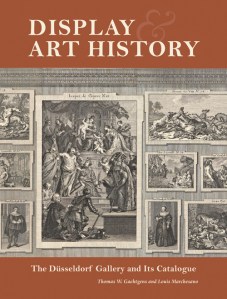
ISBN: 9781606060926, $20
Display and Art History: The Düsseldorf Gallery and Its Catalogue illustrates the making of one of the earliest modern catalogues, La galerie électorale de Dusseldorff (1778), a revolutionary two-volume publication that played a significant role in the history of museums and helped mark the transition from the Baroque to the Enlightenment.
Constructed by Elector Palatine Johann Wilhelm II von der Pfalz between 1709 and 1714, the Düsseldorf gallery is an early example of exhibiting an art collection in a nonresidential structure. It charted the course toward what would eventually become the institution of the public museum. The Düsseldorf gallery featured a new system of display in which the arrangement of objects was determined by art historical principles such as style and school, rather than subject. Published in the second half of the eighteenth century, the Düsseldorf catalogue represented this new display in numerous etchings; the accompanying text sought to educate a broader circle of readers.
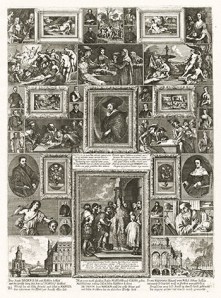
Fictive Wall of Paintings from the Imperial Collection in Vienna, Frans van Stampart and Anton Joseph von Prenner, etching. Prodromus (Vienna, 1735), pl. 21. 88-B2961
Display and Art History: The Düsseldorf Gallery and Its Catalogue, on view at the Getty Research Institute at the Getty Center from May 31 through August 21, 2011, showcases the exquisite watercolors, red chalk drawings, and architectural elevations that were used to produce this revolutionary catalogue. The exhibition explores their role in the printmaking process and underscores their value as precious works of art created by accomplished draftsmen. “We are most fortunate to have an almost complete set of preparatory drawings in our archives, which allows for the reconstruction of this ambitious enterprise and reflects a pivotal moment in the history of art as well as the history of the art museum,” says Thomas Gaehtgens, Director of the Getty Research Institute.
Prince-elector Johann Wilhelm II assembled one of the most important European art collections of the eighteenth century. He constructed a gallery to exhibit his nearly 400 paintings, 46 of which were by Peter Paul Rubens. At the time, many princes were reorganizing their substantial collections in order to convey the message that they not only possessed a wide variety of artistic treasures but were also able to care for them properly and make
them available for study.

Pierre-Louis de Surugue's etching after the "The Night" by Correggio, 1753–1757. Karl Heinrich von Heinecken, Recueil d'estampes d'apres les plus celebres tableaux de la Galerie Royale de Dresde..., vol. 2 (Dresden, 1757), pl. 1.
A generation later, Prince-elector Carl Theodor von der Pfalz, Johann Wilhelm’s nephew and successor, commissioned Lambert Krahe, director of the Düsseldorf Academy and gallery, to rehang the paintings collection following its storage during the Seven Years’ War (1756-63). Krahe broke with the Baroque tradition of decoratively covering entire walls with paintings. Instead, he displayed the paintings in a didactic, symmetrical arrangement ordered by schools, thus introducing a completely new and modern system of organizing art. Rather than hanging paintings frame-to-frame, Krahe integrated space between them, preserving their identity as separate works of art. This new display encouraged viewers to draw comparisons.
The Düsseldorf catalogue similarly fostered learning and education, in addition to celebrating the prestige of the collector. Produced by court architect Nicolas de Pigage, printmaker Christian von Mechel, and linguist Jean-Charles Laveaux, the catalogue illustrates Krahe’s display of paintings on the gallery walls. Unlike earlier catalogues that only provided brief inventories, Pigage’s publication offers an analysis of each painting that was aimed at an educated public. “In this sense, the catalog was very much a work of the Enlightenment, and the princely gallery, accessible to interested visitors,
became more like a museum as we understand it today,” says Gaehtgens.
Louis Marchesano, the GRI’s Curator of Prints and Drawings, adds, “The catalogue no longer simply represented princely magnificence; it now also fostered aesthetic reflection and art historical education.”
◊ ◊ ◊ ◊ ◊
Exhibition catalogue: Thomas W. Gaehtgens and Louis Marchesano, Display and Art History: The Düsseldorf Gallery and Its Catalogue (Los Angeles: Getty Publications, 2011), 104 pages, ISBN: 9781606060926, $20.










 Enfilade
2 comments