Exhibition: ‘The Art of Courtly Lucknow’
I’m afraid this exhibition slipped past me when it was at LACMA. It opens today, however, at the Musée Guimet in Paris. Thanks to Hélène Bremer for pointing it out. The following description comes from the LACMA press release:
India’s Fabled City: The Art of Courtly Lucknow / Une cour royale en Inde: Lucknow
The Los Angeles County Museum of Art, 12 December 2010 — 27 February 2011
Musée National des Arts asiatiques-Guimet, Paris, 6 April — 11 July 2011
Curated by Stephen Markel and Tushara Bindu Gude
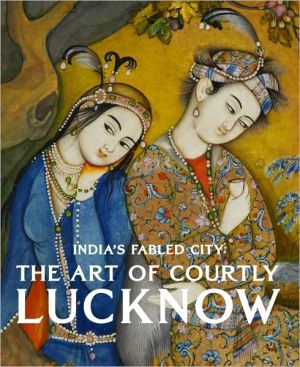
Exhibition catalogue, 272 pages, ISBN: 9783791350752
The Los Angeles County Museum of Art presents India’s Fabled City: The Art of Courtly Lucknow—the first major international exhibition devoted to the cosmopolitan culture of the northern Indian court of Lucknow, and the refined artistic production of the city’s multiethnic residents and artists. On view from December 12, 2010 through February 27, 2011, the exhibition will include almost 200 artworks: European oil paintings, watercolors, and prints; Indian opaque watercolor paintings generally made for albums, vintage photography, textiles, and garments, and a range of decorative art objects including metalwork, glassware, weaponry, and jewelry. Organized by Stephen Markel, LACMA curator of South & Southeast Asian art and department head, and Tushara Bindu Gude, associate curator, The Art of Courtly Lucknow will not only present the unique artistic traditions of Lucknow, but will also provide a framework for understanding the history of this extraordinary region and the nature of India’s colonial history and memory. . . .

After Johann Zoffany, "Colonel Polier Watching a Nautch," gouache on paper, ca. 1786-88 (Zurich: Museum Rietberg)
Lucknow was the capital of Awadh (a province in the Mughal Empire located in the present-day Indian state of Uttar Pradesh), and has become identified with the broader region and culture. From the mid-eighteenth century until the establishment of formal British rule in India in 1858, Lucknow overshadowed Delhi—the capital of the Mughal dynasty—to become the cultural center of northern India. Indian artists, poets, and courtiers flocked to Awadh seeking security and patronage, as Delhi suffered an extended period of unrest beginning in 1739. European artists, travelers and political agents were also soon lured to the region, seduced by tales of the wealth, opulence, and the generosity of Lucknow’s rulers (nawabs) and by the beauty of the city itself. The dynamic interaction between Indians and Europeans, the interplay
between their respective tastes and traditions, and the hybrid
lives led by many of Lucknow’s residents are explored in the
exhibition and accompanying publication. (more…)
Reviewed: ‘Artistic and Cultural Exchanges between Europe and Asia’
Recently added to caa.reviews:
Michael North, ed., Artistic and Cultural Exchanges between Europe and Asia, 1400–1900: Rethinking Markets, Workshops and Collections (Burlington, VT: Ashgate, 2010), 216 pages, ISBN: 9780754669371, $114.95.
Reviewed by David Carrier, Case Western Reserve University/Cleveland Institute of Art; posted 24 March 2011.
The necessary precondition for a world art history is the close study of cultural exchanges. Even nowadays, when you can travel from New York to Beijing in less than a day, the distance between America’s and China’s visual cultures is still immense. When such travel was much slower, and curators were not much concerned with exotic art, the diverse artistic traditions were relatively self-sufficient. But once Vasco da Gama circumnavigated the globe, it was inevitable that those artifacts called works of art would move from their places of origin to other cultures. The world had become one, which is to say that all art traditions were interconnected. This, then, is why close analysis of the slow-moving process in which Europeans brought their art to China, India, and other places outside the West, as well as collected non-European art, is extremely important.
“Artistic and Cultural Exchanges between Europe and Asia,” an anthology that collects the proceedings of a conference held in Sydney in 2005, contains an introduction by Thomas DaCosta Kaufmann and Michael North, and essays by Karl-Heinz Spiess on Asian artifacts in Western European courts during the Middle Ages; Peter Borschberg on the trade in Bezour stones, the minerals believed to possess magical properties; Ting Chang on French fantasies about Asia; Martin Krieger on Dutch collecting in colonial India, circa 1800; Alexander Drost on Mughal architecture as it was incorporated into European memorials in seventeenth-century India; North on art making by European companies in Asia; Mia Mochizuki on the uses of Dutch maps in Japan; Kaufmann on markets in Funi-e; and Yoriko Kobayashi-Sato on the relationships between Japan and the West during the Edo period. . . .
The full review is available here» (CAA membership required)
Stockholm Show Surveys Sexuality
Press release from the museum:
Lust & Last / Lust & Vice
Nationalmuseum, Stockholm, 24 March — 14 August 2011

Louis Lagrenée, "Amor and Psyche," (Stockholm: Nationalmuseum)
On 24 March 2011, Nationalmuseum opens the doors to Lust & Vice, a major exhibition filling three rooms and five display cases. Over 200 works from the 16th century to the present day, mostly little-known treasures from the museum’s own collection, will illustrate how views of sexuality, virtue and morality have changed over the centuries. The exhibition includes works coloured by the religious teachings of the 16th and 17th century, which held that sexual relationships could only take place inside marriage. However, there was a big difference between the behaviour the church prescribed for ordinary people and the liberties taken by the elite. The exhibition continues by examining the upper-class view of marriage in the 18th century: a social institution that left the parties to seek true passion elsewhere. In other words, an
attitude diametrically opposed to that of the church. The 18th
century was a time of double standards: one for the masses
and another for the enlightened elite.

Adolf Ulrik Wertmüller, "Danaë and the Shower of Gold,"(Stockholm: Nationalmuseum)
From the 19th century onward, the city becomes a central theme. Large-scale urbanization frequently led to anonymous sexual encounters and prostitution. Secret images for private consumption coexisting with moralistic public art were another by-product of urbanization. The exhibition presents examples of how virtue and sin have been depicted in art through the ages. One of the display cases examines how girls were brought up to lead a virtuous life in order to be good marriage material. Exhibits include a real chastity belt on loan from Nordiska museet. One wall in the first room displays paintings of women’s bottoms – an erotic reference that was long considered sinful because sex, besides taking place inside marriage, required eye contact in order to be morally acceptable. Artists managed to paint erotic motifs by portraying
myths or biblical scenes, often with moralistic undertones
alluding to the consequences of a sinful lifestyle. (more…)
Review: Amanda Lahikainen on Thomas Rowlandson
The Rowlandson exhibition opens next week at The Frances Lehman Loeb Art Center at Vassar College (8 April — 11 June 2011). And so in a timely manner, Amanda Lahikainen here inaugurates a new feature of Enfilade, original reviews. They won’t become a major feature of the site anytime soon, but there are a few more on the way.
Patricia Phagan, Vic Gatrell, and Amelia Rauser, Thomas Rowlandson: Pleasures and Pursuits in Georgian England (London: D. Giles Limited, 2011), 184 pages, ISBN: 9781904832782.
Reviewed for Enfilade by Amanda Lahikainen
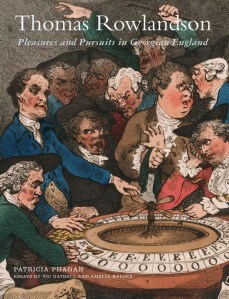 The lens of social life and social mixing frames the exhibition and accompanying catalogue, Thomas Rowlandson: Pleasure and the Pursuits in Georgian England. It’s a concept that Rowlandson himself might have chosen for such an exhibition of his own work. The show and catalogue stress the importance of broad historical contextualization, with an emphasis on pleasure and socialization in England during Rowlandson’s life (1757-1857). Edited by the exhibition’s curator, Patricia Phagan, the catalogue divides Rowlandson’s prints into six categories, each with an introductory essay, including images of street life and scenes from the theater. The color photographs are generously sized, and the entries aid readers both in deciphering the social and political references within the satires and in contextualizing the prints within the market for satire more generally. Entry #9, for instance, includes a caricature by the cotemporary satirist James Gillray for comparison, and entry #27 allows us to compare Rowlandson’s print The Brilliants to its likely predecessor, A Midnight Modern Conversation by William Hogarth. Readers find detailed information about Rowlandson’s life and the placement of his work within Britain’s hierarchy of genres. Also included is discussion of his pornographic subject matter and boisterous tavern scenes so important for an artist who relished whimsical and grotesque vignettes from common life. Fortunately, the catalog offers multiple points of engagement between “high art” and “low art,” thereby problematizing facile distinctions that have long plagued scholarly assessments of Rowlandson.
Especially valuable for British art studies are the two essays by Vic Gatrell, a historian, and Amelia Rauser, an art historian. Both scholars have recently published important books on graphic satire, in 2006 and 2008 respectively, and they usefully approach Rowlandson’s art from different perspectives. Gatrell lays bare the complex network of print makers and artists that defined Rowlandson’s world and visualizes this history using a detailed topographical map of Covent Garden and the Strand, an area of London which he describes as the “emotional heartland and a chief source” of Rowlandson’s comic vision. Toward the end of the essay, he tackles the critical reception of Rowlandson; this section is well worth reading even as an abstract meditation on the values that often guide our judgments of prints, including anxieties about reproduction and the pitfalls of strict subject categories.
Rauser’s essay asks us to look closely at Rowlandson’s prints and acknowledge that his work often simultaneously captivates and repulses. She gives a compelling answer to the question of what makes Rowlandson’s satire distinctive. Starting from the observation that Rowlandson’s art is amoral, she identifies his “commitment to embodiedness” and bemused “ironic detachment” as exceptional strengths. Her point is a good one: Rowlandson deflates his subjects by relentlessly reminding his viewers that they inhabit a body bound by the laws of nature and desire. Whether or not we follow Rauser in thinking of Rowlandson’s unrelenting interest in the human body as a product of Romanticism or Gatrell in thinking of Rowlandson’s humorous and grotesque bodies as responses to the growing wealth of the middle-class print buyers, we can agree that Rowlandson handles the human form to great effect. It is perhaps because of his disregard for didactic messages that he so successfully demonstrates the absurdity of social norms, especially deflating the rich and powerful along the way.
Amanda Lahikainen, a Ph.D. candidate at Brown University, is finishing her dissertation on the representation of abstract ideas in British graphic satire during the French Revolution. She has an article forthcoming in Print Quarterly and is currently working towards writing a book on the embodiment of debt in satire over the course of the eighteenth and nineteenth centuries.
Conservation of Jefferson’s Bible
Press release (11 March 2011), from the National Museum of American Art:
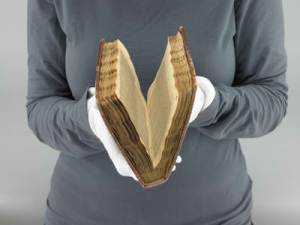 The Smithsonian’s National Museum of American History is currently performing a specialized conservation treatment to ensure the long-term preservation of Thomas Jefferson’s bible, a small handmade book that provides an intimate view of Jefferson’s private religious and moral philosophy.
At age 77 and living at Monticello in retirement following his two terms as President, Jefferson completed a project he had long planned and long discussed with others. In 1820 he assembled what he titled “The Life and Morals of Jesus of Nazareth.” Using excerpts from the Four Gospels of the New Testament, Jefferson
arranged the text to tell a chronological and edited story of Jesus’
life and moral philosophy.
 “The volume provides an exclusive insight to the religious and moral beliefs of the writer of the Declaration of Independence, the nation’s third President, as well as his position as an important thinker in the Age of Enlightenment,” said Brent D. Glass, director of the museum. “The treatment will ensure that generations to come will be able to study and view this tangible witness to history.”
Professionally bound in rich Morocco leather with gold tooling, this volume (86 pages; 8.25 inches by 5 inches) was not printed but rather constructed more like a “scrapbook.” Jefferson clipped
various passages from printed New Testaments in English, French,
Greek and Latin and glued them onto the front and back of blank
pages in four columns to allow for immediate comparison. On
those pages, Jefferson wanted to clarify and distill Jesus’ teachings. (more…)
Exhibition: Chardin in Madrid
The Chardin exhibition formerly on view in Ferrara recently opened at the Prado:
Chardin: The Painter of Silence
Ferrara, Palazzo dei Diamanti, Ferrara, 17 October 2010 — 30 January 2011
Museo Nacional del Prado, Madrid, 1 March — 29 May 2011
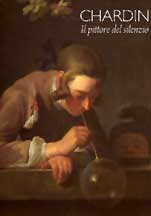 The Museo del Prado presents the exhibition Chardin, a comprehensive survey of the work of Jean Siméon Chardin (1699-1779). Chardin is one of the leading names in 18th-century French painting but has never been the subject of an exhibition in Spain, which only houses three of his paintings, all in the Museo Thyssen. After being shown at the Palazzo dei Diamante in Ferrara, the exhibition is presented in Madrid thanks to the sponsorship of Fundación AXA. It comprises 57 paintings by this great master of the still life and of genre painting, including some works not shown in the version of the exhibition seen in Italy.
Additional information is available here»
Reviewed: ‘The City’s Pleasures: Istanbul in the Eighteenth Century’
From The Art Bulletin 93 (March 2010): 101-04.
Shirine Hamadeh, The City’s Pleasures: Istanbul in the Eighteenth Century (Seattle: University of Washington Press, 2007), 368 pages, ISBN: 9780295986678, $60.
Reviewed alongside Cigdem Kafescioglu’s Constantinopolis/Istanbul: Cultural Encounter, Imperial Vision, and the Construction of the Ottoman Capital (2009) and Murat Gül’s The Emergence of Modern Istanbul: Transformation and Modernisation of a City (2009).
Reviewed by Robert S. Nelson, Yale University.
. . . Hamadeh defines the character of a period through its buildings. Especially noteworthy is her use of poetry and building inscriptions. And, like Kafescioglu, she discusses vision, power, and the location of buildings . . . . she relies on the concept of ‘pleasure’ in the title and, behind it, a more fundamental notion of public space, adapted from Jürgen Habermas and others, that did not exist in the earlier centuries. Istanbul in the eighteenth century resembles John Brewer’s view of London from the late seventeenth century, in which ‘high culture moved out of the narrow confines of the court and into diverse spaces’ [The Pleasures of the Imagination, p. 3]. Finally, while her book is firmly ensconced in Turkish studies, the author also situates it laterally in early modern studies and critiques Westernization theories of
Ottoman architecture, that is, the notion that it follows at a
distance fashions set elsewhere. . .
Exhibition: Pastel Portraits at the Met
Press release from the Met:
Pastel Portraits: Images of 18th-Century Europe
Metropolitan Museum of Art, New York, 17 May — 14 August 2011
Curated by Katharine Baetjer and Marjorie Shelley
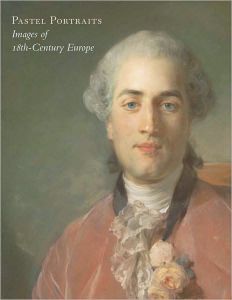 In the 18th century, pastel portraiture was so popular in Europe that by 1750 almost 2,500 artists and amateurs were working in pastel in Paris alone. Across Europe works were commissioned by royalty and courtiers, as well as the wealthy middle classes. Although pastel is a drawing material, 18th-century portraits are often highly finished, relatively large, brightly colored, elaborately framed, and hung in the same fashion as oil paintings. The powdery pastel crayons and slightly roughened paper are particularly suited to capturing the evanescent effects of expression that characterize the most life-like portraits. Pastel Portraits: Images of 18th-Century Europe will feature 40 pastel portraits from the collections of the Metropolitan Museum and other museums, and from private collections in New York, Princeton, and New Haven. At the core of the exhibition will be a group of French works, and the English, German, Italian, and Swiss schools will also represented.
Pastels are susceptible to fading if overexposed to light, and they are vulnerable to damage from excessive vibration, which can loosen the powder. As a practical consequence, they can only be shown three months of the year, rarely travel, and are not often exhibited in museums. Pastel Portraits will give visitors the rare opportunity to view these exquisite works in a museum exhibition, which will include generous loans from the Princeton University Art Museum, Yale Center for British Art, New Haven, Pierpont Morgan Library, New-York Historical Society, and Frick Collection, as well as several private collections.
Pastel Portraits will feature a number of fine works by Maurice Quentin de La Tour and Jean Baptiste Perronneau, two of the best known and outstanding artists who were working with this medium in mid-18th–century Paris. Highlights of the exhibition will include La Tour’s Jacques Dumont le Romain (1701-1781) Playing the Guitar; Perronneau’s Olivier Journu; Adélaïde Labille-Guiard’s portrait of the sister of Louis XVI, Madame Elisabeth de France (1764-1794), recently acquired by the Metropolitan Museum; Jean Étienne Liotard’s Young Woman in Turkish Costume with a Tambourine; John Russell’s John Collins of Devizes; and the beautiful Young Woman with Pearl Earrings by Venetian artist Rosalba Carriera, who became a favorite of Grand Tourists visiting Italy. The popularity and appeal of pastel in the 18th century reached as far as Boston, where John Singleton Copley, who was self-taught and had never seen an important European work in the medium, created exceptional portraits. Two of Copley’s portraits, also recently acquired by the Metropolitan Museum, will be on view in the exhibition.
Katharine Baetjer and Marjorie Shelley, Pastel Portraits: Images of 18th-Century Europe, exhibition catalogue (New Haven: Yale University Press, 2011), 9780300169812, 56 pages, $14.95.
New Title: Dorothy Johnson’s ‘David to Delacroix’
From the UNC Press:
Dorothy Johnson, David to Delacroix: The Rise of Romantic Mythology (Chapel Hill: University of North Carolina Press, 2011), 260 pages, ISBN: 9780807834510, $45.
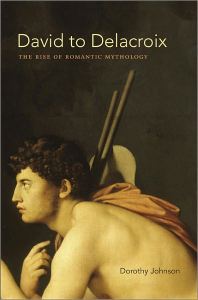 In this beautifully illustrated study of intellectual and art history, Dorothy Johnson explores the representation of classical myths by renowned French artists in the late eighteenth and early nineteenth centuries, demonstrating the extraordinary influence of the natural sciences and psychology on artistic depiction of myth. Highlighting the work of major painters such as David, Girodet, Gérard, Ingres, and Delacroix and sculptors such as Houdon and Pajou, David to Delacroix reveals how these artists offered innovative reinterpretations of myth while incorporating contemporaneous and revolutionary discoveries in the disciplines of anatomy, biology, physiology, psychology, and medicine. The interplay among these disciplines, Johnson argues, led to a reexamination by visual artists of the historical and intellectual structures of myth, its social and psychological dimensions, and its construction as a vital means of understanding the self and the individual’s role in society. This confluence is studied in depth for the first time here, and each chapter includes rich examples chosen from the vast number of mythological representations of the period. While focused on mythical subjects, French Romantic artists, Johnson argues, were creating increasingly modern modes of interpreting and meditating on culture and the human condition.
Dorothy Johnson is Roy J. Carver Professor of Art History at the University of Iowa.
Call for Nominations: Marc Raeff Book Prize
Marc Raeff Book Prize for Outstanding Work on Imperial Russia
Nominations due by 30 May 2011
The Eighteenth-Century Russian Studies Association (ECRSA) is now accepting submissions for the first annual Marc Raeff Book Prize. The award is sponsored by the ECRSA and named in honor of Marc Raeff (1923-2008), historian, teacher, and dix-huitièmiste par excellence. The Raeff Prize will be awarded annually for a publication that is of exceptional merit and lasting significance for understanding Imperial Russia, particularly during the long eighteenth-century. The submitted work must bear a copyright date of either one or two years preceding the award year (e.g. for the 2011 competition the published copyright dates are 2009 and 2010). It can be published in any language read by members of the ECRSA Prize Selection Committee (including Russian) and in any format (analog or digital). Scholarly merit, originality, and felicity of style will be the main criteria for selection. Submissions from scholars who are less than five (5) years from receiving their doctoral degree are particularly encouraged. The recipient of the award will be recognized with a cash prize, which will be presented in November 2011, during the ASEEES annual convention. See ECRSA Events for full details.










 Enfilade
leave a comment