Exhibition: Four Hundred Years of French Drawings
Press release from The Frick in Pittsburgh:
Storied Past: Four Centuries of French Drawings from the Blanton Museum of Art
The Frick Art & Historical Center, Pittsburgh, 5 February — 17 April 2011
Blanton Museum of Art, The University of Texas, Austin, 18 September — 31 December 2011
Iris and B. Gerald Cantor Center for Visual Arts, Stanford University, 28 May — 24 August 2014
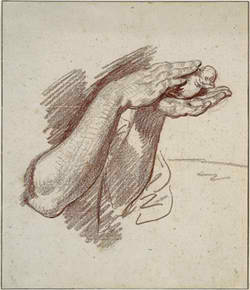
Jean-Baptiste Greuze, "The Arms of a Girl Holding a Bird," red chalk on cream paper, ca. 1765 (Austin: Blanton Museum of Art, The University of Texas)
Composed of 56 drawings made between 1500 and 1900, this exhibition chronicles the full range of artistic uses of the medium, from quick sketches to finished compositional studies, to drawing as an end in itself. The Blanton Museum at the University of Texas at Austin has organized the exhibition from their permanent collection, which was supplemented a bit more than a decade ago by a large gift of drawings. The French drawings from this gift had not received systematic academic study, nor had most of them been published. Especially rich in 17th- and 18th-century drawings, the exhibition illustrates the rise to dominance of the Académie royale de peinture et de sculpture as one of the most dominant cultural and political institutions in Europe. The exhibition includes works by François Boucher (1703–1770), Jean-Baptiste Greuze (1725–1805), and Nicolas Lancret (1690–1743), among others, with the nineteenth century represented by choice sheets from François-Marius Granet (1777–1849), Théodore Rousseau (1812–1867), Jean Forain (1852–1931), Théophile-Alexandre Steinlen (1859–1923), and others who reflect shifts in the approach to drawing
in the modern era.

Exhibition catalogue, ISBN: 9781555953560, $65
At the Frick, the exhibition will find a perfect counterpart in the museum’s permanent collection, which visitors will enter as they exit the traveling drawings show. Paintings by Jean-Marc Nattier (1685–1766), Lancret (1690–1743), Jean-Baptiste Pater (1695–1736), Boucher, Hubert Robert (1733–1808), and Nicolas-Bernard Lepicié (1735–1784), will be displayed with examples of decorative arts from the period, which will provide for a richer understanding of the 18th century in particular. . . .
The exhibition begins in a period of transition from the mannerism of the late Renaissance to the Baroque period. Two sheets showing designs for a powder flask made by an artist associated with the School of Fontainebleau show the sophisticated sense of decoration that prevailed among artists working around the court of Francis I. Two drawings attributed to seminal printmaker Jacques Callot (1592–1635) and his circle date to the period he spent in Florence, and show his interest in melding his observations of life around him into his expressive and inventive finished compositions. The fluid chalk Study of a Man with a Turban, c. 1617, attributed to Callot, is characteristic of his elegant figures and displays a masterful ability at controlling light and shade and swiftly capturing the spirit of a figure, as well as its contours. (more…)
Exhibition: Bronze Sculpture in Minneapolis
Notwithstanding the show’s title, there are significant eighteenth-century works included (the ‘long Baroque’). Press release from the MIA:
Beauty and Power: Renaissance and Baroque Bronzes from the Peter Marino Collection
The Wallace Collection, London, 29 April — 25 July 2010
The Huntington Library, San Marino, CA, 9 October 2010 — 24 January 2011
Minneapolis Institute of Arts, 6 February — 15 May 2011
Curated by Jeremy Warren
 An important international exhibition, Beauty and Power: Renaissance and Baroque Bronzes from the Peter Marino Collection opens at the Minneapolis Institute of Arts (MIA) February 6 and runs through May 15. Additionally, the MIA is presenting Lost Wax, Found Sculpture, an exhibition that explains the technique of making bronze sculpture according to the historically popular technique of lost-wax casting.
Beauty and Power is selected from Marino’s unparalleled private collection of 16th- to 18th-century Italian and French bronzes, and contains many pieces never publicly displayed before the show debuted in early 2010 at the Wallace Collection in London. It comes to the MIA from its only other U.S. venue, the Huntington Library, Art Collections and Botanical Gardens in San Marino, California.
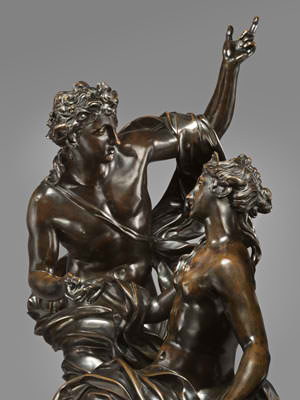
Corneille van Clève (1646-1732), "Bacchus and Ariadne," bronze, ca. 1703-04
“The MIA is fortunate to be able to show more about thirty bronzes statuettes from Mr. Marino’s exemplary collection that spans the golden age of the art form,” said Eike Schmidt, the James Ford Bell curator of Decorative Art and Sculpture at the MIA. “For three-and-a-half months we are the beneficiaries of his two-decade quest to assemble one of the strongest compilations of Renaissance and Baroque small bronzes in the nation.”
Beauty and Power coincides with and complements three other important MIA exhibitions from the same time period: Titian and the Golden Age of Venetian Paintings: Masterpieces from the National Galleries of Scotland, Venice on Paper, and The Mourners: Tomb Sculptures form the Court of Burgundy. . . .
Bronze statuettes became a serious art form in Renaissance Italy when interest in ancient Rome and Roman bronze-casting was revived, often using themes inspired by Greek and Roman mythology. Bronze has always been valued for its surface and molten qualities, which create complex and satisfying sculptural forms full of sensuality and emotion. Created on a scale that made them easy to collect and display, these bronzes were in demand, and sculptors across Europe created them to showcase their abilities. Included in the show are such works as the powerfully violent Samson and the Philistine (c. 1550–60), attributed to Baccio Bandinelli; the atypical depiction of an at-peace Diana (c. 1720–40) by Antonio Montauti; and Corneille van Cleve’s masterpiece Bacchus and Ariadne (c. 1703–4), showing the romantic encounter between the abandoned goddess and her rescuer. It also includes Florentine sculptor Giovanni Battista Foggini’s heroic David and Goliath (c. 1722), Ferdinando Tacca’s touching Hercules and Iole (c. 1640–50), and Robert Le Lorrain’s symbolically portrayed Andromeda (c. 1695–1700). (more…)
New Title: Michael Yonan on Empress Maria Theresa
From Penn State UP:
Michael Yonan, Empress Maria Theresa and the Politics of Habsburg Imperial Art (University Park, PA: Penn State University Press, 2011), 240 pages, ISBN 9780271037226, $89.95.
 Between 1740 and 1780, Empress Maria Theresa governed the Habsburg Empire, a multilingual conglomeration of states centered on Austria. Although recent historical scholarship has addressed Maria Theresa’s legacy, she remains entirely absent from art history despite her notable role in shaping eighteenth-century European diplomatic, artistic, and cultural developments. In Empress Maria Theresa and the Politics of Habsburg Imperial Art, Michael Yonan explores the role that material culture—paintings, architecture, porcelain, garden sculpture, and decorative objects—played in forming the monarchical identity of this historically prominent woman ruler.
Maria Theresa never obtained her power from men, but rather inherited it directly through birthright. In the art and architecture she commissioned, as well as the objects she incorporated into court life, she redefined visually the idea of a sovereign monarch to make strong claims for her divine right to rule and for hereditary continuity, but also allowed for flexibility among multiple and conflicting social roles. Through an examination of Maria Theresa’s patronage, Michael Yonan demonstrates how women, art, and power interrelated in an unusual historical situation in which power was legitimated in women’s terms.
Addition information is available here»
New Title: ‘Jean de Jullienne’
Isabelle Tillerot, Jean de Jullienne et les collectionneurs de son temps (Paris: Editions Maison des Sciences de L’homme, 2011), 510 pages, ISBN: 9782735112531, €48.
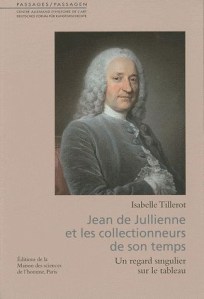 Fils d’un marchand de draps que rien ne prédisposait à devenir l’une des figures emblématiques de son époque, Jean de Jullienne (1686-1766) occupe une place à part dans le monde des collectionneurs au XVIIIe siècle. Si sa collection, riche de près de cinq cents tableaux, rassemble, parmi des peintres des écoles nordique, française et italienne, des noms comme ceux de Poussin, Rembrandt ou Titien, elle se distingue de celles de la comtesse de Verrue, du prince de Carignan ou d’autres grands collectionneurs de son temps par le fait qu’elle accorde aux peintres vivants un statut nouveau. Selon Mariette, Jullienne posséda un temps presque tous les tableaux de Watteau. Entreprise unique au XVIIIe siècle, il fait graver son œuvre peint et dessiné. Au-delà du choix des tableaux, Jullienne apporte un soin tout particulier à l’accrochage. Tournant le dos à la mode des galeries richement décorées où les peintures ne sont que des ornements parmi d’autres, il fait construire dans sa mai son des Gobelins une galerie aux murs nus où le tableau règne en maître. Le catalogue illustré de son cabinet, document
inédit, témoigne de ce nouveau regard et permet de récuser l’idée d’une collection
immuable.
L’histoire de Jullienne est en effet celle d’un homme qui, s’il ne cesse d’aimer Watteau, continue d’aimer la peinture après lui et fait entrer jusqu’à la fin de sa vie de nouvelles œuvres dans sa collection, privilégiant les beautés des tableaux par rapport à leur ancienneté. Fait sans précédent, sa collection est dispersée au Louvre après sa mort. Amateur? Connaisseur? Isabelle Tillerot interroge ces notions essentielles au XVIIIe siècle et montre comment Jullienne, au travers d’un savoir acquis et ressenti, parvient au statut de paradigme du collectionneur.
◊ ◊ ◊ ◊ ◊
Note (added 8 August 2011): A review of the book by David Pullins for Enfilade is available here»
Exhibition: Canaletto in Washington
Venice: Canaletto and His Rivals
National Gallery, London, 13 October 2010 — 16 January 2011
National Gallery, Washington D.C., 20 February — 30 May 2011

Canaletto, "The Square of Saint Mark's, Venice," 1742/1744 (DC: National Gallery, Gift of Mrs. Barbara Hutton 1945.15.3)
As the Canaletto exhibition opens in Washington, it will be introduced with a lecture by Charles Beddington (guest curator) and David Alan Brown (curator of Italian and Spanish paintings, National Gallery of Art). The show runs through the end of May.
Additional information is available here»
Book Review: ‘Thomas Roberts’ Catalogue
From the February issue of Apollo Magazine:
William Laffa and Brendan Rooney, Thomas Roberts (1748-1777): Landscape and Patronage in Eighteenth-Century Ireland, exhibition catalogue (Tralee: Churchill House Press for the National Gallery of Ireland, 2009), 416 pages, ISBN: 9780955024634, $110.
Reviewed by Toby Barnard, Hertford College, Oxford University; posted 1 February 2011.
Thomas Roberts (1748–77) blazed briefly across the Irish skies in the 1770s. Little in Irish painting before that decade prepared for his sudden appearance on the scene. At that time in 18th-century Ireland, the techniques and subjects of Claude, Poussin and Salvator Rosa appealed to artists and collectors alike. A succession of painters – Willem van der Hagen, Robert Carver, John Lewis and Joseph Tudor – assimilated the conventions and demands of pastoral landscape painting, and created decorative but generalised images. Roberts, in contrast, applied these classical dressings to recognisable Irish scenes. The results, seen in a revelatory exhibition at the National Gallery in Dublin in 2009, encompass the mansions and demesnes of Protestant grandees and remoter views of the west, notably the modest townships of Ballyshannon and Belleek. . . .
The full review is available here»
Exhibition: The Tragic Muse in Chicago
From the Smart:
The Tragic Muse: Art and Emotion, 1700-1900
Smart Museum of Art, University of Chicago, 10 February — 5 June 2011
Curated by Anne Leonard

Noël Hallé, detail of "Joseph Accused by Potiphar’s Wife," c. 1740–44 (Chicago: Smart Museum of Art)
Art is often appreciated for its ability to delight our eyes and refresh our minds. But it can also serve as a powerful vehicle for exploring darker emotions, such as fear, sadness, and grief. And while these themes have a history dating back to the ancients, the ways in which they have been represented in art has changed dramatically over time.
This exhibition examines two centuries of works intertwined with emotion—from the sacrifice of classical heroines to the grief of ordinary people, from martyred saints to actors in tragic roles—and explores how art’s cathartic power grows or fades for new generations of viewers. With over forty paintings, sculptures, and prints, The Tragic Muse combines works from the Smart’s collection—both long-held treasures and new acquisitions—with important loans from the Art Institute of Chicago, Milwaukee Art Museum, National Gallery of Art, and Tate. Together with an accompanying catalogue, the exhibition draws on the scholarship of University of Chicago faculty to offer fresh insight into the visual representation of tragedy and art’s power to express and elicit intense emotions.
This exhibition is one in a series of projects at the Smart Museum of Art supported by an endowment from the Andrew W. Mellon Foundation that fosters interdisciplinary use of the Museum’s collections by University of Chicago faculty and students in both courses and special exhibitions. The Tragic Muse exhibition catalogue has received additional grant support from the Samuel H. Kress Foundation.
◊ ◊ ◊ ◊ ◊
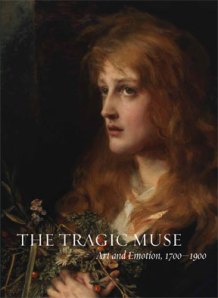 Anne Leonard with contributions by Joyce Suechen Cheng, Glenn W. Most, Erin Nerstad, Sarah Nooter, and Thomas Pavel, The Tragic Muse: Art and Emotion, 1700-1900, exhibition catalogue (Chicago: Smart Museum of Art, 2011), 128 pages, ISBN: 9780935573497, $30.
Published to coincide with the Smart Museum of Art’s exhibition The Tragic Muse, the publication draws on the work of several distinguished scholars to examine the richly varied representation of tragedy in the European artistic tradition over the course of two centuries. This catalogue is generously illustrated with full-color reproductions of all the works contained in the exhibition, and the fascinating contributions offer new insights into the approaches taken by the visual arts, as well as literature and drama, in expressing and eliciting strong emotions.
Exhibition: Baroque Ivory at the Court of Vienna
From the Liebieghaus Skulpturensammlung:
Ivory: Baroque Splendor at the Viennese Court / Elfenbein: Barocke Pracht am Wiener Hof
Liebieghaus Skulpturensammlung, Frankfurt am Main, 3 February — 26 June 2011
Curated by Maraike Bückling and Sabine Haag

Ignaz Bendl (1682–1730) "Medaillon commemorating the erection of the mercy columm," ca. 1692
Ivory has been one of the most popular materials since ancient times. Its origins in unknown faraway lands and its rarity account for its costliness. It was particularly the Baroque era that had an extraordinarily high demand for ivory. In the seventeenth century, ivory work reached its culmination in Vienna in the days of Prince Karl Eusebius of Liechtenstein and Emperor Leopold I. The shimmering appearance of the polished material served princely-imperial claims to prestige, as its possession testified to its owners’ power and wealth. The exhibition Ivory: Baroque Splendor at the Court of Vienna, presented in the Liebieghaus Skulpturensammlung from February 3 to June 26, 2011, will focus on this heyday of ivory art. It will feature thirty-six splendid, virtuoso carvings impressively documenting the artisans’ great skill, among them masterly executed statuettes, pitchers, goblets, tankards, and bowls of ivory, objects created for display in so-called cabinets of curiosities and not intended for any practical use. The show comprises works by the most famous ivory artists of the Baroque period, such as Adam Lenckhardt, Johann Caspar Schenck, and Matthias Steinl. It was prepared together with the Kunsthistorisches Museum in Vienna, whose world-renowned Cabinet of Wonders is closed for the time being because of comprehensive restoration measures. This presented the Liebieghaus with the unique opportunity to show a high-caliber selection of masterpieces from the Kunstkammer of the Kunsthistorisches Museum in Frankfurt before the items will be on display again on a permanent basis in Vienna after the Cabinet’s reopening in late 2012. Eight additional high-carat loans come from the Reiner Winkler Collection.

Matthias Steinl (1643/44–1727) "Allegory of the Elements of Water and Air," ca. 1688
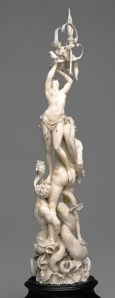
Matthias Steinl (1643/44–1727) "Allegory of the Elements of Water and Air," ca. 1688
In Ancient Greece, Phidias already created large statues of gods whose skin was executed in ivory, and the Bible describes Solomon’s throne as made up of ivory parts. It was above all in the Middle Ages and in the Baroque era that ivory was held in high esteem as a material. The great demand finally resulted in the emergence of new ports of entry in the seventeenth century; both the East India Company and the West India Company furthered the transport of African ivory in particular. The concentration on necessarily small-format ivory works fit in well with the fact that there were hardly any or no commissions at all conferred for large-size church or palace interiors during the Thirty Years’ War and the plague epidemics. Sculptors and their clients increasingly or entirely dedicated themselves to small mobile sculptures.
In the Renaissance and Mannerist periods, bronze was preferred for small sculptures. Yet, ivory outstripped the material in the course of the seventeenth century. People appreciated its combination of elasticity and hardness, as well as its gleaming transparency and delicate veining resembling the tone of flesh. The heyday of the production of ivory works in the seventeenth century was based on sixteenthcentury ivory turnery, on such early examples as those by the Master of the Furies. Besides the major bourgeois towns, the secular and ecclesiastical capitals became centers of ivory production from about 1650 on – a development that did not come to an end before the early eighteenth century. Ivory carvers were to be found mainly in Munich and Augsburg, but also in Schwäbisch Hall, Ulm, Mechlin, Amsterdam, Dresden, and Düsseldorf. (more…)
New Title: Meredith Martin’s ‘Dairy Queens’
From Harvard University Press:
Meredith Martin, Dairy Queens: The Politics of Pastoral Architecture from Catherine de’ Medici to Marie-Antoinette (Cambridge: Harvard Historical Studies, 2011), 336 pages, ISBN 9780674048997, $45.
 In a lively narrative that spans more than two centuries, Meredith Martin tells the story of a royal and aristocratic building type that has been largely forgotten today: the pleasure dairy of early modern France. These garden structures—most famously the faux-rustic, white marble dairy built for Marie-Antoinette’s Hameau at Versailles—have long been dismissed as the trifling follies of a reckless elite. Martin challenges such assumptions and reveals the pivotal role that pleasure dairies played in cultural and political life, especially with respect to polarizing debates about nobility, femininity, and domesticity. Together with other forms of pastoral architecture such as model farms and hermitages, pleasure dairies were crucial arenas for elite women to exercise and experiment with identity and power.
Opening with Catherine de’ Medici’s lavish dairy at Fontainebleau (c. 1560), Martin’s book explores how French queens and noblewomen used pleasure dairies
to naturalize their status, display their cultivated tastes, and proclaim their virtue as nurturing mothers and capable estate managers. Pleasure dairies also provided women with a site to promote good health, by spending time in salubrious gardens and consuming fresh milk. Illustrated with a dazzling array of images and photographs, Dairy Queens sheds new light on architecture, self, and society in the ancien régime.
Furniture: ‘Inspired by Antiquity’ Highlights Thomas Hope
From a Carlton Hobbs press release:
Inspired by Antiquity: Classical Influences on 18th- and 19th-Century Furniture and Works of Art
Carlton Hobbs, New York, 20 January — 14 February 2011

One of a pair of wall lights in the form of a griffin, related to a design by Thomas Hope, bronze, ca. 1802
The opening night reception, on January 19th, benefited the Sir John Soane Museum Foundation. Tim Knox, the Soane Museum’s eminent director, lectured on the subject of the exhibition and elaborated on some of the highlights on view. “We are honored to have Sir John Soane’s Museum Foundation as the opening night beneficiary,” said Carlton Hobbs. “We are particularly enthusiastic to present forty magnificent pieces inspired by antiquity, including the important group of Thomas Hope pieces from the Philip Hewat-Jaboor collection of Regency furniture and works of art,” he said. “It is the single largest collection of Thomas Hope pieces to come onto the market since the Christie’s auction of the contents of Deepdene, Hope’s country estate, in 1917.” Thomas Hope, the fabulously successful banker, connoisseur collector and designer, revolutionized British taste of the late 18th, early 19th century with his radical, classically inspired design ideas and came to be one of the key figures shaping the Regency taste.
In the continuous effort to deepen our understanding of the decorative arts of the 18th and 19th centuries we wanted to further explore the visual and philosophical inspirations that gave rise to the multitude of fascinating designs, which are now broadly described as Neoclassical,” said Stefanie Rinza. “We are thrilled to collaborate with some of today’s leading academics in identifying the ancient design sources for our pieces and in interpreting the symbolism of the decorative devices used. We hope our clients, colleagues and friends will much enjoy the catalog accompanying the exhibition.
Carlton Hobbs is most grateful for the contributions and collaboration of some of today’s leading experts in the field of decorative arts and in the compilation of the catalog accompanying the exhibition, including Martin Levy, former chairman of the British Antiques Dealers Association, author and specialist in 19th-century furniture and works of art, Tim Knox, Director of the Sir John Soane Museum, Philip-Hewat Jaboor, the authority on Thomas Hope and independent art consultant to private and institutional collectors, and John Hardy, the long-time director of Osterley Park House Museum, who added his insights into the meaning of the symbolism of the classical design elements to every entry.










 Enfilade
1 comment