Shortlisted: Mrs. Delany!
 Warm congratulations to Mark Laird and Alicia Weisberg-Roberts. Their edited exhibition catalogue, Mrs. Delany and Her Circle (Yale Center for British Art, 2009) has been shortlisted for CAA’s 2011 Alfred H. Barr, Jr., Award! HECAA’s collective fingers are crossed for you!
Also, addressing the eighteenth century, Molly Emma Aitken’s The Intelligence of Tradition in Rajput Court Painting (New Haven: Yale University Press, 2010) is on the shortlist for the 2011 Charles Rufus Morey Book Award.
The winners of both prizes, along with the recipients of ten other Awards for Distinction, will be announced in December and presented on Thursday, February 10, 6:00–7:30 PM, in the Grace Rainey Rogers Auditorium at the Metropolitan Museum of Art in New York. The event is free and open to the public. The CAA Centennial Reception will follow
(ticket required).
Additional information from CAA News is available here»
Reviewed: ‘The Intimate Portrait’
Recently added to caa.reviews:
Stephen Lloyd and Kim Sloan, The Intimate Portrait: Drawings, Miniatures, and Pastels from Ramsay to Lawrence, exhibition catalogue (Edinburgh and London: National Galleries of Scotland and British Museum, 2009). 272 pages, ISBN: 9781844543984, £25.
Reviewed by Robin Nicholson, Virginia Museum of Fine Arts; posted 1 December 2010.
The 2008 exhibition that this catalogue accompanied was instigated by the British Museum’s acquisition of an important drawing by Sir Thomas Lawrence, “Mary Hamilton” (1789). Cover-girl of the catalogue and an astonishing tour-de-force by the gifted nineteen-year-old artist, this work reminded authors Stephen Lloyd and Kim Sloan of just how ubiquitous miniatures and portrait drawings were in the eighteenth and nineteenth centuries—particularly at the Royal Academy—and how central they were to the contemporary debates on the purpose and significance of portraiture. As Lloyd (of the Scottish National Portrait Gallery) and Sloan (of the British Museum) admit, this publication only begins to address some of the pressing issues of the genre. Their goal is “to open up the discourse . . . looking at them as physical objects as well as symbolic ones, asking how and why they were made, commissioned, whether for pleasure or as gifts, where they were kept or hung or worn—displayed, encased or bejeweled” (9). Although it can be deemed only a partial success, the catalogue is nonetheless a beautiful, erudite, and informative publication. . . .
For the full review, click here» (CAA membership required)
Exhibition: Furniture of John Shearer
From the DAR Museum:
‘A True North Britain’: The Furniture of John Shearer, 1790-1820
Daughters of the American Revolution Museum, Washington, D.C., 8 October 2010 — 26 February 2011
Curated by Elizabeth Davison
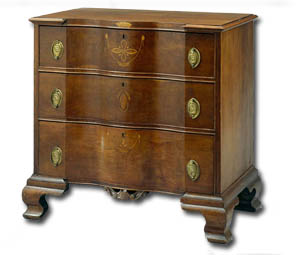 The exquisitely detailed furniture of craftsman John Shearer is showcased in the DAR Museum exhibition ‘A True North Britain’: The Furniture of John Shearer, 1790-1820, which runs from October 8, 2010, through February 26, 2011. Noted not only for its form but also for the politically charged symbols inlaid in many pieces, the furniture helps to explore early America’s cultural ties to Great Britain during the most contentious period in the two nations’ shared history.
John Shearer worked in northern Virginia and western Maryland in the late 18th and early 19th centuries. He left behind no paper trail, choosing instead to inscribe his biography and his politics directly on his furniture. While other early craftsmen were inlaying
their work with eagles to symbolize a new American government,
Shearer glorified Great Britain and its Royal Navy.
Shearer was from Edinburgh, Scotland. Like many from this region, he identified with the Kingdom of Great Britain, formed by the 1707 Treaty of Union which unified Scotland and England. Shearer touts his loyalty by signing two desks on view in this exhibition with the slogan, “A True North Britain.” On another desk, he cheers Napoleon’s downfall and Britain’s victory in the Peninsular War by depicting a crowned lion rampant (rearing on hind legs, paws raised) from the Scottish and English royal coats of arms along with the inscription “Victory Be Thine.”
Shearer documented the Royal Navy’s exploits almost like a political cartoonist. Although fine furniture was an unusual medium for these messages, 52 of his pieces survive, showing that his pro-British sentiments did not deter demand for the simple but unconventionally embellished furniture. As America formed a national identity, its cultural and political diversity included many who retained a strong sense of loyalty to Great Britain.
 Not all Shearer’s messages were meant to be seen, however. Shearer, following the age-old tradition of artist retaliating against problematic patron, hid a note inside one desk accusing his customer, a slave holder and trader, of being “the Greatest Scoundrel in Loudoun County.” This unique piece is among 20 on display in “A True North Britain.” Independent scholar Elizabeth Davison is the guest curator for this exhibition. Her book, a catalog raisonne of Shearer’s work, will be published this winter. Her expertise informs this exhibition, exploring the work of one eccentric artist to show how a diversity of cultures and loyalty was built into the foundations of our country.
◊ ◊ ◊ ◊ ◊
Elizabeth Davison, The Furniture of John Shearer, 1790-1820: A True North Britain in the Southern Backcountry (Altamira Press, 2011), 256 pages, ISBN: 978-0759119543, $90.
Exhibition to Recreate a Day in the Life of a Parisian Townhouse
Press release from the Getty:

Paris: Life & Luxury
J. Paul Getty Museum, Los Angeles, 26 April — 7 August 2011
Museum of Fine Arts, Houston, 18 September — 10 December 2011
Curated by Charissa Bremer-David with Peter Björn Kerber
The nation of France, and its capital city of Paris in particular, held a special status in European culture during the 18th century. The upper echelons of societies throughout Europe were predominantly Francophiles—imitating French fashions of dress and furniture in their daily lives. On view in the Exhibitions Pavilion at the J. Paul Getty Museum at the Getty Center, April 26 through August 7, 2011, Paris: Life & Luxury re-imagines, through art and material culture, the complex and nuanced lifestyle of elite 18th-century Parisians who made their city the fashionable and cultural epicenter of Europe.

ISBN: 978-1606060520, $45
Inspired by the Getty Museum’s extensive French decorative arts collection and the correspondingly strong holdings of French illustrated books in the Getty Research Institute, Paris: Life & Luxury will provide a rich cultural and historical experience that closely mirrors daily life in 18th-century France. Bringing together approximately 160 objects, roughly half of which will be on loan from twenty-six museums and private collections around the world, the exhibition will include a wide range of paintings, sculpture, applied arts, drawings, metalwork, furniture, architectural fittings, lighting and hearth fixtures, scientific and musical instruments, clocks and watches, textiles and dress, books, and maps.
David Bomford, acting director of the J. Paul Getty Museum said, “Paris: Life & Luxury will transport visitors back to Paris in the mid-1700s. More than celebrating the period or perpetuating the mythology of its charm and gallantry, this exhibition re-imagines the varied and complex range of values and practices of the city’s elite within a rich material context.”
Charissa Bremer-David, curator of sculpture and decorative arts at the J. Paul Getty Museum and the exhibition’s co-curator added, “The exhibition will be a rich and deep sensory experience, engaging the viewer’s initial attention with the compelling visual appeal of superlative and virtuoso works of art. From this breadth and diversity, visitors will learn generally about the contributions of the French, and in particular the Parisian, to the visual and performing arts, language, literature, history, science, and even culinary arts during this time period—in short, about their major contribution to the humanities at large.”
Following a structure based on the traditional visual allegories of the Four Times of Day, the objects in the exhibition are grouped according to their associations with common activities as pursued in the chronology of a single day, from morning to night. As such, objects of diverse mediums are juxtaposed, as they would have been within an 18th-century Parisian domestic setting, regardless of modern museological or academic categories. Through constellations of art and related artifacts, the exhibition follows the conventional activities in the cycle of a Parisian day, such as dressing, writing, collecting, eating, and evening entertainment—allowing visitors to envision the activities and accessories of quotidian life, in order to find resonances with their own daily lives. (more…)
HBA Publication Grant
Historians of British Art 2010 Publication Grant
Due by 31 January 2011
The Historians of British Art (HBA) invites applications for its 2011 publication grant. The society will award up to $500 to offset publication costs of, or to support additional research for, a journal article or book manuscript in the field of British visual culture that has been accepted by a publisher. Applicants must be current members of HBA. To apply, send a 500-word project description, publication information (name of journal or press and projected publication date), budget, and CV to Renate Dohmen, HBA Prize Committee chair.
Reviewed: ‘James Barry’
Recently added to caa.reviews:
Tom Dunne and William L. Pressly, eds., James Barry, 1741–1806: History Painter (Burlington: Ashgate, 2010), 300 pages, ISBN: 9780754666349, $114.95.
Reviewed by Jonathan Rinck, Department of Art, Spring Arbor University; posted 10 November 2010.
The writing of ‘James Barry, 1741–1806: History Painter’ was occasioned by the bicentennial of Barry’s death, an event commemorated by the exhibition ‘James Barry (1741–1806): “The Great Historical Painter”’ at the Crawford Art Gallery in Cork, Ireland, in 2005, and followed by a related symposium in February 2006. This book contains fourteen papers given at that conference, presented by a uniformly capable cross-section of scholars ranging from the graduate student to the seasoned authority. The expressed intent of the collection is to help correct the regrettably scant corpus of scholarship devoted to this Irish painter. The topics of the essays are diverse, but the book is cohesive in its enlightening and informative narrative of Barry as, if not the greatest of British eighteenth-century history painters, then as one of its most fascinating and fervent proponents. . . .
For the full review, click here» (CAA membership required)
Forthcoming: ‘Hogarth’s Hidden Parts’
Out this month, as noted at the publisher’s website:
Bernd W. Krysmanski, Hogarth’s Hidden Parts: Satiric Allusion, Erotic Wit, Blasphemous Bawdiness and Dark Humour in Eighteenth-Century English Art (Hildesheim, Zürich and New York: Georg Olms Verlag, 2010), ISBN: 9783487144719, EUR 48.
 If you think of William Hogarth as a moralist who gave charitable support to foundlings and provided ethical guidance through his pictorial satires, then it is high time you changed your mind. This challenging, thoroughly researched and thought-provoking book reveals many new findings on Hogarth, showing us a different, hidden and immoral English artist: a carouser, a debauchee, and a spiteful joker who mercilessly attacked his contemporaries. Although a pictorial satirist and a successful print-dealer, Hogarth nevertheless wallowed in obscene amusement, frequented prostitutes, possibly had paedophilic tendencies, and seemingly died from the lingering effects of syphilis. Hogarth the popular painter and engraver is shown here as a dark humorist who dealt primarily in sexual double entendre and produced blasphemous motifs that satirically lambasted “high” religious art and debunked the eighteenth-century taste for Old Master work. This book ought to change the way we think about Hogarth.
New Title on Hubert Robert: ‘Futures & Ruins’
From the Getty’s website:
Nina Dubin, Futures & Ruins: Eighteenth-Century Paris and the Art of Hubert Robert (Los Angeles: Getty Publications, 2010), 210 pages, ISBN: 978-1-60606-023-0, $50.
 In this timely and provocative study, Hubert Robert’s paintings of urban ruins are interpreted as manifestations of a new consciousness of time, one shaped by the uncertainties of an economy characterized by the dread-inducing expansion of credit, frenzied speculation on the stock exchange, and bold ventures in real estate. As the favored artist of an enterprising Parisian elite, Robert is a prophetic case study of the intersections between aesthetics and modernity’s dawning business culture.
At the center of this lively narrative lie Robert’s depictions of the ruins of Paris—macabre and spectacular paintings of fires and demolitions created on the eve of the French Revolution. Drawing on a vast range of materials, Futures & Ruins understands these artworks as harbingers of a modern appetite for destruction. The paintings are examined as expressions of the pleasures and perils of a risk economy. This captivating account—lavishly illustrated with
rarely reproduced objects—recovers the critical significance of the eighteenth-
century cult of ruins and of Robert’s art for our times.
Nina L. Dubin is an assistant professor of art history at the University of
Illinois at Chicago.
Advance praise for Futures & Ruins
Nina Dubin’s incisive readings of Hubert Robert’s ruin pictures, seen through the lens of period financial fears and speculations, will completely alter the prevailing wisdom about these paintings. These artworks were hitherto interpreted exclusively via the rhetorics of “the picturesque,” but Dubin brings their salient modernities to life. The context of economic risk and the concomitant imagination of calamity that she evokes in this beautifully written book could not be more topical if she had invented the whole thing. And she did not!
—Hollis Clayson, Bergen Evans Professor in the Humanities, Northwestern University
An astute reader of images and their cultural implications, Nina Dubin proposes in this beautifully produced study of Hubert Robert’s enigmatic apocalypses a new understanding of how late-eighteenth-century aesthetics responded to the precarious temporality of dislocations that redefined economic value, politics, urbanism, and the very sense of what history might be.
—Thomas Kavanagh, Augutus R. Street Professor of French, Yale University
Exhibition: Rowlandson on Pleasures and Pursuits
From The Block Museum:
Thomas Rowlandson: Pleasures and Pursuits in Georgian England
The Mary and Leigh Block Museum of Art, Northwestern University, Evanston, IL, 14 January — 13 March 2011
The Frances Lehman Loeb Art Center, Vassar College, Poughkeepsie, NY, 8 April — 11 June 2011
Curated by Patricia Phagan
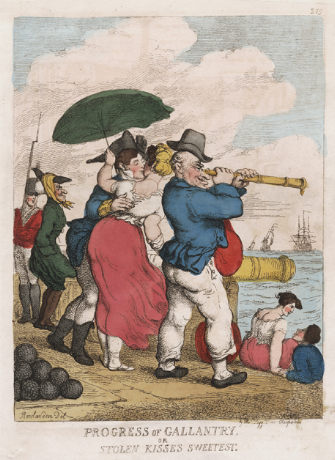
Thomas Rowlandson, “Progress of Gallantry, or Stolen Kisses Sweetest,” 1814, etching with stipple, in black ink with watercolor on cream wove paper (Yale University: Lewis Walpole Library)
Artist Thomas Rowlandson (1757–1827) depicted high society and politics, encounters on the street, camaraderie in clubs and taverns, outdoor entertainments, musings about art, drama, and dance, and romantic and sexual tangles. In other words, the social life of Georgian England. One of the most popular caricaturists of his time, Rowlandson’s work was noted for lighthearted, deft humor and the unmatched flowing line of his drawing.
Organized by the Frances Lehman Loeb Art Center at Vassar College, Thomas Rowlandson: Pleasures and Pursuits in Georgian England presents more than 70 of the artist’s prints, drawings, watercolors, and illustrated books. The exhibition is curated by Patricia Phagan, the Philip and Lynn Straus Curator of Prints and Drawings at the Frances Lehman Loeb Art Center. The first major exhibition of Rowlandson’s work in the United States in 20 years, it will be accompanied by a full-color 184-page catalogue.
◊ ◊ ◊ ◊ ◊
Description of the catalogue, from the publisher’s website:
Patricia Phagan, Vic Gatrell, and Amelia Rauser, Thomas Rowlandson: Pleasures and Pursuits in Georgian England (London: D. Giles Limited, 2011), 184 pages, ISBN: 9781904832782.
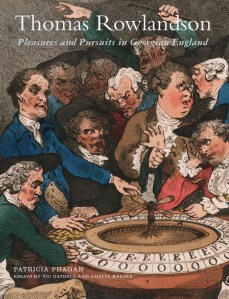 Thomas Rowlandson: Pleasures and Pursuits in Georgian England is a completely new illustrated volume which presents 72 watercolours, drawings, prints, and illustrated books to reassess the legacy of this renowned 18th-century satirist. Published in February 2011 by D. Giles Limited in association with the Frances Lehman Loeb Art Center, it accompanies the first major exhibition of Rowlandson’s work in North America for 20 years, and reflects the growing emphasis on the social and political context of the satirical art of the 18th- and early 19th-centuries. In so doing, it rescues Rowlandson from what co-author Vic Gatrell calls “the immense condescension of posterity.” This catalogue explores Rowlandson’s unique perspective on Georgian social life, and the crossing of class boundaries.
With heavy-handed humour and a low subject matter, the work of Thomas Rowlandson (1757–1827) provides an invaluable insight into the workings and mentality of late Georgian society. He was quite simply a product of his times, who relished recording the street life of London and whose drawings and etchings reveal an attraction to repulsive visions of wickedness and hardship, whilst maintaining a high degree of humanity. (more…)
Domestic Life in England
Upcoming lecture at the University Paris Diderot:
Amanda Vickery — Behind Closed Doors: At Home in Georgian England
University Paris Diderot, 26 November 2010
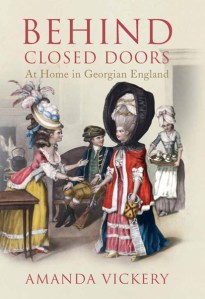 Amanda Vickery (University of Royal Holloway) will present her book, Behind Closed Doors: At Home in Georgian England (Yale University Press, 2009), on Friday, November 26 at 4:30 at the University Paris Diderot, 10 rue Charles V 75004 Paris (Metro St Paul/Sully-Morland/ Bastille).
Professor Vickery, of the Department of History at Royal Holloway, University of London, lectures on British social, political and cultural history from the 17th century to the present. She is the Director of Royal Holloway’s Bedford Centre for the History of Women. Vickery’s first book, The Gentleman’s Daughter (Yale, 1998), won the Whitfield prize, the Wolfson prize, and the Longman-History Today prize and is considered a reference in 18th-century studies. Professor Vickery’s latest monograph, Behind Closed Doors: At Home in Georgian England, was published by Yale University Press in December 2009.
The book unlocks the homes of Georgian England to examine the lives of the people who lived there. She introduces us to men and women from all walks of life: gentlewoman Anne Dormer in her stately Oxfordshire mansion; bachelor clerk and future novelist Anthony Trollope in his dreary London lodgings; genteel spinsters keeping up appearances in two rooms with yellow wallpaper; and, servants with only a locking box to call their own. Professor Vickery makes ingenious use of upholsterer’s ledgers, burglary trials, and other unusual sources to reveal the roles of house and home in economic survival, social success, and political representation during the long 18th century. Through the spread of formal visiting, the proliferation of affordable ornamental furnishings, the commercial celebration of feminine artistry at home, and the currency of the language of taste, even modest homes turned into arenas of social campaign and exhibition.
The book has received rave reviews from critics. Michael Kerrigan from The Scotsman calls it a “beautifully textured exploration of domestic life,” and Frances Wilson from The Sunday Times says: “We see the Georgians at home as we have never seen them before in this ground-breaking book. Behind Closed Doors is both scholarly and terrifically good fun.” The book has been adapted to form a 30-part radio series on BBC Radio 4 on the “history of private life” (aired in autumn 2009) and is soon to be turned into a BBC 2 documentary series (to be broadcast in December 2010).
For further information, please contact: ariane.fennetaux@univ-paris-diderot.fr










 Enfilade
2 comments