Reviewed: ‘The Pygmalion Effect’
Recently added to caa.reviews:
Victor I. Stoichita, The Pygmalion Effect: From Ovid to Hitchcock, translated from the French by Alison Anderson (Chicago: University of Chicago Press, 2008), 232 pages, ISBN: 9780226775210, $45.
Reviewed by Alison Syme, Department of Art, University of Toronto; posted 26 August 2010.
In ‘The Pygmalion Effect’ Victor Stoichita makes the astonishing claim that there is a libidinal component to mimetic production. Western art history—taken here to be a history of mimesis, of copies—has a dark, disavowed, erotic heart: the simulacrum. The simulacrum differs from the copy in that it is magical rather than mimetic, invites touch rather than merely looking, and is autonomous rather than merely derived from a model; Pygmalion’s statue is its founding myth. Arguing that “the simulacrum was not completely banished by Platonism” (3), Stoichita explores the “reverberations” (5) of the Pygmalion myth through Western art, paying close attention to shifts in iconography, animating tropes, and materials. Unsurprisingly he finds echoes of the work of one great male artist after another (van Eyck, Leonardo, Raphael, Michelangelo, etc.) in the work of lesser artists in a triumphal tale of the legacy of original creation. The author’s contention that “the ‘evolution’ of the Pygmalion Effect duplicates, in a significant way, the path taken by various methods for simulating movement, or even life” (6), while hardly new (this idea has been explored in the work of Kenneth Gross, Hillel Schwartz, Michael Cole, and Allison Muri, for example), is certainly borne out by the examples he uses. But Stoichita does not deliver on his claim that he is concerned “with the ‘imaginary woman’ and her place in a phallocentric universe” (6). . .
Chapter 5, “The Nervous Statue,” is devoted to the eighteenth century, a period “haunted” by the Pygmalion myth (111), which is explored in dance, literature, painting, and sculpture. Rather than the blush or the pulse, which had hitherto dominated Pygmalionian iconography, in the Enlightenment the statue’s power of movement becomes the key proof of life. The statue moves and even dances. Stoichita argues that its steps must be considered “in dialectical relation” to the plinth (113), for the sculpted works depicting the Pygmalion myth that appear are faced with a challenge unique to the medium: how can animate, inanimate, and becoming-animate figures be differentiated in sculpture? Falconet solved the problem with a double plinth. The contemporary understanding of the nervous system also informs representations of the myth. Louis Lagrenée’s 1770s paintings emphasize the characters’ actions and reactions—their responsiveness to physical stimuli and the circulation of vital energy through a network of touch and sight—which create “a veritable interaction” (143). Later, Girodet’s 1819 ‘Pygmalion in Love with His Statue’ takes “the idea of a network of energies already authoritatively suggested by someone like Lagrenée” (151) and extends it to the idea of magnetism: the importance of touch gives way to the idea of mesmeric fluids. Such changes in the representation of the myth reflect the materialism of the age, but religious iconography does not vanish from the scene: following Rousseau’s conflation of “artistic creation and religious adoration” (120) . . . .
For the full review, click here» (CAA membership required)
Enlightenment Art in China
It’s interesting to see the politics of the Enlightenment play out two centuries later. From the the Staatliche Kunstsammlungen Dresden:
Art of the Enlightenment
National Museum of China, Beijing, 1 March 2011 — 31 March 2012
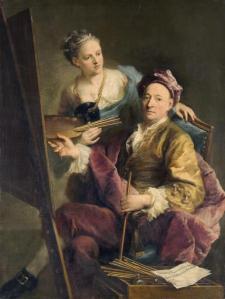
Georg Desmarées "The Artist with His Daughter, Antonia," 1750-1774 © Bayerische Staatsgemäldesammlungen München
The Staatliche Museen zu Berlin, the Staatliche Kunstsammlungen Dresden, and the Bayerische Staatsgemäldesammlungen Munich are to collaborate in presenting the largest exhibition on European art from the Enlightenment period ever to go on show in Asia. In the spring of 2011 the three museums will be exhibiting more than 350 works of art in an area covering 2,700 square metrers at the National Museum of China. The focus will be on major works of art which demonstrate the great ideas of this period, their influence on the fine arts and the history of their reception from the artistic revolutions of the 18th century down to the present day.
The exhibition presents the image world of a period on the threshold of modernity, the ideas of which are of programmatic significance for art today. Paintings, drawings, prints, costumes, furniture and spatial art, sculptures and books will bring all the various facets of the Enlightenment period and its reception history to life for a Chinese audience. Among the masterpieces on display will be works by Watteau, Boucher, Pesne, Piranesi, Chodowiecki, Hogarth and Goya, thus illustrating the wide range of works and the themes which informed the culture of this era, from the Ancien Régime to the Modern period.
The catalogue, which will be published in Chinese and English, will present the latest research findings concerning the art of the Enlightenment and other aspects of this period. This joint exhibition is being financed primarily by the German Foreign Office. It marks the high point of the programme of German-Chinese cultural exchange that was agreed in 2005.
The exhibition Art of the Enlightenment at the National Museum of China will be on display for 18 months. The National Museum on Tiananmen Square in Beijing is currently being refurbished and expanded according to plans drawn up by the Hamburg firm of architects Gerkan, Marg and Partners (gmp). When completed, it will have a total floor area of approximately 200,000 square metres. With its redesigned building, the museum is intended to become a centre for the world’s cultures, a venue in which outstanding guest exhibitions from all over the world will be presented.
◊ ◊ ◊ ◊ ◊
One hint of the politics at work surrounding the exhibition (at least on the German side) can be gleaned from the efforts of Stiftung Mercator (for information on the group, see below) . . .
Stiftung Mercator is currently planning a series of events to officially accompany the “Art in Enlightenment” exhibition which is to be shown in the National Museum of China in Beijing in 2011. In cooperation with the Berlin State Museums, the Dresden State Art Collections, the Bavarian State Painting Collections in Munich and the Federal Foreign Office, Stiftung Mercator will be organizing a series of events entitled “Enlightenment in Dialogue” within the framework of the National Museum of China exhibition “The Art in Enlightenment” in Beijing.
The events will comprise a number of dialogue blocks which will continue for the entire duration of the exhibition. The dialogue blocks will take place in parallel to the exhibition, addressing various facets of a contemporary examination of the subject of enlightenment. Each dialogue consists of a lecture and a panel discussion.
The objective of the series of events is to perceive enlightenment as part of a universal “global heritage of ideas” and to stimulate an open dialogue on the importance of enlightenment in modern times. Stiftung Mercator wishes to bring together Chinese and European scholars, writers and artists and, in particular, to highlight the value of enlightenment for key questions relating to identity and the future.
As described on the foundation’s website:
Stiftung Mercator is one of the largest private foundations in Germany. It pursues clearly defined objectives in its thematic clusters of integration, climate change and arts education and it achieves these objectives with a combination of socio-political advocacy and practical work. Stiftung Mercator implements its own projects and supports external projects in its centres for science and humanities, education and international affairs. It takes an entrepreneurial, professional and international approach to its work.
◊ ◊ ◊ ◊ ◊
This recap comes from ArtDaily.com (note added 1 April 2012) . . .
With a joint ceremony on March 25th 2012, Cornelia Pieper, Minister of State in the Foreign Office, and Zhao Shaohua, Deputy Minister of Culture for the People’s Republic of China, officially concluded the exhibition The Art of the Enlightenment at the National Museum of China. For the past year the exhibition has been on view in Beijing. So far, more than 450,000 visitors have attended. . . .
The full article is available here»
‘Empires of the Imagination’ — British Politics, War, and the Arts
Apollo Magazine’s book competition:
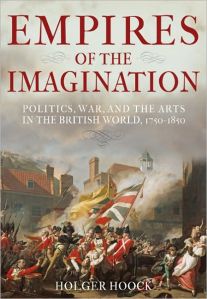 We are pleased to announce that our new competition prize is Empires of the Imagination, Politics, War, and the Arts in the British World, 1750–1850 by Holger Hoock (Profile Books, £30). Over the course of the century after 1750, Britain evolved from a substantial international power into a global superpower and a leading cultural force in Europe. Empires of the Imagination illuminates the manifold ways in which the cultures of power were interwoven in this period of dramatic change. Drawing on a broad range of textual sources and material culture, Hoock combines scholarly analysis with a lively narrative style to revise our understanding of the cultural role of the Hanoverian and early Victorian British state. For your chance to win simply answer the following question and submit your details below before midday on 16th September 2010:
In which Cathedral is Sir Joshua Reynolds buried?
◊ ◊ ◊ ◊ ◊
Maya Jasanoff reviewed Empires of the Imagination for The Guardian back in March. Jacob Glicklich provides a scholarly response at Reviews in History.
Lawrence Exhibition and Conference
Opening next month at the NPG in London is a major exhibition on Thomas Lawrence, which will then appear in New Haven in the first part of next year. As noted by The Art History Newsletter, Mark Brown of The Guardian offers a preview. As noted previously here at Enfilade, the Paul Mellon Centre will sponsor a two-day conference in conjunction with the show November 18-19.
◊ ◊ ◊ ◊ ◊
Thomas Lawrence: Regency Power and Brilliance
National Portrait Gallery, London, 20 October 2010 — 23 January 2011
Yale Center for British Art, New Haven, 24 February — 5 June 2011
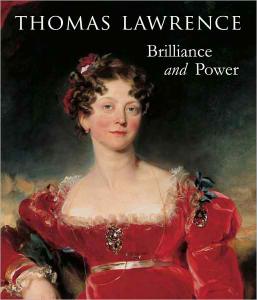 This will be the first exhibition in the United Kingdom since 1979 to examine Lawrence’s work and the first substantial presentation of this artist in the United States. It will present Lawrence as the most important British portrait painter of his generation and will explore his development as one of the most celebrated and influential European artists of the late eighteenth and early nineteenth centuries. By his untimely death in 1830, Lawrence had achieved the greatest international reach and reputation of any British artist. Based on new research and fresh perspectives, this exhibition will introduce Lawrence to a new generation of museum visitors and students. It will also contextualise his work in the light of recent scholarship on the art, politics and culture of the period. The exhibition will include the artist’s greatest paintings and drawings alongside lesser known works in order to provide a fresh understanding of Lawrence and his career. It will contrast his approach to sitters according to age and gender, juxtapose the power and impact of his public works with the intimacy and intensity of those portraits of his friends and family, trace his innovations as a draughtsman and painter, and place him within the broader contexts of the aesthetic debates, networks of patronage and international politics of his day.
Current Issue of ‘The Art Bulletin’
Eighteenth-century coverage in the current issue of The Art Bulletin 92 (September 2010):
Richard Taws, “Material Futures: Reproducing Revolution in P.-L. Debucourt’s Almanach National,” pp. 169-87.
Abstract: Philibert-Louis Debucourt’s 1790 Almanach national, intended to serve as a frame for a pasted calendar for the subsequent year, is a unique combination of allegory and everyday scene. Dominated by a bas-relief representing the National Assembly, the image presents responses to the French Revolution organized in terms of race, age, and social class and features a singular representation of a female newspaper vendor at work. Debucourt’s image effectively mobilizes print to conceptualize the reproduction of Revolution across temporal and national boundaries, providing a means of thinking about the relation between Revolutionary time and the materiality of the image.
Darius A. Spieth, “Giandomenico Tiepolo’s Il Mondo Nuovo: Peep Shows and the ‘Politics of Nostalgia’,” pp. 188-210.
Abstract: What was the historiography of Il mondo nuovo, a fresco painted in 1791 by Giandomenico Tiepolo? How did its title emerge? Giandomenico likely found the inspiration for his subject in popular entertainment on Venice’s Piazzetta. The houselike structure in the fresco’s middle ground—a peep show—had been labeled il mondo nuovo by the eighteenth-century playwright Carlo Goldoni. Yet the fresco was not named until after 1906. Art historian Pompeo Molmenti introduced the Goldoni-inspired title, his efforts seconded by Corrado Ricci, a powerful art administrator. Both were steeped in the “politics of nostalgia,” associated with the Italian Aesthetic movement.
Satish Padiyar, Review of Erika Naginski’s Sculpture and Enlightenment, pp. 256-58.
“. . . This ambitious book is the result of a productive interaction between the new cultural history, which has sought to rethink a history of cultural objects and practices beyond disciplinary confines, art histories of French sculpture and architecture, the history of philosophy, and the study of iconoclasm, or demonumentalizing acts of destruction. Over the last twenty years, the sculptural work of Augustin Pajou, Jean-Antoine Houdon, Clodion, Pierre Julien, and Jean Guillaume Moitte has received monographic and curatorial attention: it is thus no longer true to say that eighteenth-century French sculpture is a neglected field. But a careful reframing of key sculptural projects (either realized or planned) within the shift from a theological to a secular idea of immortality, leading to the radical minimalism of sculpture produced during the French Revolution, is long overdue — and very welcome. It begins to do for the eighteenth-century French public funerary monument what has already been achieved so impressively for the British . . .”
In This Month’s ‘Burlington Magazine’
From this month’s issue of The Burlington Magazine 152 (August 2010):

 Teresa Leonor M. Vale, “An Eighteenth-Century Roman Silver Altar Service in the Church of S. Roque, Lisbon,” pp. 528-35.
- Louise Rice, “Art History Reviewed: Francis Haskell’s Patrons and Painters: A Study in the Relations between Italian Art and Society in the Age of the Baroque (1963),” pp. 543-46
- Margaret Scott, review of The Borghese Collections and the Display of Art in the Age of the Grand Tour by R. Duits.
- John Brewer, review of The Arts of Industry in the Age of Enlightenment by C. Fox, pp. 554-55.
New Title: ‘British Art and the Seven Years’ War’
Douglas Fordham, British Art and the Seven Years’ War: Allegiance and Autonomy (Philadelphia: University of Pennsylvania Press, 2010), 352 pages, ISBN 9780812242430, $65.00s / £42.50.
 Between the Jacobite Rebellion of 1745 and the American Declaration of Independence, London artists transformed themselves from loosely organized professionals into one of the most progressive schools of art in Europe. In British Art and the Seven Years’ War Douglas Fordham argues that war and political dissent provided potent catalysts for the creation of a national school of art. Over the course of three tumultuous decades marked by foreign wars and domestic political dissent, metropolitan artists—especially the founding members of the Royal Academy, including Joshua Reynolds, Paul Sandby, Joseph Wilton, Francis Hayman, and Benjamin West—creatively and assiduously placed fine art on a solid footing within an expansive British state.
London artists entered into a golden age of art as they established strategic alliances with the state, even while insisting on the autonomy of fine art. The active marginalization of William Hogarth’s mercantile aesthetic reflects this sea change as a newer generation sought to represent the British state in a series of guises and genres, including monumental sculpture, history painting, graphic satire, and state portraiture. In these allegories of state formation, artists struggled to give form to shifting notions of national, religious, and political allegiance in the British Empire. These allegiances found provocative expression in the contemporary history paintings of the American-born artists Benjamin West and John Singleton Copley, who managed to carve a patriotic niche out of the apolitical mandate of the Royal Academy of Arts.
Douglas Fordham teaches art history at the University of Virginia.
Spanish Drawings at The Frick This Fall
Press release (PDF) from The Frick:
The Spanish Manner: Drawings from Ribera to Goya
The Frick Collection, New York, 5 October 2010 — 9 January 2011

Catalogue by Jonathan Brown, Lisa Banner, Susan Grace Galassi, Reva Wolf, and Andrew Schulz (Scala, 2010), ISBN: 9781857596519, $65
The greatest Spanish draftsmen from the seventeenth through the nineteenth century—Ribera, Murillo, and Goya, among them—created works of dazzling idiosyncrasy. These diverse drawings, which may be broadly characterized as possessing a specifically “Spanish manner,” will be the subject of an exclusive exhibition at The Frick Collection in the fall of 2010. The presentation will feature more than fifty of the finest Spanish drawings from public and private collections in the Northeast, among them The Metropolitan Museum of Art, The Hispanic Society of America, The Morgan Library & Museum, the Princeton University Art Museum, and the Philadelphia Museum of Art. Opening the show are rare sheets by the early seventeenth-century masters Francisco Pacheco and Vicente Carducho, followed by a number of spectacular red chalk drawings by the celebrated draftsman Jusepe de Ribera. The exhibition continues with rapid sketches and painting-like wash drawings from the rich oeuvre of the Andalusian master Bartolomé Esteban Murillo, along with lively drawings by Francisco de Herrera the Elder and his son and the Madrid court artist Juan Carreño de Miranda, among others.
The second part of the exhibition will present twenty-two sheets by the great draftsman Francisco de Goya, whose drawings are rarely studied in the illuminating context of the Spanish draftsmen who came before him. These works, mostly drawings from his private albums, attest to the continuity between his thematic interests and those of his Spanish forebears, as well as to Goya’s own enormously fertile imagination. The exhibition is organized by Jonathan Brown, Carroll and Milton Petrie Professor of Fine Arts, New York University; Lisa A. Banner, independent scholar; and Susan Grace Galassi, Senior Curator at The Frick Collection. It will be accompanied by a fully illustrated catalogue with entries by the show’s organizers and by Reva Wolf, Professor of Art History, State University of New York at New Paltz, and author of Goya and the Satirical Print in England and on the Continent, 1730–1850, and by Andrew Schulz, Associate Professor of Art History and Department Head at the University of Oregon and author of Goya’s Caprichos: Aesthetics, Perception, and the Body. The exhibition is made possible, in part, by the David L. Klein Jr. Foundation, Elizabeth and Jean-Marie Eveillard, and the Samuel H. Kress Foundation. The accompanying catalogue has been generously underwritten by the Center for Spain in America.
Grasmair Exhibition: Religious Painting in South Tyrol
From Südtirol.online:
Johann Georg Grasmair (1691–1751), Barockmaler in Tirol
Diözesanmuseum, Brixen, Italy 12 June — 31 October 2010

Johann Georg Grasmair, "König aus dem Aufsatzbild der Heiligen Drei Könige," 1729, (Brixen: Diözesanmuseum Hofburg)
Die Ausstellung in der Hofburg Brixen bietet erstmals einen repräsentativen Querschnitt durch die verschiedenen Werkgruppen von Johann Georg Grasmair, einem hervorragenden, aber wenig beachteten Meister der Tiroler Barockmalerei. Grasmair wurde 1691 als Sohn des Glockengießers Jörg Grasmair und seiner Ehefrau Anna Maria Maurer in Brixen geboren. Er erlernte zwar das Glockengießerhandwerk, widmete sich in weiterer Folge aber ganz der Malerei. Nach einer ersten Lehre bei Giuseppe Alberti in Cavalese begab er sich zunächst nach Venedig und dann weiter nach Rom, wo er von der Malerei Carlo Marattas und dessen Schule seine wichtigste künstlerische Prägung erhielt. Dem streng klassisch ausgerichteten römischen Barockstil in der Tradition Marattas blieb Grasmair zeitlebens verpflichtet.
Um 1721 kehrte er von seinem mehrjährigen Aufenthalt in Italien zurück, vermählte sich mit Anna Katharina Hueber aus Mauls und schuf erste Werke in Brixen, Klausen und Niederdorf. Von 1722–1724 war er als Hofmaler der Familie Fürstenberg in Donaueschigen (Baden-Württemberg) tätig.

ISBN: 9788888570143
1724 kehrte Grasmair nach Tirol zurück und ließ sich in Wilten bei Innsbruck nieder. Dort soll er, zeitgenössischen Berichten zufolge, still und anspruchslos bis zu seinem Tode am 28. Oktober 1751 gelebt haben, obwohl er mit den besten Künstlern seiner Zeit wetteifern konnte. Zu den wichtigsten Auftraggebern für Grasmair zählen die Klöster der Serviten und Jesuiten in Innsbruck sowie die Kirche im Allgemeinen, weshalb sein Werk vorwiegend religiöse Themen umfasst. Bekannt sind vor allem seine Altarbilder für renommierte Nordtiroler Kirchen wie den Dom von Innsbruck, die Basilika von Wilten, die Innsbrucker Landhauskapelle oder die Pfarrkirchen von Axams, Fulpmes und Schwaz. Auch in Südtirols Kirchen ist eine Reihe von Werken Grasmairs vorhanden, so etwa in Brixen in der Hofburgkapelle und in der Schutzengelkirche in Stufels, in Neustift, Bruneck, Sterzing, Klausen, Lajen, Lana, Untermais, Naturns und Montan. Einzelne Werke schuf Grasmair auch für das Trentino.
Neben sakralen Werken zeigt die Ausstellung auch wenig bekannte Landschaftsbilder und Darstellungen von allegorischen und mythologischen Themen, die Grasmair für adelige Auftraggeber schuf. Auch seine Ölskizzen und zahlreichen Zeichenstudien, die bisher kaum beachtet wurden, werden in der Ausstellung erstmals gewürdigt. Anders als viele Maler seiner Zeit widmete sich Grasmair ausschließlich der Ölmalerei und nicht auch der prestigeträchtigeren Freskomalerei. Trotzdem galt er bei seinen Zeitgenossen als hoch geschätzter Maler. Seine heute geringe Bekanntheit ist wohl hauptsächlich auf den begrenzten Schaffensraum (Tirol und Trentino) zurückzuführen. Von der künstlerischen Qualität seines Schaffens her ist Grasmair durchaus mit Paul Troger und Michael Angelo Unterberger zu vergleichen, auch wenn er deren überregionale Karriere nicht mitgemacht hat. Im Katalog zur Ausstellung ist erstmals das gesamte Schaffen des Künstlers berücksichtigt und mit einem umfassenden Werkverzeichnis dokumentiert.
Sino-French Relations in the Eighteenth & Ninteenth Centuries
From the museum’s website:
La Soie & le Canon, France-Chine (1700-1860)
Musée d’Histoire de Nantes, 26 June — 7 November 2010
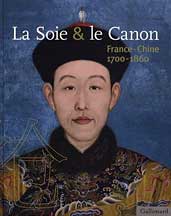
Catalogue ed. by Bertrand Guillet, ISBN: 9782070129492, $72.50
En octobre 1700, L’Amphitrite, premier navire français à commercer avec la Chine, revient en France et c’est à Nantes, grand port de commerce colonial, qu’il vend sa cargaison : thé, soie, porcelaine, nacre, ivoire, panneaux laqués… Cette première arrivée massive d’objets et produits nourrit une véritable fascination pour la culture chinoise. C’est ainsi que se développe en France « un goût pour la Chine » dont on a oublié l’ampleur. Il est alimenté par les Jésuites présents à la cour de Chine. L’Europe devient sinophile. Artistes et artisans produisent dans le goût chinois. Jusqu’à la fin du 18e siècle, ce commerce au volume marginal mais dont l’influence se révèle marquante, est dominé par les Chinois qui dictent leurs conditions aux Occidentaux. Ces derniers n’arrivent cependant pas à introduire en retour leurs produits commerciaux. La Chine attire de plus en plus les convoitises et peu à peu, « le mythe » s’écorne. Les guerres de l’Opium au 19e siècle, avec en point d’orgue le sac du Palais d’été à Pékin en 1860, achèvent la bascule du rapport économique au profit des Européens et participent au déclin de l’Empire du Milieu.
L’exposition La Soie & le Canon met en lumière les relations franco-chinoises entre ces deux dates – 1700/1860 – et montre l’évolution du regard porté sur cet Extrême-Orient lointain qui suscita tour à tour fascination et rejet, en s’appuyant sur la présentation d’objets et documents prestigieux prêtés par de grands musées dont le musée national des arts asiatiques Guimet, partenaire associé au projet. Avec cette exposition d’histoire, le musée d’histoire de Nantes propose une démarche inédite en montrant les différentes phases qui ont caractérisé dès l’origine les relations entre la France et la Chine. Plus largement, l’exposition contribue à faire mieux comprendre notre rapport à la Chine d’aujourd’hui, toujours fascinante, souvent critiquée, alors que s’amorce un nouvel équilibre mondial dans lequel ce géant qui rassemble un cinquième de l’humanité joue un rôle de premier plan.










 Enfilade
leave a comment