New and Forthcoming Books from Ashgate
From Ashgate’s website:
Denise Amy Baxter and Meredith Martin, eds., Architectural Space in Eighteenth-Century Europe: Constructing Identities and Interiors (Aldershot: Ashgate, 2010), ISBN: 9780754666509.
 Architectural Space in Eighteenth-Century Europe: Constructing Identities and Interiors explores how a diverse, pan-European group of eighteenth-century patrons – among them bankers, bishops, bluestockings, and courtesans – used architectural space and décor to shape and express identity. Eighteenth-century European architects understood the client’s instrumental role in giving form and meaning to architectural space. In a treatise published in 1745, the French architect Germain Boffrand determined that a visitor could “judge the character of the master for whom the house was built by the way in which it is planned, decorated and distributed.”
This interdisciplinary volume addresses two key interests of contemporary historians working in a range of disciplines: one, the broad question of identity formation, most notably as it relates to ideas of gender, class, and ethnicity; and two, the role played by different spatial environments in the production – not merely the reflection – of identity at defining historical and cultural moments. By combining contemporary critical analysis with a historically specific approach, the book’s contributors situate ideas of space and the self within the visual and material remains of interiors in eighteenth-century Europe. In doing so, they offer compelling new insight not only into this historical period, but also into our own.
Contents: Introduction: constructing space and identity in the 18th-century interior, Denise Amy Baxter; Section I Crossing Boundaries, Making Space: The ascendancy of the interior in 18th-century French architectural theory, Meredith Martin; ‘Très belle, agréable, et bien meublée’: the Electoral palace at Saint-Cloud in the early 18th century, Max Tillman; In the right place at the right time: political propaganda in the Archiepiscopal palace of Würzburg, Csongor Kis; Getting plastered: ornamentation, iconography, and the ‘desperate faction’, Katherine R.P. Clark. Section II The Interior as Masquerade: Salon as stage: actress/courtesans and their homes in late 18th-century Paris, Kathryn Norberg; Fashioning bluestocking conversation: Elizabeth Montagu’s Chinese room, Stacey Sloboda; The space of the mask, from stage to ridotto, Marc J. Neveu. Section III The Politics of Display: Improving taste in the private interior: gentlemen’s galleries in post-Napoleonic London, Anne Nellis Richter; A nation of statues: museums and identity in 18th-century Rome, Jeffrey Collins; (Re)constructing an 18th-century interior: the value of interiority on display, Daniel Brewer; Bibliography; Index.
About the Editors: Denise A. Baxter is an Assistant Professor in the School of Visual Arts at the University of North Texas. Meredith S. Martin is Assistant Professor of Eighteenth- and Nineteenth-Century Art in the History of Art Department at Wellesley College.
◊ ◊ ◊ ◊ ◊
John Potvin and Alla Myzelev, eds., Material Cultures, 1740–1920: The Meanings and Pleasures of Collecting (Aldershot: Ashgate, 2009), ISBN: 9780754661443.
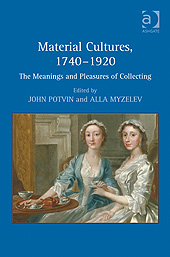 Interweaving notions of identity and subjectivity, spatial contexts, materiality and meaning, this collection makes a significant contribution to debates around the status and interpretation of visual and material culture. Material Cultures, 1740–1920 has four primary theoretical and historiographic lines of inquiry. The first is how concepts of otherness and difference inform, imbricate, and impose themselves on identity and the modes of acquisition as well as the objects themselves. The second concern explores the intricacies of how objects and their subjects negotiate and represent spatial narratives. The third thread attempts to unravel the ideological underpinnings of collections of individuals which inevitably and invariably rub up against the social, the institutional, and the political. Finally, at the heart of Material Cultures, 1740–1920 is an intervention moving beyond the disciplinary ethos of material culture to argue more firmly for the aesthetic, visual, and semiotic potency inseparable from any understanding of material objects integral to the lives of their collecting subjects. The collection argues that objects are semiotic conduits or signs of meanings, pleasures, and desires that are deeply subjective; more often than not, they reveal racial, gendered, and sexual identities. As the volume demonstrates through its various case studies, material and visual cultures are not as separate as our current disciplinary ethos would lead us to believe.
Contents: Introduction: the material of visual cultures, John Potvin and Alla Myzelev; Porcelain bodies: gender, acquisitiveness and taste in 18th-century England, Stacey Sloboda; Women’s home-crafted objects as collections of culture and comfort 1750–1900, Clive Edwards; Spatializing the private collection: John Fiott Lee and Hartwell House, Anastasia Filippoupoliti; ‘Everyone to his taste’ or ‘truth to material’?: the role of materials in collections of applied arts, Nadine Rottau; Collecting/painting harem/clothing, Joan DelPlato; ‘Chinamania’: collecting Old Blue for the house beautiful c 1860–1900, Anne Anderson; From specimen to scrap: Japanese textiles in the British Victorian interior, 1875–1900, Elizabeth Kramer; Indian crafts and imperial policy: hybridity, purification and imperial subjectivities, Julie F. Codell; Collecting peasant Europe: peasant utilitarian objects as museum artifacts, Alla Myzelev; Collecting intimacy one object at a time: material culture, perception and the spaces of aesthetic companionship, John Potvin; Collecting the sublime and the beautiful: from romanticism to revolution in Celtic revival jewellery, Joseph McBrinn; Index.
About the Editors: John Potvin is Assistant Professor of European Art and Design History at the University of Guelph, Canada. He is the author of Material and Visual Cultures Beyond Male Bonding, 1880–1914: Bodies, Boundaries and Intimacy (2008) and editor of The Places and Spaces of Fashion, 1800–2007 (2009). Alla Myzelev is an Assistant Professor of Art History at the University of Guelph, Canada. She has published on the relationship between Russian and Ukrainian avant-garde and craft, the role of women in the Arts and Crafts Movement as well as the representation of material culture in museums and private collections.
◊ ◊ ◊ ◊ ◊
Tom Dunne and William Pressly, eds., James Barry, 1741–1806: History Painter (Ashgate, 2010), ISBN: 9780754666349.
 Bringing into relief the singularity of Barry’s unswerving commitment to his vision for history painting despite adverse cultural, political and commercial currents, these essays on Barry and his contemporaries offer new perspectives on the painter’s life and career. Contributors, including some of the best known experts in the field of British eighteenth-century studies, set Barry’s works and writings into a rich political and social context, particularly in Britain.
Among other notable achievements, the essays shed new light on the influence which Barry’s radical ideology and his Catholicism had on his art; they explore his relationship with Reynolds and Blake, and discuss his aesthetics in the context of Burke and Wollstonecraft as well as Fuseli and Payne Knight. The volume is an indispensable resource for scholars of eighteenth-century British painting, patronage, aesthetics, and political history.
Contents: Foreword: Barry studies from a bicentennial perspective, William L. Pressly; Introduction: James Barry’s ‘moral art’, and the fate of history painting in Britain, Tom Dunne; From oddity to odd man out: James Barry’s critical legacy, 1806–66, David H. Solkin; James Barry’s ‘hairbreath niceties’: risk, reward, and the reform of culture around 1770, Martin Myrone; James Barry: a history painter in Paris in the 1760s, Fionnuala McManamon; ‘Glowing thoughts on glowing canvas’: James Barry’s Venus Rising from the Sea, Margaret W. Lind; Barry, Reynolds and the British school, Martin Postle; Barry and Fuseli: Milton, exile and expulsion, Asia Haut; The politics of envy: Blake and Barry, David Bindman; Reform and revolution: James Barry’s writings in the 1790s, John Barrell; History painting and aesthetics: Barry and the politics of friendship, Liam Lenihan; No 36 Castle Street East: a reconstruction of James Barry’s house, painting and printmaking studio, and the making of The Birth of Pandora, Michael Phillips; Crowning the Victors at Olympia: the great room’s primary focus, William L. Pressly; Barry’s Bosseut in Elysium: Catholicism and counter-revolution in the 1790s, Daniel R. Guernsey; ‘A monument to perpetuate his memory’: James Barry’s Adelphi cycle revisited, David G.C. Allan; Select bibliography; Index.
About the Editors: Tom Dunne is Professor Emeritus of History at University College Cork, Ireland. William Pressly is a Professor in the Department of Art History & Archaeology at the University of Maryland, College Park.
◊ ◊ ◊ ◊ ◊
Alden Cavanaugh and Michael Yonan, eds., The Cultural Aesthetics of Eighteenth-Century Porcelain (Aldershot: Ashgate, 2010), ISBN: 9780754663867.
During the eighteenth century, porcelain held significant cultural and artistic importance. This collection represents one of the first thorough scholarly attempts to explore the diversity of the medium’s cultural meanings. Among the volume’s purposes is to expose porcelain objects to the analytical and theoretical rigor which is routinely applied to painting, sculpture and architecture, and thereby to reposition eighteenth-century porcelain within new and more fruitful interpretative frameworks. The authors also analyze the aesthetics of porcelain and its physical characteristics, particularly the way its tactile and visual qualities reinforced and challenged the social processes within which porcelain objects were viewed, collected, and used.
The essays in this volume treat objects such as figurines representing British theatrical celebrities, a boxwood and ebony figural porcelain stand, works of architecture meant to approximate porcelain visually, porcelain flowers adorning objects such as candelabra and perfume burners, and tea sets decorated with unusual designs. The geographical areas covered in the collection include China, North Africa, Spain, France, Italy, Britain, America, Japan, Austria, and Holland.
Contents: Introduction, Alden Cavanaugh and Michael Yonan; Rethinking the Arcanum: porcelain, secrecy, and the 18th-century culture of invention, Glenn Adamson; The nature of artifice: French porcelain flowers and the rhetoric of the garnish, Mimi Hellman; Igneous architecture: porcelain, natural philosophy, and the rococo cabinet chinois; Michael Yonan Marketing Celebrity: Porcelain and Theatrical Display; Heather McPherson; Balancing act: Andrea Brustolon’s ‘La Forza’ and the display of imported porcelain in 18th-century Venice, Erin J. Campbell; The Queen’s nécessaire, Alden Cavanaugh; Porcelain, print culture and mercantile aesthetics, Dawn Odell; Sugar boxes and blackamoors: ornamental blackness in early Meissen porcelain, Adrienne L. Childs; Ties that bind: relations between the Royal Academy of San Fernando and the royal porcelain factory of the BuenRetiro, Andrew Schulz; Selected bibliography; Index.
About the Editors: Alden Cavanaugh is Associate Professor of Art History at Indiana State University. Michael E. Yonan is Assistant Professor of Eighteenth- and Nineteenth-Century Art at the University of Missouri-Columbia.
◊ ◊ ◊ ◊ ◊
Nebahat Avcioglu, Turquerie and the Politics of Representation, 1728-1876 (Aldershot: Ashgate, 2010), ISBN: 9780754664222.
In this first full-length study of Turkish-inspired architecture in Western Europe in the eighteenth and nineteenth centuries, Nebahat Avcioglu offers a new reading of the notion of cultural frontiers as rapport of heterogeneities rather than separations. Reclaiming turquerie from the confines of inconsequential exoticism and reframing it as cross-cultural art in its own right, Avcioglu analyses hitherto neglected images, designs and constructions linking Western interest in the Ottoman Empire to issues of self-representation and national politics. Investigating how and why Europeans turned to the Turks for inspiration she provides a far-reaching reinterpretation of architectural thought and culture in this period.
Organised as a series of case studies focusing on three specific buildings types — kiosks, mosques, and baths — each representing the first manifestation of their genre to be erected in Western Europe, the study delves into the politics of architectural forms and styles. Avcioglu argues that the appropriation of these types was neither accidental nor merely reflected European domination of another culture but that its process was essentially dialectical and contributed to transculturation in both the West and the East.
Contents: Introduction: toward a cross-cultural interpretation of art; Part I The Kiosk: Stanislas Leszczynski as Ahmed III or the union of the crown and the turban; ‘The Turkish Paradise or Vaux-hall Gardens’. Part II The Mosque: Kew Gardens: the Turkish mosque and the representation of empire. Part III The Hammam: The Turkish bath in Europe. Conclusion: Turquerie from imperial gardens to the Exposition Universelle; Bibliography; Index.
About the Author: Nebahat Avcioglu is Research Coordinator at Columbia University Institute for Scholars in Paris. And Maître de conférence at Sciences-Po (Institut d’Etudes Politiques de Paris).
Happy (Belated) Birthday, Dr. Sloane!
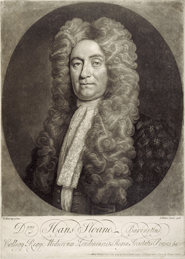 In the midst of the disruptions from the volcanic ash cloud, I failed to note the birthday of Sir Hans Sloane (1660-1753), who would have turned 350 years this past Friday (April 16). The physician was an important naturalist, bibliophile, and collector. As outlined in his will, the bequest of his vast collections to the nation provided the foundation of the British Museum. To mark the anniversary, a series of events have been organized at the British Museum, London’s Natural History Museum, and the Old Operating Theatre Museum, as well as in the Northern Ireland village of Killyleagh, where Sloane was born. Although most events took place last week, in June a major conference will be held at the British Library (see below for the schedule). For whatever it’s worth, I have a hunch that Sloane would have been thrilled to have his birthday marked by the eruption of Iceland’s Eyjafjallajokull -C.H.
◊ ◊ ◊ ◊ ◊
In addition, the Sloane Printed Books Catalogue, is an outstanding new online resource. As noted on the BL’s website:
Sloane’s library of approximately 40,000 volumes, now dispersed within the collections of the British Library and other research libraries, is being identified. Bibliographical descriptions are enhanced with information about pre-Sloane provenance, annotations and other copy-specific information. The information accumulated is being made available through a web-accessible database, the Sloane Printed Books Catalogue, maintained by the British Library. The work of this project will form a significant research resource for medical, scientific and intellectual historians of the period.
◊ ◊ ◊ ◊ ◊
From Books to Bezoars: An International Conference Celebrating the 350th Anniversary of the Birth of Sir Hans Sloane, Physician, Naturalist and Collector
British Library, London, 7-8 June 2010
MONDAY, JUNE 7
9:30 Registration
10:00 Plenary Session
- James Delbourgo (Rutgers University), Collecting Sir Hans Sloane
10:45 Coffee
11:05 Sloane’s Origins, Life and Work
- Mark Purcell (National Trust), “Settled in the north of Ireland”, or Where did Sloane come from?
- Pratik Chakrabarti (University of Kent), The Voyages of Hans Sloane: A colonial history of gentlemanly science
- Lisa Smith (University of Saskatchewan), Sir Hans Sloane: Physician of the family
12:15 Lunch
1:10 Specimens and Classification
- Charlie Jarvis, Mark Spencer, and Rob Huxley (Natural History Museum), Sloane’s plant specimens at the Natural History Museum
- Savithri Preetha Nair (Independent Scholar), Botanising on the Coromandel coast in the seventeenth century
- Jill Cook (British Museum), Sloane, elephants and climate change
3:00 Tea
3:20 Sloane and the West Indies
- James Robertson (University of the West Indies), Knowledgeable readers- Jamaican critiques of Hans Sloane’s botany
- Julie Chun Kim (Fordham University), The African and Amerindian sources of Atlantic medicine
- Wendy Churchill (University of New Brunswick), Hans Sloane’s perspectives on the medical knowledge and health practices of non-Europeans
- Tracy-Ann Smith and Katherine Hann (Natural History Museum), Sloane, slavery and the natural world: New perspectives from community programming
6:30 Reception in the Enlightenment Gallery of the British Museum
TUESDAY, JUNE 8
10:00 Plenary Session
- Kim Sloan (British Museum), Sir Hans Sloane’s ‘Paper Museum’
10:45 Coffee
11:05 The Culture of Collecting
- Kathryn James (Beinecke Library, Yale), Hans Sloane and the public performance of natural history
- Barbara Benedict (Trinity College, Hartford), Sloane’s Ranges: Shifts in Sir Hans Sloane’s literary representation in the eighteenth century
- Eric Jorink (Huygens Instituut), Sloane and the Dutch connection
12:15 Lunch
1:15 Catalogues, Books, and Manuscripts
- Alison Walker, The Sloane Printed Books Project
- Marjorie Caygill (British Museum), Sloane’s catalogues in the British Museum
- Arnold Hunt, Sloane as a manuscript collector
2:20 Tea
2:50 Sloane’s Book Collections
- John Goldfinch (British Library), A rediscovered volume of printed and mss fragments from Sloane’s library
- Julianne Simpson (Wellcome Library), The dispersal of Sir Hans Sloane’s library: A case study from the Medical Society of London collection
- Stephen Parkin (British Library), Sloane’s Italian books
- Will Poole (New College, Oxford), Sloane’s books at the Bodleian Library
4:20 Concluding Remarks
New Eighteenth-Century Titles at Artbooks.com
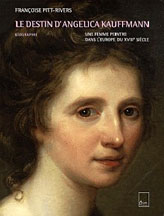
Francoise Pitt-Rivers, "Le destin d'Angelica Kauffmann: Une femme peintre dans l'Europe du XVIIIe siècle, biographie"
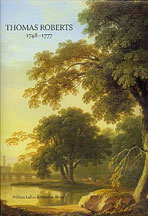
William Laffan and Brendan Rooney, "Thomas Roberts: Landscape and Patronage in Eighteenth-Century Ireland."

Antoine Schnapper, "Jean Jouvenet (1644-1717) et la peinture d'histoire à Paris" (available May 2010)
Early Modern Art Markets: Flemish & Dutch Paintings in Geneva
From the Geneva museum’s website:
L’art et ses marchés: La peinture flamande et hollandaise, XVIIe et XVIIIe siècles
Les Musées d’art et d’histoire, Geneva, 1 October 2009 – 29 August 2010
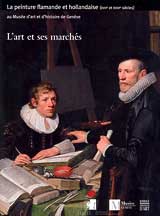
Frédéric Elsig (Paris: Somogy, 2009), ISBN: 9782757202500
This exhibition is in follow-up to La naissance des genres (2005-2006), and it similarly has two objectives. On the one hand, it will present a part of the Museum’s collection that is as important as it is little known: a selection of Flemish and Dutch paintings from the 16th to the 18th centuries that have been treated for purposes of conservation and restoration, and of which the catalogue raisonné will be published on the same occasion. On the other hand, it will illustrate a consequential phenomenon that first emerged during this period in the former Low Countries: the rapid expansion of the art market. With different sections devoted to what were then perfectly constituted categories, the display will highlight the new development’s principal characteristics as well as the predilection of Geneva collectors for Dutch paintings of the Siècle d’Or.
Recent Reviews for French Studies
Excerpts of recent reviews featured at the H-France website:
◊ ◊ ◊ ◊ ◊
H-France Review Vol. 10 (March 2010), No. 49
Raymonde Monnier, ed., À Paris sous la Révolution. Nouvelles approches de la ville. Paris: Publications de la Sorbonne, 2008. 221 pp. Notes. €25.00 (pb) ISBN 978-2-85944-596-6.
Review by Sydney Watts, University of Richmond.
Quoi de neuf sur la Révolution? Raymonde Monnier’s latest publication on Paris during the French Revolution stands out as a valuable collection of fresh ideas and illuminating scholarship, the ongoing work of a number of both young and well established historians from France and abroad. This plentiful compilation of groundbreaking research, taken from conference proceedings held at the Hôtel de Ville in October 2005, reveals the vitality of historical scholarship on this topic over the past two decades. Certainly, one would think after the flurry of publications following the bicentennial of 1789 that the subject of revolutionary Paris has been exhausted. Not so. In fact, the seventeen contributors to this collection open more historical terrain to the interested scholar than they close off. While each essay is kept brief, close to its conference paper format, many of them point to burgeoning fields of study. These historians have left behind ideological debates to focus on new topics, original historical problems, and open-ended discussion.
The questions around which the conference focused point to the place of Paris under the Revolution, its role as a site of acculturation that transformed its citizens as much as the city was transformed by its citizens. These scholars look to Paris as the center of revolutionary activity, keeping in mind the historical change in material conditions, social life and economic activity. Many of them contend with the fact that Paris was a growing metropolis with its own urban problems that were further challenged under the revolution. Other participants focus on the political culture that permeated urban life in ways that to a greater or lesser degree demonstrate what Parisians made of this revolutionary world. In turning to clearly delineated objects of study located in Paris (i.e., urban politics related to financing urban projects and policing the city, cultural venues such as the theatre and museums, city businesses such as construction, public transportation the meat trade, and examples of political culture as seen in sermons, engravings and Parisian academies) these scholars aim to untangle Paris from the Revolution writ large. As a result, instead of using Paris as a backdrop to this revolutionary period, Paris–its urban administration, economic life and political culture–is both the subject and object of this historical period. . . .
◊ ◊ ◊ ◊ ◊
H-France Review Vol. 10 (March 2010), No. 57
Stéphanie Loubère, L’Art d’aimer au siècle des Lumières. Studies on Voltaire and the Eighteenth Century 2007: 11. Oxford: The Voltaire Foundation, 2007. 343 pp. Illustrations, footnotes, bibliography and index. $111 U.S./£65 U.K./€78 (pb). ISBN 978-0-7294-0917-9.
Review by Elena Russo, The Johns Hopkins University.
In this erudite, careful and thorough study, Stéphanie Loubère surveys and analyzes the surprisingly rich story of the translations and adaptations of Ovid’s “Art of Love” in eighteenth-century France. This is a story that is likely to interest the reader more for what it reveals about the vicissitudes of translating and adapting the classics, and for the role they continued to play in French letters throughout the Enlightenment, than for its potential to seduce the senses and captivate the amorous imagination. Indeed, the expectant reader is bound to be disappointed, for never has eroticism felt so dull, dogmatic and pedantic. Certainly, had Ovid written according to the spirit of his French translators, it is safe to assume that he would never have incurred disgrace, exile, or been accused of immorality. Like them, he would have lived and died in dignified obscurity.
Still, it was worth resurrecting those authors, if only for a moment, and we may agree with Loubère’s claim that a study of the minores is likely to yield some interest for those who wish to explore the intellectual context, or better yet, the rhetorical and argumentative underbelly, of libertine literature, from Crébillon to Laclos. As Loubère points out, both in the Augustan empire and in the ancien regime, writing careers were shaped on the benches of law schools; all of the arts of love, to a greater or lesser extent, deliberately parodied treatises on rhetorics, at a time when rhetorics could no longer find an outlet in the practice of politics. The boudoir, rather than the tribune, became the space in which the arts of persuasion were honed and refined. The same may be argued of the Middle Ages, of such works as André Le Chapelain’s “De Amore” in the twelfth century and Guillaume de Lorris and Jean de Meung’s “Romance of the Rose” in the thirteenth century. . . .
◊ ◊ ◊ ◊ ◊
H-France Review Vol. 10 (March 2010), No. 58
Michel Baridon. A History of the Gardens of Versailles. Translated by Adrienne Mason. Philadelphia: University of Pennsylvania Press, 2008. vii + 296 pp. 48 illustrations, notes, bibliography, and index. $55.00 U.S. (cl). ISBN 978-0-8122-4078-8.
Alain Renaux. Louis XIV’s Botanical Engravings. Hampshire, England and Burlington, Vt: Lund Humphries, 2008. 144 pp. 70 illustrations, bibliography. £30 UK. (cl). ISBN 978-1-84822-000-3.
Review by Elizabeth Hyde, Kean University.
The last week of January 2009 saw the toppling of one of the last surviving trees planted for Marie Antoinette. Since 1786 the beech tree had grown in the gardens of the Hameau, the queen’s pastoral retreat (just recently renovated) at Versailles. The tree had born witness to the collapse of the French monarchy and had survived the ambivalence felt towards Versailles and the royal gardens, symbols as they were of Bourbon rule, as France lurched right and left in search of political stability in the century afterwards. The beech had been weakened in the 1999 storms that devastated the gardens of Versailles (and forced a replanting on a scale not undertaken since the 1770s); January’s storm finished it off. Associated Press photos showed gardeners unceremoniously sawing up the arboreal remains of the ancien regime. (more…)

Review of the Met’s Watteau Exhibition and Catalogue
Recently added to CAA Reviews:
Katherine Baetjer, ed., Watteau, Music, and Theater, exhibition catalogue (New York and New Haven: Metropolitan Museum of Art in association with Yale University Press, 2009), 176 pages, ISBN: 9780300155075, $35.
Reviewed by Sarah R. Cohen, University at Albany, State University of New York; posting added 24 March 2010.
The Metropolitan Museum of Art is ideally suited for an exhibition devoted to the theme of “Watteau, Music, and Theater” because two of Watteau’s most incisive treatments of these themes reside in its collection: the solitary singer “Mezzetin” (ca. 1718–20) and the tragic-comic “French Comedians” (ca. 1720–21). Both works also display Watteau’s ineffable fusion of performance and humanity, artifice and nature, and gestures both rote and heartfelt. The exhibition, rich in drawings as well as paintings loaned from a wide variety of institutions and private collections, allowed viewers to ponder the artist’s compelling transformation of music and theater into an exploratory pictorial language. But only about half of the exhibition featured works by Watteau himself; the rest comprised an eclectic mix drawn largely from the Metropolitan’s extensive collections of eighteenth-century objects, including paintings, graphic arts, porcelain figures, miniature boxes, and musical instruments. . . .
The exhibition catalogue, edited by Baetjer, features an essay on Watteau by Pierre Rosenberg as well as an account by Cowart of the multiple venues where eighteenth-century Parisians could encounter musical theater. Scholarly entries on all of the objects in the exhibition were contributed by the Metropolitan’s curators as well as outside experts, notably Mary Tavenor Holmes on Lancret and Kim de Beaumont on Gabriel de Saint-Aubin. . . .
For the full review (CAA membership required), click here»
The Circle of Tiepolo
From the cultura italia site:
Bortoloni, Piazzetta, Tiepolo: il ‘700 Veneto
Pinacoteca di Palazzo Roverella, Rovigo, 30 January — 13 June 2010

Mattia Bortoloni "Giunone chiede a Eolo di liberare i venti"
Finally, a major exhibit to ‘reveal’ Mattia Bortoloni, juxtaposing Piazzetta, Tiepolo, Balestra, Ricci and other greats from 18th-century Veneto. Some only know him for a Guinness-type work: the widest single fresco of all times and places – 5,500 square meters of delicate painting covering the entire, enormous elliptical dome, the largest in the world, of the Vicoforte Sanctuary, in Piedmont. A colossal work, more or less the dimension of an entire football field, considered the masterpiece of the Piedmontese Baroque period, frescoed in celebration of the Blessed Virgin, while at the same time, glorifying the House of Savoy.
Mattia Bortoloni (Canda di Rovigo, 1696 – Bergamo, 1750), famous, and quite sought-after during his lifetime, then faded into oblivion, considered ‘merely’ one of the best of Giovan Battista Tiepolo’s assistants, to the point that in not a few of the great master’s most celebrated pieces, it is to this day difficult to distinguish which brushstrokes to credit to which artist.
Over the last twenty years, more and more detailed studies have brought about a rediscovery of the breadth of Bortoloni’s own talent. Today it is possible to say, without qualifications, that he was an extraordinary and rather original artist, “suffocated” during his lifetime and by his notoriety as an assistant to the titans of 18th-century artists from the Veneto region, from the Veronese Balestra (who was his teacher) to Tiepolo himself. This major exhibit, entitled Bortoloni, Piazzetta and Tiepolo: 18th-Century Veneto will offer a selection of Bortoloni’s masterpieces juxtaposed with around thirty extraordinary works by Pellegrini, Piazzetta, Ricci and Tiepolo, the ‘titans’ of 18th-century Veneto.

Giambattista Pittoni "Diana e le ninfe"
Among the masterpieces on display, some early works by Tiepolo are worth special mention, including the Glory of St. Dominic and the Temptations of St. Anthony, next to essays into mythological subjects such as Diana and Actaeon and The Judgement of Midas, made available courtesy of the Galleries of the Academy of Venice. Of Piazzetta to be displayed is a rather moving altar piece depicting The Ecstasy of St. Francis, a work on loan from the Civic Museum of Vicenza, next to an early attempt by Sebastiano Ricci depicting Hercules at the Crossroads, on loan from the historic Palazzo Fulcis in Belluno. By Giambattista Pittoni are two works placed next to each other, the first inspired by the tales by Torquato Tasso depicting Olindo and Sofronia and, also of 17th-century layout, the second, Diana and the Nymphs, which shows an already rocailles flavour.

Giambattista Tiepolo "Digntario della Serenissima"
By Bortoloni’s teacher, Antonio Balestra, will be exhibit a never-before-seen Nativity and two extraordinary paintings, on loan from the Benedictine monastery of St. Paul of Argon, following a lengthy restoration project. The exhibit will be further enhanced by a valuable sketch section featuring works by the greatest fresco artists of the 18th century: besides Tiepolo (Giambattista and Giandomenico), Piazzetta and Bortoloni himself, as well as Diziani, Crosato Fontebasso Guarana, who were the great followers of this art form in later years. For the first time, completing this snapshot of the group is one of the key players, unduly forgotten for many years: Mattia Bortoloni, around whom this major exhibit pivots.
Bortoloni was a revered artist, so much so that at just twenty years of age he earned a much sought-after commission – that of frescoing the interior of Villa Cornaro in Piombino Dese, one of Palladio’s masterpieces. An undertaking in which he, albeit extremely tender in years, wisely anticipated the rococo style, which his friend in later years,
Giovanbattista Tiepolo, would then articulate with aplomb.
Light and shadow accompanied his extensive career in which, together with others but often alone, saw his busy with a kind of tunnel-vision (even for those days) with major works in Venice, and throughout the Regions of Veneto, Lombardy and Piedmont. Among his masterpieces are the series of frescoes at the Cathedral of Monza, for the Sanctuary of the Consolata (“The Consoled”), and for Palazzo Barono in Turin, for Palazzo Clerici and Palazzo Dugnani in Milan, Villa Vendramin Calergi in Fiesso Umbertino, Villa Albrizzi in Preganziol, Villa Raimondi in Birago di Lentate and Visconti-Citterio in Brignano d’Adda, the Venetian Churches of Saints John and Paul, and of St. Nicholas in the Tolentini, Ca’ Sceriman and Ca’ Rezzonico, also in Venice, through to his unquestionable masterpiece, the formidable series for the Vicoforte Sanctuary, more than five-thousand square meters of the finest fresco for the world’s largest elliptical dome.
In addition to his work as a fresco painter, Bortoloni was also a wonderful historical-painting artist, works in which storytelling ability goes hand in hand with original interpretive skill. For obvious reasons, this important production was the first to be delved into at the highly anticipated exhibit at Palazzo Roverella. These are works often being studied for the first time, with credits and attributions assigned for the first time as well, pieces never before shown to the public (and others that are ordinarily quite difficult to access), works that restore Bortoloni to a well-deserved prominence, which he enjoyed during his life, before being eclipsed by the magnificence of Tiepolo’s art work.

Catalogue available from Artbooks.com
In this panels, Bortoloni proves himself an inspired and original painter. These are compositions that are laid out in an anti-academic way, ironic and sometimes irreverent, which unquestionably ran against the grain with respect to the era’s other sacred painting. The piece with St. Thomas of Villanova of the Concordi Academy represents, in this light, one of Bortoloni’s highest accomplishments. Bortoloni, indeed, marked the passage from the late 17th century tradition, well ahead of his time even with respect to the great Tiepolo and – as demonstrated by the two historical paintings with the Adoration of the Magi and of the Shepherds of Fratta Polesine – much in line with Pittoni and Ricci’s innovations.
Exhibition Catalogue: Alessia Vedova and Fabrizio Malachin, eds., Bortoloni Piazzetta Tiepolo: il ‘700 veneto (Milan: Silvana, 2010), 255 pages, ISBN: 978883661503, €30 / $59.
Recent Reviews: ‘The Intimate Portrait’ and ‘Fuseli’s Milton Gallery’
Reviews from the current issue of The Journal for Eighteenth-Century Studies 33 (March 2010),
◊ ◊ ◊ ◊ ◊
The Intimate Portrait: Drawings, Miniatures and Pastels from Ramsay to Lawrence, curated by Kim Sloan and Stephen Lloyd, Scottish National Portrait Gallery, 25 October 2008 — 1 February 2009; British Museum, 5 March — 31 May 2009.
Reviewed by Kate Retford, Birkbeck College, University of London.
This exhibition brought together nearly 200 portrait drawings, pastels and miniatures from the rich collections of the British Museum and the Scottish National Portrait Gallery, billed as “more intimate types of Georgian and Regency portraiture.” These were not regularly exhibited works. Miniatures are hard to display, particularly in a way that will convey full experience of their qualities and functions. Drawings can only ever be shown for limited periods of time, owing to the threat of fading. The show included some exceptional images, not least Thomas Lawrence’s 1789 drawing of Mary Hamilton, enhanced with red and black chalk, used for the publicity materials. It was the export licence deferral and subsequent acquisition of this beautiful portrait by the British Museum which prompted the show. . . .
◊ ◊ ◊ ◊ ◊
Luisa Calè, Fuseli’s Milton Gallery: ‘Turning Readers into Spectators’ (Oxford: Oxford University Press, 2006), 273 pages, ISBN: 0199267383, $125.
Reviewed by Martin Myrone, Tate Britain.
The Swiss-born history painter Henry Fuseli (1741-1825) was a central figure in London’s cultural scene from the 1770s through to his death, both acclaimed and reviled for his extravagant paintings of supernatural, heroic and uncanny scenes. Approaching Fuseli from the perspective of a literary scholar armed with the lessons of narrative theory and reception studies, Luisa Calè’s new study makes a highly significant contribution to the literature on this artist, and seeks to establish his work in the context of a commercial culture of art that fostered complex dependencies and exchanges between the visual and the textual, the social and the aesthetic. The book focuses on Fuseli’s Milton Gallery – a scheme of ambitious paintings based on subjects drawn from the poet’s writings and life that preoccupied the artist through the 1790s – which opened, to almost complete public indifference, in 1799 and 1800. Calè offers an impressively thoughtful reconsideration of this major artistic project which has wide implications for our understanding of narrative painting and the commerce of art at the end of the eighteenth century. . . .
The Last Guillotine
Crime et châtiment / Crime and Punishment
Musée d’Orsay, Paris, 16 March – 27 June 2010

Théodore Géricault, "Etude de pieds et de mains," 1818-1819 (Montpellier, Musée Fabre)
The exhibition Crime and Punishment looks at a period of some two hundred years: from 1791, when Le Peletier de Saint-Fargeau called for the abolition of the death penalty, to 30 September 1981, the date the bill was passed to abolish it in France. Throughout these years, literature created many criminal characters. The title of the exhibition is itself taken from a work by Dostoyevsky. In the press, particularly the illustrated daily newspapers, the powerful fantasy of violent crime was greatly increased through novels.
At the same time, the criminal theme came into the visual arts. In the work of the greatest painters, Goya, Géricault, Picasso and Magritte, images of crime or capital punishment resulted in the most striking works. The cinema too was not slow to assimilate the equivocal charms of extreme violence, transformed by its representation into something pleasurable, perhaps even into sensual pleasure.

It was at the end of the 19th century that a new theory appeared purporting to establish a scientific approach to the criminal mind. This tried to demonstrate that the character traits claimed to be found in all criminals, could also be found in their physiological features. Theories like these had a great influence on painting, sculpture and photography. Finally, the violence of the crime was answered by the violence of the punishment: how can we forget the ever-present themes of the gibbet, the garrotte, the guillotine and the electric chair? Beyond crime, there is still the perpetual problem of Evil, and beyond social circumstances, metaphysical anxiety. Art brings a spectacular answer to these questions. The aesthetic of violence and the violence of the aesthetic – this exhibition aims to bring them together through music, literature and a wide range of images.
Exhibition catalogue by Jean Clair (Editions Gallimard, 2010) ISBN: 978-2070128747, 49€
◊ ◊ ◊ ◊ ◊
As reported at History Today (17 March 2010),
One of the last guillotines to exist in mainland France went on display yesterday in a new exhibition entitled ‘Crime et châtiment’ at the Musée d’Orsay in Paris. The model was designed by Léon Alphonse Berger in 1872. The curator of the exhibition is former justice minister, Robert Badinter, who successfully abolished the death penalty in the first year of Mitterrand’s presidency in 1981. The last person to be guillotined in France was Hamida Djandoubi at Baumettes prison in Marseille in 1977. The guillotine is displayed alongside over 450 works of art, including sculptures by Rodin and paintings by Degas and Munch, in this exhibition which explores attitudes to crime, rehabilitation and punishment from the French revolution onwards.
New Titles
A selection of new titles from Michael Shamansky’s artbooks.com:
Nancy Keeler, Gardens in Perpetual Bloom: Botanical Illustration in Europe and America 1600-1850, exhibition catalogue (Boston: MFA, 2010), ISBN: 9780878467495, $24.95.
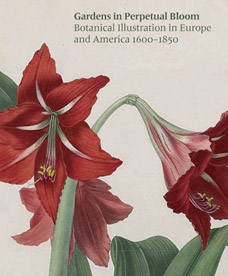 Originally developed as an aid to professional herbalists, botanical illustration quickly blossomed into an art form in its own right. The first flower books were intended as medicinal guides, or else illustrated volumes that catalogued the elaborate and extensive gardens of the well-to-do. But when Carl Linnaeus first classified the plant kingdom in 1735, the botanical book quickly took on a more scientific cast. By the nineteenth century, the flourishing of botanical publications reflected both the rapid rise of gardening as an amateur hobby and the desire of artists and decorators for new visual resources. Gardens in Perpetual Bloom: Botanical Illustration in Europe and America 1600–1850 traces the appreciation of flowers and their depiction, from the studious world of monks and princes to the era of the gardening enthusiast. The book’s 110 prints and drawings—which include masterful engravings by Georg Dionysus Ehret, the eighteenth century’s most accomplished botanical artist, and hand-colored prints by Pierre-Joseph Redouté, the premier draftsman of flowers for Marie Antoinette and Josephine Bonaparte—are remarkable for their technical virtuosity, delicate tonalities, scientific accuracy and seemingly infinite variety. Gardens in Perpetual Bloom is both a valuable historical survey and an affordable, attractively designed volume of jewel-like beauty.
◊ ◊ ◊ ◊ ◊
William Eisler, Lustrous Images from the Enlightenment: The Medals of the Dassiers of Geneva (Milan: Skira, 2010), ISBN: 9788857205076, $60.
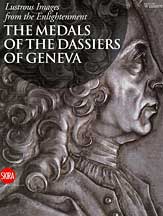 The Dassiers (Jean Dassier,1676-1763 and his two sons, Jacques-Antoine, 1715-1759 and Antoine, 1718-1780) were the only medalists of their time to have had the honour of being mentioned in the Encyclopédie by Diderot and D’Alembert, in which one can read that they “have rendered their names famous through their same talent: their fine medals after nature and several other works emerging from their burin prove that they are worthy of being counted amongst the most celebrated engravers”. The book examines the works that established the reputation of the Dassiers, starting with an elegant silver watch case by Jean Dassier for the Fabrique de Genève (Paris, Louvre), three series of small medals or tokens: The Metamorphoses by Ovid (1717; 60 pieces) and Illustrious men of the century of Louis XIV (1723-1724; 73 pieces) and, finally, The Church reformers (1725; 24 pieces). This last series was dedicated to William Wake, Archbishop of Canterbury, who offered the Dassiers his support in obtaining royal authorization to strike two major series, The Kings of England (1731-1732) and Famous Britons (1731-1738). Borrowing from the fame of his father throughout Europe, Jacques-Antoine, a former pupil of the École de Rome, threw himself into the creation of a new series dedicated to worthies in England, including savants, writers and politicians. At the peak of his career, he had the privilege of producing a portrait of Montesquieu, a work that is a milestone in the history of art (1753). This European reputation ensured that he was invited as engraver to the court of Russia, where he produced his last masterpiece, The founding of the University of Moscow (1754), decorated with an extremely bold portrait of the Empress Elizabeth. The death of Jacques-Antoine in 1759 and of his father four years later marked the end of a glorious artistic and commercial enterprise after 60 years of activity. This publication offers a summary and updating of the catalogue raisonné, The Dassiers of Geneva: 18th-century European medalists (Lausanne and Geneva, 2002-2005), the scientific point of reference for the subject. The new bilingual publication aims to offer direct access for a wider public of enthusiasts, historians and researchers.
◊ ◊ ◊ ◊ ◊
Werner Busch, Englishness: Beiträge zur englischen Kunst des 18. Jahrhunderts von Hogarth bis Romney (Munich: Beuscher Kunstverlag, 2010), ISBN: 9783422069565, $92.50.
 Ten essays on British art in the 18th century offer precise observations and historic as well as art-theoretic roots.
Werner Busch hat sich als einer der wenigen deutschen Kunsthistoriker immer wieder mit der britischen Malerei und Graphik beschäftigt. Der Band, der anlässlich seines 65. Geburtstages erscheint, versammelt zehn Aufsätze Buschs zur englischen Kunst und spannt einen Bogen vom Beginn bis zum Ende des 18. Jahrhunderts. Neben Hogarth werden mit Joshua Reynolds, Joseph Wright of Derby, Thomas Gainsborough und George Romney die prominentesten englischen Künstler des 18. Jahrhunderts in den Blick genommen.
◊ ◊ ◊ ◊ ◊
Marcello Fantoni, George Gorse, and Maclolm Smuts, eds., The Politics of Space: European Courts ca. 1500-1750 (Rome: Bulzoni, 2009), ISBN: 9788878704190, $55.
 Contents: Malcolm Smuts and George Gorse, “Introduction”; Marcello Fantoni, “The City of the Prince: Space and Power”; Jeroen Duindam, “Palace, City, Dominions: The Spatial Dimension of Habsburg Rule”; John Robert Christianson, “Terrestrial and Celestial Spaces of the Danish Court, 1550-1650”; Jesús Escobar, “A Forum for the Court of Philip IV: Architecture and Space in Seventeenth-Century Madrid”; John Beldon Scott, “Fashioning a Capital: The Politics of Urban Space in Early Modern Turin”; Linda A. Curcio-Nagy, “Commemorating the Conquest: Local Politics and Festival Statecraft in Early Colonial Mexico City”; Monique Chatenet, “The King’s Space: The Etiquette of Interviews at the French Court in the Sixteenth Century”; Patricia Waddy, “”Many Courts, Many Spaces”; Tracy Ehrlich, “Otium cum negotium: Villa Life at the Court of Paul V Borghese”; Nicola Courtright, “A New Place for Queens in Early Modern France”; Simon Thurley, “The Politics of Court Space in Early Stuart London”; Caroline M. Hibbard, “The Somerset House Chapel and the Topography of London Catholicism”; Anna Keay, “Charles II: Buildings, Politics and Power”; Magdalena S. Sánchez, “Privacy, Family, and Devotion at the Court of Philip II”. (“Europa delle Corti” Centro studi sulle società di antico regime, Biblioteca del Cinquecento, 142)
◊ ◊ ◊ ◊ ◊
Isabelle Michel-Evrard and Pierre Wachenheim, eds., La gravure: quelles problématiques pour les Temps modernes? (Bordeaux: William Blake & Co, 2009), ISBN: 9782911059261, $60.
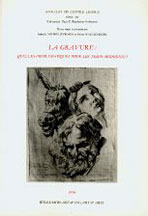 Annales du Centre Ledoux,Universite Paris-I, Pantheon-Sorbonne, VII
Essays include: Anne Nadeau, “Charles Simmoneau : un graveur de l’entre-deux siècles. Un aperçu de la gravure d’interprétation de 1667 à 1727”; Jean-Gérald Castex, “Un seul graveur peut-il « interpréter » tous les peintres ? Etienne Fessard ou les paradoxes de la gravure d’interprétation dans la seconde moitié du XVIIIe siècle”; Antonia Nessi, “Fabriquer Venise. La production de vedute gravées au XVIIIe siècle”; Isabelle Michel-Evrard, “Les échos visuels et philosophiques de la gravure dans la peinture des XVIIe et XVIIIe siècles”; etc.
◊ ◊ ◊ ◊ ◊
Linda Borean and Stefania Mason, eds., Il collezionismo d’arte a Venezia: Il Settecento (Venezia: Marsilio, Fondazione di Venezia, 2010), ISBN: 9788831799263, $65.
 Includes: L. Borean “Dalla galleria al ‘museo’: un viaggio attraverso pitture, disegni e stampe nel collezionismo veneziano del Settecento,” C. Whistler “Venezia e l’Inghilterra: Artisti, collezionisti e mercato dell’arte 1700-1750,” E. Manikowska “I polacchi e la pittura veneziana,” S. Mason “Il caso Mocenigo di San Samuele,” etc.










 Enfilade
leave a comment