Review: ‘William Hogarth’s Surprising Cosmopolitanism’
Recently posted at H-Albion:
Robin Simon, Hogarth, France and British Art (London: Greenhill Books/Lionel Leventhal, 2007), 313 pages, ISBN 978-0-9554063-0-0, $90.
Reviewed by Douglas Fordham, Assistant Professor of Art History, University of Virginia; published on H-Albion, January 2010.
Since his death in 1764, William Hogarth has become a protean figurehead for a great many impulses in British culture. John Trusler’s “Hogarth Moralized” (1768) was an early and overt instance of the ends to which Hogarth’s life and oeuvre could be put, and Hogarth continues to be, if not moralized, then at least channeled into a disparate series of voices and roles. While the “New Art History” of the past two decades has turned its pragmatic sights on Hogarth the calculating businessman, it has also tended to reduce the artist to a somewhat bland spokesman for a polite and commercial age.[1] In the writings of David Solkin and David Bindman, in particular, Hogarth has been cast as a cultural latitudinarian, mainstream in his preoccupations and eager to please. To the extent that Hogarth’s works reveal contradictions, unpleasant truths, or impolite expressions they tend to be viewed as apt reflections of an anxious age. This view of the artist offered a calculated response to Ronald Paulson’s towering contribution to Hogarth scholarship, beginning in the 1970s, which emphasized the artist’s antinomian impulses and his empathetic eye for the sub-cultural. If Hogarth merges seamlessly into hegemonic discourses in the former, he activates a dizzying array of allusions and a daunting density of meaning in the voluminous writings of Paulson.[2] While each of these accounts, and a great many others, have transformed our understanding of the artist and his age, readers are ultimately tasked with choosing which Hogarth they prefer. For it hardly seems possible for one individual to embody so many contrary impulses.
Robin Simon makes a welcome contribution to this debate in “Hogarth, France and British Art,” where he offers a surprisingly fresh iteration of the artist and his milieu. Simon’s Hogarth is cosmopolitan in his understanding of European Old Masters and contemporary French art, sophisticated in his handling of oil paints, and a friend to “Tory wits” and Whig politicians alike. Hogarth emerges in Simon’s account as an intellectually serious artist and a deeply gifted painter who almost single-handedly elevated British art to a Continental level of refinement. In his desire to translate French theories and standards into a uniquely English vernacular, “Hogarth demands to be ranked with the literary giants of the ‘Augustan’ age in England” (p. 8). Simon shares with Paulson a propensity for making analogies between English literature and art, and some of Simon’s most compelling observations entail comparisons between Hogarth’s paintings and the English stage. . . .
The paradox latent in Simon’s approach is that Hogarth already had an English visual vernacular at his disposal in London printshops, on painted street signs, and in countless urban spectacles. While Simon deliberately challenges the “determinedly insular” (p. 3) quality of recent Hogarth scholarship, at what cost does Hogarth the cosmopolitan painter become divested from Hogarth the graphic satirist as Diana Donald and Mark Hallett, for example, have presented him?[3] This is a question of synthesis, however, rather than a legitimate critique of Simon’s stated aims. On its own terms, Simon’s book deserves to be read by everyone with an interest in British culture in the first half of the eighteenth century, and it dramatically improves our understanding of Anglo-French relations. It also manages to present us with yet another incarnation of the artist from which to choose. This is a significant accomplishment in itself, and if this new Hogarth sits uncomfortably alongside his forebearers, then it can only encourage us to look anew at Hogarth’s astonishingly diverse and provocative career.
For the full review, click here»
Notes (more…)
Spanish Enlightenment: The Collection of Carlos IV
From Artdaily.org (7 March 2010)
Royal Splendor in the Enlightenment: Charles IV of Spain, Patron and Collector
Meadows Museum, Southern Methodist University, Dallas, TX, 7 March — 18 July 2010

Francisco de Goya, "Carlos IV," 1789 (Madrid: Royal Academy of History), Inv. No. 76
The Meadows Museum at Southern Methodist University will present “Royal Splendor in the Enlightenment: Charles IV of Spain, Patron and Collector”, the first major exhibition to showcase the exceptional art collection and refined taste of King Charles IV of Spain (1748-1819), from March 7 through July 18, 2010.
The Meadows Museum will be the only venue outside of Spain for the exhibition, the result of a unique collaboration between the museum and Patrimonio Nacional, the Spanish government institution that manages the artistic holdings created through the patronage and sponsorship of the Spanish monarchs. The exhibition is curated by Patrimonio Nacional curators Dr. Javier Jordán de Urríes y de la Colina and Dr. José Luis Sancho.
Charles IV and his wife, Queen María Luisa, reigned from 1788 to 1808 (when they were forced into exile by Napoleon), at the end of the Enlightenment period. They had a special passion for the arts and collected avidly throughout their lives.

Royal Workshops, "Sedan Chair of Queen María Luisa of Parma," 1795 (Madrid: Royal Palace, National Heritage), Inv. No. 10008050
“During his reign, Charles IV created a highly sophisticated, refined and cosmopolitan court for which the arts played a major role,” said Dr. Mark Roglán, museum director. “The combination of collecting works from the past as well as investing in those of the present, especially in the field of decorative arts, became part of the daily life of this king, whose artistic taste was among the finest in his time and in the history of the Spanish monarchy. The exhibition also shows the development of Charles’ artistic interests; he was not only influenced by the Spanish tradition, but had a special fondness for Italian art because of his childhood origins in Naples, and for French art, due to the dense network of dynastic relations that linked the Bourbons of Versailles to those of Madrid in the 18th century.”
The exhibition includes more than 80 examples of furniture, textiles, clocks, porcelains, paintings and sculptures selected from the casas de campo (country estates) and royal palaces of Madrid, Aranjuez, El Escorial and El Pardo. The majority of works are from Patrimonio Nacional (the Spanish National Heritage), and most of them have never before traveled to the U.S. The collection includes some of the finest examples of art styles of the day, from Rococo paintings to a stunning Neoclassical dessert centerpiece of semi-precious stones, lapis lazuli, gilded bronze and enamel. Other highlights include the queen’s ceremonial throne with its 18-foot-tall canopy, an elaborate sedan chair in which she was carried by footmen, a gilded bronze, porcelain and enamel bird cage clock, and a shotgun of wood, steel, gold and silver belonging to the king, an avid hunter. Also included are works by Francisco de Goya, the first court painter under Charles IV; his 1789 portrait of the king is making its only appearance outside of Madrid in 200 years. A painting by Diego Velázquez, Portrait (miniature) of the Count-Duke of Olivares, c. 1638, collected by Charles, will also be featured, as well as paintings by Luis Meléndez, Juan de Flandes, Anton Mengs and Giovanni Panini, among others.
The exhibition, which will be shown in the Jake and Nancy Hamon Galleries, will be accompanied by a scholarly, fully illustrated catalogue in English produced by the Meadows Museum. Also included will be a documentary that will feature, in HD video, the rooms and gardens of the palaces highlighted in the exhibition, bringing to life the splendid residences of the King. (more…)
More on the ‘Art and Theatre’ Exhibition in Toronto
Artdaily.org (11 March 2010) includes more information on the ‘Art and Theatre’ show as it will appear at the AGO, starting in June (interesting to see how it will be presented in Toronto, complete with “a life-size 18th-century set”).
De la scène au tableau / Drama and Desire: Artists and the Theatre
Musée Cantini, Marseille, 6 October 2009 — 3 January 2010
Museo di Arte Moderna e Contemporanea, Rovereto, 6 February — 23 May 2010
Art Gallery of Ontario, Toronto, 19 June — 26 September 2010
Lust. Passion. Murder. Many of the greatest artists of the 19th century shared a profound fascination with the theatre and its themes of triumph and destruction, love and despair. This summer, the Art Gallery of Ontario gives centre stage to key artworks by these artists in a major international exhibition titled Drama and Desire: Artists and the Theatre, opening June 19 and continuing through September 26.
Conceived by Guy Cogeval, president of the Musée d’Orsay in Paris, the exhibition includes over 100 paintings, drawings and theatrical maquettes, by masters such as Edgar Degas, Eugène Delacroix, Jacques-Louis David, Jean Auguste Dominique Ingres, William Blake, Aubrey Beardsley, Henri de Toulouse-Lautrec, and Édouard Vuillard. The works were selected from the collections of some of the world’s greatest museums, including the Louvre, the Metropolitan Museum of Art, the Musée d’Orsay, the British Museum, and the Victoria and Albert Museum.
The AGO has commissioned Gerard Gauci, set designer for Toronto’s Opera Atelier, to make Drama and Desire an experience like no other. Visitors will enter the exhibition by walking ‘onstage’ through a life-size 18th-century set; the works will be displayed using enhanced lighting, sound and video components as well as innovative theatrical devices; and a full-scale re-creation of an early 20th-century theatre maquette will mark the finale of the exhibition. (more…)
Catalogue of French Porcelain
From the March 2010 issue of Apollo Magazine:
Geoffrey de Bellaigue, French Porcelain in the Collection of Her Majesty The Queen, 3 volumes (London: The Royal Collection, 2009), 1291 pages, 2400 illustrations, ISBN 9781905686100, £500.
Reviewed by Selma Schwartz; Curator of Porcelain and Special Projects, Waddesdon Manor, The Rothschild Collection, Buckinghamshire, posting added 21 February 2010.
In the preface to his catalogue for the exhibition ‘Sèvres Porcelain from the Royal Collection,’ held at the Queen’s Gallery, Buckingham Palace, in 1979- 1980, Sir Geoffrey de Bellaigue wrote that “eventually a catalogue raisonné will be published” and that the catalogue “represents, in a sense, an interim report on a selection of pieces.”
Now, 30 years later, and over 100 years after the publication of Sir Guy Francis Laking’s ‘Sèvres Porcelain of Buckingham Palace and Windsor Castle,’ we finally have the monumental three-volume work (1,291 pages, with 2,400 illustrations – nearly all in colour) that scholars, collectors and amateurs of Vincennes/Sèvres porcelain have been anticipating eagerly for such a long time and the likes of which will probably never be seen again. Expectation and curiosity about the publication have been heightened principally for two reasons. The first being that although Windsor Castle and Buckingham Palace are open for public visits, a large quantity of the porcelain is not on display in public areas. The second is the renown that the author (or compiler, as he refers to himself in the text) rightly enjoys for meticulous and profound scholarly research.
The catalogue covers all the French porcelain in the Royal Collection, including that from Paris factories made in the 18th and 19th centuries, which, however, makes up only 37 of the 368 entries. Sèvres porcelain, as it was known after the manufactory moved to the town in 1756 from the château of Vincennes, is the star of the catalogue. The Royal Collection holds what is probably the finest and certainly the largest collection of this porcelain in the world, most of it acquired by that voracious collector George IV . . .
For the full review, click here»
Theater and Painting
From the website of the Musée d’Orsay:
De la scène au tableau / From Stage to Painting
Musée Cantini, Marseille, 6 October 2009 — 3 January 2010
Museo di Arte Moderna e Contemporanea, Rovereto, 6 February — 23 May 2010
Art Gallery of Ontario, Toronto, 19 June — 26 September 2010

"De la scène au tableau" (Flammarion, 2009) ISBN: 9782081236912
David, Delacroix, Hayez, Degas, Gustave Moreau, Toulouse-Lautrec, Vuillard . . . all these painters shared a passion for the performing arts. What role did the theatre and the opera play in the artistic production of these great masters and in developing the composition of their paintings? To what extent did their art influence future developments in stage design?
Ranging from the Neoclassicism of David to the experimental work of the scenographer and stage director Adolphe Appia, this exhibition highlights the direct influence of the theatre, or the more subtle effect of theatricality, on painting. Conversely, it also demonstrates how the great movements in the history of art influenced the theatre and opened it up to the 20th century.
However, there is another story, that of the movement towards the dematerialisation of the image (a specific feature of Modernism) which is presented in Marseille through almost two hundred works from prestigious institutions and collections around the world, including a collection of drawings and paintings by Daumier, Degas, Toulouse-Lautrec and Cabanel, on special loan from the Musée d’Orsay.
◊ ◊ ◊ ◊ ◊
The description perhaps downplays the role of the eighteenth-century for the exhibition, though the following review by Didier Rykner posted at The Art Tribune suggests there may be a bit more here for dix-huitièmistes.
The goal of the exhibition organized at the Musée Cantini is to understand the relationship between theatre and painting from the second half of the 18th century to the early 20th . . . Two paintings by Louis-Jean-François Lagrenée . . . prove very early on – halfway through the 18th century – the progressive change towards Neoclassicism, particularly Horace after Slapping his Sister from the Musée des Beaux-Arts in Rouen. While David is represented by well-known canvases (his copy of Girodet’s The Oath of the Horaces, recently seen at the Louvre, and his reception piece for the Ecole des Beaux-Arts), the two works from Bordeaux by Pierre-Narcisse Guérin and the very beautiful Marcus Curtius Dentatus Refusing the Gifts from the Samnites by Pierre Peyron, held at the Musée des Beaux-Arts in Marseille, are admirable. As is often the case in this type of exhibition, the most pleasant surprises come from the lesser-known paintings, discovered a new thanks to excellent restorations.
For the full review, click here»
Eighteenth-Century Religion between History and Art History
Recently added to caa.reviews:
Nigel Aston, Art and Religion in Eighteenth-Century Europe (London: Reaktion Books, 2009), 320 pages, ISBN: 9781861893772, $45.
Reviewed by Michael Yonan, University of Missouri–Columbia; posted 25 February 2010.
. . . Among crossdisciplinary connections, perhaps none is so elusive, so fraught with traps, as the boundary between history and art history. It is a boundary all the more striking for its invisibility. Art historians typically assume that they are partaking in historical study, that the tools they bring to cultural artifacts from the past illuminate an understanding comparable to that of their historian colleagues. All the greater their surprise, then, when they attend a history seminar or delve into historical journals and discover that their colleagues actually speak a different language and reach sometimes strikingly unfamiliar conclusions. Confusion and misunderstanding can happen in the opposite direction, too. Historians create knowledge about the past typically from texts, and it can seem a small step to translate that knowledge to images and spaces, visual constructions that likewise are products of the past and which ostensibly engage the same concerns. Nigel Aston recognizes the divide between his discipline, history, and art history and notes their differences in the introduction to his book “Art and Religion in Eighteenth-Century Europe.” He begins by registering his own interdisciplinarity, but reminds his readers that as a historian he brings a disciplinary perspective to the material at hand. That material is this period’s plentiful religious art, and he adds that in being fascinated by it he has been more or less alone among Anglo-American scholars. Certainly he is correct in noting that religious imagery desperately requires additional study and greater emphasis in our growing discourse on eighteenth-century art. . . .
For the full review, click here»
Enamels at the Hermitage
Enamels of the World 1700-2000 from the Khalili Collections
Hermitage, St Petersburg, 8 December 2009 – 18 April 2010

Throne table Guangzhou (Canton), 1736-1795 Gilt copper, painted enamel, 37 x 90.5 x 42 cm
Due to popular demand Enamels of the World 1700-2000 from the Khalili Collections, being exhibited at the State Hermitage Museum, St Petersburg, has been extended until 18 April. This is the inaugural presentation of a remarkable new facet of the Khalili Collections, perhaps best known for the their unparalleled Islamic and Japanese art. The exhibition features some 320 pieces selected from approximately 1,200 works in the enamel collection.
Enamelling has been an essential accomplishment of the virtuoso jeweller for more than 3,000 years, and many ancient works rank among the treasures of European and Asian art – to the extent, perhaps, that it tends to be popularly, though
misleadingly, identified with ancient and mediaeval art.

Novelty scent spray, attributed to Mouliné, Bautte & Co. or Moulinié & Bautte, Geneva, circa 1805 Gold, translucent and painted enamel, agate and seed pearls, 11 x 5.5 x 1.4 cm
Partly because of this, its history since 1700 or so has become the province of highly specialised scholars often working in ignorance of their colleagues’ work in closely related fields, which is especially paradoxical since enamellers themselves have always been highly mobile. The rapidity of travel and the ease with which motifs and techniques could be transferred, virtually from one end of the industrialised world to the other, in the 18th and 19th centuries, has given their work a truly international dimension. Many of their names are little known to the general public. Professor Nasser D Khalili’s achievement has been not just to present their work but to show them working in a global environment and, whether European or Asian, transcending the boundaries of national frontiers or individual enterprise. The historicist taste of the 19th century, imbued by the conviction that the traditions of the past dynamically influenced the arts of a nation, went hand in hand with the conviction that exotic art could be exploited to revive them. This was as true of Meiji Japan and Qing China, as of Tsarist Russia, Victorian Britain and Ottoman Turkey.

Drawn by the most humble Muhsin known as ‘The Aleppan’, Iran, ca. 1800
The exhibition includes splendid enamelling by the most prestigious European masters. The firm of Fabergé is represented by twenty-six works including a combined timepiece and photograph frame, while the work of Feodor Rückert, a workmaster who regularly supplied Fabergé, is seen in three items dating from different periods of his career including one of his great masterworks, the Ol’sen kovsh. The eminent French master Jean-Valentin Morel is also represented by three works, among them the very last that he made. The genius of René Lalique, which was so fêted at the Paris Exposition Universelle of 1900, may be appreciated both on a small scale with a corsage ornament and on a large scale with a remarkable surtout de table. At the same Exposition, the firm of Cartier also enjoyed great critical acclaim and the exhibition features fifteen works by Cartier, among them clocks, cigarette cases and vanity cases. Much of the enamelling produced in the Islamic lands is the work of anonymous craftsmen. However, the exhibition includes a rare signed example, a gold box signed by Muhsin, known as ‘the Aleppan’, an artist working at the court of Fath ‘Ali Shah.

Timepiece Laurent, Paris, 1793-1794 Painted marble and gilt-metal, copper with opaque, translucent and painted enamel with paillons, 40.8 x 26 x 16 cm
As a whole the collection magnificently displays the great variety of work produced by enamellers ranging from precious personal accessories such as jewellery to clocks, vases, and even pieces of furniture. Similarly striking is the element of fantasy employed in their creation, for example the scent spray formed as a pistol, the scent issuing from a flower that emerges from the muzzle when the trigger is pulled, or the evening bag made by Aloisia Rucellai in 1968, where the folds and ‘watering’ of moiré silk have been extravagantly replicated in engraved gold and enamel. Equally remarkable is the variety of techniques used to decorate these pieces including cloisonné, painted and plique à jour enamel. At the same time fascinating differences may be noted in the use of the same technique in different locations such as China and Japan.
The impact of patronage is well illustrated by many works in the exhibition. Specific commissions include the small almanac made for the Empress Marie-Louise, second consort of Napoleon I, to commemorate the birth of their son, the King of Rome, and the casket made for Elisabeth, Queen of Roumania, which she gave to the French painter Jean Lecomte de Nouÿ. Other works were made to order for royal and imperial households; among these are the Russian cigarette case by Hahn with a diamond-set imperial eagle and the pair of Japanese vases by Hattori Tadasaburo which incorporate the Imperial kikumon. In other instances enamelled works of art were used to commemorate an event such as the spectacular charger by Pavel Ovchinnikov that was presented by the city of Moscow to Emile Loubet, President of the French Republic, during his state visit to Russia in 1902.

Edited by Haydn Williams
Historical revivalism is a major theme covered by the Collection. The rise of nationalism during the 19th century encouraged artists to study the past in the hope of defining national identity. In northern Europe the Gothic era was thoroughly reviewed while in Russia interest focused upon the art made before Peter the Great’s policy of westernisation. Filigree enamelling, a traditional technique practised in the cities of Moscow, Velikii Ustiug and Solvychegodsk, was revived. One of the leading exponents of this was Pavel Ovchinnikov, the maker of the imposing double-handled kovsh. Widespread interest in the past also stimulated collectors to seek antiques for their collections. The scarcity of authentic examples, combined with great demand, soon led to the production of imitations that made good the shortfall. One of the most noted makers of such work was Reinhold Vasters and the exhibition includes three spectacular examples by him, among them the large covered bowl applied with jewelled gold and enamel mounts. Other masters drew on the past in a more informal and fanciful way as can be seen in the charger by Herman Ratzersdorfer or the timepiece by Vever frères which was exhibited at the Paris Exposition Universelle in 1889.
The importance of the Khalili Collection and the number of wonderful pieces made by Russian craftsmen make its unveiling in one of the world’s greatest museums, the State Hermitage Museum, entirely appropriate and in keeping with Professor Khalili’s wish to share his collections with the world and to promote greater understanding between people of different cultures.
Exhibition catalogue: Haydn Williams, ed., Enamels of the World, 1700-2000 : The Khalili Collections (London: The Khalili Family Trust, 2009), 450 pages, ISBN: 9781874780175, $75
CAA Now Accepting Nominations for Its Publications Committee
As noted at CAA News:
CAA invites nominations and self-nominations for two members-at-large to serve on the Publications Committee for a three-year term, July 1, 2010–June 30, 2013. Candidates must possess expertise appropriate to the committee’s work. Museum-based arts professionals with an interest and experience in book, journal, or museum publishing and those with experience in digital publishing are especially encouraged to apply.
The Publications Committee is a consultative body that advises the CAA Publications Department staff and the CAA Board of Directors on publications projects; supervises the editorial boards of The Art Bulletin, Art Journal, and caa.reviews, as well as CAA’s book-grant juries; sponsors a practicum session at the Annual Conference; and, with the CAA vice president for publications, serves as liaison to the board, membership, editorial boards, book-grant juries, and other CAA committees. The committee meets three times a year, including once at the CAA Annual Conference; members pay travel and lodging expenses to attend the conference. Members of all committees volunteer their services to CAA without compensation. Candidates must be current CAA members and should not serve concurrently on other CAA committees or editorial boards. Applicants may not be individuals who have served as members of a CAA editorial board within the past five years. Nominators should ascertain their nominee’s willingness to serve before submitting a name; self-nominations are also welcome. Appointments are made by the CAA president in consultation with the vice president for publications.
Please send a letter of interest describing your interest in and qualifications for appointment, a CV, and contact information to: Vice President for Publications, c/o Alexandra Gershuny, CAA, 275 Seventh Ave., 18th Floor, New York, NY 10001. Materials may also be submitted to agershuny@collegeart.org. Deadline: 15 April 2010.
The Eighteenth Century in the Current Issue of ‘Art History’
Kate Retford, “A Death in the Family: Posthumous Portraiture in Eighteenth-Century England,” Art History 33 (February 2010): 74-97.
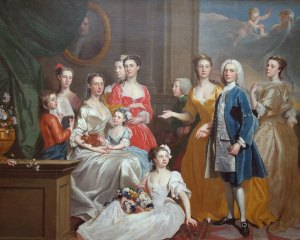
Joseph Highmore, "The Lee Family," 1736. Oil on canvas, 243.8 × 289.6 cm. (Wolverhampton Art Gallery)
Abstract: This article explores a number of unusual portraits produced in eighteenth-century England in which the realms of the posthumous and the living were mingled. In some cases, the dead were brought ‘back to life’ and restored to their rightful place in the family unit. In others, such as Joseph Highmore’s portrait of The Lee Family (1736), Thomas Gainsborough’s The Sloper Family (1787–88) or The Knatchbull Family by John Singleton Copley (1800–03), they were included in spiritualized form, hovering in a supernatural realm above the relatives they had left behind on terra firma. The article unpicks the particular circumstances that prompted these extraordinary commissions, exploring the personal and emotional histories of the sitters and artists. It also draws conclusions about the broader social, cultural, religious and artistic contexts that made these relatively rare, and frequently problematic images.
Kate Retford is Lecturer in History of Art at Birkbeck College, University of London. Her book, The Art of Domestic Life: Family Portraiture in Eighteenth-Century England, was published by Yale University Press in 2006. In addition, she has written a number of articles on topics relating to eighteenth-century portraiture, gender, and the country house art collection.
◊ ◊ ◊ ◊ ◊
Review of Ephemeral Bodies: Wax Sculpture and the Human Figure, with a translation of Julius von Schlosser’s “History of Portraiture in Wax,” edited by Roberta Panzanelli (Los Angeles: Getty Research Institute for the History of Art and the Humanities, 2008), pp. 170-72.
Reviewed by Matthew Bowman (lecturer at the University of Essex and co-founding editor of Rebus: Journal of Art History and Theory)
Most of the eight contributions in “Ephemeral Bodies” were originally presented in a workshop held at the Getty Research Institute in 2004. The texts examine the utilization of wax to depict the human body (in whole and in part, internally and externally) from a variety of methodological perspectives in accordance with the very different uses to which wax has been put. This includes considerations of wax sculpture from medical, anatomical, art-historical, philosophical, anthropological and political standpoints. From an art historian’s viewpoint, wax has not really figured in the discipline of art history. Indeed, it is curious that Julius von Schlosser’s stimulating “Geschichte der Porträtbildnerei in Wachs” (“History of Portraiture in Wax”), which originally came out in 1911 and which is published here for the first time in English, remains the central art-historical text on the production of wax sculptural objects. Ephemeral Bodies is, therefore, not only a useful scholarly collection on a neglected topic but also an opportunity to gauge and expand the theoretical presuppositions of art history as a discipline. . .
For additional contents, click here»
Jean Raoux Retrospective
Jean Raoux, virtuose et sensuel (1677-1734)
Musée Fabre de Montpellier, 28 November 2009 – 11 April 2010
 Jean Raoux est avec Sébastien Bourdon, Joseph-Marie Vien, François-Xavier Fabre et Frédéric Bazille, l’un des grands artistes français originaires du Languedoc. Ce peintre, contemporain d’Antoine Watteau, participa de manière active au renouvellement de la peinture française au temps de la Régence. Virtuose, sensuel, élégant, Jean Raoux mérite que sa ville natale lui consacre une exposition d’envergure.
Cette première rétrospective réunit les plus beaux chefs-d’oeuvre de l’artiste provenant des grands musées français, mais aussi de collections allemandes, autrichiennes, italiennes, anglaises, américaines et russes. De provenance prestigieuse, rarement montrés, les tableaux de cette exposition dévoilent l’étendue de son talent de portraitiste de l’aristocratie, du monde du spectacle, de peintre de sujets historiques et religieux, mais aussi de scènes de genre à la manière hollandaise. Sa poésie exalte la beauté de la femme, qu’elle soit héroïne de la mythologie ou coquette vaquant à ses occupations quotidiennes. Cette sélection permet de mettre en lumière les multiples facettes de cet artiste célèbre en son temps et estimé de Voltaire.
Qui est Jean Raoux ?
Né à Montpellier en 1677, Raoux a continué sa formation à Paris dans le grand atelier de Bon Boullongne. De 1705 à 1714, il séjourne à Rome, Padoue et Venise où il répond à d’importantes commandes de peintures mythologique et religieuse. De retour à Paris en 1714, il entre à l’Académie et reçoit la protection du Grand Prieur de l’Ordre de Malte, le libertin Philippe de Vendôme et travaille aussi pour le régent Philippe d’Orléans. Ses portraits, ses scènes de genre très poétiques et d’une exécution virtuose témoignent de l’esprit de ce milieu qu’il fréquente, à la fois léger, féminin et parfois mélancolique.
Exhibition Catalogue: Michel Hilaire and Olivier Zeder, Jean Raoux, 1677-1734 (Paris: Somogy, 2009), ISBN: 9782757202876, $58.95 (for an English description and a link to purchase the catalogue, click here»)










 Enfilade
leave a comment