Listening to Furniture
Recently added to caa.reviews:
Dena Goodman and Kathryn Norberg, eds., Furnishing the Eighteenth Century: What Furniture Can Tell Us about the European and American Past (New York: Routledge, 2007), 272 pages, $69.95 (9780415949538)
Reviewed by Stacey Sloboda, Assistant Professor of Art History, Southern Illinois University; posted 4 November 2009.
In a conceptually wide-reaching and useful introduction to “Furnishing the Eighteenth Century: What Furniture Can Tell Us about the European and American Past,” editors Dena Goodman and Kathryn Norberg ask, “Can the settee speak?” (2). That this question remains relatively novel suggests the importance of the book. Their answer, of course, is affirmative; and the twelve essays that constitute this collection provide ample new, thoughtful, and frequently surprising revelations about what exactly eighteenth-century furniture said to a broad range of makers, users, and audiences. Written by scholars in the fields of history, literary studies, and art history, the essays are methodologically diverse yet unified by an interest in the social and cultural uses and meanings of objects and interiors in the eighteenth century. . . .
In a revelatory essay that should become standard reading for students of eighteenth-century French visual and material culture, “The Joy of Sets: The Uses of Seriality in the French Interior,” Mimi Hellman explores multiple reasons why sets, serial designs, and matching objects became characteristic features of the eighteenth-century French interior. Deftly weaving formal, cultural, and historical approaches to specific objects, Hellman deploys a wide range of theoretical insights, from anthropology to psychoanalysis, to argue that, “serial design was a crucial site for the enactment of elite self-fashioning, an eloquent representational system that elicited performances of social mastery” (147). Furthering the concept of signifying objects, Mary Salzman’s careful analysis of Jean-François de Troy’s pendant paintings “The Garter” and “The Declaration of Love” (1724) argues that decorative objects in de Troy’s paintings constitute a form of visual rhetoric that communicated with savvy viewers for whom judgment was an important critical activity. . . .
◊ ◊ ◊ ◊ ◊
Sloboda, Hellman, and Salzman are all HECAA members. For CAA members, the entire review can be found here»
Happy Birthday, Angelica Kauffman!
Angelica Kauffman turns 268 today. The following comes from Meredith Martin’s 2007 review of Angela Rosenthal’s book on the artist. From caa.reviews:
Angela Rosenthal, Angelica Kauffman: Art and Sensibility (New Haven: Yale University Press in association with Paul Mellon Centre for Studies in British Art, 2005) 352 pages, $65.
Reviewed by Meredith Martin, Assistant Professor, Wellesley College; posted 1 May 2007.
Cover Image: Angelica Kauffman, "Self-Portrait," detail, 1784 (Munich: Bayerische Staatgemäldesammlung Neue Pinakothek)
Rosenthal’s monograph restores Kauffman’s own work to center stage. Her project is not simply one of “historical recovery,” for as the author notes, “unlike some other female artists, [Kauffman] never fully lost her position within the art-historical canon” (2). Generally speaking, Kauffman’s story is not one of isolation or exclusion, but rather of strong support, widespread influence, and international renown. One need only glance at her voluminous, multilingual correspondence with the leading cultural figures of eighteenth-century Europe—Goethe, Johann Caspar Lavater, and Izabella Czartoryska among them—to get a sense of the professionally rewarding and breathlessly glamorous life that Kauffman led. Zoffany’s painting notwithstanding, Angelica Kauffman was nobody’s wallflower. . .

Member News
Angela Rosenthal is associate professor at Dartmouth. She specializes in early modern European visual culture (especially British art within a global perspective), with an emphasis on cultural history, gender studies, feminist and post-colonial theory, and the history of art criticism. She studied art history, psychology and social anthropology at Trier University, Germany and in the UK (The Courtauld Institute of Art, University College London, and Westfield College). Before joining the faculty at Dartmouth College in 1997, she was curator of contemporary art at the Stadtgalerie in Saarbrücken (1994-95), and Andrew W. Mellon Assistant Professor of Art History at Northwestern University (1995-97). Rosenthal’s most recent research project emerged from her past work on the visual formulation of subjectivity, as well as from her engagement with contemporary post-colonial art theory. In this new book project, entitled The White of Enlightenment: Racializing Bodies in 18th-Century British Visual Culture, Rosenthal seek to complement the growing field of research on concepts of “race” and “ethnicity” in the visual arts.
Meredith Martin joined the Wellesley faculty in 2008. She received a BA in Art History from Princeton University in 1997 and a PhD in the History of Art and Architecture from Harvard University in 2006. Her research interests include: eighteenth- and nineteenth-century French visual and material culture, architectural theory and landscape design; gender, space, and the domestic interior; early neo-classicism; art and colonialism; and the historiography of the Rococo. She is the co-author, with Scott Rothkopf, of Period Eye: Karen Kilimnik’s Fancy Pictures (Serpentine Gallery/Koenig Books, 2007). Her book, Dairy Queens: Pastoral Architecture and Political Theater from Catherine de’ Medici to Marie-Antoinette, is forthcoming from Harvard University Press, and she is also co-editing a volume with Denise Baxter entitled Architecture Space in Eighteenth-Century Europe: Constructing Identities and Interiors to be published by Ashgate next spring. Her current research addresses diplomatic and material exchanges between France and India in the late eighteenth century.
Collecting and Display in Italy
Recently added to caa.reviews:
Carole Paul, The Borghese Collections and the Display of Art in the Age of the Grand Tour (Aldershot, UK: Ashgate, 2008), 358 pages, $124.95 (9780754661344)
Reviewed by Jason Kelly, Assistant Professor, Department of History, IUPUI; posted 23 September 2009.
Carole Paul’s ‘The Borghese Collections and the Display of Art in the Age of the Grand Tour’ is an analysis of the shifting attitudes toward collection and display—form, content, and contexts—in the world of Settecento Rome. With a focus on the Borghese’s Galleria Terrena, the suites where most of the family’s paintings hung, and the Casino Nobile, home to the sculptures, Paul examines the interrelated narratives of aristocratic patronage, grand tour sociability, the international aesthetic landscape, and the development of museums. Her arguments rest on a detailed reading of the redesign of the Borghese galleries under Prince Marcantonio Borghese IV and his architect, Antonio Asprucci, beginning in 1767 and continuing to 1800. Paul argues that the re-outfitting of the Galleria Terrena and the Casino Nobile was “one of the most significant cultural events in Rome during the age of the Grand Tour” (2). The analysis of this process sheds light on how these exhibition spaces became the high point of the princely display of antiquities and paintings in eighteenth-century Rome. As readers familiar with Paul’s earlier publications, especially ‘Making a Prince’s Museum: Drawings for the Late-Eighteenth-Century Redecoration of the Villa Borghese‘ (Los Angeles: Getty, 2000), will recognize, ‘The Borghese Collections’ is the culmination of work that has been developing for some time. It extends many of the themes discussed in the earlier book by examining the entire aesthetic, iconographic, and didactic program of the late Settecento Borghese estate. . . .
In common with Christopher Johns’s ‘Papal Art and Cultural Politics: Rome in the Age of Clement XI‘ (Cambridge, UK: Cambridge University Press, 1993), Peter Bowron and Joseph Rishel’s ‘Art in Rome in the Eighteenth Century’ (Philadelphia: Philadelphia Museum of Art, 2000), and Jeffrey Collins’s ‘Papacy and Politics in Eighteenth-Century Rome’ (Cambridge, UK: Cambridge University Press, 2004), ‘The Borghese Collections’ examines eighteenth-century Rome’s vibrant artistic climate. Whereas Johns and Collins are concerned with papal collections and display, Paul’s work reveals the extent to which Roman aristocrats both innovated and competed with the Vatican. When comparing Prince Marcantonio Borghese IV’s program to that sponsored by Pope Pius VI Braschi at the Pio-Clementino in the 1780s, it is clear that rivalries spurred, at least in part, both patronage and new schemes for display. Along with these earlier books, Paul’s work reveals the importance of collecting as a political strategy, and she explains the centrality of iconographic programs to their design. ‘The Borghese Collections and the Display of Art in the Age of the Grand Tour’ is essential reading for students of Settecento museums, architecture, design, and the Grand Tour. . . .
◊ ◊ ◊ ◊ ◊
Writing for the TLS (30 September 2009) on the topic of artistic plunder in antiquity, Mary Beard (Cambridge classics professor and author of the blog, A Don’s Life) invokes Paul’s book in connection with evaluating the lines between collecting as an act of cultural productivity and collecting as a form of cultural destruction:
For a start, the contested boundary between the cultured patron and the obsessive, rapacious collector is an almost universal one. This is nicely illustrated in Carole Paul’s meticulous account of the display of the Borghese collection of paintings and antiquities in eighteenth- century Rome, ‘The Borghese Collections and the Display of Art in the Age of the Grand Tour’. In discussing the formation of the collection she devotes a short section to the seventeenth-century Scipione Borghese – a “distinguished . . . patron of the arts,” “a great Maecenas.” It is only in the next paragraph that we learn that “Scipione was also a remarkable – and ruthless – collector, who would stoop to confiscation and theft to obtain paintings, and even had artists imprisoned when they displeased him.” Same person, same habits: it all depended which side of Scipione’s patronage you were on.
Drawings at the Getty
From the Getty’s website:
Capturing Nature’s Beauty: Three Centuries of French Landscapes
Getty Center, Los Angeles, 28 July – 1 November 2009
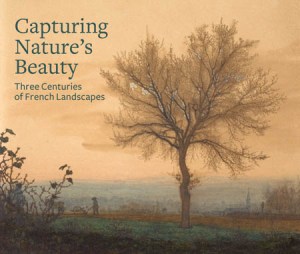
Édouard Kopp, exhibition catalogue (Getty, 2009) $19.95
This selection of over 40 drawings from the collections of the J. Paul Getty Museum and the Getty Research Institute highlights key moments in the French landscape tradition, from its emergence in the 1600s to its preeminence in the 1800s. The exhibition showcases drawings by some of the masters of the genre, including Nicolas Poussin, Claude Lorrain, François Boucher, Jean-Honoré Fragonard, Camille Pissarro, and Vincent van Gogh. Together these works reveal a tension between a passion for the real and the quest for an ideal. They demonstrate different facets of the relationship between the artist and the land: from simple record to creative transformation, if not pure invention. . . .

Fragonard, "Ruins of an Imperial Palace," 1759
Jean-Honoré Fragonard made this accomplished drawing while he was a student at the French Academy in Rome. The curriculum was relatively unusual because it actively promoted the practice of sketching outdoors, a sign of landscape’s increasingly elevated status as an artistic genre. In this view of the Palatine Hill as seen from the Roman Forum, the artist adopted a low viewpoint and a wide angle that allowed him to create a bold, forceful composition. Using red chalk, he brilliantly rendered the complex formal interaction between buildings and nature.
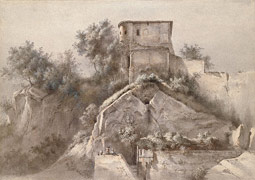
Boissieu, "Château Galliard," 1796
Jean-Jacques de Boissieu is best known for his large and delicately washed picturesque views. A trip to Italy inspired his practice of illuminating his compositions with bright sunlight. Yet his palette—dominated by grays—and meticulous attention to detail are reminiscent of earlier Dutch landscape drawings. This style enabled de Boissieu to work quite independently from the artistic trends of his time, exemplified by the works of Fragonard and Hubert Robert. The draftsman carefully framed his motif: an abandoned fortified house in Lyon, his native city, perched on a craggy hill and overgrown by nature. While capturing the atmosphere of the locale, Boissieu rendered the variety of textures with a compelling sense of materiality.
Townley in His Library and a New Zoffany Biography
Last week’s Apollo competition asked:
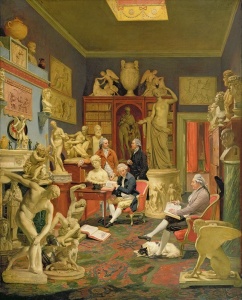
Johan Zoffany, "Charles Townley with His Friends in the Townley Library," oil on canvas, 1781-3 (Burnley: Townley Hall Art Gallery)
Which antiquary and collector lived at Number 14 Queen Anne’s Gate (originally called 7 Park Street)?
Clue: Most of the collection of antiquities amassed by this person was acquired by the British Museum.
The Enfilade posting on the query from October 4 included, as a hint, this well-known painting of Charles Townley with His Friends in the Townley Library by Johan Zoffany. The portrait is now part of the collection at the Towneley Hall Art Gallery at Burnley in Lancashire, England. As noted on the museum’s website, the family left the ancestral home in 1902, and the Great Hall opened as a museum the next year. In addition to a gallery of paintings, the museum showcases a variety of displays covering natural history, Egyptology, local history, textiles, and decorative arts.
As for Zoffany, we can look forward to a new biography of the painter scheduled for release in January 2010. Penelope Treadwell’s Johan Zoffany: Artist and Adventurer will be published early next year by
Paul Holberton.
Book Prize for Biography
Biennial Annibel Jenkins Biography Prize
Due 15 November
The biennial Annibel Jenkins Prize is given to the author of the best book-length biography of a late seventeenth-century or eighteenth-century subject and carries an award of $1,000. The prize is named in honor of Annibel Jenkins, Professor of English (Emerita) at the Georgia Institute of Technology. A founding member of the Southeastern American Society for Eighteenth-Century Studies, she is an outstanding teacher and scholar who has been for many years one of the most active and encouraging members of the academic community in America.
Rules:
- To be eligible for this year’s competition, a book must have a copyright date between November 2007 and October 2009.
- The author must be a member of ASECS at the time of submission.
- Submission must be made by the publisher, and six copies must be received by 15 November 2009.
Send all submissions and inquires for to: ASECS, Annibel Jenkins Book Prize, 2598 Reynolda Rd., Suite C, Winston-Salem, NC 27106; E-mail: asecs@wfu.edu
Weekly Apollo Competition
Each week, Apollo Magazine gives away a book to a lucky reader who sends in an email in response to a simple question and is then selected from a pool of respondents with the correct answer. This week’s contest seems worth noting both for the book on offer and the query, which is closely related to the painting pictured below (hint, hint!). From the Apollo website:

Emily Cole (Yale University Press, 2009) ISBN: 978-0300148718, $85
This week we are offering you the chance to win Lived In London: Blue Plaques and the Stories Behind Them, edited by Emily Cole (Yale; £40). This superb book charts the fascinating history of London’s Blue Plaques while telling the story of the city’s most famous residents and the buildings in which they lived. Arranged geographically, by borough and area, this book is the first published guide for over half a century to be compiled with the aid of local government and English Heritage files. It includes new research and findings on the people and buildings commemorated, as varied as Winston Churchill, Virginia Woolf, Mahatma Gandhi and Charlie Chaplin. In the book’s foreword Stephen Fry writes, “Part of the sport of Plaque Spotting is to encounter remarkable men and women of whom one has not heard, but whose claim to greatness one can discover. . . The presence of their plaques tells us much about them but also about the London they chose to stay in and which offered them refuge and hospitality. This invaluable book, written with insight and exemplary scholarship, is a perfect companion for anyone who has ever looked up and wondered. . .”
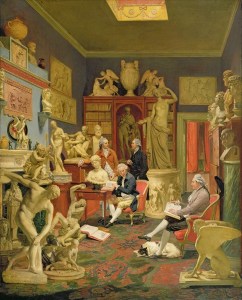 For your chance to win, simply answer the following question:
Which antiquary and collector lived at Number 14 Queen Anne’s Gate (originally called 7 Park Street)?
Clue: Most of the collection of antiquities amassed by this person was acquired by the British Museum.
Email your answers ot offers@apollomag.com using ‘Blue Plaques’ as the subject of your email. Only answers received before midday on 9 October will be entered into the competition draw.
Recapping the Récamier Exhibition and Colloquium in Lyon
By HEATHER BELNAP JENSEN
Juliette Récamier, muse et mécène
Musée des Beaux-Arts de Lyon, 27 March – 29 June 2009
Colloquium: Historiennes et critiques d’art à l’époque de Juliette Récamier, international colloquium organised by the Institut national d’histoire de l’art, Musée des Beaux-Arts, Lyon, 26 June 2009
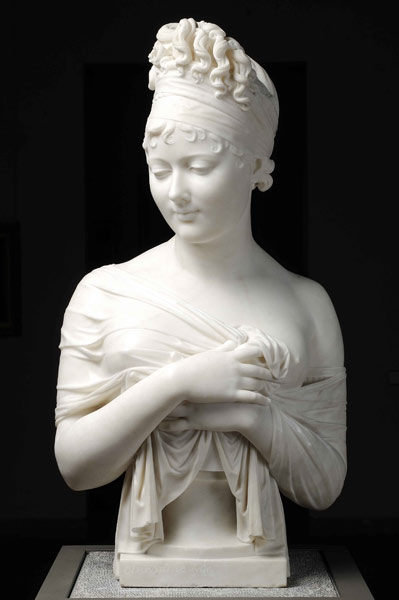
J. Chinard, "Portrait of Juliette Récamier," 1805-06 (Lyon: Musée de Beaux-Arts)
Juliette Récamier: Muse et mécène, recently mounted by the Musée de Beaux-Arts in Lyon, was surely one of the highlights of this past summer’s exhibition season. Thoughtfully conceived and beautifully executed, this show did much to restore Récamier to her rightful place as a key arbiter of taste in post-Revolutionary France. Upon entering the foyer, one was immediately transported to the refined and graceful realm of this cultural luminary. Art, fashion, and furnishings were disposed so as to emphasize her various powers. This exhibition compellingly argued that Récamier not only inspired some of the most enchanting art of the period (one thinks immediately of the portraits of this figure by Jacques-Louis David and François Gérard—neither of which were able to travel, unfortunately), but that she also figured as a formidable patron of the arts. The most exquisite space in this show was the re-creation of Récamier’s salon, as detailed in François Louis Dejuinne’s painting of 1826. To see in conversation some of the most iconic paintings of the age, including Anne-Louis Girodet’s Portrait of Chateaubriand, Elisabeth Vigée-Lebrun’s Portrait of Mme de Staël as Corinne, and Gérard’s Corinne at Cape Miseno, was a truly captivating experience. Attesting to the enduring interest in the figure of Recamier was the 1928 film of Gaston Ravel that played in an adjacent room, along with the twentieth-century works by René Magritte that paid homage to ‘la dame au sofa’. The accompanying catalogue (available here via Amazon.ca) was as exquisitely crafted as the exhibition, with contributions by the curator, Stéphane Paccoud, as well as other notable French and American scholars including Laura Auricchio. The essays attest to the complexities of Récamier’s roles as muse and patron and point to the need to reconsider conventional characterizations of such well-positioned women in the fashioning of artistic sensibilities. In sum, I must concur with Didier Rykner’s assessment of the exhibition made in La Tribune de l’Art: it did indeed approach perfection.

Robert Smirke, "Chambre de Juliette Récamier,” 1802 (London: Royal Institute of British Architects Library)
In conjunction with the exhibition, Historiennes et critiques d’art à l’époque de Juliette Récamier, a colloquium dedicated to the women writing about the arts in France, c. 1800, was held on June 26 in Lyon. This international colloquium was sponsored by the Institut national d’histoire de l’art and convened by Mechthild Fend (University College, London), Melissa Hyde (University of Florida), Anne Lafont (INHA), and Stéphane Paccoud (MBA-Lyon). Many of the presenters discussed the place of individual figures in the construction of the post-Revolutionary art world. American scholars were well represented. Mary Sheriff (University of North Carolina) argued for Vigée-Lebrun’s position as an art historian and addressed her Souvenirs as a critical historical enterprise. Susan Siegfried (University of Michigan) gave careful consideration to the role of la presse féminine in the formation of female subjectivity, and Sarah Betzer (University of Virginia) engaged Marie d’Agoult’s critical work. In my own paper, I discussed the significance of Julie Candeille’s activities as critic and agent in the career of Anne-Louis Girodet. That no one treated the contributions made to art writing by the uncontested doyenne of the era, Germaine de Staël, was much commented upon. The lively discussion that ensued after the presentations testified to the need for a continued dialogue regarding women as art historians and critics at this historical juncture. There are plans to publish the proceedings.
Heather Belnap Jensen received her Ph.D. in 2007 from the University of Kansas. She is currently assistant professor of art history at Brigham Young University. For more information about her recent scholarly activities, click here». Images are drawn from the exhibition website; other HECAA members who participated in the exhibition or colloquium are indicated with bold type.
Assessing the Glow of ‘Blake’ and ‘Brilliant Women’
Recent pieces from CAA.reviews address exhibition publications on William Blake at the Petit Palais in Paris and bluestockings at the National Portrait Gallery in London:
◊ ◊ ◊ ◊ ◊
Catherine de Bourgoing, ed., William Blake: Le Génie visionnaire du romantisme anglais, exhibition catalogue (Paris: Petit Palais and Musée de la Vie Romantique, 2009), 256 pages, €39 (9782759600779)
Exhibition schedule: Petit Palais and Musée de la Vie Romantique, Paris, April 2–June 28, 2009
Meredith Davis writes that
This overdue exhibition was expansive and thorough, if not inspirational; it was beautifully installed in the Petit Palais’s well-appointed special exhibition rooms, but the roughly thematic groupings were at times opaque or barely articulated. Arguably, Blake is as much a poet as a visual artist, and with a museum show such as this, one inevitably favors the visual dimension of his art over the literary. Typically problematic in this sense are his “Illuminated Books.” Among his most important works, these hand-printed manuscripts are miniscule in some cases; many, including his Songs of Innocence and Experience (1789–94), were certainly not meant to be presented as individual framed sheets of paper, but rather as objects to be cradled in one’s hands or lap, like a book of hours or diary. . . .
Despite such inherent difficulties, the exhibition succeeded in creating several intimate spaces and in offering a comprehensive presentation of Blake’s range. Blake’s long absence from France was remedied, and French audiences did get a broad view of Blake’s world. However, it is not certain that they came away from the exhibition with anything like a clear vision of his art (to the extent that such a thing is possible). The exhibition did not begin with an introductory wall text as one typically finds in a similar exhibition in the United States. Instead viewers were launched straight into a series of modestly scaled rooms, arranged around major works, themes, or historical benchmarks. In some ways the exhibition seemed to take a cue from Blake himself. . . .
Michael Phillips’s excellent catalogue essay, “William Blake Graveur Visionnaire,” provides some much-needed and detailed information on Blake’s printing processes. Phillips offers a lucid discussion of Blake’s technical innovations in printmaking, as well as discusses the symbolic significance the medium took on for Blake, pointing out how the artist drew parallels, for example, between the corrosive action of the acid on the plate (in etching) and a similar corrosion of the soul. The catalogue’s overall format mirrors the exhibition itself in its avoidance of linear narrative, choosing again a thematic and multi-vocal presentation of the artist. It does not provide a roadmap to the exhibition in any sense, but is a stand-alone volume with high ambitions. There are, in all, a total of thirty essays in the volume, some of them as short as five hundred words, all of them in French. While some essays are informative, others seem to end abruptly, or to focus on esoteric topics. Nonetheless, this approach clearly demonstrates the many dimensions of Blake’s work, as well as the range of current approaches to it.
◊ ◊ ◊ ◊ ◊
Elizabeth Eger and Lucy Pelz, Brilliant Women: 18th-Century Bluestockings (New Haven: Yale University Press, 2008). 160 pages; 84 color illustrations; 64 b/w illustrations, cloth $50 (9780300141030)
Exhibition schedule: National Portrait Gallery, London, March 13–June 15, 2008
Wendy Wassyng Roworth writes that
Brilliant Women is not a catalogue; however, all the works in the exhibition are splendidly illustrated, many in high-quality color or as full-page reproductions. Portraits of the bluestockings, their associates, and followers, along with engravings, drawings, caricatures, and Wedgwood plaques provide an abundance of visual material not usually available in studies of literary figures. Intended primarily for general readers and exhibition visitors, Brilliant Women does not break major new ground but offers an excellent overview of the bluestocking phenomenon. However, the authors’ focus on visual representations of learned women in portraits, book illustrations, and other pictorial forms and their analyses of how and why bluestockings were depicted by both admirers and critics makes this study useful for scholars of eighteenth-century art, literature, and history. This consideration of visual imagery contributes to a larger understanding of the vital role women played in the eighteenth-century republic of letters through their images as well as their works in ways that textual accounts alone cannot achieve. Whether disparaged and mocked in caricature, elevated as allegorical personifications, or portrayed as graceful ladies in fashionable dress, these images call attention to the complex identities of intellectually ambitious women.
Built by Numbers
This exhibition just closed at Oxford’s Museum of the History of Science; it opens at the YCBA in February. The following description comes from the latter’s website:
Compass & Rule: Architecture as Mathematical Practice in England, 1500-1750
Museum of the History of Science, Oxford, 16 June — 6 September 2009
Yale Center for British Art, New Haven, 18 February — 30 May 2010
The spread of Renaissance culture in England coincided with the birth of architecture as a profession. Identified as a branch of practical mathematics, architecture became the most artistic of the sciences and the most scientific of the arts. During this time, new concepts of design based on geometry changed how architects worked and what they built, as well as the intellectual status and social standing of their discipline.
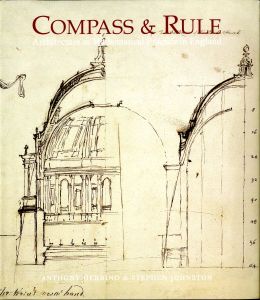
Catalogue edited by Anthony Gerbino and Stephen Johnston (New Haven: Yale University Press, 2009)
Compass & Rule examines the role of mathematics in architectural design and building technology, highlighting the dramatic transformation of English architecture between the sixteenth and eighteenth centuries. The exhibition brings together some of the finest architectural and scientific material from the early modern period, including drawings of St. Paul’s Cathedral, an astrolabe commissioned for Queen Elizabeth I, and architectural drawings by King George III. Also on view will be nearly one hundred drawings, paintings, printed books and manuscripts, maps, and other unique mathematical instruments that illustrate the changing role of both the architect and the profession 1500 to 1750.
An illustrated catalogue edited by exhibition curators Anthony Gerbino, architectural historian and Senior Research Fellow of Worcester College, University of Oxford, and Stephen Johnston, Assistant Keeper at the Museum of the History of Science, University of Oxford, will accompany the exhibition.










 Enfilade
leave a comment