New Work on the Académie Royale de Peinture et de Sculpture
Member News
Reed Benhamou, Regulating the Académie: Art, Rules and Power in ‘ancien régime’ France, SVEC 2009:08 ISBN 978-0-7294-0972-8, 298 pages, £60 / €93 / $127
The Académie royale de peinture et de sculpture, the second oldest academy in France, was abolished in 1793. To fully appreciate the drama of its dissolution, Benhamou examines the codes and practices of the Académie, exploring why certain rules were adopted and the power politics they engendered. This work culminates with nine annotated appendices of registered and proposed statutes, many of which are published for the first time. It’s published as part of the SVEC book series by the Voltaire Foundation. To place an order, please contact: email@voltaire.ox.ac.uk.
Reed Benhamou is a Professor Emerita at Indiana University. Her publications focus on the Académie royale de peinture, and educational programmes in art and architecture of the ancien régime. She is currently researching the effectiveness of the Ecole royale des élèves protégés.
A list of recent publications from the Voltaire Foundation is available here.
Watteau at the Met
Press release from the Met:
Watteau, Music, and Theater
Metropolitan Museum of Art, New York, 22 September – 29 November 2009

Catalogue ed. Katharine Baetjer (Yale University Press)
Watteau, Music, and Theater, the first exhibition of Jean-Antoine Watteau’s paintings in the United States in 25 years, will demonstrate the place of music and theater in Watteau’s art, exploring the tension between an imagery of power, associated with the court of Louis XIV, and a more optimistic and mildly subversive imagery of pleasure that was developed in opera-ballet and theater early in the 18th century. It will demonstrate that the painter’s vision was influenced directly by musical works devoted to the island of Cythera, the home of Venus, and to the Venetian carnival, and will shed new light on a number of Watteau’s pictures.
Made possible by The Florence Gould Foundation, the exhibition will feature more than 60 works of art, consisting of major loans of paintings and drawings by Watteau and his contemporaries from collections in the United States and Europe. The balance of the paintings will be drawn from the Metropolitan Museum’s collections, together with most of the works on paper, and all of the musical instruments, gold boxes, and ceramics. Watteau, Music, and Theater will honor Philippe de Montebello, Director Emeritus of The Metropolitan Museum of Art.
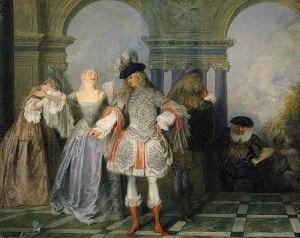
Watteau, “The French Comedians,” 1720–21, (New York: Metropolitan Museum)
Born in 1684 in Valenciennes in the Hainault (French, but formerly part of the Spanish Netherlands), Jean-Antoine Watteau is widely considered the most important artist in early eighteenth-century France. A solitary, ill-educated, self-taught, largely itinerant figure, he was a supremely gifted painter and draftsman whose surviving works of art are his testament. Most of them are so-called fêtes galantes, idyllic scenes that have no specifically identifiable subject. Only one of Watteau’s paintings, The Embarkation for Cythera (1717), was publicly exhibited in his lifetime. Watteau died in 1720 at the age of 36 after a long illness. While relatively little is known about Watteau, an expanding body of literature relating to Paris opera-ballet, plays, and the less formal and more traditional seasonal théâtres de la foire relates to specific works in the exhibition, and these can now be mined more deeply to examine the artist’s life and work.
Among the many highlights of Watteau, Music, and Theater will be the Metropolitan Museum’s Watteau paintings Mezzetin and French Comedians; the Städel Museum’sThe Island of Cythera; Pleasures of the Dance from the Dulwich Picture Gallery; Love in the French Theater and Love in the Italian Theater, both from the Gemäldegalerie in Berlin; and The Alliance of Music and Comedy (private collection), which has not been on view in any museum in decades.
The exhibition will mark the first time the painting La Surprise (private collection) will be seen in a museum. Lost for almost 200 years and presumed to have been destroyed, La Surprise was rediscovered last year in a British country house and later sold at auction. (more…)
Gemmae Antiquae, Part I
From the Getty Villas’s website:
Carvers and Collectors: The Lasting Allure of Ancient Gems
Getty Villa, Los Angeles, 19 March – 7 September 2009
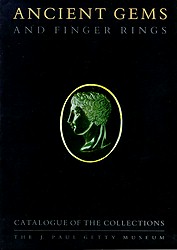
Jeffrey Spier, Ancient Gems and Finger Rings: Catalogue of the Collections (Getty Museum, 1993), ISBN 978-0-89236-215-8 ($70)
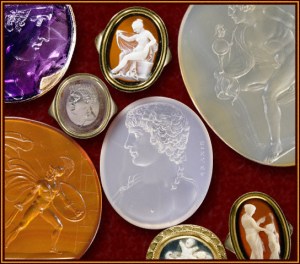
Gems from the collection of the J. Paul Getty Museum (For individual identifications, click on the image)
The beauty of carved gemstones has captivated collectors, connoisseurs, and craftsmen since antiquity. Precious markers of culture and status, gems were sought by Greek and Roman elites as well as modern monarchs and aristocrats. This exhibition features intaglios and cameos carved by ancient master engravers along with outstanding works by modern carvers and works of art in diverse media that illustrate the lasting allure of gems. . . .
In antiquity, gems were engraved with personal or official insignia that, when impressed on wax or clay, were used to sign or seal documents. Carved gems were valued not only for their distinctive designs, but also for the beauty of their stones, some of which were believed to have magical properties. From the Middle Ages to the nineteenth century, rulers, nobles, and wealthy merchants sought and traded classical gems, and carvers produced replicas and forgeries.

Augustin de Saint-Aubin after Charles-Nicolas Cochin II, engraving in François Arnaud, Description des principales pierres gravées du cabinet de S.A.S. Monseigneur le duc d'Orléans. . . (Paris, 1870) The Getty Research Institute 85-B16748
Sumptuous engraved catalogues of gem collections were published in the days before photography. Like the gems they illustrated, these volumes functioned as luxury objects. The engravings in these books sometimes improve upon the already excellent carving of the gems themselves. Louis Philippe d’Orléans (1725–1785), the great-grandson of King Louis XIV of France, published his gem collection in an elaborately engraved volume dedicated to his cousin King Louis XVI. The frontispiece, shown here, depicts the duke himself and also represents the superiority of gems over other art forms: in the foreground, two cupids inspect the contents of drawers pulled from a large gem cabinet, while symbols of architecture, sculpture, and painting are relegated to the upper right and lower left corners. . . .
Since the Renaissance, gem carvers have attempted to equal and surpass their ancient counterparts. Because of the high demand for classical gems, some carvers, dealers, and collectors sought to pass off modern works as ancient. Some even forged the signatures of famous Greek and Roman carvers. No scientific method exists for proving the antiquity of gems, and quality is no proof of authenticity. Thus it is usually some deviation in style or imagery that reveals a piece to be modern. . . .
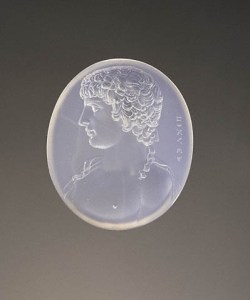
Engraved Gem, signed by Giovanni Pichler or Luigi Pichler, ca. 1750-1850
Austrian carver Antonio (Johann Anton) Pichler worked in Rome in the 1700s copying ancient gems. His son Giovanni also became an accomplished gem carver, as did Giovanni’s half-brothers Giuseppe and Luigi and Giovanni’s son Giacomo. Luigi was the most renowned: he received commissions from the Vatican and the French and Austrian courts to carve both classical and contemporary subjects. This intaglio is modeled after a famous relief of Antinous (the beloved of the Roman emperor Hadrian) housed in the Villa Albani, Rome. The fact that the gem is signed “Pichler” in Greek indicates no intention to deceive but rather an emulative spirit, the artist vying with his ancient predecessors.
[Text and images from the Getty Villa exhibition website]
Masculin, féminin
Member News

Anne-Louis Girodet, "Self Portrait with Julie Candeille"
Heather Belnap Jensen, Assistant Professor of Art History at Brigham Young University, participated this past June in the colloquium, Historiennes et critiques d’art à l’époque de Juliette Récamier, which was organized in conjunction with the exhibition on Juliette Récamier and her circle, held at the Musée de Beaux-Arts in Lyon. Jensen’s talk, “Quand la muse parle: Julie Candeille sur l’art de Girodet,” questioned androcentric interpretations of Girodet’s life and art. Papers from the journée d’étude are to be published by the Institut national d’histoire de l’art (IHNA).
In addition, Jensen is co-editing a collection of essays (together with Temma Balducci and Pamela Warner), entitled Interior Portraiture and Masculine Identity in France, 1789-1914 (Ashgate, 2010). As a pendant, she and Balducci next turn their attention to the role of women in public: they’re chairing a session at CAA on the topic (“Women, Femininity, and Public Space in Nineteenth-Century Visual Culture”), and plans are in the works for a second edited volume.
 Jensen’s essay “Diversionary Tactics: Art Criticism as Political Weapon in Staël’s Corinne, ou l’Italie (1807),” appeared in Women Against Napoleon: Historical and Fictional Responses to his Rise and Legacy (Campus Verlag, 2008), and she recently reviewed Ruth Iskin’s Modern Women and Parisian Consumer Culture in Impressionist Painting for French Studies (volume 63, Spring 2009).
[HECAA members Mechthild Fend, Melissa Hyde, and Mary Sheriff also participated in the Récamier colloquium. A summary of the event and exhibition will be published as a separate posting in the near future.]
New Books: Recently Posted at caa.reviews
caa.reviews recently posted reviews of two late-eighteenth-century books. Brief excerpts are provided below; for the full texts, click on the picture of each book.
◊ ◊ ◊ ◊ ◊
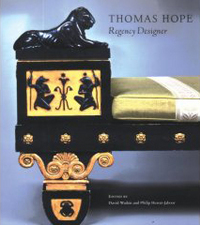 Philip Hewat-Jaboor and David Watkin, eds. Thomas Hope: Regency Designer, exhibition catalogue (New York and New Haven: Bard Graduate Center for Studies in the Decorative Arts, Design, and Culture and Yale University Press, 2008). 520 pages; 420 color ills.; 40 b/w ills. Cloth $100.00 (9780300124163).
Reviewed by Christopher Drew Armstrong, Assistant Professor, Department of History of Art & Architecture, University of Pittsburgh; posted 18 August 2009
An unparalleled glimpse into Hope’s world and by extension into the world of design and elite culture after the French Revolution was provided last fall by the exhibition Thomas Hope: Regency Designer, organized by the Bard Graduate Center for Studies in the Decorative Arts, Design, and Culture. The effort that went into assembling objects for the exhibition and texts for the accompanying catalogue was fully justified by the results, yielding the most complete panorama of Hope’s activities as a designer and collector since the contents of his residences were dispersed. Simultaneous to John Soane’s experiments in his house at Lincoln’s Inn Fields, and Percier’s and Fontaine’s renovation of La Malmaison, Hope was borrowing from the same sources and exploring similar ideas. Though his houses have been demolished, it is now possible to imagine the wealth of innovation that went into their planning and to appreciate how Hope’s interiors and furnishings were used to showcase his aspirations and ideals.
◊ ◊ ◊ ◊ ◊
 Hubertus Kohle and Rolf Reichardt, Visualizing the Revolution: Politics and Pictorial Arts in Late Eighteenth-Century France (London: Reaktion Books, 2008), 240 pages, 30 color ills.; 156 b/w ills. Cloth $45.00 (9781861893123)
Reviewed by Nina Dubin, Assistant Professor, Department of Art History, University of Illinois at Chicago; posted 19 August 2009
Among the strengths of Visualizing the Revolution: Politics and Pictorial Arts in Late Eighteenth-Century France—an ambitious new study co-authored by the historian Rolf Reichardt and the art historian Hubertus Kohle—is the compelling case it makes that prints comprised the art form par excellence of the age, less because of their representational force than because of the special capacity of the medium to embody the “message” of the Revolution. Published in newspapers, sold by street vendors, pirated, re-worked and re-circulated, printed pictures—particularly mass-produced etchings—asserted the new-found and irrepressible power of the many over the few, of the multiple over the singular. Prints, more than illustrating the events of the Revolution, decisively shaped them. . . .
While the authors are to be commended for the wealth of visual evidence they present, equally noteworthy is the book’s underlying provocation to the art historian: namely, that to prioritize the individual aesthetic achievement of works of Revolutionary art is to lose sight of their participation in a collective political project.
Prints of War
 James Clifton, Leslie Scattone, Emine Fetvaci, Ira Gruber, and Larry Silver, The Plains of Mars: European War Prints, 1500-1825, from the collection of the Sarah Campbell Blaffer Foundation (Yale University Press), 254 pages, $65 (hardback) ISBN 9780300137224
Last week’s Art Newspaper includes a review by Alexander Adams of The Plains of Mars, the catalogue from a show that appeared at the Museum of Fine Arts, Houston earlier this year, February 7 – May 10, 2009.
◊ ◊ ◊ ◊ ◊
Editors have organised a diverse spectrum of material into themes, within which prints are sequenced chronologically. The catalogue section is preceded by enlightening essays dealing with the imagery of the Landsknecht (German mercenary of the 15th to 17th centuries), the recurrence of the Turk—as symbol of alien despotism and the exotic Orient—and the mixture of pictorial, cartographic and topographic modes in war prints. A concise survey by Professor Gruber deftly covers military developments in conflicts of this period. The catalogue section, complete with comparative figures, includes extensive commentaries necessary to contextualise individual prints . . .
The Plains of Mars presents a wealth of socially and historically important sources (some of them great artistic achievements) in a clear and authoritative fashion. A glossary, index and biographical notes of all featured artists conclude this impressive volume.
Read the full review at The Art Newspaper›
Gender on the Grand Tour
Member News

Italy's Eighteenth Century: Gender and Culture in the Age of the Grand Tour (Stanford University Press, 2009), ISBN 978-0804759045, 504 pages, 51 illustrations, $65
A new collection of essays co-edited by Wendy Wassyng Roworth recently was published by Stanford University Press. Italy’s Eighteenth-Century: Gender and Culture in the Age of the Grand Tour, edited by Roworth, Paula Findlen, and Catherine Sama, “illuminates the social and cultural landscape of eighteenth-century Italy by exploring how questions of gender in music, art, literature, science, and medicine shaped perceptions of Italy in the age of the Grand Tour.” The essays grew out of a 2002 conference held in conjunction with the Getty’s trio of exhibitions on the Grand Tour (and co-sponsored by UCLA’s Center for Seventeenth-Century Studies).
Among the thirteen essays appears Roworth’s own contribution, “‘The Residence of the Arts’: Angelica Kauffman’s Place in Rome” (fellow HECAA member Christopher Johns is also represented with “Gender and Genre in the Religious Art of the Catholic Enlightenment”).
In January, Roworth spoke at a conference in Rome on Salvator Rosa, co-sponsored by Università di Roma and Bibliotheca Hertziana; an expanded version of the paper is scheduled to appear later in the fall in Salvator Rosa e il suo tempo, 1615-1673. At the annual ASECS meeting this past spring in Richmond, Roworth presented “A ‘Tour of Painters’: Visits to Artists’ Studios
and Galleries in London.”
Sèvres in London
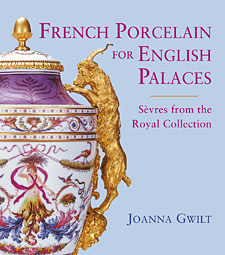
200 pages, 185 ills. Joanna Gwilt is Assistant Curator of Works of Art at the Royal Collection. Formerly of the Wallace Collection, she specialises in French eighteenth-century decorative arts, in particular Sèvres porcelain.
From the website of the British Royal Collection:
23 May — 11 October 2009
The Queen’s Gallery, Buckingham Palace — London
French Porcelain for English Palaces:
Sèvres from the Royal Collection
This exhibition brings together around 300 pieces created by the pre-eminent European porcelain factory of the 18th century. The finely painted and gilded works by Sèvres were loved by royalty, aristocrats, connoisseurs and collectors. The factory’s unrivalled techniques and complex methods of production appealed to their liking for the rare, exotic and extravagant.
The assemblage of Sèvres in the Royal Collection is considered to be the world’s finest. Much of it was acquired between 1783 and 1830 by George IV, who popularised the taste for French porcelain in Britain. The King’s choice of Sèvres was greatly influenced by his admiration for and extensive knowledge of France and the French royal family. The French Revolution brought on to the market a vast quantity of furniture, porcelain and other works of art that had been the property of the French Crown and France’s erstwhile ruling classes, and there was an active trade in souvenirs of the old political and social system.

Sèvres Flower Vase, c.1760 (RCIN 36073). The Royal Collection ©2009. The cuvette Mahon is named to commemorate the seizure by the French of the British-held port of Mahon on the island of Menorca in May 1756, at the start of the Seven Years War between France and England (1756-63). The painted scene depicting peasants drinking – one of whom stands brandishing an empty pitcher in the direction of a serving wench – may be inspired by a detail taken from "La Quatrième Fête Flamande," engraved by Philippe Le Bas (1707-83) after David Teniers the Younger.
Among the highlights of the exhibition are a garniture of three vases first bought by Marie-Antoinette and recently reunited through an acquisition by Her Majesty The Queen; a vase that was probably bought by Louis XV’s mistress Madame du Barry and is decorated with a youthful profile of the French king, and the Table of the Grand Commanders, which was made for Napoleon and given to George IV by Louis XVIII.
Sèvres suited George IV’s taste for lavish and colourful decoration, particularly at his London residence Carlton House. In 1783, at the age of 21, he made his first purchase from the factory and continued to buy as Prince of Wales, Regent and King. He bought ornamental vases to place on chimneypieces and furniture in the richly decorated principal rooms of Carlton House. Pieces were often grouped together by colour, shape or painted decoration. George IV also followed the French practice of displaying practical tablewares, such as broth basins and déjeneurs (tea sets), as bibelots or trinkets. To this day, dinner services bought by George IV continue to be used for State Banquets and ceremonial occasions.
◊ ◊ ◊ ◊ ◊
[Text and photos from the exhibition website; information on the Flower Vase, as presented on the Royal Collection site, is adapted from the catalogue, French Porcelain for English Palaces, Sèvres from the Royal Collection (London, 2009). Historical-fiction author Catherine Delors includes an informal review on her website, usefully noting that Sèvres remains an active state-owned manufacture of porcelain.]
New Books




Here’s a selection of new titles from the July 25th issue of the Michael Shamansky catalogue. Shamansky – online as artbooks.com – specializes in monographs, guides, and exhibition catalogues imported from European publishers.
- Viccy Coltman, Classical Sculpture and the Culture of Collecting in Britian since 1760 (Oxford: Oxford University Press, 2009), 360 pp, 117 illus., $145
- Francesca Nevola, Giovanni Battista Piranesi: The Grotteschi, the Early Years 1720 to 1750 (Rome: Ugo Bozzi, 2009), 221pp, 166 illus., $123
- Nigel Aston, Art and Religion in Eighteenth-Century Europe (London: Reaktion Books, 2009) 344 pp., 110 illus., $45.00
- Katrin Seibert, Rom besuchen: Italienreisen deutscher Künstlerinnen zwischen 1750 und 1850 (Munich: Meidenbauer, 2009) 2 vols., 473 text, 230 illus., $132
- Lucio Fino, The Myth of Naples in Art and Literature by 17th- to 18th-Century Travelers (Napoli: Grimaldi, 2009) 240pp., 156 color plates, slipcase, English text, $145
Adam the Romantic
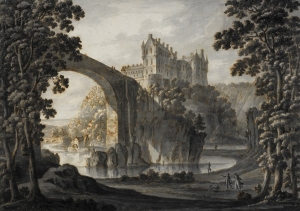
Robert Adam, "Cullen Castle, Banffshire," ca. 1770s (Edinburgh: National Gallery)
25 April – 2 August 2009
Robert Adam’s Landscape Fantasies:
Watercolors and Drawings from the Permanent Collection
National Gallery of Scotland, Edinburgh
This is the final week for an exhibition in Edinburgh that explores a less familiar dimension of Robert Adam’s oeuvre. As noted from The Magazine Antiques:
The Scottish architect, interior designer, and furniture designer, who designed such neoclassical masterpieces as Kenwood House, Osterley Park, and Stowe, created the landscape watercolors and drawings on view toward the end of his life for his own private enjoyment. While some, such as this detailed depiction of Cullen Castle in Banffshire, painted about 1770 to 1780, portray real sites, the majority depict picturesque fantasies, evoking in an entirely Scottish guise the capricci of Giovanni Battista Piranesi, with whom Adam had studied while in Rome on an extended grand tour in the 1750s.
The more than thirty watercolors by Adam on view are accompanied by drawings by his sketching partners: his brother-in-law, John Clerk of Eldin, and Paul Sandby, an English landscape artist who traveled extensively through Scotland. These brooding, atmospheric renderings of steep cliffs, ancient castles, and gushing waterfalls offer up a cooling tonic to summer’s heat.
 The show stands as a fine complement to an exhibition from 2000 mounted by the John Soane Museum, Robert Adam’s Castles, which included a catalogue by Stephen Astley. As described in the archives seciton of the museum’s website, the London show sought to
cast Robert Adam, Scotland’s most celebrated architect, in a dramatic new light, reassessing an important but much neglected element of his architectural portfolio, his designs in ‘the castle style’. Robust and sublime, Adam’s castles make a startling contrast to the refined and delicate decorative schemes for which the architect is principally known, and comprise over 10 percent of his career output. Of the realised castle projects, many have now gone and others lie in ruins – an unjust fate for a group of buildings representing the most personal expression of Adam’s art. (more…)










 Enfilade
leave a comment