Wanted: ‘caa.reviews Field Editor’ for Architecture & Urbanism
The July issue of CAA News, now available for download, includes the following announcement, which unfortunately comes with an August 1 deadline:
◊ ◊ ◊ ◊ ◊
CAA invites nominations and self-nominations for two field-editor positions for reviews of books and related media in caa.reviews for a four-year term, through June 30, 2013. Needed now are specialists in pre-1800 architecture and urbanism and the art of Egypt and the Ancient Near East. This candidate may be an art historian, art critic, curator, or other art professional; institutional affiliation is not required.
Each field editor commissions reviews of books and related media for caa.reviews within an area of expertise. He or she selects books to be reviewed, commissions reviewers, determines the appropriate character of the reviews, and works with reviewers to develop manuscripts for publication. The field editor works with the caa.reviews Editorial Board as well as the caa.reviews editor-in-chief and CAA’s staff editor and is expected to keep abreast of newly published and important books and related media in his or her field of expertise.
The Council of Field Editors meets annually at the CAA Annual Conference. Field editors must pay travel and lodging expenses to attend the conference. Candidates must be current CAA members and should not be serving on the editorial board of a competitive journal or on another CAA editorial board or committee. Nominators should ascertain their nominee’s willingness to serve before submitting a name; self-nominations are also welcome. Please send a letter of interest, CV, and contact information to:
Chair, caa.reviews Editorial Board, CAA
275 Seventh Ave., 18th Floor
New York, NY 10001
or to caareviews@collegeart.org
Deadline: August 1, 2009
May I please . . .
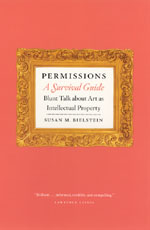 For many art historians, summer is the season for securing permissions for publishing images in forthcoming articles and books. Even without the copyright challenges that face our colleagues working on twentieth-century topics, the process is still often laborious and expensive. Susan Bielstein, Executive Editor for Art, Architecture, Classical Studies and Film at the University of Chicago Press, provides an essential starting point with her 2006 book, Permissions, A Survival Guide: Blunt Talk About Art as Intellectual Property.
Writing for caa.reviews, Christine Kuan, Senior Editor for Grove Art Online/Grove Dictionaries of Art, Oxford University Press, calls the book “concise, engaging, and digestible,” a valuable guide to a “convoluted and vexed subject.”
In thirteen chapters containing summaries of major court cases and their ramifications, countless hilarious anecdotes illustrative of copyright conundrums, footnotes, sample letters, useful sidebars, a sample image permissions log, a list of image sources, and suggested further reading, this book deftly interweaves explanations of intellectual property issues with real-life experiences in academic publishing.
Soon after the book’s release, Bielstein appeared on “The Library Café,” a weekly radio program from Vassar College then hosted by Dr. Thomas Hill. The website for WVKR FM 91.3 includes a ‘Listen Link’ for the 2007 episode featuring Bielstein. In addition to talking about her book, Bielstein addresses the state of the field of art history publishing more generally.
Amazon + Ann Arbor = ?
An agreement announced earlier this week between Amazon.com and the University of Michigan will make over 400,000 rare books available through softcover reprints, ranging in price from $10-45. No word yet on what eighteenth-century works are included, but might there be possibilities for teaching texts? Should we be thrilled or wary? For details, see this article at the University of Michigan’s ‘New Service’.
Call for Papers: Colonial Built Environment at SAH
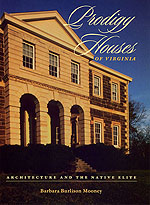 Barbara Burlison Mooney, author most recently of Prodigy Houses of Virginia: Architecture and the Native Elite – which, I should note, received a glowing review earlier this year from the Virginia Magazine of History and Biography – is chairing a session at next year’s meeting of the Society of Architectural Historians in Chicago (21-25 April 2010). She sends the following call for papers:
◊ ◊ ◊ ◊ ◊
Proposals are due 15 August 2009
Taking the Measure of New Colonial Architectural History
Arguably, the article “Impermanent Architecture in the Southern American Colonies,” the result of collaboration among architectural historians, archaeologists, and historians and published in 1981, stands as the most important work of scholarship on the built environment of America’s colonial period appearing in the last half century. By exploiting archaeological practices, the interdisciplinary authors of this article demonstrated the pervasive presence of hole-set, or earthfast, construction technology in Tidewater Virginia and Maryland and undermined the stereotyped image of extant genteel mansions that was well known through the scholarship of S. Fiske Kimball and Thomas T. Waterman, among others. Combined with critical concepts from the Annales School, the Civil Rights Movement, Feminism, and post-Formalist literary theory, “Impermanent Architecture” heralded a new, productive era of research in the field of Colonial American architectural history, which is open to diverse and challenging interpretations.
Subsequently, architectural historians and their cohorts in other disciplines have created a more nuanced image of the colonial built environment that includes African Americans, women, the so-called “middling sort,” and a greater sensitivity to discerning regional and international practices operative in early America. Scholars of the period also have become more attuned to the importance of non-British building traditions. Researchers continue to marshal new methodologies, as well as interdisciplinary and trans-Atlantic approaches, to expand our understanding of the era and its elastic boundaries. This session aims to take the current measure of the New Colonial Architectural History by inviting paper proposals demonstrating how both innovative and traditional research strategies and theoretical perspectives continue to inform the history of the early North American built envinronment. Paper proposals are invited that address new archaeological, archival, analytical, or methodological investigations in the field. Research in French, Spanish, Dutch, German, and Caribbean as well as British colonial architecture is welcome.
Send proposals by August 15, 2009 to Barbara Burlison Mooney, School of Art and Art History, W619 Seashore Hall, University of Iowa, Iowa City, IA 52242 Email: barbara-mooney@uiowa.edu Phone 319-335-1785 Fax 319-335-1774. For proposal length and other requirements, please consult the Society of Architectural Historians website.
HBA Now Accepting Nominations for Book Prizes
The Historians of British Art annually award prizes to outstanding books on the history of British art and visual culture in three categories: Pre-1800, Post-1800, and multi-authored volume. The committee welcomes nominations for its 2009 prize (for books published in 2008). There is no limit on the number of books from a single publisher that may be considered in each category. For further information on how to nominate books, please contact the committee chair at the email address below. Winners will be announced before the annual meeting of the College Art Association in February, 2010.

Anne Nellis Richter
Committee Chair
HBAbookprize@hotmail.com
Here, incidentally, are the 2008 winners (for books published in 2007)
- Single Author before ca.1800: Thomas P. Campbell, Henry VIII and the Art of Majesty: Tapestries at the Tudor Court (Yale University Press, 2007)
- Single Author after ca.1800: Elizabeth Prettejohn, Art for Art’s Sake: Aestheticism in Victorian Painting (Yale University Press, 2007)
- Multiauthored: Tim Barringer, Geoff Quilley, and Douglas Fordham, eds., Art and the British Empire (Manchester University Press, 2007)
Versailles in the 18th Century
In a recent issue of the TLS (17 June 2009), John Rogister – author of Louis XV and the Parlement of Paris, 1737–1755 – reviews two new books on Versailles: Tony Spawforth, Versailles: A Biography of a Palace (St Martin’s Press, 2008); and William Ritchey Newton, Derrière la Façade: Vivre au château de Versailles au XVIIIe siècle (Librairie Académique Perrin, 2008) – along with a new printing of the 1886 English translation of Madam Campan’s memoirs (the original French edition appeared in 1822).


Baroque at the V&A

Massimiliano Soldani Benzi (1656-1740), Ewer Depicting the Triumph of Neptune Vase, Florence, ca. 1721, bronze (London: V&A Museum no. A.18-1959)

Catalogue edited by Michael Snodin and Nigel Llewellyn
BAROQUE 1620-1800: Style in the Age of Magnificence
Victoria and Albert Museum, London
April 4 – July 19
Robert Oresko’s review from Apollo (June 2009)
“Ever since Heinrich Wölfflin, the successor in Basel of Jacob Burckhardt, published his Renaissance und Barock (1888) and fixed the word ‘baroque’ into intellectual consciousness and discourse, its meaning has been a focal point of debate. The new and visually sumptuous exhibition at the Victoria & Albert Museum attempts a presentation attuned to concerns in the early 21st century.”
Robin Blake’s review from The Financial Times
“Baroque is certainly a conundrum, both superficial and profound, beautiful and ugly, ordered and chaotic, sexy and sacred. But for true devotees that is the essence of baroque charm – and they will find plenty to be charmed by in this show.”
Tom Lubbock’s review from The Independent
“Baroque 1620-1800: Style in the Age of Magnificence is the Victoria & Albert Museum’s spring blockbuster. . . And even before going through the door, you can see that it’s not going to narrow down the definition. Check that title: a movement generally set in the 17th century is extended through the whole of the following century, too.
What’s more, the show takes the Baroque out of Europe and across the world. Colonisation took it to Peru and to Indonesia. It was the first global style. And the exhibits go beyond art and artefacts – there’s every sort of luxury object, from an ornamental sled to an ornamental ostrich, an entire and huge Mexican altarpiece, and (on film) an authentic period firework display.
It does everything it can to imitate itself a Baroque spectacle. You proceed through galleries devoted to various places of display – the theatre, the public square, the church, the palace, the garden. Baroque music accompanies you. . . . There’s an obvious practical problem. The bigger the subject, the harder it is to exhibit it in a museum. . . .”










 Enfilade
leave a comment