Symposium | Anna Dorothea Therbusch in Context
From the Staatliche Museen zu Berlin, and noted at ArtHist.net:
Anna Dorothea Therbusch in Context: 18th-Century (Women) Artists in Berlin and Europe
Anna Dorothea Therbusch im Kontext: Künstlerinnen und Künstler des 18. Jahrhunderts in Berlin und Europa
Berlin, Gemäldegalerie, Kulturforum, 26–27 September 2024
Registration due by 4 August 2024
 The Berlin painter Anna Dorothea Therbusch (1721–1782) enjoyed a remarkable international career in the eighteenth century, travelling to Stuttgart, Mannheim, and Paris. Here, she was accepted into the Académie royale and she exhibited at the Salon. Back in her native city in 1769, Therbusch became a sought-after portraitist of Berlin society and worked for the Russian Tsar’s court and the Prussian royal family. The symposium marks the conclusion of a two-year art-historical and art-technological research and publication project by the Berlin Gemäldegalerie on Therbusch’s works in the public collections in Berlin and Brandenburg. It serves to bring researchers together, share the results obtained, and highlight further research perspectives.
Registration is possible until 4 August 2024. Please send an email with your contact details to a.groeger@smb.spk-berlin.de. You will receive a registration confirmation. The number of participants is limited for organisational reasons; early registration is recommended.
t h u r s d a y , 2 6 s e p t e m b e r
18.00 Begrüßung | Welcome
• Dagmar Hirschfelder (Direktorin der Gemäldegalerie, Staatliche Museen zu Berlin)
18.15 Buchvorstellung | Book Presentation
• Anna Dorothea Therbusch in Berlin und Brandenburg: Werke, Technik, Kontext, Nuria Jetter, Sarah Salomon, Anja Wolf (Gemäldegalerie, Staatliche Museen zu Berlin)
18.45 Abendvortrag | Evening Lecture
• Ein ,Meteor‘ am süddeutschen Himmel: Anna Dorothea Therbuschs Netzwerke und Karrierestrategie —Katharina Küster (Landesmuseum Württemberg, Stuttgart)
f r i d a y , 2 7 s e p t e m b e r
9.00 Registrierung | Registration
9.15 Begrüßung | Welcome
Dagmar Hirschfelder (Direktorin der Gemäldegalerie, Staatliche Museen zu Berlin)
9.30 Morning Session 1
• Anna Dorothea Therbusch und der ,weibliche Pinsel‘: Karrierestrategien einer Malerin im Europa des 18. Jahrhunderts — Gernot Mayer (Universität Wien)
• Therbuschs Künstlerporträts: Künstlerische Weiterentwicklung und kollegiale Anerkennung — Léonie Paula Kortmann (Julius-Maximilians-Universität Würzburg)
• ,Mit einer Rembrandt’schen Kraft und van Dyck’schen Wahrheit‘: Anna Dorothea Therbuschs Stuttgarter Selbstporträt (1761) — Sanja Hilscher (Akademie der Bildenden Künste Stuttgart)
11.00 Kaffeepause | Coffee Break
11.30 Morning Session 2
• Gemalte Leben: Selbstbildnisse der Lisiewska-Schwestern — Sarah Salomon (Gemäldegalerie, Staatliche Museen zu Berlin)
• Therbusch unter der Lupe: Ergebnisse der maltechnischen Untersuchungen — Anja Wolf (Gemäldegalerie, Staatliche Museen zu Berlin) und Jens Bartoll (Stiftung Preußische Schlösser und Gärten Berlin-Brandenburg)
• Beobachtungen zur Maltechnik Christoph Friedrich Reinhold Lisiewskys im Spiegel der Arbeitsweise seiner Schwester Anna Dorothea Therbusch — Maria Zielke (Kulturstiftung Dessau-Wörlitz)
13.00 Mittagspause | Lunch Break
14.30 Afternoon Session 1
• Diderot’s ‚Mystification‘: Anna Dorothea Therbusch and Prince Dmitry Alexandrovich Golitsyn in Paris and Brussels — Catherine Phillips (Norwich)
• Schadow vs. Therbusch? Porträts der Henriette Herz als Seismografen für die Wandlungen des (jüdischen) Frauenbildes um 1800 — Claudia Czok und Hannah Lotte Lund (Berlin)
15.30 Kaffeepause | Coffee Break
16:00 Afternoon Session 2
• How Dare She: Fleshing Out Therbusch’s Female Nudes — Christina Lindeman (University of South Alabama)
• Therbuschs Historien — Nuria Jetter (Gemäldegalerie, Staatliche Museen zu Berlin)
Image: The conference programme reproduces Anna Dorothea Therbusch’s Self-Portrait with Monocle, 1776 (Berlin: Gemäldegalerie).
New Book | Anna Dorothea Therbusch in Berlin und Brandenburg
From Michael Imhof Verlag:
Anna Dorothea Therbusch in Berlin und Brandenburg: Werke, Technik, Kontext (Berlin: Stiftung Preußischer Kulturbesitz, 2024), 208 pages, ISBN: 978-3731913788, €40.
 Anna Dorothea Therbusch (1721–1782) war eine der bedeutendsten Künstlerinnen des 18. Jahrhunderts. Schon als junge Frau arbeitete sie für Adlige im Umfeld des preußischen Königshauses. Später reüssierte sie in Paris, wo ihr als einer der wenigen Frauen überhaupt im Jahr 1767 die Aufnahme in die wichtigste europäische Kunstakademie der Zeit, die Pariser Académie royale de peinture et de sculpture, gelang. Zurück in ihrer Heimatstadt wurde sie eine gefragte Porträtmalerin der Berliner Gesellschaft und fertigte auch mythologische Historien für die Schlösser Friedrichs II. an. Das Buch macht erstmals die in Berlin und Brandenburg aufbewahrten Gemälde der außergewöhnlichen Preußin systematisch in einem Buch greifbar. Darüber hinaus vermittelt es neue Erkenntnisse zu Therbuschs Arbeitsweise und den von ihr verwendeten Materialien. Die thematischen Essays verfolgen übergreifende Fragen zum Leben und künstlerischen Schaffen der Malerin und dienen so zugleich als aktuelle Einführung in ihr Gesamtwerk.
New Book | The Gallery at Cleveland House
From Bloomsbury:
Anne Nellis Richter, The Gallery at Cleveland House: Displaying Art and Society in Late Georgian London (London: Bloomsbury Visual Arts, 2024), 248 pages, ISBN: 978-1350372757, $120.
 In 1806, the Marquess and Marchioness of Stafford opened a gallery at Cleveland House, London, to display their internationally-renowned collection of Old Master paintings to the public. A ticket to the gallery’s Wednesday afternoon openings was a sought-after prize, granting access to the collection and the house’s dazzling interior in the company of artists, celebrities, and Britain’s elite. This book explores the gallery’s interior through the lens of its abundant material culture, including paintings in gilded frames, furniture, silver oil lamps, flower arrangements, and the numerous printed catalogues and guidebooks that made the gallery visible to those who might never cross its threshold.
Through detailed analysis of these objects and a wide range of other visual, material, textual, and archival sources, the book presents the gallery at Cleveland House as a methodological case study on how the display of art in the 19th century was shaped by notions about public and private space, domesticity, and the role art galleries played in the formation of national culture. In doing so, the book also explains how and why magnificent private galleries and the artworks and objects they contained gripped the public imagination during a critical period of political and cultural transformation during and after the Napoleonic Wars. Combining historical, cultural, and material analysis, the book will make essential reading for researchers in British art in the Regency period, museum studies, collecting studies, social history, and the histories of interior decoration and design in the 18th and 19th centuries.
Anne Nellis Richter is an independent scholar and adjunct faculty, Smithsonian Internship Semester program, at Smith College.
c o n t e n t s
List of Illustrations
Introduction: ‘The Finest in England’
1 ‘A Very Complete Business’: Designing and Building the Gallery
2 ‘The High Attraction of the Spectacle’: Displaying Sociability
3 ‘The Superb Furniture within’: Materiality and the Domestic Interior
4 ‘We Have Lately Been Much Attacked’: Exhibiting Morality
5 ‘To Private Collections Alone’: The Apotheosis of the Private Gallery
Conclusion: The ‘Home’ of Art
New Book | Belonging: An Intimate History of Slavery and Family
Forthcoming from Penn Press:
Gloria McCahon Whiting, Belonging: An Intimate History of Slavery and Family in Early New England (Philadelphia: University of Pennsylvania Press, 2024), 360 pages, ISBN: 978-1512824490, $40.
 Explores how Black New Englanders maintained a sense of belonging among their kin in the face of slavery
As winter turned to spring in the year 1699, Sebastian and Jane embarked on a campaign of persuasion. The two wished to marry, and they sought the backing of their community in Boston. Nothing, however, could induce Jane’s enslaver to consent. Only after her death did Sebastian and Jane manage to wed, forming a long-lasting union even though husband and wife were not always able to live in the same household.
New England is often considered a cradle of liberty in American history, but this snippet of Jane and Sebastian’s story reminds us that it was also a cradle of slavery. From the earliest years of colonization, New Englanders bought and sold people, most of whom were of African descent. In Belonging, Gloria McCahon Whiting tells the region’s early history from the perspective of the people, like Jane and Sebastian, who belonged to others and who struggled to maintain a sense of belonging among their kin. Through a series of meticulously reconstructed family narratives, Whiting traces the contours of enslaved people’s intimate lives in early New England, where they often lived with those who bound them but apart from kin. Enslaved spouses rarely were able to cohabit; fathers and their offspring routinely were separated by inheritance practices; children could be removed from their mothers at an enslaver’s whim; and people in bondage had only partial control of their movement through the region, which made more difficult the task of maintaining distant relationships. But Belonging does more than lay bare the obstacles to family stability for those in bondage. Whiting also charts Afro-New Englanders’ persistent demands for intimacy throughout the century and a half stretching from New England’s founding to the American Revolution. And she shows how the work of making and maintaining relationships influenced the region’s law, religion, society, and politics. Ultimately, the actions taken by people in bondage to fortify their families played a pivotal role in bringing about the collapse of slavery in New England’s most populous state, Massachusetts.
Gloria McCahon Whiting is E. Gordon Fox Assistant Professor of History at the University of Wisconsin–Madison.
New Book | Slavery in the North
Published in 2018, Slavery in the North was released in paperback earlier this year by Penn Press:
Marc Howard Ross, Slavery in the North: Forgetting History and Recovering Memory (Philadelphia: University of Pennsylvania Press, 2018), 320 pages, ISBN: 978-0812250381 (hardback), $70 / ISBN: 978-1512826128 (paperback), $30.
 In 2002, we learned that President George Washington had eight (and, later, nine) enslaved Africans in his house while he lived in Philadelphia from 1790 to 1797. The house was only one block from Independence Hall and, though torn down in 1832, it housed the enslaved men and women Washington brought to the city as well as serving as the country’s first executive office building. Intense controversy erupted over what this newly resurfaced evidence of enslaved people in Philadelphia meant for the site that was next door to the new home for the Liberty Bell. How could slavery best be remembered and memorialized in the birthplace of American freedom? For Marc Howard Ross, this conflict raised a related and troubling question: why and how did slavery in the North fade from public consciousness to such a degree that most Americans have perceived it entirely as a ‘Southern problem’?
Although slavery was institutionalized throughout the Northern as well as the Southern colonies and early states, the existence of slavery in the North and its significance for the region’s economic development has rarely received public recognition. In Slavery in the North, Ross not only asks why enslavement disappeared from the North’s collective memories but also how the dramatic recovery of these memories in recent decades should be understood. Ross undertakes an exploration of the history of Northern slavery, visiting sites such as the African Burial Ground in New York, Independence National Historical Park in Philadelphia, the ports of Rhode Island, old mansions in Massachusetts, prestigious universities, and rediscovered burying grounds. Inviting the reader to accompany him on his own journey of discovery, Ross recounts the processes by which Northerners had collectively forgotten 250 years of human bondage and the recent—and continuing—struggles over recovering, and commemorating, what it entailed.
Marc Howard Ross is the William Rand Kenan, Jr., Emeritus Professor of Political Science at Bryn Mawr College. He is author of numerous books and is editor of Culture and Belonging in Divided Societies, also available from the University of Pennsylvania Press.
c o n t e n t s
Introduction
1 Collective Memory
2 Surveying Enslavement in the North
3 Slavery and Collective Forgetting
4 Enslaved Africans in the President’s House
5 Memorializing the Enslaved on Independence Mall
6 The Bench by the Side of the Road
7 Burying Grounds
8 Overcoming Collective Forgetting
Epilogue
Notes
Works Cited
Index
Acknowledgments
New Book | The Memory of ’76
From Yale UP:
Michael Hattem, The Memory of ’76: The Revolution in American History (New Haven: Yale University Press, 2024), 360 pages, ISBN: 978-0300270877, $35.
The surprising history of how Americans have fought over the meaning and legacy of the Revolution for nearly two and a half centuries
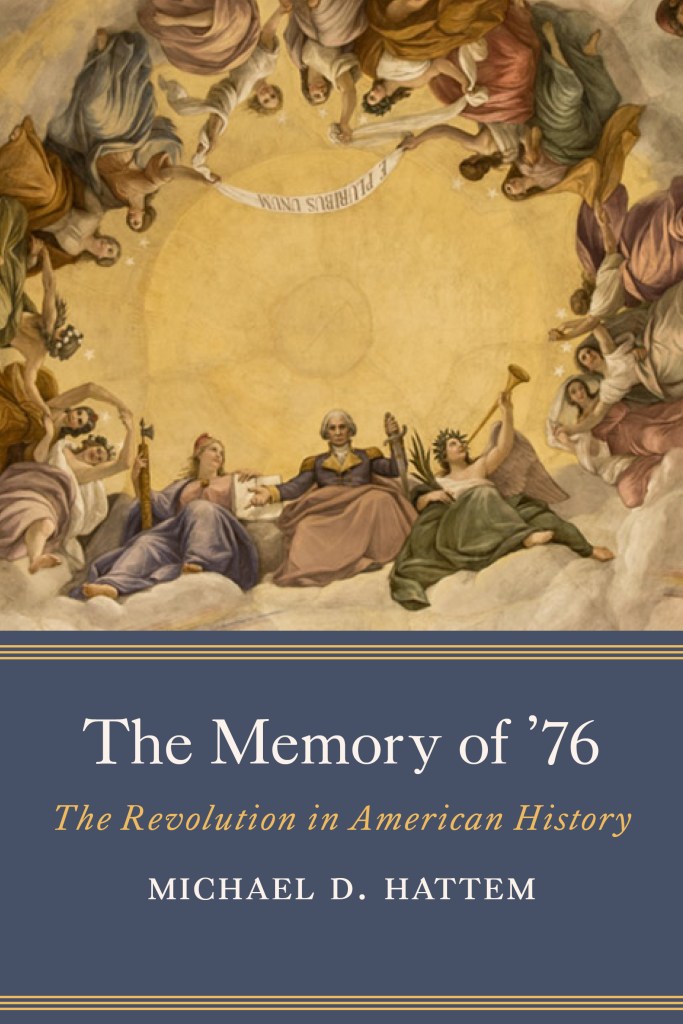 Americans agree that their nation’s origins lie in the Revolution, but they have never agreed on what the Revolution meant. For nearly two hundred and fifty years, politicians, political parties, social movements, and a diverse array of ordinary Americans have constantly reimagined the Revolution to fit the times and suit their own agendas. In this sweeping take on American history, Michael D. Hattem reveals how conflicts over the meaning and legacy of the Revolution—including the Declaration of Independence and the Constitution—have influenced the most important events and tumultuous periods in the nation’s history; how African Americans, women, and other oppressed groups have shaped the popular memory of the Revolution; and how much of our contemporary memory of the Revolution is a product of the Cold War. By exploring the Revolution’s unique role in American history as a national origin myth, Hattem shows how the meaning of the Revolution has never been fixed, how remembering the nation’s founding has often done far more to divide Americans than to unite them, and how revising the past is an important and long‑standing American political tradition.
Michael D. Hattem is a historian of early America and author of Past and Prologue: Politics and Memory in the American Revolution. He is the associate director of the Yale–New Haven Teachers Institute and lives in New Haven, Connecticut.
New Book | Glorious Lessons: John Trumbull
From Yale UP:
Richard Brookhiser, Glorious Lessons: John Trumbull, Painter of the American Revolution (New Haven: Yale University Press, 2024), 276 pages, ISBN: 978-0300259704, $30.
 The complicated life and legacy of John Trumbull, whose paintings portrayed both the struggle and the principles that distinguished America’s founding moment
John Trumbull (1756–1843) experienced the American Revolution firsthand—he served as aid to George Washington and Horatio Gates, was shot at, and was jailed as a spy. He made it his mission to record the war, giving visual form to what most citizens of the new United States thought: that they had brought into the world a great and unprecedented political experiment. His purpose, he wrote, was “to preserve and diffuse the memory of the noblest series of actions which have ever presented themselves in the history of man.” Although Trumbull’s contemporaries viewed him as a painter, Trumbull thought of himself as a historian. Richard Brookhiser tells Trumbull’s story of acclaim and recognition, a story complicated by provincialism, war, a messy personal life, and, ultimately, changing fashion. He shows how the artist’s fifty-year project embodied the meaning of American exceptionalism and played a key role in defining the values of the new country. Trumbull depicted the story of self-rule in the modern world—a story as important and as contested today as it was 250 years ago.
Richard Brookhiser is a senior editor of National Review and a fellow of the National Review Institute. His books include Founding Father: Rediscovering George Washington and Founders’ Son: A Life of Abraham Lincoln. He lives in New York City.
New Book | Edward Duffield: Philadelphia Clockmaker
Coming in August from the APS Press, with distribution by the University of Pennsylvania Press:
Bob Frishman, Edward Duffield: Philadelphia Clockmaker, Citizen, Gentleman, 1730–1803 (Philadelphia: The American Philosophical Society Press, 2024), 256 pages, ISBN: 978-1606180099, $60.
 Edward Duffield (1730–1803) was a colonial Philadelphia clockmaker, whose elegant brass, mahogany, and walnut timekeepers stand proudly in major American museums and collections. Duffield, unlike other leather-apron ‘mechanics,’ was born rich and owned a country estate, Benfield, and many more properties. He was deeply involved in civic and church affairs during crucial years in American history—his lifelong close friend, Benjamin Franklin, was staying at Duffield’s Benfield estate when Franklin, Thomas Jefferson, and John Adams first discussed the Declaration of Independence. Sally, Franklin’s daughter, brought her family there for extended periods during the Revolution and Franklin’s wife, Deborah, was best friends for fifty years with Duffield’s mother-in-law. Duffield was even one of three executors of Franklin’s will.
In this lavishly illustrated book, Bob Frishman catalogs and describes seventy-one known Duffield clocks and instruments and reveals how, during the mid-eighteenth century, they largely were not fabricated from scratch by isolated individuals. He contends that Duffield and his fellow clockmakers were not furniture-makers; they were mechanical artisans whose complex metal machines rang the hours and steadily ticked inside wooden cases made by others. Existing books on Philadelphia clocks have focused on these artifacts as furniture, including their woodwork, cabinetmakers, and decorative aspects. However, Frishman, a professional horologist for nearly four decades, brings his vast expertise to bear on this first comprehensive study of Duffield’s life and work.
Far more than a treatise on pre-industrial horological timekeeping, this book tells the compelling stories of a man, a city, and an era, while deepening our appreciation for Duffield’s stately sentinels—often a colonial American family’s most valuable possession—and the times and places in which their makers lived.
Bob Frishman was introduced to horology―the science of timekeeping―on Thanksgiving Day, 1980, when he was invited into the overflowing cellar of a collector and dealer of antique clocks, watches, tools, and machinery. Had Bob stayed home that day, or not left the holiday dining table and gone down those basement stairs, this book would not have been written. Nor would Bob’s other horological efforts during the past four decades ever have happened: eight thousand mechanical clocks repaired; two thousand antique clocks and watches restored and sold; hundred-plus articles and reviews published; hundred-plus in-person and virtual lectures delivered to horological and general audiences here and abroad; annual NAWCC symposia organized at the Winterthur Museum, the Museum of Fine Arts, Boston, the Henry Ford Museum, and the Museum of the American Revolution; and exhibits created and mounted by him at venues including the Horological Society of New York and the Willard House & Clock Museum.
Bob is a Silver Star Fellow of the National Association of Watch and Clock Collectors, and a Liveryman of the Worshipful Company of Clockmakers in London. As a dedicated supporter of other venerable cultural institutions, he is a Proprietor of the Boston Athenaeum, holder of Share Number 8 of the Library Company of Philadelphia, a member of the Grolier Club, the American Antiquarian Society, and the Ross Society of the Museum of Fine Arts, Boston. He continues to operate Bell-Time Clocks in Andover, Massachusetts, where he lives with his wife, author Jeanne Schinto.
New Book Series | Gender and Art in the Museum: The Prado Collection

Peter Paul Rubens and Jan Brueghel the Elder, The Infanta Isabel Clara Eugenia, ca. 1615, oil on canvas, 113 × 176 cm
(Madrid: Prado)
◊ ◊ ◊ ◊ ◊
From the Prado’s press release announcing this series from Amsterdam University Press:
This ambitious new series from Amsterdam University Press approaches the study of the collections in the Prado Museum from a gender perspective, exploring the women who became artists and the many women who promoted artists and collected works of art, as well as the women who inspired some of the masterpieces in this institution. It will offer new insights on a wide range of topics on art and women and their interactions with politics, money, and power.
Edited by Noelia García Pérez, director of The Female Perspective project, the series arises from the Prado’s firm commitment to making the role of women in the world of art visible. Studies will address the output of women artists and their presence or absence in the galleries, links between the formation of the Prado’s collections and women artistic promoters, and the role of women in inspiring some of the Prado’s masterpieces.
While women patrons and artists have motivated a significant number of publications in recent decades, this is the first series to address the study of the creation of one of the largest art collections in the world, now housed in the Museo del Prado, through a gender perspective, focusing on the women who promoted, inspired, created, donated, and conserved many of the works preserved and displayed in the institution in order to demonstrate the crucial role that they played in the production, promotion, dissemination, and conservation of art. With a broad chronology corresponding to the Prado’s collections, the series will foreground the role of women and their relationship with the arts, as well as the evolution of this important institution and its connection with them.
The editorial committee includes Estrella de Diego (Universidad Complutense de Madrid), Sheila Ffolliott (George Mason University), M. José Rodríguez Salgado (The London School of Economics and Political Sience-Oxford University), Alejandro Vergara (Museo del Prado), Carmen Gaitán (CSIC), and Sheila Barker (director of the prestigious Jane Fortune Research Program on Women Artists / Medici Archive Project).
New Book | Policing Same-Sex Relations in Eighteenth-Century Paris
From Penn State University Press:
Jeffrey Merrick, ed., Policing Same-Sex Relations in Eighteenth-Century Paris: Archival Voices from 1785 (University Park: Penn State University Press, 2024), 264 pages, ISBN: 978-0271097114, $125.
 Police in Paris arrested thousands of men for sodomy or similar acts in the eighteenth century. In the mid-1780s, they recorded depositions in which prisoners recounted their own sexual histories. These remarkable documents, curated and translated into English by Jeffrey Merrick, allow us to hear the voices of men who desired men and to explore complex questions about sources, patterns, and meanings in the history of sexuality. This volume centers on two cartons of paperwork from commissaire Charles Convers Desormeaux. Dated from 1785, the cartons contain 221 dossiers of men arrested for sodomy or similar acts in Paris. Merrick translates and annotates the police interviews from these dossiers, revealing how the police and those they arrested understood sex between men at the time. Merrick discusses the implications of what the men said (and what they did not say), how they said it, and in what contexts it was said.
The best-known works of clergy and jurists, of enemies and advocates of Enlightenment, and of novelists and satirists from the eighteenth century tell us nothing at all about the lived experience of men who desired men. In these police dossiers, Merrick allows them to speak in their own words. This primary text brings together a wealth of important information that will appeal to scholars, students, and general readers interested in the history of sexuality, sodomy, and sexual policing.
Jeffrey Merrick is Professor Emeritus of History at the University of Wisconsin–Milwaukee. His books include Sodomy in Eighteenth-Century France and Sodomites, Pederasts, and Tribades in Eighteenth-Century France, the latter also published by Penn State University Press.










 Enfilade
leave a comment