Exhibition | Splendour in Venice: Canaletto and Guardi

Francesco Guardi, The Feast of the Ascension in the Piazza San Marco, detail, ca. 1775, oil on canvas
(Lisbon: Calouste Gulbenkian Museum)
◊ ◊ ◊ ◊ ◊
Opening this fall at Lisbon’s Calouste Gulbenkian Museum:
Splendor in Venice: Canaletto and Guardi in 18th-Century Painting
Veneza em Festa: Canaletto e Guardi na Pintura do Século XVIII
Calouste Gulbenkian Museum, Lisbon, 24 October 2024 — 13 January 2025
Museo Thyssen-Bornemisza, Madrid, 3 February — 12 May 2025
In 2024, the Calouste Gulbenkian Museum welcomes the masters of 18th-century Venetian painting in an exhibition organised in collaboration with the Museo Thyssen-Bornemisza. After working together on a 2009 exhibition devoted to the French painter Henri Fantin-Latour, the Calouste Gulbenkian Museum and the Museo Thyssen-Bornemisza are joining forces once again to promote an encounter between the works of their respective collections, based on their characteristic affinities. This new project, which starts in Lisbon in autumn 2024 and continues in Madrid in early 2025, takes as its theme 18th-century Venetian painting, with each museum contributing works that echo and complement one another. Canaletto, Guardi, Bellotto, and Tiepolo—creators of some of the most brilliant compositions of their time—will be brought together with other artists for the exhibition. The display will focus on the feste (the celebrations held in La Serenissima), vedute (panoramic views of a specific location), and capricci (fantastical architectures dreamt up by local artists), all of which are naturally festive motifs.
◊ ◊ ◊ ◊ ◊
Note (added 16 August 2025) — The posting was updated to include the dates in Madrid. Also, note that the catalogue is distributed by ACC Art Books and Simon & Schuster.
Exhibition | Ranjit Singh: Sikh, Warrior, King
Now on view at The Wallace Collection:
Ranjit Singh: Sikh, Warrior, King
The Wallace Collection, London, 10 April — 20 October 2024
Explore the life of the great Sikh leader Ranjit Singh (1780–1839) in this major exhibition
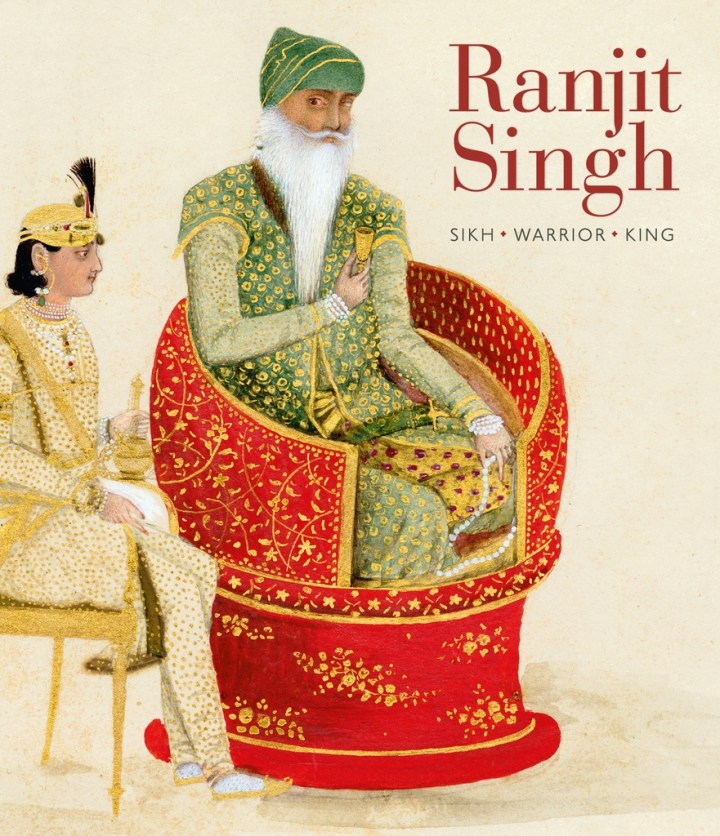 With an unwavering sense of destiny, Ranjit Singh conquered the Punjab, an area that today encompasses Pakistan, following a period of anarchy caused by decades of Afghan invasions. By the early 19th century, he emerged as the undisputed Maharaja, establishing the influential Sikh Empire. Ranjit Singh’s leadership led to a golden age marked by thriving trade, flourishing arts, and a formidable army. Discover his story through nearly 100 stunning artworks, including jewellery and weaponry from the Sikh Empire drawn from major private and public collections. The exhibition also features historic objects from his court, courtiers, and family, including items owned by the Maharaja and the most famous of his 30 wives, Maharani Jind Kaur. Ranjit Singh: Sikh, Warrior, King is a unique opportunity to see our remarkable collection of Sikh arms and armour alongside other Sikh artworks for the first time.
From Bloomsbury Press:
Davinder Toor, Ranjit Singh: Sikh, Warrior, King (London: Philip Wilson Publishers, 2024), 144 pages, ISBN: 978-1781301265, £20 / $30.
This book, published to coincide with the exhibition at the Wallace Collection, features historic artworks, jewellery, and weaponry from Ranjit Singh’s court, courtiers, and family members. Also highlighted are objects intimately connected with his son, Maharaja Duleep Singh—the deposed boy-king turned country squire who was a favourite of Queen Victoria and father of the prominent suffragette Princess Sophia Duleep Singh. Richly illustrated, this catalogue also reveals the achievements of Ranjit Singh’s European and American officials. Acknowledging Ranjit Singh’s remarkable feat of holding back the threat of a British invasion for four decades, these ‘Firangis’ would nickname their esteemed Sikh sovereign ‘The Napoleon of the East’.
Davinder Toor is a leading figure among a new generation of Sikh, Indian, and Islamic art collectors. He has acted as a consultant to major private collectors, auction houses and institutions such as the British Museum, the Victoria and Albert Museum, and the Wallace Collection. He currently lectures on the ‘Arts of the Royal Sikh Courts’ and ‘Sikh Painting and Manuscripts’ for the V&A’s prestigious Arts of Asia course. Both he and objects from the Toor Collection of Sikh Art were featured on the BBC’s Lost Treasures of the Sikh Kingdom (2014) and The Stolen Maharajah: Britain’s Indian Royal (2018) documentaries. The Toor Collection, comprising more than 1,500 works, acts as a lasting legacy to the empire of the Sikhs.
c o n t e n t s
Maps
Foreword
Preface
Prelude to Power — Davinder Toor
Masters of War — Davinder Toor
The Lahore Durbar — Davinder Toor
Firangis — William Dalrymple
Legacies — Davinder Toor
Notes
Bibliography
Image credits
New Book | Liberty, Equality, Fashion
From Norton:
Anne Higonnet, Liberty, Equality, Fashion: The Women Who Styled the French Revolution (New York: Norton, 2024), 304 pages, ISBN: 978-0393867954, $35.
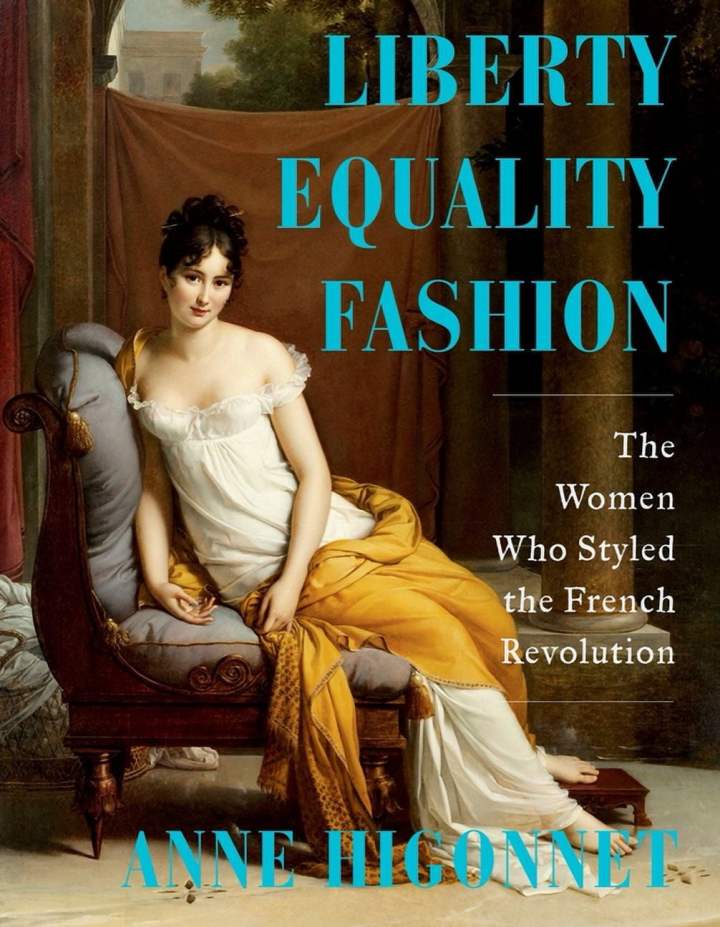 Three women led a fashion revolution and turned themselves into international style celebrities.
Joséphine Bonaparte, future Empress of France; Térézia Tallien, the most beautiful woman in Europe; and Juliette Récamier, muse of intellectuals, had nothing left to lose. After surviving incarceration and forced incestuous marriage during the worst violence of the French Revolution of 1789, they dared sartorial revolt. Together, Joséphine and Térézia shed the underwear cages and massive, rigid garments that women had been obliged to wear for centuries. They slipped into light, mobile dresses, cropped their hair short, wrapped themselves in shawls, and championed the handbag. Juliette made the new style stand for individual liberty. The erotic audacity of these fashion revolutionaries conquered Europe, starting with Napoleon. Everywhere a fashion magazine could reach, women imitated the news coming from Paris. It was the fastest and most total change in clothing history. Two centuries ahead of its time, it was rolled back after only a decade by misogynist rumors of obscene extravagance. New evidence allows the real fashion revolution to be told. This is a story for our time: of a revolution that demanded universal human rights, of self-creation, of women empowering each other, and of transcendent glamor.
Anne Higonnet is professor of art history at Barnard College, Columbia University, where she teaches a course called ‘Clothing’. She has received many awards, including Guggenheim and Harvard Radcliffe Institute fellowships.
Exhibition | High Strung: 500 Years of Keyboard Instruments
One of the world’s finest musical instrument collections (boasting the world’s oldest cello as well as significant archival resources) is housed on the campus of the University of South Dakota in Vermillion, in the southeast corner of the state, about 40 miles from Sioux City, Iowa. Founded in 1973 around Arne Larson’s collection of some 2500 instruments, the National Music Museum recently finished a major renovation and re-installation project. In January, Elizabeth Rembert provided a profile for NPR’s All Things Considered (2 January 2024), and later that month the museum announced the acquisition of five cellos (including 17th- and 18th-century instruments), 27 bows, archival materials, and a Hawaiian guitar previously owned by the late cellist Robert Cancelosi. In addition to the NMM’s regular exhibitions, this special exhibition is on view through the end of the year:
High Strung: Five Centuries of Stringed Keyboard Instruments
National Music Museum, Vermillion, South Dakota, March — December 2024
 For over 600 years, stringed keyboard instruments have served as repositories for human imagination, science, technology, craft, artistry, and music. They are admired for their stature—and oftentimes stunning beauty—alongside their ability to play both melody and harmony. Keyboard innovation has continuously expanded throughout the world, throughout time. The special exhibition High Strung: Five Centuries of Stringed Keyboard Instruments explores the form, function, and development of keyboard instruments from early harpsichords to the modern piano. The special exhibition brings together nearly 20 keyboard instruments from the NMM’s collections—some of which have never before been exhibited.
New Book | Life of Adélaïde Labille-Guiard
From Chronicle Books:
Bridget Quinn, Portrait of a Woman: Art, Rivalry, and Revolution in the Life of Adélaïde Labille-Guiard (New York: Chronicle Books, 2024), 224 pages, ISBN: 978-1797211879, $30.
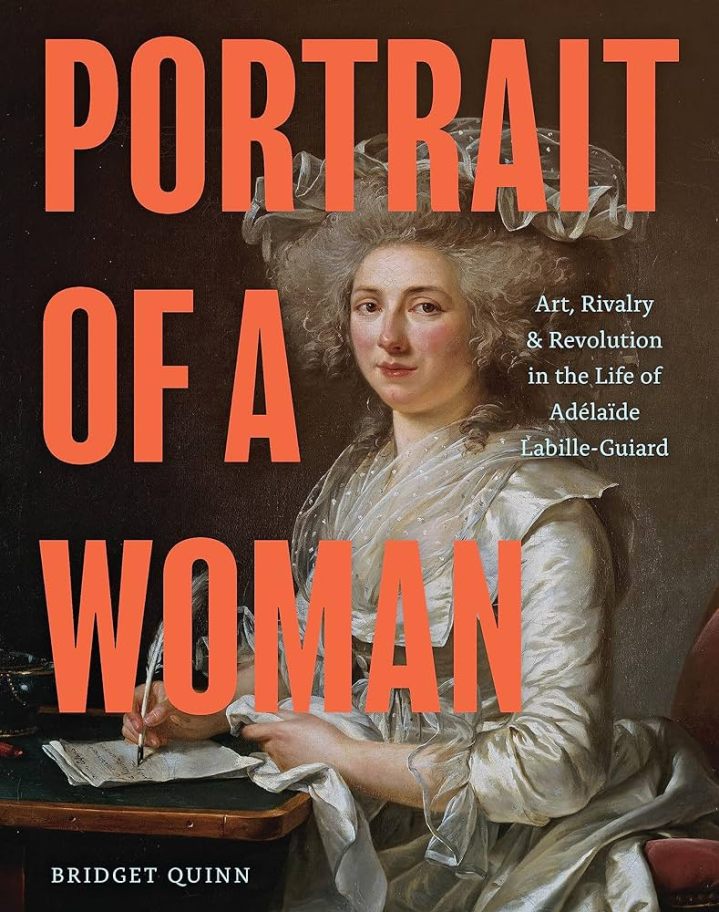 Discover the story of Adélaïde Labille-Guiard—a long-ignored artist and feminist of eighteenth-century France—in this imaginative and illuminating biography from an award-winning writer.
Summer in Paris, 1783. The Louvre steps, too hot and no breeze, the air electric with the heady anticipation of a coming storm: the year’s Royal Salon. Bewigged and powdered Parisians mill amid pigeons, dogs, and detritus; food and flower sellers; pamphleteers and propagandists. Men and women of every estate (clergy, nobles, commoners) are united under art: to love it, to despise it, to gossip endlessly about it.
Exhibiting at the Royal Salon was not for the faint of heart, and it was never intended for women.
Enter Adélaïde Labille-Guiard . . .
Born in Paris in 1749, Adélaïde Labille-Guiard rose from shopkeeper’s daughter to an official portraitist of the royal court—only to have her achievements reduced to ash by the French Revolution. While she defied societal barriers to become a member of the exclusive Académie Royale and a mentor for other ambitious women painters, she left behind few writings, and her legacy was long overshadowed by celebrated portraitist and memoirist Élisabeth Vigée-Lebrun.
But Adélaïde Labille-Guiard’s story lives on. In this engaging biography, Bridget Quinn applies her insightful interpretation of art history to Labille-Guiard’s life. She offers a fascinating new perspective on the artist’s feminism, her sexuality, and her vision of the world. Quinn expertly blends close analyses of paintings with broader context about the era and inserts delicately fictionalized interpersonal scenes that fill the gaps in the historical record. This is a compelling and inspiring look at an artist too long overlooked. Despite numerous setbacks, Labille-Guiard built a legacy as an accomplished royal portraitist and a mentor to other young women artists of her era. This tale of solidarity, self-belief, and true passion for painting is sure to inspire contemporary creatives and women today.
Bridget Quinn is a writer, art historian, and critic. She is the author of the award-winning Broad Strokes: 15 Women Who Made Art and Made History (in That Order) and She Votes: How U.S. Women Won Suffrage, and What Happened Next. A graduate of New York University’s Institute of Fine Arts and a regular contributor to the arts magazine Hyperallergic, Quinn is a sought-after speaker on women and art. She lives in the San Francisco Bay Area with her family.
Call for Articles | Casting Art
From ArtHist.net:
Casting Art
Volume published by De Gruyter and edited by Yaëlle Biro and Noémie Etienne
Proposals due by 1 September 2024, with full articles due by February 2025
Plaster casts molded from artworks are ubiquitous in museum and university collections. In the art history department at the university of Vienna, for instance, a small vitrine surrounded by plants displays old plaster casts of medieval ivories. The installation functions simultaneously as an educational tool from the past, an archive of the department history, and a decorative ensemble. The German anthropologist Leo Frobenius had multiple plaster casts made of several terracottas he excavated in 1910 in Ife, Nigeria, marked them with his name and donated them to European ethnographic museums. He thus transformed masterpieces of an ancient West African civilization into his own vanity pieces-carte de visite and subjects of scientific research.
As can be seen in many museum storage and gypsotheques, over centuries, plaster casts have been molded on art works, architectural elements, and even human beings. The Italian Renaissance and the 19th century are two contexts often discussed in the framing of the importance of casting as part of broader creative processes but their presence and impact goes beyond. Since the 1990s and the work by Georges Didi-Huberman (e.g. L’empreinte, 1997), plaster casts have stimulated art historical research and have expanded thinking about heritage.
In this edited volume from De Gruyter (new series Traces), we propose to redefine collectively what plaster casts are across different geographies and time periods, focusing mainly on the reproduction of objects. As the use of 3D printing of works of art is becoming common practice as a tool to the current debate on restitution of cultural patrimony, we would like to interrogate how this replication practice differs conceptually from the earlier one. We will explore what plaster casts were upon production and what they have become, what they enable, and how they impact original productions as well as discourses surrounding them.
Topics of interest can include
1. Past: Plaster copies were highly circulated between institutions and continents. How were they traded, commercialized, and commodified? How did plaster cast enable the forging of specific disciplines, in which context and for whose profit? How were plaster casts used in teaching and study collections? How were they produced, circulated, and exhibited?
2. Present: We believe that plaster casts, and casts in general, need to be better defined in a global theoretical framework. Despite the numerous single studies focusing on specific contexts, in both art history and anthropology, the topic per se lacks broader conceptualization. How should this type of object be defined? What do they convey? How do they transform the casted original, be it an artwork (or even sometimes a human being)? Topics can also include the connection between artistic and anthropological castings, as well as the use of casts in contemporary art.
3. Future: Plaster is a very sensitive material prone to degradation. What are the specific challenges of exhibiting and preserving plaster cast today? Should they be preserved at all as parts of the museums’ collections? Does today’s proliferation of 3D printing of works of art, and their possible use in the context of restitution practices, present similar challenges and should these processes be submitted to better control?
Guest editors: Yaëlle Biro and Noémie Etienne
Publisher: De Gruyter
In the New Series: Traces. Public History and Cultural Heritage Studies
Publication date: 2026
Abstracts expected (c. 300 words): September 1st 2024
Please send your abstracts to: yaellebiro@gmail.com and noemie.etienne@univie.ac.at
Full articles (if abstracts are accepted): February 2025
A peer-reviewed evaluation will take place
Final versions of the articles are expected for April 2025
New Book | John Soane’s Cabinet of Curiosities
Forthcoming from Yale UP:
Bruce Boucher, John Soane’s Cabinet of Curiosities: Reflections on an Architect and His Collection (New Haven: Yale University Press, 2024), 224 pages, ISBN: 978-0300275698, £35 / $45.
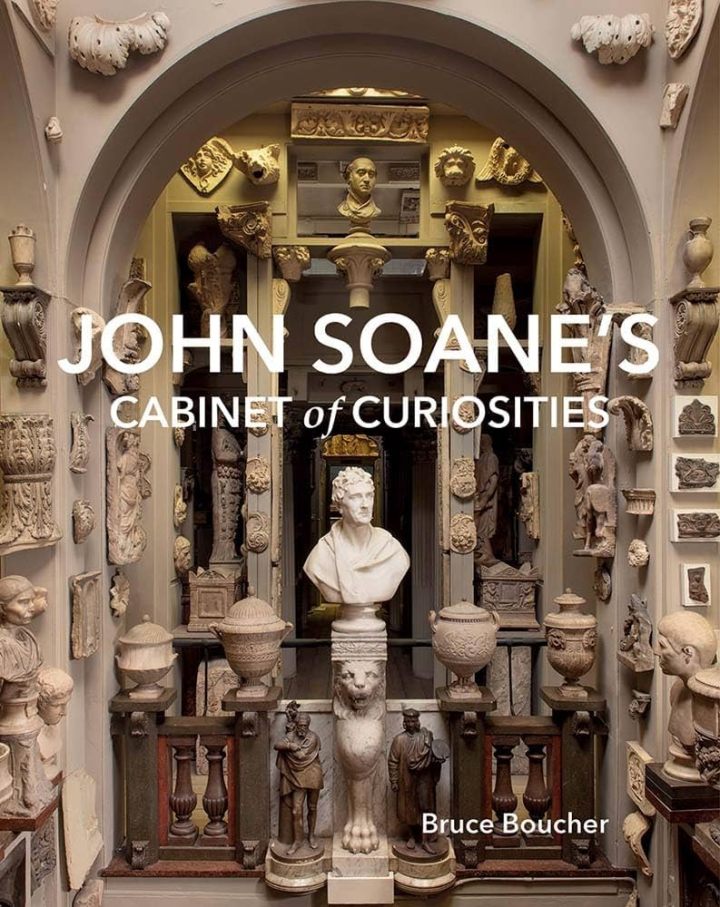 An in-depth study that sheds a fascinating new light on Sir John Soane (1753–1837) and his world-renowned collection
Sir John Soane’s architecture has enjoyed a revival of interest over the last seventy years, yet Soane as a collector—the strategy behind and motivation for Soane’s bequest to the nation—has remained largely unexplored. While Soane referred to the display of objects in his house and museum as “studies for my own mind,” he never explained what he meant by this, and the ambiguity surrounding his motivation remains perennially fascinating. This book illuminates a side of Soane’s personality unfamiliar to most students of his life and work by examining key strands in his collection and what they reveal about Soane and the psychology of collecting. Topics include the display of antiquities; his fascination with ruins, both literal and figurative; his singular response to Gothic architecture; and his investment in modern British painting and sculpture. These aspects are bookended by an introductory biographical chapter that highlights the ways in which his family and career informed his collecting habits as well as an epilogue that analyses the challenges of turning a private house and collection into a public museum.
Bruce Boucher is an art historian and curator who served as director of Sir John Soane’s Museum from 2016 to 2023. Specializing in Italian Renaissance, Baroque, and Neo-classical art and architecture, he is the author of a number of books, including The Sculpture of Jacopo Sansovino, Andrea Palladio: The Architect in his Time, and Earth and Fire: Italian Terracotta Sculpture from Donatello to Canova.
New Book | Libertine London
Forthcoming from Reaktion, with distribution by The University of Chicago Press:
Julie Peakman, Libertine London: Sex in the Eighteenth-Century Metropolis (London: Reaktion Books, 2024), 352 pages, £25 / $40.
 An eye-opening and richly detailed history of women’s sexuality that upends entrenched perceptions of the long eighteenth century.
Libertine London investigates the sex lives of women throughout the period 1680 to 1830, known as the long eighteenth century. The book uncovers the various experiences of women, whether as mistresses, adultresses, or as participants in the sex trade. From renowned courtesans to downtrodden streetwalkers, it examines the multifaceted lives of these women within brothels, on stage, and even behind bars. Based on new research in court transcripts, asylum records, magazines, pamphlets, satires, songs, theater plays, and erotica, Libertine London reveals the gruesome treatment of women who were sexually active outside of marriage. Julie Peakman looks at sex from women’s points of view, undercutting the traditional image of the bawdy eighteenth century to expose a more sordid side, which often left women distressed, ostracized, and vilified for their sexual behavior.
Julie Peakman is a historian and author of many books on the history of sexuality, including Amatory Pleasures: Explorations in Eighteenth-Century Sexual Cultures. She lives in London.
c o n t e n t s
Prologue
1 Rambles through London
2 Street-Walkers
3 Brazen Bawds
4 Courtesans
5 Public Opinion: The Way with Whores
6 Stage Strumpets
7 Libertines and Their Fashions
8 Quacks, the Pox, and the New Sexual Predators
9 Mad about the Boy
10 Rape on Trial
11 Seduction, Abduction, and Adultery
12 Royal Mistresses
References
Acknowledgements
Photo Acknowledgements
Index
New Book | Lady Caroline Lamb
From Simon & Schuster:
Antonia Fraser, Lady Caroline Lamb: A Free Spirit (New York: Pegasus Books, 2023), 224 pages, ISBN: 978-1639364053, $29.
 The vivid and dramatic life of Lady Caroline Lamb, whose scandalous love affair with Lord Byron overshadowed her own creativity and desire to break free from society’s constraints.
From the outset, Caroline Lamb had a rebellious nature. From childhood she grew increasingly troublesome, experimenting with sedatives like laudanum, and she had a special governess to control her. She also had a merciless wit and talent for mimicry. She spoke French and German fluently, knew Greek and Latin, and sketched impressive portraits. As the niece of Georgiana, Duchess of Devonshire, she was already well connected, and her courtly skills resulted in her marriage to the Hon. William Lamb (later Lord Melbourne) at the age on nineteen. For a few years they enjoyed a happy marriage, despite Lamb’s siblings and mother-in-law detesting her and referring to her as “the little beast.” In 1812 Caroline embarked on a well-publicised affair with the poet Lord Byron—he was 24, she 26. Her phrase “mad, bad and dangerous to know” became his lasting epitaph. When he broke things off, Caroline made increasingly public attempts to reunite. Her obsession came to define much of her later life, as well as influencing her own writing—most notably the Gothic novel Glenarvon—and Byron’s. Antonia Fraser’s vividly compelling biography animates the life of ‘a free spirit’ who was far more than mad, bad, and dangerous to know.
Antonia Fraser is the author of many widely acclaimed historical works which have been international bestsellers. She was awarded the Medlicott Medal by the Historical Association in 2000 and was made a DBE in 2011 for services to literature. Her previous books include Mary Queen of Scots; King Charles II; The Weaker Vessel: Woman’s Lot in Seventeenth-Century England, which won the Wolfson History Prize; Marie Antoinette: The Journey; Perilous Question; The King and the Catholics; and The Wives of Henry VIII. Must You Go?, a memoir of her life with Harold Pinter, was published in 2010, and My History: A Memoir of Growing Up in 2015. Fraser’s The Case of the Married Woman is available from Pegasus Books. She lives in London.
Byron 200 Years after His Death
George Gordon Byron (1788–1824) died 200 years ago on Friday (19 April). Writing this week for The Washington Post, Michael Dirda reviews two new books about the poet (noted below), while Benjamin Markovits, in a New York Times essay, grapples with how (and whether) people still read him. A Byron Festival is being held at Trinity College, Cambridge (yesterday and today) while the Keats-Shelley House presents the exhibition, Byron’s Italy: An Anglo-Italian Romance, along with a series of talks and other events throughout the year. Finally (for now), Liverpool UP has discounted some of its Byron books.
The Byron Festival at Trinity
Trinity College Cambridge 19–20 April 2024
 Trinity College Cambridge will host a two-day festival to coincide with the 200th anniversary of Lord Byron’s death on 19 April 1824, in Missolonghi, Greece. Byron was a student at Trinity College and is one of its most celebrated alumni. While enrolled as an undergraduate, Byron published his collection of poetry, Hours of Idleness, and began the satirical poem that would become English Bards and Scotch Reviewers, a scathing provocation of the literary establishment.
Described by the College’s Senior Tutor of the time as a “young man of tumultuous passions,” Byron became one of the most controversial, celebrated, and influential poets of his age. When Westminster Abbey declined to accept the magnificent statue of Byron, created after his death by the Danish sculptor Thorvaldsen, Trinity gave it a home in the Wren Library, where the poet still stands—an impressive presence for students, scholars, and visitors.
But what kinds of presence does Byron have now? This question is the focus of an exciting programme of talks, readings, music, and exhibited work, which will address, and mediate, the legacy and status of Byron now, within the contexts of today’s culture and scholarship. The Byron Festival Conference programme includes talks about Byron, by academics and writers including Bernard Beatty, Drummond Bone, Clare Bucknell, Will Bowers, Christine Kenyon Jones, Mathelinda Nabugodi, Seamus Perry, Diego Saglia, Dan Sperrin, Jane Stabler, Fiona Stafford, A.E. Stallings, Andrew Stauffer, Corin Throsby, Clara Tuite, Ross Wilson.
◊ ◊ ◊ ◊ ◊
Fiona Stafford, ed., Byron’s Travels: Poems, Letters, and Journals (New York: Everyman’s Library, 2024), 728 pages, ISBN: 978-1101908426, $35.
 George Gordon, Lord Byron, was one of the leading figures of British Romanticism. The Byronic hero he gave his name to—the charming, dashing, rebellious outsider—remains a powerful literary archetype. Byron was known for his unconventional character and his extravagant and flamboyant lifestyle: he had numerous scandalous love affairs, including with his half-sister Augusta Leigh. Lady Caroline Lamb, one of his lovers, famously described him as “mad, bad and dangerous to know.”
His letters and journals were originally published in two volumes; this new one-volume selection includes poems and provides a vivid overview of his dramatic life arranged to reflect his travels through Scotland, Italy, Spain, Turkey, Albania, Switzerland, and of course Greece, where he died. It contains a new introduction by scholar Fiona Stafford highlighting Byron’s enduring significance and the ways in which he was ahead of his time.
Fiona Stafford is a professor of English literature at Oxford University. The author of many books, including a biography of Jane Austen, she also wrote and presented the highly acclaimed The Meaning of Trees for BBC Radio 3’s The Essay. Her book The Long, Long Life of Trees, published in 2017, was a Sunday Times Nature Book of the Year.
◊ ◊ ◊ ◊ ◊
Andrew Stauffer, Byron: A Life in Ten Letters (Cambridge: Cambridge University Press, 2024), 300 pages, ISBN: 978-1009200165, $30.
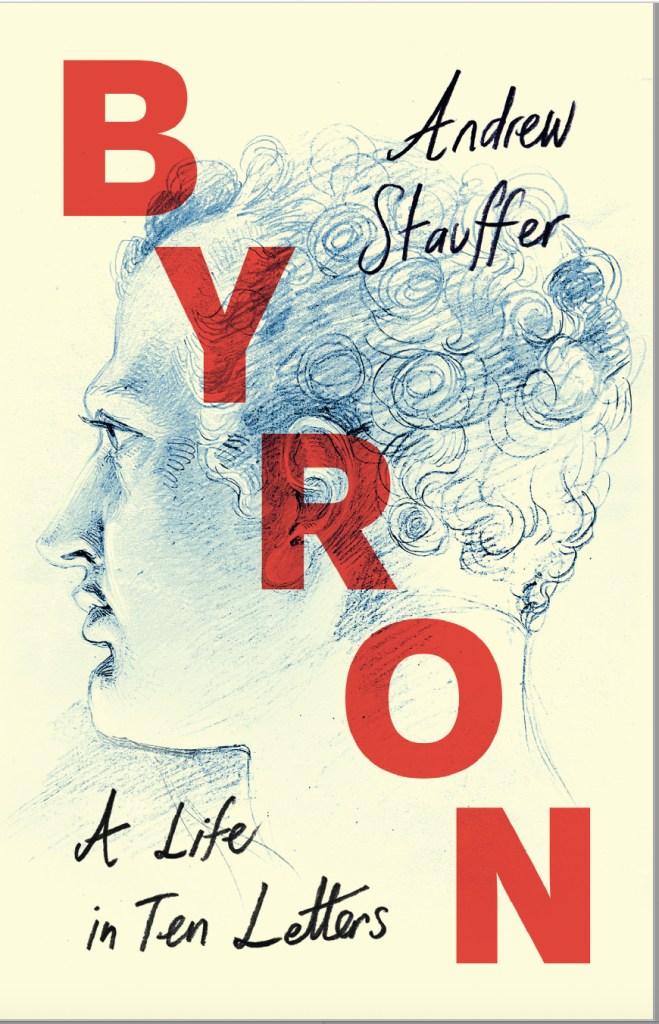
Lord Byron was the most celebrated of all the Romantic poets. Troubled, handsome, sexually fluid, disabled, and transgressive, he wrote his way to international fame—and scandal—before finding a kind of redemption in the Greek Revolution. He also left behind the vast trove of thrilling letters (to friends, relatives, lovers, and more) that form the core of this remarkable biography. Published to coincide with the 200th anniversary of Byron’s death, and adopting a fresh approach, it explores his life and work through some of his best, most resonant correspondence. Each chapter opens with Byron’s own voice—as if we have opened a letter from the poet himself—followed by a vivid account of the emotions and experiences that missive touches. This gripping life traces the meteoric trajectory of a poet whose brilliance shook the world and whose legacy continues to shape art and culture to this day.
Andrew M. Stauffer is a professor in the English Department at the University of Virginia, where he specializes in nineteenth-century literature, especially poetry.










 Enfilade
leave a comment