New Book | Antiquity in Print
Forthcoming from Bloomsbury:
Daniel Orrells, Antiquity in Print: Visualizing Greece in the Eighteenth Century (London: Bloomsbury Academic, 2024), 368 pages, ISBN: 978-1350407763 (hardback), $95 / ISBN: 978-1350407770 (paperback), $31.
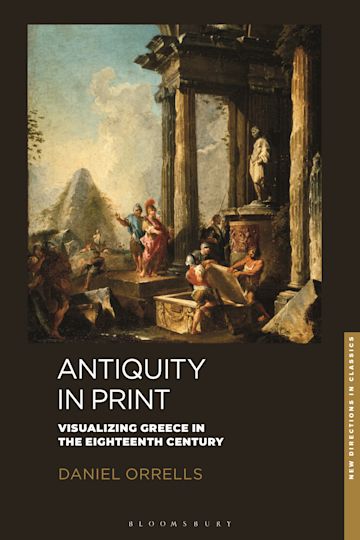 Daniel Orrells examines the ways in which the ancient world was visualized for Enlightenment readers and reveals how antiquarian scholarship emerged as the principal technology for envisioning ancient Greek culture, at a time when very few people could travel to Greece which was still part of the Ottoman Empire. Offering a fresh account of the rise of antiquarianism in the 18th century, Orrells shows how this period of cultural progression was important for the invention of classical studies. In particular, the main focus of this book is on the visionary experimentalism of antiquarian book production, especially in relation to the contentious nature of ancient texts. With the explosion of the Quarrel between the Ancients and the Moderns, eighteenth-century intellectuals, antiquarians, and artists such as Giambattista Vico, Johann Joachim Winckelmann, the Comte de Caylus, James Stuart, Julien-David Leroy, Giovanni Battista Piranesi, and Pierre-François Hugues d’Hancarville all became interested in how printed engravings of ancient art and archaeology could visualize a historical narrative. These figures theorized the relationship between ancient text and ancient material and visual culture—theorizations which would pave the way to foundational questions at the heart of the discipline of classical studies and neoclassical aesthetics.
Daniel Orrells is Professor of Classics at King’s College London. He is author of Sex: Antiquity and Its Legacy (2015) and Classical Culture and Modern Masculinity (2011), and is co-editor of The Mudimbe Reader (2016) and African Athena: New Agendas (2011).
c o n t e n t s
Introduction: Historicity, Disciplinarity, and Materiality
1 Achilles’ Shield and Vico’s Frontispiece
2 Visualising Philhellenism
3 Putting Ancient Greece into the Picture
Epilogue: From Lessing to Kauffmann: Awaiting the Return of Ancient Greece
Notes
Bibliography
Index
Exhibition | The Tiepolos: Invention and Virtuosity in Venice
Now on view at the Beaux-Arts de Paris:
The Tiepolos: Invention and Virtuosity in Venice
Beaux-Arts de Paris, 22 March — 30 June 2024
Curated by Hélène Gasnault and Giulia Longo
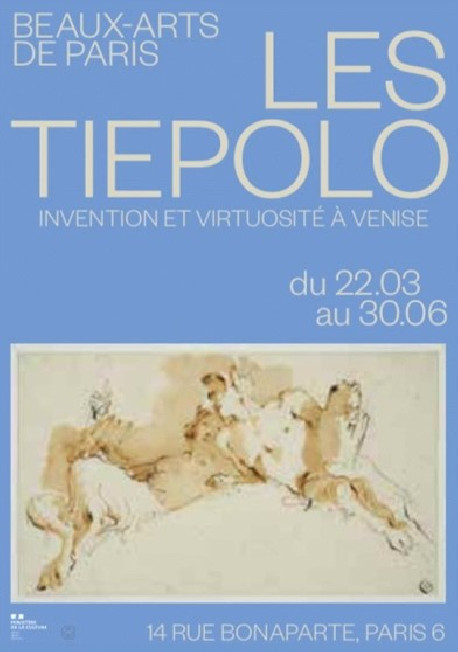 This exceptional exhibition brings together drawings and etchings by Giambattista Tiepolo and his two sons, Giandomenico and Lorenzo Tiepolo, a family of virtuoso artists in 18th-century Venice.
The Beaux-Arts de Paris owns a remarkable collection of ten works by Giambattista Tiepolo (1696–1770), making it the second-largest public collection of the artist’s drawings in France. Above all, this collection is the only one in France to include drawings not only by Giambattista, but also by his two painter sons, Giandomenico (1727–1804) and Lorenzo (1736–1776), as well as another of Tiepolo’s assistants in the 1730s, Giovanni Raggi. This collection alone provides an overview of graphic practices within the family and the studio.
The study of these sheets and prints, combined with works by other artists—sources of inspiration such as Rembrandt, masters such as Piazzetta, and contemporaries such as Canaletto, Guardi, and Novelli—highlights the great modernity of their art. This is particularly evident in their ability to produce variations on the same theme, both in traditional religious and mythological subjects and in figure studies, particularly caricatures, as well as scenes from Venetian life. The exhibition also explores the relationship between the father and his sons, and the work within a family of artists.
The exhibition opens with a series of studies of heads and faces that raise the question of training in the Tiepolo studio. It then moves on to religious paintings and large-scale secular decors produced by the Tiepolos and their contemporaries in Venice, followed by autonomous graphic works conceived outside of any painted project, as pure graphic exercises or pleasures, based on iconographic themes repeated almost obsessively, in multiple variants. It is the exceptional inventiveness of Giambattista and Giandomenico Tiepolo, one of the most fascinating facets of their artistic personalities, that these drawings and prints allow us to rediscover.
Curated by Hélène Gasnault, curator of drawings at Beaux-Arts de Paris, and Giulia Longo, curator of engravings and photos at Beaux-Arts de Paris.
Hélène Gasnault, ed., with additional texts by Catherine Loisel and Giulia Longo, Les Tiepolo: Invention et virtuosité à Venise (Paris: Beaux-Arts de Paris éditions, 2024), 112 pages, ISBN: 978-2840568780, €25.
Exhibition | Disegno Disegni
This exhibition of over 100 Italian drawings closed on Sunday, though there is a catalogue:
Disegno Disegni
Musée Jenish, Vevey, Switzerland, 8 December 2023 — 14 April 2024
Curated by Emmanuelle Neukomm et Pamella Guerdat

Pietro Palmieri, Trompe-l’oeil with eight copied engravings and study drawings stacked on top of each other, 1783, pen, black and brown inks, brown wash, and blue watercolor on paper, 45 × 60 cm (Vevey: Musée Jenish; photo by David Quattrocchi).
Avec Guerchin, Novelli, Piola, Tiepolo ou encore Zuccari, le dessin italien ancien et moderne est au coeur de l’exposition Disegno disegni.
Dans le sillage du legs de René de Cérenville en 1968, qui faisait la part belle à la création graphique de la Péninsule, les fonds italiens du Musée Jenisch Vevey n’ont cessé de s’enrichir au fil des années, constituant aujourd’hui l’un des noyaux essentiels du patrimoine veveysan. Plus de 100 feuilles issues d’une collection particulière déposée au musée depuis 2003 sont mises en lumière pour l’occasion, dans un dialogue fécond avec les propres fonds de l’institution. Les pièces ainsi réunies invitent à voyager à travers les grands centres artistiques d’Italie, de Venise à Rome, en passant par Bologne et Florence. Autant d’écoles à l’origine d’une production dessinée placée sous le signe de la diversité technique et matérielle. Sujets religieux et profanes, pages d’études et dessins autonomes célèbrent la pluralité qui caractérise le médium et ses multiples fonctions, entre la fin du XVe siècle et les premières décennies du XIXe siècle.
Une exposition sous le commissariat de Emmanuelle Neukomm et Pamella Guerdat, conservatrice et conservatrice adjointe Beaux-Arts, assistées de Leïla Thomas, collaboratrice scientifique.
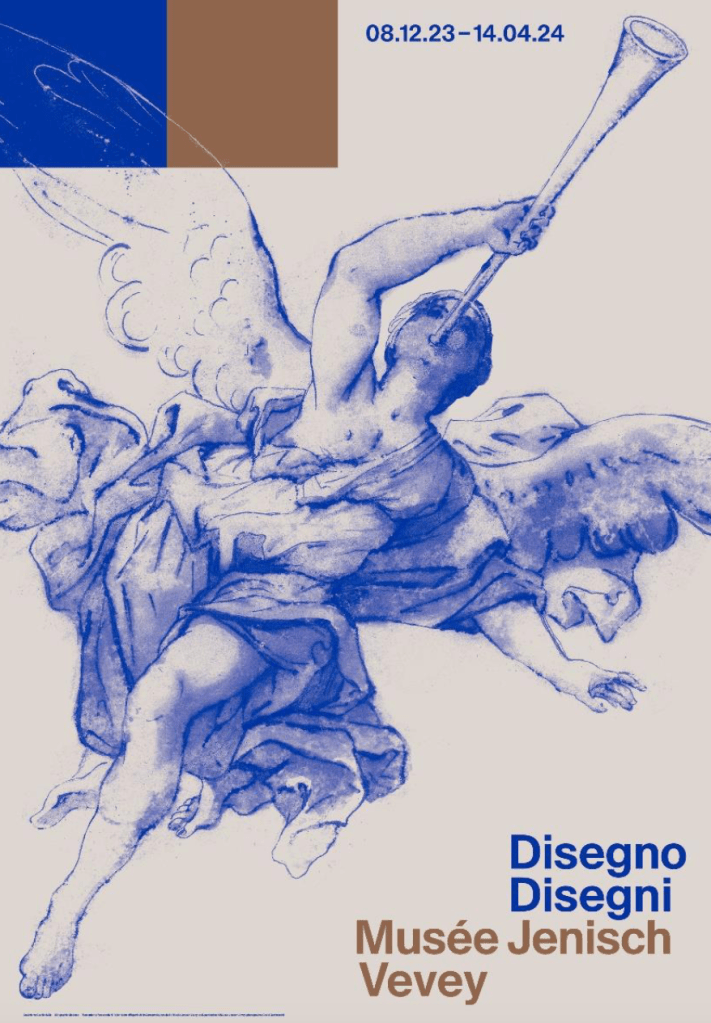
Marcantonio Franceschini, Allegory of Fame, before 1696 (Private Collection).
Pamella Guerdat et Emmanuelle Neukomm, eds., Disegno disegni: Dessins italiens de la Renaissance au XIXe siècle (Milan: Silvana Editoriale, 2024), 340 pages, ISBN: 978-8836654727, €45.
Préface — Nathalie Chaix
Le dédale des provenances — Ètienne Dumont
Connoisseurship et marché de l’art — Frédéric Elsig
Avertissement
Catalogue: Dessins italiens de la Renaissance au XIX siècle
Du dessin, la part maudite — Jérémie Koering
Index
Bibliographie sélective
Remerciements
Impressum
Exhibition | Pocket Luxuries
Now on view at the Cognacq-Jay:
Pocket Luxuries: Small Precious Objects in the Age of Enlightenment
Luxe de poche: Petits objets précieux au siècle des Lumières
Musée Cognacq-Jay, Paris, 28 March — 29 September 2024
Curated by Sixtine de Saint Léger and Gabrielle Baraud
 L’exposition Luxe de poche au musée Cognacq-Jay présente une collection exceptionnelle de petits objets précieux et sophistiqués, en or, enrichis de pierres dures ou de pierres précieuses, couverts de nacre, de porcelaine ou d’émaux translucides, parfois ornés de miniatures. Les usages de ces objets varient, mais ils ressortent tous des us et coutumes d’un quotidien raffiné, signe de richesse, souvenir intime. Au siècle des Lumières comme aux suivants, ils suscitent un véritable engouement en France d’abord puis dans toute l’Europe. Luxe de poche a pour ambition de renouveler le regard que l’on porte sur ces objets, en adoptant une approche plurielle, qui convoque à la fois l’histoire de l’art et l’histoire de la mode, l’histoire des techniques, l’histoire culturelle et l’anthropologie en faisant résonner ces objets avec d’autres œuvres : des accessoires de mode, mais aussi les vêtements qu’ils viennent compléter, le mobilier où ils sont rangés ou présentés et enfin des tableaux, dessins et gravures où ces objets sont mis en scène. Ce dialogue permet d’envisager ces objets dans le contexte plus large du luxe et de la mode au XVIIIe et au début du XIXe siècle.
Point de départ de cette nouvelle exposition, la remarquable collection d’Ernest Cognacq est enrichie de prêts importants—d’institutions prestigieuses comme le musée du Louvre, le musée des Arts décoratifs de Paris, le Château de Versailles, le Palais Galliera, les Collections royales anglaises ou le Victoria and Albert Museum à Londres—afin d’offrir une nouvelle lecture de ces accessoires indispensables du luxe.
Commissariat scientifique
• Vincent Bastien, collaborateur scientifique au Château de Versailles
• Ariane Fennetaux, professeure des universités, Université Sorbonne Nouvelle
• Pascal Faracci, conservateur en chef du patrimoine
Sixtine de Saint-Léger, ed., Luxe de poche: Petits objets précieux au siècle des Lumières (Paris: Musée Cognacq-Jay, 2024), 96 pages, ISBN: 978-2759605798, €19. With contributions by Gabrielle Baraud, Vincent Bastien, Ariane Fennetaux, and Alice Minter.
Exhibition | Timeless Beauty: A History of Still Life
From the Staatliche Kunstsammlung Dresden:
Timeless Beauty: A History of Still Life / Zeitlose Schönheit: Eine Geschichte des Stilllebens
Gemäldegalerie Alte Meister, Zwinger, Dresden, 17 November 2023 — 1 September 2024
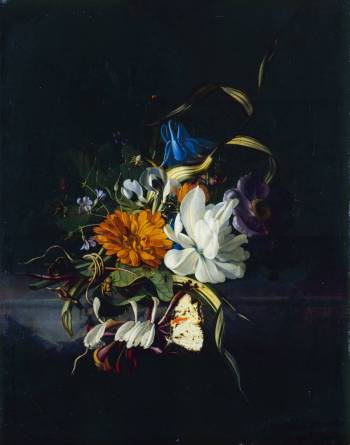
Rachel Ruysch (1664–1750), Floral Still Life, 1690, oil on canvas on oak panel, 35 × 27 cm (Dresden: Museum Gemäldegalerie Alte Meister, 3149).
In the Winckelmann Forum of the Semper Building, the Gemäldegalerie Alte Meister presents around 80 works from its own collection in the exhibition Timeless Beauty: A History of Still Life. The wide-ranging presentation—with masterpieces by painters such as Frans Snyders, Balthasar van der Ast, Jan Davidsz. de Heem, Adriaen van Utrecht, Willem Claesz. Heda, Abraham Mignon, and Rachel Ruysch—comprehensively illuminates the genre ‘still life’. Since when has it existed? What exactly constitutes a still life? What meaning, what content and what function did they have and still have today? What allegories and symbols are hidden in these motifs?
Still lifes were not only showpieces of decorative room furnishings, in which the overall effect was in the foreground. They also bear witness to natural scientific interests: the depicted object is regarded as a scientifically object and ‘document’—today as in the Age of Enlightenment. At the same time, however, still lifes are also an illusion, a game with the eye (trompe-l’œuil), in which the optical effect of the entire motif takes center stage. Through the bravura of painting, the ephemeral is immortalized. Many of the works on display, some of them recently restored, allow visitors to rediscover this fascinating genre, as only a few of the more than 100 still lifes in the Gemäldegalerie Alte Meister are on permanent display.
Konstanze Krüger, ed., Stillleben: Zeitlose Schönheit (Berlin: Hatje Cantz Verlag, 2023), 160 pages, ISBN: 978-3775751131, $50.
Konstanze Krüger, ed., Still Life: Timeless Beauty (Berlin: Hatje Cantz Verlag, 2024), 144 pages, ISBN: 978-3775751148, $40.
New Book | The Garden Against Time
From Pan Macmillan:
Olivia Laing, The Garden Against Time: In Search of a Common Paradise (London: Picador, 2024), 336 pages, ISBN: 978-1529066678, £20 / $28.
 “A garden contains secrets, we all know that: buried elements that might put on strange growth or germinate in unexpected places. The garden that I chose had walls, but like every garden it was interconnected, wide open to the world . . .”
In 2020, Olivia Laing began to restore an 18th-century walled garden in Suffolk, an overgrown Eden of unusual plants. The work drew her into an exhilarating investigation of paradise and its long association with gardens. Moving between real and imagined gardens, from Milton’s Paradise Lost to John Clare’s enclosure elegies, from a wartime sanctuary in Italy to a grotesque aristocratic pleasure ground funded by slavery, Laing interrogates the sometimes shocking cost of making paradise on earth.
But the story of the garden doesn’t always enact larger patterns of privilege and exclusion. It’s also a place of rebel outposts and communal dreams. From the improbable queer utopia conjured by Derek Jarman on the beach at Dungeness to the fertile vision of a common Eden propagated by William Morris, new modes of living can and have been attempted amidst the flower beds, experiments that could prove vital in the coming era of climate change. The result is a beautiful and exacting account of the abundant pleasures and possibilities of gardens: not as a place to hide from the world but as a site of encounter and discovery, bee-loud and pollen-laden.
Olivia Laing is a widely acclaimed writer and critic. She’s the author of seven books, including The Lonely City, Funny Weather, and Everybody. Her first novel, Crudo, was a Sunday Times top ten bestseller and won the 2019 James Tait Memorial Prize. Her work has been translated into twenty-one languages, and in 2018 she was awarded a Windham-Campbell Prize for non-fiction. She lives in Suffolk.
New Book | Charles Bridgeman (c.1685–1738)
From Boydell & Brewer:
Susan Haynes, Charles Bridgeman (c.1685–1738): A Landscape Architect of the Eighteenth Century (London: Boydell & Brewer, 2023), 270 pages, ISBN: 978-1837651177, £75 / $115.
 An examination of the garden plans of eighteenth-century landscape architect Charles Bridgeman, shedding light on his artistic vision and contributions to English garden history.
Charles Bridgeman was a popular and highly successful landscape architect in the first part of the eighteenth century. He was Royal Gardener to George I and George II, designing the gardens at Kensington Palace for them and working for many of the ruling Whig elite, including Sir Robert Walpole at Houghton Hall in Norfolk. His landscapes were audacious and monumental, but he is barely known outside the world of academic garden history; most of his gardens have disappeared, changed out of all recognition to chime with later tastes shaped by Lancelot Brown’s vision of a more ‘natural’ landscape, or buried under housing developments and golf courses; and there is little archaeological or written evidence of his work. This book aims to redress this injustice and rescue his legacy. It draws on the only significant body of evidence which survived him: an extensive but wildly heterogenous corpus of garden plans. Close examination of them reveals an artistic vision heavily influenced by the late seventeenth-century geometric garden but deeply rooted in the ‘genius of the place’, and working methods that include a proto-business model which prefigures the gentleman improvers who followed him. The volume brings Bridgeman from obscurity to demonstrate his skill as an artist, a manipulator of space on a grand scale, and a consummate practitioner, a deserved member of the canon of famous and revered English landscape gardeners.
Susan Haynes is a retired teacher with a PhD in landscape history from the University of East Anglia. Her principal interest is seventeenth- and eighteenth-century garden history.
c o n t e n t s
List of Illustrations
Acknowledgements
List of Abbreviations
Introduction
1 Who Was Charles Bridgeman?
2 Towards A Reliable Corpus
3 A Revised Catalogue
4 Reading The Plans
5 The Art-Historical Context Revisited
6 The ‘Ingenious Mr Bridgeman’
7 Building a Landscape
8 A Commercial Enterprise
Conclusion
Appendices
I A Summary of Willis’s Catalogue from Charles Bridgeman and the English Landscape Garden
II A Revised Catalogue
III Bridgeman’s Projects by Year
IV Bridgeman’s Income
Gazetteer of Bridgeman Sites
Glossary
Bibliography
Index
New Book | Chatsworth: The Gardens
From Penguin Books:
Alan Titchmarsh, with photography by Jonathan Buckley, Chatsworth: The Gardens and the People Who Made Them (London: Ebury Spotlight, 2023), 288 pages, ISBN: 978-1529148213, £35 / $65.
 Follow Alan Titchmarsh into Chatsworth’s irresistible world of visionaries, pioneers, heroes, villains, and English eccentrics and celebrate the men and women who have shaped the history of the estate over five centuries. With his passionate knowledge of both the house and gardens, as well as his long-established relationship with the Cavendish family, Alan is the perfect guide with whom to explore the Palace of the Peaks. Featuring stunning, specially commissioned photography of the gardens and parkland, alongside long-forgotten images and memorabilia newly unearthed in the estate archives, this vivid companion, crowded with character and colour, is a book to treasure and revisit over and over again.
Alan Titchmarsh MBE is an English gardener, broadcaster, and author of over 40 books, many of which have been bestsellers. He has twice been named Gardening Writer of the Year and for four successive years was voted Television Personality of the Year by the Garden Writers’ Guild.
New Book | Chinese Dress in Detail
From Thames & Hudson:
Sau Fong Chan, with photographs by Sarah Duncan, Chinese Dress in Detail (London: Thames & Hudson, 2023), 224 pages, ISBN: 978-0500480939, £30 / $40.
 A head-to-toe exploration of Chinese dress through sumptuous, detailed photography of some of the most fascinating historic and contemporary pieces in the V&A’s outstanding collection (part of the V&A Fashion in Detail series)
Chinese Dress in Detail reveals the beauty and variety of Chinese dress for women, men, and children, both historically and geographically, showcasing the intricacy of decorative embroidery and rich use of materials and weaving and dyeing techniques. The reader is granted a unique opportunity to examine historical clothing that is often too fragile to display, from quivering hair ornaments, stunning silk jackets and coats, festive robes, and pleated skirts, to pieces embellished with rare materials such as peacock-feather threads or created through unique craft skills, as well as handpicked contemporary designs. A general introduction provides an essential overview of the history of Chinese dress, plotting key developments in style, design, and mode of dress, and the traditional importance of clothing as social signifier, followed by eight thematic chapters that examine Chinese dress in exquisite detail from head to toe. Each garment is accompanied by a short text and detail photography; front-and-back line drawings are provided for key items.
Sau Fong Chan is a curator in the V&A’s Asian department and looks after the textiles and dress collections from China and Southeast Asia.
c o n t e n t s
Introduction
1 Headwear
2 Necklines and Shoulders
3 Sleeves
4 Pleats
5 Edgings
6 Buttons
7 Embroidery
8 Footwear
Glossary
Further Reading
Acknowledgments
Picture Credits
Index
Print Quarterly, March 2024
The long eighteenth century in the latest issue of Print Quarterly:
Print Quarterly 41.1 (March 2024)
a r t i c l e s
• Przemysław Wątroba, “Jacques Rigaud’s Drawings in Warsaw of the Residences of Louis XIV,” pp. 23–32.
“In the collection of the last king of Poland, Stanisław August Poniatowski (1732–98), kept in the Print Room of the University of Warsaw Library, there is a renowned volume titled Recueil choisi des plus belles vues des palais et maisons royales de Paris et des environs containing a series of 106 engravings by Jacques Rigaud (1681–1754). . . . A set eight hitherto unpublished drawings by Rigaud [also in Warsaw and] formerly kept in Portfolio 174 are here presented as designs” for eight of the prints (23, 25).
n o t e s a n d r e v i e w s

Seven Creamware Plates, ca. 1808–36, diameters 20–23 cm, transfer-printed with various scenes, clockwise from top: Defoe’s Robinson, Choisy factory; Cervantes’s Don Quixote, Montereau factory; Perrault’s Fairies, Montereau factory; Fontaine’s Fable of the Fox and Grapes, Sèvres factory; Ovid’s Metamorphoses, Judgement of Midas, Choisy factory; Chateaubriand’s Atala Found with Chactus by Father Aubry, Choisy factory; and at centre, Cottin’s Matilda Saved by Malek Adhel, Choisy factory (Germany, Peter-Christian Wegner Collection).
• Marzia Faietti, Review of Heather Madar, ed., Prints as Agents of Global Exchange: 1500–1800 (Amsterdam UP, 2021), pp. 37–39.
• Sheila McTighe, Review of Francesco Ceretti and Roberta D’Adda, eds., Immaginario Ceruti: Le stampe nel laboratorio del pittore (Skira, 2023), pp. 42–43. This catalogue accompanied an exhibition that explored the work of the painter Giacomo Ceruti (1698–1767) and his reliance on printed images. “A complementary show of Ceruti’s paintings, Miseria & Nobiltà: Giacomo Ceruti nell’Europa del Settecento was also held in 2023 at the Museo Santa Giulia in Brescia, followed by a reduced version at the J. Paul Getty Museum, Los Angeles during the second half of that year, Giacomo Ceruti: A Compassionate Eye” (42).
• Natasha Ruiz-Gómez, Review of Rebecca Whiteley, Birth Figures: Early Modern Prints and the Pregnant Body (University of Chicago Press, 2023), pp. 43–45.
• Antony Griffiths, Review of Chiara Travisonni with Luca Fiorentino and Andrea Muzzi, Pietro Giacomo Palmieri (Edifir, 2023), pp. 45–46. This monograph on the draughtsman and printmaker, Pietro Giacomo Palmieri (1737–1804), “will become the definitive source of information” for the artist and his work (46).
• Patricia Ferguson, Review of Peter-Christian Wegner, Literatur auf französischen Steingut-Tellern des frühen 19. Jahrhunderts (Georg Olms, 2022), pp. 46–47. Wegner addresses the popularity of subjects drawn from French literature for transfer-printed ceramics, starting in 1808. “While we await a larger in-depth survey of this engaging material, Wegner’s publication is a huge contribution to its appreciation” (46).
• Elizabeth Savage, Review of Christien Melzer and Georg Josef Dietz, Holzschnitt: 1400 bis heute (Hatje Cantz, 2022), pp. 48–50. This is the catalogue for an exhibition that “featured more than 100 prints from the Kupferstichkabinett [in Berlin], as well as what was effectively the first large-scale display of woodblocks from its enormous yet relatively little-known collection” (50).

Johann Christoph Weigel, Sheet for Découpage with Figures on Cloudlike Landscapes and a Fantastical Bird, c. 1700–25, from album Inventions Chinoises V, handcoloured engraving, 216 x 151 mm (Dresden, Kupferstich-Kabinett).
• Brief notice of Katy Barrett, Looking for Longitude: A Cultural History (Liverpool UP, 2022), p. 76. Rather than a retelling of the familiar story of accurately calculating longitude, this book “is a remarkably well-researched account of the ways in which this long-running sage impacted on many areas of public discourse, thought, and imagery” (76).
• Emanuele Lugli, Review of Miriam Vogelaar, The Mokken Collection: Books and Manuscripts on Fencing before 1800 (MMIT Publishing, 2020), pp. 88–92.
• Nadine Orenstein, Review of Maureen Warren, ed., Paper Knives, Paper Crowns: Political Prints in the Dutch Republic (Champaign: Krannert Art Museum, 2022), 92–96. “Never have these prints been so lavishly presented. The beautifully produced catalogue, winner of the 2023 IFPDA Book Award, exceptionally allocates plenty of space to the images. It allows the reader to see entire works along with accompanying text and provides space for multi-plate productions” (93).
• Maureen Cassidy-Geiger, Review of Cordula Bischoff and Petra Kuhlmann-Hodick, eds, La Chine: Die China-Sammlung Des 18. Jahrhunderts Im Dresdner Kupferstich-Kabinett (Sandstein Verlag, 2021), 97–103. This “is the catalogue of an exhibition at the Dresden State Museum devoted to the Chinese works on paper and European chinoiserie prints acquired by the Saxon Electors before 1750” (97). It “was an ambitious project that took many years to come to fruition and required collaboration between colleagues in different disciplines with different working languages” (102).










 Enfilade
leave a comment