New Book | Where Words and Images Meet
From Bloomsbury:
Ludmilla Jordanova and Florence Grant, eds., Where Words and Images Meet (London: Bloomsbury Visual Arts, 2024), 248 pages, ISBN: 978-1350300569 (hardback), $120 / ISBN: 978-1350300552 (paperback), $40.

From 19th-century frontispieces to Soviet photo albums, from the relationships between portraits and biographies to museum labels, the book’s richly illustrated chapters open up historically specific connections between word and image to collective examination and fruitful analysis. Written by both established and emerging scholars in a range of interrelated fields, the chapters deliberately foreground previously overlooked topics as well as unfamiliar disciplinary approaches, to offer a stimulating and carefully developed framework for looking at these ubiquitous phenomena afresh. Where Words and Images Meet opens up for analysis and reflection the forms of attention, practices, skills and assumptions that underlie visual interpretation and meaning-making in the writing of history. By bringing the features of the materials we read and look at into focus, we can grasp more effectively the complex interrelationships involved, and enhance our practice and understanding.
Ludmilla Jordanova is Emeritus Professor of History and Visual Culture at Durham University. She is also the author of History in Practice, 3rd Edition (Bloomsbury, 2019).
Florence Grant holds a PhD in History from King’s College London and is currently an independent writer and editor based in Western North Carolina.
c o n t e n t s
List of Plates
List of Illustrations
List of Contributors
Preface and Acknowledgements
Introduction
Part I | Identifying with Books
Discussion
1 Fronts Matter: The Role of the Authorial Frontispiece in Germaine de Staël’s Corinne: or, Italy — Seren Nolan, Durham University
2 Othering the Ex-Libris: Israel Solomons (1860–1923) and the Invention of the Jewish Bookplate — Tom Stammers, Durham University
Bridge
Part II | Representing Authority
Discussion
3 Picturing Criminal Law in Old Regime France: Brunel, Known as Bétancourt, Being Led to the Scaffold (1670) — Tom Hamilton, Durham University
4 Word and Image in Popular Science— Joseph D. Martin, Durham University
Bridge
Part III | Order and Disorder
Discussion
5 Museum Labels: Word and Object on Display — Lola Sánchez-Jáuregui, University of Glasgow
6 Play with Literacy in Edward Lear’s Nonsense Alphabets — A. Robin Hoffman, Art Institute of Chicago
Bridge
Part IV | Authenticity and Interpretation
Discussion
7 On Taking Artists at Their Word: Artists’ Writings and Statements from 1850 to the Present — Lucy Whelan, University of Cambridge
8 Portraiture and Biography: Harmonious Marriage or Difficult Relationship? — Ludmilla Jordanova, Durham University
Bridge
Part V | Making, Compiling, Arranging
Discussion
9 Extra-Illustration in Early Twentieth-Century England — Ludmilla Jordanova, Durham University
10 Beyond the Caption: Words and Images in an Interwar Soviet Amateur Photograph Album — Antonia Miejluk, Durham University
Bridge
Part VI | Words in the Visual Field
Discussion
11 Word as Image: The Verbal in the Photograph — J. J. Long, Durham University
12 Text-Image Hybridity in Know Thyself and Early Modern English Print — Finola Finn, Independent Scholar, Germany
Bridge
Afterword: Word, Image, and Play
Bibliography
Index
Exhibition | William Blake’s Universe

From the press release for the exhibition:
William Blake’s Universe / William Blakes Universum
The Fitzwilliam Museum, Cambridge, 23 February — 19 May 2024
Hamburger Kunsthalle, 14 June — 8 September 2024
Curated by David Bindman and Esther Chadwick
Responding to the upheavals of revolution and war in Europe and the Americas, visionary artist, poet, and printmaker William Blake (1757–1827) produced an astonishing body of work that combined criticism of the contemporary world with his vision for universal redemption. But he wasn’t the only one. William Blake’s Universe is the first major exhibition to consider Blake’s position in a constellation of European artists and writers striving for renewed spirituality in art and life.
Organised in collaboration with the Hamburger Kunsthalle, and drawing on extensive research, this ambitious exhibition will explore the artist’s unexpected yet profound links with important European figures including pre-eminent German Romantic artists Philipp Otto Runge (1777–1820) and Caspar David Friedrich (1774–1840). It will also place Blake within his artistic network in Britain, drawing parallels with the work of his peers, mentors, and followers including Henry Fuseli (1741–1825), John Flaxman (1755–1826), and Samuel Palmer (1805–1881).

Poster with detail of William Blake after Henry Fuseli, Head of a Damned Soul, ca. 1788–90, engraving and etching on paper (University of Cambridge: The Fitzwilliam Museum).
Featuring around 180 paintings, drawings, and prints—including over 90 of those by Blake—this major exhibition marks the largest ever display of work from the Fitzwilliam’s world-class William Blake collection, with additional loans from the British Museum, Tate, Ashmolean and other institutions. Examples of the artist’s most iconic and much-loved works including Albion Rose (1794–96) and Europe: A Prophecy (1794), will be joined by rarely exhibited artworks from Blake’s oeuvre, including outstanding new acquisitions from the Sir Geoffrey Keynes bequest, displayed publicly for the first time since joining the Fitzwilliam collection. These include the trial frontispiece of Blake’s prophetic book Jerusalem (1804–1820) and his spectacular large drawing Free Version of the Laocoön (c.1825). Additional highlights include the unique first state of Joseph of Arimathea (1773), produced by Blake as an apprentice aged 16, shown alongside a reworked version of the same image, completed by Blake in his mature years.
Visitors will have a special opportunity to discover the work of Runge, one of Germany’s most important Romantic artists, who has been very rarely seen in the UK until now. Bringing together the largest number of Runge works in the UK to date, the exhibition will include the engravings from the Times of Day (1802–10) series, a defining work of German Romanticism. Representing not only the changing times of day, but the seasons, the ages of man and historical epochs, Runge obsessively returned to this important body of work, an extensive number of preparatory drawings and studies of which will be presented at the Fitzwilliam. Among the works on loan from the Hamburger Kunsthalle will be The Large Morning (1808–09), a fragmentary oil painting widely considered to be one of the most important works from Runge’s short career, cut short by his death aged 33.
Another highlight of the exhibition will be Caspar David Friedrich’s seven sepia drawings The Ages of Man (c.1826) on loan from the Hamburger Kunsthalle. Thought to be inspired by Runge’s interest in visual representations of time, the exquisitely delicate series is associated with the themes of change in nature, the cyclical representation of time, and the temporality of human life.
 William Blake’s Universe will unfold in three main sections—past, present and future—with an introductory display of artists’ portraits. ‘The Past: Antiquity and the Gothic’ will focus on the legacy of classical antiquity and Blake’s turn towards the Gothic as an alternative source of inspiration, as well as a spotlight section on Flaxman, an artistic mentor to Blake who gained great acclaim in Germany and across Europe. ‘The Present: Europe in Flames’ will concentrate on the responses of Blake and his close contemporaries in Britain to the revolutionary 1790s. The third section, ‘The Future: Spiritual Renewal’, will show how visions of redemption from a fallen world became a central concern for Blake and his contemporaries in the post-revolutionary period. Jacob Böhme’s mystical ideas about light and cosmic unity, which form a bridge between Blake and his German contemporaries, will be a central display.
William Blake’s Universe is curated by David Bindman, emeritus Durning-Lawrence professor of the History of Art at University College London, and Esther Chadwick, Lecturer in Art History at the Courtauld Institute of Art. The exhibition will be accompanied by a fully illustrated catalogue featuring new scholarship by the curators, as well as essays by leading academics Sarah Haggarty, Joseph Leo Koerner, Cecilia Muratori, William Vaughan, and James Vigus.
Curators David Bindman and Esther Chadwick said: “This is the first exhibition to show William Blake not as an isolated figure but as part of European-wide attempts to find a new spirituality in face of the revolutions and wars of his time. We are excited to be able to shed new light on Blake by placing his works in dialogue with wider trends and themes in European art of the Romantic period, including transformations of classical tradition, fascination with Christian mysticism, belief in the coming apocalypse, spiritual regeneration and national revival.”
David Bindman and Esther Chadwick, eds., William Blake’s Universe (London: Philip Wilson Publishers, 2024), 224 pages, ISBN: 978-1781301272, £35 / $45.
New Book | Writing on the Wall
From Profile Books:
Madeleine Pelling, Writing on the Wall: Graffiti, Rebellion, and the Making of Eighteenth-Century Britain (Profile Books, 2024), 352 pages, ISBN: 978-1800811997, £25.
 What if walls could talk? For historian Madeleine Pelling, they can—if you know where to look. Hear the voices of the eighteenth century in this eye-opening new history of Britain’s most tumultuous period, told through its graffiti.
A brilliant new cultural history of the long eighteenth century, Writing on the Wall is told through the marks its citizens left behind, bringing into focus lost voices from the highest to the lowest in society. From the centre of London to the islands of the Caribbean, Pelling goes in search of graffiti, evidence of how ordinary people experienced the world-changing events that defined their lives—from political prisoners to sex workers, homesick sailors, Romantic poets, and the artisans of the industrial revolution. Here are lives, loves, triumphs, and failures, scratched into the walls of prisons and latrines, chalked up on doors, and etched into windows. The names of their creators may be lost to history, but together they tell the real story of Britain’s most rebellious and transformative century.
Madeleine Pelling is a cultural historian, author and broadcaster. She holds a PhD from the University of York and has held research fellowships at the universities of Yale, Edinburgh, and Manchester. She is co-host of History Hit’s After Dark: Myths, Misdeeds and the Paranormal, a podcast that shines a light on the shadier corners of the past and which brings a rigorous historical lens to folklore and true crime. She is also a regular contributor for television, most recently for Titanic in Colour (Channel 4, 2025), Mayhem! Secret Lives of the Georgian Kings (2025), Queens that Changed the World (Channel 4, 2023), and Who Do You Think You Are? Australia (Warner Bros, 2023). Her words appear in The Guardian, The Independent, BBC History Magazine, and History Today.
New Book | A House Restored
From W.W. Norton:
Lee McColgan, with a foreword by Roy Underhill, A House Restored: The Tragedies and Triumphs of Saving a New England Colonial (New York: Countryman Press, 2024), 224 pages, ISBN: 978-1682688366, $25.
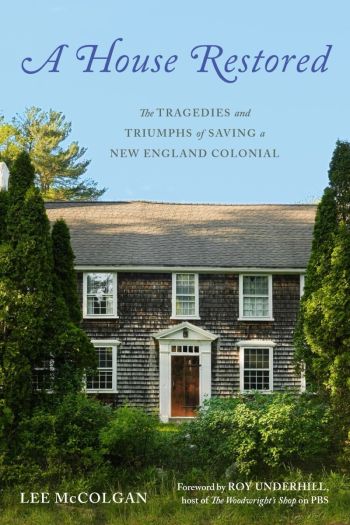 Shop Class as Soulcraft meets A Place of My Own in this lyrical meditation of a woodworker steadfastly repairing a historic home.
Old houses share their secrets only if they survive. Trading the corporate ladder for a stepladder, Lee McColgan commits to preserving the ramshackle Loring House, built in 1702, using period materials and methods and on a holiday deadline. But his enchantment withers as he discovers the massive repairs it needs. A small kitchen fix reveals that the structure’s rotten frame could collapse at any moment. In a bathroom, mold appears and spreads. He fights deteriorating bricks, frozen pipes, shattered windows, a punctured foundation, and even an airborne chimney cap while learning from a diverse cast of preservationists, including a master mason named Irons, a stone whisperer, and the Window Witch. But can he meet his deadline before family and friends arrive, or will it all come crashing down? McColgan’s journey expertly examines our relationship to history through the homes we inhabit, beautifully articulating the philosophy of preserving the past to find purpose for the future.
Lee McColgan has worked on Boston’s Old North Church, Louisa May Alcott’s Orchard House, and other buildings. His work has appeared in Architectural Digest, The Boston Globe, and The Wall Street Journal. He lives with his wife in the Loring House in Pembroke, Massachusetts.
New Book | Royalty and Architecture
From Stolpe Publishing:
Clive Aslet and Frank Salmon, eds., Royalty and Architecture: Visions and Ambitions of European Monarchs and Nobility (Stockholm: Bokförlaget Stolpe, 2024), 250 pages, ISBN: 978-9189425958, £35.
 It is well known that, throughout history, royalty have built castles, fortresses, and entire cities. However, less consideration has been given to individual monarchs who pursued an interest in architecture and in some cases acted as architects. Recent research on Gustav III of Sweden (1746–1792) has shown that he was in fact the architect for a number of important building projects. George III of England (1760–1820) also had a great interest in architecture, and his drawings and sketches have been preserved. Louis XIV of France (1638–1715) was greatly involved in shaping the palace and garden at Versailles. And Stanislaw II August’s (1732–1798) interest in architectural work had a major impact on the neoclassical style in Poland. This richly illustrated book provides additional examples and perspectives on the importance of monarchs for architecture and architectural policy. Along with essays by Aslet and Salmon, the volume includes contributions from leading international scholars: Barbara Arciszewska (Warsaw University), Basile Baudez (Princeton University), Julius Bryant (Victoria and Albert Museum), John Goodall (Editor of Country Life), Elisabeth Kieven (Biblioteca Hertziana, Rome), Jarl Kremeier (Berlin), Rebecca Lyons (Royal Academy of Arts), Magnus Olausson (Nationalmuseum, Stockholm), Emily Roy (National Trust), Ian Thompson (University of Newcastle), and Simon Thurley (Chair of the National Heritage Lottery Fund). An essay has also been prepared from the late David Watkin’s 2004 book on King George III as architect.
Clive Aslet is an award-winning writer and journalist who has published over twenty books.
Frank Salmon is Associate Professor of the History of Art at the University of Cambridge and a Fellow of St John’s College, Cambridge, having served as President of the College from 2015 to 2019.
New Book | John Carr of York: Collected Essays
From PHP and The University of Chicago Press:
Ivan Hall, edited by Kenneth Powell, John Carr of York: Collected Essays (London: Paul Holberton Publishing, 2024), 500 pages, ISBN: 978-1399959155, £50 / $60.
 An introduction to the life and mind of one of England’s most significant architects.
John Carr of York (1723–1807) was one of the most prolific and significant architects of the eighteenth century, with an output of more than four hundred designs, which range from simple gateways to the grandest schemes. Highly successful in his day, he had a recognizable style that was sensitive to the latest fashions as they continued to change. His ability to create beautiful buildings and marry this with a practical approach to both the purpose of the building and the budget of his clients won him many commissions.
Carr was born in Yorkshire in the North of England and remained there for the duration of his career. Because of this, he has often been overlooked as an architect, and his extensive output has defeated many attempts to write a complete study of his work. Although not a comprehensive review, John Carr of York seeks to situate Carr as an architect of national significance. It includes photographs and covers overarching themes such as landscape and color and some commissions in more detail.
Ivan Hall, FSA is a British architectural historian specialising in the architecture of John Carr.
Kenneth Powell is an architectural critic, historian, and consultant.
New Book | Architecture in Britain and Ireland, 1530–1830
From Yale UP:
Steven Brindle, Architecture in Britain and Ireland, 1530–1830 (London: Paul Mellon Centre, 2024) 592 pages, ISBN: 978-1913107406, $75.
 A major new history of architecture in Britain and Ireland that looks at buildings and their construction in detail while revealing the cultural, material, political, and economic contexts that made them
Architecture in Britain and Ireland, 1530–1830 presents a comprehensive history of architecture in Britain during this three-hundred-year period. Drawing on the most important advances in architectural history in the last seventy years, ranging across cultural, material, political, and economic contexts, this book also encompasses architecture in Ireland and includes substantial commentary on the buildings of Scotland and Wales. Across three chronological sections—1530 to 1660, 1660 to 1760, and 1760 to 1830—this volume explores how architectural culture evolved from a subject carried solely in the minds and skills of craftsmen to being embodied in books and documents and with new professions—architects, surveyors, and engineers—in charge. With chapters dedicated to towns and cities, landscape, infrastructure, military architecture, and industrial architecture, and beautifully illustrated with new photography, detailed graphics, and a wealth of historic images, Architecture in Britain and Ireland, 1530–1830 is an invaluable resource for students, historians, and anyone with an interest in the architecture of this period.
Steven Brindle is senior properties historian at English Heritage and publishes widely on the history of architecture and engineering, with major works including Brunel: The Man Who Built the World and, as editor, Windsor Castle: A Thousand Years of a Royal Palace.
New Book | Freemasonry and Civil Society
From Peter Lang:
Margaret Jacob and María Eugenia Vázquez Semadeni, Freemasonry and Civil Society: Europe and the Americas (North and South) (Bern: Peter Lang, 2023), 170 pages, ISBN: 978-1433198397, $90.

Version 1.0.0
This is the first comprehensive account of freemasonry in the Western world, written by two of the field’s foremost scholars. It embraces every country in the Americas, with a particular focus on the American experience. The authors devote significant attention to the Scottish origins of the lodges and their growth in the American colonies, against a backdrop of European imperialism and the emergence of democratic movements. Later they examine the story of freemasonry in the twentieth century, from its encounter with Nazism to its decline beginning in the 1960s. Future directions for the movement are also discussed. Along the way major figures in the movement are assessed: Benjamin Franklin, Alessandro Cagliostro, Giuseppe Garibaldi, Harry S. Truman, and many others. Masons and non-masons, college students, and the curious general reader will find Freemasonry and Civil Society a dazzling and accessible account of one of the world’s most enduring fraternal organizations.
Margaret C. Jacob holds the position of Distinguished Chair of Research in History at UCLA. She has a PhD from Cornell University and an honorary doctorate from Utrecht University in the Netherlands. She is a Guggenheim Fellow and a member of the American Academy of Arts and Sciences, the American Association for the Advancement of Science, and the American Philosophical Society. She is the author of The Radical Enlightenment: Pantheists, Freemasons, and Republicans; Living the Enlightenment: Freemasonry in Eighteenth Century Europe; The Newtonians and the English Revolution; and The Secular Enlightenment.
María Eugenia Vázquez Semadeni has a PhD from El Colegio de Michoacán, Mexico. She has held postdoctoral positions at the Instituto de Investigaciones Históricas, UNAM, México, and at UCLA, as well as Tinker Visiting Professor at Stanford University. She is a member of the Centro de Estudios Históricos de la Masonería Española and a founding member of the Centro de Estudios Históricos de la Masonería Latinoamericana y Caribeña. She is the author of La formación de una cultura política republicana: El debate público sobre la masonería. México 1821–1830.
c o n t e n t s
List of Figures
Acknowledgments
Introduction
1 British Origins
2 European Lodges in the Age of Enlightenment
3 Freemasonry in the New World: North America
4 European Freemasonry in the Age of Nationalism and Imperial Expansion
5 Freemasonry in the New World: Latin America, 1770–c.1830
6 United States Freemasonry: From the Civil War to the End of World War II and Beyond
7 Freemasonry in Latin America and Spain, 1850s–1940s
Conclusion
Bibliography
Index
New Book | Der Hameau de la Reine in Versailles
From Diaphanes:
Felix Vogel, Empfindsamkeitsarchitektur: Der »Hameau de la Reine« in Versailles (Paris: Deutsches Forum für Kunstgeschichte, 2023), 464 pages, ISBN: 978-3035806281, €30. Also available as a free open access PDF file.
 Der von Marie-Antoinette in Auftrag gegebene und zwischen 1783 und 1789 durch Richard Mique in Versailles erbaute Hameau de la Reine besteht aus einem um einen künstlichen Weiher angelegten Ensemble von zwölf Bauernhäusern. Die vermeintlich vernakuläre Anlage ist jedoch von einem Widerspruch gekennzeichnet: Manche der rustikalen Gebäude waren vom dort arbeitenden Personal bewohnt oder wurden für agrikulturelle Produktion genutzt, andere dienten lediglich dem höfischen Vergnügen. Der äußerliche Schmutz war aufgemalt, innen zeigte sich zum Teil eine opulente Ausstattung.
Das Buch rekonstruiert die Funktions- und Nutzungsgeschichte der Gartenanlage anhand bislang nicht berücksichtigter Archivquellen. Zugleich erschließt es den Hameau de la Reine kulturwissenschaftlich, indem es ihn in den Horizont der sich herausbildenden Epoche der Empfindsamkeit einordnet. Dabei zeigen sich die Objekthaftigkeit von Architektur, der Status von »ausgestellten Körpern«, Nützlichkeit als ästhetische Kategorie oder die Frage nach der künstlichen Herstellung von »Natürlichkeit« als zentrale Themen, die weit über die »Sattelzeit« hinaus Bedeutung beanspruchen: Im Hameau de la Reine wird Authentizität zum ästhetischen Kalkül, dessen Spuren bis in die Gegenwart reichen.
Der Kunsthistoriker Felix Vogel ist seit 2021 Professor für Kunst und Wissen an der Universität Kassel und Mitglied des documenta Instituts. Zuvor unterrichtete er unter anderem in Basel, Hamburg, São Paulo, Toronto und Zürich. Seine Promotion schloss er 2017 an der Université de Fribourg ab. Neben der Kunst des 18. Jahrhunderts beschäftigt sich Felix Vogel insbesondere mit der Conceptual Art sowie der Theorie und Geschichte der Ausstellung.
Exhibition | Kaendler’s Meissen Porcelain Figures
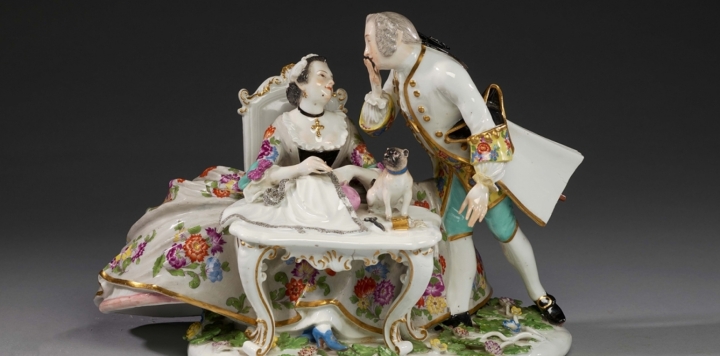
This summer at the Wawel Royal Castle:
Magnificence of Rococo: Kaendler’s Meissen Porcelain Figures
Wspaniałość rokoka: Miśnieńskie figurki porcelanowe Johanna Joachima Kaendlera
Wawel Royal Castle, National Art Collection, Kraków, 23 May — 29 September 2024
At the age of 25, Johann Joachim Kaendler (1706–1775) was appointed court sculptor by Augustus the Strong (r. 1694–1733). In the same year he joined the Meissen porcelain manufactory as a modeller, to which he remained loyal throughout his life. Kaendler’s name is closely associated with the golden age of the Meissen manufactory in the 18th century, where, he demonstrated his artistic and technical talent in creating numerous porcelain sculptures, which are still highly valued as collectors’ items today. At the same time they are still part of the manufactory’s repertoire.
 The choice of themes in Kaendler’s works reflects the courtly life of the period, which ranged from the late Baroque through the Rococo to the emerging Classicism. Until the end of the Saxon-Polish joint reign in 1763, the nobility and the court were almost the only clients of the manufactory, before the emerging middle classes finally discovered porcelain for themselves. Accordingly, Kaendler’s early works are oriented towards the preferences and fashions of the court. Hunting and theatre—especially the popular Commedia dell’arte—played a central role here, as did the Masonic Order, which was replaced by the Order of the Pug after the papal ban of 1738.
In 1736, for the first time Kaendler created one of the highly esteemed crinoline groups, which often depicted men and women in everyday court life, also in an amorous context. They were named after the ladies’ flared skirts, which were given their shape by a framework of fishbone. Alongside love adventures, the pastoral idyll, the simple life, was one of the secret longings of the nobility. This trend found its most famous manifestation in the Hameau of the French Queen Marie Antoinette (1755–1793) in Versailles. Kaendler served this fad with figures from the people, craftsmen, peasants and, last but not least, the ‘Cris de Paris’ (Cries of Paris), which embody various professions.
Increasing world trade and travel reports from distant countries stimulated people’s curiosity at that time. Exotic depictions of all kinds were in vogue. Artists and craftsmen endeavoured to satisfy the wishes of their customers with ever new subjects, which, however, were often far removed from reality—and few could verify it anyway. Kaendler devoted himself to the subject in his own way. He modelled figures in the national costumes of various peoples as well as animals that were foreign to Central Europeans at the time, such as elephants, lions and dromedaries, to name but a few. The chinoiseries had long since developed into a fashion in their own right. Kaendler did not limit himself to shaping individual figures in their characteristic costumes and physiognomy, but also created family scenes with a unique charm.
Kaendler’s surviving notes from the 1740s prove his productivity. The surviving porcelain sculptures bear witness to his creativity, his genius. Thus, within a few years, a world of his own was created in porcelain, which was enjoyed by the society of the time. Even if tastes have changed since then, Kaendler still proves to be a gifted artist when we take a closer look.
The exhibition jointly organised by the Röbbig Gallery and Wawel Royal Castle will present, for the first time in Poland, a magnificent group of figures by Johann Joachim Kaendler from European private collections. The exhibition will be an excellent pendant to the Wawel collection of Meissen porcelain, which centres around stately objects that create illustrate how the manufactory worked to elevate the prestige of the Wettin court. Wawel Hill was the seat of Polish kings from 1025, and coronations took place here, including that of Augustus II the Strony and his son Augustus III. The figurines presented by the Röbbig Gallery served the more private needs of porcelain lovers all over the world and continue to do so today. Together, the two collections will provide an opulent picture of life in the palaces and residences of the mid-eighteenth century.
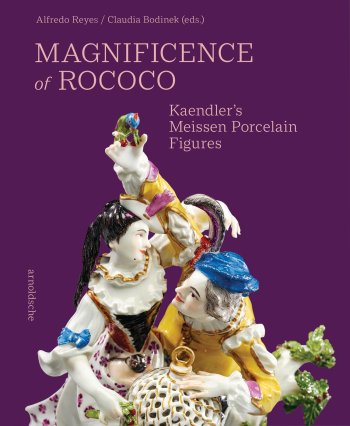
Alfredo Reyes and Claudia Bodinek, eds., Magnificence of Rococo: Kaendler’s Meissen Porcelain Figures (Stuttgart: Arnoldsche, 2024), 400 pages, ISBN: 978-3897907072, $135.










 Enfilade
leave a comment