New Book | Volcanic
From Yale UP:
John Brewer, Volcanic: Vesuvius in the Age of Revolutions (New Haven: Yale University Press, 2023), 544 pages, ISBN: 978-0300272666, £30 / $40.
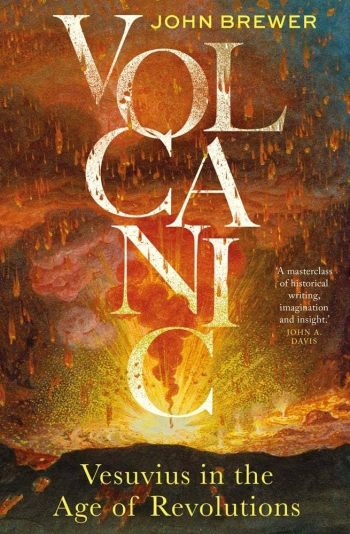 A vibrant, diverse history of Vesuvius and the Bay of Naples in the age of Romanticism
Vesuvius is best known for its disastrous eruption of 79CE. But only after 1738, in the age of Enlightenment, did the excavations of Herculaneum and Pompeii reveal its full extent. In an era of groundbreaking scientific endeavour and violent revolution, Vesuvius became a focal point of strong emotions and political aspirations, an object of geological enquiry, and a powerful symbol of the Romantic obsession with nature. John Brewer charts the changing seismic and social dynamics of the mountain, and the meanings attached by travellers to their sublime confrontation with nature. The pyrotechnics of revolution and global warfare made volcanic activity the perfect political metaphor, fuelling revolutionary enthusiasm and conservative trepidation. From Swiss mercenaries to English entrepreneurs, French geologists to local Neapolitan guides, German painters to Scottish doctors, Vesuvius bubbled and seethed not just with lava, but with people whose passions, interests, and aims were as disparate as their origins.
John Brewer is emeritus professor of humanities and social sciences at the California Institute of Technology and a faculty associate of the Harvard University History Department. His books include Pleasures of the Imagination, which won the Wolfson History Prize and was shortlisted for the National Book Awards.
A New Chapter for the Berger Prize
From The Walpole Society:
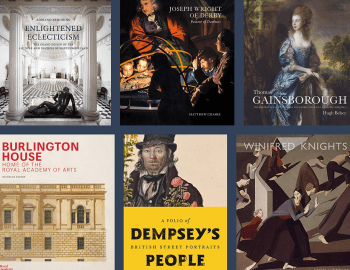 The Walpole Society is delighted to announce an agreement with the Berger Collection Educational Trust (BCET) to run the leading book prize for British art history, the Berger Prize. The Berger Prize celebrates brilliant writing and scholarship about the arts and architecture of the United Kingdom. The Walpole Society, which promotes the study of Britain’s art history, will deliver the Berger Prize from 2024, working alongside the BCET and Denver Art Museum, home of the Berger Collection of British art. The Walpole Society was appointed following the retirement of Robin Simon, co-founder and organiser of the prize since 2001. Chair of BCET trustees, Katherine MB Berger, and Dr Jonny Yarker, incoming chair of judges, paid tribute to Robin Simon at the 2023 Prize ceremony.
Several initiatives starting in 2024 will build on the Prize’s two decades of support for British art history, further broadening its reach:
• A new website to showcase the prize.
• The prize’s eligibility and rules, with a renewed commitment to governance and transparency, will be updated. Nominations for the 2024 prize close on 28 March.
• The incumbent prizewinner will deliver a lecture at the Denver Art Museum, home of the Berger Collection. The 2024 lecture by Tim Clayton is on 7 May.
• A summer event in London will announce the long list. In 2024 this will be on 28 June, when Tim Clayton will talk about his 2023 Berger Prizewinning book, James Gillray: A Revolution in Satire.
• New from 2024, each shortlisted book will receive a prize of £500. The 2024 shortlist will be announced at a virtual event on 15 September.
• The first prize of £5000 is the largest sum offered by any art history book prize. The winner of the 2024 Berger Prize will be presented on 15 November, at a ceremony at London’s Reform Club.
• A new podcast from The Walpole Society, launching in the latter part of 2024, will showcase brilliant writing and scholarship about the arts and architecture of the United Kingdom, with a focus on Berger Prize shortlisted authors.
• Walpole Society trustee, Dr Jonny Yarker, succeeds Robin Simon as chair of judges. Joining the panel in 2024 are Clare Hornsby, Chairwoman of The Walpole Society, and Angelica Daneo, Chief Curator at the Denver Art Museum. Click here for information about the 2024 prize jury.
Katherine MB Berger, Chairman of the Berger Collection Educational Trust (BCET), commented: “We are all so excited and we look forward to future vibrant initiatives—and to working together with The Walpole Society on our shared aim for promoting excellence in British art history.”
Clare Hornsby, Chairwoman of The Walpole Society, said: “We’re honoured to have been chosen by the Berger Collection Educational Trust to run the Berger Prize. The Prize feels like a natural fit for The Walpole Society, whose goals are so closely aligned with it and with the BCET. We intend the Prize in this new era to reach an even wider audience—in the UK, US, and internationally, whilst honouring its twenty year heritage established by Robin Simon and Katherine Berger.”
Incoming chair of Berger Prize judges, Dr Jonny Yarker, said: “British art history is extraordinary for its richness, range and creativity. I look forward to the Berger Prize both recognising the brilliance and dedication of researchers, whose books are often the summation of a life’s research, and also for the Prize to offer an annual snapshot of the field of studies in all its diversity and depth.”
New Book | The Beauty of the Flower
From Reaktion, with additional distribution by The University of Chicago Press:
Stephen Harris, The Beauty of the Flower: The Art and Science of Botanical Illustration (London: Reaktion Books, 2023), 336 pages, ISBN: 97-81789147803, £30 / $45.
 Featuring superb and rare images, this book reveals the fascinating stories behind botanical illustration.
In a world flooded with images designed to create memories, validate perceptions and influence others, botanical illustration is about creating technically accurate depictions of plants. Reproductions of centuries-old botanical illustrations frequently adorn greetings cards, pottery and advertising, to promote heritage or generate income, yet their art is scientific: its purpose is to record, display and transmit scientific data. The Beauty of the Flower shows us how scientific botanical illustrations are collaborations among artists, scientists and publishers. It explores the evolution and interchanges of these illustrations since the mid-fifteenth century, the ways in which they have been used to communicate scientific ideas about plants and how views of botanical imagery change. Featuring unique images rarely seen outside of specialist literature this book reveals the fascinating stories behind these remarkable illustrations.
Stephen A. Harris is an Associate Professor of Plant Sciences and curator of the herbarium at the University of Oxford. His books include Sunflowers (Reaktion, 2018) and Roots to Seeds: 400 Years of Oxford Botany (2021).
c o n t e n t s
Preface
1 Plant and Page
2 Themes and Trends
3 Science and Illustration
4 Blood and Treasure
5 Garden and Grove
6 Inside and Out
7 Habit and Habitat
8 Observe and Test
9 Sweat and Tears
Appendix: Plant Names
References
Further Reading
Acknowledgements
Photo Acknowledgements
Index
New Book | The Man Who Organized Nature
From Princeton UP:
Gunnar Broberg, The Man Who Organized Nature: The Life of Linnaeus, translated by Anna Paterson (Princeton: Princeton University Press, 2023), 512 pages, ISBN: 978-0691213422, £35 / $40.
 A new biography of Carl Linnaeus, offering a vivid portrait of Linnaeus’s life and work
Carl Linnaeus (1707–1778), known as the father of modern biological taxonomy, formalized and popularized the system of binomial nomenclature used to classify plants and animals. Linnaeus himself classified thousands of species; the simple and immediately recognizable abbreviation ‘L’ is used to mark classifications originally made by Linnaeus. This biography, by the leading authority on Linnaeus, offers a vivid portrait of Linnaeus’s life and work. Drawing on a wide range of previously unpublished sources—including diaries and personal correspondence—as well as new research, it presents revealing and original accounts of his family life, the political context in which he pursued his work, and his eccentric views on sexuality.
The Man Who Organized Nature describes Linnaeus’s childhood in a landscape of striking natural beauty and how this influenced his later work. Linnaeus’s Lutheran pastor father, knowledgeable about plants and an enthusiastic gardener, helped foster an early interest in botany. The book examines the political connections that helped Linnaeus secure patronage for his work, and untangles his ideas about sexuality. These were not, as often assumed, an attempt to naturalize gender categories but more likely reflected the laissez-faire attitudes of the era. Linnaeus, like many other brilliant scientists, could be moody and egotistical; the book describes his human failings as well as his medical and scientific achievements. Written in an engaging and accessible style, The Man Who Organized Nature—one of the only biographies of Linnaeus to appear in English—provides new and fascinating insights into the life of one of history’s most consequential and enigmatic scientists.
Gunnar Broberg (1942–2022) was professor emeritus of history of ideas and sciences at Lund University in Sweden. He was the author of numerous books, including Golden Apples, which won the August Prize for best Swedish nonfiction title of the year, and The History of the Night, which was nominated for Best Swedish History Book of the Year. Anna Paterson, a retired neuroscientist, is an award-winning translator and the author of Scotland’s Landscape: Endangered Icon.
New Book | A Delicate Matter
From The Pennsylvania State UP:
Oliver Wunsch, A Delicate Matter: Art, Fragility, and Consumption in Eighteenth-Century France (University Park: Penn State University Press, 2024), 192 pages, ISBN: 978-0271095288, $100.
 Eighteenth-century France witnessed an unprecedented proliferation of materially unstable art, from oil paintings that cracked within years of their creation to enormous pastel portraits vulnerable to the slightest touch or vibration. In A Delicate Matter, Oliver Wunsch traces these artistic practices to the economic and social conditions that enabled them: an ascendant class of art collectors who embraced fragile objects as a means of showcasing their disposable wealth. While studies of Rococo art have traditionally focused on style and subject matter, this book reveals how the physical construction of paintings and sculptures was central to the period’s reconceptualization of art. Drawing on sources ranging from eighteenth-century artists’ writings to twenty-first-century laboratory analyses, Wunsch demonstrates how the technical practices of eighteenth-century painters and sculptors provoked a broad transformation in the relationship between art, time, and money. Delicacy, which began the eighteenth century as a commodified extension of courtly sociability, was by century’s end reimagined as the irreducible essence of art’s autonomous value. Innovative and original, A Delicate Matter is an important intervention in the growing body of scholarship on durability and conservation in eighteenth-century French art. It challenges the art historical tendency to see decay as little more than an impediment to research, instead showing how physical instability played a critical role in establishing art’s meaning and purpose.
Oliver Wunsch is Assistant Professor of Art History at Boston College.
New Book | Color Charts: A History
With the original French edition (Nuanciers: éloge du subtil) published in October, the English translation is due in February from Princeton UP:
Anne Varichon, Color Charts: A History, translated by Kate Deimling (Princeton: Princeton University Press, 2024), 284 pages, ISBN: 978-0691255170, £45 / $55.
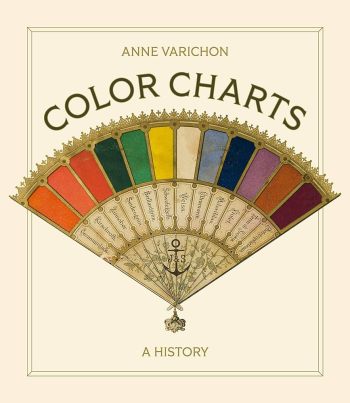 A beautifully illustrated history of the many inventive, poetic, and alluring ways in which color swatches have been selected and staged
The need to categorize and communicate color has mobilized practitioners and scholars for centuries. Color Charts describes the many different methods and ingenious devices developed since the fifteenth century by doctors, naturalists, dyers, and painters to catalog fragments of colors. With the advent of industrial society, manufacturers and merchants developed some of the most beautiful and varied tools ever designed to present all the available colors. Thanks to them, society has discovered the abundance of color embodied in a plethora of materials: cuts of fabric, leather, paper, and rubber; slats of wood and linoleum; delicate skeins of silk; careful deposits of paint and pastels; fragments of lipstick; and arrangements of flower petals. These samples shape a visual culture and a chromatic vocabulary and instill a deep desire for color.
Anne Varichon traces the emergence of modern color charts from a set of processes developed over the centuries in various contexts. She presents illuminating examples that bring this remarkable story to life, from ancient writings revealing attention to precise shade to contemporary designers’ color charts, dyers’ notebooks, and Werner’s famous color nomenclature. Varichon argues that color charts have linked generations of artists, artisans, scientists, industrialists, and merchants, and have played an essential and enduring role in the way societies think about color. Drawing on nearly two hundred documents from public and private collections, almost all of them previously unpublished, this wonderfully illustrated book shows how the color chart, in its many distinct forms and expressions, is a practical tool that has transcended its original purpose to become an educational aid and subject of contemplation worthy of being studied and admired.
Anne Varichon is an anthropologist specializing in material cultures and ideas about color. She is the author of Colors: What They Mean and How to Make Them.
Exhibition | Canops: Extraordinary Furniture for Charles III of Spain
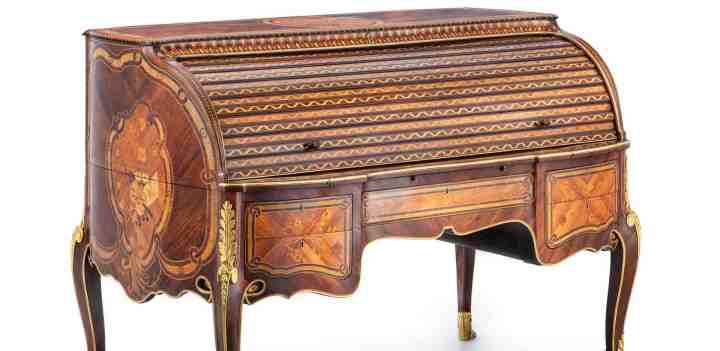
Madrid court workshop of Charles III under the direction of José Canops, Writing bureau with exotic marquetry decoration, ca. 1772–73
(Staatliche Museen zu Berlin, Kunstgewerbemuseum; photo by Stephan Klonk)
◊ ◊ ◊ ◊ ◊
Now on view at Berlin’s Museum of Decorative Arts, from the Staatliche Museen zu Berlin, with a related conference taking place 25–27 January:
Canops: Extraordinary Furniture for Charles III of Spain, 1759–1788
Kunstgewerbemuseum, Schloss Köpenick, Berlin, 12 October 2023 — 11 February 2024
Curated by Achim Stiegel
Although largely unknown today, the work of José Canops (1733–1814), an ébéniste of German descent born Joseph Cnops, and his Madrid workshop is one of the crowning achievements of European furniture-making.
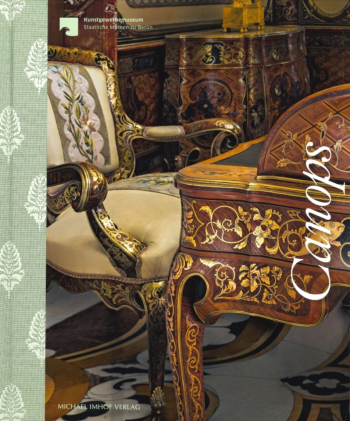 The furniture and boiseries are from the apartments of Charles III of Spain (r. 1759–1788), a Gesamtkunstwerk in exuberant rococo style conceived by the court painter and stuccoist Mattia Gasparini—a truly European creation inspired by Italian traditions, a taste for Parisian opulence, and the exotic worlds of Asia. Such elements combine in Canops’s work with the precision of German cabinetmaking and the riches of the Spanish colonies.
The starting point for the exhibition and publication was the acquisition for the Kunstgewerbemuseum of a magnificent roll-top desk by José Canops. With lavish new photography and never previously exhibited loans from the Patrimonio Nacional (the Spanish royal collections in Madrid), German and international audiences are afforded a glimpse into a hitherto hidden world.
In conjunction with the Spanish Embassy, the Ibero-Amerikanisches Institut of the Preußischer Kulturbesitz and Instituto Cervantes Berlin, the exhibition is accompanied by a programme of supporting events within the context of the 2023 Spanish presidency of the Council of the European Union.
Daniela Heinze, Achim Stiegel, et al., Canops: Möbel von Welt für Karl III. von Spanien (1759–1788), with photographs by Stephan Klonk (Petersberg: Michael Imhof Verlag, 2023), 288 pages, ISBN: 978-3731913689, €50.
The Decorative Arts Trust Announces New Publishing Grants
From the press release (11 December 2023) . . .
Publishing Grant for First-Time Authors or Recent PhD Graduates, up to $5000
Publishing Grant in Support of Catalogues and Conference Proceedings, up to $50,000
Proposals due by 31 March 2024
The Decorative Arts Trust announces the creation of a new publishing grant program. This latest expansion of the Trust’s efforts to invigorate scholarship and broaden appreciation of material culture represents a major initiative under the leadership of Brock Jobe and Margaret Pritchard, who serve as President and Vice President of the Board of Governors, respectively. The endeavor is structured to respond to the changing needs of the field and to support publishing efforts in both the print and digital sectors.
“The Trust’s Board recognizes the strong demand for and limited supply of resources focused on publishing in the art community,” according to Executive Director Matthew A. Thurlow. “The organization receives dozens of requests for funding each year for publishing-related projects through our Prize for Excellence and Innovation and Failey Grant program and has supported a variety of books through those awards. This new venture establishes a commitment to sharing important art historical research as broadly as possible.”
The Trust will allocate funding to two separate grants. Building on its long tradition of promoting emerging scholars, the Trust will award an annual grant of up to $5,000 to a first-time author or a PhD graduate who is converting their dissertation into a book-length academic publication. Academic presses are also able to apply on behalf of authors currently under contract.
The second grant line is applicable to exhibition and collections catalogues and compilations of conference papers. The Trust will provide up to $50,000 per year for this purpose, and proposals can request funding from $5,000 to the full $50,000, depending on the level of need. Both nonprofit organizations and independent scholars are welcome to apply. Project and publication teams that include early career professionals will receive preference.
To steward the program and oversee the selection of grant recipients, the Trust created a new advisory committee overseen by Pritchard. The committee consists of museum professionals and academics with broad experience in publishing. The members are eager for the opportunity to support publications tackling the broad context of the Americas and to encourage projects that advance diversity in the study of American decorative arts and material culture.
The deadline to submit proposals for the inaugural round of grants is 31 March 2024. More information and submission guidelines can be found here.
New Book | Futuristic Fiction, Utopia, and Satire
Coming in March from Brepols:
Giulia Iannuzzi, Futuristic Fiction, Utopia, and Satire in the Age of the Enlightenment: Samuel Madden’s ‘Memoirs of the Twentieth Century’ (1733) (Brepols, 2024), 460 pages, ISBN: 978-2503606026, €125.
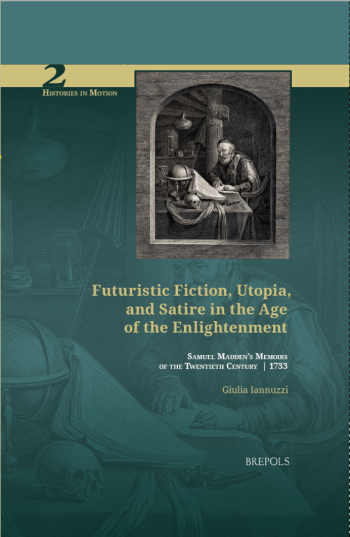 Published anonymously in 1733, Memoirs of the Twentieth Century is one of the earliest futuristic novels known in Anglophone and Euro-American literature. It foregrounds an acceleration of history brought about by an increasing degree of global interconnectedness and the exclusion of prophetism and astrology as credible ways to know the future. The work of Samuel Madden, an Irish writer and philanthropist of Whig sympathies, it consists of a collection of diplomatic letters composed in the 1990s, which the narrator claims were brought to him from the time to come by a supernatural entity. Through these correspondences, twentieth-century world scenarios are spread out before the reader, in which British naval power rules the waves and international commerce, while the transnational scheming of the Jesuits threatens the independence of weaker European courts.
This book—which includes a study followed by an annotated edition of the text—assesses the cultural significance of this literary work, as an apt observatory on how historical time as a cultural construction was shaped, during the eighteenth century, by new forms of transnational circulation of information, and by the dubious space carved out in European culture by seventeenth- and early eighteenth-century debates on the nature of historical knowledge. Through and by means of the Memoirs case study, this volume aims to contribute to a wider cultural history of the future and speculative fiction. The novel’s ironic distancing of beliefs considered to be superstitious and absurd—such as divination techniques and occult and magical disciplines—offers an exceptional testimony to the negotiation of the boundaries of verisimilitude and credibility within a religious enlightenment.
Giulia Iannuzzi has worked on the history of publishing and translation processes, and on the history of speculative imagination in a comparative perspective. Her articles have been published in academic journals such as History, History of Historiography, Cromohs, Perspectives, American Literary Scholarship, and Journal of Romance Studies.
c o n t e n t s
Introduction: Knowledge, Power, and Time in the Age of the Enlightenment
Part I | Samuel Madden’s Eighteenth-Century Memoirs from the Future
1 Where Was the Future?
2 When Was the Future?
3 An Irish Whig between Philanthropism and Literature
4 An Eighteenth-Century Twentieth Century
5 An (Unreliable) Historian of the Future
6 A ‘Good Genius’ and the ‘Scene of Things below’
7 Empirical Science, Global Consciousness, and ‘the History of Future Times’
8 Blurring the Dichotomy between History and Fiction
9 Satirising Past Futures
10 ‘Publishing’ the Letters
11 ‘This Prodigious Society’: Anti-Jesuit Satire
12 Whose Credulity, Whose Credibility
13 Bookish Mysteries and an ‘Alternate George VI’
14 Concluding Remarks
Part II | Memoirs of the Twentieth Century
A Note on the Text
Samuel Madden, Memoirs of the Twentieth Century
Notes to the Text
Bibliography
Index
New Book | Mozart in Italy
Published in the UK in October and coming to the American market in the spring; from Picador:
Jane Glover, Mozart in Italy: Coming of Age in the Land of Opera (London: Picador, 2023), 288 pages, ISBN: 978-1529059861, £25 / $30.
 At thirteen years old Wolfgang Amadeus Mozart was a child prodigy who had captured the hearts of northern Europe, but his father Leopold was now determined to conquer Italy. Together, they made three visits there the last when Mozart was seventeen, all vividly recounted here by acclaimed conductor Jane Glover. Father and son travelled from the theatres and concert salons of Milan to the church-filled streets of Rome to Naples, poorer and more dangerous than the prosperous north, and to Venice, the carnivalesque birthplace of public opera. All the while Mozart was absorbing Italian culture, language, style and art, and honed his craft. He met the challenge of writing Italian opera for Italian singers and audiences and provoked a variety of responses, from triumph and admiration to intrigue and hostility: in a way, these Italian years can be seen as a microcosm of his whole life. Evocative, beautifully written and with a profound understanding of eighteenth-century classical music, Mozart in Italy reveals how what he experienced during these Italian journeys changed Mozart—and his music—forever.
In Jane Glover’s long and hugely successful career as a conductor, she has been Music Director of the Glyndebourne Touring Opera, Artistic Director of The London Mozart Players, and, since 2002, is Music Director of Chicago’s Music of the Baroque. She has conducted all the major symphony and chamber orchestras in Britain, as well as many in the United States of America and across the world. She appears regularly at the BBC Proms and is a regular broadcaster, with highlights including a television series on Mozart. She is also the author of Mozart’s Women and Handel in London. She lives in London.










 Enfilade
leave a comment