Exhibition | James Gillray: Characters in Caricature
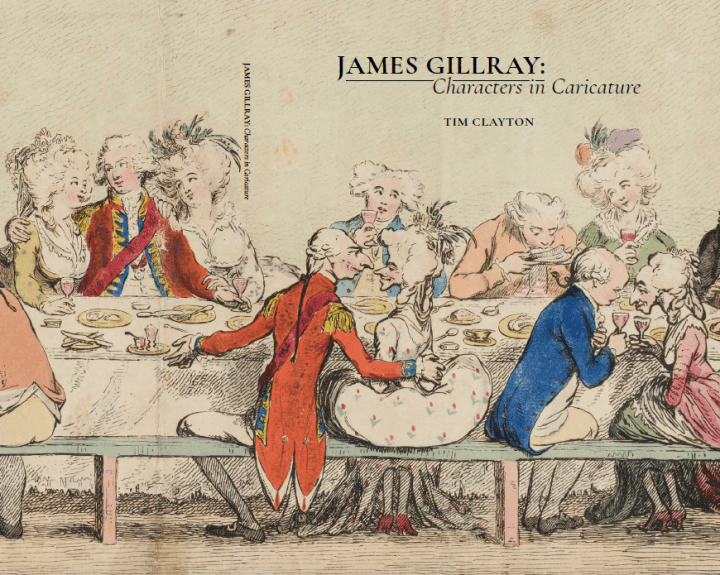
Now on view at Gainsborough’s House (which was just announced as the winner of The Georgian Group’s 2023 award for the ‘Restoration of a Georgian Building in an Urban Context’). . .
James Gillray: Characters in Caricature
Gainsborough’s House, Sudbury, 11 November 2023 — 10 March 2024
Curated by Tim Clayton
James Gillray (1756–1815) was Georgian Britain’s funniest, most inventive, and most celebrated graphic satirist. His work transcends his own time and has continued to influence his successors of the modern age, from David Low to Martin Rowson. Tim Clayton, author of 2022’s definitive biography of James Gillray, brings the master satirist to life in an astonishing, colourful, and at times salacious exhibition, James Gillray: Characters in Caricature. This lively and daring exhibition examines how Gillray exposed the most notorious scandals of his time by focusing on the artist’s principal characters—household names to which he returned to again and again, from Emma Hamilton to the Emperor Napoleon.
Tim Clayton, James Gillray: Characters in Caricature (Sudbury: Gainsborough’s House Society, 2023), ISBN: 978-0946511693, £20.
Print Quarterly, December 2023

J. J. Grandville, after Francisco de Goya, And So Was His Grandfather (‘Hasta su abuelo’), 1834, graphite, over stylus indentations, 79 × 119 mm
(Nancy: Musée des Beaux-Arts)
◊ ◊ ◊ ◊ ◊
The long eighteenth century in the latest issue of Print Quarterly:
Print Quarterly 40.4 (December 2023)
a r t i c l e s
• Thea Goldring, “Beyond Siberia: Drawings by Le Prince for the Histoire Générale des Voyages,” pp. 391–406.
This article examines two signed and dated drawings by Jean-Baptiste Le Prince (1734–1781) that were acquired by the Metropolitan Museum of Art in 2012 and identifies their origins and purpose, proving Le Prince’s hitherto unknown participation in the Histoire Générale des Voyages project. The author discusses their relationship with the commissioned illustrations to Voyage en Sibérie by Jean Chappe d’Auteroche (1728–1769), as well as Le Prince’s contribution to other illustrated books. Throughout the paper, there is a detailed analysis of his common practice to appropriate and modify visual information from earlier sources, reworking them for illustrated travel texts.

Jean-Baptiste Le Prince, Inuit Manner of Dress, 1769, pen and black ink, brush and grey wash, over black chalk, with additions in graphite, 170 × 120 mm (New York: The Metropolitan Museum of Art).
• Paula Fayos-Pérez, “La Fontaine, Goya, Grandville: A Study of Visual and Literary Sources,” pp. 406–419.
This article considers how J.J. Grandville (1803–1847) was deeply influenced by Francisco de Goya y Lucientes (1746–1828), particularly how the plates from the Caprichos inspired the former’s illustrations to Jean de la Fontaine’s Fables and other illustrated books. Incidentally, Goya had also previously derived his sources for the Caprichos and Desastres de la Guerra from earlier illustrations to La Fontaine’s 17th-century text. In doing so, the interconnection of literary and visual sources in both artists is revealed, highlighting their shared concern for public education and masked political undertones.
n o t e s a n d r e v i e w s
• Tim Clayton, Review of David Alexander, A Biographical Dictionary of British and Irish Engravers, 1714–1820 (Paul Mellon Centre for Studies in British Art and Yale University Press, 2021), pp. 442–43.
This review is just as much a praise of David Alexander’s research methods and resourcefulness as it is to the book’s groundbreaking contributions in this field. Clayton highlights the book’s revelations concerning invisible women engravers, who often worked alongside and carried on the business after their husbands had died. In keeping with Alexander’s wide area of focus, the book also includes native and foreign engravers in branches of the trade outside of fine art, leading to a far more expansive and representational dictionary than previous ones.
• Alexandra C. Axtmann, Review of Dominique Lerch, Kristina Mitalaité, Claire Rousseau and Isabelle Seruzier, eds., Les Images de Dévotion en Europe XVIe–XXIe Siècle. Une précieuse histoire (Bibliothèque Beauchesne, 2021), pp. 477–79.
This review summarises a copious book based on papers presented at a two-day conference in Paris in 2019 organized by the Dominican library of Le Saulchoir together with the Académie des Inscriptions et Belles-Lettres. The content offers a European-wide perspective on small printed devotional prints that are often considered ‘kitsch’, enabling them to be studied with a variety of approaches concerning their creation, function, and reception up to the present day.
New Book | The Art of the Chinese Picture-Scroll
Published by Reaktion and also distributed by The University of Chicago Press:
Shane McCausland, The Art of the Chinese Picture-Scroll (London: Reaktion Books, 2023), 299 pages, ISBN: 978-1789147964, £35 / $50.
 The Chinese picture-scroll, a long painting or calligraphic work held within a horizontal scrolling mount, has been China’s pre-eminent aesthetic format for the last two millennia. This first extended history of the picture-scroll explores its extraordinary longevity, and its adaptability to social, political, and technological change. The book describes what the picture-scroll demands of a viewer, how China’s artists grappled with its cultural power, and how collectors and connoisseurs have left their marks on scrolls for later generations to judge. The return to mass appeal of scrolling—a media technology that seemed long outdated yet persists in our digital age—provides urgent and fascinating context to this book.
Shane McCausland is Percival David Professor of the History of Art at SOAS University of London. His many books include The Mongol Century: Visual Cultures of Yuan China, 1271–1368 (Reaktion Books, 2014), and he has curated numerous exhibitions in Europe, North America, and China.
c o n t e n t s
Introduction
1 On Origins and Uses over the First Millennium
2 Inscribing the Artist and the Collector: The Picture-Scroll in the Song–Liao–Jin Period
3 Handscrolls in Mongol Palaces
4 Musing on Shadows: Reading the Ming Picture-Scroll
5 Qing: Reading the ‘Baroque’ Handscroll
6 Modernist Uses of the Chinese Picture-Scroll
7 The Medium of Silent Poetry in the Late Modern World
References
Further Reading
Acknowledgements
List of Illustrations
Index
New Book | East Asian Aesthetics and the Space of Painting
Isabelle Tillerot’s Orient et ornement: l’espace à l’oeuvre ou le lieu de la peinture was published in 2018; an English edition will soon be available from The Getty:
Isabelle Tillerot, East Asian Aesthetics and the Space of Painting in Eighteenth-Century Europe, translated by Chris Miller (Los Angeles: Getty Research Institute, 2024), 272 pages, ISBN: 978-1606067970 (paperback), $70.
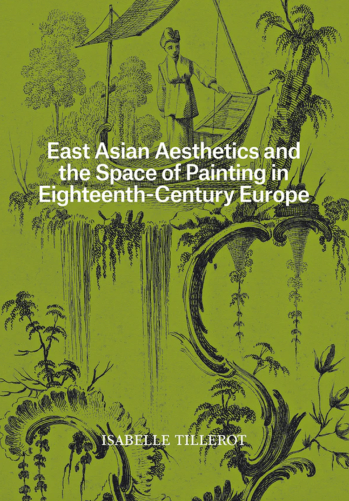 This volume offers the first critical account of how European imports of East Asian textiles, porcelain, and lacquers, along with newly published descriptions of the Chinese garden, inspired a revolution in the role of painting in early modern Europe. With particular focus on French interiors, Isabelle Tillerot reveals how a European enthusiasm for East Asian culture and a demand for novelty transformed the dynamic between painting and decor. Models of space, landscape, and horizon, as shown in Chinese and Japanese objects and their ornamentation, disrupted prevailing design concepts in Europe. With paintings no longer functioning as pictorial windows, they began to be viewed as discrete images displayed on a wall—and with that, their status changed from decorative device to autonomous work of art. This study presents a detailed history of this transformation, revealing how an aesthetic free from the constraints of symmetry and geometrized order upended paradigms of display, enabling European painting to come into its own.
Isabelle Tillerot is an independent scholar of eighteenth-century French art.
New Book | The Borders of Chinese Architecture
From Harvard UP:
Nancy Shatzman Steinhardt, The Borders of Chinese Architecture (Cambridge: Harvard University Press, 2022), 448 pages, ISBN: 978-0674241015, $57.
 An internationally acclaimed expert explains why Chinese-style architecture has remained so consistent for two thousand years, no matter where it is built.
For the last two millennia, an overwhelming number of Chinese buildings have been elevated on platforms, supported by pillars, and covered by ceramic-tile roofs. Less obvious features, like the brackets connecting the pillars to roof frames, also have been remarkably constant. What makes the shared features more significant, however, is that they are present in Buddhist, Daoist, Confucian, and Islamic milieus; residential, funerary, and garden structures; in Japan, Korea, Mongolia, and elsewhere. How did Chinese-style architecture maintain such standardization for so long, even beyond China’s borders?
Nancy Shatzman Steinhardt examines the essential features of Chinese architecture and its global transmission and translation from the predynastic age to the eighteenth century. Across myriad political, social, and cultural contexts within China and throughout East Asia, certain design and construction principles endured. Builders never abandoned perishable wood in favor of more permanent building materials, even though Chinese engineers knew how to make brick and stone structures in the last millennium BCE. Chinese architecture the world over is also distinctive in that it was invariably accomplished by anonymous craftsmen. And Chinese buildings held consistently to the plan of the four-sided enclosure, which both afforded privacy and differentiated sacred interior space from an exterior understood as the sphere of profane activity. Finally, Chinese-style buildings have always and everywhere been organized along straight lines. Taking note of these and other fascinating uniformities, The Borders of Chinese Architecture offers an accessible and authoritative overview of a tradition studiously preserved across time and space.
Nancy Shatzman Steinhardt is Professor of East Asian Art and Curator of Chinese Art at the University of Pennsylvania and the author of Chinese Architecture: A History (2019). Her work has been supported by the Guggenheim Foundation, Getty Foundation, National Endowment for the Humanities, and the American Philosophical Society.
c o n t e n t s
Preface
Introduction: The Borders Problem
1 Chinese Architecture before China
2 Han
3 Architecture before Reunification
4 Seeing the Sixth Century as the Seventh and Eighth
5 Tang Internationalism
6 Defining Chinse Architecture and Borders during Liao
7 Western Xia, Song, Japn, Jin
8 A Revisionist History of Yuan Architecture
9 Ming
10 The Long Eighteenth Century
Afterword
New Report | Survey of Asian Ceramics, National Trust for Scotland
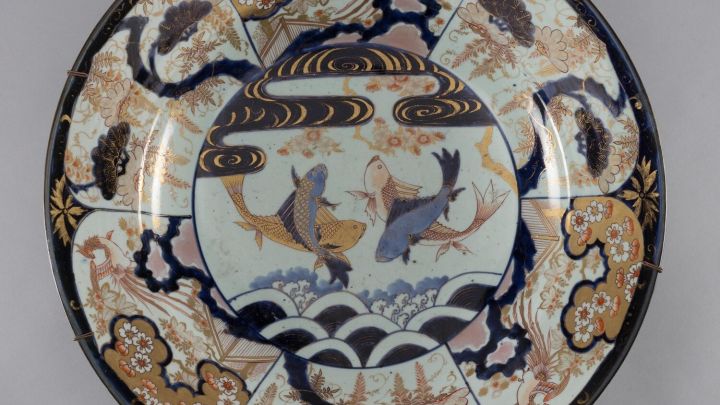
Large dish, porcelain, painted in underglaze blue, iron-red, and gold, Imari-type palette, made in Arita kilns, Japan, Edo period, c.1700–20
(National Trust for Scotland)
◊ ◊ ◊ ◊ ◊
The report was released early this year; Patricia Ferguson provides an introduction here. The full report is available (for free) as a PDF file here.
Patricia Ferguson, Survey of Asian Ceramics in the Collection of the National Trust for Scotland (National Trust for Scotland, 2023), 162 pages.
Between 2017 and 2019 the National Trust for Scotland delivered Project Reveal, a major collections project inventorying a collection of over 140,000 objects, distributed across 50 properties throughout Scotland. Encompassing major object groupings in the areas of fine and decorative art, household furniture and domestic life, these collections chart the experiences of people living in Scotland through 500 years of Scottish history, as well as demonstrating Scotland’s past relationships with the rest of the world.
This survey of Asian ceramics is a natural successor to Project Reveal. It delves deeper into the history and significance of a collection of circa 1,700 ceramic items. Undertaken by the independent researcher Patricia F. Ferguson this report sets out the survey findings, drawing together disparate existing research on the subject and contributing new collection research and knowledge. Focusing on key collections at nine different National Trust for Scotland properties, the report positions the collections within the broader context of historic ceramic production and collecting, with attention to influences such as: fashion and the role of royalty; production in and trade with China and Japan; and the growth of and changes in demand.
Patricia Ferguson is a ceramic specialist with an MA from the School of Oriental and African Studies (SOAS), London. She has worked in London at the British Museum and Victoria & Albert Museum, and as Honorary Adviser on Ceramics to the National Trust (England, Wales, and Northern Ireland). She published Ceramics: 400 Years of British Collecting in 100 Masterpieces in 2016.
New Book | Pockets: An Intimate History
We now have two books on pockets (Carlson’s joins that of Barbara Burman and Ariane Fennetaux, published by Yale UP in 2019). From Hachette Book Group:
Hannah Carlson, Pockets: An Intimate History of How We Keep Things Close (Algonquin Books, 2023), 320 pages, ISBN: 978-1643751542, $35.
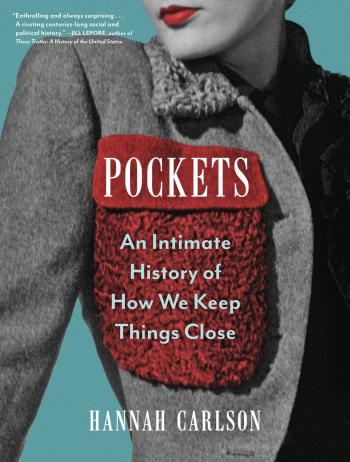 Who gets pockets, and why? It’s a subject that stirs up plenty of passion: Why do men’s clothes have so many pockets and women’s so few? And why are the pockets on women’s clothes often too small to fit phones, if they even open at all? In her captivating book, Hannah Carlson, a lecturer in dress history at the Rhode Island School of Design, reveals the issues of gender politics, security, sexuality, power, and privilege tucked inside our pockets.
Throughout the medieval era in Europe, the purse was an almost universal dress feature. But when tailors stitched the first pockets into men’s trousers five hundred years ago, it ignited controversy and introduced a range of social issues that we continue to wrestle with today, from concealed pistols to gender inequality. See: #GiveMePocketsOrGiveMeDeath.
Filled with incredible images, this microhistory of the humble pocket uncovers what pockets tell us about ourselves: How is it that putting your hands in your pockets can be seen as a sign of laziness, arrogance, confidence, or perversion? Walt Whitman’s author photograph, hand in pocket, for Leaves of Grass seemed like an affront to middle-class respectability. When W.E.B. Du Bois posed for a portrait, his pocketed hands signaled defiant coolness.
And what else might be hiding in the history of our pockets? (There’s a reason that the contents of Abraham Lincoln’s pockets are the most popular exhibit at the Library of Congress.) Thinking about the future, Carlson asks whether we will still want pockets when our clothes contain ‘smart’ textiles that incorporate our IDs and credit cards. Pockets is for the legions of people obsessed with pockets and their absence, and for anyone interested in how our clothes influence the way we navigate the world.
Hannah Carlson teaches dress history and material culture at the Rhode Island School of Design. After training as a conservator of costume and textiles at the Fashion Institute of Technology, she received a PhD in material culture from Boston University. She has contributed articles to Commonplace: The Journal of Early American Life; Dress; and MacGuffin: The Life of Things.
Exhibition | Pleasing Truths: Power and Portraits in the American Home
Closing this month at the DAR Museum, with a curatorial talk scheduled for the 12th.
Pleasing Truths: Power and Portraits in the American Home
Daughters of the American Revolution Museum, Washington, DC, 17 March — 31 December 2023
Curated by William Strollo

Unidentified French artist, Portrait of Elisabeth Has Haley, ca. 1810, oil on canvas, 32 × 38 inches (Washington, DC: DAR Museum, Gift of Sarah Hawkes Thornton, 75.189.2).
In 1754, artist Lawrence Kilburn advertised that “all Gentlemen and Ladies inclined to favour him in having their pictures drawn, that he don’t doubt of pleasing them in taking a true Likeness.” Kilburn’s advertisement, loaded with meaning, is one of many examples of advertisements placed by artists in the 18th and 19th centuries to garner portrait commissions. This ad reveals a lot about his, and other artists, potential clients, and their desires for being represented on canvas. In looking closer at portraits, subjects, artists, and the context in which they were produced, a deeper understanding of society is revealed—a society that valued power, personal leisure, and prescribed gender roles. This exhibition takes a deeper dive into the context and symbolism of early portraits to better understand the transmission of ideas and their impact on people over time.
William Strollo, Pleasing Truths: Power and Portraits in the American Home (Washington, DC: Daughters of the American Revolution Museum, 2023), 135 pages, $35.
◊ ◊ ◊ ◊ ◊
As noted at Events in the Field, the calendar maintained by The Decorative Arts Trust:
Curator’s Talk: William Strollo on Pleasing Truths
Online and in-person, DAR Museum, Washington, DC, 12 December 2023, noon
The exhibition Pleasing Truths: Power and Portraits in the American Home features over 50 portraits from the DAR Museum’s collection, dating from the 17th to the 19th centuries. In this talk, William Strollo, Curator of Exhibitions, will discuss the use of portraits to convey power and prestige and to reinforce traditional gender roles in the early American home. This free event will take place in-person and will also be streamed online; pre-registration is requested.
New Book | The Art of Mary Linwood
From Bloomsbury (and on sale for $76 until the 10th December) . . .
Heidi Strobel, The Art of Mary Linwood: Embroidery, Installation, and Entrepreneurship in Britain, 1787–1845 (London: Bloomsbury Visual Arts, 2023), 256 pages, ISBN: 978-1350428096, $120.
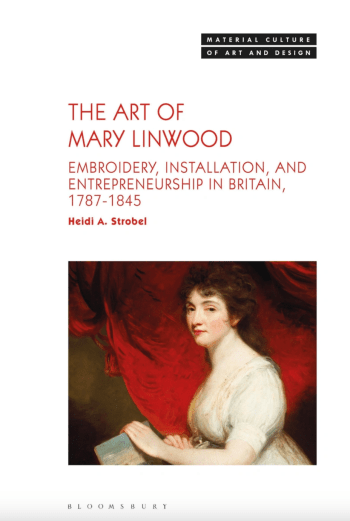 The first book on Leicester textile artist Mary Linwood, with a catalogue of her work
When British textile artist and gallery owner Mary Linwood died in 1845 just shy of 90 years old, her estate was worth the equivalent of £5,199,822 in today’s currency. As someone who made, but did not sell, embroidered replicas of famous artworks after artists such as Gainsborough, Reynolds, Stubbs, and Morland, how did she accumulate so much money? A pioneering woman in the male-dominated art world of late Georgian Britain, Linwood established her own London gallery in 1798 that featured copies of well-known paintings by these popular artists. Featuring props and specially designed rooms for her replicas, she ensured that her visitors had an entertaining, educational, and kinetic tour, similar to what Madame Tussaud would do one generation later. The gallery’s focus on picturesque painters provided her London visitors with an idyllic imaginary journey through the countryside. Its emphasis on quintessentially British artists provided a unifying focus for a country that had recently emerged from the threat of Napoleonic invasion.
This book brings to the fore Linwood’s gallery guides and previously unpublished letters to her contemporaries, such as Birmingham inventor Matthew Boulton and Queen Charlotte. It also includes the first and only catalogue of Linwood’s extant and destroyed works. By examining Linwood’s replicas and their accompanying objects through the lens of material culture, the book provides a much-needed contribution to the scholarship on women and cultural agency in the early 19th century.
Heidi A. Strobel is Associate Dean of Academic and Student Affairs at the University of North Texas.
c o n t e n t s
Acknowledgements
List of Plates
List of Figures
Introduction
1 Embroidery, Education, and Commerce: Linwood’s Early Years
2 The Pantheon and Hanover Square Exhibitions
3 Portraiture, Publications, and Promotion
4 The Leicester Square Gallery: Performing British Patriotism
5 Of Students and Studying: The Academic Tradition and the Scripture Room
6 Linwood’s Legacies
Appendix: Catalogue of Linwood’s Textiles
Notes
Bibliography
New Book | National Museum of Women in the Arts Collection Highlights
Following a two-year closure, the National Museum of Women in Arts, reopened in October (with details available in this press release). Complementing the renovation is this new publication from Hirmer and distributed by The University of Chicago Press:
National Museum of Women in the Arts Collection Highlights (Munich: Hirmer Verlag, 2023), 264 pages, ISBN: 978-3777441696, $60.
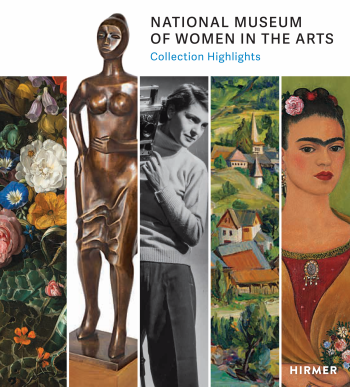 The National Museum of Women in the Arts, Washington, DC, is the first museum in the world solely dedicated to championing women through the arts. Drawing from a collection that spans five centuries and includes artists from six continents, this publication spotlights new additions to the museum as well as longstanding highlights. Vibrant images present over 175 works from the museum’s collections, including key artworks by Louise Bourgeois, Lalla Essaydi, Frida Kahlo, Hung Liu, Clara Peeters, Faith Ringgold, Niki de Saint Phalle, Amy Sherald, Alma Woodsey Thomas, and many others. Thematic chapters weave connections across medium, genre, and time. Essays by museum curators and more than thirty guest artists and scholars illuminate the mission of NMWA and help readers discover great women artists.










 Enfilade
leave a comment