New Book | Heroines and Local Girls
First published in 2019, Heroines and Local Girls was awarded the 2022 Laura Shannon Prize in Contemporary European Studies by the Nanovic Institute for European Studies at the University of Notre Dame; it’s scheduled for paperback release in February.
Pamela Cheek, Heroines and Local Girls: The Transnational Emergence of Women’s Writing in the Long Eighteenth Century (Philadelphia: University of Pennsylvania Press, 2019), 280 pages, ISBN: 978-0812251487 (hardcover), $85 / ISBN: 978-1512826166 (paperback), $30.
 Over the course of the long eighteenth century, a network of some fifty women writers, working in French, English, Dutch, and German, staked out a lasting position in the European literary field. These writers were multilingual and lived for many years outside of their countries of origin, translated and borrowed from each others’ works, attended literary circles and salons, and fashioned a transnational women’s literature characterized by highly recognizable codes. Drawing on a literary geography of national types, women writers across Western Europe read, translated, wrote, and rewrote stories about exceptional young women, literary heroines who transcend the gendered destiny of their distinctive cultural and national contexts. These transcultural heroines struggle against the cultural constraints determining the sexualized fates of local girls.
In Heroines and Local Girls, Pamela L. Cheek explores the rise of women’s writing as a distinct, transnational category in Britain and Europe between 1650 and 1810. Starting with an account of a remarkable tea party that brought together Frances Burney, Sophie von La Roche, and Marie Elisabeth de La Fite in conversation about Stéphanie de Genlis, she excavates a complex community of European and British women authors. In chapters that incorporate history, network theory, and feminist literary history, she examines the century-and-a-half literary lineage connecting Madame de Maintenon to Mary Wollstonecraft, including Charlotte Lennox and Françoise de Graffigny and their radical responses to sexual violence. Neither simply a reaction to, nor collusion with, patriarchal and national literary forms but, rather, both, women’s writing offered an invitation to group membership through a literary project of self-transformation. In so doing, argues Cheek, women’s writing was the first modern literary category to capitalize transnationally on the virtue of identity, anticipating the global literary marketplace’s segmentation of affinity-based reading publics, and continuing to define women’s writing to this day.
Pamela L. Cheek is Professor of French and Comparative Literature at the University of New Mexico and author of Sexual Antipodes: Enlightenment Globalization and the Placing of Sex.
c o n t e n t s
Preface
1 Networks of Women Writers, circa 1785–87
2 Two Quarrels
3 Ravishing and Romance Language
4 The Repertoire of the School for Girls
5 Heroines and Local Girls
6 Heroines in the World
Notes
Works Cited
Index
Acknowledgments
Exhibition | Maestras
Now on view at the Thyssen:
Maestras / Women Masters
Museo Nacional Thyssen-Bornemisza, Madrid, 31 October 2023 — 4 February 2024
Curated by Rocío de la Villa
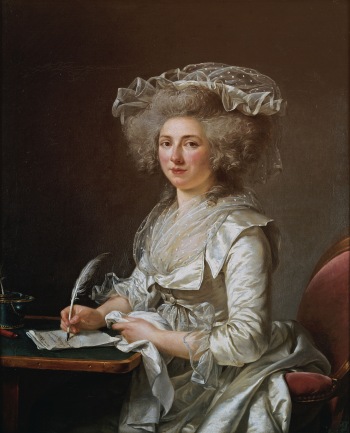
Adélaïde Labille-Guiard, Portrait of a Woman, ca. 1787, oil on canvas. 100 × 81 cm (Musée des Beaux-Arts de Quimper).
Artemisia Gentileschi, Angelica Kauffmann, Clara Peeters, Rosa Bonheur, Mary Cassatt, Berthe Morisot, María Blanchard, Natalia Goncharova, Sonia Delaunay, and Maruja Mallo were celebrated artists in their lifetimes who are now enjoying renewed recognition in response to their erasure from the art-historical account alongside others who broke moulds with creations of undoubted excellence. Featuring nearly 100 works—including paintings, sculptures, works on paper, and textiles—Maestras is curated from a feminist viewpoint by Rocío de la Villa. The exhibition presents a survey from the late 16th century to the early decades of the 20th century through eight contexts important within women’s path towards emancipation. Starting from the contemporary notion of sisterhood, it focuses on groups of female artists, patrons, and gallerists who shared values as well as favourable socio-cultural and theoretical conditions despite the patriarchal system. Employing a structure principally based on the conjunction of historical periods, artistic genres, and themes, the exhibition reveals how these artists approached important issues of their day, established their positions, and contributed new iconographies and alternative gazes.
The exhibition is divided into eight sections:
• Sisterhood I. The Causa delle Donne
• Botanists, Well-Versed in Wonders
• Enlightened Women and Academicians
• Orientalism / Genre Painting
• Workers, Carers
• New Portrayals of Motherhood
• Sisterhood II. Rapport
• Emancipated Women
Women Masters is the first major exhibition to reflect the process of feminist rethinking on which the Museo Thyssen has been engaged over the past few years. It benefits from the collaboration of the Comunidad de Madrid and sponsored by Carolina Herrera. After its presentation in Madrid, a reduced version of the exhibition can be seen at the Arp Museum Bahnhof Rolandseck in Remagen (Germany).
Rocío de la Villa, Haizea Barcenilla, Ana Martínez-Collado, and Marta Mantecón, Maestras (Madrid: Museo Nacional Thyssen-Bornemisza, 2023), 256 pages, ISBN: 978-8417173784, €38. Spanish with appendix with texts in English.
Exhibition | Berthe Morisot and the Art of the 18th Century
Now on view at the Musée Marmottan Monet:
Berthe Morisot et l’art du XVIIIe siècle: Watteau, Boucher, Fragonard, Perronneau
Dulwich Picture Gallery, London, 31 March — 10 September 2023
Musée Marmottan Monet, Paris, 18 October 2023 — 3 March 2024
Curated by Marianne Mathieu and Dominique d’Arnoult, with Claire Gooden
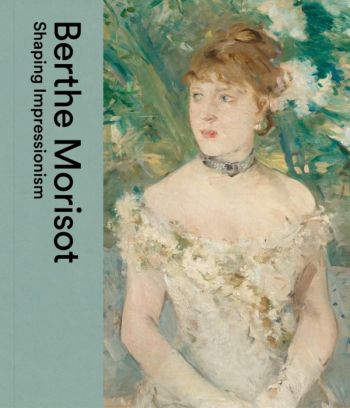 From 18 October 2023 to 3 March 2024, the Musée Marmottan Monet will present a very special exhibition, entitled Berthe Morisot and the Art of the 18th Century: Watteau, Boucher, Fragonard, Perronneau. The exhibition is curated by art historians Marianne Mathieu and Dominique d’Arnoult, with the participation of Claire Gooden, Head of Conservation at the Musée Marmottan Monet. Sixty-five art works from French and international museums, as well as private collections are brought together here for the first time to highlight the links between the work of the first female Impressionist Berthe Morisot (1841-1895) and the art of Antoine Watteau (1684–1721), François Boucher (1703–1770), Jean-Honoré Fragonard (1732–1806), and Jean-Baptiste Perronneau (1715–1783). Based on an analysis of mainly unpublished sources (letters, press clippings, and notebooks belonging to Berthe Morisot and her husband Eugène Manet and their entourage) and an in-depth genealogical study, this exhibition and the corresponding catalogue shed new light on a subject often mentioned by historians yet never having been the focus of dedicated and exhaustive research. While it has been demonstrated that Berthe Morisot is not Fragonard’s great-grand-niece and had no family ties to him, the exhibition nevertheless emphasizes the veritable foundations of their artistic affinities, retracing the chronology of their development, as well as their main characteristics.
Berthe Morisot: Shaping Impressionism (London: Dulwich Picture Gallery, 2023), 210 pages, ISBN: 978-1898519485, $40.
New Book | Practices of Ephemera in Early Modern England
The volume focuses on materials produced before 1700, though the final essay addresses 18th-century trade cards. From Routledge:
Callan Davies, Hannah Lilley, and Catherine Richardson, eds., Practices of Ephemera in Early Modern England (New York: Routledge, 2023), 252 pages, ISBN: 978-0367528362 (hardback), $160 / ISBN: 978-1003058588 (ebook), $40.
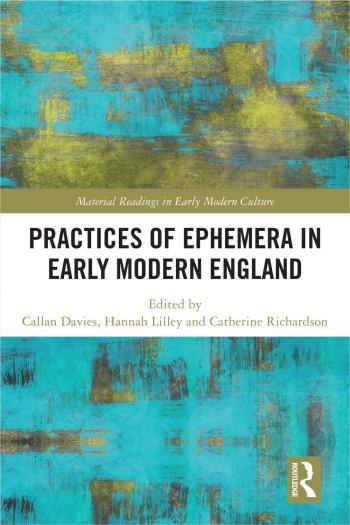 This collection is the first to historicise the term ephemera and its meanings for early modern England and considers its relationship to time, matter, and place. It asks: how do we conceive of ephemera in a period before it was routinely employed (from the eighteenth century) to describe ostensibly disposable print? In the sixteenth and seventeenth centuries—when objects and texts were rapidly proliferating—the term began to acquire its modern association with transitoriness. But contributors to this volume show how ephemera was also integrally related to wider social and cultural ecosystems. Chapters explore those ecosystems and think about the papers and artefacts that shaped homes, streets, and cities or towns and their attendant preservation, loss, or transformation. The studies here therefore look beyond static records to think about moments of process and transmutation and accordingly get closer to early modern experiences, identities, and practices.
c o n t e n t s
Acknowledgements
List of Illustrations
Biographies
1 Introduction: Spawning
Concepts/ Emerging
2 Megan Heffernan — Expired Time: Archiving Waste Manuscripts
3 Anna Reynolds — What Do Texts and Insects Have in Common?; or, Ephemerality before Ephemera
3 Bruce Boehrer — Time’s Flies: Ephemerality in the Early Modern Insect World
4 Robert Bearman — What Is an ‘Ephemeral Archive’? Stratford-upon-Avon, 1550–1650: A Case Study
5 Alison Wiggins — Paper and Elite Ephemerality
Matter / Metamorphosing
6 Elaine Leong — Recipes and Paper Knowledge
7 Katherine Hunt — More Lasting than Bronze: Statues, Writing, and the Materials of Ephemera in Ben Jonson’s Sejanus His Fall
8 Hannah Lilley — Uncovering Ephemeral Practice: Itineraries of Black Ink and the Experiments of Thomas Davis
9 Helen Smith — Things That Last: Ephemerality and Endurance in Early Modern England
Environments / Buzzing
10 Michael Lewis — Toy Coach from London
11 Jemima Matthews — Maritime Ephemera in Walter Mountfort’s The Launching of the Mary
12 Callan Davies — Playing Apples and the Playhouse Archive
13 William Tullet — Extensive Ephemera: Perfumer’s Trade Cards in Eighteenth-Century England
Paul Mellon Centre Book Night

From the PMC:
Winter Book Night
Paul Mellon Centre, London, 13 December 2023, 5.30pm
Join us for our winter Book Night to celebrate our latest publications. Each author will give a short talk discussing the research behind their book, followed by the opportunity to ask questions. Afterwards, there will be drinks, canapes, and a chance to meet the authors.
Session 1
• Finola O’Kane, Landscape Design and Revolution in Ireland and the United States
• Mark Crinson, Shock City: Image and Architecture in Industrial Manchester
Session 2
• Tim Clayton, James Gillray: A Revolution in Satire
• Tom Young, Unmaking the East India Company: British Art and Political Reform in Colonial India, c. 1813–1858
• Kirsty Sinclair Dootson, The Rainbow’s Gravity: Colour, Materiality and British Modernity
◊ ◊ ◊ ◊ ◊
And Clayton’s book was recently named Book of the Year by Apollo.
New Book | The Art of the Illustrated Book
From Thames & Hudson:
Julius Bryant, ed., The Art of the Illustrated Book: History and Design (London: Thames & Hudson, 2022), 288 pages, ISBN: 978-0500480694, £45 / $60.
 This is the story of the illustrated book, from the earliest printed examples to the present day, told through the collections of the National Art Library at the Victoria and Albert Museum, London—a library that was created to bring together examples of superlative book-making on almost every subject. Gathered here are some of the most influential, compelling and striking examples of the illustrated book, arranged thematically in chapters devoted to subjects such as art, literature, religion, architecture, natural history, fashion, and shopping. Brimming with innovative and beautiful examples, ranging from well-known titles, such as Owen Jones’s Grammar of Ornament and James Audubon’s Birds of America, to other wonderful but less familiar publications, this collection offers a fascinating overview of some of the finest illustrated books ever created—demonstrating their enduring appeal.
Julius Bryant is the Emeritus Keeper of the Victoria and Albert Museum.
c o n t e n t s
Introduction
1 Religion
2 Natural History
3 Travel
4 Fables & Folk Tales
5 Literature
6 Art Making
7 Art History
8 Architecture
9 Ornament and Pattern
10 Festivals
11 World Fairs
12 Fashion
13 Shopping
New Book | In the Shadow of St. Paul’s Cathedral
Now available in paperback from Yale UP:
Margaret Willes, In the Shadow of St. Paul’s Cathedral: The Churchyard that Shaped London (New Haven: Yale University Press, 2022), 320 pages, ISBN: 978-0300249835 (hardcover), $35 / ISBN: 978-0300273380 (paperback), $17.
 The extraordinary story of St. Paul’s Churchyard—the area of London that was a center of social and intellectual life for more than a millennium
St. Paul’s Cathedral stands at the heart of London, an enduring symbol of the city. Less well known is the neighborhood at its base that hummed with life for over a thousand years, becoming a theater for debate and protest, knowledge, and gossip. For the first time Margaret Willes tells the full story of the area. She explores the dramatic religious debates at Paul’s Cross, the bookshops where Shakespeare came in search of inspiration, and the theater where boy actors performed plays by leading dramatists. After the Great Fire of 1666, the Churchyard became the center of the English literary world, its bookshops nestling among establishments offering luxury goods. This remarkable community came to an abrupt end with the Blitz. First the soaring spire of Old St. Paul’s and then Wren’s splendid Baroque dome had dominated the area, but now the vibrant secular society that had lived in their shadow was no more.
Margaret Willes, formerly publisher at the National Trust, is author of several books, including The Curious World of Samuel Pepys and John Evelyn, Reading Matters, and The Gardens of the British Working Class. She lives in London.
New Book | The Notebook
From Profile Books:
Roland Allen, The Notebook: A History of Thinking on Paper (London: Profile Books, 2023), 416 pages, ISBN: 978-1788169325, £25.
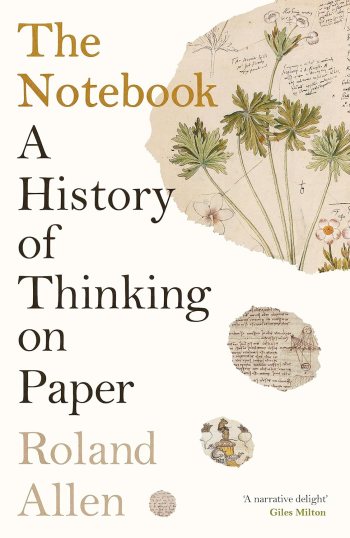 Diaries, sketchbooks, common-places, notebooks, ledgers, and ships’ logs: how the blank book changed the way we think, and helped us change the world. The first history of the notebook, a simple invention that changed the way the world thinks.
We see notebooks everywhere we go. But where did this simple invention come from? How did they revolutionise our lives, and why are they such powerful tools for creativity? And how can using a notebook help you change the way you think? In this wide-ranging story, Roland Allen reveals all the answers. Ranging from the bustling markets of medieval Florence to the quiet studies of our greatest thinkers, he follows a trail of dazzling ideas, revealing how the notebook became our most dependable and versatile tool for creative thinking. He tells the notebook stories of artists like Leonardo and Frida Kahlo, scientists from Isaac Newton to Marie Curie, and writers from Chaucer to Henry James. We watch Darwin developing his theory of evolution in tiny pocketbooks, see Agatha Christie plotting a hundred murders in scrappy exercise books, and learn how Bruce Chatwin unwittingly inspired the creation of the Moleskine. On the way we meet a host of cooks, kings, sailors, fishermen, musicians, engineers, politicians, adventurers, and mathematicians, who all used their notebooks as a space for thinking and to shape the modern world. In an age of AI and digital overload, the humble notebook is more relevant than ever. Allen shows how bullet points can combat ADHD, journals can ease PTSD, and patient diaries soften the trauma of reawakening from coma. The everyday act of moving a pen across paper can have profound consequences, changing the way we think and feel: making us more creative, more productive—and happier.
Roland Allen is a publisher and author who lives in Hove. He studied at Manchester University and works in book (and notebook) publishing. He has written about subjects as diverse as bicycles and bread, kept a diary for decades, and enjoys stationery a little too much.
New Book | Liotard: A Portrait of Eighteenth-Century Europe
In October, Christopher Baker was announced as the incoming editor of The Burlington Magazine (replacing Michael Hall, who has held the position since 2017). Baker’s book on Liotard has just been published in the UK by Unicorn and will be available in the US market soon.
Christopher Baker, Liotard: A Portrait of Eighteenth-Century Europe (Lewes: Unicorn Publishing Group, 2023), 176 pages, ISBN: 978-1911397595, £30 / $45.
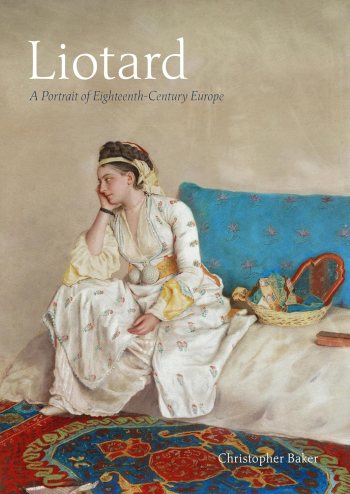 Jean Etienne Liotard (1702–1789) was one of the most accomplished, idiosyncratic, and witty artists of eighteenth-century Europe. Born in Geneva, he pursued a remarkable career, travelling across the continent and the Near East, portraying a riveting cross-section of society. Liotard worked in Paris, London, Amsterdam, Venice, Constantinople, and Vienna and excelled as a specialist in the delicate art of pastel. He became renowned for the uncanny realism of his portraits as well as the beauty of his drawings, while also experimenting with watercolour, oil painting, printmaking, and enamels. In Britain he enjoyed notoriety because of his exotic persona, and received commissions from royalty, aristocrats, grand tourists, and celebrities. Liotard: A Portrait of Eighteenth-Century Europe plots the career and practice and reputation of an extraordinary artist who deserves to be better known. This new study throws light on the wider cultural environment he navigated, illuminating connected themes, including fashion history, orientalism, and the promotion and display of portraits in the public and private spheres of Enlightenment Europe.
Christopher Baker is an art historian, curator, and author; he has been a Director at the National Galleries of Scotland and worked at Christ Church, Oxford, and the National Gallery in London. Christopher has also held Visiting Fellowships at Yale University and the British School in Rome and organised numerous highly successful exhibitions, chiefly on 18th- and 19th-century British and European art and the history of collecting.
The Burlington Magazine, November 2023
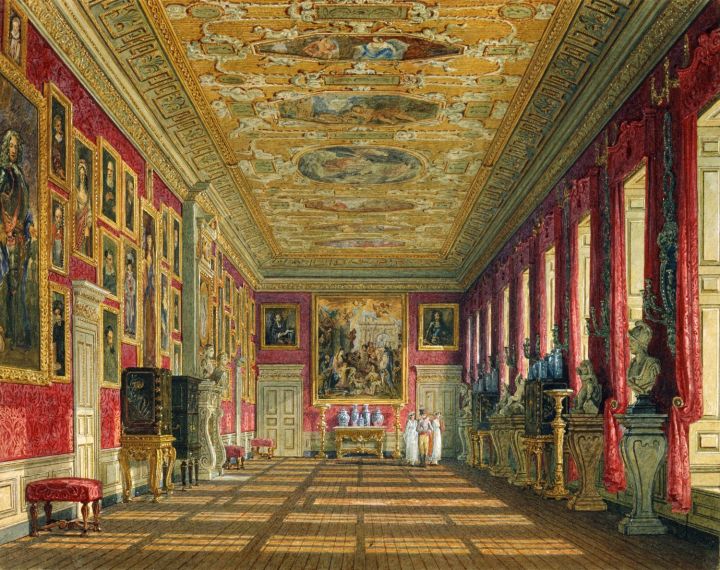
Charles Wild, Kensington Palace: The King’s Gallery, 1816, watercolour with touches of bodycolour over etched outlines, 20 × 25 cm c
(Royal Collection Trust, 922158)
◊ ◊ ◊ ◊ ◊
The eighteenth century in the November issue of The Burlington, which focuses on sculpture:
The Burlington Magazine 165 (November 2023)
e d i t o r i a l
• History of Art after Brexit, p. 1171.
It is probably fair to say that the United Kingdom’s withdrawal from the European Union in 2020 as a consequence of the referendum of 2016 was not greeted with much enthusiasm by professional art historians. The subject as it has developed over the past century is by its very nature transnational in outlook.
 a r t i c l e
• Jonathan Marsden, “George I’s Kensington Palace: The Sculptural Dimension,” pp. 1196–1205.
William Kent’s decoration of the new state rooms at Kensington Palace, London, for George I in 1722–27 has long been recognised as a pioneering exercise in neo-Palladianism. It was also an early example of the use of Classical sculpture in English interiors, a development in which Michael Rysbrack played a larger role than has formerly been recognised.
s h o r t e r n o t i c e
• Nicola Ciarlo, “Domenico Guidi in Padula: A Rediscovered Annunciation,” pp. 1206–09.
r e v i e w s
• Adriano Aymonino, “Albanimania,” pp. 1214–19.
A series of recent publications has turned the spotlight on Cardinal Alessandro Albani—described by Winckelmann as ‘the greatest patron in the world’—his villa in Rome, and collection of Classical antiquities, which have become newly accessible to scholars and the public after decades of seclusion.
• Heather Hyde Minor, Review of the exhibition catalogue, Victor Plahte Tschudi, Piranesi and the Modern Age (Nationalmuseum, Oslo / MIT Press, 2022), pp. 1239–41.
• Adam Bowett, Review of Ada De Wit, Grinling Gibbons and His Contemporaries (1650–1700): The Golden Age of Woodcarving in the Netherlands and Britain (Brepols, 2022), pp. 1247–49.
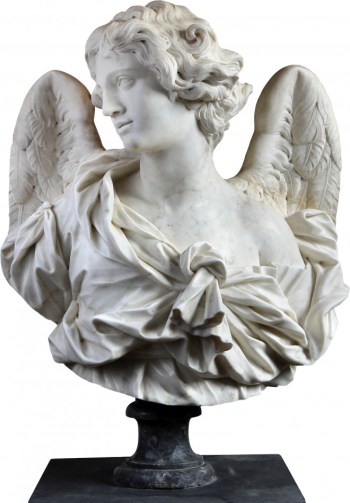
Archangel Gabriel, attributed by Nicola Ciarlo to Domenico Guidi, ca.1699–1701, marble, 94 × 81 × 39 cm, with socle (Padula: Charterhouse of S. Lorenzo).
• Marjorie Trusted, Review of Jan Zahle, Thorvaldsen: Collector of Plaster Casts from Antiquity and the Early Modern Period, 3 volumes (Thorvaldsens Museum and Aarhus University Press, 2020), pp. 1249–50.
• Natacha Coquery, Review of Iris Moon, Luxury after the Terror (Pennsylvania State University Press, 2022), pp. 1254–56.
• Joshua Mardell, Review of Jane Grenville, Pevsner’s Yorkshire, North Riding (Yale University Press, 2023), pp. 1256–57.
o b i t u a r y
• Paul Williamson, Obituary for Michael Kauffmann (1931–2023), pp. 1258–60.
Keeper of the Department of Prints & Drawings and Paintings at the Victoria and Albert Museum and subsequently Director of the Courtauld Institute of of Art, Michael Kauffmann was a scholar with a remarkable breadth of interest, as well as a widely respected and sensitive administrator and manager.
s u p p l e m e n t
• “Recent Acquisitions (2007–2023) of European Sculpture at the Victoria and Albert Museum, London,” pp. 1261–68.
Seventeen years have passed since the publication of the last supplement in this Magazine describing the recent sculpture acquisitions made by the Victoria and Albert Museum, London (V&A). The present supplement therefore highlights a selection of the most noteworthy works acquired in the intervening years.










 Enfilade
leave a comment