Print Quarterly, September 2023
The long eighteenth century in the latest issue of Print Quarterly:
Print Quarterly 40.3 (September 2023)
a r t i c l e s
 • Vitalii Tkachuk, “Averkiy Kozachkovskyi and Western Sources of Kyiv Prints, 1720s–40s,” pp. 265–86.
This article features the oeuvre of the Ukrainian engraver Averkiy Kozachkovskyi (active 1721–46), whose illustrated output by the press of the Orthodox monastery Kyiv of the Caves (Kyiv Pechersk Lavra) numbers about forty engravings. He primarily produced book illustrations, but also illustrated printed oaths taken by new members of the local student confraternity. His sources derived largely from seventeenth- and eighteenth-century Catholic imagery from German, Flemish, and French schools, several of which are discussed in detail throughout the article, especially the compositions of Peter Paul Rubens. Such borrowings testify to the willingness of Orthodox recipients to accept imagery—unaltered in iconography or style—stemming from other denominations and cultures. The paper contributes to our knowledge of Ukrainian engraving and to the study of the global transfer of images during the early modern period.
• Nicholas J.S. Knowles, “Thomas Rowlandson’s The Women of Muscovy and Other Russeries after Jean-Baptiste Le Prince,” pp. 287–301.
This article discusses a previously unidentified series of prints by Thomas Rowlandson (1757–1827), after Jean-Baptiste Le Prince (1734–1781), mentioned only as a single lot in the sale of his art collection and studio contents. No definitive set of these “Various Dresses of the Women in Muscovy” has been found, but the author has identified several substantial groups in public and private collections; the largest of these, with twenty-two prints, is in the British Museum. Most of these Rowlandson impressions reside among Le Prince originals and have previously been catalogued as by or after Le Prince. As a series overall, five hundred and forty impressions are claimed to have been produced in the lot description. The article continues with an in-depth discussion of the series and its context. An appendix lists all known impressions of Rowlandson’s Women of Muscovy prints and their location.
n o t e s a n d r e v i e w s
• Mark McDonald, Review of Susan Stewart, The Ruins Lesson: Meaning and Material in Western Culture (The University of Chicago Press, 2020), pp. 322–25. This book explores the significance of ruins in Western art and literature, paying close attention to the evidentiary role of prints and how the printmaking process parallels the ruinous lifecycle of its subject matter. In the review, Piranesi is cited as a fascinating example of creating trompe l’oeil in his prints, while later discussions focus on the discovery and metaphorical associations of Rome’s antique ruins in the eighteenth century.
• David Bindman, Review of the exhibition catalogue, Edina Adam and Julian Brooks, William Blake: Visionary (Getty Publications, 2020), pp. 330–31. This brief review pertains to a previously rescheduled, now forthcoming, exhibition on William Blake at the J. Paul Getty Museum. The author examines the collecting of Blake in America and some of the curatorial choices for this anticipated show.
 • Patricia Mainardi, Review of Pascal Dupuy and Rolf Reichardt, La caricature sous le signe des révolutions. Mutations et permanences, XVIIIe–XIXe siècles (Presses Universitaires de Rouen et du Havre, 2021), pp. 331–34. This book and review introduce the origins and rapid development of caricature during the French Revolutionary period, focusing on how topical imagery and signs manifested into an accessible visual language capable of being understood by ordinary citizens at the time. More importantly, many of these signifying tropes, such as severed heads and raids on government buildings have become universally recognisable up to the present day.
• Mark Bills, Review of Tim Clayton, James Gillray: A Revolution in Satire (Paul Mellon Centre for Studies in British Art, 2022), pp. 353–57. This extensive review of the latest monograph on James Gillray highlights the British artist’s unique achievements in the world of graphic satire. The book bravely tackles some of his previously neglected areas, such as very early and pornographic prints, or previously unpublished ones that can now be contextualised. The same is true of Gillray’s interplay of word and image (his titles, conversations and commentary of the images), which the author believes is Clayton’s most original piece of scholarship in this book.
• Jeannie Kenmotsu, Review of the exhibition catalogue, Hans Bjarne Thomsen, ed., Japanische Holzschnitte: Aus der Sammlung Ernst Grosse / Japanese Woodblock Prints: From the Ernst Grosse Collection (Michael Imhof Verlag, 2018), pp. 357–60. This review recognises the value of this catalogue in bringing Ernst Grosse and his collecting practices to a larger audience, especially since the Museum Natur und Mensch’s collection of Japanese woodblock prints was a historically important case of intersection between European japonisme and ethnological approaches to non-Western cultures. Most of Grosse’s acquisitions were made through the art dealer Hayashi Tadamasa.
Exhibition | Liotard and The Lavergne Family Breakfast

The exhibition opens this fall at The National Gallery (with the press release available here) . . .
Discover Liotard and The Lavergne Family Breakfast
The National Gallery, London, 16 November 2023 — 3 March 2024
In the second of our ‘Discover’ exhibitions, which explore well-known paintings through a contemporary lens, we reunite for the first time in 250 years Swiss painter Jean-Étienne Liotard’s pastel and oil versions of The Lavergne Family Breakfast. With the pastel and oil works side by side, the exhibition presents a rare opportunity to compare the difference in technique and effect between the two.

Jean-Etienne Liotard, The Lavergne Family Breakfast, 1754, pastel on paper stuck down on canvas, 80 × 106 cm (London: National Gallery, accepted in lieu of Inheritance Tax by HM Government from the estate of George Pinto, 2019, NG6685).
Long regarded as Liotard’s masterpiece, The Lavergne Family Breakfast (executed in Lyon in 1754) is the artist’s largest and most ambitious work in pastel. Despite the medium’s notorious delicacy, Liotard skilfully reproduced complex textures: the sheen on the metal coffee pot, the shiny ceramic jug, the silky fabrics and reflections, in the black lacquer tray. Liotard was extremely versatile, producing works in pastel, oil, enamel, chalk, and even on glass. Highly unusually, he returned to The Lavergne Family Breakfast 20 years later to make an exact replica in oil.
Liotard (1702–1789) worked across the length and breadth of 18th-century Europe. Following four years in Constantinople, he grew a long beard, adopted Turkish dress, and nicknamed himself ‘the Turkish painter’. The exhibition showcases the raw materials used to make pastels as well as drawings, paintings, and miniatures that seek to bring this idiosyncratic artist to life.
Francesca Whitlum-Cooper, with contributions by Iris Moon, Discover Liotard & The Lavergne Family Breakfast (New Haven: Yale University Press, 2024), 120 pages, ISBN: 978-1857097023, $20.
New Book | The Future Future
Adam Thirlwell, The Future Future: A Novel (New York: Farrar, Straus and Giroux, 2023), 352 pages, ISBN: 978-0374607616, £19 / $28.
 A wild story of female friendship, language, and power, from France to colonial America to the moon, from 1775 to this very moment: a historical novel like no other.
It’s the eighteenth century, and Celine is in trouble. Her husband is mostly absent. Her parents are elsewhere. And meanwhile men are inventing stories about her—about her affairs, her sexuality, her orgies, and addictions. All these stories are lies, but the public loves them and spreads them like a virus. Celine can only watch as her name becomes a symbol for everything rotten in society. This is a world of decadence and saturation, of lavish parties and private salons, of tulle and satin and sex and violence. It’s also one ruled by men—high on colonial genocide, natural destruction, crimes against women, and, above all, language. To survive, Celine and her friends must band together in search of justice, truth, and beauty. Fantastical, funny, and blindingly bright, Adam Thirlwell’s The Future Future follows one woman on an urgently contemporary quest to clear her name and change the world.
Adam Thirlwell was born in London in 1978. He is the author of four novels, and his work has been translated into thirty languages. His essays appear in The New York Review of Books and the London Review of Books, and he is an advisory editor of The Paris Review. His awards include a Somerset Maugham Award and the E. M. Forster Award from the American Academy of Arts and Letters; in 2018 he was made a Fellow of the Royal Society of Literature. He has twice been selected by Granta as one of its Best of Young British Novelists.
New Book | Goya and the Mystery of Reading
From Vanderbilt University Press:
Luis Martín-Estudillo, Goya and the Mystery of Reading (Nashville: Vanderbilt University Press, 2023), 268 pages, ISBN: 978-0826505330, $120 / ISBN: 978-0826505323 (paperback), $50. Also available as an ebook.
 Spanish artist Francisco de Goya (1746–1828) lived through an era of profound societal change. One of the transformations that he engaged passionately was the unprecedented growth both in the number of readers and in the quantity and diversity of texts available. He documented and questioned this reading revolution in some of his most captivating paintings, prints, and drawings. Goya and the Mystery of Reading explores the critical impact this transition had on the work of an artist who aimed not to copy the world around him, but to see it anew—to read it. Goya’s creations offer a sustained reflection on the implications of reading, which he depicted as an ambiguous, often mysterious activity: one which could lead to knowledge or ecstasy, to self-fulfillment or self-destruction, to piety or perdition. At the same time, he used reading to elicit new possibilities of interpretation. This book reveals for the first time the historical, intellectual, and artistic underpinnings of reading as one of the pillars of his art.
Luis Martín-Estudillo is a professor and Collegiate Scholar at the University of Iowa. His previous books include The Rise of Euroskepticism, winner of an NEH Open Book Award. He is executive editor of the Hispanic Issues series.
c o n t e n t s
Author’s Note
Introduction: Francisco de Goya and the Reading Revolutions
1 Reading and Politics
2 Reading and the Self
3 Reading, Leisure, and Sensuality
4 Reading and the Contours of the Human
Afterword: Words Written at the Edge of Shadows
Notes
Bibliography
Image Credits
Index
Exhibition | Hokusai: Beyond the Great Wave

Katsushika Hokusai, Under the Wave off Kanagawa (The Great Wave), from Thirty-Six Views of Mt Fuji, late 1831, color woodblock print (London: The British Museum, acquired with the assistance of Art Fund and a contribution from the Brooke Sewell Bequest, 2008,3008.1).
◊ ◊ ◊ ◊ ◊
Opening in October at the Bowers Museum:
Beyond the Great Wave: Works by Hokusai from the British Museum
The British Museum, London, 25 May — 13 August 2017
Bowers Museum, Santa Ana, California, 21 October 2023 — 7 January 2024
Katsushika Hokusai (Japanese, 1760–1849) is the renowned artist behind The Great Wave, one of the most iconic prints ever made. Originally part of the series Thirty-Six Views of Mount Fuji, this seminal vision of man in nature is just one of the estimated 30,000 prints that Hokusai designed over his 70-year career. This exhibition includes a beautiful early example of The Great Wave and ventures beyond to feature a broad selection of works that Hokusai produced right up to his death at the age of 90.
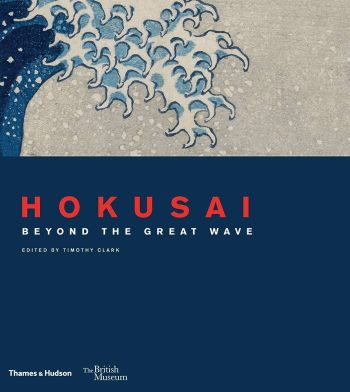 Visitors will be able to examine Hokusai’s personal beliefs through more than 100 paintings, drawings, woodblock prints, and illustrated books that speak to his early career, rise to fame, interest in the natural and supernatural worlds, personal life, and search for immortality. Distinct from the art of his Japanese contemporaries, Hokusai’s work is intensely individual, subjective, energized, and sublime; and the exhibition will provide a powerfully emotional and spiritual experience.
Hokusai never left Japan, but his work traveled around the globe to inspire many European artists and collectors such as Monet and Van Gogh. The exhibition includes biographical portraits of six individuals who helped build the Hokusai collection at the British Museum and shows how these scholars and proponents of Japanese art understood and appreciated Hokusai’s genius, skill, and invention.
The presentation of this exhibition is a collaboration between the British Museum and the Bowers Museum.
Timothy Clark, ed., Hokusai: Beyond the Great Wave (London: Thames & Hudson, 2017), 352 pages, ISBN: 978-0500094068, $65.
New Book | Art and Architecture of Sicily
From Lund Humphries:
Julian Treuherz, Art and Architecture of Sicily (London: Lund Humphries, 2023), 320 pages, ISBN: 978-1848226043, £40 / $80.
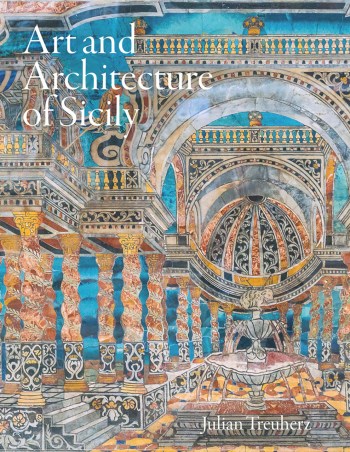 Sicily’ s strategic position in the centre of the Mediterranean led to settlement or conquest by a succession of different peoples—Phoenicians, Greeks, Romans, Byzantines, Muslims, Normans, Germans, French, Spanish—each one leaving its traces on Sicilian culture. This book provides a chronological survey, each section opening with a brief historical overview which is followed with an authoritative and engaging account of the development of the period’ s art and architecture. The leading architects, artists and stylistic currents are all discussed and outstanding individual buildings and works of art are analysed in detail, while archaeology, urban development, patronage and decorative arts are also covered. This is not a story of artistic conquests, but as a successive layering of different cultures: the way each one interacted with its predecessors produced art and architecture quite distinct from anywhere else in Europe.
Julian Treuherz is an art historian who was Keeper of Art Galleries for National Museums Liverpool between 1989 and 2007. He has written many books, articles and exhibition catalogues, and over the last twenty years he has spent part of each year in Sicily studying its art and architecture.
c o n t e n t s
• Introduction
• Prehistoric Sicily
• The Greeks come to Sicily: The Archaic Period
• The Greeks in Sicily: The Classical Period
• Punic Sicily
• The Greeks in Sicily: The late Classical and Hellenistic Periods
• Sicily, Province of Rome
• Early Christian, Byzantine, and Arabic Sicily
• The Normans in Sicily: A New Architectural Style
• The Normans in Sicily: The Royal Workshops, the Pleasure Pavilions, and the Later Cathedrals
• Sicily under the Hohenstaufen Emperors
• Late Medieval Sicily: German, French, and Aragonese Rule
• Sicily under the Spanish Viceroys: The 15th Century
• Sicily under the Spanish Viceroys: The 16th Century
• The Coming of the Baroque to Western Sicily
• The Earthquake of 1693 and the Rebuilding of Eastern Sicily
• Late Baroque Architecture in Western Sicily
• Baroque Painting, Sculpture, and Decorative Arts
• Neoclassicism in Sicily
• The Search for a New Style: Sicily, 1840–1918
• Sicily after 1918
New Book | Nobility and the Making of Race in 18th-C. Britain
From Bloomsbury:
Tim McInerney, Nobility and the Making of Race in Eighteenth-Century Britain (London: Bloomsbury Academic, 2023), 264 pages, ISBN: 978-1350346383, $115.
 Nobility and the Making of Race in Eighteenth-Century Britain focuses on Britain and Ireland at a time when race theory as we know it today was steadily emerging in the realm of natural philosophy to examine the structural relationship between nobility and race. This ground-breaking book examines texts from the fields of naturalism, political philosophy, medicine, and colonial venture, as well as interrogating works of drama and literature, in order to track how climate-based understandings of human variety at this time became increasingly imbued with noble traditions of genealogical purity and hierarchies of descent.
This process, the book argues, allowed British naturalists and wider society to understand global populations according to an already familiar pattern of genealogical inequality and offered the proponents of race theory a ready made model of natural supremacy. Tim McInerney explains why nobility and race developed in the way they did and how the premise of each promoted a certain idea of superiority. The result is an in-depth understanding of how genealogical exclusivity works as a power strategy.
Tim McInerney is Senior Lecturer in British and Irish civilisation at Université Paris 8 – Vincennes Saint Denis.
c o n t e n t s
Introduction
1 The Race Myth in Retrospect
2 Performing Nobility in Eighteenth-Century Britain
3 Human Hierarchy and the Great Chain of Being
4 The Noble Body in Ethno-national and Medical Discourse
5 Civilised Anatomies in Eighteenth-Century Human Variety Theory
6 Creating a Global Nobility: The Rise of Genealogical Race Theory
7 Ireland: A Nation of Nobilities
8 The South Seas: Laboratory of the Noble Physique
9 ‘Royal Slaves’: Abolitionism and the Fantasy of Slave Nobility
10 Noble Race in a Time of Revolution
Conclusion: How Nobility Shaped the Concept of Race
Exhibition | William Blake: Visionary
Opening this fall at The Getty:
William Blake: Visionary
Getty Center, Los Angeles, 7 October 2023 — 14 January 2024
 A remarkable printmaker, painter, and poet, William Blake (1757–1827) developed a wildly unconventional world view, representing universal forces of creation and destruction—physical, psychological, historical—through his own cast of characters. By combining his poetry and images on the page through radical graphic techniques, Blake created some of the most striking and enduring imagery in British art. This major international loan exhibition explores the artist-poet’s imaginative world through his most celebrated works.
Organized by the J. Paul Getty Museum in cooperation with Tate.
Edina Adam and Julian Brooks, with an essay by Matthew Hargraves, William Blake: Visionary (Los Angeles: J. Paul Getty Museum, 2020), 168 pages, ISBN: 978-1606066423, $35.
Celebrated for his boundless imagination and unique vision, William Blake (1757–1827) created some of the most striking and distinctive imagery in art, often combining his poetry and visual images on the page through innovative graphic techniques. He has proven an enduring inspiration to artists, musicians, poets, and performers worldwide and a fascinating enigma to generations of admirers. Featuring over 130 color images, this catalogue brings together many of Blake’s most iconic works. Organized by theme, it explores Blake’s work as a professional printmaker, his roles as both painter-illustrator and poet-painter, his relationship to the medieval, Renaissance, and Baroque artists that preceded him, and his legacy in the United States. It also examines his visionary prophetic books, including all eighteen plates of America a Prophecy.
A specialist in works on paper, Edina Adam is assistant curator of drawings at the J. Paul Getty Museum. Julian Brooks is senior curator and head of the Department of Drawings at the J. Paul Getty Museum and is the author of many books, most recently The Lure of Italy: Artists’ Views (Getty Publications, 2017) and Andrea del Sarto: The Renaissance Workshop in Action (Getty Publications, 2015). Now the director of the Wadsworth Atheneum Museum of Art, Matthew Hargraves was previously chief curator of art collections and head of collection information and access at the Yale Center for British Art.
New Book | The Tsarina’s Lost Treasure
First published in 2020, the book appeared in paperback in 2022; from Simon & Schuster:
Gerald Easter and Mara Vorhees, The Tsarina’s Lost Treasure: Catherine the Great, a Golden Age Masterpiece, and a Legendary Shipwreck (New York: Pegasus Books, 2020), 400 pages, ISBN: 978-1643135564 (hardback), $30 / ISBN: 978-1643139425 (paperback), $19.
 A riveting history and maritime adventure about priceless masterpieces originally destined for Catherine the Great.
On October 1771, a merchant ship out of Amsterdam, Vrouw Maria, crashed off the stormy Finnish coast, taking her historic cargo to the depths of the Baltic Sea. The vessel was delivering a dozen Dutch masterpiece paintings to Europe’s most voracious collector: Catherine the Great, Empress of Russia. Among the lost treasures was The Nursery, an oak-paneled triptych by Leiden fine painter Gerrit Dou, Rembrandt’s most brilliant student and Holland’s first international superstar artist. Dou’s triptych was long the most beloved and most coveted painting of the Dutch Golden Age, and its loss in the shipwreck was mourned throughout the art world. Vrouw Maria, meanwhile, became a maritime legend, confounding would-be salvagers for more than two hundred years. In July 1999, a daring Finnish wreck hunter found the ship, upright on the sea floor and perfectly preserved. The Tsarina’s Lost Treasure masterfully recounts the fascinating tale of Vrouw Maria—her loss and discovery—weaving together the rise and fall of the artist whose priceless masterpiece was the jewel of the wreckage. Gerald Easter and Mara Vorhees bring to vivid life the personalities that drove (and are still driving) this compelling tale—evoking Robert Massie’s depiction of Russian high politics and culture, Simon Schama’s insights into Dutch Golden Age art and art history, and Gary Kinder’s spirit of, danger and adventure on the beguiling Archipelago Sea.
Gerald Easter is a Professor at Boston College who has been teaching and writing about Russian/East European politics and history for more than two decades.
Mara Vorhees is a travel writer with an expertise in Russia, New England, and Central America. She has written or contributed to more than 40 guidebook editions, published by Lonely Planet.
New Book | The Women Who Saved the English Countryside
From Yale UP:
Matthew Kelly, The Women Who Saved the English Countryside (New Haven: Yale University Press, 2022), 400 pages, ISBN: 978-0300232240 (hardback), $35 / ISBN: 978-0300270396 (paperback), $24.
 A vibrant history of English landscape preservation over the last 150 years, told through the lives of four remarkable women.
In Britain today, a mosaic of regulations protects the natural environment and guarantees public access to green spaces. But this was not always so. Over the last 150 years, activists have campaigned tirelessly for the right to roam through the countryside and the vital importance of preserving Britain’s natural beauty. Matthew Kelly traces the history of landscape preservation through the lives of four remarkable women: Octavia Hill, Beatrix Potter, Pauline Dower, and Sylvia Sayer. From the commons of London to the Lake District, Northumberland, and Dartmoor, these women protected the English landscape at a crucial period through a mixture of environmental activism, networking, and sheer determination. They grappled with the challenges that urbanization and industrial modernity posed to human well-being as well as the natural environment. By tirelessly seeking to reconcile the needs of particular places to the broader public interest they helped reimagine the purpose of the English countryside for the democratic age.
Matthew Kelly is professor of modern history at Northumbria University. He is the author of Finding Poland: From Tavistock to Hurzdowa and Back Again and Quartz and Feldspar: Dartmoor—A British Landscape in Modern Times.
c o n t e n t s
List of Illustrations
Acknowledgments
Maps
Introduction: The Four
Octavia Hill: Gathering in the Givers
Beatrix Potter: A Farm of One’s Own
Pauline Dower: ‘Inconspicuous Good’
Sylvia Sayer: Segregating Dartmoor
Epilogue: Fifty Years On
Notes
Further Reading
Index










 Enfilade
leave a comment