New Book | The Invention of the English Landscape, c. 1700–1939
Peter Borsay died in 2020 at the age of 70; his last book, prepared for publication by Rosemary Sweet, has just been published by Bloomsbury:
Peter Borsay, with Rosemary Sweet, The Invention of the English Landscape, c. 1700–1939 (London: Bloomsbury Academic, 2023), 304 pages, ISBN: 978-1350031678, $115.
 Since at least the Reformation, English men and women have been engaged in visiting, exploring and portraying, in words and images, the landscape of their nation. The Invention of the English Landscape examines these journeys and investigations to explore how the natural and historic English landscape was reconfigured to become a widely enjoyed cultural and leisure resource.
Peter Borsay considers the manifold forces behind this transformation, such as the rise of consumer culture, the media, industrial and transport revolutions, the Enlightenment, Romanticism, and the Gothic revival. In doing so, he reveals the development of a powerful bond between landscape and natural identity, against the backdrop of social and political change from the early modern period to the start of the Second World War. Borsay’s interdisciplinary approach demonstrates how human understandings of the natural world shaped the geography of England, and uncovers a wealth of valuable material, from novels and poems to paintings, that expose historical understandings of the landscape. This innovative approach illuminates how the English countryside and historic buildings became cultural icons behind which the nation was rallied during war-time, and explores the emergence of a post-war heritage industry that is now a definitive part of British cultural life.
Peter Borsay was Professor of History at Aberystwyth University, a member of the advisory boards of Urban History and the Journal of Tourism History, and a committee member of the British Pre-Modern Towns Group. His books include The English Urban Renaissance (1989); The Image of Georgian Bath, 1700–2000: Towns, Heritage, and History (2000); and A History of Leisure: the British Experience since 1500 (2006). He co-edited Resorts and Ports: European Seaside Towns since 1700 (2011) and Leisure Cultures in Urban Europe, c. 1700–1870: A Transnational Perspective (2016).
Rosemary Sweet is Professor of Urban History and Director of the Centre of Urban History at the University of Leicester. She is the author of The English Town, 1680–1840 and The Writing of Urban Histories in Eighteenth-Century England.
c o n t e n t s
List of Illustrations
Foreword
Acknowledgments
1 Introduction
2 Revealing the Early Modern Landscape
3 Ideas and Representations
4 Reconfiguring the Landscape
5 New Geographies and Topographies
6 Timescapes
7 Economic and Social Change
8 The Transport Revolution and the Journey
9 Identities
10 Conclusion: The Second World War and Beyond
Select Bibliography
Index
Book Launch in Honour of Peter Borsay
From Eventbrite:
Book Launch in Honour of Peter Borsay
Online and in-person, University of Leicester, 29 September 2023, 3pm
The Centre for Urban History at the University of Leicester will mark the publication of Peter Borsay’s last book, The Invention of the English Landscape c. 1700–1939, with a symposium in honour of the late professor, who passed away in 2020. Free and open to all, the event will take place on Friday, 29th September 2023, from 15.00 until 17.00, via Teams Live and in person in the Attenborough Film Theatre. Please contact hypirfinance@le.ac.uk with any questions.
The symposium will be chaired by Professor Rosemary Sweet with the following panel of speakers:
• Penelope J. Corfield (President of the International Society of Eighteenth-Century Studies)
• Richard Coopey (Emeritus Senior Lecturer, Department of History & Welsh History, Aberystwyth University)
• Katy Layton Jones (School of History, Open University)
• Keith Snell (Emeritus Professor of English Local History, University of Leicester)
New Book | The A–Z of Regency London, 1819
From the London Topographical Society:
Sheila O’Connell, ed., with an introduction by Paul Laxton and indexes by Roger Cline, The A–Z of Regency London 1819 (London: London Topographical Society, 2023), 159 pages, £36.
 The A–Z of Regency London 1819 reproduces at two-thirds actual size the 4th and last edition of Richard Horwood’s map of London. As a guide to the topography of early-nineteenth-century London it is unequalled. The 40 sheets of the map are accompanied by an introductory essay describing its making, assessing its qualities, and casting new light on the life of the map-maker, as well as indexes to streets and buildings showing the juxtaposition of residential and industrial premises.
As described in a recent issue of Salon (the newsletter of The Society of Antiquaries of London, 30 August 2023):
In about 1790, Richard Horwood (1758–1803) embarked on what was to be the largest map of London ever published. He told his subscribers that it would be “on a Scale so extensive and accurate as to exhibit, not only every Street, Square, Court, Alley, and Passage therein, but also each individual House, the Number by which it is distinguished.” It was completed in 32 sheets in 1799. William Faden reissued the map in 1807, 1813, and 1819, adding eight new plates to cover developments to the east. The publication reproduces at two-thirds actual size the 4th and last edition of Richard Horwood’s map of London. As a guide to the topography of early-nineteenth-century London it is unequalled. The 40 sheets of the map are accompanied by an introductory essay describing its making, assessing its qualities, and casting new light on the life of the map-maker (including a surprising link with the emerging United States of America), as well as indexes to streets and buildings showing the juxtaposition of residential and industrial premises.
New Book | Small Spaces: Recasting the Architecture of Empire
From Bloomsbury:
Swati Chattopadhyay, Small Spaces: Recasting the Architecture of Empire (London: Bloomsbury Visual Arts, 2023), 360 pages, ISBN: 978-1350288225 (hardback), $100 / ISBN: 978-1350288232 (paperback), $35. Also available as an ebook.
 Small Spaces recasts the history of the British empire by focusing on the small spaces that made the empire possible. It takes as its subject a series of small architectural spaces, objects, and landscapes and uses them to narrate the untold stories of the marginalized people-the servants, women, children, subalterns, and racialized minorities-who held up the infrastructure of empire. In so doing it opens up an important new approach to architectural history: an invitation to shift our attention from the large to the small scale. Taking the British empire in India as its primary focus, the book presents eighteen short, readable chapters to explore an array of overlooked places and spaces. From cook rooms and slave quarters to outhouses, go-downs, and medicine cupboards, chapters reveals how and why these kinds of minor spaces are so important to understanding colonialism. With the focus of history so often on the large scale—global trade networks, vast regions, and architectures of power and domination—Small Spaces shows instead how we need to rethink this aura of magnitude so that our reading is not beholden to such imperialist optics. With chapters that can be read separately as individual accounts of objects, spaces, and buildings and introductions showing how this critical methodology can challenge the methods and theories of urban and architectural history, Small Spaces is a must-read for anyone wishing to decolonize disciplinary practices in the field of architectural, urban, and colonial history. Altogether, it provides a paradigm-breaking account of how to ‘unlearn empire’, whether in British India or elsewhere.
Swati Chattopadhyay is Professor in the Department of History of Art and Architecture with an affiliated appointment in the Department of Comparative Literature at the University of California, Santa Barbara.
c o n t e n t s
Preface and Acknowledgments
I | Small Spaces
1 Of Small Spaces
2 Empire of Small Spaces
II | Trade and Labor
3 Dependency
4 Locating the Bottlekhana
5 Potable Empire
6 Europe Goods
7 Strange Tongues
8 Making Invisible
III | Land Imagination
9 Vantage
10 Connective Spaces
11 Anomalous Spaces
12 An Aesthetic Episode
13 Roofscape
IV | A Geography of Small Spaces
14 Collections and Containment
15 Portable Geographies
16 A Good Shelf
17 A Box of Medicine
18 Epilogue
Appendix A
Index
New Book | The Book of Marble

From Taschen:
Jan Christiaan Sepp, Marmora / The Book of Marble, edited by Geert-Jan Koot (Cologne: Taschen, 2023), 312 pages, ISBN: 978-3836594349 (English, French, and German), $125.
An exhaustive compendium of marble, Afbeelding der Marmor Soorten (A Representation of Marble Types) depicted 570 samples across 100 colour plates, accompanied by texts in five languages. Published in 1776 at the peak of the Enlightenment, it is regarded, rightly, as one of the finest illustrated scientific books of the era.
 Over the course of the 18th century, beautiful books that categorised, annotated, and illuminated the Enlightenment pursuit of learning across Europe had become increasingly popular. Knowledge was everything and everywhere, and these books provided it for those not wealthy enough to build their own personal collections of rare and exotic objects. Marmor Soorten, one such edition, took the standards of both aesthetics and categorisation to a whole new level.
Jan Christiaan Sepp and his father Christian—himself a respected collector—had already earned a reputation for luxury publications on scientific themes, starting with Christian’s own Nederlandsche Insecten (Insects of the Netherlands). But it was his son who created the visual masterpiece Marmor Soorten, revising an existing German publication from 1775 by Adam Ludwig Wirsing. The result, published in 11 installments to a print run of around 100, was among the finest examples of its kind.
Featuring new photography to depict the intricate details of the marble samples, this edition brings an unknown treasure back to relevance. The plates, each meticulously hand-coloured and arranged with painstaking precision, have an abstract-art feel that gives this volume an almost modern slant. This edition reproduces the pages from two copies of Marmor Soorten held at the State and University Library in Dresden and the Getty Research Institute in Los Angeles. Reprinting the work in full for the first time, The Book of Marble brings that rare blend of beauty and encyclopedic knowledge to a wider audience.
Geert-Jan Koot holds an MA in Art History and Archaeology from the Radboud University, Nijmegen. From 1988, he was the head of the Rijksmuseum’s Research Library and curator of library collections, as well as chair of the Working Group for Specialist Academic Libraries (Werkgroep Speciale Wetenschappelijke Bibliotheken), until his retirement in 2021. Koot now works as a consultant for book collectors and auction houses. He has also spearheaded the WorldCat Art Discovery project, a new search tool for art libraries hosting over 250 million articles.
New Book | The Wood that Built London
From Sandstone Press:
C. J. Schüler, The Wood that Built London: A Human History of the Great North Wood (Sheffield: Sandstone Press, 2021), 368 pages, ISBN: 978-1913207496 (hardcover) / ISBN: 978-1914518164 (paperback), £20.
 It is hard to imagine that the busy townscape of South London was once a great wood, stretching almost seven miles from Croydon to Deptford or that, scattered through the suburbs, from Dulwich to Norwood, a number of oak woodlands have survived since before the Norman Conquest. These woods were intensively managed for a thousand years, providing timber for construction, furniture and shipbuilding, and charcoal for London’s blacksmiths, kilns, and bakeries. Now they afford important green space, a vital habitat for small mammals, birds, and insects. Drawing on a wealth of documents, historic maps, and environmental evidence, The Wood That Built London charts the fortunes of the North Wood from its earliest times: its ecology, ownership, management, and the gradual encroachment of the metropolis.
Chris Schüler is the author of three illustrated histories of cartography: Mapping the World, Mapping the City, and Mapping the Sea and Stars and co-author of the best-selling Traveller’s Atlas. His most recent book, Writers, Lovers, Soldiers, Spies: A History of the Authors’ Club of London, 1891–2016 was published in 2016. He has also written on literature, travel, and the arts for The Independent, The Independent on Sunday, The Tablet, The Financial Times, and New Statesman.
C O N T E N T S
Foreword by Rachel Licthenstein
Introduction
Measurements, Money, and Other Matters
1 Taming the Wildwood, ca. 8000 BC–1485
2 Surveys, Ships, and Statutes, 1485–1600
3 The World Turned Upside Down, 1600–1700
4 Faith or Science? 1700–1790
5 Industry and Enclosure, 1790–1850
6 The Palace and the Railway, 1850–1910
7 The Home Front, 1910–1945
8 A Design for Living, 1945–1970
9 Save the Woods! 1970–1997
10 A New Millennium, 1997–2021
11 A Tour of the Woods Today
12 Ways through the Woods, 2021–?
Acknowledgments
A Woodland Glossary
Notes
Bibliography
Chris Schüler on the Wood that Built London
An evening lecture at the Society of Antiquaries:
Chris Schüler, The Wood That Built London
In-person and online, Society of Antiquaries of London, 12 October 2023, 5pm
Drawing on historic documents, maps and environmental evidence, The Wood That Built London charts the fortunes of the Great North Wood that once covered much of what is now South London [‘north’ relative to Croydon]. It records its botany, ecology, ownership and management, the gradual encroachment of the metropolis, and the battles fought by locals and the London Wildlife Trust to save what remained.
The lecture will discuss the documentary research into historic land ownership and management in the medieval and early modern periods that informed the book, which draws on a wide range of primary sources, some never previously cited. These include 16th-century Court of Exchequer depositions in a dispute over land ownership in the National Archives at Kew; Archbishop Morton’s 1492 survey of the Manor of Croydon and a 1678 plan of the Archbishop’s woods in Croydon Museum; Archbishop Cranmer’s 1552 survey of the Manor of Croydon in the Bodleian Library; estate maps in the British Library and London Metropolitan Archives; parish accounts; and records of woodland management in Dulwich College Archive and Lambeth Palace Library. Considered together, these scattered records combine to create a picture of the former extent of the wood, which stretched from Deptford to Croydon, its ownership by religious bodies such as Bermondsey Abbey and the Archbishopric of Canterbury, and its management by rotational coppicing, which generated income for its owners over several centuries. Tudor Acts of Parliament and the publications of 16th– and 17th-century agronomists such as Thomas Tusser and Barnaby Googe are examined to provide insight into the theory and practice of woodland management at this period.
The book also records how that income dwindled as the Industrial Revolution rendered many woodland products obsolete, leading landowners to grub up coppices, at first for farmland and then, as the railways brought the area within commuting distance of London, for housing development, to the fury of commentators such as John Ruskin and John Stuart Mill.
Presented both in-person at Burlington House and online, the event is free and open to the public. Please reserve tickets here.
New Book | The Jesuits: A History
From Princeton UP:
Markus Friedrich, The Jesuits: A History, translated by John Noël Dillon (Princeton: Princeton University Press, 2022), 872 pages, ISBN: 978-0691180120 (hardback), $40 / ISBN: 978-0691226200 (paperback), $28.
 The most comprehensive and up-to-date exploration of one of the most important religious orders in the modern world.
Since its founding by Ignatius of Loyola in 1540, the Society of Jesus—more commonly known as the Jesuits—has played a critical role in the events of modern history. From the Counter-Reformation to the ascent of Francis I as the first Jesuit pope, The Jesuits presents an intimate look at one of the most important religious orders not only in the Catholic Church, but also the world. Markus Friedrich describes an organization that has deftly walked a tightrope between sacred and secular involvement and experienced difficulties during changing times, all while shaping cultural developments from pastoral care and spirituality to art, education, and science.
Examining the Jesuits in the context of social, cultural, and world history, Friedrich sheds light on how the order shaped the culture of the Counter-Reformation and participated in the establishment of European empires, including missionary activity throughout Asia and in many parts of Africa in the sixteenth and seventeenth centuries. He also explores the place of Jesuits in the New World and addresses the issue of Jesuit slaveholders. The Jesuits often tangled with the Roman Curia and the pope, resulting in their suppression in 1773, but the order returned in 1814 to rise again to a powerful position of influence. Friedrich demonstrates that the Jesuit fathers were not a monolithic group and he considers the distinctive spiritual legacy inherited by Pope Francis. With its global scope and meticulous attention to archival sources and previous scholarship, The Jesuits illustrates the heterogeneous, varied, and contradictory perspectives of this famed religious organization.
Markus Friedrich is professor of early modern history at the University of Hamburg. His books include The Birth of the Archive. He lives in Hamburg, Germany.
C O N T E N T S
List of Illustrations
List of Abbreviations
Prologue: Ignatius Loyola Founds an Order
1 The Inner Life and Structure of the Society
2 The Society, the Churches, and the Faithful
3 Saeculum and the Kingdom of God: The The Jesuits ‘in the World’
4 The Global Society
5 A World without the Society of Jesus: Hostility, Suppression, Revival
Epilogue: The Modern Society
Acknowledgments
Afterword to the English Edition
Translator’s Note
Notes
Works Cited
Names Index
Subject Index
New Book | The Image of the Black in Latin American and Caribbean Art
From Harvard University Press:
David Bindman, Alejandro de la Fuente, and Henry Louis Gates, Jr., eds., The Image of the Black in Latin American and Caribbean Art, Book 1: From Colony to Nation (Cambridge, MA: Hutchins Center for African and African American Research, 2024), 400 pages, ISBN: 978-0674248861, £87 / €91 / $100.
 The Image of the Black in Latin American and Caribbean Art is the first comprehensive survey of the visual representation of people of African descent in Latin America and the Caribbean, some twelve million of whom were forcibly imported into the Americas during the transatlantic slave trade. This first volume spans four centuries, from the first Spanish occupation of Latin America and the Caribbean in the fifteenth century; through the establishment of slave colonies on the mainland and islands by the British, French, and Danish; to the revolutionary emergence of independence, first in Haiti in 1804, and then across Latin America. Essays by leading scholars and superb illustrations bring to light a remarkable range of imagery that provides vivid insights into the complex racial history of the period.
The two volumes complement the vision of Dominique and Jean de Menil, art patrons who, during the 1960s, founded an archive to collect images depicting the myriad ways that people of African descent have been represented in Western art from the ancient world to modern times. The Image of the Black in Latin American and Caribbean Art continues the de Menil family’s original mission and brings to the fore a renewed focus on a rich and understudied area.
David Bindman is Professor of the History of Art, Emeritus, at University College London.
Alejandro de la Fuente is Robert Woods Bliss Professor of Latin American History and Economics, and Professor of African and African American Studies and History, at Harvard University.
Henry Louis Gates, Jr., is the author of numerous books and has written extensively on the history of race and anti-Black racism in the Enlightenment. His most recent works include Stony the Road and The Black Church. He is the Alphonse Fletcher University Professor and Director of the Hutchins Center for African and African American Research at Harvard University.
Exhibition | Black Atlantic: Power, People, Resistance
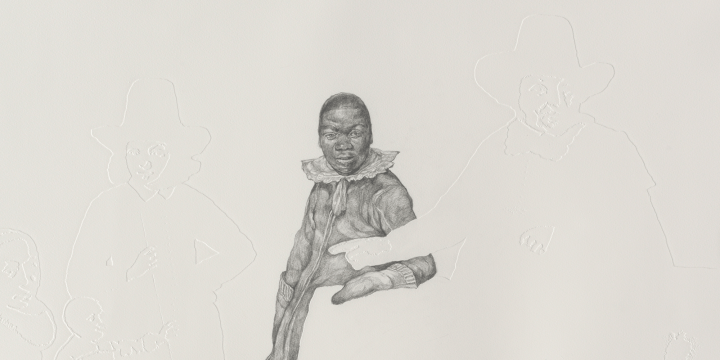
Barbara Walker, Vanishing Point 29 (Duyster), 2021 / © Barbara Walker, 2023.
More information on the Vanishing Point series is available here»
◊ ◊ ◊ ◊ ◊
Opening soon at The Fitzwilliam:
Black Atlantic: Power, People, Resistance
The Fitzwilliam Museum, Cambridge, 8 September 2023 — 7 January 2024
Curated by Jake Subryan Richards
A landmark exhibition exploring the impact of the Black Atlantic staged in the Museum’s historic Founder’s Galleries, which were built using the profits from enslavement and exploitation.
Black Atlantic: Power, People, Resistance brings together significant national and international loans with collections from across the University of Cambridge’s museums, libraries, and colleges to tell both a Cambridge story and a global one. Using as its starting point the story of the Museum’s founder, Viscount Richard Fitzwilliam, whose family wealth came in part from the South Sea Company and East India Company, the exhibition charts a history from pre-colonial Africa and the Caribbean, the rise and racialisation of Atlantic enslavement, and histories of resistance by enslaved people and their allies. Artworks and other objects illustrating the financial, scientific, and commercial transformations in seventeenth- and eighteenth-century Britain that came about because of enslaved labour are shown in dialogue with modern and contemporary artworks by artists including Donald Locke, Barbara Walker, Keith Piper, and Jacqueline Bishop that respond to hidden histories and reveal stories of courage, resistance, hope, and repair.
Black Atlantic is curated by Dr Jake Subryan Richards, acclaimed early career historian of law, empire, and the African diaspora in the Atlantic world at the London School of Economics. It is the first in a series of exhibitions and gallery interventions planned for 2023–2026.
The catalogue is published by Bloomsbury:
Victoria Avery and Jake Subryan Richards, eds., Black Atlantic: Power, People, Resistance (London: Philip Wilson Publishing, 2023), 192 pages, ISBN: 978-1781301234, £30 / $40.
Published to accompany the landmark exhibition on view at the Fitzwilliam Museum in autumn 2023, the catalogue contains contributions by curators, historians, and artists.
 Black Atlantic: Power, People, Resistance brings together significant national and international loans with exhibits from the Fitzwilliam’s collection and from other University museums, colleges, and libraries. Objects and artworks illustrating the financial, scientific, and commercial transformations in seventeenth- and eighteenth-century Britain that came about because of enslaved labour are shown in dialogue with modern and contemporary artworks by artists including Donald Locke, Barbara Walker, Keith Piper, and Jacqueline Bishop that respond to hidden histories and reveal stories of courage, resistance, hope, and repair.
c o n t e n t s
Contributor Biographies
Acknowledgements
Foreword by Luke Syson
Introduction
Section 1 | Before Atlantic Enslavement
• Africa: Akan Region
• Indigenous Islands in the Caribbean Sea
• Europe: Slavery before Racism, Blackness before Slavery
Section 2 | Cambridge Wealth from Atlantic Enslavement
• Royal Patronage
• Making Money: Dutch Connections
• Technology for the Transatlantic Trade
• Warfare between the British, Dutch, and Spanish Empires
Section 3 | Fashion, Consumption, and Racism
• Blackness in European Art
• Enslavement and Fashion
Section 4 | Plantations: Production and Resistance
• Production, Knowledge Generation, and Exploitation
• Plantation Violence
• Remembering
Further Reading
Image Credits
Index










 Enfilade
leave a comment