New Book | Transpacific Engagements
From The Getty:
Florina Capistrano-Baker and Meha Priyadarshini, eds., Transpacific Engagements: Trade, Translation, and Visual Culture of Entangled Empires, 1565–1898 (Los Angeles: Getty Publications, 2022), 320 pages, ISBN: 978-6218028258 (hardback), $55 / ISBN: 978-6218028227 (paperback), $45.
 This wide-ranging collection of scholarly essays explores the hybrid cultures, intellectual clashes, and dynamic exchanges of the transpacific region in the age of imperialism.
Between the sixteenth and nineteenth centuries, competing European empires vied for commercial and political control of oceanic routes between Asia and the Americas. Transpacific Engagements addresses the resulting cultural and artistic exchanges with an emphasis on the Spanish and American enterprises in the Asia-Pacific region. This volume explores artistic expressions of imperial aspirations and imaginaries in the Philippines, Spain, Japan, and Hawaii; the transformations of texts, images, and culinary practices as they moved from one cultural context to another; and the movement of objects and people across the transpacific, with particular attention to the Manila Galleon trade that flourished from 1565 to 1815. Featuring contributions by art historians, anthropologists, historians, and cultural studies scholars, Transpacific Engagements gathers groundbreaking investigations of objects and histories to illustrate the role of East, South, and Southeast Asian polities and dynasties in these multilateral exchanges.
Published by the Ayala Foundation, Inc. in association with the Getty Research Institute and Kunsthistorisches Institut in Florenz (Max-Planck-Institut).
Florina H. Capistrano-Baker is the former director of the Ayala Museum and its current consulting curator and project consultant for international operations. Meha Priyadarshini is assistant professor in the Department of History at the University of Edinburgh.
New Book | Pet Revolution
From Reaktion Books and The University of Chicago Press:
Jane Hamlett and Julie-Marie Strange, Pet Revolution: Animals and the Making of Modern British Life (London: Reaktion Books, 2023), 256 pages, ISBN: 978-1789146868, £20 / $35.
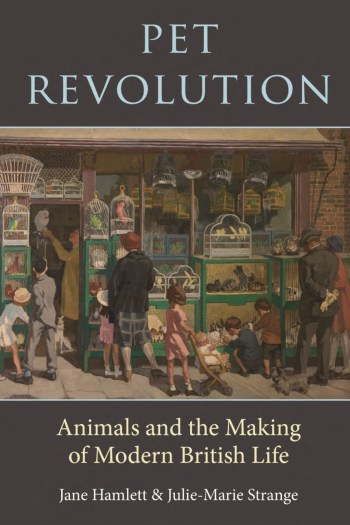 Pet Revolution tracks the British love affair with pets over the last two centuries, showing how the kinds of pets we keep, as well as how we relate to and care for them, has changed radically. The book describes the growth of pet foods and medicines, the rise of pet shops, and the development of veterinary care, creating the pet economy. Most importantly, pets have played a powerful emotional role in families across all social classes, creating new kinds of relationships and home lives. For the first time, through a history of companion animals and the humans who lived with them, this book puts the story of the ‘pet revolution’ alongside other revolutions—industrial, agricultural, political—to highlight how animals contributed to modern British life.
Jane Hamlett is professor of modern British history at Royal Holloway, University of London. Her books include Material Relations: Middle-Class Families and Domestic Interiors in England, 1850–1910.
Julie-Marie Strange is professor of modern British History at Durham University. Her books include The Invention of the Modern Dog: Breed and Blood in Victorian Britain.
Exhibition | Portraits of Dogs

Jean-Jacques Bachelier, Dog of the Havana Breed, detail, 1768, oil on canvas, 70 × 91 cm
(The Bowes Museum, Barnard Castle, BM 913)
◊ ◊ ◊ ◊ ◊
For anyone celebrating, a very happy National Dog Day to you and yours! Now on at The Wallace Collection:
Portraits of Dogs: From Gainsborough to Hockney
The Wallace Collection, London, 29 March — 15 October 2023
The exhibition Portraits of Dogs: From Gainsborough to Hockney explores our devotion to four-legged friends across the centuries. Through carefully selected paintings, sculptures, drawings, works of art and even taxidermy, the exhibition highlights the unique bond between humans and their canine companions. Dog portraiture developed as an artistic genre contemporaneously with its human counterpart—dogs are represented in the earliest cave paintings alongside humans—and it flourished, particularly in Britain, from the 17th century onwards. More than any other nationality perhaps, the British have both commissioned and collected portraits of dogs. Bringing over 50 works of art to Hertford House, Portraits of Dogs presents a broad range of portraiture showing dogs in all their different shapes and sizes, with each painter or sculptor challenging themselves how best to represent mankind’s most faithful and fearless friend.
From Giles:
Xavier Bray and Bruce Fogle, Faithful and Fearless: Portraits of Dogs (London: Giles, 2021), 160 pages, ISBN: 978-1913875015, £25 / $35.
 Throughout history, dogs and humans have had a special relationship based on trust, loyalty, and friendship—a relationship frequently immortalised in art. Faithful and Fearless: Portraits of Dogs features 50 works of art depicting the bond between people and their beloved pet—from members of the British Royal Family, to artists themselves. Organised in a series of thematically grouped sections—the dog as hero, as a companion to royals, aristocrats and artists, or as an allegory of the human condition—the book explores the canine portrait in its many guises and features dogs belonging to many celebrated figures, including Queen Victoria’s Tilco, Lucian Freud’s Pluto, and David Hockney’s portraits of his dachshunds, Stanley and Boodgie. The pieces are all drawn from major British collections including the Royal Collection, the V&A, Tate Britain, the British Museum, and a wealth of regional museums and private collections. In “A Vet’s Point of View,” renowned clinical veterinarian Bruce Fogle examines the many reasons for the extraordinary bond between dogs and their owners. At a time of rising dog ownership, this enchanting volume is a welcome reminder of our devotion to our four-legged friends.
c o n t e n t s
Director’s Foreword
Faithful and Fearless: Portraits of Dogs by Xavier Bray
Catalogue: Introduction
• The Aristocratic Dog
• The Royal Dog
• Kylin and AhCum: Two Pekinese
• The Artist’s Dog
• The Allegorical Dog
• The Heroic Dog
• The Dog Immortal
• Until Death
A Vet’s Point of View by Bruce Fogle
Notes
Index
Photo credits
New Book | Venice: City of Pictures
Coming this fall from Thames & Hudson:
Martin Gayford, Venice: City of Pictures (London: Thames & Hudson, 2023), 384 pages, ISBN: 978-0500022665, $40.
 A visual journey through five centuries of the city known for centuries as, ‘La Serenissima’—a unique and compelling story for both lovers of Venice and lovers of its art.
Enchanting, captivating, precious—Venice is one of the most cherished cities in the world. For centuries it was the heart of a global maritime power and a crossroads for diverse cultures. Today the city attracts millions of visitors each year, enticed by its irresistible beauty. Art lovers are drawn here by the paintings, prints, drawings, and films made by generations of artists who have captured its magical allure. It is through images—both of the city and the art created there—that Venice’s identity has been forged and spread so powerfully. Venice was a major center of art in the Renaissance: the city where the medium of oil on canvas became the norm. The achievements of the Bellini brothers, Vittore Carpaccio, Giorgione, Titian, Tintoretto, and Paolo Veronese are a key part of this story. Nowhere else has been depicted by so many great painters in so many diverse styles and moods. Venetian views were a specialty of native artists such as Canaletto and Francesco Guardi, but the city has also been represented by outsiders: William Turner, Claude Monet, John Singer Sargent, Howard Hodgkin, and many more. Then there are those who came to look at and write about art. The reactions of Henry James, George Eliot, Richard Wagner, and others enrich this tale. Nor is the story over. Since the advent of the Venice Biennale in the 1890s, the city has become a shop window for the contemporary art of the whole world. In this elegant volume, Martin Gayford takes us on a visual journey through the past five centuries of the city known as “La Serenissima,” the ‘Most Serene’.
Martin Gayford is art critic for The Spectator. His books include Man with a Blue Scarf; Modernists and Mavericks; Spring Cannot Be Cancelled, with David Hockney; A History of Pictures, with David Hockney; Shaping the World, with Antony Gormley; and Love Lucian: The Letters of Lucian Freud, 1939–1954, with David Dawson.
New Book | Lauritz de Thurah: Architecture and Worldviews
From Strandberg Publishing:
Peter Thule Kristensen, ed., with contributions by Thomas Lyngby, Else Marie Bukdahl, Martin Søberg, Sanne Maekelberg, Natalie Körner, and Nina Ventzel Riis, Lauritz de Thurah: Architecture and Worldviews in 18th-Century Denmark (Copenhagen: Strandberg Publishing, 2023), 432 pages, ISBN: 978-8794102704, £70.
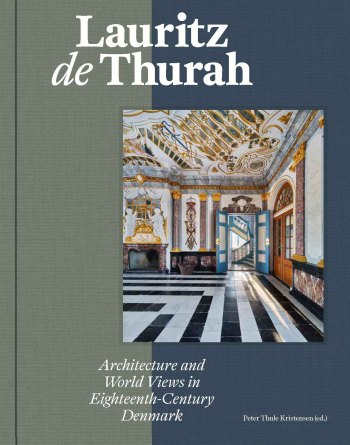 Lauritz de Thurah (1706–1759) was one of Denmark’s most significant architects of the Baroque period. He created several important buildings—including the Hermitage Hunting Lodge, the Royal Palace in Roskilde, Gammel Holtegaard, and the famous spire of the Church of Our Saviour in Copenhagen—and masterminded conversions and extensions of properties such as Ledreborg, Frederiksberg Castle, Børglum Kloster, and the now demolished summer residence Hirschholm Palace (widely known as the ‘Versailles of the North’). The mainstay of this monograph is Peter Thule Kristensen’s presentation of Thurah’s rich and complex architecture. The other chapters—written by experts Else Marie Bukdahl, Martin Søberg, Thomas Lyngby, Natalie Patricia Körner, Sanne Maekelberg, and Nina Ventzel Riis—describe Thurah’s roles as a leading architectural historian, topographer, grand tour traveller, civil servant, military man, and trailblazer within the new social structure in Denmark under absolute rule. The book also sheds light on the Baroque period in a broader sense, delving into the era’s court culture, garden design, and church architecture. Finally, the afterlife of Thurah’s works is addressed: how do his buildings function in our present day, having been adapted to the needs and users of a new era?
Peter Thule Kristensen is Professor, Head of the Master Programme Spatial Design at the Royal Danish Academy – Institute of Architecture and Design and a Core Scholar at the Centre for Privacy Studies at University of Copenhagen. He is M.Arch. from The Royal Danish Academy of Fine Arts, School of Architecture (1994), Ph.D. in architectural history from the same institution (2014), and dr.phil. in art history from Aarhus University (2014).
New Book | The Architecture of Empire
From McGill-Queen’s University Press:
Gauvin Alexander Bailey, The Architecture of Empire: France in India and Southeast Asia, 1664–1962 (McGill-Queen’s University Press, 2022), 488 pages, ISBN: 978-0228011422, $74.
 Most monumental buildings of France’s global empire—such as the famous Saigon and Hanoi Opera Houses—were built in South and Southeast Asia. Much of this architecture, and the history of who built it and how, has been overlooked. The Architecture of Empire considers the large-scale public architecture associated with French imperialism in seventeenth- and eighteenth-century India, Siam, and Vietnam, and nineteenth- and twentieth-century Indochina, the largest colony France ever administered in Asia. Offering a sweeping panorama of the buildings of France’s colonial project, this is the first study to encompass the architecture of both the ancien régime and modern empires, from the founding of the French trading company in the seventeenth century to the independence and nationalist movements of the mid-twentieth century.
Gauvin Bailey places particular emphasis on the human factor: the people who commissioned, built, and lived in these buildings. Almost all of these architects, both Europeans and non-Europeans, have remained unknown beyond—at best—their surnames. Through extensive archival research, this book reconstructs their lives, providing vital background for the buildings themselves. Much more than in the French empire of the Western Hemisphere, the buildings in this book adapt to indigenous styles, regardless of whether they were designed and built by European or non-European architects. The Architecture of Empire provides a unique, comprehensive study of structures that rank among the most fascinating examples of intercultural exchange in the history of global empires.
Gauvin Alexander Bailey is professor and Alfred and Isabel Bader Chair in Southern Baroque Art at Queen’s University and the author of Architecture and Urbanism in the French Atlantic Empire.
c o n t e n t s
Acknowledgments
1 Introduction: Architecture, Empire, and Hubris
2 Origins: Fort Dauphin, Surat, Pondicherry, ca 1672
3 DipLomacy: Ayutthaya, ca 1688
4 Grandeur: Pondicherry, ca 1752
5 Interregnum: Diên Khánh, ca 1793
6 Semblance: Saigon and Hanoi, ca 1900
7 Appropriation: Phnom Penh, ca 1917
8 Association: Saigon and Hanoi, ca 1925
9 Hybridity: India and Southeast Asia, 1738–1962
Notes
Bibliography
Index
New Book | Book Parts
This collection of essays from Oxford University Press was first published in 2019; it’s just out in paperback.
Dennis Duncan and Adam Smyth, eds., Book Parts (Oxford: Oxford University Press, 2023), 352 pages, ISBN: 978-0198885443 (paperback), $25.
 What would an anatomy of the book look like? There is the main text, of course, the file that the author proudly submits to their publisher. But around this, hemming it in on the page or enclosing it at the front and back of the book, there are dozens of other texts—page numbers and running heads, copyright statements and errata lists—each possessed of particular conventions, each with their own lively histories. To consider these paratexts—recalling them from the margins, letting them take centre stage—is to be reminded that no book is the sole work of the author whose name appears on the cover; rather, every book is the sum of a series of collaborations. It is to be reminded, also, that not everything is intended for us, the readers. There are sections that are solely directed at others—binders, librarians, lawyers parts of the book that, if they are working well, are working discreetly, like a theatrical prompt, whispering out of the audience’s ear-shot
Book Parts is a bold and imaginative intervention in the fast growing field of book history: it pulls the book apart. Over twenty-two chapters, Book Parts tells the story of the components of the book: from title pages to endleaves; from dust jackets to indexes—and just about everything in between. Book Parts covers a broad historical range that runs from the pre-print era to the digital, bringing together the expertise of some of the most exciting scholars working on book history today in order to shine a new light on these elements hiding in plain sight in the books we all read.
Dennis Duncan is writer, translator, and lecturer in English at University College, London, and was formerly a British Academy Postdoctoral Fellow at the Bodleian Library, Oxford, then Munby Fellow in Bibliography at Cambridge. His research interests include book history, translation, and avant-garde literature, particularly French groups like the Oulipo and the Collège de ‘Pataphysique. His most recent books include Index, A History of the (Penguin, 2021) and The Oulipo and Modern Thought (Oxford University Press, 2019).
Adam Smyth is Professor of English Literature and the History of the Book at Balliol College, Oxford. His most recent books include Material Texts in Early Modern England (Cambridge University Press, 2018), Autobiography in Early Modern England (Cambridge University Press, 2010), A History of English Autobiography (edited, Cambridge University Press, 2016), and Book Destruction from the Medieval to the Contemporary (edited with Gill Partington, Palgrave, 2014). He is the co-editor of Routledge’s book series Material Readings in Early Modern Culture. He also enjoys discussing his work beyond the academy: he writes regularly for the London Review of Books and has appeared on TV and radio in the UK and abroad. Smyth is the co-host of the literary discussion podcast and radio show, Litbits.
c o n t e n t s
List of Figures
List of Plates
Contributors
A Note on the Type
1 Introductions — Adam Smyth and Dennis Duncan
2 Dust-jackets — Gill Partington
3 Frontispieces — Luisa Calè
4 Title Pages — Whitney Trettien
5 Imprints, Imprimaturs, and Copyright Pages — Shef Rogers
6 Tables of Contents — Joseph Howley
7 Addresses to the Reader — Meaghan J. Brown
8 Acknowledgements and Dedications — Helen Smith
9 Printer’s Ornaments and Flowers — Hazel Wilkinson
10 Character Lists — Tamara Atkin
11 Page Numbers, Signatures, and Catchwords — Daniel Sawyer
12 Chapter Heads — Nicholas Dames
13 Epigraphs — Rachel Sagner Buurma
14 Stage Directions — Tiffany Stern
15 Running Titles — Claire M. L. Bourne
16 Woodcuts — Alexandra Franklin
17 Engravings — Sean Roberts
18 Footnotes — Jenny Davidson
19 Errata Lists — Adam Smyth
20 Indexes — Dennis Duncan
21 Endleaves — Sidney Berger
22 Blurbs — Abigail Williams
Select Bibliography
Index
New Book | Embroidering the Landscape
Coming this fall from Lund Humphries:
Andrea Pappas, Embroidering the Landscape: Women, Art, and the Environment in British North America, 1740–1770 (London: Lund Humphries, 2023), 192 pages, ISBN: 978-1848226241, £50 / $90.
 Linking histories of women, relationships to the natural environment, material culture and art, Andrea Pappas presents a new, multi-dimensional view of eighteenth-century American culture from a unique perspective. This book investigates how and why women pictured the landscape in their needlework. It explores the ways their embroidered landscapes address the tumultuous environmental history of the period; how their depictions of nature differ from those made by men; and what women’s choices of motifs can tell us about their lives and their relationships to nature. Embroidering the Landscape situates these pastoral and georgic needleworks (c. 1740–1775) at the intersection of environmental and social histories, interpreting them through ecocritical and social lenses. Pappas’ investigation draws out connections between women’s depicted landscapes and environmental and cultural history at a time when nature itself was a charged arena for changes in agriculture, husbandry, gardening, and the emerging discourses of botany and natural history. Her insights change our understanding of the relationship between culture and the environment in this period and raise new questions about the unrecognized extent of women’s engagement with nature and natural science.
Andrea Pappas is Associate Professor at Santa Clara University. She has published on topics ranging from the Renaissance to the present and is particularly interested in the work of people on the margins or in overlooked artifacts.
c o n t e n t s
Introduction: Surveying the Field
1 The Eye of the Needle
2 Roots and Terroir
3 Greener Pastures
4 Flock, Fish, and Fowl
5 Women’s Estate
6 Women and ‘Experiential Botany’
Conclusion: Women’s Harvest
Notes
Bibliography
Illustration Credits
Index
New Book | Landscape Design & Revolution in Ireland and the U.S.
Distributed by Yale UP:
Finola O’Kane, Landscape Design & Revolution in Ireland and the United States, 1688–1815 (London: Paul Mellon Centre for Studies in British Art, 2023), 272 pages, ISBN: 978-1913107383, £45 / $65.
 Explores how revolutionary ideas were translated into landscape design, encompassing liberty, equality, improvement and colonialism.
Spanning the designed landscapes of England’s Glorious Revolution of 1688, the American Revolution of 1776, and the Irish rebellion of 1798, with some detours into revolutionary France, this book traces a comparative history of property structures and landscape design across the eighteenth-century Atlantic world and evolving concepts of plantation and improvement within imperial ideology. Revolutionaries such as Jean-Jacques Rousseau, George Washington, Arthur Young, Lord Edward FitzGerald, and Pierce Butler constructed houses, farms, and landscape gardens—many of which have since been forgotten or selectively overlooked. How did the new republics and revolutionaries, having overthrown social hierarchies, translate their principles into spatial form? As the eighteenth-century ideology of improvement was applied to a variety of transatlantic and enslaved environments, new landscape designs were created—stretching from the suburbs of Dublin to the sea islands of the state of Georgia. Yet these revolutionary ideas of equality and freedom often contradicted reality, particularly where the traditional design of the great landed estate—the building block of aristocratic power throughout Europe—intersected with that of the farm and the plantation.
Finola O’Kane is a landscape historian, architect, and professor at the School of Architecture, Planning and Environmental Policy, University College Dublin.
New Book | Drawn from Nature: The Flowering of Irish Botanical Art
The related exhibition was on view in Dublin at the National Gallery of Ireland in 2020. Forthcoming from ACC:
Patricia Butler, Drawn from Nature: The Flowering of Irish Botanical Art (Woodbridge: ACC Art Books, 2023), 256 pages, ISBN: 978-1788842365, £35 / $40.

For centuries, artists of all disciplines have expressed delight in nature through the highly skilled and captivating medium of botanical art. The distinguished contributions of Irish botanical artists include records of plants from 17th-century Ireland, early illustrated floras, and botanical art found in the field of design. Drawn from Nature: The Flowering of Irish Botanical Art also covers the importance of botanical art to the Ordnance Survey of Ireland during the 19th century, as well as the vital plant portraits produced by Irish women. These portraits assisted generations of botanists in understanding and describing the natural world but received scant recognition. Published for the first time, these outstanding examples of Irish botanical art, from both public and private collections, demonstrate a shared desire by botanical artists to observe, illuminate, and record Ireland’s unique flora. This book finally affords them the recognition they deserve.
Patricia Butler is an art historian and gardener. The author of Irish Botanical Illustrators & Flower Painters (2000), she curated the exhibition Drawn from Nature: Irish Botanical Art, on view in Dublin at the National Gallery of Ireland in 2020. She owns the historic garden at Dower House, Rossanagh, Ashford, Co Wicklow.










 Enfilade
leave a comment