New Book | Media and the Mind
To mark the book’s launch, Matthew Eddy will give a 45-minute talk this Friday (16 June, 5pm) at the University of Edinburgh Main Library to mark the book’s launch; there will also be on view a small exhibition of student manuscripts that Eddy used in writing the book. From The University of Chicago Press:
Matthew Daniel Eddy, Media and the Mind: Art, Science, and Notebooks as Paper Machines, 1700–1830 (Chicago: The University of Chicago Press, 2023), 512 pages, ISBN: 978-0226183862, $65.
 A beautifully illustrated argument that reveals notebooks as extraordinary paper machines that transformed knowledge on the page and in the mind.
Information is often characterized as facts that float effortlessly across time and space. But before the nineteenth century, information was seen as a process that included a set of skills enacted through media on a daily basis. How, why, and where were these mediated facts and skills learned? Concentrating on manuscripts created by students in Scotland between 1700 and 1830, Matthew Daniel Eddy argues that notebooks functioned as workshops where notekeepers learned to judge the accuracy, utility, and morality of the data they encountered. He shows that, in an age preoccupied with ‘enlightened’ values, the skills and materials required to make and use notebooks were not simply aids to reason—they were part of reason itself.
Covering a rich selection of material and visual media ranging from hand-stitched bindings to watercolor paintings, the book problematizes John Locke’s comparison of the mind to a blank piece of paper, the tabula rasa. Although one of the most recognizable metaphors of the British Enlightenment, scholars seldom consider why it was so successful for those who used it. Eddy makes a case for using the material culture of early modern manuscripts to expand the meaning of the metaphor in a way that offers a clearer understanding of the direct relationship that existed between thinking and notekeeping. Starting in the home, moving to schools, and then ending with universities, the book explores this argument by reconstructing the relationship between media and the mind from the bottom up.
Matthew Daniel Eddy is professor and chair in the history and philosophy of science at Durham University. He is the author and editor of numerous works on the cultural history of Britain and its former empire.
C O N T E N T S
Bibliographic Note
Prologue
Introduction
1 Recrafting Notebooks
The Tabula Rasa and Media Interface
Notebooks as Artifacts
Notekeeping as Artificing
Notekeepers as Artificers
Thought as a Realtime Activity
Science as a System
Book Outline
Part I | Inside the Tabula Rasa
2 Writing
Writing as a Knowledge-Creating Tool
The Place of Writing within Literacy
Script and Observational Learning
Grids and Verbal Pictures
Copies and the Exercise of Memory
3 Codexing
Paper Machines as Material Artifacts
Paper as an Informatic Medium
Quires and Knowledge Management
Books and Customized Packaging
4 Annotating
Revisibilia Made through Annotation
Marginalia as Scribal Interface
Paratexts and Editorial Training
Ciphers and the Acquisition of Numeracy
Part II | Around the Tabula Rasa
5 Categorizing
Headings as Realtime Categories
Headings as Mnemonic Labels
Headings as Visual Cues
Headings as Coordinates for Scanpaths and Sightlines
6 Drawing
Description and Movement across a Page
Learning to Draw a Picture
Figures as Developmental Tools
Scenes as Observational Training
Observation and the Utility of Perception
7 Mapping
Mapkeepers and Knowledge Systems on Paper
Map-Mindedness and Embodied Experience
Desk Maps as Crafted Constructions
Field-Mindedness in the Classroom
Field Maps and Visualized Data
Maps as Mnemonic Devices
Part III | Beyond the Tabula Rasa
8 Systemizing
The Syllabus as a System and a Machine
Lecture Notebooks and Knowledge Formation
The Syllabus and Its Organizational Technologies
Scroll Books and the Strategies of Realtime Learning
Transcripts and the Extension of Memory
Lines and the Media of the Mind
9 Diagramming
Paths and Diagrammatic Knowledge
Schemata as Useful Mnemonic Aids
Shapes as Repurposed Perceptual Devices
Pictograms and Visual Judgment
Tables as Kinesthetic Diagrams
Traces and Realtime Observation
10 Circulating
Local and Global Networks
Personal and Institutional Libraries
Commodities within Knowledge Economies
Courts of Law and Public Opinion
Conclusion
11 Rethinking Manuscripts
The Tabula Rasa and Manuscripts
Manuscripts as Dynamic Artifacts
Manuscript Skills as Artifice
Manuscript Keepers as Artificers
Acknowledgments
Bibliography
Abbreviations
Primary Sources
Manuscripts and Ephemera
Printed Primary Sources
Secondary Sources
Index
New Book | Great Irish Households: Inventories
From Distributed by ACC Art Books:
Tessa Murdoch, ed., with a foreword by Toby Barnard, a preface by Leslie Fitzpatrick, inventory transcriptions by Jessica Cunningham and Rebecca Campion, and inventory preambles by Jessica Cunningham Rebecca Campion, Edmund Joyce, Alec Cobbe, and John Adamson, Great Irish Households: Inventories from the Long Eighteenth Century (Cambridge: John Adamson, 2022), 436 pages, ISBN: 978-1898565178, £75.00 / $115.
 Inventories of fourteen great Irish country houses, three Dublin town houses, and one London town house yield remarkable insights into the lifestyle of leading families across Ireland and the households that supported them. With startling directness, they record in detail the goods and chattels inherited, accumulated, or acquired for enjoyment or everyday use.
Two sections in colour feature likenesses of many of the owners or householders of the properties at the time, including portraits by Pompeo Batoni, Michael Dahl, Thomas Gainsborough, Godfrey Kneller, Thomas Lawrence, and Joshua Reynolds, as well as the Irish artists Hugh Douglas Hamilton and Charles Robertson.
The value of inventories in charting how houses were arranged, furnished and used is now widely appreciated. Typically, the listings and valuations were occasioned by the death of an owner and the consequent need to deal with testamentary dispositions. That was not always so. The inventory for Castlecomer House, Co. Kilkenny, for example, was drawn up to make a claim following the house’s devastation in the 1798 uprising. Mostly hitherto unpublished, the inventories chosen give new-found insights into the lifestyle and taste of some of the foremost families of the day. Above stairs, the inventories show the evolving collecting habits and tastes of eighteenth-century patrons across Ireland and how the interiors of great town and country houses were arranged or responded to new materials and new ideas. The meticulous recording of the contents of the kitchen and scullery likewise sheds light on life below stairs. Itemized equipment required for the brewhouse, dairy, stables, garden and farmyard reflects the at times significant scale of the communities the houses supported and the remarkable degree of self-sufficiency at some of the demesnes.
A comprehensive index facilitates access to the myriad items within the inventories, while the books listed at three of the houses are tentatively identified in separate appendices. A foreword, together with preambles to the inventories, sets the households in their historical context. Illustrated with historical engravings of the houses and with portraits of the owners of the time, the inventories will appeal to country-house visitors, historians of interiors, patronage, collecting and material culture as well as to scholars, curators, collectors, creative designers, film directors, bibliographers, lexicographers, and historical novelists.
The eighteenth century is the period onto which the Knight of Glin directed his penetrating gaze as art historian. The book is dedicated to his memory.
Tessa Murdoch, FSA, is Research Curator, Rosalinde and Arthur Gilbert Collection at the Victoria and Albert Museum. Toby Barnard, FBA, is Emeritus Fellow in History at Hertford College, University of Oxford, and a specialist in the political, social and cultural histories of Ireland and England, c. 1600–1800. Leslie Fitzpatrick is the former Samuel and M. Patricia Grober Associate Curator, European Decorative Arts, at the Art Institute of Chicago.
C O N T E N T S
1 Lismore Castle, Co. Waterford, 1702/3
2 Kilkenny Castle, Co. Kilkenny, 1705
3 Dublin Castle, 1707
4 The Duke of Ormonde’s House, London, c. 1710
5 Bishop’s mansion house, Elphin, Co. Roscommon, 1740
6 Captain Balfour’s town house, auction sale, Dublin, 1741/2
7 Hillsborough Castle, Co. Down, 1746 and 1777
8 Kilrush House, Freshford, Co. Kilkenny, 1750
9 No. 10 Henrietta Street, Dublin (Luke Gardiner’s house), 1772
10 Morristown Lattin, Co. Kildare, 1773
11 Baronscourt, Co. Tyrone, 1782
12 Castlecomer House, Co. Kilkenny, 1798
13 Killadoon, Co. Kildare, 1807–29
14 Shelton Abbey, near Arklow, Co. Wicklow, 1816
15 Borris House, Co. Carlow, 1818
16 Carton House, Co. Kildare, 1818
17 Newbridge House, Co. Dublin, 1821
18 Mount Stewart, Co. Down, 1821
Glossary
Appendix I: Buyers at Captain Balfour’s Town House Sale, 1741/2
Appendix II: Books in the Second Duchess of Ormonde’s Closet at Kilkenny Castle, 1705
Appendix III: Books in the Study at the Bishop’s Mansion House, Elphin, Co. Roscommon, 1740
Appendix IV: Books in the Library at Newbridge House, Co. Dublin, 1821
List of Inventory Sources
List of Plates
Bibliography
Index of Personal Names
General Index
Print Quarterly, June 2023

Left: Edmé Jeaurat after Antoine Watteau, Talagrepo, Monk of Pégou, ca. 1731, etching and engraving, 24 × 17 cm (Cambridge, MA, Harvard Art Museums / Fogg Museum). Right: Gabriel Huquier after François Boucher, Flautist and Child Timpanist, ca. 1742, etching and engraving, sheet, trimmed 30 × 24 cm (New York, The Metropolitan Museum of Art).
◊ ◊ ◊ ◊ ◊
The long eighteenth century in the latest issue of Print Quarterly:
Print Quarterly 40.2 (June 2023)
A R T I C L E S

Roger Vandercruse Lacroix, Secretaire with Marquetry, ca. 1765, tulipwood, stained marquetry with bronze mounts and marble top, 114 × 73 × 38 cm (Private collection, Image courtesy Christie’s, London).
• Kee Il Choi Jr., “Watteau and Boucher Conjoined: Imagining China in Marquetry,” pp. 138–49.
This article examines the previously unknown pairing of Chinoiserie prints based on designs by Antoine Watteau (1684–1721) and François Boucher (1703–70) to create the pictorial marquetry veneered onto two nearly identical writing desks (secrétaires en armoire) attributed to the cabinetmaker Roger Vandercruse called La Croix or Lacroix (1727–99). Each cabinet retains traces of either the original engraving or the colour deployed to bring these ‘paintings in wood’ to life. This discovery not only exemplifies the role of prints in disseminating the chinoiseries of both Watteau and Boucher but also sheds light on the working practices of marqueteurs in eighteenth-century Paris.
• Lesley Fulton, “Johann Heinrich Wilhelm Tischbein’s Album of Prints in the British Museum,” pp. 150–69.
Fulton explores the Homeric subject matter and scenes depicted in the British Museum’s album of 81 previously unidentified etchings and engravings. Intended for Tischbein’s Vases and Homer projects, the etchings and engravings were prepared in Naples towards the end of the eighteenth century. Connections are made to motifs derived from painted vases and their relationship to Tischbein’s project for Sir William Hamilton’s Collection of Engravings from Ancient Vases (Naples and Germany, 1791–1803). Further analysis links the prints to the artist’s massive Illustrated Homer project in the first quarter of the 19th century. The paper highlights the discrepancy between the identification of an antique motif made in the late eighteenth century and how it is interpreted today. A contemporary document—probably a stocklist—from the Tischbein archive at Oldenburg in Germany, undated but drawn up between 1799 and 1808, has made it possible to identify the subject of each print and also to explain its original place in the album. The Appendix correlates the British Museum prints with their description as given in the Oldenburg document and also their correspondence with Tischbein’s various publication projects. Fulton concludes that the British Museum album probably served as a sales catalogue to which new material could be added as it arrived in the artist’s workshop.
N O T E S A N D R E V I E W S
• An Van Camp, Review of Gitta Bertram, Nils Büttner, and Claus Zittel, eds., Gateways to the Book: Frontispieces and Title Pages in Early Modern Europe (Brill, 2021), pp. 175–76. This edited volume presents fifteen essays on frontispieces and title-pages found in books printed between 1500 and 1800. Written by established academics as well as PhD candidates, the contributions explore how frontispieces intersect art and literature and how the printed images can be interpreted (contributions by Malcolm Baker, Martijn van Beek, Miranda L. Elston, Alison C. Fleming, Daniel Fulco, Lea Hagedorn, Constanze Keilhoz, Fabian Kolb, Hole Rößler, Delphine Schreuder, Alice Zamboni, and Cornel Zwierlein).
• Séverine Lepape, Review of Małgorzata Łazicka, ed., Old Master Prints from the 15th Century to the 1820s: German School, Barthel Beham and Sebald Beham. The Print Room of the University of Warsaw Library, Catalogue of the Collection (University of Warsay Library, 2019), pp. 176–78.
 • Michael Matile, Review of the exhibition catalogue, Kurt Zeitler, ed., Venedig, La Serenissima: Zeichnungen und Druckgraphik aus vier Jahrhunderten (Deutscher Kunstverlag, 2022), pp. 180–83. The Staatliche Graphische Sammlung in Munich recently presented a cross-section of its rich treasures of Venetian prints and drawings from the late fifteenth to the eighteenth century.
• Antony Griffiths, Review of Joyce Zelen, Blinded by Curiosity: The Collector-Dealer Hadriaan Beverland (1650–1716) and his Radical Approach to the Printed Image (Primavera Pers, 2021), pp. 186–89. The book focuses on Hadriaan Beverland’s activities during his last years, from 1680, which he spent as a ‘paranoid alcoholic drifting through the pubs and brothels of London’. He also assembled at least two little known manuscripts with new images composed of cut-out fragments of prints. The review highlights two portrait prints seemingly commissioned by Beverland himself which Griffiths believes ‘stand far outside the traditional canons of portraiture’, as well as the discovery by Zelen of a major sale of Beverland’s print collection held in 1690.
• Kristel Smentek, Review of Marianne Grivel, Estelle Leutrat, Véronique Meyer and Pierre Wachenheim, eds., Curieux d’Estampes. Collections et collectionneurs de gravures en Europe, 1500–1815 (Universitaires de Rennes, 2020), pp. 189–91. This review presents a swift overview of newly found documentary insights relating to individual and institutional collections of prints, largely focusing on French collectors and on the eighteenth century. Of the latter, mention is made of Albert Duke of Saxe-Teschen correspondences, Joseph-Dominique d’Inguimbert’s display practices, which included mounting between rollers, the collecting and marketing of French fashion prints, and the formation of print collections documenting the history of France, as was the case with Charles-Marie Fevret de Fontette.
• Mark McDonald, Review of Jessica Maier, The Eternal City: A History of Rome in Maps (University of Chicago Press, 2020) pp. 192–94. This review highlights interesting anachronistic features in topographical depictions of a reinvented Rome, for example, in Leonardo Bufalini’s woodcut map from 1551, the Baths of Trajan are depicted as a complete structure when it was in fact ruinous at the time. Further analysis pertains to the functions of printed maps, often as guides for pilgrims and secular tourists visiting important churches and historic sites.
• Christian Rümelin, Review of the exhibition catalogue, Celia Haller-Klinger, and Anette Michels, eds., Graphiksammler Ernst Riecker (1845–1918) und Otto Freiherr von Breitschwert (1829–1910) (Graphik-Kabinett Backnang, 2018), pp. 194–95. A review relating to two German collections formed around the turn of the nineteenth century, one of which focused on eighteenth- and nineteenth-century regional artists.
• Michael Matile, Review of the exhibition catalogue, Anne Buschoff, Marcus Dekiert and Sven Schütte, eds., Linie lernen: Die Kunst zu zeichnen (Wallraf-Richartz Museum & Fondation Corboud, 2021), pp. 195–96. This review pertains to a catalogue illustrating the history of drawing education from Cennino Cennini to their depictions in sixteenth- to eighteenth-century prints.
◊ ◊ ◊ ◊ ◊
Note (added 12 June 2023) — The original posting was updated to include reproductions of the two prints after Watteau and Boucher.
New Book | Danish-British Consort Portraiture, c.1600–1900
From Lund Humphries:
Sara Ayres, Danish-British Consort Portraiture, c.1600–1900 (London: Lund Humphries, 2023), 176 pages, ISBN: 978-1848225183, £60 / $100.
 This is the first book to address the long art history of dynastic marriage exchange between Denmark and Britain between 1600 and 1900. It explores an intersection of three themes trending in early modern studies: portraiture, gender, and the court as a centre of cultural exchange. This work re-evaluates the construction and staging of gender in Northern consort portraiture over a span of three hundred years, examining the development of the scientific and social paradigms inflecting consort portraiture and representation, with a view to excavating portrait images’ agency at the early modern moment of their conception and making. The consort’s liminal position between royal houses, territories, languages, and sometimes religion has often been equated with political weakness, but this new work argues that this position endowed the consort with a unique space for innovation in the representation of elite identity. As such, consort imagery drew upon gender as a generative resource of motifs and ideas. Each chapter is informed by new archival research and introduces the reader to little known, yet astonishing works of art. Collectively, they seek to trace a shift in practices of identity formation over time: the transition from an emphasis on rank to an increasingly binary emphasis on gender.
• The book builds on the recent interest around the quatercentenary in 2019 of Anna of Denmark’s death, and the burgeoning interest in Nordic history and art history.
• Anna of Denmark was born 12 December 1574; so the year 2024 will mark the 450th anniversary of that occasion.
• The tercentenary of Louise of Great Britain’s birth takes place in 2024.
• The centenary of Alexandra of Denmark’s death takes place in 2025.
Sara Ayres obtained her doctorate in Art History from Birkbeck College, University of London, in 2012. She has published in the Oxford Art Journal, the Journal of Historians of Netherlandish Art, and the Court Historian. Between 2016 and 2018 she held the position of the Queen Margarethe II Distinguished Postdoctoral Fellow at the National Portrait Gallery in London. Recent publications include the co-edited volume Sculpture and the Nordic Region (2017).
C O N T E N T S
Acknowledgements
Figure List
Introduction
1 Anna of Denmark (1574–1619)
2 Prince George of Denmark (1653–1708)
3 Louisa of Great Britain (1724–1751)
4 Caroline Matilda of Great Britain (1751–1775)
5 Alexandra of Denmark (1844–1925)
Bibliography
Endnotes
New Book | Rosalba Carriera
Oberer’s first biography of Carriera appeared in 2020 from Amsterdam UP; her second is available from The Getty and Lund Humprhies:
Angela Oberer, Rosalba Carriera (Los Angeles: Getty Publications, 2023), 144 pages, ISBN: 978-1606068601, $45 / (London: Lund Humprhies, 2023), 144 pages, ISBN: 978-1848225190, £35.
 This stunning new volume is the first accessibly written, illustrated, English-language biography of Rosalba Carriera, one of the most famous women artists in eighteenth-century Europe.
Born in Venice in 1673 to a lawyer and a lace maker, Rosalba Carriera began her career painting decorative objects and rose to international renown as a portraitist in Italy, Germany, France, and England. In 1757 she died nearly blind from cataracts, a tragic end for a painter acclaimed for exquisite miniatures and innovative pastels. During the 1700s she was deemed “the most talented female artist of our century,” so famous that she was referred to by her first name only. Today, however, she is little known outside Venice, despite the attribution to her of more than seven hundred surviving artworks.
This accessibly written, gorgeously illustrated biography surveys Carriera’s career, considering her miniatures alongside better-known works of larger scale. Interpreting her oeuvre against the historical context of her experience as a single woman in Venice, the book takes readers through the full arc of her life, including the people she met, her clients, and her artistic approach. Author Angela Oberer’s original iconographic analysis of some of Carriera’s work reveals that she was an erudite painter who drew on antiquity as well as Renaissance precedents such as Leonardo da Vinci and Paolo Veronese. Published in conjunction with the 350th anniversary of her birth, this book is a long overdue tribute to an important and prolific artist.
Angela Oberer is a lecturer in art history with a PhD from the Technische Universität Berlin. She has written and lectured extensively on the work of Rosalba Carriera.
C O N T E N T S
Acknowledgements
1 Venice at the Dawn of the Eighteenth Century and the Beginning of Carriera’s Artistic Career
2 An Independent Single Female Painter
3 Carriera, the First Female Trendsetter in Technique and Style
4 Invitations Abroad and Carriera’s International Network
5 Pastel Painting: Carriera’s Greatest Success
6 An Exceptional Life Comes to an End
Notes
Bibliography
Index
Exhibition | Rosalba Carriera: Perfection in Pastel

Rosalba Carriera, Portrait of an Unknown Lady in a Blue Coat over a Light Dress, detail, pastel on paper, 76 × 64 cm
(Dresden: Gemäldegalerie Alte Meister)
◊ ◊ ◊ ◊ ◊
From Dresden’s Zwinger:
Rosalba Carriera – Perfection in Pastel / Perfektion in Pastell
Gemäldegalerie Alte Meister, Zwinger, Dresden, 9 June — 24 September 2023
On the occasion of the 350th anniversary of the birth of Rosalba Carriera (1673–1757), the Gemäldegalerie Alte Meister (Old Masters Picture Gallery) is dedicating a special exhibition to the most famous pastel painter. More than 100 objects will be presented, including around 70 works by the portraitist, who was one of the first female artists to enjoy success throughout Europe. With 73 pastels, Dresden possesses the world’s largest collection of the Venetian artist’s work. Under August III, more than twice as many pieces by Carriera were in the gallery’s holdings, and in 1746 a separate pastel cabinet was even set up in the Johanneum near the Frauenkirche and named after her.
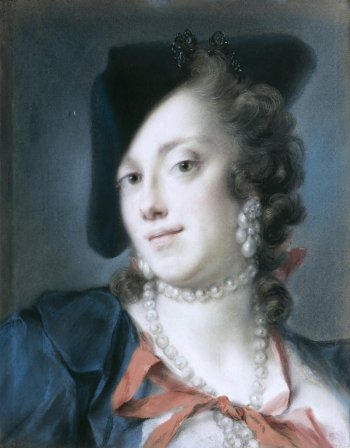
Rosalba Carriera, A Venetian from the House of Barbarigo (Caterina Sagredo Barbarigo), ca. 1735/40, pastel on paper, 42 × 33 cm (Dresden: Gemäldegalerie Alte Meister).
Pastel painting was still considered a comparatively young genre at the time. Carriera was instrumental in making this technique a valued form of painting. The many portraits of princes of the ruling dynasties of Europe show how much in demand the artist was. But she also captured the likenesses of literary figures, musicians, and dancers from her native Venice; a visit to her studio was part of the regular programme of the numerous travellers through Italy. Thus, portraits constitute the largest part of her oeuvre.
Carriera’s pastels bear witness to the beauty ideals of the Rococo period, whose cosmetics were dominated by powder: pale, even skin, powdered hair, and wigs. The powdery surfaces of pastel painting reflect this fashion and thus bring us closer to this bygone era. In cooperation with the Theatre Design/Mask Design course at the Dresden University of Fine Arts, students are illustrating the maquillage of the 18th century in a project that will thus be brought to life in the exhibition.
Carriera’s artistic beginnings lay in miniature painting, as she had little competition to fear from male painter colleagues in this field. In 1705, the San Luca Academy of Art in Rome appointed her a member. This high distinction was bestowed on only a few women, especially as academic training was still denied them for a long time. The Accademia Clementina in Bologna also accepted her as a member in 1720, and a year later the Académie Royale in Paris.
The exhibition shows over 100 objects, taking the public first to the lagoon city of Venice, with views of the Grand Canal, where Carriera had her residence. In addition to the pastel paintings, there are also typical Venetian handicraft products such as glass, lace, and fine cloth to discover.
Roland Enke and Stephan Koja, Rosalba Carriera: Perfection in Pastel (Dresden: Staatliche Kunstsammlungen Dresden, 280 pages, ISBN: 978-3954987580 (English) / ISBN 978-3954987573 (German), €44.
Installation | Nicolas Party and Rosalba Carriera
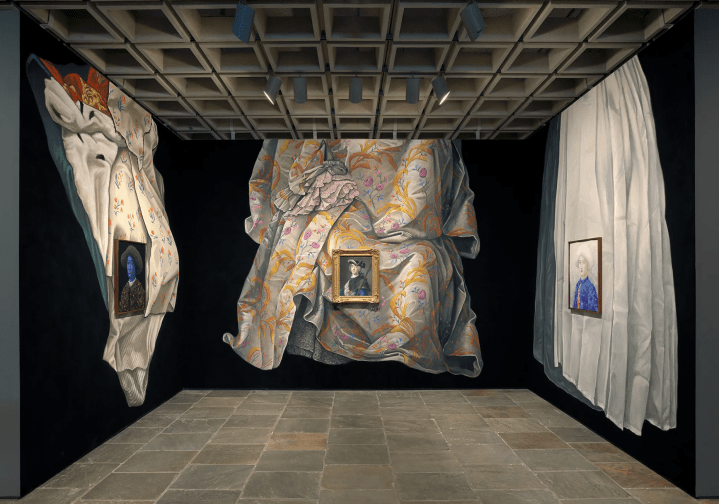
Installation View of Nicolas Party and Rosalba Carriera at Frick Madison, 2023
(Photo by Joseph Coscia Jr.)
◊ ◊ ◊ ◊ ◊
From the press release for the installation:
Nicolas Party and Rosalba Carriera
The Frick Madison, New York, 1 June 2023 — 3 March 2024
Organized by Xavier F. Salomon
The Frick Collection has unveiled a large pastel mural commissioned from the Swiss-born artist Nicolas Party at the museum’s temporary home, Frick Madison. This site-specific work was created in response to Rosalba Carriera’s Portrait of a Man in Pilgrim’s Costume—one of two eighteenth-century pastels by Rosalba bequeathed to the Frick by Alexis Gregory in 2020. The installation features Rosalba’s superb portrait at the center of a three-wall mural designed by Party, as well as two new related works specially created by Party for this presentation.
On view from 1 June 2023 through the remainder of the Frick’s residency at the Breuer building (until 3 March 2024), this installation will inspire the Frick’s summer and early fall programming as well as a new publication.
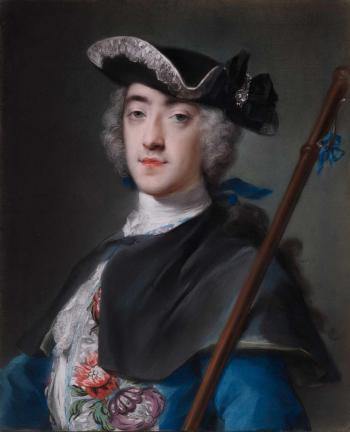
Rosalba Carriera, Portrait of a Man in Pilgrim’s Costume, ca. 1730. pastel on paper, glued to canvas, 59 × 48 cm (New York: The Frick Collection, Gift of Alexis Gregory, 2020.3.01).
The project, which also marks the 350th anniversary of Rosalba’s birth, is organized by Xavier F. Salomon, the Frick’s Deputy Director and Peter Jay Sharp Chief Curator. Salomon comments, “It has been a particular pleasure to work with Nicolas Party. I met Nicolas in April 2021 and since then have enjoyed an ongoing and enlightening conversation on pastels. Nicolas’s installation at Frick Madison is the result of our exchanges, and I am delighted with the result.”
Party adds, “When I first fell in love with pastels, some ten years ago, my research quickly led me to the queen of pastel, Rosalba. Her practice and love for the powdery sticks increased the popularity of the medium and were crucial to the development of the art form. I felt a powerful attraction to her pastels. Today, I like to think our approaches might not be all that different.”
Born in Venice, Rosalba Carriera (1673–1757) was celebrated throughout Europe during her lifetime for her portraiture. She was the preeminent portraitist in Venice in the mid-eighteenth century, at the same time the Venetian Carnival reached its zenith. During this period, foreign travelers flocked to Venice for the masked revelries that became synonymous with the city, and Rosalba’s studio was a popular stop for visiting foreigners, who often posed for her in their elegant Carnival costumes. Portrait of a Man in Pilgrim’s Costume (ca. 1730) is most likely one such work. The sitter is possibly French, British, or German, but his identity remains unknown. With his black cape, staff, and jaunty tricorn hat, he is depicted as a pilgrim.
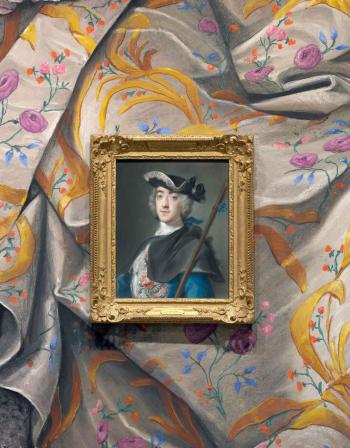
Installation View of Nicolas Party and Rosalba Carriera at Frick Madison, 2023 (Photo by Joseph Coscia Jr.)
Party’s mural includes elaborate draperies that highlight the Rosalba portrait along with two additional pastel portraits he created in response to it. These ornate draperies evoke the work of two other towering figures in European pastels—Jean-Étienne Liotard (1702–1789) and Maurice-Quentin de La Tour (1704–1788)—echoing the function of Venetian Carnival masks, designed to conceal and reveal the features of their wearers. Party’s installation engages devices of disguise and disclosure, from masks to draperies to makeup (often produced with the same chemical components used to make pastel sticks).
The large-scale murals created by Party, whose primary medium since 2013 has been pastel, are ephemeral, lasting only for the duration of a specific exhibition at a unique location. The historical nature of his practice aligns perfectly with the installation at Frick Madison, which has given the museum a unique opportunity to re-imagine its permanent collection display, presented for the first time outside the domestic setting of the Gilded Age mansion at 1 East 70th Street.
This project is part of a series of initiatives in recent years that invite contemporary responses to the Frick’s holdings. Party’s installation not only offers a fresh perspective on an important recent acquisition, but furthers Frick Madison’s prompting of visitors to question the impact of site and setting on their perception of historic objects in the collection.
Born in Lausanne in 1980, Party is a figurative painter who has achieved critical admiration for his familiar yet unsettling landscapes, portraits, and still lifes that simultaneously celebrate and challenge conventions of representational painting. His works are primarily created in soft pastel, which allows for exceptional degrees of intensity and fluidity in his depictions of objects both natural and manmade. Transforming these objects into abstracted, biomorphic shapes, Party suggests deeper connections and meanings. His unique visual language has coalesced in a universe of fantastical characters and motifs where perspective is heightened and skewed to uncanny effect.
Over the years, Party has created work in response to that of European painters including Louis-Léopold Boilly (1761–1845), Arnold Böcklin (1827–1901), and René Magritte (1898–1967). In 2019, Party organized the pastel exhibition at the FLAG Art Foundation in New York, where he created large—and ephemeral—pastel murals inspired by French eighteenth-century artists including François Boucher (1703–1770) and Jean-Honoré Fragonard (1732–1806), both of whom are represented in the Frick’s permanent collection.
Nicolas Party and Xavier Salomon, Rosalba Carriera’s Man in Pilgrim’s Costume (London: Giles, 2023), 80 pages, ISBN: 978-1913875510, £20 / $25.
Funding for the installation is generously provided by The Christian Humann Foundation and the David L. Klein, Jr. Foundation, with the support of the Swiss Arts Council Pro Helvetia.
◊ ◊ ◊ ◊ ◊
Note (added 25 August 2023) — The posting was updated with details on the publication.
Display | The Wildmans in Bedford Square and Newstead Abbey
Now on view at the Mellon Centre:
A Harpy and His Brothers: The Wildmans in Bedford Square and Newstead Abbey
Paul Mellon Centre, London, 30 May — 15 September 2023
Curated by Martin Myrone

George Romney, Portrait of Thomas Wildman MP, detail, oil on canvas, 78 × 64 cm (Private Collection).
This Drawing Room display shows some of the ways that the architectural and cultural histories of Bedford Square and Newstead Abbey have been addressed in the past and the ways in which those stories might be revised and complicated. The inclusion of the film project Blood Sugar, developed by volunteers at Newstead Abbey, offers further perspectives on these historical stories.
Bedford Square has always been esteemed as one of London’s most prestigious addresses. Built in 1775–82, it is widely considered to be the finest surviving example in London of a Georgian town square, embodying in its orderly architecture appearance the favoured self-image of the British social elite. This display explores the history and reputation of Bedford Square by focusing on two brothers who were among its first inhabitants: the successful lawyer Thomas Wildman (1740–1795) and his younger brother James Wildman (1747–1816). Together with a third brother, the merchant Henry Wildman (1746–1816), they made a fortune through their connections with the fabulously wealthy William Beckford, managing his legal affairs and his extensive plantations in the West Indies. Thomas Wildman’s wealth allowed his son, also Thomas (1787–1859), to purchase Newstead Abbey, a historic property in Nottinghamshire previously owned by the poet Lord Byron.
A digital version of the accompanying 36-page booklet is available here»
◊ ◊ ◊ ◊ ◊
More information about “Blood Sugar: The Slavery History of Newstead Abbey” can be found here, with the 5-minute 2018 film itself available on YouTube.
New Book | A Biographical Dictionary of RA Students, 1769–1830
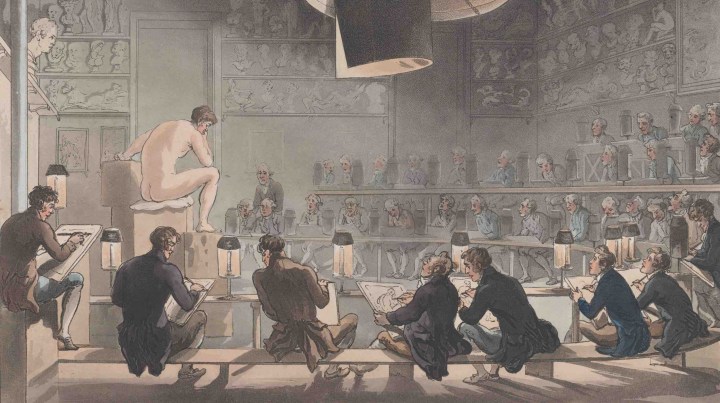
Thomas Rowlandson, Auguste Charles Pugin, and John Bluck, Drawing from Life at the Royal Academy, (detail), 1808, hand-coloured etching and aquatint, sheet: 28 × 34 cm (New York: The Metropolitan Museum of Art, New York, Elisha Whittlesey Collection, 59.533.2084).
◊ ◊ ◊ ◊ ◊
Recently published by The Walpole Society:
Martin Myrone, “A Biographical Dictionary of Royal Academy Students, 1769–1830,” The Walpole Society 84 (2022).
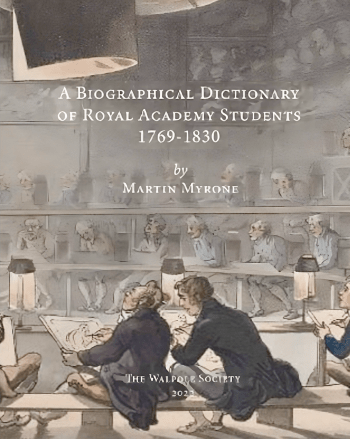 An essential new reference work for students of 18th- and 19th-century British art, Martin Myrone’s A Biographical Dictionary of Royal Academy Students 1769–1830 records every student known to have attended the RA schools in London during its first six decades. The book contains 1,800 biographical entries and draws on extensive new archival research, offering a comprehensive account of the extraordinarily diverse life stories of former RA students and an unprecedented overview of British art during the Romantic period. It provides a revealing new context for such familiar figures as John Constable, William Blake, and J.M.W. Turner, and a wealth of fresh information about three generations of obscure, forgotten, or previously unknown British painters, sculptors, engravers, and architects. As the first national art school, enjoying Royal patronage, prestige, and prominence, the Royal Academy has a pivotal role in British art history, with almost every notable figure of the era passing through its walls.
Martin Myrone is Head of Grants, Fellowships, and Networks at the Paul Mellon Centre for Studies in British Art, London.
A Biographical Dictionary of Royal Academy Students 1769–1830 is for sale to the general public exclusively through Thomas Heneage Art Books, London. It is also available free online and to download for members of the Walpole Society via their newly launched website, where a growing number of volumes can be found in a dedicated member’s area. Members of the Walpole Society support the research and publication of British art history; membership subscriptions—starting at only £20 annually for a student membership—contribute to the cost of producing new volumes, and, in return, members receive a free copy of the current year’s volume, either as a digital file or a hardback book.
The Walpole Society was formed in 1911 chiefly through the efforts of Alexander Finberg (1866—1939), who had been employed to arrange the paintings in the bequest of J.M.W. Turner. In the course of his work, Finberg saw that many artists of the 18th century lay unrecognised, and established the Society to address this lack of knowledge and to shine a light on earlier periods which were then entirely neglected. The Society was named after Horace Walpole (1717—1797), who published the first history of art in Britain, basing his work on the manuscript notebooks of George Vertue (1684—1756), which he had acquired. One of the first goals of the Walpole Society was to publish the notebooks in their original form, which included much material that Walpole omitted. This took up six volumes as well as an index volume, and was finally completed in 1950. This publication is the single most important source of information concerning art collections, artists, architects, and craftsmen working in Britain before the mid-18th century. They form part of more than 80 volumes that the Society has so far published containing articles, catalogues, and editions of original documents.
New Book | Landscape and Authority in the Early Modern World
From Penn Press:
Summer Reading Sale! 40% off all Penn Press books, plus free U.S. shipping with discount code SUMMER23-FM, until June 9 (excluding pre-order sales).
Stephen Whiteman, ed., Landscape and Authority in the Early Modern World (Philadelphia: University of Pennsylvania Press, 2023), 360 pages, ISBN: 978-1512823585, $80.
 Courts and societies across the early modern Eurasian world were fundamentally transformed by the physical, technological, and conceptual developments of their era. Evolving forms of communication, greatly expanded mobility, the spread of scientific knowledge, and the emergence of an increasingly integrated global economy all affected how states articulated and projected visions of authority into societies that, in turn, perceived and responded to these visions in often contrasting terms. Landscape both reflected and served as a vehicle for these transformations, as the relationship between the land and its imagination and consumption became a fruitful site for the negotiation of imperial identities within and beyond the precincts of the court.
In Landscape and Authority in the Early Modern World, contributors explore the role of landscape in the articulation and expression of imperial identity and the mediation of relationships between the court and its many audiences in the early modern world. Nine studies focused on the geographical areas of East and South Asia, the Islamic world, and Europe illuminate how early modern courts and societies shaped, and were shaped by, the landscape, including both physical sites, such as gardens, palaces, cities, and hunting parks, and conceptual ones, such as those of frontiers, idealized polities, and the cosmos. The collected essays expand the meaning and potential of landscape as a communicative medium in this period by putting an array of forms and subjects in dialogue with one another, including not only unique expressions, such as gardens, paintings, and manuscripts, but also the products of rapidly developing commercial technologies of reproduction, especially print. The volume invites a deeper and more nuanced understanding of the complexity with which early modern states constructed and deployed different modes of landscape for different audiences and environments.
Stephen H. Whiteman is Reader in the Art and Architecture of China, The Courtauld, University of London.
C O N T E N T S
Acknowledgments
1 Connective Landscapes: Mobilizing Space in the Transcultural Early Modern — Stephen Whiteman
Part I | Circulating Discourses
2 From Imperial to Confessional Landscapes: Engelbert Kaempfer and the Disenchantment of Nature in Safavid and Tokugawa Cities — Robert Batchelor
3 Constructing an Authentic China: Henri Bertin and Chinese Architecture in Eighteenth-Century France — John Finlay
Part II | Constructing Identities
4 Landscape and the Articulation of the Imperium: Safavid Isfahan — Seyed Mohammad Ali Emrani
5 Bridge into Metaphorical Space: Hideyoshi’s Imperial Landscapes at Osaka — Anton Schweizer
Part III | Defining Margins
6 Views of Victory: The Landscapes of the Battle of the Boyne — Finola O’Kane
7 Delineating the Sea: Maritime Law and Painting in Willem van de Velde the Elder’s Sea-Drafts — Caroline Fowler
8 Dutch Representations of Southeast Asia — Larry Silver
Part IV | Imagining Spaces
9 Landscape and Emperorship in the Connected Qing: Leng Mei’s View of Rehe — Stephen Whiteman
10 The Princely Landscape as Stage: Early Modern Courts in Enchanted Gardens — Katrina Grant
Contributors
Index










 Enfilade
leave a comment