New Book | The People of Print: Eighteenth-Century England
From Cambridge UP, with an online book launch, together with a speed-pitching workshop, scheduled for Monday (see below) . . .
Adam James Smith, Rachel Stenner, and Kaley Kramer, eds., The People of Print: Eighteenth-Century England (Cambridge: Cambridge University Press, 2025), 124 pages, ISBN: 978-1009629454, $18.
 This collection profiles understudied figures in the book and print trades of the eighteenth century. With an explicit focus on intervening in the critical history of the trades, this volume profiles seven women and three men, emphasising the broad range of material, cultural, and ideological work these people undertook. It offers a biographical introduction to each figure, placing them in their social, professional, and institutional settings. The collection considers varied print trade roles including that of the printer, publisher, business-owner, and bookseller, as well as several specific trade networks and numerous textual forms. The biographies draw on extensive new archival research, with details of key sources for further study on each figure. Chronologically organised, this Element offers a primer both on individual figures and on the tribulations and innovations of the print trade in the century of national and print expansion.
c o n t e n t s
Preface
1 Introduction — Adam James Smith, Rachel Stenner, and Kaley Kramer
2 Elizabeth Nutt: Print Trade Matriarch (1666–1746) — Helen Williams
3 John Nicholson and the Auctioning of Copyright (d.1717) — Jacob Baxter
4 Catherine Sanger: Publisher in Bartholomew Close (1687–1716) — Kate Ozment
5 John White Junior: Printer in the North (1689–1769) — Sarah Griffin
6 Selling the Enlightenment: Mary Cooper and Print Culture (1707–1761) — Lisa Maruca
7 The ‘Indefatigable’ Ann Ward: Printer in York (1715/6–1789) — Kaley Kramer
8 Anne Fisher (1719–1778): Not Simply a Printer’s Wife — Barbara Crosbie
9 Sold at the Vestry: John Rippon (1751–1836) and the Hymnbook Trade — Dominic Bridge
10 Diversity in the Book Trades: Ann Ireland (1751–1843) of Leicester — John Hinks
11 ‘Laugh when you must, be candid when you can’: The Concealed Resistance of the Radical Printer Winifred Gales (1761–1839) — Adam James Smith
◊ ◊ ◊ ◊ ◊
From Eventbrite:
The People of Print: Eighteenth-Century England
Book Launch and Early Career Researcher Speed-pitching Workshop
Online, Monday, 3 November, 6.30pm GMT
All welcome! Please register by 2 November.
Join the Centre for Print Culture at the University of Sussex to celebrate the publication of this volume, the follow-on to The People of Print: Seventeenth-Century England, with an evening of lively talks and discussion. The People of Print: Eighteenth-Century England profiles understudied figures in the book and print trades, featuring new research and critical perspectives on this fascinating and rich cultural field. We will be joined by Dr Barbara Crosbie (Durham University), Dr Jacob Baxter (St Andrews), and Dr Lisa Maruca (Wayne State, Professor Emerita), who will discuss their research for the latest collection.
Following the launch, there will be a Speed-pitching workshop (7.30–8.15pm GMT) for early career researchers studying topics in the histories of the book, print, and publishing trades. Come with an idea you can explain in 3 minutes, and we will pair you with one of our publishing panel of journal, series, and book editors for feedback:
• Dr Helen Williams, The Printing Historical Society
• Dr Kaley Kramer and Dr Adam James Smith, editors The People of Print
• Professor Samantha Rayner, Commissioning Editor of Cambridge Elements, Publishing and Book Culture
• Dr Rachel Stenner, editor of Publishing History journal and The People of Print series
The Burlington Magazine, October 2025
The long 18th century in the October issue of The Burlington:
The Burlington Magazine 167 (October 2025)
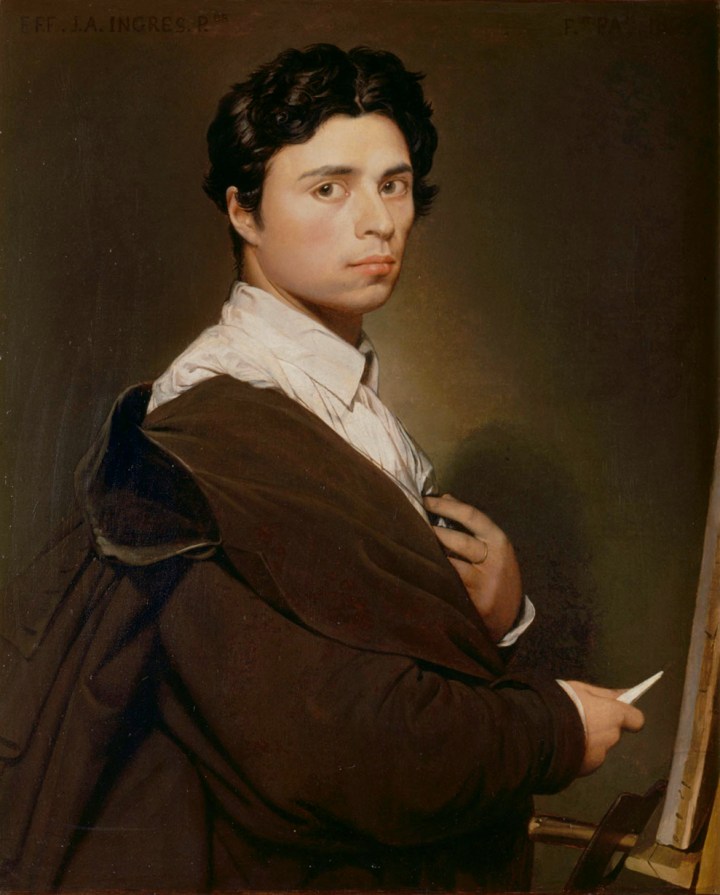
Jean-Auguste-Dominique Ingres, Self-Portrait at the Age of Twenty-Four, 1804, revised 1850–51, oil on canvas, 77 × 61 cm (Musée Condé, Chantilly).
e d i t o r i a l
• “The Story of Art at 75,” p. 959.
Gombrich’s The Story of Art is seventy-five years old this year. Its clarity of conception and expression, civilised values, and the enormous benefits that have undoubtedly resulted from its publication should be a cause for continuing admiration and celebration.
a r t i c l e s
• Sylvain Bédard, “New Proposals about Ingres’s Self-Portrait at the Age of Twenty-Four,” pp. 982–93.
Of all the self-portraits painted by Jean-Auguste-Dominique Ingres, that of 1804 now in the Musée Condé, Chantilly, remains the most discussed. The focus of criticism when it was exhibited in 1806, the painting was taken up again and transformed by the artist during his old age. Here a revised sequence for these modifications is proposed and corrections are made to its earlier history.
• Emma Roodhouse, “Scraps of Genius, Taste and Skill: Works by John Constable in the Mason Album,” pp. 994–1001.
An album emerged at auction in 2020 and was acquired by Colchester and Ipswich Museums. It included hitherto unknown and very early works by John Constable and was compiled by the Mason family, the artist’s relatives in Colchester. These juvenilia are assessed here and placed in the context of Constable’s artistic evolution and his wide social circle.
• Edward Corp, “A Recently Identified Scottish Portrait of Bonnie Prince Charlie by Katherine Read,” pp. 1012–15.
There is a set of three portraits showing the exiled King James III (1701–66) and his two sons, Prince Charles Edward Stuart (1720–88) and Prince Henry Benedict Stuart, Cardinal Duke of York (1725–1807), which are here attributed to Katherine Read (1723–78) and were painted while she was living in Rome between 1750 and 1753. The paintings, which are all in a Somerset collection, have similar dimensions and are framed within painted stone ovals, which have chips and carvings; it seems evident that they were made to be displayed together.
r e v i e w s
• Hugh Doherty, Review of the exhibition catalogue La Rotonde de Saint-Bénigne: 1000 ans d’histoire, ed. by by Franck Abert, Arnaud Alexandre, and Christian Sapin (Faton, 2025), pp. 1033–35.
• Cloe Cavero de Carondelet, Review of the exhibition catalogue Tan lejos, tan cerca: Guadalupe de México en España, ed. by Jaime Cuadriello and Paula Mues Orts (Prado, 2025), pp. 1039–41.
• Elena Cooper, Review of Cristina Martinez and Cynthia Roman, eds., Female Printmakers, Printsellers, and Print Publishers in the Eighteenth Century: The Imprint of Women, c. 1700–1830 (Cambridge: Cambridge University Press, 2024), pp. 1052–53.
• Clive Aslet, Review of Juliet Carey and Abigail Green, eds., Jewish Country Houses (Brandeis University Press, 2024), pp. 1056–57.
o b i t u a r y
• Colin Thom, Obituary for Andrew Saint (1957–2024), pp. 1059–60.
A longstanding editor for the Survey for London, an astute architectural scholar, and a personable educator, Andrew Saint effortlessly combined many skills. His time as a professor in the University of Cambridge’s Department of Architecture shaped numerous future careers, and his contributions to the Survey enriched the history of London’s urban fabric.
The Burlington Magazine, September 2025
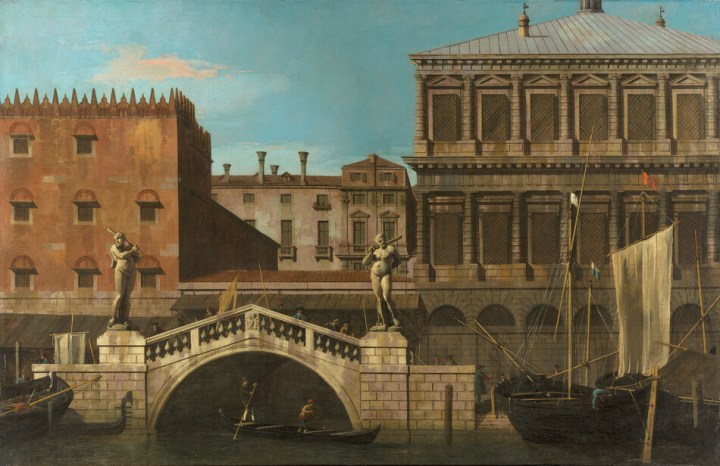
Canaletto, Cappriccio: The Ponte della Pescaria and Buildings in the Quay, Showing Zecca on the Right, 1744(?), oil on canvas, 84 × 130 cm
(Royal Collection Trust, © His Majesty King Charles III 2025)
◊ ◊ ◊ ◊ ◊
The long 18th century in the September issue of The Burlington:
The Burlington Magazine 167 (September 2025) | Italian Art
a r t i c l e s
• Gregorio Astengo and Philip Steadman, “Canaletto’s Use of Drawings of Venetian Buildings by Antonio Visentini,” pp. 896–905.
The use by Canaletto of measured drawings by Antonio Visentini and his assistants is fully considered here for the first time. He ingeniously utilised them at different points in his career to provide images of buildings in both his ‘vedute’ and ‘capricci’. This creative borrowing was possible because both painters formed part of the same successful network of artists, scientists, and patrons.
r e v i e w s
 • Philippe Bordes, Review of the exhibition Duplessis (1725–1802): The Art of Painting Life / L’art de peindre la vie (Inguimbertine, Carpentras, 2025), pp. 924–27.
• Colin Bailey, Review of Katie Scott and Hannah Williams, Artists’ Things: Rediscovering Lost Property from Eighteenth-Century France (Getty Research Institute, 2024), pp. 946–48.
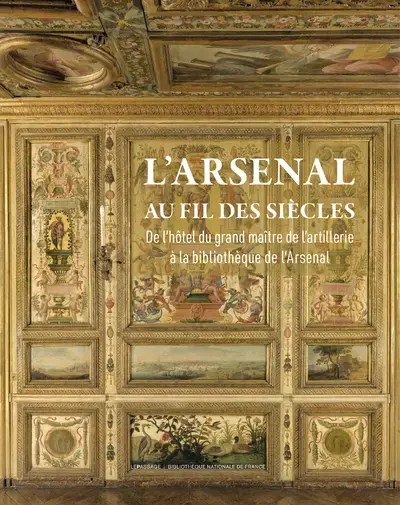
• Karl-Georg Pfändtner, Review of Olivier Bosc and Sophie Guérinot, eds., L’Arsenal au fil des siècles: De l’hôtel du grand maître de l’Artillerie à la bibliothèque de l’Arsenal (Le Passage / BNF, 2024), pp. 951–52.
• Timothy Revell, Review of Lieke van Deinsen, Bert Schepers, Marjan Sterckx, Hans Vlieghe, and Bert Watteeuw, eds., Campaspe Talks Back: Women Who Made a Difference in Early Modern Art (Brepols: 2024), pp. 952–53.
• Jonathan Yarker, Review of Katherine Jean McHale, Ingenious Italians: Immigrant Artists in Eighteenth-Century Britain (Brepols, 2024, p. 953.
• Conal McCarthy, Review of Deidre Brown, Ngarino Ellis, and Jonathan Mane-Wheoki, Toi Te Mana: An Indigenous History of Māori Art (University of Chicago Press, 2025), pp. 953–54.
New Book | Translating John Crome
From University of East Anglia Publishing Project:
Andrew Moore and Clive Scott, eds., Translating John Crome: Through Sight to Insight (Norwich: UEA Publishing Project, 2025), 256 pages, ISBN: 978-1915812728, £30.
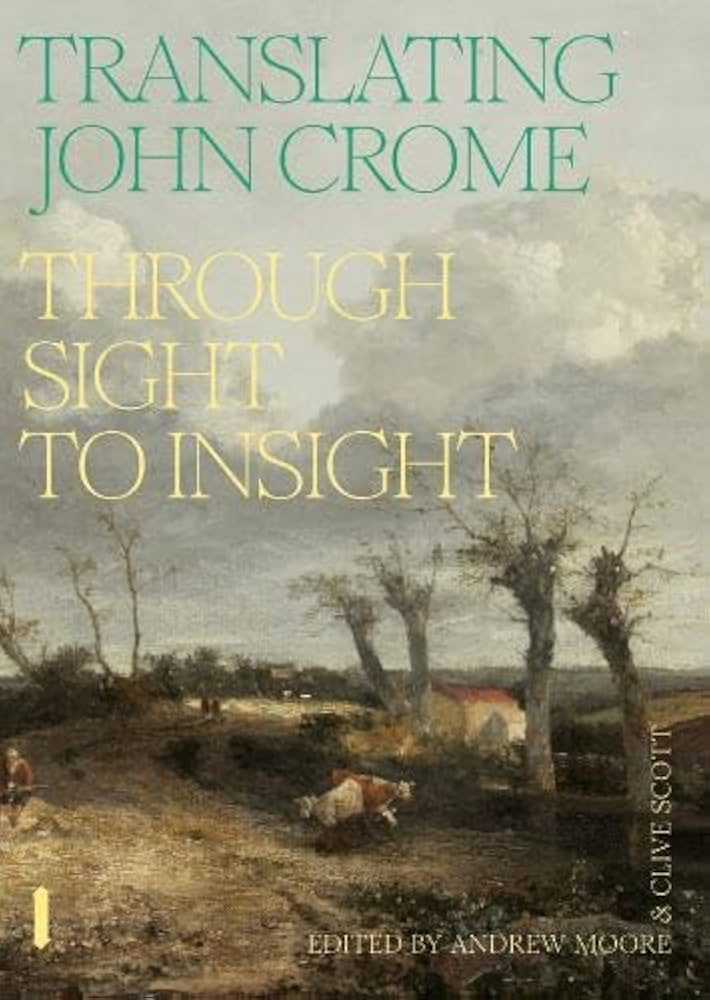 This book considers and translates the paintings and etchings of John Crome (1768–1821), founder of the Norwich School of Artists, through and into other ‘languages’ or media, verbal and pictorial. The word ‘translation’ is not used lightly. This is not an anthology of creative pieces by a variety of artists from different media ‘inspired by’ or ‘expressing a kinship with’ Crome’s paintings. Instead, these are translations in the sense of transformations into new languages designed both to incorporate the perceptual and existential responses of the ‘translator’ to examples of Crome’s work and to project those works into possible cross-medial futures. The book is as much about ‘looking’ across media, as about John Crome. What kinds of transformation do the landscapes and plant studies of John Crome, once considered the equal of J.M.W. Turner, undergo when translated into other ‘languages’ or media? The twenty contributors to this volume—from fields as diverse as travel-writing, poetry, painting, photography, and ceramics—provide a range of answers, and, in so doing, uncover new futures for Crome’s work.
Contributions and extracts from Georg Simmel, John Berger, Richard Mabey, Gerry Barnes, Tom Williamson, Virginia Woolf, Oliver Rackham, Neil MacMaster, Jacques Rancière, Malcolm Andrews, Elizabeth Helsinger, Edmund Bartell, Frances Milton Trollope, Rose Miller, Nick Stone, John Craske, Richard Long, Tacita Dean, Tor Falcon, Anya Gallaccio, Chloe Steele, Katie Spragg, Daniel & Clara, Tim Dee, Esther Morgan, George Szirtes, Anna Reckin, Edward Parnell, Kit Young, Mark Edwards, Lawrence Sail, Jacques Nimki, and Simon Carter.
Andrew Moore has enjoyed a long association with the work of John Crome through his former position as Keeper of Art, based at Norwich Castle Museum & Art Gallery, home to the national collection of works by Crome and the Norwich School of Painters.
Clive Scott is Professor Emeritus of European Literature at the University of East Anglia and an Emeritus Fellow of the British Academy. He specializes in the theory and practice of literary translation.
New Book | Americana Insights, Pennsylvania German Redware
From Penn Press:
Lisa Minardi, ed., Americana Insights 2025 (Philadelphia: University of Pennsylvania Press, 2025), 300 pages, ISBN: 979-8988533122, $65. With contributions by Johanna Brown, Laini Farrare, R. Erich Hess, Christopher Malone, Lisa Minardi, Karl Pass, Candace Perry, Jeffrey Pressman, Jean Renshaw, Justin Thomas, and Adam Zayas.
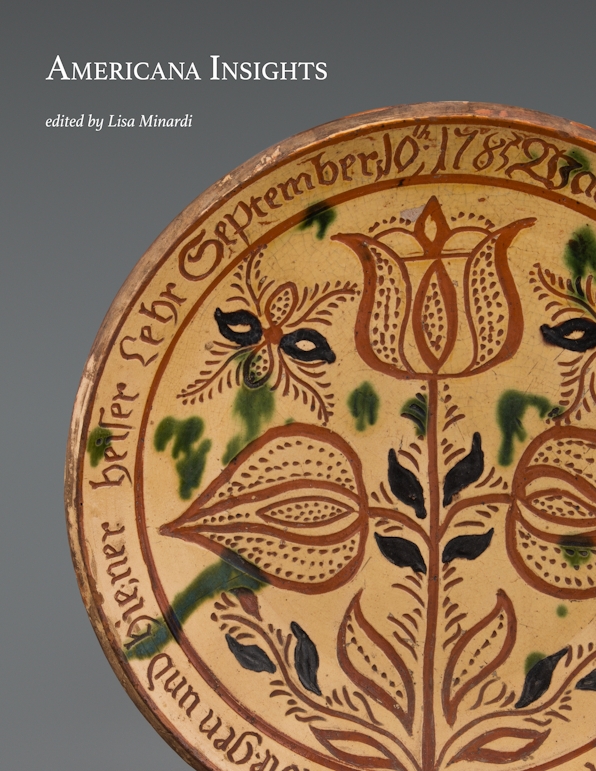 A comprehensive study of Pennsylvania German redware and a celebration of this vibrant folk art tradition
Americana Insights 2025 is the third volume in an annual series that presents the latest research and discoveries on traditional Americana, folk art, and material culture. In this volume the authors explore a beloved aspect of American folk art—Pennsylvania German redware. Focusing on redware’s production, use, and collecting in southeastern Pennsylvania from the mid-eighteenth to early twentieth century, the authors provide fresh insights into renowned potters such as Georg Hubener and Samuel Troxel as well as lesser-known figures. Other essays delve into the work of twentieth-century potters like Jacob Medinger, considered the last of the traditional Pennsylvania German potters, and Mildred Keyser, a pioneering revivalist potter. The authors also explore broader themes, including the use of political imagery and hunting iconography, and redware’s role in cultural exchange between Anglo-Americans and Pennsylvania Germans. A celebration of this vibrant folk art tradition and a vital scholarly contribution, Americana Insights 2025 represents the most comprehensive study of Pennsylvania German redware in more than a century.
Lisa Minardi is a curator and scholar of Pennsylvania German art and culture. She has organized numerous exhibitions and published extensively and was assistant curator at Winterthur Museum from 2006 to 2016. Minardi currently serves as executive director of Historic Trappe and the Center for Pennsylvania German Studies. She is a PhD candidate in the History of American Civilization Program at the University of Delaware, where she is researching the German-speaking community of early Philadelphia for her dissertation. She holds an MA from the Winterthur Program in Early American Culture and a BA in history and museum studies from Ursinus College.
Exhibition | Vanbrugh: The Drama of Architecture
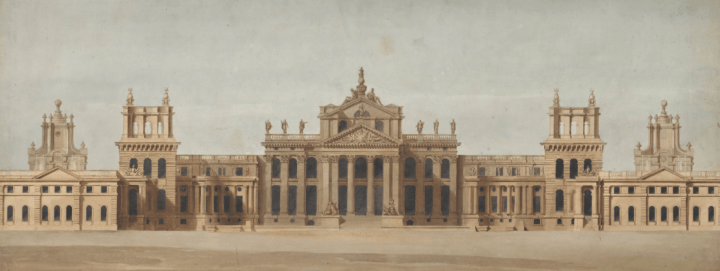
Soane office, Royal Academy Lecture Drawings of the work of Sir John Vanbrugh, Blenheim Palace, elevation
(London: Sir John Soane’s Museum, SM 74/4/8)
◊ ◊ ◊ ◊ ◊
The exhibition opens in the spring; the book launches this fall:
Vanbrugh: The Drama of Architecture
Sir John Soane’s Museum, London, 4 March — 28 June 2026
Curated by Charles Saumarez Smith
300 years after his death, a major new exhibition exploring one of the UK’s greatest architects—Sir John Vanbrugh (1664–1726)—will open in the spring at Sir John Soane’s Museum. Some of the UK’s most admired and loved country houses like Blenheim Palace and Castle Howard were the result of Vanbrugh’s genius, becoming cornerstones of English Baroque. Soane cited him as one of his great influences, saying Vanbrugh had “all the fire and power of Michelangelo and Bernini.”
Curated by Sir Charles Saumarez Smith CBE and architect Roz Barr, the exhibition will feature never-before-exhibited drawings from the collections of the V&A, the Royal Institute of British Architects, the National Portrait Gallery, and Sir John Soane’s Museum, including many in Vanbrugh’s own hand. Perhaps overshadowed by contemporaries Nicholas Hawksmoor and Sir Christopher Wren, the emotional impact and imagination of Vanbrugh has continued to be admired, particularly by architects, in the centuries since. The exhibition will highlight Vanbrugh’s enduring architectural ideas and influence, including on two of the most influential architects of the 20th century, Robert Venturi (1925–2018) and Denise Scott Brown (b.1931). A new short film by filmmaker Jim Venturi, their son, will explore this connection and will be shown on loop in the Museum’s Foyle Space. Vanbrugh: The Drama of Architecture will introduce new audiences to the work of an English Baroque architect, adventurer, playwright, and spy 300 years after his death.
Charles Saumarez Smith, John Vanbrugh: The Drama of Architecture (London: Lund Humphries, 2025), 272 pages, ISBN: 978-1848227316, £30.
◊ ◊ ◊ ◊ ◊
Book tickets at Wigmore Hall:
Book launch | John Vanbrugh: The Drama of Architecture
The Wigmore Hall, London, 20 November 2025, 12.30pm
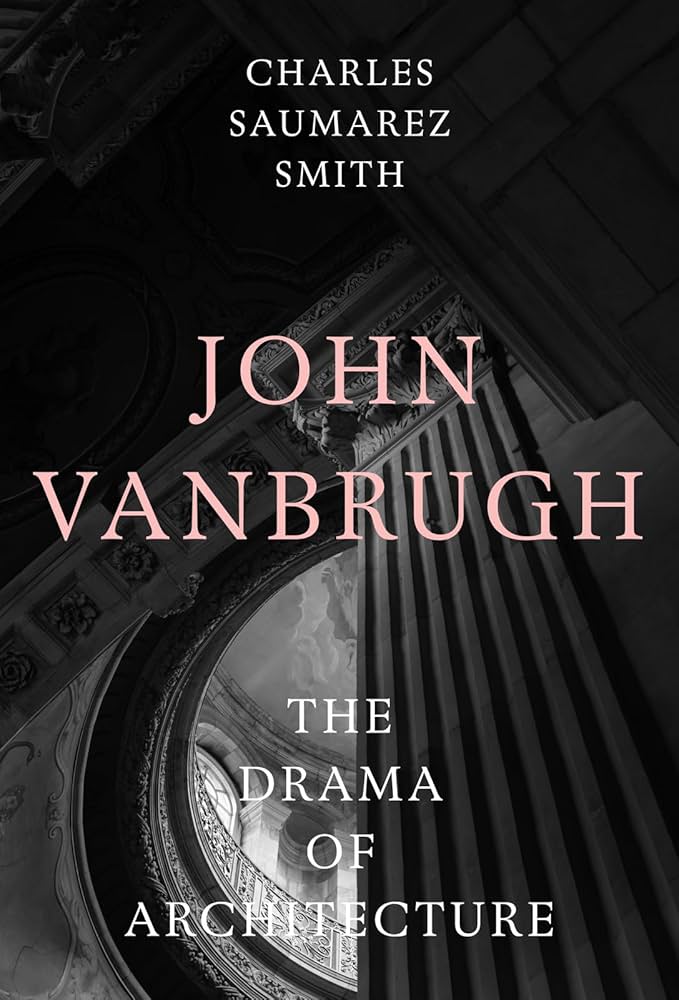 Charles Saumarez Smith will give a lunchtime talk on Vanbrugh’s extraordinary life: his upbringing; why he spent so much time in a French gaol; the writing of The Relapse and The Provoked Wife; and how he came to design Castle Howard with no previous experience of architecture. Saumarez Smith will give particular attention to Vanbrugh’s work as a theatrical impresario and the designer of the Queen’s Theatre, Haymarket, so disastrous as a venue for plays, but where all of Handel’s early operas were performed. He will then describe Vanbrugh’s quarrel with the Duchess of Marlborough and his later work as an architect, at King’s Weston, Claremont, Grimsthorpe, Seaton Delaval, and Stowe. In recent years, Vanbrugh’s reputation as an architect has been eclipsed by his subordinate, Nicholas Hawksmoor. This talk and the accompanying book will explain Vanbrugh’s originality and influence on later architects from Robert Adam to Robert Venturi and Denise Scott Brown.
Exhibition | Egypt: Influencing British Design, 1775–2025

George Dance, Front Elevation of a Library Chimney-piece for the 1st Marquess of Lansdowne, Lansdowne House, Berkeley Square, Westminster, ca. 1788–94; pen, sepia, raw umber, and crimson washes, shaded on laid paper laid down on (old) board with double-ruled border (London: Sir John Soane’s Museum, SM D3/3/3).
◊ ◊ ◊ ◊ ◊
Now on view at The Soane:
Egypt: Influencing British Design, 1775–2025
Sir John Soane’s Museum, London, 8 October 2025 — 18 January 2026
The mystery, romance, and aesthetic appeal of ancient Egypt has informed richly decorated Regency homes, Victorian factories and cemeteries, Art Deco cinemas, and twentieth-century houses, shops, and offices. This exhibition explores the British fascination with all things Egyptian through evocative drawings and books owned by Soane. Decorative objects including Wedgwood ceramics, Liberty Fabrics, and an Egyptian-style Singer sewing machine demonstrate the range of ways people have brought Egypt into their homes from Soane’s time to today.
This exhibition is accompanied by new work by Cairo-born artist Sara Sallam. As part of this exhibition, Sallam has produced A Tourist Handbook for Egypt outside of Egypt, Vol. II, London. Displayed in the Foyle Space in large scale, Sallam’s collages juxtapose photographs of London’s commemorative statues and imperial architecture with nineteenth-century paintings of correlating events in Egypt. Copies are available for purchase from the museum shop. Sallam’s second work, Eyes that Weep, Eyes that Pierce, is an audio tour, available exclusively on Bloomberg Connects, inspired by the sarcophagus of Seti I. Sallam invites you to listen closely to the Egyptian sky goddess Nut (seen inside the sarcophagus), her voice tracing the many eyes that have peered into Seti I’s sarcophagus across time.
Exhibition | Mary Linwood: Art, Stitch and Life
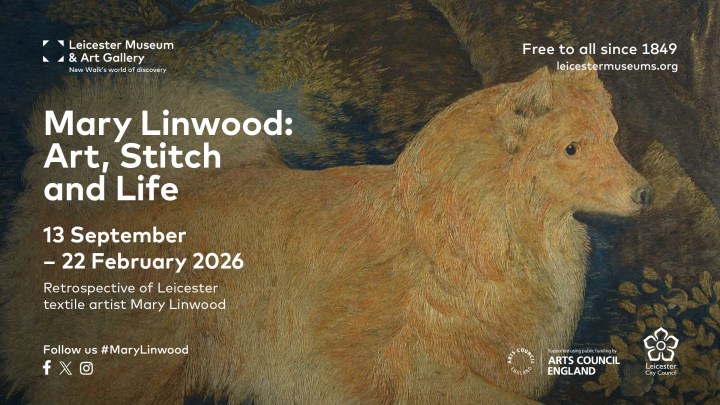
Mary Linwood, Pomeranian Dog, detail, needlework, 68 × 86 cm
(Leicester Museum & Art Gallery)
◊ ◊ ◊ ◊ ◊
Now on view, as noted by Adam Busiakiewicz for the Art History News blog:
Mary Linwood: Art, Stitch, and Life
Leicester Museum & Art Gallery, 13 September 2025 — 22 February 2026
A retrospective of the Leicester textile artist Mary Linwood (1755–1845)
Leicester’s Mary Linwood was a celebrity artist in the early 1800s but has since been largely forgotten. She created detailed embroidered versions of famous British paintings using a technique known as needle painting. Linwood was not only a talented artist but also an innovator and entrepreneur. Alongside running a successful school for young ladies in Leicester, she exhibited her embroidered works in touring exhibitions and established the first gallery in London to be run by a woman. In her lifetime, Linwood was supported by the wealthy and powerful, and was widely respected and well known. Since her death, however, she has been overlooked and undervalued. This exhibition is the first retrospective of Mary Linwood’s work since 1945, featuring 14 embroidered works from the Leicester Museums collections. Alongside these historic pieces are new textile artworks by Ruth Singer, reflecting on Linwood’s life and legacy.
Ruth Singer, Lost Threads: Mary Linwood’s Legacy (2025), 60 pages, £15. Available for purchase here.
◊ ◊ ◊ ◊ ◊
It’s also a fine opportunity to remind readers of Heidi Strobel’s recent book, The Art of Mary Linwood: Embroidery, Installation, and Entrepreneurship in Britain, 1787–1845. –CH
New Book | The Killing of Jane McCrea
From Westholme Publishing:
Paul Staiti, The Killing of Jane McCrea: An American Tragedy on the Revolutionary Frontier (Yardley, PA, Westholme Publishing, 2025), 272 pages, ISBN: 978-1594164460, $30.
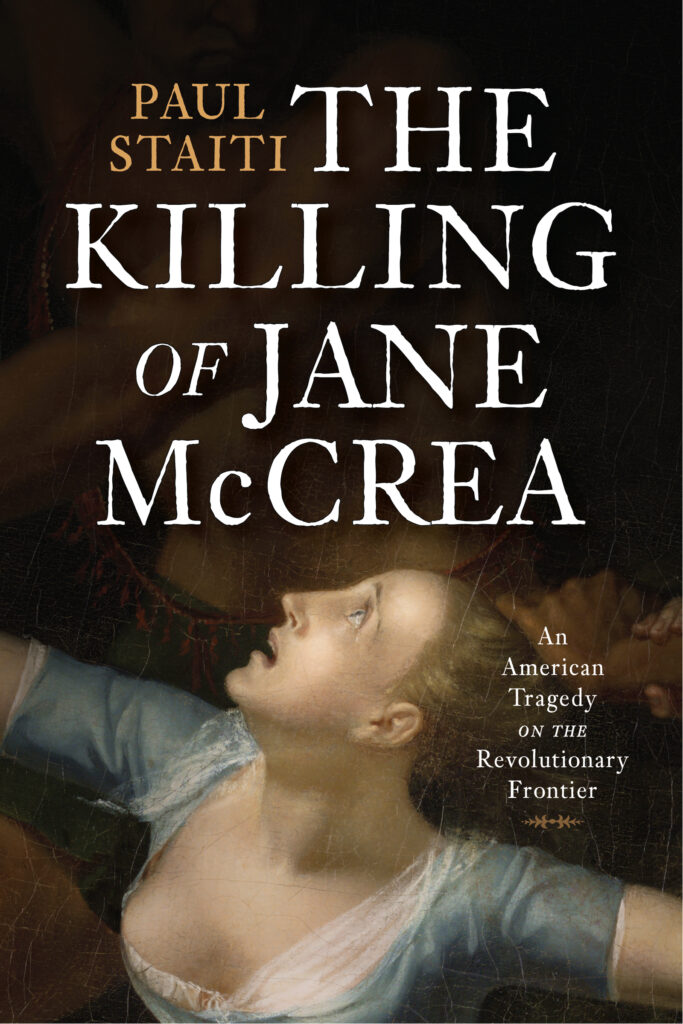 The killing of Jane McCrea on July 26, 1777, on the outskirts of a village in the northern Hudson Valley, would unexpectedly rupture the British advance from Canada that was meant to crush the American Revolution in one knockout blow. On that day, twenty-five-year-old McCrea, an unremarkable person preparing for an impending marriage, was assaulted, scalped, and killed by a group of Native Americans in the employ of British general John Burgoyne. Though the murder was but one of many civilian deaths in a fierce war zone, McCrea’s killing had far-reaching consequences for each of the three major parties involved in the Northern Campaign of 1777.
In America, McCrea became the great cause célèbre of the Revolution, the sympathetic female victim of the war symbolizing the righteousness of The Cause. In Britain, she was a human-rights tragedy that tarnished the polished surface of British honor and galvanized Whig politicians who shouted out her name in Parliament as an example of how low the nation had fallen. For Native peoples, recruited by both the British and the Americans, and caught in the middle of a war staged on ancestral grounds, McCrea’s killing was the opening salvo in a vicious chain of bloody retribution that led to the disintegration of the venerable Iroquois Confederacy and the obliteration of Native homelands. After the war, the nightmarish image of a young Jane McCrea slaughtered on the New York frontier would obsess white Americans who came to fear Native peoples as irredeemable savages. Her murder would help justify the expulsion of Indigenous tribes and open the doors for an expansionary United States that was fully intent on transforming the American continent into its own image.
The Killing of Jane McCrea: An American Tragedy on the Revolutionary Frontier by distinguished historian Paul Staiti undertakes for the first time a comprehensive investigation into McCrea’s life, death, and especially her long and strange afterlife. Using both visual arts and written records, the author reassembles the scattered fragments to illuminate a historical terrain long since shrouded in misinformation, mired in controversy, and relegated to mythology. Coming into view is a major portrait of the persons, cultures, actions, and motives that fatally converged on that hot July morning in 1777.
Paul Staiti is the author of Samuel F. B. Morse and Of Arms and Artists: The American Revolution through Painters’ Eyes. The latter was Colonial Dames of America Book of the Year in 2018 and was nominated for the Andrew Carnegie Medal for Excellence in Non-Fiction. He has written on John Singleton Copley, Gilbert Stuart, Winslow Homer, and William Michael Harnett, and has lectured widely at colleges, universities, and museums, including the National Gallery of Art and the Louvre. He holds a PhD from the University of Pennsylvania, has been the recipient of two fellowships from the The Metropolitan Museum of Art and three from the National Endowment for the Humanities. Currently he is Professor of Fine Arts on the Alumnae Foundation at Mount Holyoke College.
New Book | Murder in the Rue Marat
From Princeton UP:
Thomas Crow, Murder in the Rue Marat: A Case of Art in Revolution (Princeton University Press, 2025), 176 pages, ISBN: 978-0691274447, £25 / $30.
 How an enigmatic masterpiece of the French Revolution became a talisman of the revolutionary spirit in our own time
Jacques-Louis David’s The Death of Marat depicts the painter’s friend and fellow revolutionary Jean-Paul Marat collapsed in his bath after being fatally stabbed by a female assassin who stands just outside the frame. In this fascinating book, Thomas Crow traces the radical legacy of a painting that has been called the Pietà of the French Revolution, showing how David’s masterpiece captures the saga of that violent era in the single figure of Marat, and how it reveals itself anew today.
Crow begins by describing how the painting’s enduring power came to the fore during the countercultural tumult of the 1960s, discussing how his vocation as a scholar arose out of his own encounter with the work. He then takes readers back to 1793, telling the story of the painting’s creation through the eyes of David, his subject, and Marat’s charismatic assassin, Charlotte Corday. Charting the history of its impact across more than two centuries, Crow shows how this multilayered portrait surfaced in succeeding waves of political dissent as an enduring talisman of popular insurgency. Beautifully illustrated, Murder in the Rue Marat is an art historian’s disarmingly personal account of a painting whose hidden complexities bear witness to the promise and peril of revolution in Marat’s time and our own.
Thomas Crow is the Rosalie Solow Professor of Modern Art at New York University’s Institute of Fine Arts. His many books include Restoration: The Fall of Napoleon in the Course of European Art, 1812–1820 and The Artist in the Counterculture: Bruce Conner to Mike Kelley and Other Tales from the Edge.










 Enfilade
leave a comment