Exhibition | Vanbrugh: The Drama of Architecture
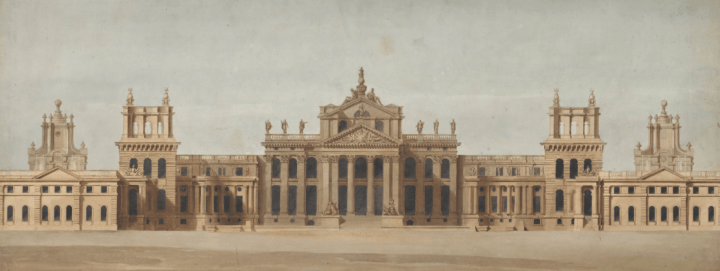
Soane office, Royal Academy Lecture Drawings of the work of Sir John Vanbrugh, Blenheim Palace, elevation
(London: Sir John Soane’s Museum, SM 74/4/8)
◊ ◊ ◊ ◊ ◊
The exhibition opens in the spring; the book launches this fall:
Vanbrugh: The Drama of Architecture
Sir John Soane’s Museum, London, 4 March — 28 June 2026
Curated by Charles Saumarez Smith
300 years after his death, a major new exhibition exploring one of the UK’s greatest architects—Sir John Vanbrugh (1664–1726)—will open in the spring at Sir John Soane’s Museum. Some of the UK’s most admired and loved country houses like Blenheim Palace and Castle Howard were the result of Vanbrugh’s genius, becoming cornerstones of English Baroque. Soane cited him as one of his great influences, saying Vanbrugh had “all the fire and power of Michelangelo and Bernini.”
Curated by Sir Charles Saumarez Smith CBE and architect Roz Barr, the exhibition will feature never-before-exhibited drawings from the collections of the V&A, the Royal Institute of British Architects, the National Portrait Gallery, and Sir John Soane’s Museum, including many in Vanbrugh’s own hand. Perhaps overshadowed by contemporaries Nicholas Hawksmoor and Sir Christopher Wren, the emotional impact and imagination of Vanbrugh has continued to be admired, particularly by architects, in the centuries since. The exhibition will highlight Vanbrugh’s enduring architectural ideas and influence, including on two of the most influential architects of the 20th century, Robert Venturi (1925–2018) and Denise Scott Brown (b.1931). A new short film by filmmaker Jim Venturi, their son, will explore this connection and will be shown on loop in the Museum’s Foyle Space. Vanbrugh: The Drama of Architecture will introduce new audiences to the work of an English Baroque architect, adventurer, playwright, and spy 300 years after his death.
Charles Saumarez Smith, John Vanbrugh: The Drama of Architecture (London: Lund Humphries, 2025), 272 pages, ISBN: 978-1848227316, £30.
◊ ◊ ◊ ◊ ◊
Book tickets at Wigmore Hall:
Book launch | John Vanbrugh: The Drama of Architecture
The Wigmore Hall, London, 20 November 2025, 12.30pm
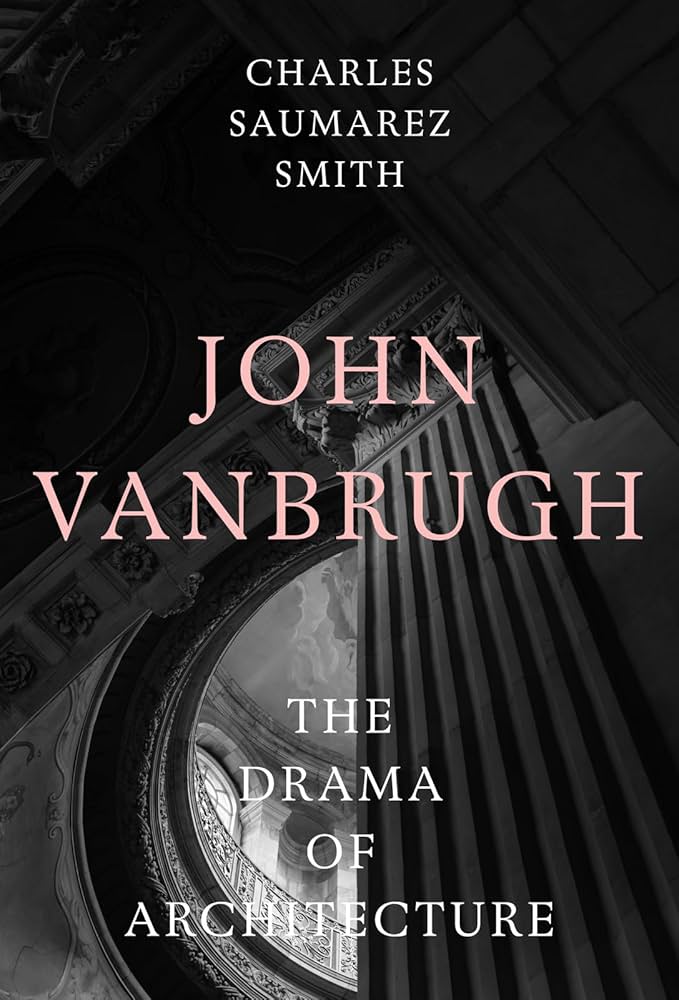 Charles Saumarez Smith will give a lunchtime talk on Vanbrugh’s extraordinary life: his upbringing; why he spent so much time in a French gaol; the writing of The Relapse and The Provoked Wife; and how he came to design Castle Howard with no previous experience of architecture. Saumarez Smith will give particular attention to Vanbrugh’s work as a theatrical impresario and the designer of the Queen’s Theatre, Haymarket, so disastrous as a venue for plays, but where all of Handel’s early operas were performed. He will then describe Vanbrugh’s quarrel with the Duchess of Marlborough and his later work as an architect, at King’s Weston, Claremont, Grimsthorpe, Seaton Delaval, and Stowe. In recent years, Vanbrugh’s reputation as an architect has been eclipsed by his subordinate, Nicholas Hawksmoor. This talk and the accompanying book will explain Vanbrugh’s originality and influence on later architects from Robert Adam to Robert Venturi and Denise Scott Brown.
Exhibition | Egypt: Influencing British Design, 1775–2025

George Dance, Front Elevation of a Library Chimney-piece for the 1st Marquess of Lansdowne, Lansdowne House, Berkeley Square, Westminster, ca. 1788–94; pen, sepia, raw umber, and crimson washes, shaded on laid paper laid down on (old) board with double-ruled border (London: Sir John Soane’s Museum, SM D3/3/3).
◊ ◊ ◊ ◊ ◊
Now on view at The Soane:
Egypt: Influencing British Design, 1775–2025
Sir John Soane’s Museum, London, 8 October 2025 — 18 January 2026
The mystery, romance, and aesthetic appeal of ancient Egypt has informed richly decorated Regency homes, Victorian factories and cemeteries, Art Deco cinemas, and twentieth-century houses, shops, and offices. This exhibition explores the British fascination with all things Egyptian through evocative drawings and books owned by Soane. Decorative objects including Wedgwood ceramics, Liberty Fabrics, and an Egyptian-style Singer sewing machine demonstrate the range of ways people have brought Egypt into their homes from Soane’s time to today.
This exhibition is accompanied by new work by Cairo-born artist Sara Sallam. As part of this exhibition, Sallam has produced A Tourist Handbook for Egypt outside of Egypt, Vol. II, London. Displayed in the Foyle Space in large scale, Sallam’s collages juxtapose photographs of London’s commemorative statues and imperial architecture with nineteenth-century paintings of correlating events in Egypt. Copies are available for purchase from the museum shop. Sallam’s second work, Eyes that Weep, Eyes that Pierce, is an audio tour, available exclusively on Bloomberg Connects, inspired by the sarcophagus of Seti I. Sallam invites you to listen closely to the Egyptian sky goddess Nut (seen inside the sarcophagus), her voice tracing the many eyes that have peered into Seti I’s sarcophagus across time.
Exhibition | Mary Linwood: Art, Stitch and Life
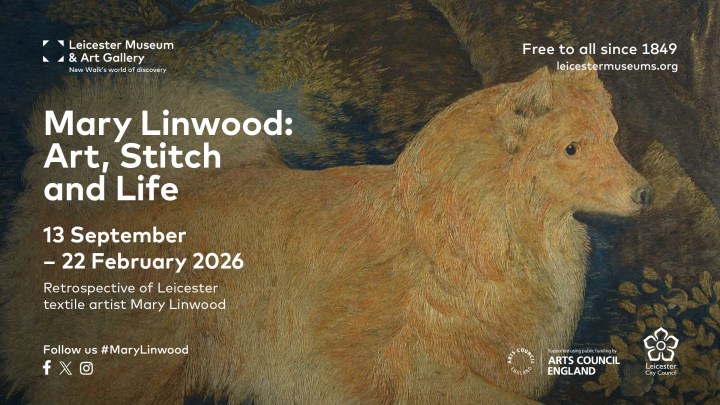
Mary Linwood, Pomeranian Dog, detail, needlework, 68 × 86 cm
(Leicester Museum & Art Gallery)
◊ ◊ ◊ ◊ ◊
Now on view, as noted by Adam Busiakiewicz for the Art History News blog:
Mary Linwood: Art, Stitch, and Life
Leicester Museum & Art Gallery, 13 September 2025 — 22 February 2026
A retrospective of the Leicester textile artist Mary Linwood (1755–1845)
Leicester’s Mary Linwood was a celebrity artist in the early 1800s but has since been largely forgotten. She created detailed embroidered versions of famous British paintings using a technique known as needle painting. Linwood was not only a talented artist but also an innovator and entrepreneur. Alongside running a successful school for young ladies in Leicester, she exhibited her embroidered works in touring exhibitions and established the first gallery in London to be run by a woman. In her lifetime, Linwood was supported by the wealthy and powerful, and was widely respected and well known. Since her death, however, she has been overlooked and undervalued. This exhibition is the first retrospective of Mary Linwood’s work since 1945, featuring 14 embroidered works from the Leicester Museums collections. Alongside these historic pieces are new textile artworks by Ruth Singer, reflecting on Linwood’s life and legacy.
Ruth Singer, Lost Threads: Mary Linwood’s Legacy (2025), 60 pages, £15. Available for purchase here.
◊ ◊ ◊ ◊ ◊
It’s also a fine opportunity to remind readers of Heidi Strobel’s recent book, The Art of Mary Linwood: Embroidery, Installation, and Entrepreneurship in Britain, 1787–1845. –CH
New Book | The Killing of Jane McCrea
From Westholme Publishing:
Paul Staiti, The Killing of Jane McCrea: An American Tragedy on the Revolutionary Frontier (Yardley, PA, Westholme Publishing, 2025), 272 pages, ISBN: 978-1594164460, $30.
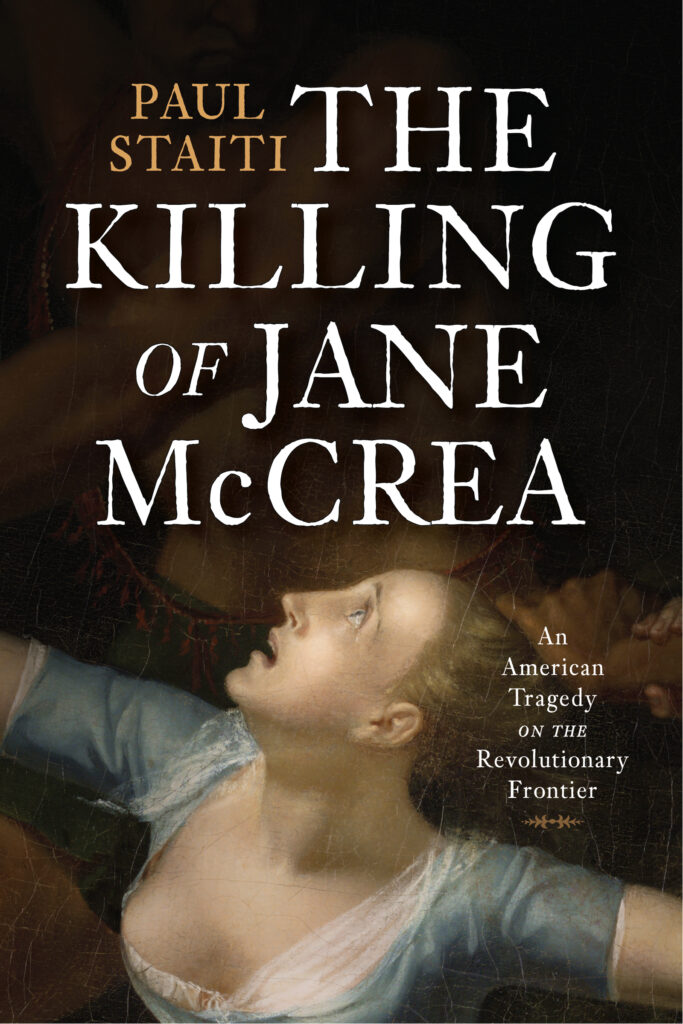 The killing of Jane McCrea on July 26, 1777, on the outskirts of a village in the northern Hudson Valley, would unexpectedly rupture the British advance from Canada that was meant to crush the American Revolution in one knockout blow. On that day, twenty-five-year-old McCrea, an unremarkable person preparing for an impending marriage, was assaulted, scalped, and killed by a group of Native Americans in the employ of British general John Burgoyne. Though the murder was but one of many civilian deaths in a fierce war zone, McCrea’s killing had far-reaching consequences for each of the three major parties involved in the Northern Campaign of 1777.
In America, McCrea became the great cause célèbre of the Revolution, the sympathetic female victim of the war symbolizing the righteousness of The Cause. In Britain, she was a human-rights tragedy that tarnished the polished surface of British honor and galvanized Whig politicians who shouted out her name in Parliament as an example of how low the nation had fallen. For Native peoples, recruited by both the British and the Americans, and caught in the middle of a war staged on ancestral grounds, McCrea’s killing was the opening salvo in a vicious chain of bloody retribution that led to the disintegration of the venerable Iroquois Confederacy and the obliteration of Native homelands. After the war, the nightmarish image of a young Jane McCrea slaughtered on the New York frontier would obsess white Americans who came to fear Native peoples as irredeemable savages. Her murder would help justify the expulsion of Indigenous tribes and open the doors for an expansionary United States that was fully intent on transforming the American continent into its own image.
The Killing of Jane McCrea: An American Tragedy on the Revolutionary Frontier by distinguished historian Paul Staiti undertakes for the first time a comprehensive investigation into McCrea’s life, death, and especially her long and strange afterlife. Using both visual arts and written records, the author reassembles the scattered fragments to illuminate a historical terrain long since shrouded in misinformation, mired in controversy, and relegated to mythology. Coming into view is a major portrait of the persons, cultures, actions, and motives that fatally converged on that hot July morning in 1777.
Paul Staiti is the author of Samuel F. B. Morse and Of Arms and Artists: The American Revolution through Painters’ Eyes. The latter was Colonial Dames of America Book of the Year in 2018 and was nominated for the Andrew Carnegie Medal for Excellence in Non-Fiction. He has written on John Singleton Copley, Gilbert Stuart, Winslow Homer, and William Michael Harnett, and has lectured widely at colleges, universities, and museums, including the National Gallery of Art and the Louvre. He holds a PhD from the University of Pennsylvania, has been the recipient of two fellowships from the The Metropolitan Museum of Art and three from the National Endowment for the Humanities. Currently he is Professor of Fine Arts on the Alumnae Foundation at Mount Holyoke College.
New Book | Murder in the Rue Marat
From Princeton UP:
Thomas Crow, Murder in the Rue Marat: A Case of Art in Revolution (Princeton University Press, 2025), 176 pages, ISBN: 978-0691274447, £25 / $30.
 How an enigmatic masterpiece of the French Revolution became a talisman of the revolutionary spirit in our own time
Jacques-Louis David’s The Death of Marat depicts the painter’s friend and fellow revolutionary Jean-Paul Marat collapsed in his bath after being fatally stabbed by a female assassin who stands just outside the frame. In this fascinating book, Thomas Crow traces the radical legacy of a painting that has been called the Pietà of the French Revolution, showing how David’s masterpiece captures the saga of that violent era in the single figure of Marat, and how it reveals itself anew today.
Crow begins by describing how the painting’s enduring power came to the fore during the countercultural tumult of the 1960s, discussing how his vocation as a scholar arose out of his own encounter with the work. He then takes readers back to 1793, telling the story of the painting’s creation through the eyes of David, his subject, and Marat’s charismatic assassin, Charlotte Corday. Charting the history of its impact across more than two centuries, Crow shows how this multilayered portrait surfaced in succeeding waves of political dissent as an enduring talisman of popular insurgency. Beautifully illustrated, Murder in the Rue Marat is an art historian’s disarmingly personal account of a painting whose hidden complexities bear witness to the promise and peril of revolution in Marat’s time and our own.
Thomas Crow is the Rosalie Solow Professor of Modern Art at New York University’s Institute of Fine Arts. His many books include Restoration: The Fall of Napoleon in the Course of European Art, 1812–1820 and The Artist in the Counterculture: Bruce Conner to Mike Kelley and Other Tales from the Edge.
Exhibition | Jacques-Louis David
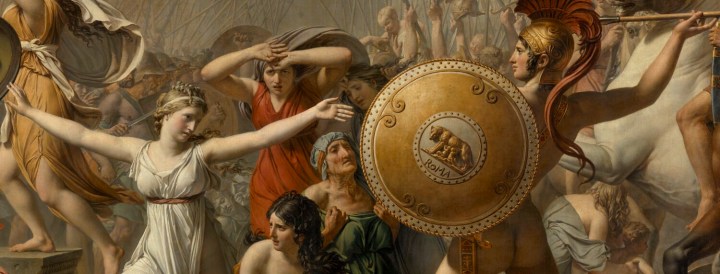
Jacques-Louis David, The Intervention of the Sabine Women, detail, 1799, oil on canvas, 3.85 × 5.22 meters
(Paris: Musée du Louvre)
◊ ◊ ◊ ◊ ◊
From the press release for the exhibition:
Jacques-Louis David
Musée du Louvre, Paris, 15 October 2025 — 26 January 2026
Curated by Sébastien Allard and Côme Fabre, with assistance from Aude Gobet
David is a towering figure. Considered the father of the French School, revered for breathing new life into painting, he produced imagery that to this day inhabits the collective imagination: from The Death of Marat to Napoleon Crossing the Alps and The Coronation of Napoleon, his paintings are the filter through which we picture the great moments of the French Revolution and the Napoleonic Empire, while his portraits bring to life the society of this period.
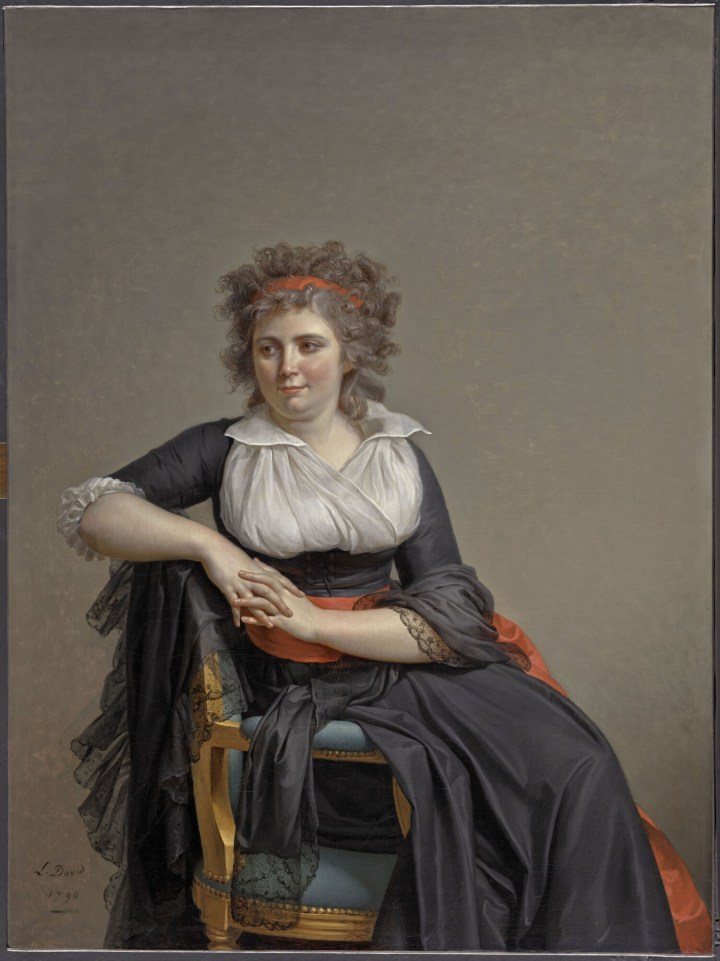
Jacques-Louis David, Portrait of Robertine Tourteau d’Orvilliers, née Rilliet (1772–1862), 1790, oil on canvas, 131 × 98 cm (Paris: Musée du Louvre / Adrien Didierjean / Sylvie Chan-Liat).
To mark the bicentennial of his death in exile in Brussels in 1825, the Musée du Louvre is offering a new perspective on a figure and body of work of extraordinary richness and diversity. The exhibition shines a light on the inventive force and expressive power of the art of Jacques-Louis David (1748–1825), whose paintings are more intensely charged with feeling than is belied by their extreme rigour. The exhibition spans the long career of an artist who witnessed six different political regimes and actively participated in the French Revolution. It gathers 100 works on special loan, including the imposing, incomplete Tennis Court Oath (Château de Versailles, long-term loan from the Musée du Louvre), and the original version of his masterpiece, the celebrated Death of Marat (Royal Museums of Fine Arts of Belgium, Brussels).
A project of such ambition could only be undertaken at the Louvre, which holds the largest existing collection of the artist’s paintings and drawings—including, first and foremost, his very large canvasses. The last major monographic exhibition devoted to David was held at the Louvre and the Château de Versailles in 1989 for bicentennial commemorations of the French Revolution. Enhanced by research conducted in the ensuing three decades, the 2025 exhibition will present a new survey revealing the unprecedented richness of David’s journey, combining artistic and political activity. Indeed, more than simply an artist observing this formative period in French history, spanning the years 1748–1825, he sought to be a prominent social actor.
The painter’s importance was unmatched in his day, for his Europe-wide artistic influence, as well as the high political offices he held in 1793–1794 alongside Robespierre, for which he suffered the consequences as a political exile after the fall of Napoleon.
The exhibition is curated by Sébastien Allard, Senior Heritage Curator, Director of the Department of Paintings, and Côme Fabre, Curator, Department of Paintings, and assisted by Aude Gobet, Head of the Department of Paintings Research Centre, Musée du Louvre. The exhibition design is by Juan-Felipe Alarcón, with graphic design by Philippe Apeloig.
Sébastien Allard, ed., Jacques-Louis David (Paris: Louvre éditions/ Hazan, 2025), 360 pages, €49.
The catalogue reflects the exhibition in offering new perspectives on David’s role and position, focusing on two essential aspects of his activity: his involvement during the French Revolution; and, after the fall of the First Empire and his exile to Brussels, his confrontation with the new generation—and Ingres, in particular—whose training he had largely overseen. The publication is divided into two parts. In the first, an essay by Sébastien Allard seeks to shift perceptions of the artist, examining his life as a coherent whole, in contrast to how historians have tended to fragment it according to the different political regimes David experienced. Sumptuous reproductions, including numerous details, help remove the proverbial dust from the image sometimes held of the painter’s work. The second part encompasses an essay by Côme Fabre on the connections between David and the Louvre; a biographical account by Aude Gobet; and a chronology of major David-related moments, from his death to today, by Morgane Weinling.
New Book | European Sculpture in the Collection of His Majesty The King
Distributed by Yale University Press:
Jonathan Marsden, European Sculpture in the Collection of His Majesty The King (London: Modern Art Press in association with the Royal Collection Trust, 2025), 4 volumes, 1648 pages, ISBN: 978-1738487813, £350 / $450.
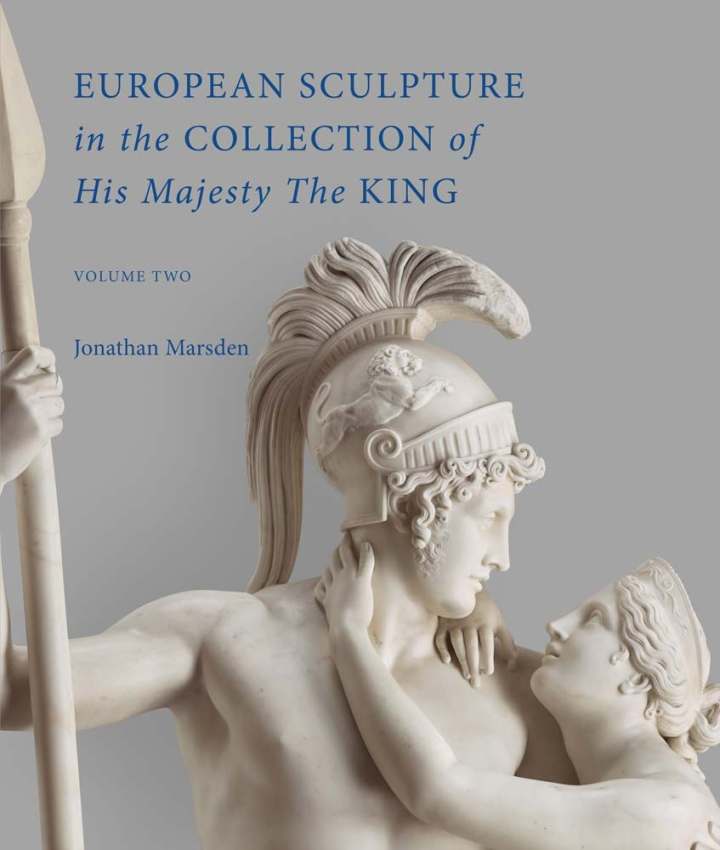 This four-volume publication marks the completion of one of the most ambitious stages in the long-term task of cataloguing sculpture in the Royal Collection.
The scope of the catalogue—covering sculpture in all materials from the fifteenth to the late twentieth century—is unprecedented. Incorporating countless new attributions and identifications and the results of conservation and scientific examination, the catalogue will be an indispensable work of reference for all students of post-medieval sculpture, impressive not only in the quality of its scholarship but also for the extent and depth of the documentation. Highlights include an exceptional group of bronze busts from the Italian and Northern Renaissance, the first bronze casts of ancient sculpture to be made in Britain, the best ensemble of French seventeenth- and eighteenth-century bronzes outside France, unrivalled examples of English portrait sculpture from the seventeenth century onwards and the most complete surviving collection of Victorian sculpture. With an introductory survey covering the relationships between British monarchs and sculptors since the seventeenth century and the impact of sculpture in the interiors of the royal palaces over the same period, the admirably clear and engaging text is essential reading for students of royal collecting. It is accompanied by almost 2,000 illustrations, most of which have been commissioned for this book.
Jonathan Marsden was Director of the Royal Collection and Surveyor of The Queen’s Works of Art from 2010 to 2017, having served as Deputy Surveyor from 1996. Prior to this, he worked for the National Trust as a Historic Buildings Representative in North Wales and Oxfordshire.
New Book | Architecture and Artifice
Distributed by Yale UP:
Christine Casey, Architecture and Artifice: The Crafted Surface in Eighteenth-Century Building Practice (London: Paul Mellon Centre for Studies in British Art, 2025), 208 pages, ISBN: 978-1913107482, £45 / $60.
 Revealing the materials and craftsmanship that shaped the look of eighteenth-century architecture in Britain and Ireland
This book uncovers the overlooked material practices that were crucial to architectural production in the eighteenth century. Centred on the architecture of England and Ireland, it examines the facing materials that define the distinctive character of cities and regions. Focusing on the final stages of construction—the external façade and interior finishes in stone, plaster, and wood—Architecture and Artifice combines archival research with insights from architectural conservation to reveal the hidden techniques behind these structures. It explores the lives of craftsmen, uncovering the unwritten standards that guided their work and argues for the agency of materials and craft in shaping the meanings of eighteenth-century buildings. Featuring a cast of lesser-known craftsmen alongside new perspectives on iconic structures such as Chatsworth, the Cambridge Senate House, and Dublin’s Parliament House, the book introduces a wealth of previously unpublished archival material uncovering the intricate processes and people behind the era’s most enduring buildings.
Christine Casey is a professor of architectural history and fellow at Trinity College Dublin. She is a member of the Royal Irish Academy and an honorary member of the Royal Institute of the Architects of Ireland.
Exhibition | Le Petit Salon
Now on view at the Middlebury College Museum of Art:
Le Petit Salon: The Journey of an 18th-Century Room from Paris to Vermont
Middlebury College Museum of Art, 8 July — 7 December 2025
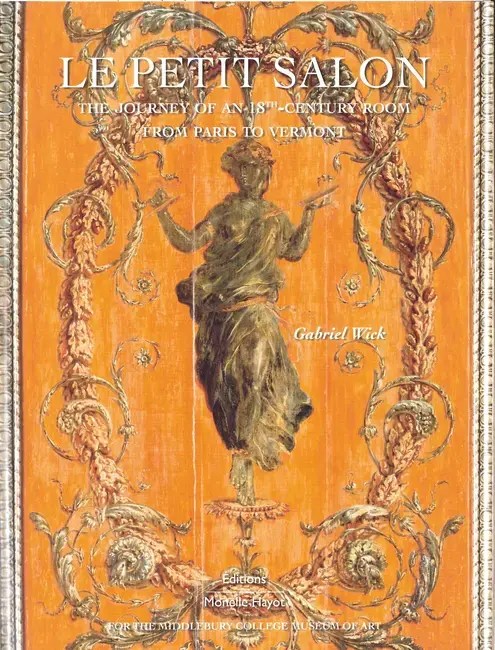 The Middlebury College Museum of Art possesses a jewel of French neoclassicism, Le Petit Salon, a delicately painted, paneled room made around 1776 for a Parisian mansion. It was designed by Pierre-Adrien Pâris ( 1745–1819), subsequently the architect of court fêtes for Louis XVI and Marie-Antoinette. His client was the duc d’Aumont, a renowned collector and patron of the arts, who had the panels installed in his Paris home, now the Hôtel de Crillon on Place de La Concorde. Gifted to Middlebury in 1959, but held in storage since the 1990s, the room will be reassembled for the first time in three decades.
The exhibition follows the journey of Le Petit Salon from Paris to Middlebury via Manhattan, where for fifty years it formed part of the decor of the Bliss family’s Gilded Age mansion. At Middlebury, the Petit Salon became part of Le Château, the college’s French language dorm, itself a fanciful recreation of a 16th-century Norman manoir. The exhibition incorporates Pâris’s 1776 exquisite watercolor elevations of Aumont’s mansion, as well as studies from his long educational sojourn in Rome and Naples. Included in the exhibition are loans from Bowdoin College, the Metropolitan Museum of Art, the Cooper-Hewitt National Design Museum, and the Fine Arts Museum of Besançon.
Gabriel Wick, Le Petit Salon: The Journey of an 18th-Century Room from Paris to Vermont (Saint-Remy-en-l’Eau: Monelle Hayot, 2025), 192 pages, €35.
Exhibition | Valkenburg — Willem de Rooij
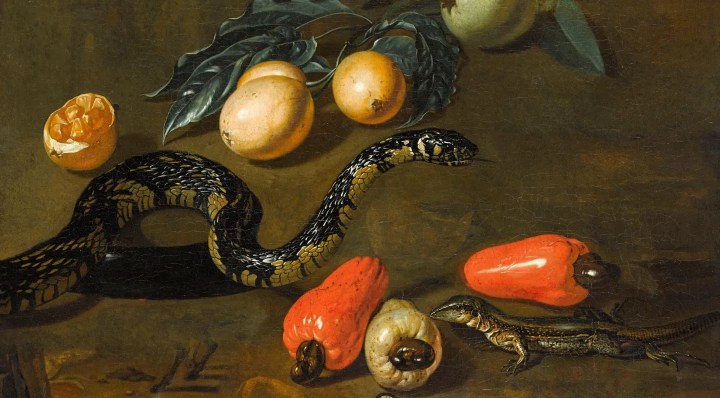
Dirk Valkenburg, Study of Cashews, Maracujas, a Tropical Chicken Snake, and an Ameiva Lizard from Suriname, detail, 1706–08, oil on canvas, 40 × 48 cm (Musée des Beaux-Arts de Quimper).
◊ ◊ ◊ ◊ ◊
Now on view at Utrecht’s Centraal Museum:
Valkenburg — Willem de Rooij
Centraal Museum Utrecht, 13 September 2025 — 25 January 2026
Dirk Valkenburg (1675–1721) was one of the first Europeans to depict Indigenous and enslaved people on Surinamese plantations, while also painting hunting still lifes and portraits of Dutch elites. The breadth of his oeuvre makes it particularly relevant for research into colonial image production and the ‘white gaze’. In this installation, Willem de Rooij displays 30 works in idiosyncratic combinations, inviting reflection on how these 18th-century Dutch elites used art to support and legitimise colonial ideology.
Since the early 1990s, Willem de Rooij (b. 1969) has created temporary installations in that explore the politics of representation through appropriation and collaboration. In 2005, he represented the Netherlands at the Venice Biennale and has since exhibited in leading museums worldwide. A distinctive feature of his practice is the reuse and rearrangement of existing images and objects, often based on in-depth art-historical and cultural research. In doing so, he creates new meanings between diverse visual elements. Recent exhibitions include King Vulture (Akademie der Künste, Vienna) and Pierre Verger in Suriname (Portikus, Frankfurt). De Rooij teaches in Frankfurt, Berlin, and Amsterdam and lectures internationally.
The exhibition will be accompanied by the first comprehensive publication on Dirk Valkenburg’s oeuvre: a catalogue raisonné developed in collaboration with the RKD–Netherlands Institute for Art History. This volume, edited by Willem de Rooij and Karwan Fatah-Black—historian and expert in Dutch colonial history, (Leiden University)—includes new essays by international scholars and thinkers from various disciplines, including art history, anthropology, postcolonial, and queer studies.










 Enfilade
leave a comment