Call for Papers | Skillful Hands: Apprentices and Networks of Learning
From the Call for Papers:
Skillful Hands: Apprentices and Networks of Learning, 1650–1950
Rienzi’s Biennial Symposium
Museum of Fine Arts, Houston, 9 November 2024
Proposals due by 15 August 2024
Rienzi, the house museum for European decorative arts of the Museum of Fine Arts, Houston, presents the symposium Skillful Hands: Apprentices and Networks of Learning 1650–1950.

William Hogarth, Industry and Idleness, Plate I: The Fellow ‘Prentices at Their Looms, October 1747, etching and engraving (Houston: Sarah Campbell Blaffer Foundation, BF.1983.5.45).
Until the late 19th century, apprenticeship was the primary way people were trained in craft trades in Europe and the Americas. Formal education was mainly out of reach for many children from middle-class and low-income families. Apprenticeship training, a legal contract between a student and a master craftsperson, became an advantageous alternative to traditional education. Apprenticeships were regulated and monitored by European craft guilds established during the medieval period to control craft production. Their influence extended beyond the training period, and apprentices were generally closely linked to master craftspeople through cultural and social ties, including intermarriage. Within the traditional guild system, females, immigrants, Indigenous and enslaved peoples, and children from low-income families were often excluded.
With the onset of the Industrial Revolution, informal apprenticeships were introduced to adapt to innovations and technologies. Colonial expansion provided a range of new raw materials and new demands for skilled labor. Outside traditional European apprenticeship models, skills were acquired through forced migration, local environments, and informal training in various colonial regions. These varied experiences resulted in a diverse network of skilled craftspeople, both anonymous and renowned. The symposium critically considers the networks of learning available—and unavailable—to diverse groups of people and how access to training and materials through apprenticeships helped to shape craft traditions. Who had access, and who did not? How did skills and ideas travel? How did apprenticeship systems affect the material, form, and quality of crafted objects? How did political, social, and cultural conditions in colonies such as British and French North America, New Spain, and the Caribbean influence trade training modes?
Graduate students and entry-level and mid-career professionals are invited to submit a 400-word abstract outlining a 20-minute presentation, along with a CV, by Thursday, 15 August 2024, to rienzisymposium@mfah.org. Selected participants will be notified by Friday, 30 August 2024, and offered a $600 honorarium for travel and lodging. All presentations are given Saturday, 9 November 2024, at the Museum of Fine Arts, Houston.
Possible themes for investigation may include, but are not limited to:
• Transatlantic trade
• Workshop traditions
• Empire and colonialism
• Technology
• Gender
• Race
• Economics
• Labor
• Class
• Education
• Childhood
Call for Papers | Women as Collectors
From the Call for Papers:
Collecting Past and Present: Women as Collectors
The Wallace Collection, London, 1 November 2024
Proposals due by 2 August 2024
In 2024, the Wallace Collection launched Collecting Past and Present. This new research series takes the format of biannual, themed study days, which include fascinating talks from specialists, exploring collecting through the ages to the modern day. Exclusive interviews with contemporary collectors also feature, revealing tantalising glimpses of extraordinary objects and how they are brought together. These are followed by drinks receptions that act as unique forums for discussion. For those further afield or unable to make it to the museum, the talks can be watched online.
We are now inviting abstracts for our November study day that explore women as collectors and patrons of all art forms. Talks should be 45-minutes long and illustrated by a presentation. They will be held in the Wallace Collection Theatre on Friday, 1 November 2024, between 10.15 and 17.30 GMT. We would like to encourage all those with a specialist interest to share a short text (500 words) and CV with Collecting.PastandPresent@wallacecollection.org by Friday, 2 August 2024. If your submission is accepted, we will require your talk’s title (maximum seven words), an abstract (60 words), and a bio (60 words). We can contribute up to the following amounts towards speakers’ travel expenses on submission of receipts:
• Speakers within the UK – £100
• Speakers from Continental Europe – £180
• Speakers from outside Europe – £300
Call for Papers | Practices of Female Botanists
From the Call for Papers:
Book of Nature, Nature of Books: Practices of Female Botanists
Livre de la nature, nature du livre: Pratiques des femmes botanistes
Dijon, 19–20 June 2025
Proposals due by 31 October 2024
The research centres TIL (Université de Bourgogne) and EMMA (Université Paul-Valéry Montpellier 3) are organizing a bilingual (French-English) international interdisciplinary conference on the role of women in the development of botany as part of visual, manuscript and print cultures, from the Middle Ages to the contemporary period. We propose to foster discussions at the intersections of the history of natural sciences, print culture, book history, illustration studies, gender studies, plant studies, and ecocriticism. Papers may focus on a wide variety of case studies pertaining to any geographical area, from herbals to non-fiction writing, from publishers’ and libraries’ archives to museum collections, or from the garden to the diary and to the printed book. They will address the role of women as amateur or professional botanists, gardeners, members of clubs, illustrators, diarists, writers, publishers, and in any other capacity where their individual practices bear on forms of manuscript and print artefacts.
Historically, a putative association between women and plants shaped the views on both (Greene; Taiz and Taiz). Even after the discovery of sexuality in plants in the late seventeenth century, the idea remained so prevalent that Hegel wrote in his Philosophy of Right (1821) that men were “like animals, active and combative,” and women “like plants, essentially placid” (Schiebinger 2). It was probably for this reason that Jean-Jacques Rousseau, among many others, recommended botany to ladies. By the early nineteenth century, botany was viewed as a feminine science, and a distinction was emerging between scientific botany, for men, and popular, literary botany, for women (Shteir). The conference aims to explore the way the spaces and boundaries of women’s contributions to botany were redefined in the face of institutional and societal conventions and restrictions. Along with histories of suppression, we will also examine the way women gained prominence in certain fields, such as illustration and shaped aspects of manuscript and print cultures. Specific case studies as well as papers looking at long-term processes will shed light on past and contemporary trends so as to assess legacies and propose revaluations.
We invite academics and young scholars, librarians, visual artists, and publishers to contribute papers exploring the following themes:
• The Book of Nature and its legacy — We would welcome papers on the legacy of the medieval trope of nature legible as a book, materialized from the 12th century by such productions as herbals. This theme could include issues around the vexed notion of ‘nature’ when it collides with ‘the feminine’ and if/how practices can be seen as gendered in the domain of botany.
• Itineraries of women and plants — Papers may include biographical accounts that trace the itineraries of female botanists in relation to the type of plants that they study. It may be fruitful to underline the implicit or explicit hierarchies that underscore gender divisions: is there a link between unobtrusive species such as moss, fungus and ferns, and their being studied by women? We will also examine the usual association between women and care, as for instance in relation to medicinal plants.
• Records, archives, and exchanges — We would like to hear about the way researchers can gain access to the role of female botanists. How much of their work has been recorded, compared to their male counterparts, and how are such records organized and archived? We also welcome contributions that explore institutional funding of research and travel, as well as traces of transnational networks and discussions with domestic and foreign correspondents. Can we imagine unknown treasures still waiting to be discovered?
• Circulation of manuscript and print artefacts — Papers may examine the specific ways women circulated their findings. This may bear on the history of publishing: how have publishers approached the female botanist? What is the role of women working as publishers themselves, or as popularizers of botany and educationalists in print? The connection between print and manuscripts may also lead us to address the interplay between restriction, emancipation and creativity, in such instances as the diary, the private circulation of manuscripts and private archives.
• Spaces of practice and display — Attention will also be paid to the spatial and medial dimension of the circulation of manuscript and print artefacts, from the page of the book, periodical and diary to museums, drawing rooms, gardens, lecture theatres, gendered spaces, all the way to the internet today. This provides an opportunity to assess the alternative function of certain spaces such asthe garden and domestic spaces when they are redefined as botanical laboratories. Space may also provide clues to how women have been confined by their social backgrounds or have moved across social boundaries.
• Botany, illustration, and nature writing — Working as illustrators often allowed women artists to engage in scientific pursuits whilst being deprived of institutional support.This limitation may have nevertheless been a way of consolidating iconic and textual models and modes of inquiry that found their way in the illustrated book, in nature writing, and in theoretical and popular views of plants’ lives. Therefore, we also invite papers that explore how the material conditions of textual and visual practices, as well as attitudes to plants have been tropedinto a “botanical poetics” (Rosenberg 10–14). We would also like to know how contemporary illustrators, botanists, and nature writers come to terms with such legacies.
• Amateur and professional science — The papers may focus on the way fully recognized or overlooked women negotiated the boundary between private and public spheres, how they construed the porosity between certain fields, and which educational spaces they had access to. This could lead to investigations of women’s contribution to the development of botany as an individual and/or institutional pursuit, as an intimate source of personal development as opposed to a professional career, and of course to assessments of overlooked contributions to the history of science.
• Female crafting and the intermedial circulation of models — We welcome contributions that highlight the material, technical, and intermedial aspects of women’s practices. Are there specific experimental productions such as Mary Delany’s paper mosaics and Anna Atkins’s cyanotypes that lend themselves to a critical analysis of their marginal status and alternative visualizations of nature? Certain types of material objects have been associated to botanical practices and the intermedial dissemination of models, as, for instance, the models of flowers made by the Brendel firm in Germany, still preserved in European universities such as Dijon. What was the role of women in the manufacturing of these models? What was their impact on the careers and aesthetics of female botanists?
Please send a 300-word abstract and a biobibliography (in English or French) before 31 October 2024 to bookofnature2025@gmail.com. Notification will be given by 15 December 2024, and the program will be finalized in January 2025. After the conference, the deadline for the submission of papers for publication will be 30 September 2025.
Keynote Speakers
Anne Hodge (curator of drawings and prints, National Gallery of Ireland)
Valérie Chansigaud (historian of science, independent scholar and author)
Scientific Committee
Marie-Charlotte Anstett (CNRS, Université de Bourgogne), Anna Cabanel (KU Leuven), Kathleen Davidson (University of Sydney), Rodolphe Leroy (Université de Bourgogne), Katherine Manthorne (City University of New York), Clélia Nau (University Paris-Cité), and Ann Shteir (York University, Canada)
Organizing Committee
Sophie Aymes, Marie-Odile Bernez, Ali Hatapçı, Candice Lemaire (Université de Bourgogne), Valérie Morisson (Université Paul-Valéry Montpellier 3)
b i b l i o g r a p h i e i n d i c a t i v e
Bending, Stephen. Green Retreats: Women, Gardens, and Eighteenth-Century Culture. Cambridge: Cambridge UP, 2013.
Chansigaud, Valérie. Histoire de l’illustration naturaliste. Paris: Delachaux et Niestlé, 2009.
Chansigaud, Valérie. Une histoire des fleurs: entre nature et culture. Paris: Delachaux et Niestlé, 2014.
Davis, Rebecca. “The Book of Nature.” Nature and Literary Studies. Ed. Peter Remien and Scott Slovic. Cambridge: Cambridge UP, 2022. 31–48.
George, Sam. Botany, Sexuality, and Women’s Writing, 1760–1830: From Modest Shoot to Forward Plant. Manchester: Manchester UP, 2007.
Greene, Edward Lee. Landmarks of Botanical History. Part 2. Ed. Frank Egerton. Stanford UP, 1983.
Johnson, Nuala. Empire, Gender, and Bio-Geography: Charlotte Wheeler-Cuffe and Colonial Burma. New York: Routledge, 2023.
LaBouff, Nicole. “Public Science in the Private Garden: Noblewomen Horticulturalists and the Making of British Botany c. 1785–1810.” History of Science 59.3 (2021): 223–55.
Laroche, Rebecca. Medical Authority and Englishwomen’s Herbal Texts, 1550–1650. London: Routledge, 2016.
Libster, Martha. Herbal Diplomats: The Contribution of Early American Nurses (1830–1860) to Nineteenth-Century Health Care Reform and the Botanical Medical Movement. Golden Apple Publications, 2004.
Lightman, Bernard, ed. A Companion to the History of Science. Malden: John Wiley & Sons, 2016.
Manthorne, Katherine. Fidelia Bridges: Nature into Art. Lund Humphries, 2023.
Page, Judith and Elise Lawton Smith. Women, Literature, and the Domesticated Landscape: England’s Disciples of Flora, 1780–1870. Cambridge: Cambridge UP, 2011.
Rosenberg, Jessica. Botanical Poetics: Early Modern Plant Books and the Husbandry of Print. Philadelphia: U of Pennsylvania P, 2022.
Rudolph, Emanuel. “Women in Nineteenth-Century American Botany: A Generally Unrecognized Constituency.” American Journal of Botany 69.8 (1982): 1346–55.
Sagal, Anna. Botanical Entanglements: Women, Natural Science, and the Arts in Eighteenth-Century England. Charlottesville: U of Virginia P, 2022.
Schiebinger, Londa. Nature’s Body: Gender in the Making of Modern Science. Rutgers: Rutgers UP, 2004.
Shteir, Ann. Cultivating Women, Cultivating Science: Flora’s Daughters and Botany in England, 1760 to 1860. Baltimore: Johns Hopkins UP, 1996.
Strocchia, Sharon. Forgotten Healers: Women and the Pursuit of Health in Late Renaissance Italy. Cambridge: Harvard UP, 2019.
Taiz, Lincoln and Lee Taiz. Flora Unveiled: The Discovery and Denial of Sex in Plants. Oxford: Oxford UP, 2017.
Call for Papers | SEASECS 2025, Savannah
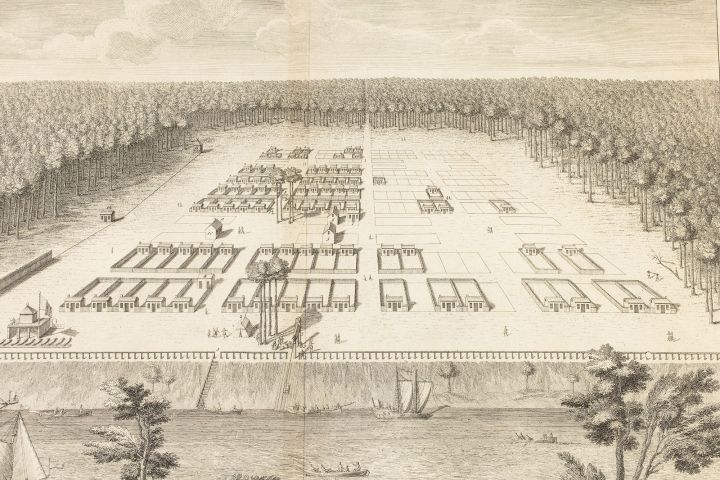
Paul Fourdrinier, after George Jones, A View of Savannah as it stood the 29th of March 1734, detail, ca. 1734, engraving, 20 × 26 inches.
◊ ◊ ◊ ◊ ◊
From SEASECS, with a selection of panels of particular interest for art historians:
51st Annual Meeting of the Southeastern American Society for Eighteenth-Century Studies
The Past is Still Present: Reclaiming the Eighteenth Century
The DeSoto, Savannah, Georgia, 6–8 February 2025
Proposals due by 16 September 2024
Conference Highlights
• Plenaries by Kurt Knoerl (underwater archaeologist and historian) and Celeste Guichard (architectural historian)
• Walking tour of historic Savannah led by Christopher Hendricks
• Reacting to the Past pedagogical workshop led by David Eick
• Writing (and submitting!) a pedagogy article led by Martha Bowden
Three ways to submit proposals
1. For any of the 23 outstanding Panels Seeking Participants, send your paper proposal (230–300 words) directly to the panel organizer by Monday, September 16. Include your full name, your institutional affiliation, and your email address (if possible, your ‘official’ institutional/professional email address).
2. For all other individual paper submissions on any topic related to the long 18th century, send your proposal to Elizabeth Kuipers by Monday, September 16, Elizabeth.Kuipers@asurams.edu. Include your full name, your institutional affiliation and your email address.
3. Send information on fully formed panels (including but not limited to undergraduate research panels) to Elizabeth Kuipers by Monday, September 16. Organizers, please send the title of your panel, your name, your institutional affiliation, and your email address along with the names of each of your participants, the titles of their papers, their institutional affiliations, and their email addresses.
Notifications of acceptances will be sent the first week of October.
Graduate students: We will have extra graduate student travel stipends this year to defray costs, thanks to the generosity of SEASECS members! Application details will be available in the fall.
◊ ◊ ◊ ◊ ◊
Illustrating the Past: The Long 18th Century in Graphic Novels, Comic Books, and Comic Strips
Joe Johnson, joejohnson@clayton.edu
This panel seeks presentations on graphic novels, comic books, and comic strips produced during or after, set in, and/or responding to the long 18th century. These comics can be adaptations of period works (such as renderings of Gulliver’s Travels, Robinson Crusoe, Tristram Shandy, and Frankenstein) or original stories depicting the era, its events, and people, such as Isaac Newton, the noted artist Jacques-Louis David, Napoleon, France’s loss of Canada in 1759, or its Revolution thirty years later.
◊ ◊ ◊ ◊ ◊
Art & Nature: Landscape in the Long 18th Century
Kasie Alt, kalt@georgiasouthern.edu
Ars et natura, art/skill and nature, form a foundational pairing, or tension depending on the source, in Enlightenment thinking. At the intersection of art and nature the concept of ‘landscape’ pervades the 18th century. Beneath what was, in European artistic hierarchies, a relatively lowly genre lies a complex matrix of identities and questions about the nature of the world and one’s place in it. Throughout the 18th century, art, literature, and philosophy, on a global scale, grappled with ideological, aesthetic, and cultural approaches to land in a manner that blurs, tests, and renegotiates the very identity of humans vis à vis nature and each other. Landscape was often used to locate oneself—to develop, negotiate, or reappraise one’s identity, place, and/or relationship to the world in which we live. Leveraging the interdisciplinary nature of the concept, this panel invites presentations examining landscape, broadly defined, in any discipline including visual and material cultures, architecture and design, literature, history, and philosophy, in any geographic area during the long 18th century. Given the theme of this year’s conference, presentations that discuss the lasting presence, effects, or ideological implications of 18th century landscape in today’s world are particularly welcome.
◊ ◊ ◊ ◊ ◊
Teaching Symposium
Martha F. Bowden, mbowden@kennesaw.edu
The teaching symposium invites teachers of the 18th century in all disciplines to contribute their particular strategies for introducing their 21st-century students to the world of the long 18th century. The 18th century offers challenges to our students: it is so near and yet so far, its developing consciousness of race, ethnicity, and gender like ours in its struggles but often so foreign in its approaches and conclusions. You may want to describe a syllabus for a class specifically about the 18th century, or a unit in a survey or freshman seminar that includes the 18th century but is not confined to it. Teachers at all levels, from AP and honors high school courses through graduate courses, are invited to submit proposals.
As time goes on, the challenges to our teaching change; how did the disruptions of the Covid pandemic change the needs of your students? Do you have strategies for dealing with AI, including teaching your students to use AI-powered tools? How has the increased availability of Digital Humanities resources affected your teaching strategies? The symposium takes the form of short, focused presentations about specific strategies, ideally accompanied by handouts that the audience can take home. While the presenters are usually the instructors, we have also had professor/student dialogues; I encourage participants to consider this dialogic approach to the pedagogy of the 18th century. Historically, the sessions have been very well attended, and the audiences not only ask really significant questions but also contribute wisdom of their own. I think of it as a conversation as much as a traditional panel. Send your proposal as a Word attachment containing the description of your teaching strategy.
◊ ◊ ◊ ◊ ◊
From Textile to Fashion and Beyond
Arlene Leis, Aleis914@gmail.com
What histories might emerge when we explore simultaneously textile and fashion practices and examine the possibilities between and beyond the two? Over the past fifty years research into the synergies between textile and dress histories continue to gain momentum. Ground breaking research by Lou Taylor, Evelyn Welch, Peter McNeil, Luca Molà, Rebecca Arnold, and John Styles have studied how dress and textiles were sources of innovation and economic and cross-cultural influences. More recently, Christopher Breward, Beverly Lemire, and Giorgio Riello’s substantial The Cambridge Global History of Fashion presents broader contextualization and investigates a range of key topics pertaining to fashion practice across time and space, including synergies between dress and textile, while also providing sharp analysis of wider visual and material cultures. There is also a continuing interest in how science and technology as seen in photography, conservation, reconstruction, and digitization help us better understand complex textiles and garment histories.
Our panel focuses on the interdisciplinarity between two seemingly separate histories: textile and fashion. Examining closely the relationship between the two, including across diverse media and genres, our goal is to utilize this panel as a way to explore, encourage, and foreground a range of interactions, and it attempts to further grasp and understand, at historical, practical, and theoretical levels, the possible links between these practices. The papers explore the cultural and social histories of apparel and textiles as well as their preservation, with the aim of presenting and making way for new and emerging research on textiles, fashion, and beyond.
◊ ◊ ◊ ◊ ◊
Artist’s Signatures
Sarah Sylvester Williams, willisj@millsaps.edu
During the 18th century, artists did not always sign their artworks. Scholar Charlotte Guichard has written about artists who did, such as Chardin, François Boucher, Hubert Robert, and Jacques-Louis David. These signatures were evidence of the changing status of the artist and art market, as well as political developments. But what about other artists who did not regularly sign their work? This panel seeks papers that deal with rare or infrequent artistic signatures. What do the odd occasions when the artist included their signature tell us about the artist, the artwork, or the circumstances of its commissioning or reception?
◊ ◊ ◊ ◊ ◊
Material Culture of Gender
Lauren DiSalvo, Laurendisalvo4@vt.edu
This is an open session exploring the relationships between material culture and gender in the long 18th century. Of interest are papers that use material culture to explore how social behavior relating to gender might be communicated or reinforced through material objects. For example, Ryan Whyte writes about miniature women’s almanacs as a subversive mode of women’s participation in Enlightenment knowledge. The miniaturizing of paintings in the almanacs’ pages and their decorative covers presented a feminized knowledge, yet the same material object allowed women to participate in the discourse of history painting. Especially welcome are papers that use material culture to challenge or complicate 18th-century understandings of gender. Participants may choose to focus discussions on gendering in relationship to individual objects or their materiality.
◊ ◊ ◊ ◊ ◊
Representations of Indigenous Perspectives
Patty Hamilton, phamilto@uu.edu
To follow up on LeAnne Howe’s plenary presentation at our 2024 conference at Furman, “The Art and Craft of Image Production in Fiction: Depictions of Native Americans in Historical Fiction,” I propose to broaden the conversation from ‘depictions’ (which may or may not be historically accurate depending on who is doing the depicting, as Prof. Howe illustrated) to ‘representations of indigenous perspectives’ in the long 18th century. Spanning genres, these representations may be literary, historical, or artistic, but they should share in common an attempt to accurately represent the perspective (beliefs, values, social fabric, experience) of indigenous peoples (as Olaudah Equiano does in the opening chapter of his autobiography). What insights or re-visioning can such representations yield? For the purposes of the panel, ‘indigenous’ may be broadly construed as the native peoples of North, Central, and South America and the Caribbean as well as West Africa, India, or other sites of European empire in the 18th century. Orientations may be critical or pedagogical.
Call for Papers | The Material Text in Latin American Digital Humanities
From the SHARP listserv (Society for the History of Authorship, Reading and Publishing) . . .
The Material Text in Colonial and Nineteenth-Century Latin American Digital Humanities
El texto como objeto material en las humanidades digitales latinoamericanas del periodo colonial y del siglo XIX
Online, Fall 2024
Proposals due by 12 July 2024
The Alliance for Digital Research on Early Latin America (adrela.net) seeks proposals for a virtual symposium examining ways that digital methods and tools enable us to ask new questions about the materiality of manuscript and print texts from the colonial period and nineteenth century. This will be a multilingual session, or series of sessions, in English, Spanish, and potentially other languages that will take place sometime between September 2024 and January 2025. Please send a title, 250-word abstract, and a short bio (150 words maximum) to Clayton McCarl, clayton.mccarl@unf.edu, by July 12.
Call for Papers | Edinburgh, Material and Visual Culture Series
From ArtHist.net:
Material and Visual Culture Seminar Series, 17th and 18th Centuries
Online, University of Edinburgh, Wednesdays, September — December 2024
Proposals due by 31 July 2024
We are pleased to announce that the Material and Visual Culture Seminar Series (MVCS), hosted by the Material and Visual Culture of the Seventeenth and Eighteenth Centuries Research Cluster at the University of Edinburgh, will be continuing for a sixth year. We therefore invite proposals for twenty-minute papers from PhD candidates, early-career researchers, and cultural heritage professionals addressing any aspect of material and visual culture studies.
These online seminars aim to explore a wide variety of themes and localities within the long seventeenth and eighteenth centuries (broadly defined) to foster methodological and interdisciplinary dialogue. Topics might include but are not limited to: object or subject case studies, material/visual culture and identity especially with respect to marginalized peoples or communities, material/visual culture and literature, craft, consumer cultures, global ‘things’, etc. Please submit a title and abstract of no more than 250 words, with a short biography (about 100 words) to materialcultureresearcheca@ed.ac.uk by 31 July.
The seminars are scheduled for Wednesday evenings online, at 5pm BST/ GMT fortnightly throughout semester one 2024/25.
Call for Papers | Windows in British Architecture and Visual Culture
From the Call for Papers:
‘What Light through Yonder Window Breaks?’: The Window as Protagonist in British Architecture and Visual Culture
Paul Mellon Centre, London, 21–22 November 2024
Proposals due by 8 July 2024
From the quintessentially romantic ‘balcony scene’ in William Shakespeare’s Romeo and Juliet to the visceral tension of Alfred Hitchcock’s classic 1954 film Rear Window; in paintings, prints and photography; in architectural drawings and their realisation in three-dimensional form, the window has played a significant role in almost every medium of artistic expression. The window serves, both literally and figuratively, as a boundary between interior spaces and the external world, between humans and nature, between the familiar and the unknown.
As we mark five years this winter since the outbreak of Covid-19, we recognise how recurring lockdowns underscored our own personal consciousness of the boundary between interior and exterior. More than a boundary, however, the window also acts as a frame, helping to define and mediate how we see and interact with the spaces around us, not least providing a view of the world outside from a place of relative protection from the elements—an important consideration following the world’s hottest year on record. Across visual media and architectural design, the window is central to a broad range of issues, including self-representation, privacy and security, surveillance and voyeurism, spiritual and religious symbolism, climate and the environment, and technological and industrial innovation.
This conference will explore the multifaceted, multi-purpose nature of the window as protagonist, with an emphasis on its place in British architecture and visual culture, broadly conceived. A range of interdisciplinary papers presented by international scholars will provide a platform for dynamic and engaging discourse that forefronts the cultural and social significance of the window in its many guises as object, as boundary, as frame, and as mediator. As part of this two-day conference, we invite proposals for papers that consider the various roles of the window across periods, media and disciplines; we are committed to championing new voices, and especially encourage proposals from graduate students and early career researchers.
Possible topics could include but are not limited to:
• How the view is framed: what is shown/captured from/through a window, window placement within a room/building, the relation between the window and the picture plane
• The figure at the window (or its absence): issues surrounding gender and voyeurism, the use of the window in literature as narrative or plot device
• Inequality: surveillance, power imbalances between inside and outside, window breaking in times of social unrest, historical window/glass taxes
• Privacy and security: elevated windows (in prisons, banks, libraries, museums), bars on windows and locking mechanisms, window dressings (curtains, blinds, shutters), window use/placement in urban versus rural environments, jali and mashrabiya
• Windows and the environment: keeping out the elements, smart windows, protecting objects from UV light (especially in museums or historic buildings)
• Setting the tone or conveying a message: contrasting light levels between inside and outside or between one space/room and the next, coloured or stained-glass windows in ecclesiastical (or secular) architecture, types/shapes of windows as linked to specific architectural styles
• Windows in motion: in vehicles, trains, ships, aeroplanes, and on film
• The window extended: full-length windows and architectural permeability, shopfront windows, glass roofs/structures
Please submit the following by noon (BST), 8 July 2024, using ‘CFP: WINDOW’ as the subject line, to events@paul-mellon-centre.ac.uk:
• 200-word abstract outlining the topic of your paper
• short biography of approximately 100 words (please do not send CVs)
The abstract and biography should be combined in a single Word document and submitted as an email attachment. Incomplete or late submissions will not be considered. Successful contributors selected through this open call will be paid a fee of £150 for their contribution and reasonable travel and accommodation costs will be covered. Please feel free to share with us any other pertinent information, such as required adjustments or access needs, and we will do our best to accommodate them.
The symposium is convened by Rebecca Tropp (Paul Mellon Centre).
Call for Papers | Textiles in Early Modern Venice
From ArtHist.net:
Venice: Trade, Production, Consumption of Textiles and Dress in the Early Modern Period
Dressing the Early Modern Network Conference
Centro Tedesco di Studi Veneziani, Venice, 28–29 May 2025
Organised by Jola Pellumbi, Sara van Dijk, and Torsten Korte
Proposals due by 30 September 2024
Venice in the early modern period flourished as a centre of textile production and trade, shaping and fostering global networks of connections that directly impacted dress in Europe and elsewhere. Due to Venice’s impenetrable location, its proximity to the centre of Europe, and a long-standing tradition of merchants and seafarers, Venice had positioned itself as a principal gateway between Europe and the East. Whether it was through the importation of luxury goods such as textiles and carpets, exports of beauty products and perfumes, or exchanges of ambassadorial gifts, Venice aided in the dissemination and infiltration of ideas, styles, and designs between Europe and the East. Furthermore, due to the flourishing art production and the thriving printing press in sixteenth-century Venice, textile patterns and dress styles were able to spread throughout Europe and the rest of Venice’s trading posts around the world influencing fashions, designs, methods of production, and patterns of consumption. Apart from the unaffected patrician government attire, infiltrations of new styles were particularly noticeable in Venice itself, throughout Carnival festivities, dogal and ambassadorial processions, operas and theatres, gambling dens, and in everyday life where both spaces and bodies were adorned. This conference aims to generate a discussion about the role of Venice as a centre of a global network of connections as seen through its trade, production, and consumption of textiles and dress as well as carpets, haberdashery, beauty products, perfumes, dyes, feathers, jewellery and design.
The conference is open to all, but we particularly welcome submissions from PhD candidates and early career researchers who are invited to speak about the topic with reference to their current or previous projects. We invite potential speakers to submit the following as a single document to the Dressing the Early Modern Network at info@dressingtheearlymodern.com: 1) a paper title; 2) a 300-word paper abstract, which should include the main question of the research project; 3) a short written biography (150 words max); 4) institutional affiliations; 5) subject of PhD thesis and (expected) date of completion; and 6) contact information. Each speaker will be allotted twenty minutes. The deadline for submissions is 30 September 2024. Notification of the outcome will be advised by email before 31 October 2024.
Organised by Jola Pellumbi, Sara van Dijk, and Torsten Korte, Dressing the Early Modern Network, in collaboration with Centro Tedesco di Studi Veneziani.
Call for Papers | The Art of Embroidery
From ArtHist.net:
The Art of Embroidery: History, Tradition, and New Horizons
University of Murcia / Lorca, 27–30 November 2024
Proposals due by 31 August 2024
Organized by the Lorca City Council and the Research Group Sumptuary Arts of the History of Art Department, University of Murcia
This congress aims to create a space to present and discuss the results of the most recent studies on the history of embroidery in its broadest dimension, without prioritizing specific cultural, artistic, or chronological areas, but encompassing all aspects that such an ancient art as embroidery entails. Languages for communications: Spanish, Portuguese, Italian, English, and French
Those interested in participating in the congress by presenting a communication must adhere to any of the themes that the scientific committee has established following the following descriptors:
Spanish embroidery history. European embroidery history. Ibero-American embroidery history. Geographies and circulation. Temporal connections. Spatial connections. Material connections. Formal connections. Technical connections. Relationships and exchanges. Aesthetic relationships. Uses and functions. Identities. Dating. Survivals. Typologies. Definition of centers, workshops, studios, schools, masters, etc. Flow of artists. Transmission of teaching. Craft and guilds. Techniques and designs. Patronage and sponsorship. Cultural histories surrounding embroidery. Religious contexts. Civil contexts. Provenances. Religious image embroidery. Civil and military embroidery. Rituals and symbolic practices. Liturgies and ceremonies. Cataloging and conservation. Theory, methodology, and historiography. Authorship and attributions. Decorations and ornamentations. Museums and collections. Restoration and conservation. Documentary findings. Research sources. Copies and fakes. Art market and trade. New challenges and approaches.
People interested in submitting a paper for its oral presentation should send their proposals by 31 August 2024 to Manuel Pérez Sánchez at congresobordadolorca@um.es. Questions are also welcome at the same address.
Proposals should include the following items
• Title of the proposal
• Brief summary of the proposal and justification (500 words maximum)
• Brief curriculum vitae (300 words maximum)
• Name(s) of the author(s)
• Institutional affiliation
• Email address
• Postal address
• Telephone number
Accepted papers will be announced 13 September 2024, when the registration period will begin (until 11 November).
Important Notes
• The papers submitted will have a maximum of three authors, must be original, unpublished, and not being considered for publication in any other medium for the dissemination of knowledge.
• Papers whose authors are not registered cannot be presented.
• One registration fee will be paid per author and paper.
• Priority will be given to those papers that provide a real advance in knowledge of the history of art and heritage in the lines of work proposed.
• The oral presentation of the paper will not exceed 15 minutes.
• The acceptance or rejection of the paper will be communicated on the given date to the authors via email
• The University of Murcia will issue certification of the papers only to those who have presented them orally at the congress.
Registration fees are as follows
• 20€ for standard presenters
• 10€ reduced fee for presenters: CEHA members, under 25, unemployed, and people with disabilities
• 5€ for non-presenting attendees
Call for Papers | Drawn to Blue
From ArtHist.net:
Drawn to Blue
Online, 12–13 November 2024
Organized by the J. Paul Getty Museum and the University of Amsterdam
Proposals due by 31 July 2024
Made from discarded blue rags, early modern blue paper was a humble material. Despite that, its manufacture required expert knowledge and its impact on European draftsmanship was transformative. This call seeks proposals for 20-minute papers that address the history of European blue paper from the fourteenth century until 1800. Open to art historians, curators, conservators, conservation scientists, paper historians, papermakers, and dyers, successful proposals will demonstrate original archival research and/or object-based approach to their discussion of works on blue paper. While all topics will be considered, organizers encourage papers related to the following subjects:
• blue paper production outside the Italian peninsula and the Netherlands
• color shift in blue paper and its implications
• technical and/or scientific examination of blue paper
• artistic applications of blue paper
• non-artistic uses of blue paper
• blue paper as means of transcultural exchange
• intersection between blue paper production and textile trade and technological developments
Co-organized by the J. Paul Getty Museum and the University of Amsterdam, this interdisciplinary online symposium will take place 12–13 November 2024, over two morning sessions Pacific Standard Time. Proposals should include author’s name, title, and an abstract (not to exceed 500 words). Submissions should be sent to drawings@getty.edu by 31 July 2024. Please put ‘Drawn to Blue’ in the subject. Accepted speakers will be notified by mid-August.
◊ ◊ ◊ ◊ ◊
Earlier this year, The Getty presented the exhibition Drawing on Blue (30 January — 28 April 2024) and published an accompanying book edited by the show’s curators, Edina Adam and Michelle Sullivan, Drawing on Blue: European Drawings on Blue Paper, 1400s–1700s (Los Angeles: J. Paul Getty Museum, 2024).










 Enfilade
leave a comment