Call for Papers | American Art Graduate Symposium: Local
From the Call for Papers:
Local: 21st Annual Yale University American Art Graduate Symposium
Yale University, New Haven, 11 April 2026
Keynote Speaker: Dr. Caitlin Beach, Associate Professor of Art History, CUNY Graduate Center
Proposals due by 31 January 2026
What is at stake in identifying artists, subjects, materials, and economies as local? The term commonly circumscribes a particular space while evoking feelings of inclusion. To be “a local” is to belong to a place or a people, to have insider knowledge, to see oneself as part of a community, to be and feel at home. From quilts made by generations of Black women in Gee’s Bend to the centuries-long production of lienzos by Ñuu Dzaui, Nahua, and other Indigenous artists, objects play outsized roles in shaping and defining the local. Embracing the local may also function as a subversive move. Establishing a local artistic identity can oppose hegemonic national narratives, a gesture in line with what Arjun Appadurai has termed “the production of locality.” Maroon communities in the Caribbean, for instance, blended West African traditions with Taino knowledge and indigenous materials to assert their own definitions of place within imperial landscapes.
Across time, place, and media, artists and viewers alike have imagined and reimagined the local, stretching and compressing its contours to define who falls within its bounds. The term’s elasticity continues to provide fertile ground for new interpretations within art history and beyond. How does the local open onto discourses of repatriation and conservation, or histories of migration, diaspora, and Indigeneity? How do we navigate the term alongside related concepts like intimacy, insularity, and domesticity? How might locality interface with decoloniality?
Featuring Dr. Caitlin Beach as our keynote speaker, the Twenty-first Annual Yale University American Art Graduate Symposium asks what centering the local affords art historical inquiry. We welcome submissions exploring art, architecture, performance, and visual and material culture across the Americas, including the Caribbean, North, Central, and South America. Possible topics include, but are not limited to:
• Community-based artistic practices, collectivized artistic labor, and local artistic identity
• Local materialities and histories of industry
• Indigenous understandings of space, the local, and (home)lands
• Site specificity and placemaking
• Local audiences and reception
• The local in relation to provincialism, urbanism, and cosmopolitanism
• Local ecologies and economies; agrarianism and rural uplift
• Tourism and the commodified local
• The local and the nation state, narratives of locality and universality
You are invited to submit an abstract of no more than 350 words and a CV to americanist.symposium@gmail.com by 31 January 2026. Accepted participants will be notified in mid-February. Local will take the form of a day-long, in-person symposium, with food and hotel accommodations provided for all speakers.
Call for Papers | Graduate Symposium: ‘Ghost Stories for Grown-Ups’
From ArtHist.net:
‘Ghost Stories for Grown-Ups’: Hauntings, Afterlives, and Reawakenings
Washington University in St. Louis, 13–14 February 2026
Proposals due by 8 December 2025
The Department of Art History and Archaeology at Washington University in St. Louis is seeking papers for its 2026 Graduate Student Art History Symposium (GSAHS). The theme of the symposium is ‘Ghost Stories for Grown-Ups’: Hauntings, Afterlives, and Reawakenings, and the event will be held in-person on our campus in St. Louis 13–14 February 2026.
While working on the Mnemosyne Atlas (1925–29), Aby Warburg characterized his art historical practice as a “ghost story for grown-ups.” As scholars, we are often all too familiar with recurring images, motifs, and ideas that persist in the canon or emerge from the archive as if of their own volition. Similarly, many communities have their own traditions and tales of spirits or spectral encounters that linger in visual culture. Many studies across the humanities have attended to the culture of the afterlife, both literally and figuratively. In his book Specters of Marx (1993), Jacques Derrida introduced the theoretical framework of “hauntology” to consider elements of the social and cultural past that endure and reappear in a manner of ghostliness. Furthermore, sociologist Avery Gordon contends that such hauntings are an index of “dispossession, exploitation, and repression” that reemerge in order to demand being addressed. This symposium seeks to lift the veil by critically engaging with hauntings, afterlives, and ghostliness as both cultural phenomena and a conceptual model for art historical inquiry.
We invite current and recent graduate students in art history, archaeology, visual culture and related disciplines to submit abstracts for this symposium. Submissions may explore aspects of this theme as manifested in any medium, historical period, cultural, and geographical context. We welcome potential topics from any time period/geographical area that contend with ghosts, phantoms, spirits, or hauntings, including but not limited to:
• Spirit photography
• Ghosts, spirits, and demons in historical folk and religious art
• Spectral images in theatre and cabaret performances
• Paranormal and horror cinema
• The afterlives of artworks, motifs, notable figures, or ideas
• The persistence and/or reemergence of repressed peoples, beliefs, and images
• Art made in the wake of war, genocide, or tragedy
• Mausoleums, tombs, memorials, or other elements of the built environment connecting the living with the dead
• The display of human remains, sacred relics, and objects that house spirits in museums, cultural institutions, and tourist attractions
To apply, please submit a 350-word abstract and a CV in a single PDF file by Monday, 8 December 2025, to Jillian Lepek and Hannah Wier at gsahs@wustl.edu. Selected speakers will be notified by Friday, January 2. Paper presentations must not exceed 18 minutes in length and should be accompanied by a PowerPoint presentation. The symposium will be held entirely in-person at Washington University in St. Louis. Modest honoraria will be provided to student speakers to offset the cost of travel and accommodation.
Keynote Speaker: Dr. Patrick R. Crowley, Associate Curator of European art at the Cantor Arts Center, Stanford University
Call for Papers | Encountering the Decorative Arts, the 18th Century
From the Call for Papers (with proposals in English welcomed) . . .
Les Rencontres des Arts Décoratifs, Le XVIIIe siècle:
Objets, sensibilités, perceptions, réceptions
Musée des Arts décoratifs de Paris, 16 April 2025
Proposals due by 15 December 2025
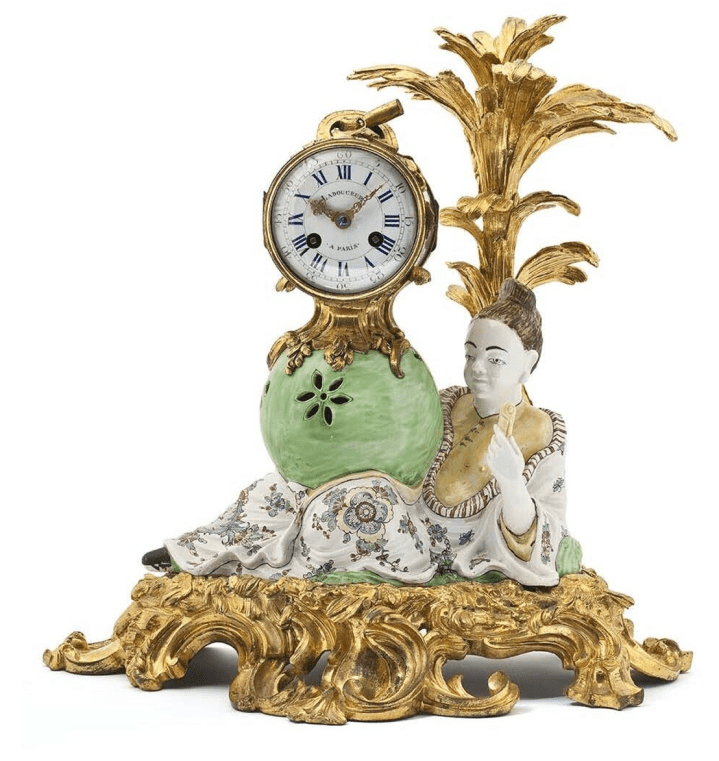
Porcelain clock, Ladouceur (clockmaker), Manufacture de Chantilly, ca. 1740–50, soft-paste porcelain, polychrome decoration, over glaze, chased and gilded bronze (Paris: Musée des Arts Décoratifs, 22757).
Les relations entre les arts, les métiers et l’industrie suscitent aujourd’hui un très grand intérêt. Cours, séminaires et conférences se multiplient, nous incitant à approfondir les connaissances et à débattre autour de questions méthodologiques, théoriques, patrimoniales et techniques. Les Rencontres des Arts Décoratifs entendent contribuer à la structuration de ce champ relativement récent de l’histoire de l’art en donnant une visibilité à la jeune recherche.
L’université, les écoles d’art et d’architecture ainsi que les institutions patrimoniales publiques et privées sont appelées à nourrir ces échanges. Étudiantes et étudiants titulaires d’un Master 1 ou d’un Master 2 (soutenu depuis moins de deux ans), doctorants et jeunes docteurs font découvrir à un large public des collections et des fonds inédits, des créations encore ignorées, des techniques oubliées, des courants esthétiques méconnus.
Les analyses et les discussions sont introduites et animées par des spécialistes reconnus pour l’acuité de leur regard et la singularité de leur approche. Chaque rencontre peut être suivie par des visites d’exposition, de fonds d’archives ou de collections. Le lieu qui nous accueille—le musée des Arts décoratifs de Paris—est hautement emblématique : conçu au milieu du XIXe siècle pour instruire artistes, artisans et ouvriers d’art, diffuser les savoirs et promouvoir la création contemporaine, il est le cadre le plus approprié pour mettre en lumière les dimensions multiples du « faire » qui, encore aujourd’hui, vivifient la production des objets. Réunis à l’occasion de ce rendez‑vous annuel, jeunes chercheurs, enseignants, professionnels et amateurs sont incités à mener ensemble une réflexion historique, critique et prospective, sur les chemins croisés de la conception des formes, de la fabrication des choses et de l’aménagement des espaces de vie.
Du 16 février au 5 juillet 2026, le musée des Arts décoratifs vous invite à plonger au cœur de l’intimité d’une demeure aristocratique du XVIIIe siècle et de ses habitants, maîtres, domestiques et animaux familiers, grâce à une exposition immersive, intitulée Une journée au XVIIIe siècle, chronique d’un hôtel particulier. Dans une mise en scène vivante, sonore, olfactive et haute en couleurs, qui convoquera tous les sens et suivra un fil narratif romanesque, le visiteur sera invité à déambuler de pièce en pièce, comme s’il était un proche, un ami ou un invité privilégié de la famille. Riche de plus de 500 pièces originales issues principalement des collections du musée des Arts décoratifs dans toute leur diversité (boiseries, mobilier, céramique, orfèvrerie, peinture, sculpture, arts graphiques, textiles et mode, jouets, bijoux, verres, papiers peints, etc.), cette exposition se propose de redonner vie à un univers fait de raffinement et de commodité, en s’intéressant à la fois à l’insertion urbaine de l’hôtel, à sa distribution et à son aménagement intérieur, à son fonctionnement, ainsi qu’aux occupations quotidiennes de ses propriétaires. De la toilette du matin aux jeux du soir en élégante compagnie, en passant par la magnificence d’un dîner à la française, les doux accords d’un concert de musique au salon ou les plaisirs piquants de la conversation au gré d’une promenade dans le jardin, celles-ci seront appréhendées sur toute la durée d’une journée, du lever au coucher, chaque pièce ainsi réinventée étant associée à un moment précis.
Comme les Rencontres précédentes, cette cinquième manifestation entend s’inscrire dans une perspective large, ouverte à toutes les approches. Le sujet de l’art de vivre et des arts du décor au XVIIIe siècle, ainsi que de leurs postérités, est envisagé dans ses liens avec l’histoire des sciences et des techniques, l’histoire culturelle, l’histoire des sensibilités, l’histoire matérielle ou encore l’histoire du genre… Les propositions pourront notamment aborder la perception du XVIIIe siècle par le XIXe siècle et par l’époque contemporaine (XXe–XXIe siècles). Amateurs, collections, lectures et interprétations pourront faire l’objet de communications centrées sur la culture matérielle et les arts décoratifs du siècle des Lumières. L’appel est ouvert aux propositions de jeunes chercheurs internationaux. Les propositions d’intervention d’environ 2500–5000 signes (espaces compris), ainsi qu’une bio-bibliographie sont à envoyer avant le 15 décembre 2025 aux adresses suivantes:
jeremie.cerman@gmail.com
rossella.froissart@ephe.psl.eu
ariane.james-sarazin@madparis.fr
anne.perrin-khelissa@univ-tlse2.fr
sebastien.quequet@madparis.fr
estelle.thibault@paris-belleville.archi.fr
celine.trautmann-waller@ephe.psl.eu
amandine.loayza-desfontaines@madparis.fr
Comité scientifique
• Jérémie Cerman, professeur, Université d’Artois, UR 4027 – Centre de Recherche et d’Études Histoire et Sociétés (CREHS)
• Rossella Froissart, directrice d’études, École Pratique des Hautes Études, EA 4116 – Savoirs et pratiques du Moyen Âge à l’époque contemporaine (SAPRAT)
• Bénédicte Gady, directrice du musée des Arts décoratifs et du musée Nissim de Camondo Ariane
• James‑Sarazin, conservatrice générale du patrimoine, musée des Arts décoratifs
• Anne Perrin, professeure, Université Toulouse-Jean-Jaurès,
UMR 5436 – FRAMESPA (France, Amériques, Espagne. Sociétés, pouvoirs, acteurs)
• Sébastien Quéquet, attaché de conservation, musée des Arts décoratifs
• Estelle Thibault, professeure, École nationale supérieure d’architecture Paris-Belleville, IPRAUS/UMR AUSSER 3329
• Céline Trautmann‑Waller, directrice d’études, École Pratique des Hautes Études, EA 4116 – Savoirs et pratiques du Moyen Âge à l’époque contemporaine (SAPRAT)
Call for Papers | Arts and Crafts in the Late Ottoman Empire
From ArtHist.net and the Lebanese American University:
Arts and Crafts in the Late Ottoman Empire:
Material Culture in Syria and Beyond, 18th–Early 20th Century
Lebanese American University, Beirut, 22–23 May 2026
Organized by May Farhat and Sarah Sabban
Proposals due by 15 January 2026
Long excluded from the foundational narratives of Islamic art and architecture history, the period from the 18th till the early 20th centuries has attracted growing scholarly attention since the turn of the 21st century (Flood and Necipoğlu 2017; Behrens-Abouseif and Vernoit 2006; Deguilhem and Faroqhi 2005; Vernoit 1997). New interdisciplinary research shaped by the material turn in the humanities and by critical reflections on the Eurocentric framing of modernity—has challenged earlier assumptions that Islamic artistic and architectural practices declined after the 17th century (Graves forthcoming; Trevathan 2025; Rosser-Owen 2020; Hamadeh and Kafescioğlu 2021; Flood 2019, Phillips 2016). Equally, scholars have demonstrated the vitality, adaptability, and creativity of late Ottoman visual and material worlds, revealing their entanglements with global flows of goods, ideas, and technologies, as well as their embeddedness in local practices, knowledge systems, and social lives (Lanzillo 2024; Graves and Seggerman 2022; Volait 2021; Avcıoğlu and Flood 2009). Despite this momentum, Syria (Bilād al-Shām) received far less sustained attention than other Ottoman and Islamic lands such as Anatolia/Turkey, Egypt, or Iran, and has only recently started to gain traction (see Milwright 2018; Abou-Hodeib 2017; Auji 2016; Sheehi 2016; Scharrahs 2013; Weber 2009, and Establet and Pascual 2005).
Building on this new scholarship, the Arts and Crafts conference aims to advance art historical and interdisciplinary research on practices and concepts of material culture in Ottoman lands between the 18th and the early 20th centuries. While inviting contributions on all geographies of the Empire, our call for papers foregrounds late Ottoman Syria as a case through which to expand the analytical and historical horizons of Islamic art and architecture studies and to contribute to broader debates in Ottoman and Arab historiographies of modernity.
Entangled Modernities: Materialities, Epistemes, and Temporalities
Following the methodological program of entangled histories, our endeavor is not limited to chronologically expanding the scope of study but strives for a deeper reflexive commitment to rethinking the relationship between material culture, knowledge, and modernity as an integral part of the history of the Islamic world. We propose to employ “entangled modernities” as a critical site of inquiry into materialities, epistemes, and temporalities at play in the configuration of arts and crafts in the late Ottoman Empire. Integral to this approach is the premise of polyvalent and malleable thinking that can transcend rigid boundaries, undo dichotomies, and illuminate processes of cross-fertilization.
Temporalities
The timespan covered by the conference aligns with a strategic decision to step back and, we hope, productively reframe the usual terms of periodization and pregiven contours of modernity and pre-modernity that preset the objects of study and their coordinates in time. We thereby encourage serious attention to indigenous temporalities embodied or performed in objects, concepts, and material processes that reveal new matrices of continuities, ruptures, and revivals. Indeed, the period under consideration witnessed the gradual integration of the Empire into the global economy and the implementation of a series of reforms, culminating in the Tanzimat period (1839–1876), which signaled profound changes that the state and society had to contend with. These developments raise the question of plural and contested temporalities, which gains further importance in light of increasingly unequal terms of exchange and interaction that characterized Ottoman relations with a fast-industrializing and expansionist Europe.
Epistemes
Our approach emphasizes the mutually constitutive nature of cross-cultural encounters (often between parties of unequal power) and, to the extent possible, contextualizes their components and outcomes in a processual, holistic, and heuristic manner. It equally entails the necessity to historicize categories of knowledge, partly by focusing on webs of meaning formed between emic and etic notions that organized the material world, transformed it, and were transformed by it. The many languages spoken across the Empire fostered unique environments where the modern Western order of knowledge was refracted in many directions and made to reflect local and regional histories. Translation between languages and epistemes undoubtedly depended on emergent, experimental, and contingent forms of knowledge that can instruct the modern historian on the changing conditions and materialities within which they existed.
Materialities
The staggering effects of the Industrial Revolution on the material world and people’s engagement with it cannot be overstated, but they were not all-encompassing, simultaneous, or uniform. Hence, the central aim of this conference on arts and crafts is to reconsider all aspects that constituted, (re)shaped, and represented material culture across this period of more than 200 years including conditions, modes, and tools of production; regional and global circulations of goods and technology transfer; interplay between science, economy, and state; relations between makers, patrons, merchants, and consumers; apprenticeship and other forms of knowledge transmission; skill and artistic traditions between artisanal and mechanical production; modes of valuation, such as taste or aesthetics; how Ottoman economic and legal reforms as well as international agreements negotiated between global pressure and internal stakes.
Overall, we encourage authors to consider the analytical frameworks—temporalities, epistemes, and materialities—that underpin the conference’s critical inquiry into the entangled modernities of Ottoman arts and crafts, in Syria and beyond. We welcome contributions engaging with any of the themes discussed in this call, or those that innovatively expound on them, including but not limited to interdisciplinary research, object-centered studies, case-based micro-histories of concepts, people, and institutions, as well as historiographical questions on sources, archives, conservation discourses, and digital humanities initiatives dealing with material culture.
Submission Guidelines
We invite abstracts of up to 300 words, along with a short biography (max. 100 words), to be sent to MAIA.events@lau.edu.lb by 15 January 2026. Papers may be delivered in English or Arabic. Decisions will be communicated by 1 February 2026. Selected papers from the conference will be considered for publication in an edited volume or a special issue of a journal.
s e l e c t e d b i b l i o g r a p h y
Abou-Hodeib, Toufoul. A Taste for Home: The Modern Middle Class in Ottoman Beirut. Stanford: Stanford University Press, 2017.
Auji, Hala. Printing Arab Modernity: Book Culture and the American Press in Nineteenth-Century Beirut. Leiden: Brill, 2016.
Avcıoğlu, Nebahat and Finbarr Barry Flood, eds. “Globalizing Cultures: Art and Mobility in the Eighteenth Century.” Special Issue, Ars Orientalis 39 (2009).
Behrens-Abouseif, Doris and Stephen Vernoit, eds. Islamic Art in the 19th Century: Tradition, Innovation, Eclecticism. Leiden: Brill, 2006.
Deguilhem, Randi and Suraiya Faroqhi, eds. Crafts and Craftsmen of the Middle East: Fashioning the Individual in the Muslim Mediterranean. London and New York: I.B. Tauris, 2005.
Establet, Colette, and Jean-Paul Pascual. Des tissus et des hommes. Beyrouth: Presses de l’Ifpo, 2005.
Flood, Finbarr Barry. Technologies de dévotion dans les arts de l’Islam: Pèlerins, reliques et copies. Paris: Hazan / Musée du Louvre, 2019.
Flood, Finbarr Barry, and Gülru Necipoğlu, eds. A Companion to Islamic Art and Architecture. 2 vols. Hoboken: John Wiley & Sons Inc., 2017.
Graves, Margaret S. Invisible Hands: Fabrication, Forgery, and the Art of Islamic Ceramics. Princeton University Press, forthcoming.
Graves, Margaret S. and Alex Dika Seggerman, eds. Making Modernity in the Islamic Mediterranean. Bloomington, Indiana: Indiana University Press, 2022.
Hamadeh, Shirine and Çiğdem Kafescioğlu, eds. A Companion to Early Modern Istanbul. Leiden, Boston: Brill, 2021.
Lanzillo, Amanda. Pious Labor: Islam, Artisanship, and Technology in Colonial India. University of California Press, 2024.
Milwright, Marcus. The Arts and Crafts of Syria and Egypt from the Ayyubids to World War I: Collected Essays. Piscataway: Gorgias Press, 2018.
Phillips, Amanda. Everyday Luxuries. Art and Objects in Ottoman Constantinople, 1600-1800. Dortmund: Verlag Kettler, 2016.
Rosser-Owen, Mariam, ed. “Middle East Craft.” Special Issue, The Journal of Modern Craft 13, no. 1 (2020).
Scharrahs, Anke. Damascene ῾Ajami Rooms: Forgotten Jewels of Interior Design. London: Archetype, 2013.
Sheehi, Stephen. The Arab Imago: A Social History of Portrait Photography, 1860–1910. Princeton: Princeton University Press, 2016.
Trevathan, Idries, ed. In Praise of the Artisan: The Enduring Legacy of Islamic Crafts. Medina Publishing Ltd, 2025.
Vernoit, Stephen. Occidentalism: Islamic Art in the 19th Century. London: Nour Foundation, 1997.
Volait, Mercedes. Antique Dealing and Creative Reuse in Cairo and Damascus 1850–1890: Intercultural Engagements with Architecture and Craft in the Age of Travel and Reform. Leiden, Boston: Brill, 2021.
Weber, Stefan. Damascus: Ottoman Modernity and Urban Transformation 1808–1918. 2 vols. Aarhus: Aarhus University Press, 2009.
Call for Articles | Markers, Journal for Gravestone Studies
From the Association for Gravestone Studies:
Markers: Annual Journal of the Association for Gravestone Studies, 2027 Issue
Submissions due by 1 January 2026
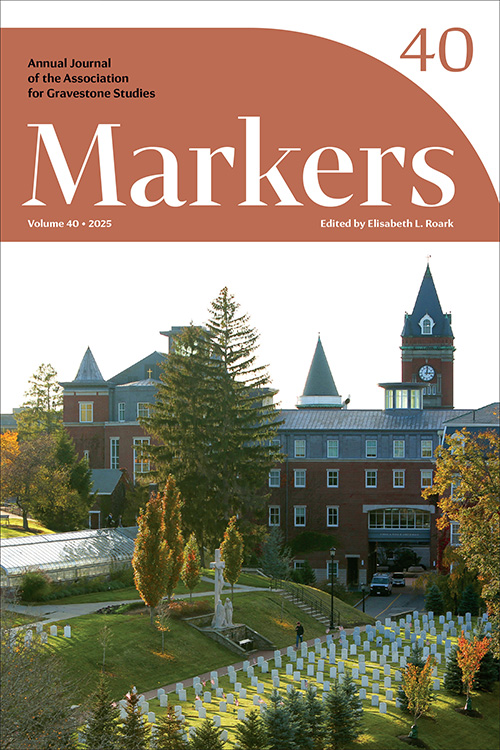 We are currently seeking article submissions for the 2027 issue of Markers, the scholarly journal of the Association for Gravestone Studies. The subject matter of Markers is defined as the analytical study of gravemarkers, monuments, tombs, and cemeteries of all types and encompassing all historical periods and geographical regions. Markers is of interest to scholars in anthropology, historical archaeology, art and architectural history, ethnic studies, material culture studies, American studies, folklore and popular culture studies, linguistics, literature, rhetoric, local and regional history, cultural geography, sociology, and related fields. Articles submitted for publication in Markers should be scholarly, analytical, and interpretive, not merely descriptive or entertaining, and should be written in a style appropriate to both a wide academic audience and an audience of interested non-academics.
Authors are encouraged to consult the “Notes for Contributors to Markers and Markers Style Guide.” Submissions for 2027 should be sent to Editor Elisabeth Roark, Professor of Art History and Museum Studies at Chatham University, at roark@chatham.edu, before 1 January 2026.
Call for Papers | Hospitals and Confraternities, 13th–18th Centuries
From ArtHist.net:
Hospitals and Confraternities in Europe, 13th–18th Centuries
Naples, 8–11 April 2026
Organized by Gemma Colesanti, Toni Conejo, Salvatore Marino, and Stefano D’Ovidio
Proposals due by 30 November 2025
The 15th edition of the Abrils de l’Hospital, a series of annual conferences promoted by the University of Barcelona since 2103, will be held in Naples in April 2026. This edition will focus on the role of charitable confraternities and craft guilds in the foundation, administration, reform, and expansion of hospitals and other welfare institutions. The conference will place particular emphasis on both the tangible and intangible heritage of these organizations, examined through interdisciplinary and gender-aware approaches. The broad chronological scope will encourage innovative research adopting a longue durée perspective on the ongoing processes of reform, refoundation, and restructuring that characterized confraternities, hospitals, and charitable institutions of the ancien régime. Special attention will be devoted to large and medium-sized urban contexts, in order to promote comparative discussions across the diverse political, economic, social, and cultural landscapes of Christian Europe.
The sessions will be organized around three main research strands:
1. The agency of confraternities, craft guilds, associations of foreigners, and charitable movements in the foundation, management, and administrative reform of hospitals.
2. The involvement of members of ruling families and the urban patriciate, merchants, artisans, and farmers in confraternities and associations responsible for hospitals and other charitable institutions (orphanages, leprosaria, lazarettos, and almsgiving organizations).
3. The written records produced by confraternities and guilds engaged in the management of pious institutions, along with the architectural and artistic heritage commissioned by lay and religious groups for the enlargement, embellishment, and ritual use of hospital spaces and their attached religious buildings.
Alongside academic sessions and discussions, the program will include poster presentations, as well as guided visits to archives and to the main hospitals and confraternal buildings in the city of Naples.
The Call for Papers is open until 30th November 2025. Proposals should be submitted to the conference organizers at abrils.hospital@ub.edu and must include the following information in a single PDF or Word file: full name, academic affiliation, paper title, abstract (150–200 words), and a short CV (maximum 200 words). Presentations may be delivered in Catalan, French, English, Italian, Portuguese, or Spanish. Accepted proposals will be notified by 31st January 2026.
Organizers: Gemma T. Colesanti (ISP-CNR, Napoli), Toni Conejo and Salvatore Marino (Universitat de Barcelona), Stefano D’Ovidio (Università di Napoli Federico II)
Call for Papers | Art and the Aesthetics of Pregnancy and Birth
From ArtHist.net and SSPRB::
Beauty and the Sublime in Gestation and Coming into Being:
Art and the Aesthetics of Pregnancy and Birth
Online, 4–5 June 2026
Keynote Speakers: Lauren Bice and Sheila Lintott
Proposals due by 1 December 2025
The Society for the Study of Pregnancy and Birth (SSPRB) is pleased to announce the Call for Papers for its second international virtual symposium, Beauty and the Sublime in Gestation and Coming into Being: Art and the Aesthetics of Pregnancy and Birth, a virtual event that will take place online across two half-day sessions on June 4–5, 2026 (to facilitate participation across time zones).
In her work on experiences of a feminist sublime in gestation and birth, American philosopher Sheila Lintott has described these experiences as, “dangerous internal experiences that prompt both introspective and extrospective exploration and recognition.” This international virtual symposium explores and recognizes these experiences, seeking to highlight scholarship and ideas on art about birth and pregnancy, as well as philosophical approaches to aesthetic properties, values, and qualities related to beauty and the sublime in gestation and coming into being.
Some areas of interest include
• How have artists represented pregnancy and birth, both historically and in our contemporary world, and what do these images convey to their viewers about the experiences they represent?
• How do aesthetic qualities emerge through our experiences of pregnancy, birth, and coming into being?
• How do birth professionals inform us about birth, neonatal life and the aesthetics of the birth environment through their work?
• Where do we see the aesthetics of pregnancy and birth within the field of philosophy?
• What are some of the ways in which different cultures celebrate or influence the art, beauty, and/or the aesthetics of pregnancy and birth?
• What are the internal and external aesthetic experiences of parents who adopt or foster children?
• How does phenomenology intersect with the aesthetics of pregnancy and birth?
• How are art and the aesthetics of pregnancy and birth part of the Birthing Justice Movement or other movements?
We are interested in philosophical, interdisciplinary, and/or artistic approaches to art and the aesthetics of pregnancy and birth, and welcome papers in fields across the arts, humanities, social sciences and psychology. We also welcome the work of birth professionals whose backgrounds inform their understanding of aesthetics in spaces of birth.
We invite abstracts for short papers (15–20 minutes) from any discipline to be submitted by Monday, 1 December 2025. Please email abstracts (with titles) of no more than 250 words and a short biography (75 words) to the Society for the Study of Pregnancy and Birth (SSPRB) at ssprbpapers@gmail.com. Full panel submissions are also welcome and should include the same information for each presenter on the panel (abstract and biography). Panels should include 3–4 presenters. Please note that presenters on a 4-person panel will have less time to present their work. The event will be recorded and accessible on request for those not able to attend.
You can contact us at ssprbsociety@gmail.com. Sign up for the SSPRB Newsletter here: ssprb.substack.com. To learn more about the Society for the Study of Pregnancy and Birth, visit our website.
Call for Articles | Queerness in 18th- and 19th-C. European Art
From ArtHist.net and Arts:
Queerness in 18th- and 19th-Century European Art and Visual Culture, 2nd Edition
Special issue of the journal Arts, guest edited by Andrew Shelton
Abstracts due by 15 January 2025; final manuscripts will be due by 1 July 2026
Essays regarding a wide variety of topics that subvert or disrupt heteronormative interpretations of the art and visual culture of this period are welcome, including the works of art produced by or under the auspices of personages who can plausibly be identified as attracted to members of the same sex; works or creative situations that can be construed as expressing or eliciting same-sex sexual desire or attraction; works or creative situations in which the heteronormative polarity of the processes of identification and desire can be perceived as having been collapsed or scrambled; works or creative situations that involve gender-bending or gender fluidity; works or creative situations that either deepen or complicate our understanding of sexuality and/or sexual identity during the 18th and 19th centuries; and works that eroticize individuals or situations that are normally regarded as lying outside the realm of the erotic.
Arts is an international, peer-reviewed, open access journal promoting significant research on all aspects of the visual and performing arts, published bimonthly online by MDPI.
Submission Planning
• Abstracts due by 15 January 2025, submission link for abstracts.
• Final manuscripts due by 1 July 2026, submission link for full articles.
Submission Criteria
• Abstract and a short biography should be sent to Andrew Shelton (shelton.85@osu.edu) and Sylvia Hao (sylvia.hao@mdpi.com).
• Final articles, in English only, should be at least 4000 words long; a 150-word abstract and 5 keywords should also be submitted.
• Authors can include image files (tables, maps, graphs, photographs …) in ..jpg; they should ensure that images are free of rights (or that rights have been obtained).
• Each article will be peer-reviewed by at least two anonymous referees.
For inquiries, please contact: Sylvia Hao (sylvia.hao@mdpi.com) and Editorial Office of Arts (arts@mdpi.com).
Call for Papers | The Art of the Syllabus
From ArtHist.net:
The Art of the Syllabus
Centre for Research in Visual Culture, University of Nottingham, January — June 2026
Proposals due by 17 November 2025
Every year the Centre for Research in Visual Culture organises its seminar programme around a given theme. This year’s theme is The Art of the Syllabus, and for the first time we are inviting scholars to propose papers to present as part of our research programme from January to June 2026.
In histories of the teaching of art, photography, and art history, the syllabus is often sidelined. Teachers, students, institutions, even government policy: these are the threads usually pulled upon to tell this history. There is a logic to this marginalisation. Without a teacher, students, or an institution, a syllabus is redundant—a dormant document awaiting activation. Moreover, even though archives are filled with records of syllabi that have been activated, anyone who has been in a classroom knows that the syllabus itself is a poor record of what was discussed. At the same time, the syllabus captures a kind of pre-history of the classroom. It is a record of the best intentions of the teacher before the reality of the students (and the institution) intervenes. By using the syllabus as the starting point for our discussions, we are hoping we might capture the histories of teaching that never came to pass as well as those that did.
If our theme relates to your current research, we would like to hear from you. We are especially interested in hearing from scholars working on pre-twentieth century histories of art, photography, and art history pedagogy, although scholars of the twentieth- and twenty-first centuries are of course welcome as well. We are less interested in hearing about completed research projects. Conversely, if you are at the beginning of a project that resonates with our call, please do consider working through your early ideas at the CRVC. Please send a short (250 word) blurb and (50 word) bio to chloe.julius@nottingham.ac.uk by 17 November. All of our seminars take place in person on Wednesdays at 4pm. Talks should be planned to run for 45 minutes to an hour, and will be followed by a lively discussion. Travel will be reimbursed up to £150.
Call for Papers | ‘Civilizing’ the World, 1780–1945
From ArtHist.net and The Warburg Institute:
‘Civilizing’ the World: Classicism, Neo-Classical Sculpture, and Plaster Casts
in the Service of Imperial Powers and Post-Colonial Elites, 1780–1945
The Warburg Institute, School of Advanced Study, University of London, 22–23 October 2026
Proposals due by 1 December 2025
We invite proposals for 20-minute papers for a two-day conference to be held at the Warburg Institute (School of Advanced Study, University of London) in co-organization with the Institute of Classical Studies (SAS, UoL) and the Department of the Classics (University of Reading).

Algiers, La Mosquée Djemaa-Djedid, La Statue du Duc d’Orléans.
Throughout the nineteenth and early twentieth centuries, European imperial and colonial powers used both Greco-Roman and neo-classical sculpture, as well as architecture and other art forms, to express and consolidate their authority, at home and in colonial settings, through the assertion of Eurocentric notions of ‘civilization’ and inherited supremacy. The establishment of museums and art academies, on a European model, remained a feature of nation-building by elites in many former colonies after independence.
This conference aims to bring together and foster new research into the roles that classical and neoclassical art (broadly defined) fulfilled for European colonial powers and post-colonial elites globally, seeking critical exploration and assessment of the ways classical visual culture has been reused, redefined and also contested. The conference seeks to investigate classical visual culture in the service of self-presentation among competing nations and as a means to ‘civilize’ and / or dominate indigenous, subaltern and settler populations. We encourage examination of the social, political and racial implications of engagement with the European classical tradition in both colonial and post-colonial contexts worldwide. We invite contributions on works including neo-classical sculpture, plaster casts after the antique, and works such as ethnographic life-casts, the creation and use of which amplified and illuminated concepts of race and evolution that underpinned notions of Greco-Roman cultural supremacy. While the principal focus of the conference is on sculptural works, proposals on other arts and/or the interaction of the visual and literary are also welcome.
We invite scholars at all stages of their career, including PhD students and early-career researchers, to submit proposals (300 words maximum) for 20-minute presentations. The preferred mode of attendance will be in person, and the organizers are aiming to raise funding in support of travel expenses for speakers who cannot obtain funding from elsewhere. In the light of the international scope of the topic and call for papers, please indicate whether you may be able to access travel subsidies from your own institution or other sources, and / or whether you would be prepared to attend and present online if necessary. Proposals and the accompanying statement should be sent to Eckart.Marchand@sas.ac.uk by 1 December 2025.
Organizers
Eckart Marchand (Warburg Institute), eckart.marchand@sas.ac.uk
Katherine Harloe (Institute of Classical Studies), katherine.harloe@sas.ac.uk
Amy Smith (University of Reading), a.c.smith@reading.ac.uk










 Enfilade
leave a comment