Call for Papers | Revivals in the Decorative Arts
From ArtHist.net:
Revivals in the Decorative Arts — Annual ICOM / ICDAD Conference
National Palace of Ajuda, Lisbon, 14–16 October 2020
Proposals due by 15 April 2020
The 2020 Annual Conference and General Assembly of ICOM International Committee for Museums and Collections of Decorative Arts and Design will take place at the National Palace of Ajuda in Lisbon, Portugal, from October 14 to 16—plus two days (17–18 October) for the post conference tour to Coimbra and Porto.
Revivals—as a socio-cultural phenomenon recurrent throughout history—seek to rescue principles and traditions of times gone by. In this conference we approach revivals with regard to decorative arts and design. Decorative arts and design are to be interpreted as any domestic or public furnishings including but not limited to textiles, silverware, furniture, wallpaper, tableware, interior decoration as a whole, graphic design, as well as personal accessories (excluding fashion). We also welcome presentations on revivals within decorative and applied art traditions (ceramics, lacquer, metalwork, textiles, woodwork, etc.) made for utilitarian or connoisseurial purposes. Hence we encourage papers proposals on a wide variety of topics including a broad array of Asian, European, or North and South American revival styles. We also include the retro design styles of the 20th and 21st centuries, referring to the resurgence of old yet relatively recent styles.
It is fascinating how heritage is being used and valued, reconsidered both from the positions of a curator, artist, or a designer. We are interested in the examples, phenomena, and notions that reflect upon the relation to the past, treating it with both unsentimental and sentimental nostalgia, introducing ways of dealing with the recent past from different periods in history.
15-minute presentations (in English) will comprise the conference sessions. Please send an abstract of 250–300 words, including your name, title, institution, and ICOM membership number to Maria José Gaivão Tavares, Curator of the Furniture Collection at National Palace of Ajuda and ICDAD Secretary, icdad.secretariat@gmail.com. Additional information is available here.
Call for Papers | Georgian London Revisited
From The Georgian Group:
2020 Georgian Group Symposium: Georgian London Revisited
Society of Antiquaries, Burlington House, London, 7 November 2020
Proposals due by 20 March 2020
The Georgian Group is organising a day-long symposium on ‘Georgian London Revisited’, to be held at the Society of Antiquaries at Burlington House, London, on Saturday, 7 November 2020. Following the successful conferences run by the Group in previous years on Women and Architecture, and on the architecture of James Gibbs and the Adam brothers, the symposium will highlight changing perspectives and new research on the architecture of London during the ‘long 18th century’ (c.1660–1830) undertaken since the publication of the 1988 edition of Sir John Summerson’s seminal Georgian London (reissued with amendments by Sir Howard Colvin, 2003). Topics may include, but are not limited to, the following:
• Housing and estate development
• Public and commercial buildings
• ‘Improvement’: infrastructure, streets, open spaces, bridges, etc
• Places of entertainment
With this in mind, proposals are invited for 15-minute papers based on original research. Please send abstracts of no more than 200 words and a copy of your CV to Dr Geoffrey Tyack (education@georgiangroup.org.uk) by 20 March 2020. Any questions regarding the symposium should be sent to the same address. Further details will be made available, and tickets will go on sale, in the Spring.
Call for Papers | Cultural Dimensions of Dutch Overseas Expansion
From ArtHist.net:
The Cultural Dimension of Dutch Overseas Expansion
Utrecht University, 28 August 2020
Proposals due by 15 March 2020
“It is only money and not knowledge that our people are seeking [in the East Indies], which is to be lamented”, complained the Amsterdam mayor and VOC governor, Nicolaes Witsen, in 1712. The Dutch trading companies may have been associated with various qualities, but an interest in culture was not one of them. None of the VOC officials even noted the presence of the world’s biggest Buddhist temple, the Borobudur, on the island of Java, leaving its re-discovery to the British in 1814. No Dutch writer tried to emulate the epic celebration of the Portuguese maritime empire by Luís de Camões. Dutch expansion had an obvious impact on the sciences and medicine, as demonstrated in Harold Cook’s Matters of Exchange: Commerce, Medicine, and Science in the Dutch Golden Age (2007). But what, if any, was its impact on culture and the humanities?
Here there is, in fact, a fruitful scholarly field that largely remains to be explored. For example, Dutch lust for money set in motion the first transfer of culture on a truly global scale, when 40 million pieces of Chinese porcelain were shipped from East Asia to Europe and the Americas. ‘Indies shops’ in different Dutch cities sold curiosities from six continents. Travelogues—even when ordered by the VOC and predominantly mercantile in outlook—offered a wealth of ethnographic knowledge for the attentive reader. Scholarly-minded individuals could break the commercial pattern, resulting in the first Western translations of a work in Sanskrit (by Abraham Rogerius, 1651), a work of Hindu iconography (by Philips Angel, 1657), and the main work of Confucius (by Pieter van Hoorn, 1675). They must have relied on the expertise of local native speakers; non-Western perspectives come into even clearer focus with at least three Chinese men who visited the Netherlands and with the Africans who sat for Amsterdam painters.
This conference brings together historians of culture, art, literature, language, philosophy, science, and religion to arrive at a fuller picture of the cultural dimensions of Dutch overseas expansion. The keynote lectures will be given by Dr. Roelof van Gelder and Dr. Mariana Françozo (Leiden University).
Possible themes include:
• Cultural topics (art, literature, language, music, mythology, religion) addressed in travelogues
• Non-Western themes in Dutch literature and drama (from ‘Moortje’ to ‘Zungchin’)
• Representations of the world’s peoples, including enslaved persons and non-Western visitors to the Low Countries
• Trade, consumption, interpretation, and imitation of non-Western material culture
• Translations, dictionaries, and grammars
• Cultural industries (print shops, painting studios, artisan’s workshops) established overseas
• Cultural education in the context of the VOC and WIC
• The impact on culture of cross-cultural encounters, slavery, servitude, and colonialism
• Challenges posed by historiographies, religions, and philosophies from beyond Europe
Working group De Zeventiende Eeuw invites all interested in this topic to send in an abstract (max. 300 words) and curriculum (max. 100 words) for a paper (in English or Dutch) of 20 minutes. Proposals for sessions, consisting of three papers, are also welcome. Deadline for abstracts: 15 March 2020, to Jaap de Haan (j.dehaan@uu.nl).
Organizing Committee: Marjolijn Bol, Surekha Davis, Jaap de Haan, Cora van de Poppe, and Thijs Weststeijn
Call for Papers | Ma thèse en histoire de l’art en 180 secondes
From ArtHist.net:
Ma thèse en histoire de l’art en 180 secondes
Festival de l’histoire de l’art, Fontainebleau, 5–7 June 2020
Proposals due by 15 March 2020
La 10e édition du Festival de l’histoire de l’art aura lieu à Fontainebleau les vendredi 5, samedi 6 et dimanche 7 juin 2020 avec le Japon comme pays invité. Le thème fédérateur choisi cette année est le Plaisir. Dans le cadre de cette édition, il est proposé aux doctorants de participer au concours « Ma thèse d’histoire de l’art en 180 secondes ».
Chaque candidat disposera de trois minutes (180 secondes) pour réaliser un exposé clair et concis de son projet de recherche. Les présentations réalisées par les candidats retenus devront convaincre deux jurys composés d’historiens de l’art et de professionnels. A l’issue du concours, trois prix seront attribués aux trois meilleurs orateurs.
Premier prix: 1000€
Deuxième prix: 500€
Troisième prix: 500€
Les frais de transport et d’hébergement des participants hors région parisienne seront pris en charge sur présentation de justificatifs (jusqu’à 150€).
Call for Papers | Critical Perspectives on Image and Text
From ArtHist.net:
Perlego: Critical Perspectives on Image and Text
University of Oxford, 3–4 July 2020
Proposals due by 1 April 2020
From writings that explore the textuality of images to the use of images in the illumination of texts, the signifying systems of image and word rub up against one another in various ways, making the meeting of text and image a long-standing area of scholarly fascination. The PERLEGO conference takes a critical approach to text-image scholarship, bringing together early career scholars working across different disciplines to explore methodological issues arising at the interface of textual and visual analysis.
With a view to initiating productive conversations about methodology, PERLEGO seeks to draw out strands of critical approaches from across research areas, time periods, and genres, to consider how integrated approaches to image and text analysis can construct robust and polyphonic histories of meaning, production, and interpretation. Hosted in July 2020 at the University of Oxford, this two-day conference unfolds as a series of panels, roundtable discussions, keynote lectures, and a hands-on session at the Ashmolean Museum.
PERLEGO invites abstracts for critical perspectives on image and text in areas including but not limited to the following:
• Visual strategies in texts
• ‘Textual’ strategies in works of art
• The idea of ‘genre’ across text and image
• The graphic act
• Hierarchies of signification
• Disciplinary hierarchies and structures of power
• Historical reconstruction and the period eye
• Text and image in colonial and postcolonial contexts
• Museum labels and taxonomies
We welcome abstracts from researchers and practitioners working in all fields, including (but not limited to): English and Comparative Literature, Art History, Modern Languages, History, Media Studies, Design Studies, and Museum Studies. Please send a 350-word abstract and a short academic bio by 1 April 2020 to perlego2020@gmail.com.
Organisers: Rebecca Bowen (Oxford), Vittoria Fallanca (Oxford), Anna Espinola Lynn (Oxford), and Sophie Koenig (Hamburg). This Conference is generously supported by the AHRC-TORCH Graduate Fund.
Call for Papers | Inside the Temporary Exhibition
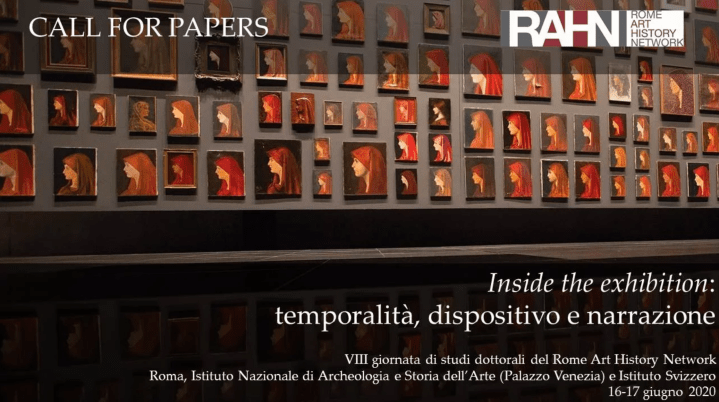
From the Call for Papers for this graduate student symposium, the full version of which includes Italian and French versions, via ArtHist.net:
Inside the Exhibition: Temporalità, Dispositivo e Narrazione
Swiss Institute and Istituto Nazionale di Archeologia e Storia dell’Arte (Palazzo Venezia), Rome, 16–17 June 2020
Proposals due by 19 April 2020
Now more than ever, temporary art exhibitions saturate museum spaces worldwide, shaping the discourse between public institutions and academia, and implicating an ever-growing and ever-changing international audience. The eighth doctoral study day organised by RAHN intends to reflect on the research opportunities afforded by the temporary display of artworks, from the early modern period to present day (15th–21st century).
In this wide time frame, temporary exhibitions have acquired multifarious meanings, shaping art-historical discourse. For example, the first public displays of paintings organised in the pronaos of the Pantheon, or in the cloisters of Roman churches for the festivals of patron saints, were tied to the religious context in which they took place. However, these displays were also key in the development of another ‘cult’, that of the artist, favouring the commercial interests of private collectors or of ante litteram curators, such as Giuseppe Ghezzi (1634–1721). With the formation of modern states, public exhibitions’ narratives were informed by different ideological programmes, which were inspired by, and in turn influenced contemporary art-historical debate. In this light, the temporary display of artworks offers an insight into the exhibition’s producing culture itself, and a unique opportunity for research.
The study day intends to focus on the ephemerality of art exhibitions, following a diachronic and interdisciplinary methodological approach inspired by Francis Haskell’s pioneering work on the subject (2000). When an artwork is put on display, its physical shift corresponds to a process of intellectual de- and re-contextualisation, through which the object acquires new meaning(s), imparted by the other objects with which it is put in dialogue, the space in which it is placed, and its audiences. With this in mind, we invite applicants to consider the following questions:
What affects such processes of de- and re-contextualisation? What happens when an art work is placed on temporary display? How does this influence the intellectual discourse surrounding the object and / or the exhibition? What interests are at stake in the organisation of artistic displays? What are their audiences, intended message and reception?
We welcome papers engaging with such questions, including, but not limited to the following contexts:
• the origins of art exhibitions and their cultural context (public, private, religious, secular, etc.)
• the artwork, its display, and fruition in the museum space
• the relationship between artistic historiography and exhibitions
• the art market: galleries, art fairs, and their exhibition spaces
• reception and critical discourses, the exhibition’s audiences and ‘verbal contexts’ (Pomian, 1986)
The application is open to doctoral students in the history of art and architecture enrolled in Italian and international institutions. We welcome 20-minute long papers focusing on methodological questions through a specific case study or proposing a theoretical approach to the subject. The proposals can be submitted in Italian, English, or French. To apply, please send a 250-word abstract and a 1-page academic CV by 19 April 2020 to the organisers: giornatadottorale.rahn@gmail.com.
Essential Bibliography
• Francis Haskell, The Ephemeral Museum: Old Master Paintings and the Rise of the Art Exhibition (New Haven: Yale University Press, 2000).
• Krzysztof Pomian, “Pour une histoire des semiophores. À propos des vases des Médicis,” Le Genre humain 14 (1986): 17–36.
Call for Papers | Piranesi @300
From the Call for Papers, which also includes Italian and French versions:
Piranesi @300
Rome, 27–30 January 2021
Proposals due by 30 April 2020
Organized by Mario Bevilacqua and Clare Hornsby
Concluding the year celebrating the 300th anniversary of the birth of Giovanni Battista Piranesi (1720–1778), this conference aims to reveal new aspects of his life and works, their contexts, and critical fortune, and we are seeking proposals for a comparison of interdisciplinary themes and innovative methodologies.
Some ideas of themes that could be addressed:
Piranesi as Artist, Theorist, Entrepreneur, and Merchant
Many aspects of Piranesi’s life and work still remain in the shadows: we hope to discover new documentary data, new drawings, new interpretations, new networks.
Piranesi and History
The Mediterranean civilizations, the fall of the Empire, the Middle Ages and the Renaissance. Egypt, Etruria, Greece, Rome. From the fall of the Empire to the Renaissance. Piranesi and the texts of his books, the birth of archaeology, the philosophy of history in 18th-century Europe.
Piranesi: Europe, America, the World
Piranesi as ‘global’ artist. His lasting reputation – from Rome across 18th-century Europe – takes on different aspects in different European contexts: England, France, Germany, Russia – and in the more distant United States and Latin America, Australia and Japan, maintaining close yet changing relationships with art, literature, photography and cinema.
Piranesi as Architect: Monument, City, Utopia
Though constantly designing, he was the architect of only one building, S. Maria del Priorato on the Aventine hill yet Piranesi always signed himself ‘architect’. His vision of Roman architecture and of the ancient metropolis states certainties and raises concerns about the dystopian future of the global city.
Piranesi in the Global 21st Century: New Methods for New Paths of Research
We can ask questions about Piranesi in the context of contemporary scenarios. His work continues to provoke reflection, inspire new projects and interpretations.
The languages of the conference are English, Italian and French, and the event will be open to the public. We invite doctoral students, postdoctoral researchers, established scholars to submit proposals for papers that contain new research or use new approaches. These will fall into two groups:
1) 15-minute presentations on one event, object, or discrete theme
2) 30-minute presentations on wider issues
Please send a 250-word CV and an abstract in English, French, or Italian of either 500 words (for a 15-minute talk) or 1000 words (for 30-minute talk); the abstract should make clear the new content of the contribution. Submissions should be sent to Piranesi300@gmail.com by April 30th 2020. We plan to offer accommodation in Rome to speakers at the conference though we are not able to assist with travel costs. We propose to publish a volume of the papers of the conference.
Supporting Institutions
Centro Studi Cultura e Immagine di Roma / Biblioteca Nazionale Centrale
Istituto Centrale per la Grafica
The British School at Rome
Académie de France à Rome – Villa Médicis
Conference Organisers
Mario Bevilacqua and Clare Hornsby
Scientific Committee
Francesca Alberti (Académie de France à Rome), Fabio Barry (Stanford University), Mario Bevilacqua (Università degli Studi di Firenze, CSCIR), Clare Hornsby (British School at Rome), Giorgio Marini (Ministero Beni Culturali), Heather Hyde Minor (Notre Dame Rome), Susanna Pasquali (La Sapienza Roma), Frank Salmon (Cambridge University), Giovanna Scaloni (Istituto Centrale per la Grafica).
Call for Essays | Giants and Dwarfs
From ArtHist.net (18 February 2020). . .
Giants and Dwarfs in Early Modern Europe: Real, Imagined, Metaphorical
Volume edited by Robin O’Bryan and Felicia Else
Abstracts due by 30 May 2020
Nourished by biblical accounts, classical precedents, and medieval traditions, the cultural interest in giants and dwarfs came of age in the early modern period. In the popular realm, the two were often to be found in carnivals, fairs, and religious festivals, the role of giants enacted by effigies or people wearing stilts. Dwarfs especially became important additions to the royal and princely courts, enlisted for amusement and prestige and featured in the ruler’s pageantry and protocol. In art, dwarfs were ubiquitous motifs in painting and sculpture, with giants portrayed literally or expressed metaphorically in colossi or other ‘gigantified’ works. Inspired by the Arthurian and Carolingian romances, chivalric spectacles were staged with dwarfs and giants, while burlesque poets and playwrights paid homage to the two in their mock-heroic poems and dramatic endeavors.
We seek essays for an edited volume dealing with any aspect of giants and/or dwarfs in early modern Europe. Topics might focus on their appearance in ephemeral entertainments; their exhibition in popular fairs and carnivals; as characters in legends, folkloric traditions, and dynastic histories; as leitmotifs in artistic and literary works; as embodiments of the period taste for the marvelous; and as manifestations of the Other. Please send abstracts of 200–250 words, along with any questions, to Robin O’Bryan at rlobryan@comcast.net by 30 May 2020.
Call for Papers | The Art of Plaster
From ArtHist.net:
The Art of Plaster: Between Creation and Reproduction, Study and Preservation
Faculty of Fine Arts, University of Lisboa / Calouste Gulbenkian Museum, Lisbon, 6–8 July 2020
Proposals due by 10 March 2020
The «Art» of plaster has been valued by our historiography over the last few years. Indeed, it was at the end of the 20th century that the first in-depth studies on the application of plaster in architectural decoration began to emerge, and a new set of plastering artists became known and valued. However, issues concerning sculptural practice itself have been secondary until very recently, although the use of plaster as a material for artistic production has been a constant over the centuries. Because it is very easy to prepare and very malleable, it has been chosen as a material for both architectural decoration and sculpture, due to its ability to imitate other noble materials and, especially, because it is replicable if using casts.
In the artistic production field, even though they often do not represent the final work, the plaster pieces can show us the artists’ original intentions or the various studies and stages of artwork creation. Their preservation often represents the memory of the creation process itself. On the other hand, its use for making moulds easily, and later plaster casts or reproductions, has allowed the spread of three-dimensional shapes around the world, making the great works of art available to those who could never see them in their original place. In the 19th-century Academies, it became practical to exchange patterns of the great museums and collections’ main sculptures, aiming at the creation of sets of models for students’ learning. At the same time, on the architectural decoration field, one witnesses a similar phenomenon, by finding elements copied from important national and foreign monuments.
The growing importance of teaching Industrial Art has also given great importance to learning through the observation and reproduction of the great national and international artistic models, seeking the creation of a new plastic expression, based on artistic tradition. This teaching method is still common today, pursuing an ancient practice of learning for the future artists and our current students, through drawing, painting, sculpture or even copying, continue learning the basis for their future artistic development.
Although its presence in museums in the 19th century was not maintained in the following century, which gradually moved away from the idea of the Universal Museum, today, the reproductions of the great masterpieces are themselves valued objects, giving birth to large collections, which must be preserved and which have been occupying prominent places in numerous museums and art galleries in the international context. The concern for the preservation of these elements is now a vital issue. The maintenance of plaster pieces is essential, as didactic material or as a register of the artistic creation, but also because they become unique testimonies of the state of the pieces in a certain moment, or even of the existence of some works of art that disappeared over the years.
The Conservation and Restoration field has also been developing studies dedicated to these issues, not only about the knowledge of production techniques and their evolution, but also about the type of restoration performed over time. To these aspects was added the importance of the information collected through the examination and analysis methods. With the wealth of information resulting from these studies, increasingly complete and elucidative information is gathered about the state of conservation of the plaster pieces and procedures to be followed for their preservation.
Thematic Lines
• Historical Memory / Art History
• Artistic Production
• Teaching
• Preservation, Conservation and Restoration
• Another subject
Official languages: Portuguese and English
Those who are interested in participating are invited to send an abstract of up to 400 words, including title, name, affiliation and text, along with a brief curriculum summary of 50 words maximum, to aartedogesso@belasartes.ulisboa.pt by 10 March 2020. The subject of the email, as well as the file, should have the following designation: ABSTRACT – Name of the first author. Results will be released by 20 March 2020.
Call for Papers | The Art of the Dealer: Selling Antique Ceramics

John Dixon Piper, Old Curiosity Shop, Bury St Edmunds, ca. 1860
(Los Angeles: The J. Paul Getty Museum, digital image courtesy of the Getty’s Open Content Program)
◊ ◊ ◊ ◊ ◊
From the Call for Papers:
The Art of the Dealer: Selling Antique Ceramics
Masterpiece Fair, London, 26 June 2020
Proposals due by 1 March 2020
The French Porcelain Society is proud to announce its second study morning at the prestigious Masterpiece Fair to be held on Friday, 26th June 2020. It will focus on the pivotal role played by dealers trading in antique and second-hand ceramics in Europe and America from the 1880s to the present day in the formation of both private and public collections, in influencing taste, and furthering knowledge and scholarship. Confirmed speakers include Dr Charlotte Vignon (shortly to take up her position as director of the Cité de la céramique Sèvres), who will speak on Duveen Brothers, and John Whitehead, who will speak on the Antique Porcelain Company. The morning will conclude with a round-table discussion between leading dealers, curators, and collectors. Tickets will include entrance to the fair and participants will have the opportunity to join a tour of the ceramics stands after the study morning. Details of the programme and booking information will be announced on the society’s website.
We invite submissions for 20-minute illustrated papers on any aspect of selling antique ceramics, from the 1880s to the present. Possible topics include:
• case studies of notable dealers and the collectors they served
• the market for specific types of ceramics including Sèvres, maiolica, blue and white, Wedgwood, and oriental porcelain
• trans-national trading networks
• the role of the auction house, provenance, and price trends
• scholar dealers and the retailing of ceramics
• the role of the dealer in helping to establish museum collections
• the evolution of art and antique fairs and dealer exhibitions
• buying back Sèvres for the French Nation
Please send your submission, of no more than 300 words, together with a brief CV to: patricia.ferguson@earthlink.net; C.McCaffrey-Howarth@leeds.ac.uk; and diana_davis@hotmail.co.uk by 1 March 2020.










leave a comment