Call for Papers | Curating History
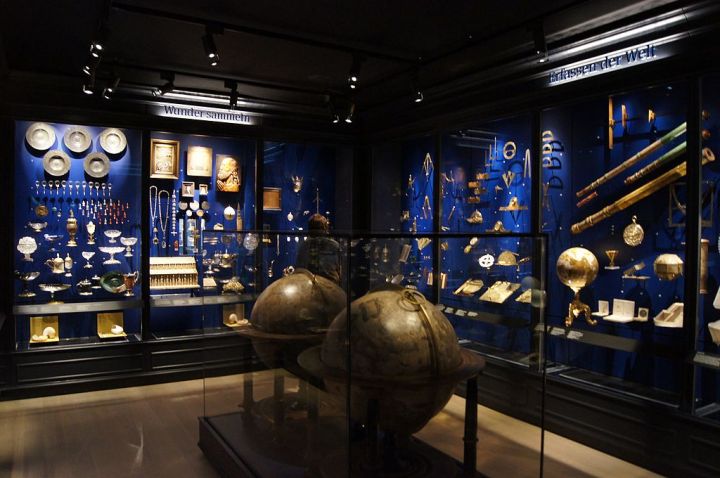
Kunstkammer, Landesmuseum Württemberg (Württemberg State Museum), Stuttgart (Photo by Bernd Gross, Wikimedia Commons, June 2016).
◊ ◊ ◊ ◊ ◊
From the workshop website:
Curating History Workshop
European University Institute, Florence, 10–13 October 201
Proposals due by 15 January 2017
Museums display objects constructed in historical complexity that cannot be explained by a single narrative. This complexity constitutes an obstacle for museum actors, who are assigned the task of providing an interpretation that can never embrace the entirety of the narratives contained in one object. Additionally, this difficulty expands when objects have to be placed in the narrative of permanent exhibitions, which present certain specific constraints.
Permanent exhibitions are at the core of the work of most museums. Even if ‘permanent’ does not mean eternal, these exhibitions are the public expression of the museum’s collections and mission. Thus, considering the limitations in both presenting the historical complexity of objects and taking into account the constraint of choosing a narrative for permanent exhibitions, we wish to look out for ways in which the museum can be turned into a place of convergence where curators, researchers, and audiences can think historically about objects. Are there new and old ways of curating history in permanent exhibitions? How is it possible to bring together museums, academia, and the public? In organising this workshop, we would like to offer a place for discussion where curators and scholars from a broad variety of institutions (museums, universities, research institutes, etc.) elaborate a joint reflection in both theoretical and practical terms, structured around four sessions: History, Responsibility, Mediation, and Communication (between Curators and Scholars).
Confirmed Speakers
Kim Sloan, The British Museum
Marta Lourenço, Museums of the University of Lisbon
Sébastien Soubiran, University of Strasbourg
The European University Institute, in Florence, the Global History & Culture Centre at the University of Warwick, and the CHAM – Centro de Humanidades, in Lisbon, in collaboration with the Victoria & Albert Museum and the Royal College of Art in London, welcome papers for the workshop Curating History, which will take place in Florence from the 10th to the 13th of October 2017. You are invited to send proposals (maximum of 250 words, in a PDF file, to curating.history@gmail.com) for a 4000-word paper of a case study or a theoretical discussion that fits one of the four sessions: History, Responsibility, Mediation, or Communication (between Curators and Scholars). The paper will be the basis for a 15-minute presentation at the workshop. Please ensure that you indicate your name, academic/professional affiliation, and which session you are writing your paper for (depending on the number of papers received, the organising committee may have to decide to allocate papers to a different session). Deadline for submitting abstracts is the 15th January 2017. Selection of abstracts will take place during the following two weeks. Once selected, participants will be invited to write their papers and submit them to the organising committee by the 1st September 2017. Papers will be made available so that participants can prepare for the discussion. The organising committee is applying for funding to help covering travel expenses or accommodation in Florence; at this stage, however, grants for participants cannot be guaranteed.
Email for abstract submission: curating.history@gmail.com
European University Institute
Charlotte Bellamy
Deborah Dubald
Bruno A. Martinho
CHAM – Centro de Humanidades
Carla Alferes Pinto
Sofia Lapa
Global History and Culture Centre, University of Warwick
Holly Winter
Josephine Tierney
V&A Museum / Royal College of Art
Matthew Wells
Call for Essays | A Worldwide Market for Old Masters
The editors assure me they’re keen to have submissions from the 1790s and early nineteenth century! –CH
A Worldwide Market for Old Masters between the Napoleonic Era and the Great Depression, edited by Susanna Avery-Quash and Barbara Pezzini (Oxford University Press).
Chapter proposals due by 1 February 2017
We are soliciting chapter abstracts for an edited collection with the provisional title A Worldwide Market for Old Masters between the Napoleonic Era and the Great Depression. The volume will be an edited collection of around 15 essays, each of 6000–7000 words (plus footnotes), with up to 5 illustrations. It is envisaged that the collection will be part of the Oxford University Press series on the History of Collecting, edited by Christina Anderson and Peter Stewart.
This project stems from a panel convened by Susanna Avery-Quash at the conference, Creating Markets: Collecting Art, which took place at Christie’s in July 2016, as part of Christie’s 250th anniversary celebrations. In the light of the positive feedback received at the conference, the editors have decided to broaden scope of the book to include historic studies about the Old Master market in Australia, Africa, and Australasia. Consequently, we are incorporating additional essays into the book, commissioning these through a call for papers. Authors who have already confirmed their participation are Julia Armstrong-Totten, Sarah Bakkali, Gail Feigenbaum, Christian Huemer, Agnès Penot, Veronique Powell, and Inge Reist.
As a result of the Napoleonic wars, vast numbers of Old Master paintings were released on to the market from public and private collections across mainland Europe. From the 1790s onwards, many ended up in London, which joined Paris as a leading centre of the art market. In the course of the 19th century the market for ‘old art’ expanded, in volume and geographically, witnessing a new worldwide distribution of Old Master paintings. This growth only diminished in the early 1930s, in the wake of the Great Depression.
The book aims to explore for the first time in a comprehensive way the worldwide movement of Old Master paintings by investigating some of the most significant agents, dealers, and commercial galleries who flourished during the period and their international networks. We are seeking for contributions that map analytically this expansion and explore the ways in which the pioneering practices of agents and dealers contributed to shape a changing market. We desire, in particular, contributions that make use of new archival resources.
In the light of new primary sources the essays in the book will address some aspects of the following questions: Why, when, and how did these dealers (or agents and galleries) come to specialise in selling Old Masters? What shaped their expertise and subsequent practice, and how did they operate and diversify? How did they make a name for themselves, and what, if anything, made them distinctive or innovative? What effect did they have on the art market and on patterns of collecting? How did the international trade contributed to the success (or demise) of their businesses? What was their relationship with established museums? How did they use other means—such as exhibitions, photographs, and advertisements—to promote their wares? Finally, what was their relationship with art historiography, art criticism, and with a changing art press?
We are seeking contributions from scholars of the Old Masters Market, 1800–1930 in its broadest sense, with a special interest in business history and/or attention to commercial international connections. The following topics are particularly desired:
• Germany, Italy, and other European countries
• Asian, African, and Australian countries
• Smaller dealers and alternative networks of circulation
• The firm of Duveen Brothers
Please send a 500-word abstract (excluding bibliography) with a title, a 150-word biography, and a short CV and contact info (for each author/co-author) to both Susanna.Avery-Quash@ng-london.org.uk and barbarartpezzini@gmail.com by 1 February 2017. Notification of decisions to follow by 1 March 2017.
Editors
Susanna Avery-Quash, Senior Research Curator in the History of Collecting, The National Gallery; and Barbara Pezzini, Editor and Index Editor, Visual Resources and The Burlington Magazine.
Call for Papers | Collecting Raphael
From H-ArtHist:
Collecting Raphael: Raffaello Sanzio da Urbino in the History of Collections
Bibliotheca Hertziana, Rome, 12–14 October 2017
Proposals due by 31 December 2016
In view of the forthcoming 500th anniversary celebration of Raphael’s death (Raffaello Sanzio da Urbino, Urbino 1483 – Rome 1520), an international conference to focus on the reception of Raphael and the history of collections will draw together scholars of collecting and history of taste with curators of the main collections of Raphael’s paintings and drawings in both Italy and abroad. The conference, organised by Sybille Ebert-Schifferer and Claudia La Malfa, will be held at the Bibliotheca Hertziana – Max-Planck-Institut für Kunstgeschichte, in Rome in October 2017.
Raphael’s works have enjoyed an uninterrupted fortuna in the history of collecting. His fame has fueled collectors’ passions for centuries, which in turn has contributed to his fortuna, never challenged through the changing cultural and artistic periods. His works were considered symbols of power by those popes, princes and nobles who owned them, eventually becoming the identity matrix of many important European museums in the 19th and 20th centuries. The aim of the conference is to explore the various mechanisms that have contributed to this phenomenon. Suggested topics include: the role of the great collectors of Raphael between the 16th and the 19th centuries, including the Gonzaga and Borghese families, Christina of Sweden, Charles I of England, Louis XIV of France, and the Kings of Spain; the function of antiquarians and art dealers, such as Daniel Nijs, Pierre Crozat, Pierre-Jean Mariette, and John Julius Angerstein, in the diffusion of Raphael’s works and copies in 17th- and 18th-century collections in Italy and abroad; the part played by figures like Filippo Baldinucci for the Uffizi, Everhard Jabach for the Louvre, and Sir Joshua Reynolds for collections in England; the influence of academies in the diffusion of the master’s oeuvre through collections of drawings and reproduction prints in the Age of the Grand Tour; the relationship between art historians and collectors, and the role of early biographers like Johann David Passavant, Bernard Berenson, Oskar Fischel, in the creation of the 19th- and 20th-century museums; the issue of connoisseurship from the 17th century on and the problem of originals, workshop productions, copies and fakes.
Please send an abstract of 250 words and a CV to c.lamalfa@aur.edu and to albl@biblhertz.it by December 31th 2016.
Doctoral Study Day | In Situ / Ex Situ
From H-ArtHist (25 November 2016). . .
In Situ / Ex Situ — The Art of Exhibiting Art: Relationships between Art and Architecture in Their Spatial Context / L’arte di esporre l’arte: relazioni nel contesto spaziale tra arte e architettura
Rome Art History Network (RAHN), 27–28 April 2017
Proposals due by 15 December 2016
The fifth international doctoral study day of the Rome Art History Network—organised in partnership with the University of Notre Dame Rome Global Gateway and the Sovrintendenza Capitolina ai Beni Culturali, Museo di Roma di Palazzo Braschi—proposes a theoretical and methodological reflection upon the relationships and strategies of installing art and architecture, both inside and outside their original spatial contexts. It is evident that the work of art always relate to the surrounding spaces. Indeed, the strategies and methods of exhibiting works in situ / ex situ are at the heart of contemporary art-historical debates. But how does the manipulation of the original spatial context alter the perception of a work of art, or the organic nature of an architectural system? How does a given layout highlight specific characteristics of an artwork? What new meanings does an object assume, following its contextual switch? Are traditional concepts of historiographical concepts still valid for current issues of museology or museography? Does an object’s de-contextualization potentially ‘save’ the art in critical cases, or does it always imply an alteration of its original meanings? The study day aims to encourage an interdisciplinary and cross-temporal debate on the issue of location and spatial relationship between the works of art and architecture and the reciprocal exchanges between these artistic domains.
Proposals may include, but are not limited to, topics about
• The role of spatial contexts in the display of and the relationship between the works of art
• How the alteration of spatial context affects of in situ / ex-situ works
• Relationships between art and architecture in the exhibitions/museographical or museological cases
• Gesamtkunstwerke, site-specific works of art, mise en scéne projects, or visual theme concepts
• Dispositio of a museum/architectural/urban system
The call for papers is open to art and architectural history graduate students of Italian and foreign academic institutions. We encourage candidates to submit 20-minute talks that, through case studies and theoretical observations, focus on the methodologies and key themes listed above. The study day (27–28 April 2017) will be held both in Italian and English, and we welcome submissions in both languages. The organization cannot cover any travel or residence costs. Proposals, in the form of an abstract (max. 400 words), should be sent, together with a short CV (max. one page), by 15 December 2016 to romearthistorynetwork@gmail.com.
Organized by
Alina Aggujaro (Bibliotheca Hertziana, Max Planck Institut for the History of Art / Sapienza, Università di Roma)
Dario Beccarini (Statens Museum for Kunst, Copenaghen / Università degli Studi di Roma ‘Tor Vergata’ )
Coordination by
Ariane Varela Braga (Coordinator Rome Art History Network / Universität Zürich)
Previous Editions
• Now or (n)ever — I tempi dell’opera: temi, teorie e metodi nella storia dell’arte (28–29 April 2016)
• Tra assenza e presenza: opere perdute e frammentarie (19–20 March 2015)
• Sopravvalutata, sacrosanta, scandalosa? La figura dell’artista nella storia dell’arte oggi (3–4 April 2014)
• La storia dell’arte tra scienza e dilettantismo: Metodi e percorsi (24 April 2012)
Call for Papers | Poor Taste
From H-ArtHist:
Poor Taste and the Exclusionary Mechanisms of Cultural Consumption
University of California Santa Barbara 42nd Annual Graduate Student Symposium
University of California Santa Barbara, 28 April 2017
Proposals due by 31 December 2016
“Taste classifies, and it classifies the classifier.”
–Pierre Bourdieu, Distinction
Cultural consumers are defined and classified by their taste. Through an evaluation of their choices and preferences, whether biologically or socially informed, taste functions as a mechanism of distinction and exclusion. Art and Architectural History has arguably been a cornerstone of this very tradition, disciplining bodies and senses in the formation of canons and cultural hierarchies. While taste is now widely accepted to be subjective and localized rather than universal, ideals of good taste and quality endure in both our disciplinary frameworks and institutional practices.
This symposium therefore aims to address the judgment of taste, and the agents and spaces involved in its creation and enforcement. We consider such questions as: Can terms like consumption, digestion, and indigestion provide useful metaphors or models for the processes by which cultural traditions and products are validated and/or dismissed? How has cultural consumption been designated as legitimate or alternatively illegitimate in various historical and cultural contexts? In the history of cultural consumption, how have poor taste and good taste proven to have both opposed and informed one another? We welcome proposals from emerging scholars of all disciplinary backgrounds whose work engages with the themes of the conference.
Topics of interest
• The performance of distinction
• Decolonization of taste
• The spaces and institutionalization of judgment
• The historical construction of (poor) taste
• Craft, camp, kitsch, and the popular aesthetic
• Cultural appropriation
• Studies of foods and foodways
We invite abstracts of 300 words or less and a 1-page CV to be sent to ucsb.haa.symposium@gmail.com by December 31, 2016. (Inclusion of working title and images encouraged). Conference presentations will be 20 minutes. All participants will be notified by early February.
Please feel free to contact conference organizers J.V. Decemvirale and Maggie Mansfield at ucsb.haa.symposium@gmail.com with any questions.
Call for Papers | Eighteenth-Century Research Seminar, Edinburgh
From the ECRS website:
Eighteenth-Century Research Seminars
Institute for Advanced Studies in the Humanities, Edinburgh, January–April 2017
Proposals due by 21 November 2016
 The Eighteenth-Century Research Seminar (ECRS) series invites proposals for twenty-minute papers from postgraduate and early-career researchers addressing any aspect of eighteenth-century history, culture, literature, education, art, music, geography, religion, science, and philosophy. The seminar series seeks to provide a regular inter-disciplinary forum for postgraduate and early-career researchers working on the eighteenth century to meet and discuss their research.
ECRS will take place at the Institute for Advanced Studies in the Humanities (IASH) in Edinburgh on a fortnightly basis from January to April 2017. Each seminar will consist of two papers, one from a University of Edinburgh-based researcher and one from a researcher based in another higher education institution, followed by a drinks reception. Non-University of Edinburgh speakers’ travel expenses will be reimbursed up to £100. Abstracts of up to 300 words along with a brief biography and institutional affiliation should be submitted in the body of an email to: edinburgh18thcentury@gmail.com. The closing date for submissions is Monday 21 November 2016.
ECRS is supported by the Eighteenth-Century and Enlightenment Studies Network (ECENS) of the University of Edinburgh.
Call for Papers | MAHS 2017, Cleveland
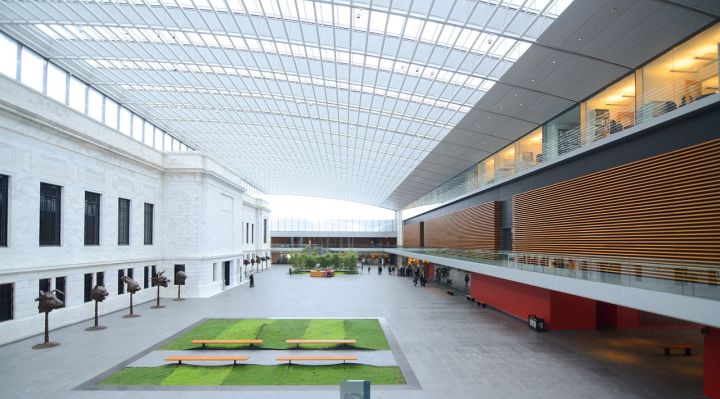
Atrium of the Cleveland Museum of Art
(Wikimedia Commons, photo by Erik Droist, January 2014)
◊ ◊ ◊ ◊ ◊
From the MAHS Fall 2016 Newsletter:
44th Annual Conference of the Midwest Art History Society
Cleveland, 6–8 April 2017
Proposals due by 16 December 2016
The Midwest Art History Society (MAHS) will hold its 44th annual conference in Cleveland, 6–8 April 2017, hosted by the Cleveland Museum of Art (CMA) and Case Western Reserve University (CWRU). Paper sessions and roundtables will be held at the Cleveland Museum of Art on April 6 and 7 and at the Allen Memorial Art Museum of Oberlin College on April 8. On April 6, a distinguished keynote panel will speak on Raphael’s School of Athens Cartoon, which is currently undergoing restoration in Milan. The panel will include Don Alberto Rocca, Director of the Pinacoteca Ambrosiana in Milan; Dr. Maurizio Michelozzi, the Florence-based paper conservator who is undertaking the restoration; and Dr. Carmen C. Bambach, Curator of Italian and Spanish Drawings at The Metropolitan Museum of Art in New York. Funding for the keynote panel has been provided by the Istituto Italiano di Cultura in Chicago, the Italian Art Society, the University of Notre Dame, the Friends of Art of CWRU, the Painting and Drawing Society of the Cleveland Museum of Art, and the Midwest Art History Society.
Cleveland and its surrounding metropolitan area have a rich arts scene, including world-class museums, vibrant galleries, and esteemed art historical resources. The Cleveland Museum of Art is renowned for the quality and breadth of its collection, which includes almost 45,000 objects and spans 6,000 years of achievement in the arts. The museum is a significant international forum for exhibitions, scholarship, performing arts and art education and recently completed an ambitious, multi-phase renovation and expansion project across its campus. One of the top comprehensive art museums in the nation and free of charge to all, the Cleveland Museum of Art is located in the dynamic University Circle neighborhood. Nearby in University Circle, Cleveland’s Museum of Contemporary Art (MOCA) plays an urgent and exciting role in the city’s cultural landscape. As a non-collecting institution and the region’s only contemporary art museum, MOCA is ever-changing, introducing new exhibitions three times a year and creating fresh experiences for visitors each season. The Cleveland History Center of the Western Reserve Historical Society houses exhibits that tell the story of Northeast Ohio through items, documents and artifacts from a variety of collections. Other cultural attractions in and around University Circle include CWRU’s Dittrick Medical History Center and Museum, the Cleveland Museum of Natural History, the Cleveland Botanical Garden, historic Lakeview Cemetery, Little Italy, and the world renowned Cleveland Orchestra housed in Severance Hall, a masterpiece of Art Deco design.
Combining a landmark historical building with a contemporary minimalist addition, the Transformer Station is a new anchor destination in Cleveland’s rapidly evolving Ohio City neighborhood. The project brings a new cultural facility to a mixed residential and industrial neighborhood within walking distance of the restaurants and shops of the Market District and blocks away from the Gordon Square Arts District. In downtown Cleveland, the Rock & Roll Hall of Fame’s mission is to engage, teach and inspire through the power of rock & roll. The Rock Hall is the world’s foremost museum devoted to the celebration and preservation of rock & roll music. Next door to the Rock Hall, visitors can explore science through hands-on exhibits at the Great Lakes Science Center. Cleveland is also home to Playhouse Square, the country’s largest performing arts center outside of New York City; a lively music scene; a vibrant culinary scene including the historic West Side Market and nationally recognized restaurants; the award- winning Cleveland Metroparks system; a fantastic zoo; and three professional sports teams.
Cleveland and its surrounds are home to distinguished academic departments of art history and college art museums. Next door to the CMA is CWRU, home to the joint program in Art History and Museum Studies. This innovative program offers master’s and doctoral degrees, preparing future academics and museum curators through an intensive object-based curriculum taught by CWRU art history professors in association with museum curators and staff. The program takes advantage of the CMA’s Ingalls Library, the third largest art library in the country. The Allen Memorial Art Museum (AMAM) at Oberlin College houses an encyclopedic collection of more than 14,000 works that provide a comprehensive overview of the history of art. Recognized as one of the best academic museums in the country, the AMAM works with faculty and students to promote direct study of original works of art and deepen appreciation for the diversity of the world’s cultures, while also serving a broad regional audience. The museum complex includes a 1917 building designed by Cass Gilbert, and a 1977 addition designed by Robert Venturi, the architect’s first museum commission. The AMAM also shares responsibility with Oberlin College for a Frank Lloyd Wright-designed house, the first Usonian house in Ohio, located in Oberlin. . .
We welcome your participation in the 2017 Midwest Art History Society Annual Conference held in Cleveland . . . In most cases, conference presentations will be expected to be under twenty minutes long. Proposals of no more than 250 words and a two-page CV should be emailed (preferably as Word documents) to the chairs of individual sessions by Friday, December 16, 2017.
The following is a selection of sessions potentially relevant for eighteenth-century studies; please see the newsletter for the full listing.
◊ ◊ ◊ ◊ ◊
The Art Market and Connoisseurship
Chair: Catherine Scallen, Case Western Reserve University, catherine.scallen@case.edu
In this session we will consider the entwined issues of the roles of art markets and of connoisseurship in the history of private and public collecting or in the historiography of art history. Papers are welcomed on any period and geographical region of art.
◊ ◊ ◊ ◊ ◊
Body and Soul: The Visual Arts and Medical Practice
Chair: Andrea Wolk Rager, Case Western Reserve University, andrea.rager@case.edu
This session invites papers that consider the complex relationship between the visual arts and the history of medical practice. The city of Cleveland has been hailed as a hub of bio-medical innovation, rendering this an ideal setting for exploring the revolutionary possibilities of interdisciplinary exchange between cutting-edge art history and medicine. This session will consider not only what lessons we can learn from the intertwined histories of medical practice and the arts, but also how art historical methodologies and critical strategies can inform the practice of healthcare professionals today. How can universities, museums, and medical institutions enrich and inform each other through the arts? Topics may include: the representation of mental and physical illness; the body as a site of knowledge and surveillance through the medical gaze; the socio-political uses of medical imagery; sexuality, pregnancy, and the representation of the female body; physical perception and the operation of cultural bias; the doctor as a figure of authority; trauma and representation; death and grieving through the arts; and the depiction of beauty, disease, and deformity. Papers are welcomed from art historians, museum professionals, and medical clinicians.
◊ ◊ ◊ ◊ ◊
Digital Art History
Chair: Anne Helmreich, Texas Christian University, a.helmreich@tcu.edu
The concept of digital art history has emerged over the past decade to describe an array of new approaches and practices in art history (in both academia and art museums) made possible by the rise of the internet and greater accessibility to computational resources. These include born-digital publications, new tools and techniques for the analysis of art objects and texts as well as building and investigating art and archival collections, and new scholarly interpretations that have resulted from such tools and techniques. It has been manifested by exemplary publications and projects as well as a robust and growing bibliography and has fostered new forms of collaboration across disciplines and institutions. Digital art history has also been an important impetus for open access within the discipline. This session seeks papers that illuminate exemplary projects as well as lessons learned; that is, speakers are expected to share with the audience the perspectives they have acquired through developing and implementing their projects in digital art history so that the session may result in a meaningful discussion of best practices that can be disseminated to the field.
◊ ◊ ◊ ◊ ◊
Is There an African Atlantic?
Chair: Matthew Francis Rarey, Oberlin College, mrarey@oberlin.edu
The Atlantic Ocean provides Africanist art historians a rich model of investigation and analysis. Connecting Africa to Europe and the Americas, the Atlantic maps the flows, circularities, and dislocations of African arts in and out of diaspora. But it also separates. In the hulls of slave ships, new worlds were both forged and lost, underscoring a separation that lives on as today even distinctly black Atlantic scholarship often includes little space for African ideas and worldviews. Responding to the inclusion of open panels dedicated separately to both African and African-American art, this thematic panel seeks contributions that take up African arts’ indeterminate space in the Atlantic world as both possibility and pitfall. Such case studies may include, but are not limited to, the role of African artworks in negotiating new identities and profound social changes wrought by the Atlantic world; the impact of diasporic arts on the African continent; African artistic responses to slavery and the slave trade; and efforts to re-center African epistemologies in diasporic contexts.
◊ ◊ ◊ ◊ ◊
Shifting Meaning: Recontextualizing Objects through Action
Chairs: Amy Sowder Koch, Towson University, akoch@towson.edu, and Susan Ludi Blevins, Washington University in St. Louis, blevins.susan@wustl.edu
This session will address the long afterlives of objects, which are by the very nature of their materiality often intended to survive their creators. With topics of reuse, recycling, appropriation, and conversion in mind, we invite papers that explore the multilayered aspects of meaning created through the physical interactions of people and objects in a variety of cultural contexts: public or private, civic or religious, ritual/ceremonial or mundane, elite or non-elite. Questions addressed might include: When objects and buildings are separated in time from their creators’ original intentions, how do their later uses fill out or complete—or perhaps simplify— these ‘degraded’ original meanings? What might the practice of materially altering an object from the past tell us about later understandings of its symbolic value? How might the physical accumulation of reused and recycled objects through repeated action transform understandings of not only the objects but also the spaces in which they are deposited or displayed? Submissions are welcome from all time periods and geographies that critically reflect on the nuanced ways in which intentional and unintentional interactions with objects from the past have the capacity to create and transform meaning in the present.
◊ ◊ ◊ ◊ ◊
Studio Practice, Research Practice
Chair: Cyra Levenson, The Cleveland Museum of Art, clevenson@clevelandart.org
This panel will explore the intersecting worlds of art making and research practice. Presentations might explore the work of contemporary artists who reference the art historical past; the pedagogical link between material study, observational experience, and research; and multi-sensory approaches to research and learning.
◊ ◊ ◊ ◊ ◊
The Teaching Museum: Best Practices and Future Development
Chairs: Liliana Milkova, Allen Memorial Art Museum, lmilkova@oberlin.edu, and Erik Inglis, Oberlin College, einglis@oberlin.edu
College and university art museums have grown significantly in the last twenty years. Many institutions have created new museums and/or museum studies programs, while established museums have re- visited their mission to deepen their educational contributions. For example, Oberlin College’s Allen Memorial Art Museum has pushed to integrate the Museum’s collection and resources into the College’s curriculum as a whole, and developed a rigorous docent training program that serves as a professional portal. For this roundtable, timed to the Allen’s centennial, we seek case- studies from faculty and museum professionals highlighting how museums contribute to a wide range of student learning. Such cases might include but are not limited to: empowering students as educators in docent programs; involving students in the curatorial process; collaborating with faculty on teaching exhibitions and curatorial projects (real or virtual); bringing STEM faculty and classes into the museum; and training and mentoring students for careers in museums, the arts, and education.
◊ ◊ ◊ ◊ ◊
Technical Art History: Evaluating the Progress of the Interdisciplinary Study of Works of Art
Chair: Maryan Ainsworth, The Metropolitan Museum of Art, Maryan.Ainsworth@metmuseum.org
The development over the last century of the technical examination of works of art has completely altered the ways in which we evaluate objects. Employing an increasingly wide range of analytical tools, researchers from the fields of academic art history, museum curatorship, conservation, and conservation science are demonstrating the value of working together in an interdisciplinary manner in a burgeoning field of study called technical art history. This session invites papers on recent research that addresses any aspect of the creation of or later adjustment to the work of art and that challenges accepted views or leads to a new understanding of an object’s place in history. Papers that demonstrate cooperation between individuals in di erent fields in a jointly-communicated paper will be most welcome.
◊ ◊ ◊ ◊ ◊
O P E N S E S S I O N S
Undergraduate Research
Chairs: Heidi Hornik, Baylor University, Heidi_Hornik@baylor. edu, and Paula Wisotzki, Loyola University Chicago, pwisots@luc.edu
African Art
Chair: Costa Petridis, Art Institute of Chicago, cpetridis@artic.edu
African-American Art
Chair: David Hart, Cleveland Institute of Art, dhart@cia.edu
American Art
Chair: Mark Pohlad, DePaul University, mpohlad@depaul.edu
Ancient Art
Chair: Michael Bennett, The Cleveland Museum of Art, mbennett@clevelandart.org
Art of the Americas
Chair: Caitlin Earley, Metropolitan Museum of Art, caitlin.earley@metmuseum.org
East Asian Art
Chair: Noelle Giuffrida, Case Western Reserve University, noelle.giuffrida@case.edu
Islamic Art
Chair: Emily Neumeier, The Ohio State University, neumeier.25@osu.edu
Latin American Art
Chair: Daniel Quiles, School of the Art Institute of Chicago, dquiles@saic.edu
Medieval Art
Chair: Marian Bleeke, Cleveland State University, m.bleeke@csuohio.edu
Modern and Contemporary Art
Chair: Matthew Levy, Penn State Erie, The Behrend College, mll33@psu.edu
Nineteenth-Century Art
Chair: Catherine Goebel, Augustana College, CatherineGoebel@augustana.edu
Photography
Chair: Andrea Wolk Rager, Case Western Reserve University, andrea.rager@case.edu
Recent Acquisitions in Midwestern Collections
Chair: Beau Rutland, The Cleveland Museum of Art, brutland@clevelandart.org
Renaissance and Baroque Art
Chair: Erin Benay, Case Western Reserve University, erin.benay@case.edu
South, Southeast Asian, and Himalayan Art
Chair: Kimberly Masteller, The Nelson-Atkins Museum of Art, kmasteller@nelson-atkins.org
Works on Paper
Chairs: Robert Randolf Coleman, University of Notre Dame, rcoleman@nd.edu, and Cheryl K. Snay, Snite Museum of Art, csnay@nd.edu
Call for Papers | Romantic Art in the Context of Philosophy and Science
From H-ArtHist:
Romantic Art in the Context of Natural Philosophy and Natural Science
Die Kunst der Romantik im Kontext von Naturphilosophie und Naturwissenschaft
Goethe Museum, Frankfurt am Main, 14–16 September 2017
Proposals due by 3 December 2016
“All art should become science and all science art,” declared Friedrich Schlegel in one of his many aphoristic fragments. As Schlegel envisioned, strengthened ties among art, philosophy, and natural science characterized the Romantic epoch. Literary salons in European artistic and intellectual centers, such as Dresden, facilitated the exchange of ideas and nurtured collaborations among intellectuals and artists that transgressed disciplinary boundaries.
In recent years, there has been substantial scholarly interest in how Romantic literature engaged with the scientific activities of its day. For example, the writings of Johann Wolfgang Goethe, Novalis, Jane Austen, William Blake, E. T. A. Hoffmann, Heinrich von Kleist, and Mary Shelley have all been linked to developments and concepts in the natural sciences. This attention to science and literature around 1800 is just beginning to prompt re-evaluations of related projects in the visual arts. In the 1990s, studies by Rebecca Bedell, Werner Busch, Charlotte Klonk, James Hamilton, Timothy Mitchell, and John Thornes brought the practice of Romantic landscape painting in proximity to natural science. These scholars proposed that new theories in optics, geology, botany, and meteorology to varying degrees inflected depictions of primordial mountain ranges, glaciers, vegetation, skies, and cyclical facets of nature by artists such as Carl Blechen, Caspar David Friedrich, Carl Gustav Carus, Joseph Anton Koch, Johan Christian Dahl, John Constable, J. M. W. Turner, and John Martin. However, in the German context especially, links between science and the visual arts remain contested. Caspar David Friedrich is an especially polarizing figure. With a few notable exceptions, most scholars continue to focus on the aesthetic, political, and, above all, religious dimensions of his practice, and locate his work outside of larger, European-wide trends in the visual arts.
This conference—a cooperation between the German Society for the Study of the Nineteenth Century and the Freies Deutsches Hochstift, where the German Museum of the Romantics will be established—considers anew the intersection between the visual arts (including, but not limited to landscape painting) and the natural sciences, as well as nature philosophy in the Romantic context across Europe. Papers are especially encouraged that explore how the nature philosophy of Friedrich Wilhelm Joseph Schelling or his contemporaries, such as Carl Gustav Carus, Gotthilf Heinrich Schubert, Lorenz Oken, Johann Wilhelm Ritter, and Frederik Christian Sibbern, influenced artists, informed their practices, and shaped art theory in the early nineteenth century. Please send abstracts (ca. 300 words) for 30-minute presentations, along with a curriculum vitae, to the conference chairs by December 3, 2016. Travel expenses and accommodations will be covered.
Gregor Wedekind
Johannes Gutenberg-Universität Mainz
Institut für Kunstgeschichte und Musikwissenschaft
Jakob-Welder-Weg 12
55128 Mainz
gregor.wedekind@uni-mainz.de
and
Nina Amstutz
Assistant Professor
History of Art and Architecture
Lawrence Hall 212
5229 University of Oregon
Eugene, OR 97403-5229 USA
namstutz@uoregon.edu
Call for Papers | European Court Culture and Greenwich Palace
From the CFP:
European Court Culture and Greenwich Palace, 1500–1750
National Maritime Museum and the Queen’s House, Greenwich, 20–22 April 2017
Proposals due by 1 December 2016
Royal Museums Greenwich and the Society for Court Studies are pleased to announce this call for papers, for a major international conference to mark the 400th anniversary year of the Queen’s House, Greenwich. Designed by Inigo Jones in 1616 and completed in 1639, this royal villa is an acknowledged masterpiece of British architecture and the only remaining building of the sixteenth and seventeenth-century palace complex. Today the Queen’s House lies at the centre of the World Heritage Site of Maritime Greenwich, which also includes the Royal Observatory and the Old Royal Naval College (previously Greenwich Hospital). The site as a whole is often celebrated as quintessentially ‘British’—historically, culturally and artistically. Yet the sequence of queens associated with the Queen’s House and Greenwich more generally reflect a wider orientation towards Europe—from Anne of Denmark, who commissioned the House, to Henrietta Maria of France, Catherine of Braganza and Mary of Modena—in addition to Greenwich’s transformation under the patronage of Tudor and Stuart monarchs. Located on the River Thames at the gateway to London and to England, royal residences at Greenwich served an important function in the early modern period as a cultural link with the continent, and in particular, with England’s nearest neighbours in the Low Countries and France. After major refurbishment, the Queen’s House reopens in October 2016 with new displays that focus on a number of important themes to historians of art, architecture and culture, and strong links to politics, diplomacy, war and royal and maritime culture.
Some of the themes that might be considered (but are not limited to) include
• Royal portraiture, in particular the representation of queens regnant and consorts
• ‘Princely magnificence’ and the design of royal spaces (such as the division between a King’s and Queen’s sides)
• Dynastic links between the houses of Stuart, Orange, Bourbon, Wittelsbach (Palatinate), and Portugal
• The history of Greenwich Palace as a royal residence and centre of power and culture
• The Queen’s House and Greenwich Palace situated in a wider royal and architectural context
• Connections between court life in Greenwich and the development of the navy (as represented by Thornhill’s allegorical paintings in the Painted Hall, and James, Duke of York, as Lord High Admiral, etc.)
• Fashions and artistic influences from overseas, notably Dutch, Flemish or French artists, architects and royal spaces (Inigo Jones, Orazio Gentileschi and James Thornhill), usage of allegory and mythology in royal/naval settings
• other areas patronized by the court, such as maritime exploration, scientific advances, prints, as represented by the Royal Observatory Greenwich
The conference will be held 20–22 April 2017 in the National Maritime Museum and the Queen’s House. Keynote speakers will include Dr Simon Thurley. We invite the submission of abstracts (300 to 400 words) for twenty-minute papers. The deadline for submissions is 1 December 2016. Please direct queries, if any, to Janet Dickinson: janet.dickinson@conted.ox.ac.uk and proposals and a brief biography to research@rmg.co.uk.
Conference Organisers
Janet Dickinson (University of Oxford), Christine Riding (Royal Museums Greenwich), and Jonathan Spangler (Manchester Metropolitan University)
Call for Papers | Trashed: Rejection and Recovery
From Boston University:
Trashed: Rejection and Recovery in the History of Art and Architecture
33rd Annual Boston University Graduate Symposium in the History of Art and Architecture
Boston University, 24–25 March 2017
Proposals due by 21 November 2016
What happens to the ideas and materials that end up in the scrap bin of history? While some projects are laid to waste, others are repurposed or reimagined. The 33rd Annual Boston University Graduate Symposium in the History of Art and Architecture invites submissions that explore themes of dispensability and resourcefulness.
Possible subjects include, but are not limited to, the following: spolia; creative use of recycled materials; deletions and deaccessioned objects; abandoned or reclaimed architectural spaces; drafts, drawings, or models for unrealized works; and the impact of unfavorable reception, as dictated by time, place, or audience. We welcome submissions from graduate students at all stages of their studies, working in any area or discipline.
Papers must be original and previously unpublished. Please send an abstract (300 words or less), a paper title, and a CV to bugraduatesymposiumhaa@gmail.com. The deadline for submissions is Monday, November 21, 2016. Selected speakers will be notified before January 1, 2017 and are expected to accept or decline the offer within a week of notification. Papers should be 20 minutes in length and will be followed by a question and answer session.
The Symposium will be held Friday, March 24 – Saturday, March 25, 2017, with a keynote lecture (TBD) on Friday evening at the Boston University Art Gallery at the Stone Gallery and graduate presentations on Saturday in the Riley Seminar Room of the Museum of Fine Arts, Boston.
This event is generously sponsored by The Boston University Center for the Humanities; the Boston University Department of History of Art & Architecture; the Museum of Fine Arts, Boston; the Boston University Graduate Student History of Art & Architecture Association; and the Boston University Art Gallery at the Stone Gallery.










leave a comment