French Drawings in D.C.
It’s shaping up to be quite an autumn for French drawing exhibitions in the United States. In addition to the shows at the Getty, the Frick, and the Morgan, the National Gallery presents a sampling from its permanent collection. As noted in a press release from the museum’s website:
Renaissance to Revolution: French Drawings from the National Gallery of Art, 1500–1800
National Gallery, Washington D.C., 1 October 2009 — 31 January 2010

Margaret Grasselli, ISBN 978-1848220430
Some 135 of the most significant and beautiful drawings made over a period of three centuries by the best French artists working at home and abroad and by foreign artists working in France will be on view in Renaissance to Revolution: French Drawings from the National Gallery of Art, 1500–1800 in the Gallery’s West Building from October 1, 2009, through January 31, 2010. This is the first comprehensive exhibition and catalogue to focus on the Gallery’s permanent collection of French old master drawings, which is remarkable for its breadth, depth, and individual masterpieces. “One of the true glories of the National Gallery of Art’s holdings of graphic art is its outstanding collection of French old master drawings,” said Earl Powell, director, National Gallery of Art. “The exhibition Renaissance to Revolution and the accompanying catalogue celebrate the singular originality, elegance, and spirit of French draftsmanship.”

Antoine Coypel, "Seated Faun," 1700/1705, red and black chalk heightened with white chalk on blue paper, 16 x 11 inches (DC: NGA)
Among the National Gallery of Art’s extensive holdings of approximately 100,000 works on paper, the collection of 6,000 European drawings includes more than 900 French old master drawings which stand out as a particular treasure. The French group has deep roots in the earliest days of the museum’s existence, with the first of these works arriving in 1942, just a year after the Gallery opened its doors to the public. Over the next 67 years, thanks to the generosity of innumerable donors, the collection has evolved into one the Gallery’s strongest and most comprehensive, and one of the finest in the Western Hemisphere.
Organized chronologically, Renaissance to Revolution presents a visual journey through the development of drawing in France, from its first flowering during the Renaissance through its neoclassical incarnation during the political and social upheavals of the French Revolution at the end of the eighteenth century. Lorrain, and Antoine Watteau, as well as many less well-known artists. All major stylistic trends and many of the greatest and best-known artists from these centuries are represented by a rich array of works executed in a variety of styles and media and covering a wide range of functions, subjects, and genres. . . .

François-André Vincent, "The Drawing Lesson," 1777, brush and brown wash over graphite, 13 x 15 inches (DC: NGA)
Within the exceptionally rich collection of eighteenth-century drawings, the major artists—Boucher, Fragonard, Jean-Baptiste Greuze, Gabriel de Saint-Aubin, Hubert Robert, and Watteau, among others—are each represented by several works of outstanding quality. Some magnificent pieces by less familiar masters are featured as well, including François-André Vincent’s Drawing Lesson (1777), arguably the most perfect representation of eighteenth-century French elegance, taste, and gallantry; Étienne-Louis Boullée’s monumental neoclassical design for a metropolitan church from 1780/1781; and a large and beautiful pastoral scene executed in pastel and gouache, Shepherds Resting by a Stream (1779) by Jean-Baptiste Pillement. Also noteworthy is a striking group of portraits by several of the leading pastellists of the period, including outstanding examples by Maurice-Quentin de La Tour and Jean-Baptiste Perronneau, as well as a particularly dashing portrait of a young woman by Adélaïde Labille-Guiard from 1787. One of the youngest drawings in the exhibition is the neoclassical portrait Thirius de Pautrizel (1795) by David, an active participant in the revolution, made when he was imprisoned for his radical politics.
A particular strength within the Gallery’s collection of French drawings is the genre of book illustration. This is represented throughout the exhibition beginning with the work by Poyet and includes distinctive pieces by such famous masters as Boucher, Fragonard, Jean-Michel Moreau the Younger, and Saint-Aubin, as well as outstanding examples by other supremely gifted but less widely known artists, such as Hubert-François Gravelot and Charles Eisen.
Margaret Morgan Grasselli, curator of old master drawings, National Gallery of Art, is curator of the exhibition. Published by the National Gallery of Art in association with Lund Humphries, Renaissance to Revolution: French Drawings from the National Gallery of Art, 1500-1800 features an introductory essay and comprehensive entries on the exhibited drawings with 260 full-color illustrations.
On Sunday, 13 December 2009, at 2pm, Grasselli will deliver the lecture Playing Favorites: A Personal Selection of French Drawings from the National Gallery of Art and sign copies of the catalogue.
Drawings from the Frits Lugt Collection at the Frick
From the Frick’s website:
Watteau to Degas: French Drawings from the Frits Lugt Collection
Frick Collection, New York, 6 October 2009 – 10 January 2010
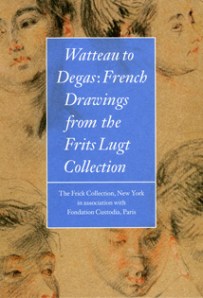
Colin Bailey, Susan Grace Galassi, Mària van Berge-Gerbaud, $60
Frederik Johannes Lugt (1884–1970) was a Dutch art historian, connoisseur, and collector. His fame in scholarly circles derives from two pioneering publications, still in use today: his Les marques de collections de dessins et d’estampes, published in 1921, which identifies the collectors’ marks found on Old Master prints and drawings, and the Répertoire des catalogues de ventes publiques intéressant l’art ou la curiosité, a comprehensive listing of nearly 90,000 auction catalogues from sales occurring between 1600 and 1925, published in four volumes between 1938 and 1987.
Frits Lugt, as he was known, was a born collector. By the age of eight, he had sold his shell collection to the natural history department of Amsterdam’s Royal Zoo; at fifteen, he acquired his first drawing. In his thirties, he began to collect in a more serious and systematic way, specializing in Dutch and Flemish drawings and prints, always his chief interest. During the 1920s, the decade in which he made his most important acquisitions, he also bought fifteenth-century Italian drawings and eighteenth-century French sheets.
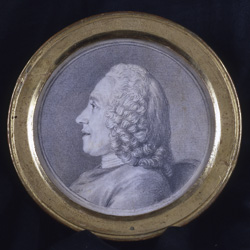
Charles-Nicolas Cochin, "Portrait of Pierre-Jean Mariette," Graphite with stumping, 1756
Lugt was among the founders and principal supporters of the Rijksbureau voor Kunsthistorische Documentatie (RKD), the institute devoted to the study of Netherlandish art and artists, established in The Hague in 1930. In 1947, he created the Fondation Custodia in Paris, to care for and to add to his collection of 6,000 Old Master drawings and 30,000 prints. The Frits Lugt Collection is widely regarded by specialists as one of the finest of its kind, but it is less well known to the general public.
Curators at The Frick Collection were invited to select for the exhibition and its accompanying catalogue Lugt’s finest eighteenth- and nineteenth-century French drawings, and the sixty-four works featured in the exhibition illuminate both Lugt’s taste and that of his successors. Included are drawings and watercolors by well-known masters of the French School such as Watteau, Boucher, Fragonard, David, Ingres, and Degas, as well as by important figures who are less familiar to the general public. This is the first time that a group of French master drawings from the Fondation Custodia has traveled to New York.
◊ ◊ ◊ ◊ ◊
Stijn Alsteens (Metropolitan Museum of Art, NY), Frits Lugt: Connoisseur and Collector of Drawings
Wednesday, 18 November 2009, 6pm
Colin Bailey (Frick Collection), Eighteenth-Century French Drawings from The Frits Lugt Collection
Saturday, 9 January 2010, 2pm
◊ ◊ ◊ ◊ ◊
The show’s illustrated checklist (available here) includes more than thirty eighteenth-century drawings. The Frick’s website also includes podcasts on the exhibition by Colin Bailey and Susan Galassi.
A Dutch Collection in New York
Dutch New York between East and West: The World of Margrieta van Varick
Bard Graduate Center, New York, 18 September 2009 — 3 January 2010
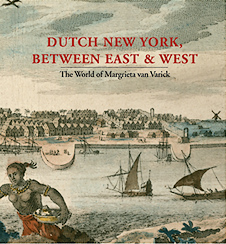
Edited by Deborah Krohn and Peter Miller with Marybeth De Filippis, $75
This autumn the Bard Graduate Center will participate in a state-wide celebration of the 400th anniversary of Henry Hudson’s voyage and the legacy of Dutch culture in New York with a landmark exhibition, Dutch New York Between East and West: The World of Margrieta van Varick. Organized by the BGC and the New-York Historical Society and curated by Marybeth De Filippis and Deborah Krohn, Dutch New York will make a major contribution to the quadricentennial and to the scholarship of colonial New York by focusing on the life and times of a woman who during the seventeenth century lived in the rural village of Flatbush on eastern Long Island, a neighborhood still known by that name in the borough of Brooklyn today. The exhibition helps elucidate what the historian Russell Shorto has called the “forgotten colony” in his book The Island at the Center of the World. Indeed, the British roots of New York City are recognized far more widely than the Dutch, despite the city’s visible connections to the Dutch founders, most evident in street names such as Amsterdam Avenue and Varick Street.

Covered Bowl from Batavia (present-day Jakarta, Indonesia), early 18th century, silver (Gemeentemuseum, The Hague)
Dutch New York offers an innovative approach to exhibition practice by using the probate inventory of Margrieta van Varick’s possessions compiled in 1696 as a means of examining life and culture in colonial New York. Born in Amsterdam in 1649, Margrieta spent several years at the other end of the Dutch colonial world in the Far East, primarily in Malacca (present day Malaysia) before returning to The Netherlands with her minister husband Rudolphus. In 1686 Margrieta and her family crossed the Atlantic to settle in Flatbush where Rudolphus was minister of the Dutch Reform Church and where she opened a textile shop, having brought with them an astonishing array of Eastern and European goods.
This exhibition is organized in five sections, each delineating a theme relevant to Margrieta van Varick’s life as well as exploring the wide range of goods in her possession when she died in late 1695. The exhibition first examines the inventory as a document of historical research and curatorial practice. A digital film (also available online) features an interview with renowned historian Natalie Zemon Davis in which she considers the various challenges confronting historians who use inventories for research purposes, as well as the role of women in the seventeenth century.
For the full description of the exhibition, click here»
◊ ◊ ◊ ◊ ◊
Lecture — Inventory: Text and Context, Bernard Herman
Thursday, 19 November 2009, 6-8 pm ($25 / $17)
RSVP required to 212.501.3011, programs@bgc.bard.edu
What can an inventory tell us? How can we use an artifact of the legal system to tease out relationships between people and their relationship to things? How does such a document translate into an exhibition? Bernard Herman, a leading scholar of American material culture, will draw on his vast knowledge of both things and people in a conversation with cultural historian Catherine Whalen and exhibition co-curator Deborah Krohn. The conversation will be followed by an exhibition viewing and reception. Bernard Herman is Edward F. and Elizabeth Goodman Rosenberg Professor of Art History, University of Delaware. Deborah Krohn is associate professor and coordinator for history and theory of museums at the Bard Graduate Center as well as co-curator of the Dutch New York exhibition. Catherine Whalen is assistant professor at the Bard Graduate Center.
◊ ◊ ◊ ◊ ◊
Study Day — Reflecting on Silver: Manufacture, Markets, and Meaning in Early New York
Friday, 20 November 2009 ($125 / $100 discount)
RSVP required to 212.501.3011, programs@bgc.bard.edu
This study day will focus on silver in New York in the late seventeenth and early eighteenth centuries, as an object signifying wealth, cultivation, and mastery. Concentrating on works by silversmiths Benjamin Wynkoop, Cornelius Kierstede, and Peter Van Dyck, curators Marybeth De Filippis, Beth Carver Wees, and Debra Schmidt Bach will consider aspects of stylistic influence, marketing of silver, and workshop practices. A visit to the studio of master silversmith Ubaldo Ubaldo “>Ubaldo “>Vitali in Maplewood, New Jersey, will provide an examination of the technical knowledge and cultural influences surrounding the production of silver through the centuries. Admission to the study day includes lunch and round-trip transportation to the Ubaldo Vitale studio. Marybeth De Filippis is assistant curator of American art at the New-York Historical Society as well as co-curator of the Dutch New York exhibition. Beth Carver Wees is curator in the Department of American Decorative Arts at the Metropolitan Museum of Art. Debra Schmidt Bach is assistant curator of decorative arts at the New-York Historical Society and a PhD candidate at the BGC. Ubaldo Vitali is a fourth-generation Roman silversmith, conservator, and art historian.
◊ ◊ ◊ ◊ ◊
A helpful article about the exhibition written by Marybeth De Filippis appears in the September issue of The Magazine Antiques.
Strawberry Hill
The Walpole show at the YCBA opened yesterday in New Haven with a lecture by Michael Snodin (Senior Research Fellow at the V&A). From the museum’s website:
Horace Walpole’s Strawberry Hill
Yale Center for British Art, New Haven, 15 October 2009 — 3 January 2010
Victoria & Albert Museum, London, 6 March — 4 July 2010

Ed. by Michael Snodin (Yale University Press), $85
Horace Walpole (1717–1797) was the youngest son of Robert Walpole, first earl of Orford and prime minister under both George I and George II. Horace’s birthright placed him at the center of society and politics, and of literary, aesthetic, and intellectual circles. His brilliant letters and other writings have made him the best-known commentator on social, political, and cultural life in eighteenth-century England. In his own day, he was most famous for his personal collections, which were displayed at Strawberry Hill, his pioneering Gothic-revival house on the banks of the Thames at Twickenham, outside London, and through which he constructed narratives of English art and history.
This groundbreaking exhibition seeks to evoke the breadth and importance of Walpole’s collections at Strawberry Hill by reassembling an astonishing variety of his objects, including rare books and manuscripts, antiquities, paintings, prints and drawings, furniture, ceramics, arms and armor, and curiosities. These will be drawn frominternational public and private collections as well as those of the Center and Yale’s Lewis Walpole Library in Farmington, Connecticut.
Horace Walpole’s Strawberry Hill has been organized by the Center, The Lewis Walpole Library, and the Victoria and Albert Museum. The exhibition will be accompanied by a fully illustrated catalogue with contributions by an array of distinguished international scholars. The Center is the only U.S. venue. The exhibition has been generously supported by the Samuel H. Kress Foundation and the Andrew W. Mellon Foundation.
◊ ◊ ◊ ◊ ◊
Michael Snodin, Discovering Strawberry Hill
Wednesday, 14 October, 5:30pm
Peter Inskip, Revealing Strawberry Hill House
Tuesday, 20 October, 5:30pm
Cynthia Roman, Works of Genius: Amateur Artists at Strawberry Hill
Wednesday, 11 November, 5:30pm
Recapping the Récamier Exhibition and Colloquium in Lyon
By HEATHER BELNAP JENSEN
Juliette Récamier, muse et mécène
Musée des Beaux-Arts de Lyon, 27 March – 29 June 2009
Colloquium: Historiennes et critiques d’art à l’époque de Juliette Récamier, international colloquium organised by the Institut national d’histoire de l’art, Musée des Beaux-Arts, Lyon, 26 June 2009
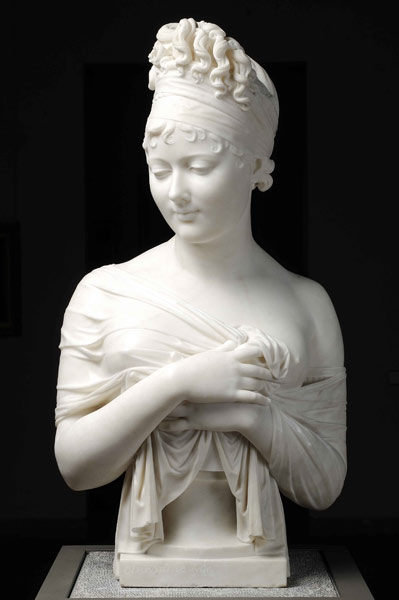
J. Chinard, "Portrait of Juliette Récamier," 1805-06 (Lyon: Musée de Beaux-Arts)
Juliette Récamier: Muse et mécène, recently mounted by the Musée de Beaux-Arts in Lyon, was surely one of the highlights of this past summer’s exhibition season. Thoughtfully conceived and beautifully executed, this show did much to restore Récamier to her rightful place as a key arbiter of taste in post-Revolutionary France. Upon entering the foyer, one was immediately transported to the refined and graceful realm of this cultural luminary. Art, fashion, and furnishings were disposed so as to emphasize her various powers. This exhibition compellingly argued that Récamier not only inspired some of the most enchanting art of the period (one thinks immediately of the portraits of this figure by Jacques-Louis David and François Gérard—neither of which were able to travel, unfortunately), but that she also figured as a formidable patron of the arts. The most exquisite space in this show was the re-creation of Récamier’s salon, as detailed in François Louis Dejuinne’s painting of 1826. To see in conversation some of the most iconic paintings of the age, including Anne-Louis Girodet’s Portrait of Chateaubriand, Elisabeth Vigée-Lebrun’s Portrait of Mme de Staël as Corinne, and Gérard’s Corinne at Cape Miseno, was a truly captivating experience. Attesting to the enduring interest in the figure of Recamier was the 1928 film of Gaston Ravel that played in an adjacent room, along with the twentieth-century works by René Magritte that paid homage to ‘la dame au sofa’. The accompanying catalogue (available here via Amazon.ca) was as exquisitely crafted as the exhibition, with contributions by the curator, Stéphane Paccoud, as well as other notable French and American scholars including Laura Auricchio. The essays attest to the complexities of Récamier’s roles as muse and patron and point to the need to reconsider conventional characterizations of such well-positioned women in the fashioning of artistic sensibilities. In sum, I must concur with Didier Rykner’s assessment of the exhibition made in La Tribune de l’Art: it did indeed approach perfection.

Robert Smirke, "Chambre de Juliette Récamier,” 1802 (London: Royal Institute of British Architects Library)
In conjunction with the exhibition, Historiennes et critiques d’art à l’époque de Juliette Récamier, a colloquium dedicated to the women writing about the arts in France, c. 1800, was held on June 26 in Lyon. This international colloquium was sponsored by the Institut national d’histoire de l’art and convened by Mechthild Fend (University College, London), Melissa Hyde (University of Florida), Anne Lafont (INHA), and Stéphane Paccoud (MBA-Lyon). Many of the presenters discussed the place of individual figures in the construction of the post-Revolutionary art world. American scholars were well represented. Mary Sheriff (University of North Carolina) argued for Vigée-Lebrun’s position as an art historian and addressed her Souvenirs as a critical historical enterprise. Susan Siegfried (University of Michigan) gave careful consideration to the role of la presse féminine in the formation of female subjectivity, and Sarah Betzer (University of Virginia) engaged Marie d’Agoult’s critical work. In my own paper, I discussed the significance of Julie Candeille’s activities as critic and agent in the career of Anne-Louis Girodet. That no one treated the contributions made to art writing by the uncontested doyenne of the era, Germaine de Staël, was much commented upon. The lively discussion that ensued after the presentations testified to the need for a continued dialogue regarding women as art historians and critics at this historical juncture. There are plans to publish the proceedings.
Heather Belnap Jensen received her Ph.D. in 2007 from the University of Kansas. She is currently assistant professor of art history at Brigham Young University. For more information about her recent scholarly activities, click here». Images are drawn from the exhibition website; other HECAA members who participated in the exhibition or colloquium are indicated with bold type.
Tiepolo in Motion at the Kimbell
Director Philip Haas (Angels & Insects, Blood Oranges, and Up at the Villa) partnered with the Kimbell for the current series of installations. From the Kimbell’s website:
Butchers, Dragons, Gods, & Skeletons: Film Installations by Philip Haas Inspired by the Works in the Collection
Kimbell Art Museum, Fort Worth, TX, 18 July – 25 October 2009
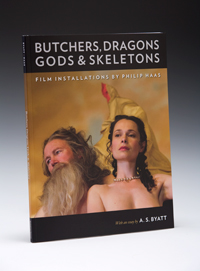
"Butchers, Dragons, Gods & Skeletons: Film Installations by Philip Haas" with an essay by A. S. Byatt, $24.95
Commissioned by the Kimbell, Philip Haas’s film installations interpret and elaborate upon selected works in the Museum’s permanent collection:
- Douris, Red-Figure Cup Showing the Death of Pentheus (exterior) and a Maenad (interior), ca. 480 BCE
- Arhat Taming the Dragon, Yuan dynasty, early fourteenth century
- Annibale Carracci, The Butcher’s Shop, 1580s
- Giovanni Battista Tiepolo, Apollo and the Continents, ca. 1739
- James Ensor, Skeletons Warming Themselves, 1889.
Though based on deep research into the original artists and cultures, Haas’s films are poetic and sensuous in approach rather than factual like a documentary. Between seven and twenty minutes in length and running continuously, they are projected on screens of various unconventional formats and configurations. All are accompanied by original music, and several appear in elaborate architectural and sculptural sets, further immersing the viewer in the experience. The installations complement a full display of the Kimbell’s permanent collection, each occupying a space near the work to which it relates.

 Giovanni Battista Tiepolo’s Apollo and the Continents is probably a sketch for a large fresco ceiling at the Palazzo Clerici in Milan; the ceiling was commissioned by Antonio Giorgio Clerici to celebrate his impending marriage. In the most elaborate and technically challenging of his installations, Haas combines filmed images projected on both walls and ceiling with real architectural elements, responding in his own terms to the spectacular, playful illusionism of a Tiepolo ceiling: “My intention has been to create the film installation as if it were designed and directed by Tiepolo himself, translating painterly trompe-l’oeil into cinematic visual effect.” On one of the walls we see Tiepolo with a young assistant in the studio. Occasionally he looks across to other walls, where models are posing for him.
 The models are played by the actresses Anna Walton — as a reclining Venus — and Rachael Stirling. Above, we see classical figure groups come to life as Tiepolo has visions, piece by piece, of a grand ceiling decoration in splendidly theatrical style. It is an assembly of the divinely beautiful, the strong, and the statuesque: Venus and Mars, Jupiter and Hebe, Juno, Ceres, river gods, and a host of numerous personages from classical myth and allegory. Finally Apollo the sun god appears, hovering in the center of the whole, breathtaking ensemble that has come together over our heads. Meanwhile Tiepolo has been working on a portrait of a betrothed couple. The climax of the piece is an apotheosis in which, through the power of the artist’s imagination, the couple become classical figures themselves and ascend into the heavens.
◊ ◊ ◊ ◊ ◊
The Butcher’s Shop appeared at the Sonnabend Gallery in New York in 2008.
A six-minute video clip with Malcolm Warner and Philip Haas summarizing the project is available via YouTube (posted by WRR101FM). It supplies a useful sense of the project, though it, unfortunately, doesn’t address the Tiepolo installation.
N.B. — One of the models for Apollo and the Continents, the actor Rachael Stirling — perhaps best known for her role in Tipping the Velvet — holds, incidentally, a B.A. in art history from the University of Edinburgh. Proof of the utility of the major for undergraduates? Comments are especially welcome from anyone who’s seen the installation at the Kimbell.
Delany Exhibition Is Here!
The highly anticipated Delany show opened earlier this week. Mark Laird (Harvard University) kicked things off on Wednesday with a talk on Delany as “A Lady of Singular Ingenuity.” Alicia Weisberg-Roberts will speak on October 7 (see below for programming details). The following description is drawn from the press release from the Yale Center for British Art:
◊ ◊ ◊ ◊ ◊
Mary Delany: Mrs. Delany and Her Circle
Yale Center for British Art, New Haven, 24 September 2009 — 3 January 2010
Sir John Soane’s Museum, London, 19 February — 1 May 2010
Curated by Alicia Weisberg-Roberts and Mark Laird
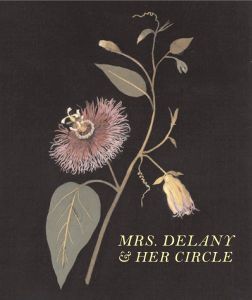
Mark Laird and Alicia Weisberg-Roberts (New Haven: Yale University Press, 2009), 416 pages, ISBN-10: 030014279X
At the age of seventy-two, Mary Delany, née Mary Granville (1700–1788), a botanical artist, woman of fashion, and commentator on life and society in eighteenth-century England and Ireland, embarked on a series of one thousand botanical collages, or “paper mosaics.” These were the crowning achievement of a life defined by creative accomplishment. The delicate hand-cut floral designs, made by a method of Mrs. Delany’s own invention, rival the finest botanical works of her time.
An ambitious exhibition, Mrs. Delany and her Circle, at the Yale Center for British Art, is the first to survey the full range of Mary Delany’s creative endeavors, revealing the complexity of her engagement with natural science, art, and design. Her prolific craft activities served to cement bonds of friendship and allowed her to negotiate the interlinked artistic, aristocratic, and scientific networks that defined her social world. A range of approximately 130 objects, including drawings, collages, embroidered textiles, shells, botanical specimens, and manuscripts related to her interest in landscape gardening, will reflect the variety of her activities. The exhibition will also feature a floral display inspired by Mrs. Delany’s designs, as well as a site-specific installation by London-based artist Jane Wildgoose.

Mrs. Delany’s tools from needlework pocket-book, given by Queen Charlotte to Mrs. Delany, 1781, satin, colored silks, and enamelled gold (The Royal Collection)
While Mrs. Delany is best known for her botanical collages, she created bold new garden designs, decorated her home and garden with shell decoupage, fashioned paper silhouettes, and was an accomplished embroiderer who produced elaborate designs for dresses and furnishings. The exhibition will reunite a significant number of Mrs. Delany’s textiles. Among her most extraordinary designs was a court dress embroidered with a cascade of naturalistic flowers on black satin, ca. 1739–40. This garment was disassembled and preserved by Mrs. Delany’s heirs and represents a marriage of art and nature that vividly foreshadows her later accomplishments. Pieces of the dress, reunited here for the first time, will be accompanied by didactic material that allows visitors to understand the garment as a whole and explains the equally interesting story of its survival. Also on view will be embroideries by Mrs. Delany and her circle that demonstrate the importance of the art of the needle to eighteenth-century female society.
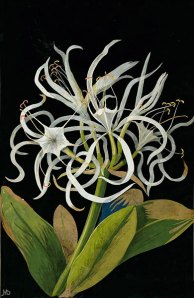
Mary Delany, Pancratium maritinum, 1778, collage of colored papers, with bodycolor and watercolor on black ink background, British Museum, Department of Prints and Drawings, © Trustees of the British Museum
The exhibition will show thirty of Mrs. Delany’s “paper mosaics,” generously lent by the British Museum, which houses nearly one thousand of her works. Unlike most botanical illustrations, these collages were created from hundreds of tiny pieces of cut paper. Horace Walpole called them “precision and truth unparalleled,” and Sir Joshua Reynolds admired their “perfection and outline, delicacy of cutting, accuracy of shading and perspective, and harmony and brilliance of color” (Ruth Hayden, Mrs. Delany: Her Life and Her Flowers, London: British Museum Press 2000).
Through comparison with the works of her contemporaries the exhibition will explore the context of Mrs. Delany’s striking collages and the relationship between her close attention to the natural world and the visual culture of natural history. Mrs. Delany and her Circle will feature works by professional botanical artists, including Georg Dionysius Ehret and Barbara Regina Dietzsch, as well as amateur botanical artists such as Mary Capel Forbes. Also on view will be objects representing the wider world of eighteenth-century collecting and classifying, ranging from mineralogy to conchology. Through drawings, maps, and topographical paintings, the exhibition will evoke the design and experience of gardens Mrs. Delany knew well, including those at Kew and Bulstrode, the remarkable estate of Margaret Cavendish Holles Harley Bentinck, Duchess of Portland (1715–1785), with whom Mrs. Delany lived and worked. The Duchess was one of the most important collectors of naturalia of the eighteenth century. Their friendship was one of the defining relationships of Mary Delany’s life.
Mrs. Delany and her Circle has been organized by the Yale Center for British Art and Sir John Soane’s Museum, London (where it will be on display from 18 February — 1 May 2010). The curators are Alicia Weisberg-Roberts, Assistant Curator of 18th- and 19th-Century Art, Walters Art Museum, and Mark Laird, Senior Lecturer, Department of Landscape Architecture, Harvard Graduate School of Design. Elisabeth Fairman, Senior Curator of Rare Books and Manuscripts at the Center, has served as the organizing curator for Jane Wildgoose’s installation, Promiscuous Assemblage. New Haven is the only North American venue for the exhibition.
◊ ◊ ◊ ◊ ◊
Tuesday, September 29, 12:30 pm
Mary Delany: A Woman Begins Her Life’s Work at the Age of 72
A thirty-minute gallery talk led by Molly Peacock, poet and non-fiction author.
Wednesday, September 30, 5:30 pm
Musical Tastes in Eighteenth-Century London as Seen by Mrs. Mary Delany, Horace Walpole, and Their Friends
Lecture and performance by Nicholas McGegan, renowned baroque music specialist and conductor.
Tuesday, October 6, 12:30 pm
Mrs. Delany’s Flowers: Entrance
A thirty-minute gallery talk led by Jason Siebenmorgen, landscape architect
Wednesday, October 7, 5:30 pm
‘She who bless’d the friend and grac’d the page’: Friendship and Self-fashioning in Mrs. Delany’s Circle
Lecture by Alicia Weisberg-Roberts, Assistant Curator of Eighteenth- and Nineteenth- Century Art, The Walters Art Museum
Painted Saints from New Mexico
From ArtDaily.org, 4 July 2009:
A Century of Retablos: The Janis and Dennis Lyon Collection of New Mexican Santos, 1780–1880
Josyln Art Museum, Omaha, NE, 5 July 5 — 4 October 2009
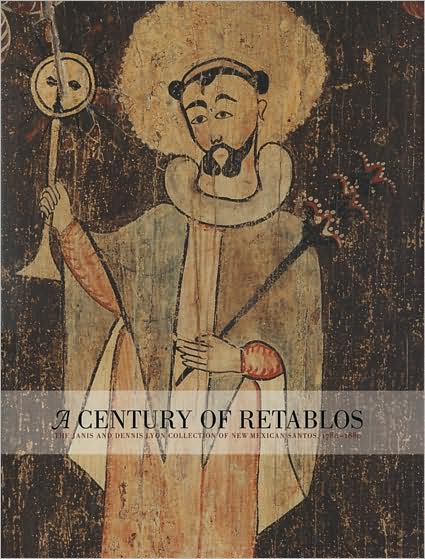
Catalogue by Charles Carrillo and Thomas Steele (Hudson Hills, 2007), $60, ISBN:978-1555952730
A rich tradition of religious painting flourished in New Mexico during the Spanish colonial period prior to 1912. In the eighteenth and nineteenth centuries, self-taught painters in New Mexican villages established workshops to produce devotional images called retablos. These colorful narrative panels consisted of images of Christian saints painted on wood, earning for their creators the title of santeros — or saint makers. These small paintings were sold to devout believers who displayed them in home altars to honor their patron saints. Virtually hundreds of saints were represented, each invoked to remedy a different situation.
The exhibition A Century of Retablos: The Janis and Dennis Lyon Collection of New Mexican Santos, 1780–1880 at the Joslyn Art Museum, July 5 through October 4, introduces retablos to museum audiences and teaches about the methods of creating these beautiful panel paintings.
A Century of Retablos is organized by the Phoenix Art Museum. The exhibition and accompanying catalogue have been generously supported by the National Endowment for the Arts through its ‘American Masterpieces: Three Centuries of Artistic Genius’ program.
A Century of Retablos features 93 wooden panels, all created during the colonial period, from one of the finest private collections of retablos in the world (click here for an exhibition checklist). The Janis and Dennis Lyon collection encompasses the breadth and depth of the retablo tradition. This exhibition provides the first opportunity for the Lyon collection of retablos to be available for public viewing.
This exhibition is groundbreaking in its approach. Previously unconsidered questions and the biographies of various santeros are explored, as well as the relationships among artists, workshops, and patrons. The research by Charles Carrillo, Ph.D., and Father Thomas Steele, S. J., is the basis of this effort. Carrillo is an accomplished anthropologist who is well respected in his field and has been widely published over the past 20 years. He is also a leading contemporary santero. Father Steele is a highly regarded author and social historian who studies Hispanic life in early New Mexico. Together, their research sheds new light on the social history and artistic significance of colonial retablos, examining not only the physical and aesthetic nature of the decorative panels, but also the ways these objects were used in churches and as private devotional objects. (more…)
Assessing the Glow of ‘Blake’ and ‘Brilliant Women’
Recent pieces from CAA.reviews address exhibition publications on William Blake at the Petit Palais in Paris and bluestockings at the National Portrait Gallery in London:
◊ ◊ ◊ ◊ ◊
Catherine de Bourgoing, ed., William Blake: Le Génie visionnaire du romantisme anglais, exhibition catalogue (Paris: Petit Palais and Musée de la Vie Romantique, 2009), 256 pages, €39 (9782759600779)
Exhibition schedule: Petit Palais and Musée de la Vie Romantique, Paris, April 2–June 28, 2009
Meredith Davis writes that
This overdue exhibition was expansive and thorough, if not inspirational; it was beautifully installed in the Petit Palais’s well-appointed special exhibition rooms, but the roughly thematic groupings were at times opaque or barely articulated. Arguably, Blake is as much a poet as a visual artist, and with a museum show such as this, one inevitably favors the visual dimension of his art over the literary. Typically problematic in this sense are his “Illuminated Books.” Among his most important works, these hand-printed manuscripts are miniscule in some cases; many, including his Songs of Innocence and Experience (1789–94), were certainly not meant to be presented as individual framed sheets of paper, but rather as objects to be cradled in one’s hands or lap, like a book of hours or diary. . . .
Despite such inherent difficulties, the exhibition succeeded in creating several intimate spaces and in offering a comprehensive presentation of Blake’s range. Blake’s long absence from France was remedied, and French audiences did get a broad view of Blake’s world. However, it is not certain that they came away from the exhibition with anything like a clear vision of his art (to the extent that such a thing is possible). The exhibition did not begin with an introductory wall text as one typically finds in a similar exhibition in the United States. Instead viewers were launched straight into a series of modestly scaled rooms, arranged around major works, themes, or historical benchmarks. In some ways the exhibition seemed to take a cue from Blake himself. . . .
Michael Phillips’s excellent catalogue essay, “William Blake Graveur Visionnaire,” provides some much-needed and detailed information on Blake’s printing processes. Phillips offers a lucid discussion of Blake’s technical innovations in printmaking, as well as discusses the symbolic significance the medium took on for Blake, pointing out how the artist drew parallels, for example, between the corrosive action of the acid on the plate (in etching) and a similar corrosion of the soul. The catalogue’s overall format mirrors the exhibition itself in its avoidance of linear narrative, choosing again a thematic and multi-vocal presentation of the artist. It does not provide a roadmap to the exhibition in any sense, but is a stand-alone volume with high ambitions. There are, in all, a total of thirty essays in the volume, some of them as short as five hundred words, all of them in French. While some essays are informative, others seem to end abruptly, or to focus on esoteric topics. Nonetheless, this approach clearly demonstrates the many dimensions of Blake’s work, as well as the range of current approaches to it.
◊ ◊ ◊ ◊ ◊
Elizabeth Eger and Lucy Pelz, Brilliant Women: 18th-Century Bluestockings (New Haven: Yale University Press, 2008). 160 pages; 84 color illustrations; 64 b/w illustrations, cloth $50 (9780300141030)
Exhibition schedule: National Portrait Gallery, London, March 13–June 15, 2008
Wendy Wassyng Roworth writes that
Brilliant Women is not a catalogue; however, all the works in the exhibition are splendidly illustrated, many in high-quality color or as full-page reproductions. Portraits of the bluestockings, their associates, and followers, along with engravings, drawings, caricatures, and Wedgwood plaques provide an abundance of visual material not usually available in studies of literary figures. Intended primarily for general readers and exhibition visitors, Brilliant Women does not break major new ground but offers an excellent overview of the bluestocking phenomenon. However, the authors’ focus on visual representations of learned women in portraits, book illustrations, and other pictorial forms and their analyses of how and why bluestockings were depicted by both admirers and critics makes this study useful for scholars of eighteenth-century art, literature, and history. This consideration of visual imagery contributes to a larger understanding of the vital role women played in the eighteenth-century republic of letters through their images as well as their works in ways that textual accounts alone cannot achieve. Whether disparaged and mocked in caricature, elevated as allegorical personifications, or portrayed as graceful ladies in fashionable dress, these images call attention to the complex identities of intellectually ambitious women.
Settecento Enlightenment
From the Polo Museale Fiorentino website:
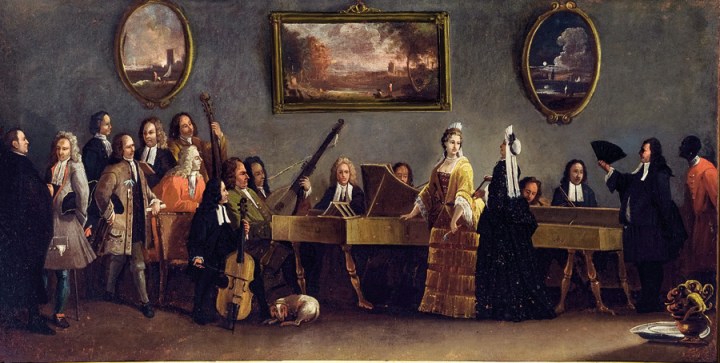
Marco Ricci, "Riunione musicale," before 1708 (Florence: Galleria dell'Accademia)
Splendour and Reason: Art in Eighteenth-Century Florence
(Il fasto e la ragione: Arte del Settecento a Firenze)
Uffizi, Florence, 30 May — 30 September 2009

Francesco Carradori, "Bacchus and Ariadne," 1776 (Florence: Palazzo Pitti, Galleria Palatina)
With the extinction of the Medici dynasty in 1743, Florence did not lose its prestige as capital of culture and the arts, thanks to the government of the Lorraines, who gave the city the international profile required by Enlightenment policies. This exhibition is the first overall panorama of the principal artistic events of the eighteenth century in Florence. We are speaking of 120 paintings, sculptures, art objects and furnishings of the great, public and private commissions, works from the entire century, which in a spectacular vein record the changes in taste from the late Baroque period to Neoclassicism.
The show starts with the commissions made by Cosimo III and the Grand Prince Ferdinando de’ Medici, which opened the city to “foreign” artists like Sebastiano Ricci and Giuseppe Maria Crespi. They favoured sculpture (with personalities like Giovan Battista Foggini and Massimiliano Soldani Benzi), and developed the manufacture of tapestries and semiprecious stones. In this context, the families of the Florentine aristocracy performed a very conspicuous role: the Gerinis for the diffusion of the veduta, the Ginoris for the famed manufactory of porcelain of Doccia, the Corsinis for their constant relations with pontifical Rome. All these episodes contributed to defining the image of a vital and modern city, crossroads of many experiences and a workshop of original artistic productions.
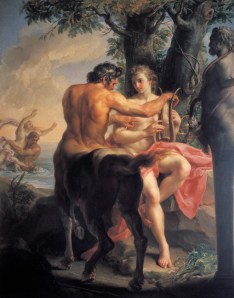
Pompeo Batoni, "The Education of Achilles," 1746 (Florence: Galleria degli Uffizi)
With the extinction of the Medicis, Peter Leopold of Lorraine brought the European version of Rococo and Neoclassicism to Tuscany, along with the reformist spirit that accompanied the theories of the Enlightenment even in the figurative arts. A new elite of patrons thus took shape in Florence, also made up of its foreign residents (the Englishman Horace Mann, for example). It was also thanks to them that Florence became a mandatory lap of the grand tour. The Tuscan artists received advantages, especially the modern painters of vedutas (landscapes) (including the naturalised Englishman Thomas Patch and Giuseppe Zocchi). Foreign visitors preferred the repertory of gallantries and vedutas translated into semiprecious stones by the renovated Opificio dei Siriès. The Grand Duke proved to be a protector of the arts. He reformed the by-laws of the Academy where prominent artists like Pietro Pedroni, Innocenzo Spinazzi, and Francesco Carradori worked. He stimulated the worksites of the grand-ducal residences – first and foremost, the Pitti Palace and the Villa at Poggio Imperiale – and spurred the study of antiquity,
transferring the spectacular group sculpture of the Niobe from Rome to Florence.
Catalogue edited by Carlo Sisi and Riccardo Spinelli, 352 pages, ISBN 9788809743755
In this climate of civic and cultural fervour, the Frenchmen François-Xavier Fabre, Bénigne Gagnereaux, Louis Gauffier and Jean-Baptiste Desmarais came to Florence, driven from Pontifical Rome after the murder of the diplomat Nicolas de Basseville. With them came the international version of neoclassicism, thus contributing to the “reform” of the portrait, the veduta, and the historical painting, on the eve of the instatement of the Napoleonic court (1799).
The exhibition is curated by Carlo Sisi and Riccardo Spinelli. The catalogue is available through Michael Shamansky, at artbooks.com.
[All images are taken from the exhibition website; click here for more information]










 Enfilade
leave a comment