Exhibition | The Regency in Paris, 1715–1723
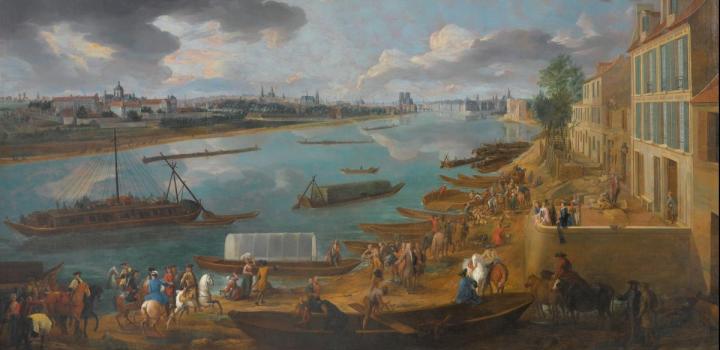
Pierre Denis Martin, View of Paris from the Quai de la Rapée toward la Salpêtrière, l’île Saint-Louis, and l’île de la Cité, 1716, oil on canvas, 170 × 315 cm (Paris: Louvre / Musee Carnavalet)
◊ ◊ ◊ ◊ ◊
Now on view at the Musée Carnavalet:
The Régence in Paris, 1715–1723: The Dawn of the Enlightenment
Musée Carnavalet, Paris, 20 October 2023 — 25 February 2024
Curated by Valérie Guillaume, with José de Los Llanos and Ulysse Jardat
The Musée Carnavalet – Histoire de Paris presents an exhibition on the Regency, a forgotten period in history, marking the return of the King and of political, economic, and cultural life to Paris.
Louis XIV died in Versailles on 1 September 1715, leaving behind a nation in debt and a five-year-old child too young to rule, Louis XV, as his heir. On 2 September, the Duke Philippe d’Orléans (1674–1723), nephew of the late King, took on the role of Regent of France. This exhibition takes place as part of the tricentennial commemoration of the Regent’s death.
In 1715, the court, the government, and all the administrations moved back to Paris, the second city in Europe, whose population then increased significantly. Thus, the city, and notably the Palais-Royal, the Regent’s residence, became the heart of all political life. A period of intense cultural effervescence ensued, giving rise to a world of philosophical, economic, and artistic innovations. Voltaire, Marivaux, Montesquieu, Law, and Watteau are some the most well-known figures of the time. With the invention of paper money and the bankruptcy of 1720, these years of economic and financial frenzy were interspersed with significant twists and turns. Under the Régence emerged a newfound freedom of criticism, which would become known as the spirit of the Enlightenment.
The exhibition’s thematic structure highlights the innovations of the period in order to illustrate the breadth of their historical significance. Over 200 works from public and private collections—paintings, sculptures, prints, items of decor, and pieces of furniture—help us explore this period of history, accounting for the mutations of society at a time when Paris was becoming the cultural capital of France in a permanent way.
Curators
• Valérie Guillaume, director of the Musée Carnavalet – Histoire de Paris
• José de Los Llanos, head curator, in charge of the Graphic Arts Department and the Maquettes Department
• Ulysse Jardat, curator, head of the Decor, Furniture, and Decorative Arts Department
La Régence à Paris (1715–1723): L’aube des Lumières (Paris: Paris-Musées, 2023), 224 pages, ISBN: 978-2759605705, €39.
Exhibition | On the Reverse

Installation view of Reversos / On the Reverse, at The Prado in Madrid, 2023.
◊ ◊ ◊ ◊ ◊
Now on view at The Prado:
On the Reverse
Museo Nacional del Prado, Madrid, 7 November 2023 — 3 March 2024
Curated by Miguel Ángel Blanco
Until 3 March 2024, the Museo Nacional del Prado and Fundación AXA are undertaking a journey that moves beyond the surface of artistic masterpieces to allow for the contemplation of a fascinating reality: the hidden side of the work of art, its reverse. Alongside works from the Prado’s own collection, On the Reverse includes generous loans from other national and international institutions. They include Assemblage with Graffiti by Antoni Tàpies from Fundación Telefónica, Cosimo I de’Medici by Bronzino from the Abelló Collection, Self-Portrait as a Painter by Van Gogh from the Van Gogh Museum, Amsterdam, Artist in His Studio by Rembrandt from the Museum of Fine Arts, Boston, and The Empty Mask by Magritte from the Kunstsammlung Nordrhein-Westfalen, Düsseldorf. In all, about a hundred works are on display.
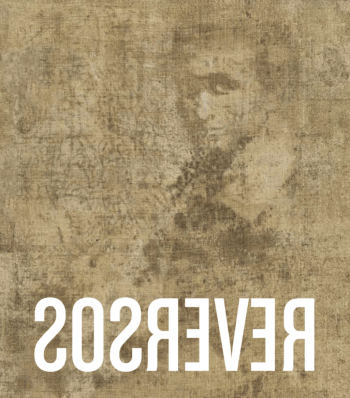 For the exhibition, curated by artist Miguel Ángel Blanco, rooms A and B of the Jerónimos Building have been painted black for the first time. On the Reverse takes the form of an open survey that gives maximum freedom to the spatial relationship between the works, devoid of any hierarchy or chronological ordering and including the presence of creations by contemporary artists such as Vik Muniz, Sophie Calle, and Miguel Ángel Blanco himself, who is represented by three of his box-books from the Library of the Forest. Taking his starting point from a contemplation of Las Meninas—in which the reverse of the vast canvas on which Velázquez is working occupies a large portion of the pictorial surface—Blanco proposes an unusual approach to painting by turning the works around in order to encourage visitors to establish a new and more complete relationship with the artists whose work is included.
Numerous studies have been undertaken to date on individual works that have interesting backs for different reasons, and some museums have explored this aspect in a partial manner through small exhibitions focused on the reverse of works in their collections. However, with the collaboration of Fundación AXA, it is the Museo Nacional del Prado that is now approaching this subject with the necessary ambition. In addition to undertaking a complete reassessment of the backs of works in its collections, the Museum has also located examples in some of the world’s leading museums that reveal how an appreciation of works of art is enriched when their contemplation is not limited to the front.
Structured thematically, the exhibition includes artists never previously seen at the Prado, among them Van Gogh (1853–1890), René Magritte (1898–1967), Lucio Fontana (1899–1968), Pablo Palazuelo (1915–2007), Antoni Tàpies (1923–2012), Sophie Calle (b. 1953), Vik Muniz (b. 1961), Michelangelo Pistoletto (b. 1933), José María Sicilia (b. 1954), Wolfgang Beurer (active 1480–1504), Louis-Léopold Boilly (1761–1845), Carl Gustav Carus (1789–1869), Vilhelm Hammershøi (1864–1916), Martin van Meytens (1695–1770), Wallerant Vaillant (1623–1677), Ernst Ludwig Kirchner (1880–1938), and Max Liebermann (1847–1935).
On the Reverse opens with ‘The Artist behind the Canvas’, crossing that dimensional threshold to which Velázquez draws our attention with the enigmatic reverse of the canvas depicted in Las Meninas. Painters frequently portrayed themselves behind a picture, but even when these backs are not so directly associated with the artist’s activity, they acquire a prominent presence as objects of special significance in painters’ studios.
The depiction of the back returns in ‘This Is Not a Reverse’, a section that paraphrases Magritte in order to bring together various trompe l’oeils that represent backs of paintings. This meta-artistic subject reveals the enormous significance that the hidden side of works could acquire for artists, leading them to imitate the annotations, inscriptions, drawings, etc, habitually found on picture backs.
One of the elements that makes up the pictorial support is the subject of ‘The Stretcher as Cross’, the exhibition’s third section. This concealed structural element normally takes the form of a wooden cross that can be used to carry the painting from one place to another. When—in a habitual, everyday action that also emphasises the three-dimensional status of the work which this exhibition analyses—an artist picks up the cross of the stretcher in order to move the work in the studio or take it outside for the purpose of painting outdoors he/she is performing a type of ‘Via Crucis’ that symbolises the effort and difficulties of artistic endeavour.

Martin van Meytens, Kneeling Nun, obverse and reverse, ca. 1731, oil on copper, 28 × 21 cm (Stockholm: Nationalmuseum, NM 7036; purchased in 2006 with the Axel och Nora Lundgren Fund). The painting was also included in the 2017–18 exhibition Casanova: The Seduction of Europe.
◊ ◊ ◊ ◊ ◊
The exhibition’s central section, ‘B-Sides’, focuses on works that can be termed ‘two-sided’. Here the back has its own artistic status and complements the principal image in various ways. It may feature the back of a figure seen from the front on the other side, a landscape or allegorical scene that modifies the meaning of the principal representation, heraldic information, associated religious themes, portraits, and more. Continuing this theme, the section ‘The Hidden Side’ includes works in which the back reveals traces of the creative process in the form of drawings, geometrical designs, or expressive whimsies.
‘More Information on the Back’ looks at a classic problem in painting. Although word and image coexisted relatively easily until the Middle Ages, a moment arrived when artists entrusted all the weight of the narrative to the latter. Furthermore, when they needed to convey information, identify subjects or individuals, or include additional information or commentaries on the execution of the work, they almost invariably wrote on the back. In some cases information has been added to backs at a later date in the form of labels and stamps or seals that help us to trace the history of the works: the collections they belonged to, the palaces they adorned, their changes of location, and any restoration undertaken on them.

Zacarías González Velázquez, Reverse of Two Fishermen, One with a Rod and the Other Seated, 1785, oil on canvas (Madrid, Cuartel General del Ejército, depósito del Museo Nacional del Prado). The back of the painting reveals a strip of canvas that was folded over the stretcher at some date in order to fit the work into a narrower space.
In other cases, as seen in ‘Ornaments and Ghosts’, the backs reveal stories contained in the works’ actual materials: textiles that had domestic uses or patterned weaves that contain unintentional ghosts which appear when oil soaks into the cloth. In addition, the section ‘Folds, Cuts, and Cutouts’ shows how old restorations and alterations made to adapt paintings to new locations or functions are visible on reverses that include repairs, cuts, and folds that result in part of the image being relegated to facing the wall.
It is easy to simplify the experience of ‘facing’ a painting to a question of fronts: the work’s and the viewer’s. Looking at a painting implies locating ourselves before it with our ‘front side’, where our eyes are located. However, for some time now, the experience of art has been understood as something more physical; our entire body in all its dimensions participates in it. In fact, in both depictions of artists working in their studios and in images of the public looking at art in museums and exhibitions these figures are often seen ‘From behind, In front of the Painting’.
Finally, ‘Nature in the Background’ investigates the unusual or less common materials that have been used over the centuries as the supports for paintings in the Museum’s collection. This research has identified copper, tin, slate, alabaster, cork, brick, porcelain, and ivory. Furthermore, dust is always present. Regular cleaning is, of course, undertaken at the Museum, but the largest and heaviest works are less frequently moved. A short time ago the Museo del Prado removed The Transfiguration by Giovanni Francesco Penni from the wall, allowing Miguel Ángel Blanco to collect some of the dust accumulated on its reverse, which he has used to make three box-books for his Library of the Forest.
Miguel Ángel Blanco, ed., Reversos (Madrid: Museo del Prado, 2023), 336 pages, ISBN: 978-8484806042, €38. With additional contributions by Ramón Andrés, Ana González Mozo, Antonio Muñoz Molina, and Victor I. Stoichita.
Exhibition | Amber: Treasures from the Baltic Sea
On view at Galerie Kugel:
Amber: Treasures from the Baltic Sea, 16th–18th Century
Galerie Kugel, Paris, 18 October — 16 December 2023
 From Roman times to the 18th century, many recognised the inherent value of amber and hypothesised its origin, some assuming it to be whale sperm, others, solidified lynx urine. Its mystery endowed it with medicinal virtues. Amber was recommended as a powder to cure melancholy, toothache, and epilepsy, among other ailments, and as a love filter. The occasional inclusions of insects and small animals found trapped in amber have also made it a symbol of immortality. Pliny the Elder was the first to unveil its nature as the result of plant resin, but it wasn’t until 1757 that the Russian scientist Mikhail Lomonossov determined its true origin.
Amber is a fossilised resin originating, in the case of the objects exhibited, from a prehistoric forest dating back to some 30 to 40 million years, located under the Baltic Sea, between the towns of Danzig (today Gdansk in Poland) and Königsberg (today Kaliningrad in Russia), then, in East Prussia. In the 16th century, Grand Master Albert of Brandenburg-Ansbach (1490–1568) converted to Protestantism and transformed the territories of the Order of the Teutonic Knights in the Duchy of Prussia. This marked the beginning of a tremendous expansion in the trade and production of amber works of art. They became Prussia’s diplomatic gifts par excellence and were sought after to adorn the ‘Kunstkammern’ of Europe’s sovereigns and princes. It took nearly 20 years to collect the fifty pieces on display in this exhibition. Combining sculptures, caskets, tankards, and game boards, the wide variety of objects presented illustrate the fascination for amber through the 16th, 17th, and 18th centuries.
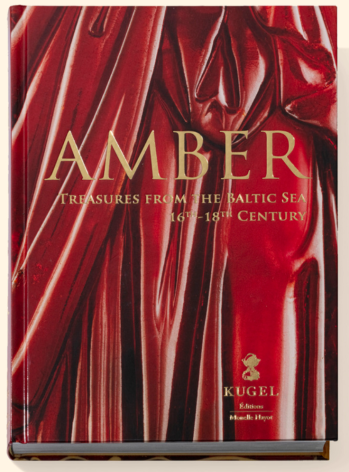
Alexis Kugel and Rahul Kulka, Amber: Treasures from the Baltic Sea, 16th to 18th Century / Ambre: Trésors de la mer Baltique du XVI au XVIIIe siècle (Saint-Remy-en-l’Eau: Éditions Monelle Hayot, 2023), 376 pages, €85. Available in French and English.
Exhibition | Drawing on Blue
Opening in January at The Getty:
Drawing on Blue
Getty Center, Los Angeles, 30 January — 28 April 2024
Curated by Edina Adam and Michelle Sullivan
Made from blue rags, blue paper has fascinated European artists from its earliest use in Renaissance Italy to Enlightenment France and beyond. Through new technical examination of drawings in the Getty’s collection, this exhibition offers fresh insight into the physical properties of blue paper and its unique contribution to artistic practice from the 15th through 18th centuries.
◊ ◊ ◊ ◊ ◊
From Getty Publications:
Edina Adam and Michelle Sullivan, eds., Drawing on Blue: European Drawings on Blue Paper, 1400s–1700s (Los Angeles: J. Paul Getty Museum, 2024), 160 pages, ISBN: 978-1606068670, $35. With contributions by Mari-Tere Álvarez, Thea Burns, Marie-Noelle Grison, Camilla Pietrabissa, and Leila Sauvage.
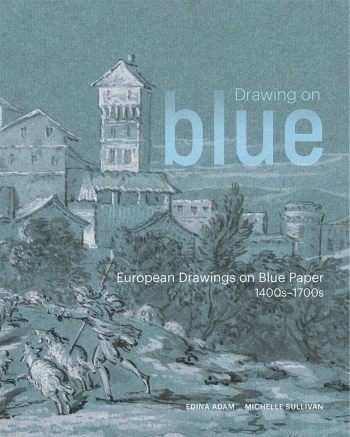 This engaging book highlights the role of blue paper in the history of drawing. The rich history of blue paper, from the late fifteenth to the mid-eighteenth centuries, illuminates themes of transcultural interchange, international trade, and global reach. Through the examination of significant works, this volume investigates considerations of supply, use, economics, and innovative creative practice. How did the materials necessary for the production of blue paper reach artistic centers? How were these materials produced and used in various regions? Why did they appeal to artists, and how did they impact artistic practice and come to be associated with regional artistic identities? How did commercial, political, and cultural relations, and the mobility of artists, enable the dispersion of these materials and related techniques? Bringing together the work of the world’s leading specialists, this striking publication is destined to become essential reading on the history, materials, and techniques of drawings executed on blue paper.
Edina Adam is assistant curator of drawings at the J. Paul Getty Museum. Michelle Sullivan is associate conservator of drawings at the J. Paul Getty Museum.
The Burlington Magazine, October 2023
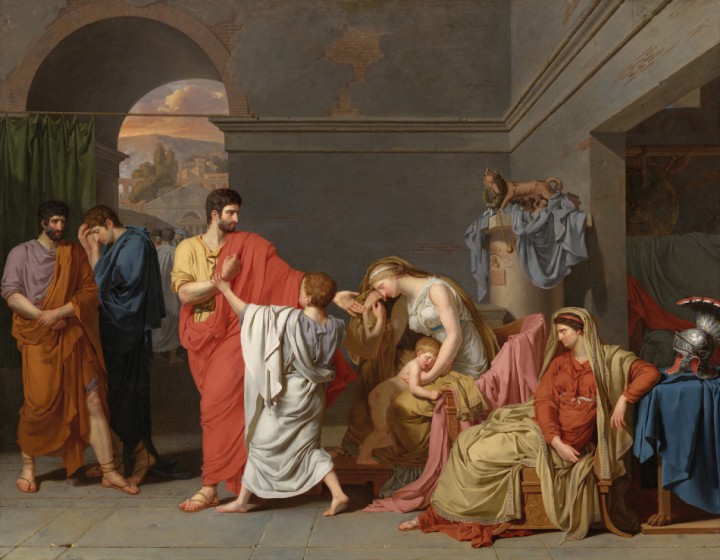
Anne-Louis Girodet de Roussy-Trioson, Coriolanus Taking Leave of His Family, 1786, oil on canvas, 114 × 146 cm
(National Gallery of Art, Washington)
◊ ◊ ◊ ◊ ◊
The eighteenth century in the October issue of The Burlington:
The Burlington Magazine 165 (October 2023)
a r t i c l e
• Aaron Wile, “Girodet’s Coriolanus Taking Leave of His Family Rediscovered,” pp. 1094–1105.
In 2019 Girodet’s lost entry for the 1786 Grand prix de peinture came to light and was acquired by the National Gallery of Art, Washington. The painting, which depicts a rarely represented incident from the story of Coriolanus—a subject that may have had contemporary political relevance—was not awarded the prize, probably because Girodet was regarded as being too close to Jacques-Louis David, a relationship to which the work may allude.
s h o r t e r n o t i c e
• Antoinette Friedenthal, “Image of a Connoisseur: An Unknown Portrait of Pierre Jean Mariette,” pp. 1106–10.
Among the unpublished miniatures in the Victoria & Albert Museum, London (V&A), is an eighteenth-century bust-length portrait of a middle-aged gentleman. A basic unillustrated inventory sheet for this work appeared in 2020 on the museum’s website. It stated that the portrait represents Pierre Jean Mariette (1694–1774) but gave no reasons for this identification and did not provide any information on the object’s provenance. It will be argued here that a combination of visual and documentary evidence confirms the identification.
r e v i e w s
 • Mark Bill, Review of the exhibition Reframing Reynolds: A Celebration (The Box, Plymouth, 2023), pp. 1124–27.
• Stephen Lloyd, Review of the refurbished Medieval, Renaissance, and Baroque galleries at the Walker Art Gallery, Liverpool, pp. 1130–33.
• Beth McKillop, Review of the exhibition China’s Hidden Century (The British Museum, London, 2023), pp. 1136–38.
• Satish Padiyar, Review of the exhibition Sade: Freedom or Evil (CCCB, Barcelona, 2023), pp. 1143–46.
• Malcolm McNeill, Review of Anne Farrer and Kevin McLoughlin, eds., Handbook of the Colour Print in China, 1600–1800 (Brill, 2022), pp. 1150–52.
• Edward Cooke, Review of Elisa Ambrosio, Francine Giese, Alina Martimyanova, and Hans Bjarne Thomsen, eds., China and the West: Reconsidering Chinese Reverse Glass Painting (De Gruyter, 2022), pp. 1152–53.
• David Ekserdjian, Review of the catalogue, Denise Allen, Linda Borsch, James David Draper, Jeffrey Fraiman, and Richard Stone, eds., Italian Renaissance and Baroque Bronzes in the Metropolitan Museum of Art (The Metropolitan Museum of Art, 2022), pp. 1156–58. The book is available as a free PDF The Met’s website.
• Rowan Watson, Review of Christopher de Hamel, The Posthumous Papers of the Manuscripts Club (Allen Lane, 2022), pp. 1160–62.
• Stefan Albl, Review of Francesco Lofano, Un pittore conteso nella Napoli del Settecento: L’epistolario e gli affari di Francesco de Mura (Istituto Italiano Studi Filosofici, 2022), pp. 1163–64.
Exhibition | From Pencil to Burin: Drawings for Printmaking

Left: Manuel Salvador Carmona, Drawing of François Boucher (after Alexander Roslin), detail, 1760–61, black and red chalk (Madrid: Museo Nacional del Prado D658). Right: Manuel Salvador Carmona, Print of François Boucher (after Alexander Roslin), detail, 1761, etching and engraving (Madrid: Museo Nacional del Prado G2693). The original source was Roslin’s painted portrait of Boucher, now at Versailles; Salvador Carmona was admitted to the Académie Royale de Peinture et de Sculpture as an engraver on the basis of this print; it includes the inscription, “Gravé par Manuel Salvador Carmona pour sa reception à l’Academie en 1761.”
◊ ◊ ◊ ◊ ◊
From the press release (16 October 2023) for the exhibition:
From Pencil to Burin: Drawings for Printmaking in Goya’s Day
Museo Nacional del Prado, Madrid, 17 October 2023 — 14 January 2024
Curated by José Manuel Matilla and Ana Hernández Pugh
Until 14 January in Room D of the Jerónimos Building, the Museo del Prado presents the exhibition From Pencil to Burin: Drawings for Printmaking in Goya’s Day. It comprises a selection of 80 prints and drawings revealing the important role of these designs in the creation of intaglio prints in Spain from the mid-18th to the early 19th centuries. The exhibition includes works by a number of artists, while focusing on two key figures for the development of printmaking: Manuel Salvador Carmona (1734–1820), the artist possessed of the greatest technical command of engraving in Spain, and Francisco de Goya (1746–1828), whose remarkable artistic powers and particular understanding of etching opened up new directions in artistic creation.
 Curated by José Manuel Matilla, Chief Curator of Prints and Drawings at the Prado, and Ana Hernández Pugh, author of the 2023 catalogue raisonné of Manuel Salvador Carmona’s drawings, the exhibition presents a survey of drawings made as preparatory designs for engravings, emphasizing both their functional and artistic importance. Visitors can see the techniques employed to transpose a composition to a copperplate, thus revealing how preparatory drawings played a significant role in the engraver’s understanding of the work.
The training of qualified draughtsmen and engravers in the second half of the 18th century allowed for the illustration of the texts that disseminated Enlightenment thought. While the prints of this period are well known, the preparatory drawings that acted as their starting point have been relegated to a secondary position in the history of art due to their functional nature. It was, however, the drawings that defined the compositions which were subsequently reproduced on copperplates with absolute precision and fidelity. The exhibition thus reveals a much broader artistic context, articulated around concepts that define the uses and techniques of prints to analyse different phases of the creative process. It shows the diversity of the phases and states through which an intaglio engraver had to pass in order to complete a work. Overall, the exhibition aims to reveal that it was only on the basis of a high quality drawing that a good print could be obtained.
José Manuel Matilla, Ana Hernández Pugh, Gloria Solache Vilela, and Sergio García, Del lapicero al buril: El dibujo para grabar en tiempos de Goya (Madrid: Museo Nacional del Prado, 2023), 264 pages, ISBN: 978-8484806066, €35.
The digital brochure (in English) is available here»

Installation view of the exhibition From Pencil to Burin: Drawings for Printmaking in Goya’s Day (Museo Nacional del Prado, 2023). The freestanding wall presents the first section of the show, “The Drawing and the Printmaker’s Image.”
Exhibition | Claude Gillot

Claude Gillot, Scène de la comédie italienne: Une pantomime, pen and ink with red chalk wash and graphite drawing, 16 × 22 cm
(Paris: Musée du Louvre, INV 26748)
◊ ◊ ◊ ◊ ◊
300 years after his death, Gillot (1673–1722) was the subject of a spring show at The Morgan and a related symposium; a second exhibition opens next month at the Louvre:
Claude Gillot
Musée du Louvre, Paris, 9 November 2023 – 26 February 2024
Organized by Hélène Meyer and Xavier Salmon
A draughtsman and printmaker in the last years of the Grand Siècle, Claude Gillot is known for the inventiveness and originality of his works, heralding the freedom of expression and mores of the Régence period (1715–1723). With his parodies, witchcraft scenes, farces, and fairground improvisations, he is an artist known for satire, comedy, and performing arts. His countless drawings, coveted by collectors, nevertheless attest to extensive activity in a broad range of fields: illustration, theatre and opera, costume, and interior decoration. At the core of his work, a rich corpus of drawings illustrates his penchant for the comedy of the Comédie Italienne (Italian companies performing in France), with its pantomimes, acrobatics, and cross-dressing figures. A costume and set designer for the Paris Opera starting in 1712, Gillot was also a sought-after decorator, notably collaborating with Claude Audran III on private interiors and reinventing arabesque painting in the process.
Xavier Salmon, Hélène Meyer, and Jennifer Tonkovitch, Claude Gillot (1673–1722): Comédies, Fables, et Arabesques (Paris: Lienart, with the Musée du Louvre, 2023), ISBN: 978-2359064124, €32.
Exhibition | Dutch Art in a Global Age
Now on view at the NC Museum of Art and arriving at the Kimbell in the fall of 2024:
Dutch Art in a Global Age: Masterpieces from the Museum of Fine Arts, Boston
North Carolina Museum of Art, Raleigh, 16 September 2023 — 7 January 2024
Kimbell Art Museum, Fort Worth, 10 November 2024 — 9 February 2025

Jan van Huysum, Flowers in a Terracotta Vase, 1730, oil on panel, 80 × 61 cm (Museum of Fine Arts, Boston. Promised gift of Rose-Marie and Eijk van Otterloo, in support of the Center for Netherlandish Art, L-R 13.2019).
In the seventeenth century, Dutch merchants sailed across seas and oceans, joining trade networks that stretched from Asia to the Americas and Africa. This unprecedented movement of goods, ideas, and people gave rise to what many consider the first age of globalization and sparked an artistic boom in the Netherlands.
Dutch Art in a Global Age brings together paintings by Rembrandt, Frans Hals, Gerrit Dou, Jacob van Ruisdael, Maria Schalcken, Rachel Ruysch, and other celebrated artists from the Museum of Fine Arts, Boston’s renowned collection. These are joined by prints, maps, and stunning decorative objects in silver, porcelain, glass, and more, from the seventeenth and the first half of the eighteenth centuries. Exploring how Dutch dominance in international commerce transformed life in the Netherlands and created an extraordinary cultural flourishing, the exhibition also includes new scholarship that contextualizes seventeenth-century Dutch art within the complex histories of colonial expansion, wealth disparity, and the transatlantic slave trade during this period.
Christopher D.M. Atkins, ed., Dutch Art in a Global Age (Boston: MFA Publications, 2023), 224 pages, ISBN: 978-0878468911, £54 / $60. With text by Christopher Atkins, Pepijn Brandon, Simona Di Nepi, Stephanie Dickey, Michele Frederick, Hanneke Grootenboer, Katherine Harper, Courtney Leigh Harris, Mary Hicks, Anna Knaap, Rhona MacBeth, Katrina Newbury, Christine Storti, Gerri Strickler, Claudia Swan, Jeroen van der Vliet, and Benjamin Weiss.
Exhibition | Hub of the World: Art in 18th-Century Rome

Gaspar van Wittel, known as Vanvitelli, The ‘Casino’ of Cardinal Annibale Albani on the Via Aurelia, 1719, oil on canvas, 74 × 135 cm
(Private Collection, United Kingdom)
◊ ◊ ◊ ◊ ◊
From the press release (via Art Daily) for the exhibition:
Hub of the World: Art in 18th-Century Rome
Nicholas Hall Gallery, New York, 6 October — 30 November 2023
This fall, Nicholas Hall presents Hub of the World: Art in 18th-Century Rome, organized in association with the Milanese Galleria Carlo Orsi. Presented at the Upper East Side gallery in New York, the exhibition celebrates the legacy of esteemed American scholar, connoisseur, and artist Anthony M. Clark (1923–1976), who would have turned 100 this year.

Pompeo Batoni, Saint Louis Gonzaga, ca. 1744, oil on canvas, oval, in an 18th-century frame, 81 × 67 cm (Private Collection, NY).
Considered one of the most influential and admired museum professionals of his generation, Clark made a profound impact on American collecting trends in the 1950s and 1960s through his taste for art made in 18th-century Rome, especially the paintings of the Pompeo Batoni. The exhibition brings together more than 60 works by artists who lived in or traveled to Rome in the 18th century, along with a selection of Clark’s personal notebooks and a portrait photograph on loan from the National Gallery of Art in Washington, DC.
After graduating from Harvard, Clark began his career in 1955 at the Rhode Island School of Design before going on to prominent curatorial roles at the National Gallery of Art, the Metropolitan Museum of Art, and the Minneapolis Institute of Arts, of which he later became director. He also taught art history at the Institute of Fine Arts, NYU and at Williams College, Williamstown. During his tenure at Mia and The Met, Clark made significant acquisitions for the institutions and organized world-class exhibitions as a pioneering American scholar of 18th-century Rome.
The Hub of the World brings to light the fundamental role Clark played in the revival of interest among American museums in collecting work from this period. Clark deeply believed in the importance of Roman Settecento painting, drawing, and sculpture, and this passion is brilliantly reflected in his scholarship and writings. As a curator, he consistently created a historic context for art by showing sculpture and decorative arts alongside paintings and drawings at a time when it was customary to maintain a ‘hierarchy’ of the arts by studying and displaying the mediums separately.

Domenico Corvi, The Liberation of Saint Peter, 1770, oil on canvas, 63 × 49 cm (Private Collection, Paris).
Tragically Clark succumbed to a heart attack at age 53 while jogging in his favorite city, where, at the time, he was a fellow at the American Academy in Rome. Born in Philadelphia, Clark worked closely with curators at the Philadelphia Museum of Art over the course of his career; and, in 2000, the PMA—in partnership with the Museum of Fine Arts, Houston—mounted The Splendor of 18th-Century Rome, which was dedicated to his memory.
In the words of Nicholas Hall: “Anthony Clark was a larger-than-life character who changed the way we look at Old Masters. He rescued the art of 18th-century Rome from obscurity by dint of his own personal enthusiasm and brilliant scholarship. He had enormous personal charm: the son of the owner of two works in the exhibition remembers how, as a boy, he enjoyed Clark’s visits to see his parents. Clark, an avid ornithologist, later bequeathed to him a stuffed Green Woodpecker. Our exhibition is an homage to a great scholar, a tastemaker, and a dedicated museum professional.”
Hub of the World highlights the richness of the culture of 18th-century Rome with its extraordinary mixture of patronage, from popes and cardinals, to Roman aristocrats and visiting foreigners—including the German writer and poet Johann Wolfgang von Goethe, from whom the exhibition borrows its title. Goethe deemed Rome the “hub of the world,” writing that “the entire history of the world is linked up with this city.” Hall and Orsi have gathered a diverse selection of paintings, drawings, sculpture, and decorative arts that will provide a rare opportunity to experience the cosmopolitan appeal of 18th-century Rome.

Hubert Robert, Colonnade and Gardens at the Villa Medici, 1759, oil on canvas, 75 × 64 cm (Assadour O. Tavitian Trust).
Headlining the exhibition is View of the Villa Medici by Hubert Robert (1733–1808), painted in 1759 during the artist’s transformative time in Rome and on loan from the Assadour O. Tavitian Trust. A recent discovery, the exceptional work has rarely been on view to the public—previously only exhibited in the U.S. briefly at the National Gallery of Art. Other works on view include the Hemp Harvest in Caserta, executed by Jackob Philipp Hackert for the King of Naples; a portrait of the Cardinal Carlo Rezzonico by Anton Raphael Mengs that remained in the sitter’s family until the last decade; a unique view of the Villa Albani by Vanvitelli, recorded in the inventory of Cardinal Albani; a pair of oil on coppers by Angelika Kauffmann based on James Thomson’s pastoral poetry that newly resurfaced from a private Kenyan collection; a caricature painting by Joshua Reynolds, recently discovered at the estate where it has hung for over two centuries; A Vestal by Jacques-Louis David painted in Rome; a harbor scene painted on copper by Claude Joseph Vernet; Anton von Maron’s Portrait of Two English Gentlemen before the Arch of Constantine; the Rockingham Silenus, a 1st-century sculpture reworked by the celebrated Roman sculptor Bartolomeo Cavaceppi; a set of candelabras in the form of Antonius-Osirus by Luigi Valadier; and a console table designed by Antonio Asprucci, made for the Egyptian Room of the Palazzo Borghese. The exhibition pays tribute to Clark as an expert on Pompeo Batoni, as represented by a painting of Saint Louis Gonzaga and its preparatory drawing in red chalk, among several other works. Once belonging to Clark, a painting of the artist Paolo de Matteis by Pier Leone Ghezzi will also be showcased.
In conjunction with the exhibition, Nicholas Hall and Galleria Carlo Orsi will publish a fully illustrated catalogue with original essays by Italian art experts and renowned historians Edgar Peters Bowron, Alvar Gonzáles-Palacios, Melissa Beck Lemke, and J. Patrice Marandel.

Pier Leone Ghezzi, Four Samples of Classical Polychrome Marbles, 1726, watercolor on paper; from top left clockwise: ‘Diaspro Verde Fiorito, 16 × 21 cm, ‘Bianco e negro antico’, 19 × 24 cm, ‘Broccatello’, 19 × 21 cm, ‘Alabastro Orientale’, 19 × 23 cm (Private Collection, Italy). To be published by Dr. Adriano Aymonino in his upcoming book from MIT press, Paper Marbles: Pier Leone Ghezzi’s Studio di Molte Pietre (1726).
The Burlington Magazine, September 2023
The eighteenth century in the September issue of The Burlington:
The Burlington Magazine 165 (September 2023)

Bed, by Ince and Mayhew, 1768, mahogany and other woods, with original blue silk ‘flowered tabby’ in the ‘Large Antique Headboard’, tester and cornice, height 356 cm (Stamford: The Burghley House Collection).
a r t i c l e r e v i e w
• Lucy Wood, “The Industry and Ingenuity of William Ince and John Mayhew,” pp. 996–1001.
Fifty years ago, the question was asked what had become of the furniture made by Ince and Mayhew, one of the most successful and long-lasting firms of cabinetmakers in eighteenth-century London? A monograph by Hugh Roberts and Charles Cator, decades in the making, provides the answer in a revelatory picture of the achievements of these rivals of Thomas Chippendale.
r e v i e w s
• Christoph Martin Vogtherr, Review of the exhibition Rosalba Carriera – Perfection in Pastel (Gemäldegalerie Alte Meister, Zwinger, Dresden, 2023), pp. 1007–10.
• Christopher Baker, Review of the Redevelopment of the National Portrait Gallery, London (reopened in June 2023), pp. 1013–17.
• Raha Shahidi, Review of the exhibition catalogue L’Amour en scène! François Boucher, du théâtre à l’opéra, ed. by Hélène Jagot, Jessica Degain, and Guillaume Kzerouni (Éditions Snoeck, 2022), pp. 1029–31.
• Christopher Rowell, Review of Tessa Murdoch, ed., Great Irish Households: Inventories from the Long Eighteenth Century (John Adamson, 2022) and Conor Lucey, ed., House and Home in Georgian Ireland: Spaces and Cultures of Domestic Life (Four Courts Press, 2022), pp. 1038–40.
• Armin Kunz, Review of Mareike Hennig and Neela Struck, eds., Zeichnen im Zeitalter Goethes: Zeichnungen und Aquarelle aus dem Freien Deutschen Hochstift (Hirmer, 2022), pp. 1040–42.

Sewell Bequest, 2008,3008.1). Room 18 of the National Portrait Gallery, London, showing the newly acquired Portrait of Mai (Omai) by Joshua Reynolds (c. 1776) as the centrepiece of a group of eighteenth-century portraits (Photography by Dave Parry).










 Enfilade
leave a comment