Exhibition | Giacomo Ceruti: A Compassionate Eye
From The Getty:
Giacomo Ceruti: A Compassionate Eye
Brescia Musei Foundation, 14 February — 11 June 2023
The Getty Center, Los Angeles, 18 July — 29 October 2023
 In a group of remarkably haunting paintings by the Italian 18th-century artist Giacomo Ceruti, beggars, vagrants, and impoverished workers are portrayed in mesmerizing realism, emanating a sense of dignity and emotional depth. Why were these subjects painted? Where and how were these works displayed, and for whom? At a time when severe inequalities continue to mark even the wealthiest societies, Ceruti’s work testifies to the enduring power of art to reflect our shared humanity.
Organized with Fondazione Brescia Musei.
From The Getty Shop:
Davide Gasparotto, ed., with contributions by Roberta D’Adda, Francesco Frangi, Alessandro Morandotti, and Lorenzo Coccoli, Giacomo Ceruti: A Compassionate Eye (Los Angeles: J. Paul Getty Museum, 2023), 128 pages, ISBN: 978-1606068366, $28.
The northern Italian artist Giacomo Ceruti (1698–1767) was born in Milan and active in Brescia and Bergamo. For his distinctive, large-scale paintings of low-income tradespeople and individuals experiencing homelessness, whom he portrayed with dignity and sympathy, Ceruti came to be known as Il Pitocchetto (the little beggar). Accompanying the first US exhibition to focus solely on Ceruti, this publication explores relationships between art, patronage, and economic inequality in early modern Europe, considering why these paintings were commissioned and by whom, where such works were exhibited, and what they signified to contemporary audiences. Essays and a generous plate section contextualize and closely examine Ceruti’s pictures of laborers and the unhoused, whom he presented as protagonists with distinct stories rather than as generic types. Topics include depictions of marginalized subjects in the history of early modern European art, the career of the artist and his significance in the history of European painting, and period discourses around poverty and social support. A detailed exhibition checklist, along with provenance, exhibition history, and a bibliography, provides information critical for the further understanding of Ceruti’s oeuvre.
Davide Gasparotto is senior curator of paintings and chair of curatorial affairs at the J. Paul Getty Museum.
◊ ◊ ◊ ◊ ◊
Note (added 6 August 2023) — The posting was updated to include the Brescia venue, where the exhibition was entitled Miseria & Nobiltà: Giacomo Ceruti nell’Europa del Settecento.
Exhibition | Object Lessons in American Art
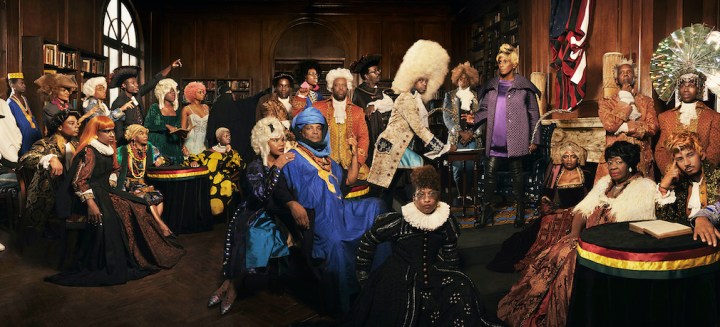
Renee Cox, The Signing, 2018, inkjet print, 122 × 213 cm
(Princeton University Art Museum)
◊ ◊ ◊ ◊ ◊
From Princeton University Art Museum:
Object Lessons in American Art: Selections from the Princeton University Art Museum
Georgia Museum of Art, University of Georgia, Athens, 4 February — 14 May 14 2023
Florence Griswold Museum, Old Lyme, Connecticut, 3 June — 10 September 2023
Speed Art Museum, Louisville, 29 September 2023 — 7 January 2024
Curated by Karl Kusserow

Henry Inman, O-Chee-Na-Shink-Ka a, 1832–33, oil on canvas, 78 × 645 cm (Promised gift from a Private Collection, member of Class of 1982).
Object Lessons in American Art features four centuries of works from the Princeton University Art Museum that collectively explore American history, culture, and society. Inspired by the concept of the object lesson—the study of a material thing to communicate a larger idea—the exhibition brings groups of objects together to ask fundamental questions about artistic significance, materials, and how meaning changes across time and contexts. With a focus on race, gender, and the environment, these pairings demonstrate the value of juxtaposing diverse objects to generate new understanding. Object Lessons presents Euro-American, Native American, and African American art from contemporary perspectives, illustrating how fresh investigations can inform and enrich its meaning, affording new insights into the American past and present. Curated by Karl Kusserow, John Wilmerding Curator of American Art.
Karl Kusserow, ed., with contributions by: Horace Ballard , Kirsten Pai Buick , Ellery Foutch , Karl Kusserow , Jeffrey Richmond-Moll, and Rebecca Zorach, Object Lessons in American Art (Princeton: Princeton University Press, 2023), 200 pages, ISBN: 978-0691978857, £35 / $40.
Object Lessons in American Art explores a diverse gathering of Euro-American, Native American, and African American art from a range of contemporary perspectives, illustrating how innovative analysis of historical art can inform, enhance, and afford new relevance to artifacts of the American past. The book is grounded in the understanding that the meanings of objects change over time, in different contexts, and as a consequence of the ways in which they are considered. Inspired by the concept of the object lesson, the study of a material thing or group of things in juxtaposition to convey embodied and underlying ideas, Object Lessons in American Art examines a broad range of art from Princeton University’s venerable collections as well as contemporary works that imaginatively appropriate and reframe their subjects and style, situating them within current social, cultural, and artistic debates on race, gender, the environment, and more.
C O N T E N T S
Foreword
Preface and Acknowledgments
• Introduction — Lenticular: Subject and Object in American Art — Karl Kusserow
• ‘Race’ as Object Lesson: Objects of Rebellion — Kirsten Pai Buick
• Looking Back and Looking Forward: A Feminist Lens on a Collection of American Art — Ellery E. Foutch
• Oblique Assemblies: Toward Queer Ecologies in American Art — Horace D. Ballard
• Intimations of Ecology: Varieties of Environmental Experience in American Art — Karl Kusserow
• Material Echoes, Traumatic Histories, and Liquid Transformations: The Romance of the Sea in American Art — Rebecca Zorach
• Learning from Object Lessons: Toward a Curatorial Pedagogy of Unfixing and Defamiliarizing the Past — Jeffrey Richmond-Moll
Contributors
Index
Photography Credits
Exhibition | Peter Brathwaite: Rediscovering Black Portraiture
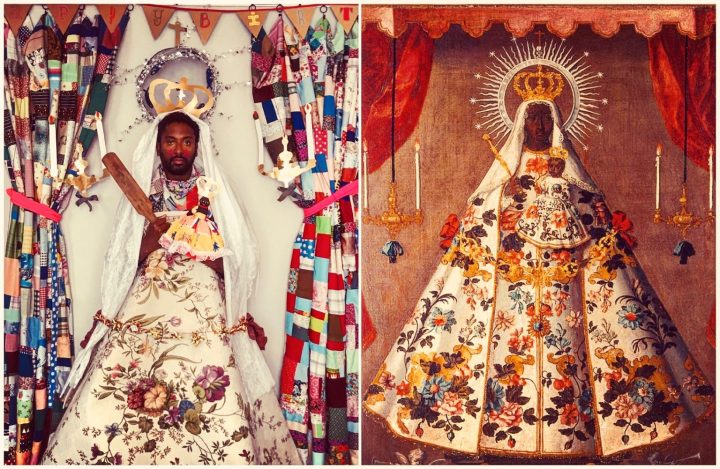
Left: Peter Brathwaite’s restaged version of The Virgin of Guadalupe. Right: Unknown painter, The Virgin of Guadalupe, oil painting, 1745 (London: Wellcome Collection), cropped from original and colour saturated.
◊ ◊ ◊ ◊ ◊
From the Bristol Museum & Art Gallery:
Peter Brathwaite: Rediscovering Black Portraiture
King’s College London, Strand Campus, October 2021 — February 2022
Bristol Museum & Art Gallery, 14 April — 3 September 2023
During the first lockdown in 2020, with all his performances cancelled, baritone, artist, broadcaster, and writer Peter Brathwaite began researching and reimagining more than 100 artworks. These artworks featured portraits of Black sitters, as part of the online #GettyMuseumChallenge to use household objects to restage famous paintings. He called the photographic series Rediscovering Black Portraiture. Alongside this project he also intensified his research into his dual heritage Barbadian roots, uncovering a wealth of detail about his enslaved and enslaver ancestors and their history, including an uprising of enslaved people in 1816 and songs of resistance they sang. Three years on, with a London exhibition behind him and a book out with Getty Publications, Peter Brathwaite brings his whole practice to the history of Georgian House Museum and the collections of Bristol Museum & Art Gallery. New interventions and sound installations reveal the Black presence hidden at the heart of our spaces and objects. The exhibition opened to coincide with the anniversary of the Barbados insurrection, 14 April 1816.
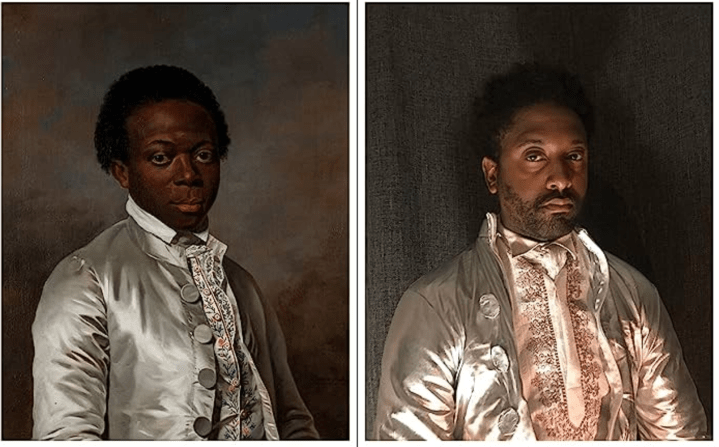
Left: Marie-Victoire Lemoine, Portrait of a Youth in Embroidered Vest, 1785, oil on canvas, 68 × 50 cm (Jacksonville, Florida: Cummer Museum of Art & Gardens). Right: Peter Brathwaite’s restaged version of a Youth in Embroidered Vest.
◊ ◊ ◊ ◊ ◊
From The Getty:
Peter Brathwaite, with contributions by Cheryl Finley, Temi Odumosu, and Mark Sealy, Rediscovering Black Portraiture (Los Angeles, Getty Publications, 2023), 168 pages, ISBN: 978-1606068168, $40.
 Join Peter Brathwaite on an extraordinary journey through representations of Black subjects in Western art, from medieval Europe through the present day. Since the beginning of the COVID-19 pandemic, Peter Brathwaite has thoughtfully researched and reimagined more than one hundred artworks featuring portraits of Black sitters—all posted to social media with the caption “Rediscovering #blackportraiture through #gettymuseumchallenge.”
Rediscovering Black Portraiture collects more than fifty of Brathwaite’s most intriguing re-creations. Introduced by the author and framed by contributions from experts in art history and visual culture, this fascinating book offers a nuanced look at the complexities and challenges of building identity within the African diaspora and how such forces have informed Black portraits over time. Artworks featured include The Adoration of the Magi by Georges Trubert, Portrait of an Unknown Man by Jan Mostaert, Rice n Peas by Sonia Boyce, Barack Obama by Kehinde Wiley, and many more. This volume also invites readers behind the scenes, offering a glimpse of the elegant artifice of Brathwaite’s props, setup, and process. An urgent and compelling exploration of embodiment, representation, and agency, Rediscovering Black Portraiture serves to remind us that Black subjects have been portrayed in art for nearly a millennium and that their stories demand to be told.
Peter Brathwaite is an acclaimed baritone who performs in operas and concerts throughout Europe. He is a presenter on BBC Radio 3 and has been shortlisted for a Royal Philharmonic Society Award. Cheryl Finley is inaugural distinguished visiting director of the Atlanta University Center Art History and Curatorial Studies Collective and the author of Committed to Memory: The Art of the Slave Ship Icon (2018). Temi Odumosu is an art historian, curator, and assistant professor at University of Washington Information School and the author of Africans in English Caricature 1769–1819: Black Jokes, White Humour (2017). Mark Sealy is director of Autograph and professor of photography, race, and human rights at University of the Arts London. His numerous publications include Different (2001), coauthored with Stuart Hall; Decolonising the Camera: Photography in Racial Time (2019); and Photography: Race, Rights, and Representation (2022).
Print Quarterly, June 2023

Left: Edmé Jeaurat after Antoine Watteau, Talagrepo, Monk of Pégou, ca. 1731, etching and engraving, 24 × 17 cm (Cambridge, MA, Harvard Art Museums / Fogg Museum). Right: Gabriel Huquier after François Boucher, Flautist and Child Timpanist, ca. 1742, etching and engraving, sheet, trimmed 30 × 24 cm (New York, The Metropolitan Museum of Art).
◊ ◊ ◊ ◊ ◊
The long eighteenth century in the latest issue of Print Quarterly:
Print Quarterly 40.2 (June 2023)
A R T I C L E S

Roger Vandercruse Lacroix, Secretaire with Marquetry, ca. 1765, tulipwood, stained marquetry with bronze mounts and marble top, 114 × 73 × 38 cm (Private collection, Image courtesy Christie’s, London).
• Kee Il Choi Jr., “Watteau and Boucher Conjoined: Imagining China in Marquetry,” pp. 138–49.
This article examines the previously unknown pairing of Chinoiserie prints based on designs by Antoine Watteau (1684–1721) and François Boucher (1703–70) to create the pictorial marquetry veneered onto two nearly identical writing desks (secrétaires en armoire) attributed to the cabinetmaker Roger Vandercruse called La Croix or Lacroix (1727–99). Each cabinet retains traces of either the original engraving or the colour deployed to bring these ‘paintings in wood’ to life. This discovery not only exemplifies the role of prints in disseminating the chinoiseries of both Watteau and Boucher but also sheds light on the working practices of marqueteurs in eighteenth-century Paris.
• Lesley Fulton, “Johann Heinrich Wilhelm Tischbein’s Album of Prints in the British Museum,” pp. 150–69.
Fulton explores the Homeric subject matter and scenes depicted in the British Museum’s album of 81 previously unidentified etchings and engravings. Intended for Tischbein’s Vases and Homer projects, the etchings and engravings were prepared in Naples towards the end of the eighteenth century. Connections are made to motifs derived from painted vases and their relationship to Tischbein’s project for Sir William Hamilton’s Collection of Engravings from Ancient Vases (Naples and Germany, 1791–1803). Further analysis links the prints to the artist’s massive Illustrated Homer project in the first quarter of the 19th century. The paper highlights the discrepancy between the identification of an antique motif made in the late eighteenth century and how it is interpreted today. A contemporary document—probably a stocklist—from the Tischbein archive at Oldenburg in Germany, undated but drawn up between 1799 and 1808, has made it possible to identify the subject of each print and also to explain its original place in the album. The Appendix correlates the British Museum prints with their description as given in the Oldenburg document and also their correspondence with Tischbein’s various publication projects. Fulton concludes that the British Museum album probably served as a sales catalogue to which new material could be added as it arrived in the artist’s workshop.
N O T E S A N D R E V I E W S
• An Van Camp, Review of Gitta Bertram, Nils Büttner, and Claus Zittel, eds., Gateways to the Book: Frontispieces and Title Pages in Early Modern Europe (Brill, 2021), pp. 175–76. This edited volume presents fifteen essays on frontispieces and title-pages found in books printed between 1500 and 1800. Written by established academics as well as PhD candidates, the contributions explore how frontispieces intersect art and literature and how the printed images can be interpreted (contributions by Malcolm Baker, Martijn van Beek, Miranda L. Elston, Alison C. Fleming, Daniel Fulco, Lea Hagedorn, Constanze Keilhoz, Fabian Kolb, Hole Rößler, Delphine Schreuder, Alice Zamboni, and Cornel Zwierlein).
• Séverine Lepape, Review of Małgorzata Łazicka, ed., Old Master Prints from the 15th Century to the 1820s: German School, Barthel Beham and Sebald Beham. The Print Room of the University of Warsaw Library, Catalogue of the Collection (University of Warsay Library, 2019), pp. 176–78.
 • Michael Matile, Review of the exhibition catalogue, Kurt Zeitler, ed., Venedig, La Serenissima: Zeichnungen und Druckgraphik aus vier Jahrhunderten (Deutscher Kunstverlag, 2022), pp. 180–83. The Staatliche Graphische Sammlung in Munich recently presented a cross-section of its rich treasures of Venetian prints and drawings from the late fifteenth to the eighteenth century.
• Antony Griffiths, Review of Joyce Zelen, Blinded by Curiosity: The Collector-Dealer Hadriaan Beverland (1650–1716) and his Radical Approach to the Printed Image (Primavera Pers, 2021), pp. 186–89. The book focuses on Hadriaan Beverland’s activities during his last years, from 1680, which he spent as a ‘paranoid alcoholic drifting through the pubs and brothels of London’. He also assembled at least two little known manuscripts with new images composed of cut-out fragments of prints. The review highlights two portrait prints seemingly commissioned by Beverland himself which Griffiths believes ‘stand far outside the traditional canons of portraiture’, as well as the discovery by Zelen of a major sale of Beverland’s print collection held in 1690.
• Kristel Smentek, Review of Marianne Grivel, Estelle Leutrat, Véronique Meyer and Pierre Wachenheim, eds., Curieux d’Estampes. Collections et collectionneurs de gravures en Europe, 1500–1815 (Universitaires de Rennes, 2020), pp. 189–91. This review presents a swift overview of newly found documentary insights relating to individual and institutional collections of prints, largely focusing on French collectors and on the eighteenth century. Of the latter, mention is made of Albert Duke of Saxe-Teschen correspondences, Joseph-Dominique d’Inguimbert’s display practices, which included mounting between rollers, the collecting and marketing of French fashion prints, and the formation of print collections documenting the history of France, as was the case with Charles-Marie Fevret de Fontette.
• Mark McDonald, Review of Jessica Maier, The Eternal City: A History of Rome in Maps (University of Chicago Press, 2020) pp. 192–94. This review highlights interesting anachronistic features in topographical depictions of a reinvented Rome, for example, in Leonardo Bufalini’s woodcut map from 1551, the Baths of Trajan are depicted as a complete structure when it was in fact ruinous at the time. Further analysis pertains to the functions of printed maps, often as guides for pilgrims and secular tourists visiting important churches and historic sites.
• Christian Rümelin, Review of the exhibition catalogue, Celia Haller-Klinger, and Anette Michels, eds., Graphiksammler Ernst Riecker (1845–1918) und Otto Freiherr von Breitschwert (1829–1910) (Graphik-Kabinett Backnang, 2018), pp. 194–95. A review relating to two German collections formed around the turn of the nineteenth century, one of which focused on eighteenth- and nineteenth-century regional artists.
• Michael Matile, Review of the exhibition catalogue, Anne Buschoff, Marcus Dekiert and Sven Schütte, eds., Linie lernen: Die Kunst zu zeichnen (Wallraf-Richartz Museum & Fondation Corboud, 2021), pp. 195–96. This review pertains to a catalogue illustrating the history of drawing education from Cennino Cennini to their depictions in sixteenth- to eighteenth-century prints.
◊ ◊ ◊ ◊ ◊
Note (added 12 June 2023) — The original posting was updated to include reproductions of the two prints after Watteau and Boucher.
Exhibition | Rosalba Carriera: Perfection in Pastel

Rosalba Carriera, Portrait of an Unknown Lady in a Blue Coat over a Light Dress, detail, pastel on paper, 76 × 64 cm
(Dresden: Gemäldegalerie Alte Meister)
◊ ◊ ◊ ◊ ◊
From Dresden’s Zwinger:
Rosalba Carriera – Perfection in Pastel / Perfektion in Pastell
Gemäldegalerie Alte Meister, Zwinger, Dresden, 9 June — 24 September 2023
On the occasion of the 350th anniversary of the birth of Rosalba Carriera (1673–1757), the Gemäldegalerie Alte Meister (Old Masters Picture Gallery) is dedicating a special exhibition to the most famous pastel painter. More than 100 objects will be presented, including around 70 works by the portraitist, who was one of the first female artists to enjoy success throughout Europe. With 73 pastels, Dresden possesses the world’s largest collection of the Venetian artist’s work. Under August III, more than twice as many pieces by Carriera were in the gallery’s holdings, and in 1746 a separate pastel cabinet was even set up in the Johanneum near the Frauenkirche and named after her.
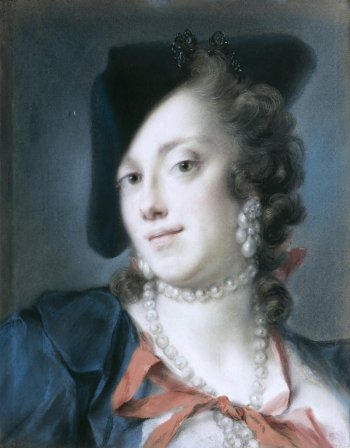
Rosalba Carriera, A Venetian from the House of Barbarigo (Caterina Sagredo Barbarigo), ca. 1735/40, pastel on paper, 42 × 33 cm (Dresden: Gemäldegalerie Alte Meister).
Pastel painting was still considered a comparatively young genre at the time. Carriera was instrumental in making this technique a valued form of painting. The many portraits of princes of the ruling dynasties of Europe show how much in demand the artist was. But she also captured the likenesses of literary figures, musicians, and dancers from her native Venice; a visit to her studio was part of the regular programme of the numerous travellers through Italy. Thus, portraits constitute the largest part of her oeuvre.
Carriera’s pastels bear witness to the beauty ideals of the Rococo period, whose cosmetics were dominated by powder: pale, even skin, powdered hair, and wigs. The powdery surfaces of pastel painting reflect this fashion and thus bring us closer to this bygone era. In cooperation with the Theatre Design/Mask Design course at the Dresden University of Fine Arts, students are illustrating the maquillage of the 18th century in a project that will thus be brought to life in the exhibition.
Carriera’s artistic beginnings lay in miniature painting, as she had little competition to fear from male painter colleagues in this field. In 1705, the San Luca Academy of Art in Rome appointed her a member. This high distinction was bestowed on only a few women, especially as academic training was still denied them for a long time. The Accademia Clementina in Bologna also accepted her as a member in 1720, and a year later the Académie Royale in Paris.
The exhibition shows over 100 objects, taking the public first to the lagoon city of Venice, with views of the Grand Canal, where Carriera had her residence. In addition to the pastel paintings, there are also typical Venetian handicraft products such as glass, lace, and fine cloth to discover.
Roland Enke and Stephan Koja, Rosalba Carriera: Perfection in Pastel (Dresden: Staatliche Kunstsammlungen Dresden, 280 pages, ISBN: 978-3954987580 (English) / ISBN 978-3954987573 (German), €44.
Display | The Wildmans in Bedford Square and Newstead Abbey
Now on view at the Mellon Centre:
A Harpy and His Brothers: The Wildmans in Bedford Square and Newstead Abbey
Paul Mellon Centre, London, 30 May — 15 September 2023
Curated by Martin Myrone

George Romney, Portrait of Thomas Wildman MP, detail, oil on canvas, 78 × 64 cm (Private Collection).
This Drawing Room display shows some of the ways that the architectural and cultural histories of Bedford Square and Newstead Abbey have been addressed in the past and the ways in which those stories might be revised and complicated. The inclusion of the film project Blood Sugar, developed by volunteers at Newstead Abbey, offers further perspectives on these historical stories.
Bedford Square has always been esteemed as one of London’s most prestigious addresses. Built in 1775–82, it is widely considered to be the finest surviving example in London of a Georgian town square, embodying in its orderly architecture appearance the favoured self-image of the British social elite. This display explores the history and reputation of Bedford Square by focusing on two brothers who were among its first inhabitants: the successful lawyer Thomas Wildman (1740–1795) and his younger brother James Wildman (1747–1816). Together with a third brother, the merchant Henry Wildman (1746–1816), they made a fortune through their connections with the fabulously wealthy William Beckford, managing his legal affairs and his extensive plantations in the West Indies. Thomas Wildman’s wealth allowed his son, also Thomas (1787–1859), to purchase Newstead Abbey, a historic property in Nottinghamshire previously owned by the poet Lord Byron.
A digital version of the accompanying 36-page booklet is available here»
◊ ◊ ◊ ◊ ◊
More information about “Blood Sugar: The Slavery History of Newstead Abbey” can be found here, with the 5-minute 2018 film itself available on YouTube.
Exhibition | The Shape of Time: Art and Ancestors of Oceania
A portion of The Met’s Oceanic Collection, now on view in Shanghai at the Museum of Art Pudong:
The Shape of Time: Art and Ancestors of Oceania
Museum of Art Pudong, Shanghai, 1 June — 20 August 2023
National Museum of Qatar, Doha, 16 October 2023 — 15 January 2024
Accompanies the reopening of The Michael C. Rockefeller Wing at The Metropolitan Museum of Art, Spring 2025

Maori Weaving Peg (Turuturu), late 18th–early 19th century, wood, 14 inches high (NY: The Metropolitan Museum of Art, The Michael C. Rockefeller Memorial Collection, Bequest of Nelson A. Rockefeller, 1979.206.1600. ‘Ko te taura whiri, he whiri i te tangata’ (‘The woven cord is like the cord that connects people’). –Māori proverb
The exhibition The Shape of Time: Art and Ancestors of Oceania from The Metropolitan Museum of Art is produced by the Lujiazui (Group) Co., Ltd., and co-organized by The Metropolitan Museum of Art (The Met) and the Museum of Art Pudong (MAP). The exhibition marks the first time that MAP collaborates with The Met, a world-renowned art institution. Meanwhile, it is also the first time ever that an exhibition taken entirely from The Met’s collection has come to Shanghai, China, adding extraordinary historical significance to the event.
The Shape of Time centers around The Met’s Oceanic art collection, showing the exuberant and diverse culture of Oceania. Divided into three main sections— Voyaging, Ancestors, and Time—the exhibition displays more than 110 valuable artworks from the past four centuries. Encompassing the arts and cultures of the Pacific Islands, The Met’s collection of Oceanic art comprises over 2,800 works that reflect the rich history of creative expression and innovation that is emblematic of the region. Since joining in The Met’s permanent collection, these treasures of Oceania have never left New York. The exhibition The Shape of Time therefore is the first time after about half a century that these works will travel out of the United States, and MAP is honoured to be the first stop of this historic voyage.
From The Met’s catalogue entry for the weaving peg (at right):
This weaving peg incorporates a distinctively carved male figure with elaborate designs that accentuate his tattooed skin (moko). Carved in the round, intricate low-relief carvings cover the entire surface of the figure’s body except for the back of his head, which is the seat of an individual’s mana or personal sanctity. With elbows resting on each knee, the arms extend up towards the chin, which is supported by five-fingered hands. The face is dynamic—serial notching accentuates the pronounced arch of each brow, giving way to more fluid grooves, lengthened lines that delineate elongated eyes and the contours of the lips and mouth. The nostrils flare, the mouth is wide open and gaping, as if to consume this flow of energy. Spiral designs on each knee spill over onto the top section of the polished shaft and create a characteristic double spiral motif. This feature frames the face of a further face which faces the other direction, drawing the eye around to the back, creating an energy and dynamism much admired in Māori figural sculpture. . . . The process of twining began when the weaver drove two pegs into the ground and stretched between them a single cord from which the strands of flax were hung. The left-hand peg was always left plain, while the right-hand one was carved and dedicated to the female deity associated with the moon, Hine-te-iwaiwa. The more complex form of carved weaving pegs, such as this one, were designed to incorporate the spiritual potency associated with the goddess whose efficacy was believed to become integrated into the bound texture of the cloak, thus enhancing the spiritual armature of the wearer. . .
The catalogue is published by Yale UP:
Maia Nuku, Oceania: The Shape of Time (New Haven: Yale University Press, 2023), 208 pages, ISBN: 978-1588397669, $50.
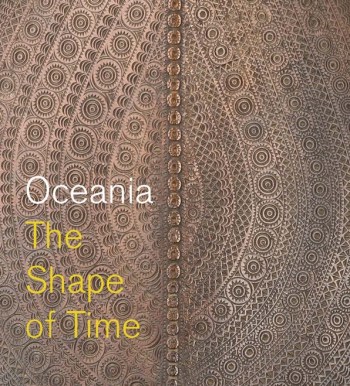 The visual arts of Oceania tell a wealth of dynamic stories about origins, ancestral power, performance, and initiation. This publication explores the deeply rooted connections between Austronesian-speaking peoples, whose ancestral homelands span Island Southeast Asia, Australia, Papua New Guinea, and the island archipelagoes of the northern and eastern Pacific. Unlike previous books, it foregrounds Indigenous perspectives, alongside multidisciplinary research in art history, ethnography, and archaeology, to provide an intimate look at Oceania, its art, and its culture. Stunning new photography highlights more than 130 magnificent objects, ranging from elaborately carved ancestral figures in ceremonial houses, towering slit drums, and dazzling turtle-shell masks to polished whale ivory breastplates. Underscoring the powerful interplay between the ocean and its islands, and the ongoing connection with spiritual and ancestral realms, Oceania: The Shape of Time presents an art-focused approach to life and culture while guiding readers through the artistic achievements of Islanders across millennia.
Maia Nuku is Evelyn A. J. Hall and John A. Friede Associate Curator for Oceanic Art at The Metropolitan Museum of Art.
Exhibition | Style & Society: Dressing the Georgians

Installation view of Style & Society: Dressing the Georgians at the Queen’s Gallery, Buckingham Palace, London, 2023.
◊ ◊ ◊ ◊ ◊
From the press release (20 April 2023) for the exhibition:
Style & Society: Dressing the Georgians
The Queen’s Gallery, Buckingham Palace, London, 21 April – 8 October 2023
The King’s Gallery, Palace of Holyroodhouse, Edinburgh, 22 March — 22 September 2024
Curated by Anna Reynolds
The wedding dress of George IV’s daughter Princess Charlotte of Wales, on display for the first time in over a decade, is among more than 200 works from the Royal Collection on view at The Queen’s Gallery in the exhibition Style & Society: Dressing the Georgians.

Thomas Gainsborough, Portrait of Queen Charlotte, ca. 1781, oil on canvas, 239 × 159 cm (London: Royal Collection, RCIN 401407). As noted at the exhibition website, this full-length portrait, “usually hangs in the White Drawing Room at Windsor Castle. Painted by candlelight, it depicts the Queen in a magnificent gown, worn over a wide hoop and covered with gold spangles and tassels.”
The exhibition explores what fashion can tell us about life in Georgian Britain, a period rocked by social, political, and technological revolutions. Alongside paintings, prints, and drawings by artists such as Gainsborough, Zoffany, and Hogarth are rare surviving examples of clothing, jewellery, and accessories. Together, they provide a fascinating insight into what was worn across all levels of society, from the practical dress of laundry maids to the glittering gowns at court.
Princess Charlotte was George IV’s only legitimate child, but died in childbirth at the age of 21 in 1817. Her marriage to Prince Leopold a year earlier was considered one of the most important royal weddings of the era. Her silk embroidered bridal gown is the only royal wedding dress that survives from the Georgian period, though it appears to have been significantly altered from its original form, in keeping with the Georgian practice of repurposing and recycling clothing. The Princess followed the tradition for European royal brides to wear silver, despite white wedding dresses becoming popular by the end of the 18th century.
Princess Charlotte’s mother, Caroline of Brunswick, also wore silver for her wedding to the future George IV in 1795. On display for the first time is a portrait of the wedding ceremony by John Graham, displayed alongside the original silver and gold dress samples supplied for the bride and other royal guests, on loan from Historic Royal Palaces. While the royal couple and their congregation made a glittering spectacle, their highly embellished clothing and wide skirts would have been noticeably outdated in fashionable circles, reflecting the increasing association of the court with old-fashioned styles of dress rather than cutting-edge trends.
Anna Reynolds, curator of Style & Society, said, “Dress is so much more than just what we see on the surface, and it’s fascinating what we can learn about a period when looking at it through a fashion history lens. Visitors might be surprised to learn how much the Georgian period has in common with the fashion landscape we know today, from influencers and fashion magazines to ideas about the value of clothes and how they can be recycled and repurposed.”
At the heart of the exhibition is a full-length portrait by Thomas Gainsborough, ca.1781, depicting Queen Charlotte wearing a magnificent court gown. It will be shown alongside a beautifully preserved gown of a similar style, worn at Queen Charlotte’s court in the 1760s, on loan from the Fashion Museum Bath. Portraits throughout the exhibition will demonstrate how artists rendered magnificent gowns such as these in paint in exquisite detail, from the metallic woven silk in Antoine Pesne’s Duchess of Saxe-Wessenfels, to the bows and fine lace of Francis Cotes’ Princess Louisa and Princess Caroline.
Allan Ramsay’s life-size coronation portraits of George III and Queen Charlotte demonstrate how ceremonial clothing was carefully chosen to emphasise themes of continuity, tradition, and spectacle. Queen Charlotte wears a gown heavily embroidered with gold thread and a stomacher panel covered with diamonds. This stomacher, which no longer survives, was valued by a contemporary spectator at £60,000—the equivalent of almost £10 million today.
The exhibition trailer (above), engages with the painting St James’s Park and the Mall, by an unknown painter, ca. 1745, oil on canvas, 104 × 139 cm (London: Royal Collection, RCIN 405954).
◊ ◊ ◊ ◊ ◊
With the rise of a professional class, more women earning wages, and cheaper fabrics available, the 18th century saw fashion becoming more accessible to the masses. Pleasure gardens, theatres, and coffee houses provided new settings to show off the latest styles, and the first fashion periodicals spread up-to-the-minute trends, many inspired by clothing previously reserved for working-class or sporting pursuits. Pages from influential French fashion periodicals, on display for the first time, recommend looks inspired by men’s riding dress and military uniforms, both of which became popular everyday styles for women.
 The Georgian period saw specific forms of children’s clothing introduced, designed with comfort, practicality and freedom of movement in mind. In Benjamin West’s 1782 portrait of Prince Octavius, the 13th child of George III and Queen Charlotte, the three-year-old wears a skeleton suit—a new style of children’s dress inspired by the working-class clothing of sailors and fishermen. The young prince, perhaps playing at being king, is shown carrying his father’s sword, which will be shown alongside the painting, both on public display for the first time.
Georgian jewellery was often highly personal and sentimental. Items on display include diamond rings given to Queen Charlotte on her wedding day and a bracelet with nine lockets, six containing locks of hair and one with a miniature of the left eye of Princess Charlotte of Wales. As with textiles, jewellery was often repurposed; a striking necklace was made from pearl-adorned dress-coat buttons that had belonged to George III. Other accessories that may be less familiar to visitors will include jewel-encrusted snuffboxes and chatelaines, which were attached to the waist and used to carry items from pocket watches to perfume bottles.
The exhibition also explores the hair, cosmetics, and grooming tools used by Georgian men and women to achieve their elaborate styles, as well as 18th-century developments in eyewear and dentistry. On show for the first time is a silver-gilt travelling toilet service, acquired by the future George IV as a gift for his private secretary at a cost of £300, the equivalent of more than £20,000 today. The toilet service gives a remarkable insight into a Georgian gentleman’s grooming routine, containing more than 100 objects including razors, combs, ear spoons, and tongue scrapers—as well as tools for cleaning guns and making hot chocolate.
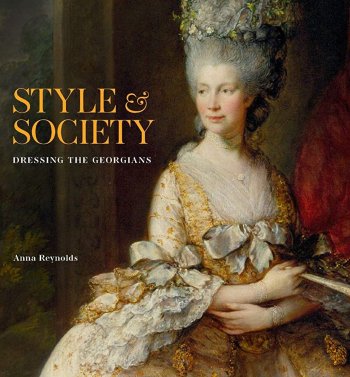
Anna Reynolds, Style & Society: Dressing the Georgians (London: Royal Collection Trust, 2023), 344 pages, ISBN: 978-1909741850, £40 / $50.
◊ ◊ ◊ ◊ ◊
Note (added 20 April 2024) — The posting was updated to include information on the exhibition as presented in Edinburgh.
Exhibition | Giuseppe Marchesi (il Sansone)

Giuseppe Marchesi, known as il Sansone, Moses and the Daughters of Jethro / Mosé e le figlie di Jethro, ca. 1720–25, oil on canvas
(Private Collection)
◊ ◊ ◊ ◊ ◊
Bologna’s Musei Civici d’Arte Antica hosts the first monographic exhibition on the early career of the painter Giuseppe Marchesi, known as Samson.
Leggiadro Barocco: L’attività giovanile di Giuseppe Marchesi detto il Sansone
Collezioni Comunali d’Arte, Palazzo d’Accursio, Bologna, 1 April — 2 September 2023
Curated by Antonella Mampieri and Angelo Mazza
Giuseppe Marchesi (1699–1771)—of restless temperament and imposing build, to which he owed his nickname ‘Samson’—was among the most fruitful painters in cosmopolitan 18th-century Bologna, where the art scene was as lively as ever. He was, however, forgotten as a result of changes in the history of taste. Leggiadro Barocco: L’attività giovanile di Giuseppe Marchesi detto il Sansone aims to rediscover this significant painter from the classicist side of the Bolognese school. A pupil of leading artists of the previous generation, including Aureliano Milani and Marcantonio Franceschini, Marchesi was part of the local painting tradition that found an indispensable model in the Carracci and their pupils—particularly Guido Reni, Francesco Albani, and Domenichino.
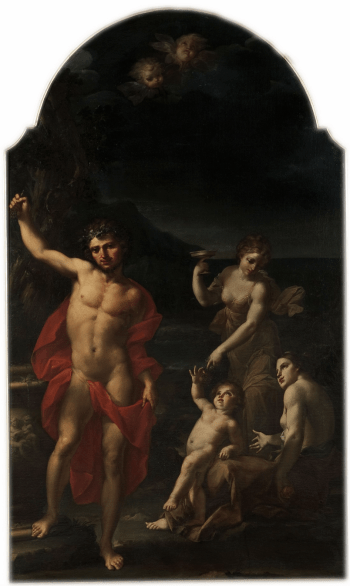
Giuseppe Marchesi, known as il Sansone, Autumn, from The Four Seasons, ca. 1725, oil on canvas (Bologna: Pinacoteca Nazionale).
This stylistic orientation was also supported and promoted by the city’s main artistic institution, the Accademia Clementina, to which Marchesi belonged, holding a variety of positions, didactic and directorial, until his appointment as Principe in 1752. His subsequent artistic evolution led him to the gradual abandonment of an Arcadian classicism in favor of an almost Mannerist style, similar to that of Francesco Monti and Vittorio Maria Bigari. Marchesi’s biography, present only in the manuscript lives composed by the Bolognese scholar Marcello Oretti in the second half of the century, is missing in Luigi Crespi’s Felsina Pittrice (1739) and appears only marginally in the Storia dell ’ Accademia Clementina by Giampietro Zanotti (1739), who nevertheless recognized, along with Luigi Lanzi, Marchesi’s remarkable artistic qualities for “a manner of painting so beautiful and so strong, that all delight, and good, and great fame comes to him.”
Early on there was overlap between Marchesi’s work and that of his contemporary Ercole Graziani, so much so that at the 1935 Mostra del Settecento Bolognese, which marked the resurgence of interest in this period of local art history, many of the works now ascribed to Marchesi were attributed to Graziani. It was up to critic Renato Roli to make a brilliant first reconstruction of Marchesi’s oeuvre in 1971, distinguishing the hands of the two painters. Subsequent studies, conducted mainly by Antonella Mampieri and Angelo Mazza, expanded the catalogue of known paintings, adding specimens of graphics and engravings made from Marchesi’s drawings. The ability to blend warm colors and strong musculature, derived from the Carracci, with the Arcadian grace of drawing, typical of Franceschini’s painting, made Samson a fashionable painter, up to date with the post-Baroque trends that were already in vogue in France and Austria, appreciated by the public and his colleagues.
A prolific and garrulous petit maître, his lively narrative vein yielded extremely pleasing results, especially in his younger years. The culmination of this phase was the fresco decoration of the vault and apse of the church of Santa Maria di Galliera, in Bologna, Marchesi’s first great public commission (1732–44), which established his reputation as a painter at home, in other Italian regions, and in other European countries, including England and Holland.
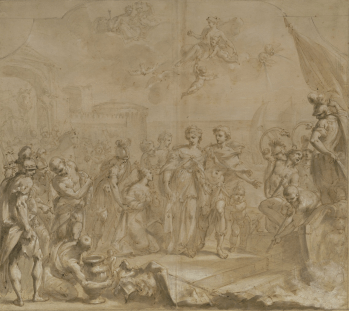
Giuseppe Marchesi, known as il Sansone, The Abduction of Helen, 1725 (Bologna: Collezioni d’Arte e di Storia della Cassa di Risparmio).
The exhibition, designed for the Collezioni Comunali d’Arte, which keeps in its permanent collection the painting Clement VIII Returning the Keys of the City to the Elders of Bologna, focuses on the early period of the artist’s elegant and graceful career: his relationship with Marcantonio Franceschini, who transmitted to him his moderate Arcadian taste, to 1725, the conventional starting point of Marchesi’s independent career. Two paintings recently found on the antiques market and exhibited here for the first time from a private collection—Moses and the Daughters of Jethro and Solomon Censoring the Idols, the success of which is demonstrated by the presence of copies at the Museo Diocesano in Imola—and other examples of paintings of sacred and profane themes demonstrate the artist’s youthful style. These include the Four Seasons from the Pinacoteca Nazionale in Bologna and The Drunkenness of Noah, now in a private collection. Completing the exhibition are a miniature Portrait of a Maiden preserved at the Museo Civico d’Arte Industriale and Galleria Davia Bargellini and two lively drawings from the the Fondazione Cassa di Risparmio in Bologna: The Abduction of the Sabine Women and The Abduction of Helen, preparatory projects for a large painting to be made in the hall of honor of the house that later belonged to the Buratti merchants, promoters of the arts and various Bolognese artists. Only the second one, dated 1725, was later realized by the painter, opening his documented career.
Leggiadro Barocco: L’attività giovanile di Giuseppe Marchesi detto il Sansone proposes a renewed reading of this protagonist of the Bolognese ’barocchetto’, allowing new hypotheses on the chronological ordering of his early work. The exhibition is accompanied by a publication edited by Antonella Mampieri and Angelo Mazza, with the collaboration of Silvia Battistini, a preface by Massimo Medica, text by Mirko Bonora, and essays by Antonella Mampieri and Angelo Mazza.
Exhibition | Louis XVI, Marie-Antoinette, and the Revolution
From the French National Archives and the Boutiques de musées:
Louis XVI, Marie-Antoinette, and the Revolution: The Royal Family at the Tuileries, 1789–1792
Archives Nationales / Hôtel de Soubise, Paris, 29 March — 6 November 2023
Curated by Isabelle Aristide-Hastir, Jean-Christian Petitfils, and Emmanuel de Waresquiel
 A period of almost three years separated the end of the ancien régime from the collapse of the French monarchy. Between 1789 and 1792, the royal family, forced to leave Versailles and its splendour, lived under house arrest in Paris, in the Tuileries Palace. Through archival documents, engravings, works of art, and pieces of furniture from the Tuileries, this tumultuous period is presented in the exhibition with a particular focus on the daily life of the royal couple, Marie-Antoinette’s secret correspondence with the Swedish Count Axel de Fersen, and the intimacy of a palace that has since disappeared.
Les Archives nationales éclairent d’un jour nouveau la période méconnue qui a suivi les événements de 1789. Cette exposition rassemble une centaine de documents, tableaux, gravures et plusieurs éléments de mobilier, et propose une immersion dans le quotidien de la famille royale, depuis son départ de Versailles pour les Tuileries jusqu’à la chute de la monarchie.
Comment la famille royale a-t-elle vécu la période de grande tension politique qui a suivi le déclenchement de la Révolution ? À quoi ressemblait la vie de la cour dans l’enceinte des Tuileries ? De quelle manière le roi et la reine ressentaient-ils le tumulte de la rue et la pression de l’opinion publique ? Autant de questions qui sont au cœur de l’exposition Louis XVI, Marie-Antoinette et la Révolution. La famille royale aux Tuileries, 1789–1792, présentée par les Archives nationales, à l’hôtel de Soubise, du 29 mars au 6 novembre 2023.
Riche en événements politiques, cet épisode de mille jours est bien représenté dans les archives et l’iconographie. Entre autres documents inédits ou méconnus, les visiteurs pourront ainsi découvrir le prAdolf Ulrik Wertmüller, Portrait de la reine Marie-Antoinette, vers 1785–1788. Marie-Antoinette est ici représentée dans une tenue d’intérieur. Le peintre suédois Wertmüller a aussi peint la reine en 1785 avec ses deux enfants dans le jardin de Trianon, et en 1788 en habit d’amazone. Collection particulièreé-cieux journal de Louis XVI (« Mardi 14 juillet : rien ») ouvert aux pages des années 1791–1792, son manifeste politique aux Français (20 juin 1791), un portrait de la reine très rarement exposé et la correspondance secrète entre Marie-Antoinette et le comte de Fersen. Pour la première fois, le contenu de leurs lettres codées, chiffrées et caviardées sera révélé au grand public. L’une des facettes les plus fascinantes de cette période fondatrice de l’histoire de France, marquée Lettre de Marie-Antoinette à Fersen (copie faite par Fersen), avec passages caviardés. Autographe, 26 septembre 1791par la fin d’un règne et la naissance d’un monde nouveau.
Isabelle Aristide-Hastir, Jean-Christian Petitfils, Emmanuel de Waresquiel, Lucien Bély, and Philip Mansel, Louis XVI, Marie-Antoinette et la Révolution: La famille royale aux Tuileries, 1789–1792 (Paris: Éditions Gallimard, 2023), 192 pages, ISBN: 978-2072974618, €30.
The cover of the catalogue comes from a print after Jean-Louis Prieur, Siege and Capture of the Château des Tuileries on 10 August 1792 / Siège et prise du château des Tuileries le 10 août 1792, ca. 1792 (Paris: Archives nationales, AE/II/3019).










 Enfilade
leave a comment