Exhibition | Recasting the Past: The Art of Chinese Bronzes, 1100–1900

Incense Burner in the Form of a Goose, Ming dynasty (1368–1644), early 15th century, bronze
(New York: The Metropolitan Museum of Art).
◊ ◊ ◊ ◊ ◊
From the press release (9 January) for the exhibition:
Recasting the Past: The Art of Chinese Bronzes, 1100–1900
The Metropolitan Museum of Art, New York, 28 February — 28 September 2025
Shanghai Museum, 3 November 2025 — 8 March 2026
Curated by Pengliang Lu
In ancient China, bronze vessels were emblems of ritual and power. A millennium later, in the period from 1100 to 1900, such vessels were rediscovered as embodiments of a long-lost golden age that was worthy of study and emulation. This ‘return to the past (fugu) was part of a widespread phenomenon across all the arts to reclaim the virtues of a classical tradition. An important aspect of this phenomenon was the revival of bronze casting as a major art form. Opening at The Metropolitan Museum of Art on 28 February 2025, Recasting the Past: The Art of Chinese Bronzes, 1100–1900 aims to be the most comprehensive study of Chinese bronzes during this period. This exhibition, co-organized by The Met and the Shanghai Museum, where it will open following its display in New York, will present the new aesthetic represented by these creative adaptations of the past, while exploring their cultural and political significance throughout China’s long history.
 “While bronze as an art form has long held a significant role throughout China’s history, this exhibition explores an often-overlooked time period when a resurgence of craftsmanship and artistic achievements revitalized the medium,” said Max Hollein, The Met’s Marina Kellen French Director and Chief Executive Officer. “Bringing together major loans from institutions in China alongside works from The Met collection, this exhibition offers viewers an important opportunity to better understand the lasting aesthetic and cultural impact of bronze objects.”
The exhibition will be divided into five thematic and chronological sections that explicate over 200 works of art—an array of bronze vessels complemented by a selection of paintings, ceramics, jades, and other media. Some 100 pieces from The Met collection will be augmented by nearly 100 loans from major institutions in China, Japan, Korea, Germany, France, the United Kingdom, and the United States to present the most comprehensive narrative of the ongoing importance of bronzes as an art medium throughout China’s long history. Featured in the exhibition are around 60 loans from institutions in China, including major works such as a monumental 12th-century bell with imperial procession from the Liaoning Provincial Museum, documented ritual bronzes for Confucian temples from the Shanghai Museum, and luxury archaistic vessels made in the 18th-century imperial workshop from the Palace Museum, Beijing.
The exhibition begins with the section “Reconstructing Ancient Rites,” which introduces how emperors and scholar-officials commissioned ritual bronzes from the 12th to the 16th century as part of an effort to restore and align themselves with antique ceremonies and rites. The exhibition continues with “Experimenting with Styles,” illustrating how the form, decoration, and function of ancient bronzes were creatively reinterpreted from the 13th to the 15th century. The next section, “Establishing New Standards,” will explore further transformations in both the aesthetic and technical direction of bronze making from the 15th to the 17th century. The fourth section, “Living with Bronzes,” will feature a display in the Ming Furniture Room (Gallery 218) to demonstrate how bronzes were used in literati life from the 16th to the 19th century. The last section, “Harmonizing with Antiquity,” will examine how the deep scholarly appreciation of archaic bronzes during the 18th and 19th centuries led to a final flourishing of bronze production.
Pengliang Lu, Brooke Russell Astor Curator of Chinese Art at The Met, said: “This exhibition attempts a long-overdue reevaluation of later Chinese bronzes by seeking to establish a reliable chronology of this art form across the last millennium of Chinese history. The exhibition will also distinguish outstanding works from lesser examples based on their artistic and cultural merits.”
Later Chinese bronzes have long been stigmatized as poor imitations of ancient bronzes rather than being seen as fundamentally new creations with their own aesthetic and functional character. This exhibition redresses this misunderstanding by showcasing their artistic virtuosity, innovative creativity, and wide cultural impact. Through archaeologically recovered examples and cross-medium comparisons to a wide range of objects, the exhibition demonstrates the ongoing importance and influence of bronzes as well as how they inspired the form and function of works in other media. Recasting the Past: The Art of Chinese Bronzes, 1100–1900 is curated by Pengliang Lu, Brooke Russell Astor Curator of Chinese Art at The Metropolitan Museum of Art.
The catalogue is distributed by Yale University Press:
Pengliang Lu, Recasting the Past: The Art of Chinese Bronzes, 1100–1900 (New York: The Metropolitan Museum of Art, 2025), 320 pages, ISBN: 978-1588397904, $65.
Exhibition | Luisa Roldán: Royal Sculptor
Adam Busiakiewicz noted the exhibition at Art History News a few weeks ago:
Luisa Roldán: Escultora Real
Museo Nacional de Escultura, Valladolid, 29 November 2024 — 9 March 2025
Curated by Miguel Ángel Marcos Villán and Pablo Amador Marrero
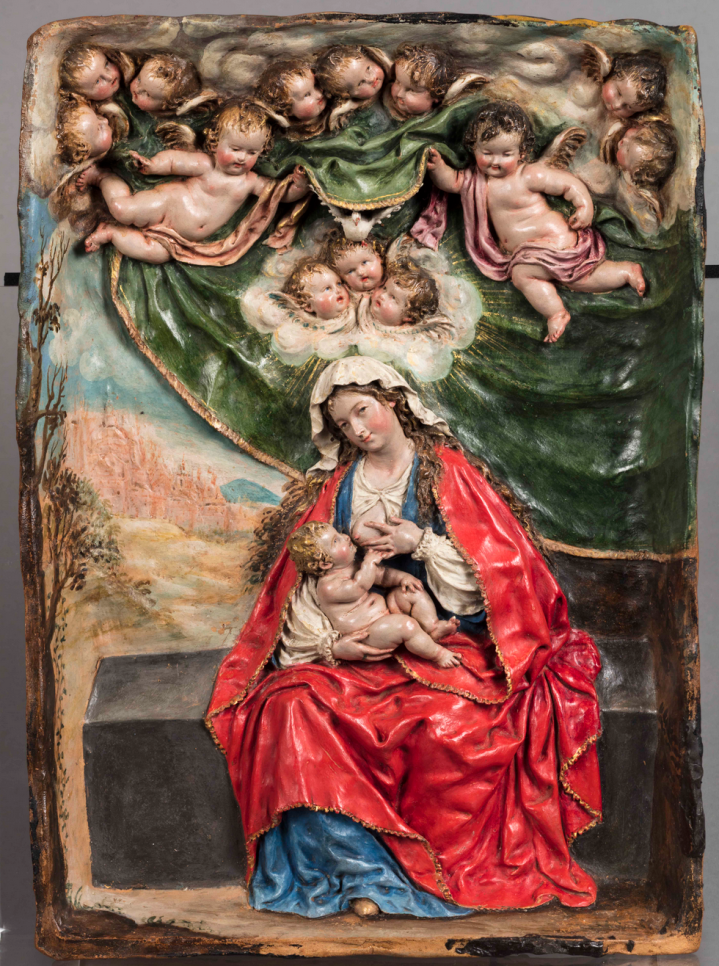
Luisa Roldán, Virgen con el Niño (Sevilla, Convento de San José).
Esta exposición permitirá al visitante adentrarse en una vida apasionante. Luisa Roldán (1652–1706) aunó excelencia, versatilidad y habilidad para romper las barreras de género y llegar a lo más alto como artista: fue nombrada escultora del rey por Carlos II, cargo que mantuvo con Felipe V. Además, fue la primera artista española en ingresar en la Academia de San Lucas en Roma, un hito nunca antes alcanzado por escultores hispanos.
Pero Luisa Roldán: Escultora real también es el producto de una reivindicación y de una necesidad de hacer presente la trayectoria de una de las más destacadas artistas españolas. De hecho, nunca cayó en el olvido y autores como Antonio Palomino (quien la conocería personalmente), Antonio Ponz o Juan Agustín Ceán Bermúdez alabaron su obra. Sin embargo, el hecho de que fuera considerada por muchos como autora de menor calidad que su padre, identificando con él buena parte de su producción, ha pesado en algunos de los estudios que se realizaron sobre su figura. Como también que se le adjudicaran sobre todo obras de devoción, delicadas y de pequeño formato en barro cocido, «más propias de su condición y sexo», según autores como el propio Ceán Bermúdez, dejando en un lugar secundario su rica y extraordinaria producción de obras en madera y de mayor formato.
La dedicación de Luisa Roldán al oficio de la escultura sólo fue posible por su nacimiento en el seno de una familia dedicada a esta disciplina. Su padre, Pedro Roldan fue el gran artista del mercado sevillano y de buena parte del andaluz durante la segunda mitad del siglo XVII. La artista, cuyas dotes para el oficio se desvelaron en época muy temprana, heredó de él la inquietud por el mejor conocimiento del arte. Tras dejar el taller paterno se estableció en Sevilla junto a su marido, Luis Antonio de los Arcos. De allí se trasladaron a Cádiz, metrópoli comercial del momento, y posteriormente el matrimonio y sus hijos fijaron su residencia en Madrid. Allí la escultora pudo entrar al servicio de la Corte, alcanzando el mayor éxito y reconocimiento al que cualquier artista de la época podía aspirar.
Miguel Ángel Marcos Villán and Pablo Amador Marrero, Luisa Roldán: Escultora Real (Valladolid: Museo Nacional de Escultura, 2024), €40.
The Burlington Magazine, December 2024
The long 18th century in the December issue of The Burlington:
The Burlington Magazine 166 (December 2024)
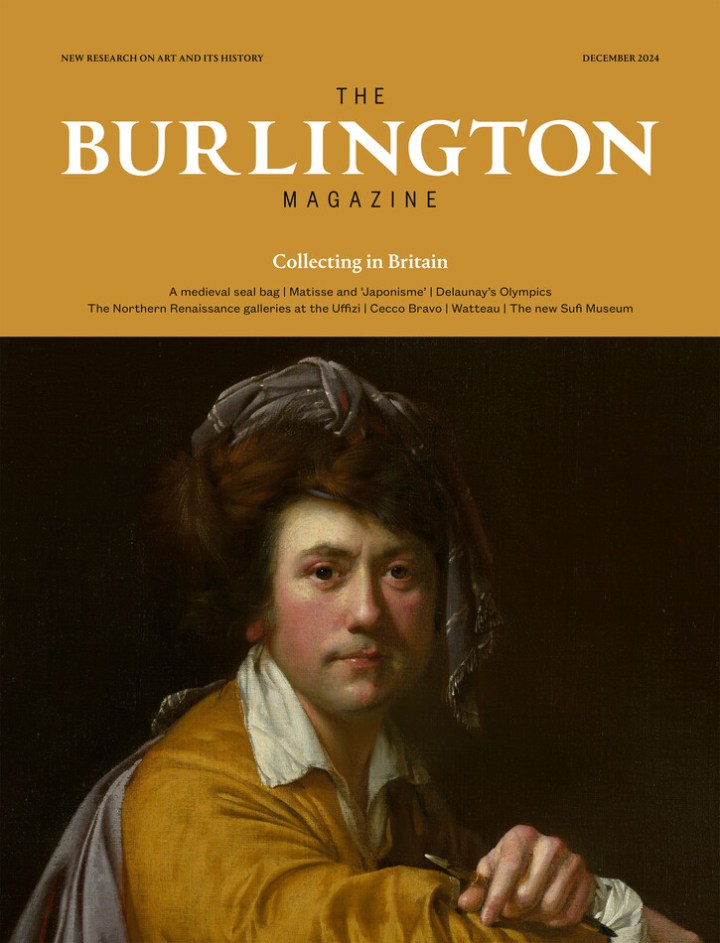 e d i t o r i a l
• “A ‘Grand Life’: Belle da Costa Greene,” pp. 1203–04.
New York’s Morgan Library & Museum was founded as a public institution in 1924 and its centenary this year has been celebrated in style. The most substantial project to form part of the anniversary is the exhibition (25th October–4th May 2025) on Belle da Costa Greene (1879–1950), the museum’s inaugural Director. This is an exercise in fascinating institutional storytelling, but at the same time also considerably more, as Greene was an extraordinary and accomplished figure.
l e t t e r
• Elizabeth Cropper, “Further Notes on boîtes à portrait’,” p. 1205.
A response to Samantha Happé’s article in the October issue of The Burlington: “Portable Diplomacy: Louis XIV’s ‘boîtes à portrait’,” pp. 1036–43.
r e v i e w s
• Richard Rand, Review of the exhibition Revoir Watteau: Un comédien sans réplique. Pierrot, dit le ‘Gilles’ (Louvre, 2024–25), pp. 1238–40.
• Gauvin Alexander Bailey, Review of the exhibition Paris through the Eyes of Saint-Aubin (The Metropolitan Museum of Art, 2024-25), pp. 1249–50.
• Denise Amy Baxter, Review of the exhibition The Legacy of Vesuvius: Bourbon Discoveries on the Bay of Naples (Meadows Musem, 2024), pp. 1251–53.
• Camilla Pietrabissa, Review of the exhibition catalogue L’arte di tradurre l’arte: John Baptist Jackson incisore nella Venezia del Settecento, ed. by Orsola Braides, Giovanni Maria Fara, and Alessia Giachery (Biblioteca Marciana, 2024), pp. 1270–72.
The British printmaker John Baptist Jackson was active in Venice from 1731 to 1745.
• Tom Stammers, Review of Oliver Wunsch, A Delicate Matter: Art, Fragility, and Consumption in Eighteenth-Century France (Pennsylvania State University Press, 2024), pp. 1285–86.
o b i t u a r y
• Simon Jervis, Obituary for Georg Himmelheber (1929–2024), pp. 1287–88.
A pioneering historian of furniture and a curator at Karlsruhe and Munich, Georg Himmelheber was also a founder member of the Furniture History Society; although his expertise encompassed many periods and styles, he was perhaps best known for his work on ‘Biedermeier’ furniture.
s u p p l e m e n t
• “Acquisitions by Public Collections across the UK (2013–23) Made Possible by the Acceptance in Lieu of Tax and Cultural Gifts Schemes,” pp. 1289ff.
Exhibtion | John Smart: Virtuoso in Miniature

John Smart | Left: Portrait of a Woman, 1772, watercolor on ivory, framed: 5.1 × 3.8 cm, F65-41/13. Center: Portrait of Muhammad Ali Khan Wallajah, Nawab of Arcot and the Carnatic, 1788, watercolor on ivory, framed: 5.4 × 4.5 cm, F71-32. Right: Portrait of Mr. Holland, 1806, watercolor on ivory, framed: 11.1 × 7.8 cm, F65-41/47.
◊ ◊ ◊ ◊ ◊
From the press release for the exhibition:
John Smart: Virtuoso in Miniature
Nelson-Atkins Museum of Art, Kansas City, 21 December 2024 — 4 January 2026
Curated by Aimee Marcereau DeGalan with Blythe Sobol and Maggie Keenan
A stunning array of jewel-like portrait miniatures by English artist John Smart (1741—1811), including signed and dated examples from nearly every year of his career, are being featured at The Nelson-Atkins Museum of Art in Kansas City in the exhibition John Smart: Virtuoso in Miniature. Included is a rare self-portrait of the artist, one of only nine known examples. It was made in 1793 while the artist was living in India. Timed to coincide with the final launch in spring 2025 of the digital Starr Catalogue of Portrait Miniatures—a groundbreaking resource dedicated to John Smart that reveals fresh discoveries across his career— this exhibition presents his work chronologically, showcasing new additions to the collection for the first time in nearly six decades. Presented to the Nelson-Atkins by Mr. and Mrs. John W. Starr in two major gifts in 1958 and 1965, and numerous additional gifts throughout the years, the Starr Collection of Portrait Miniatures illustrates the history of European miniatures across more than 250 objects.

John Smart, Self-Portrait, 1793, pencil on laid paper, oval image 19.8 × 17.5 cm (Kansas City: Nelson-Atkins Museum of Art, 2024.10).
“Visitors will be able to see Smart’s progression of style and technique and also explore themes of self-presentation,” said Julián Zugazagoitia, Director & CEO of the Nelson-Atkins. “The Starr family’s dedication to collecting the work of John Smart reflects their commitment to preserving the legacy of one of the most skilled portrait miniaturists of the eighteenth-century.”
Martha Jane Phillips and John W. ‘Twink’ Starr assembled one of the most comprehensive collections of works by English artist John Smart, including signed and dated examples from nearly every year of the artist’s career. Despite their persistent efforts, acquiring a self-portrait remained elusive. In 1954, they learned of the potential availability of a self-portrait in private hands, but they were too late; it was sold to the Museum of Fine Arts, Boston. Relentless in their pursuit, they appealed to successive Boston museum directors to sell or trade for the work, but they were unsuccessful. They ultimately acquired an oil painting of Smart by his near-contemporary Richard Brompton (English, 1734–1783), which they later donated to the Philbrook Museum in Tulsa, Oklahoma. The Starrs’ quest for a self-portrait, initiated on their twenty-fifth wedding anniversary, remained unrealized in their lifetime due to the rarity of such works.
“None of John Smart’s contemporaries painted as many self-portraits, which suggests Smart’s conscious understanding of what the vehicle of portraiture played in self-promotion,” said Aimee Marcereau DeGalan, Louis L. and Adelaide C. Ward Senior Curator, European Arts, and co-curator of this exhibition, along with Starr researchers Blythe Sobol and Maggie Keenan. “Smart was incredibly ambitious and self-confident, and this is the largest known self-portrait that he made. We are unbelievably thrilled to have been able to make this strategic acquisition.”
This self-portrait was acquired by a private London collector, who kept it until fall 2023, when it was consigned to a London dealer. With support from Starr family descendants, the Nelson-Atkins purchased this remarkable work in the year marking John and Martha Jane Starr’s 95th wedding anniversary—a fitting tribute to their enduring legacy.
John Smart: Virtuoso in Miniature facilitates a greater understanding of the artist’s stylistic evolution, working methods, and impact across two continents, while exploring the impact of British colonialism and the changing fashions of the eighteenth and early nineteenth centuries.
Print Quarterly, December 2024
The long eighteenth century in the latest issue of Print Quarterly:
Print Quarterly 41.4 (December 2024)
a r t i c l e s
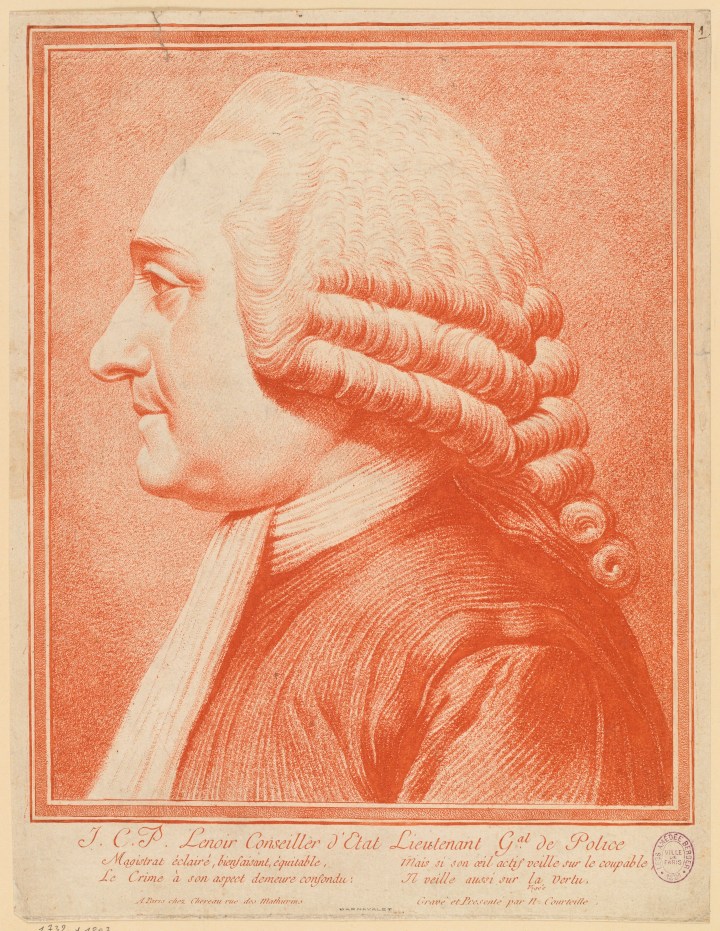
Nicholas de Courteille, presumably after Jean Pierre Bouch, Jean Charles Pierre Lenoir, 1779, soft-ground etching, 308 × 235 mm (Paris, Musée Carnavalet, Histoire de Paris).
• Dorinda Evans, “Jean Pierre Bouch, A Rediscovered Polymath”, pp. 394–407. This article attempts to compile the real identity and life story of the French artist Jean Pierre Bouch (1765–1820), whose diverse career included being a balloonist and pyrotechnician as well as portrait artist.
n o t e s a n d r e v i e w s
• Christian Rümelin, Review of Jean-Gérald Castex, ed., Graver pour le Roi: Collections Historiques de la Chalcographie du Louvre (Louvre éditions and Lienart éditions, 2019), pp. 434–37.
• Evonne Levy, Review of Bettina Wassenhoven, Gravuren nach Skulpturen – Skulpturen nach Gravuren (Konigshausen & Neumann, 2021), pp. 437–38.
• Simon McKeown, Review of Rosa de Marco and Agnès Guiderdoni, eds., Eliciting Wonder: The Emblem on the Stage (Librairie Droz, 2022), pp. 438–41.
• Clarissa von Spee, Review of Anne Farrer and Kevin McLoughlin, eds., The Handbook of the Colour Print in China, 1600–1800 (Brill, 2022), pp. 441–45.
• Nicholas JS Knowles, “The First British Caricature in Aquatint?,” pp. 445–47.
• Bénédicte Maronnie, Reviews of Chiara Casarin and Pierluigi Panza, eds., Giambattista Piranesi: Architetto senza tempo / An Architect out of Time (Silvana Editoriale, 2020); Moritz Wullen and Georg Schelbert, eds., Das Piranesi-Prinzip (E.A. Seeman Verlag, 2020); and Carolyn Yerkes and Heather Hyde Minor, Piranesi Unbound (Princeton University Press, 2020), pp. 469–73.
b o o k s r e c e i v e d
• Jennifer Milam and Nicola Parsons, eds., Making Ideas Visible in the Eighteenth Century (University of Delaware Press, 2021), p. 460.
• Ian Haywood, Queen Caroline and the Power of Caricature in Georgian England (Palgrave Macmillan, 2023), p. 460.
Exhibition | In Slavery’s Wake: Making Black Freedom
From the press release for the exhibition, recently covered by Jennifer Schuessler for The New York Times:
In Slavery’s Wake: Making Black Freedom in the World
National Museum of African American History and Culture, Washington DC, 13 December 2024 — 8 June 2025
Other venues will include museums in Belgium, Brazil, England, Senegal, and South Africa

The Smithsonian’s National Museum of African American History and Culture (NMAAHC) recently unveiled its first international touring exhibition, In Slavery’s Wake: Making Black Freedom in the World. Through powerful forms of artistic expressions, such as quilting, music and ironwork, the exhibition reveals healing traditions rooted in the resilience of enslaved people. Featuring more than 190 artifacts, 250 images, interactive stations, and newly commissioned artworks, In Slavery’s Wake offers a transformative space to honor these legacies of strength and creativity.
“This global exhibition is a profound journey through the African diaspora, reflecting on our shared history and envisioning a future shaped by resilience and freedom,” said Kevin Young, Andrew W. Mellon Director, Smithsonian National Museum of African American History and Culture. “It beautifully intertwines the past and present, inviting visitors to experience our heritage’s multilingual, multinational, and forward-looking spirit. This show reflects not just the impact of slavery but a celebration of the freedom-making efforts of the enslaved and abolitionists, embodying the humane and interconnected world we live in today.”
In Slavery’s Wake reckons with the impact of slavery and colonialism on present-day societies around the world and explores the often-overlooked efforts of the enslaved to force the end of slavery with legal emancipation and abolition as well as to provide a wellspring for descendants to draw upon to help create a better world for themselves and their communities through art, storytelling, music, protest, and communal healing. It delves into key questions about freedom and its expressions across six sections.
Organized by the National Museum of African American History and Culture’s Center for the Study of Global Slavery and the Ruth J. Simmons Center for the Study of Slavery and Justice at Brown University, the exhibition grew out of a decade-long collaboration between international curators, scholars, and community members who were committed to sharing stories of slavery and colonialism in public spaces. The collective worked across geographies, cultures, and languages, connecting the past and the present.
After its close in Washington, the exhibition will travel to museums in Belgium, Brazil, England, Senegal, and South Africa. Curatorial partners from each location contributed stories, objects and oral histories that reflect their local communities within this global history. It also incorporates a new collection of more than 150 oral histories filmed at each partner site, titled Unfinished Conversations. Voices from this international archive of everyday people’s memories and stories are featured throughout.
Paul Gardullo, Johanna Obenda, and Anthony Bogues, eds., with a foreword by Lonnie G. Bunch III, In Slavery’s Wake: Making Black Freedom in the World (Washington, DC: Smithsonian Books, 2024), 240 pages, ISBN: 978-1588347794, $40.
Exhibition | The Art of Dining: Food Culture in the Islamic World
I saw the exhibition last weekend at the DIA: so many amazing objects, especially from the Middle Ages, but also plenty of 18th-century treats (with a stunning catalogue). –CH
The Art of Dining: Food Culture in the Islamic World
LACMA, Los Angeles, 17 December 2023 — 4 August 2024
Detroit Institute of Arts, 22 September 2024 — 5 January 2025
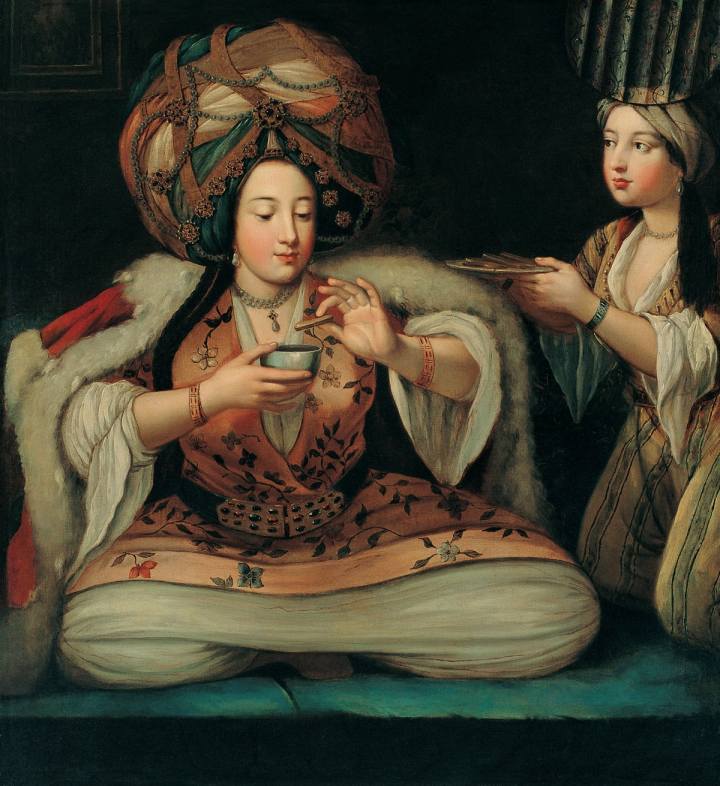
Unknown painter (French School), Enjoying Coffee, Turkey, first half of the 18th century (Istanbul: Pera Museum).
The Art of Dining brings together more than 200 works from the Middle East, Egypt, Central and South Asia, and beyond to explore connections between art and cuisine from ancient times to the present day. Paintings of elaborate feasts, sumptuous vessels for food and drink, and historical cookbooks show how culinary cultures have thrived in the Islamic world for centuries. Highlighting the relationship of these works to preparing, serving, and enjoying food, the exhibition engages multiple senses and invites us to appreciate the pleasures of sharing a meal.
Originally organized by the Los Angeles County Museum of Art (LACMA), the exhibition includes works from 30 public and private collections from across the U.S., Europe, and the Middle East, and 16 from the DIA’s collection.
Linda Komaroff, ed., Dining with the Sultan: The Fine Art of Feasting (DelMonico Books, 2023), 375 pages, ISBN: 978-1636810881, $85.
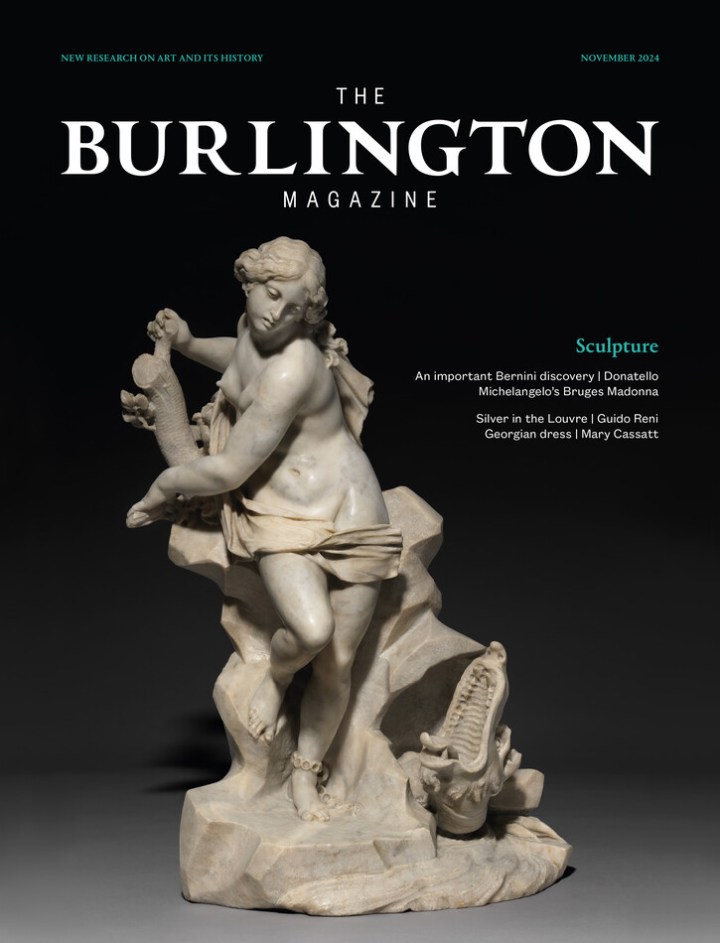
The Burlington Magazine, November 2024
The long 18th century in the November issue of The Burlington:
The Burlington Magazine 166 (November 2024)
e d i t o r i a l
 “The Life Cycle of Art History,” p. 1099.
Art history is withering. Art history is flourishing. Which of these statements is true? Very mixed impressions can be gathered from across the United Kingdom, where the future health and reach of the academic discipline is far from clear. Amid all this uncertainty, however, there are some inspiring developments that should be applauded.
a r t i c l e s
• Maichol Clemente, “‘Une pièce fort singulière’: The Rediscovery of Gian Lorenzo Bernini’s Andromeda and the Sea Monster,” pp. 1100–22.
An important early sculpture by Gian Lorenzo Bernini, Andromeda and the Sea Monster, is here attributed to him and published for the first time. It displays all the finesse and invention that characterises the work of his youth and is also notable for having been offered to Jean-Baptiste Colbert, First Minister of Louis XIV, before forming part of the collection of the Prince of Soubise [in the eighteenth century.]
r e v i e w s
• William Barcham, Review of the exhibition catalogue, Les Tiepolo: Invention et Virtuosité à Venise, edited by Hélène Gasnault with Giulia Longo and a contribution by Catherine Loisel (Beaux-Arts de Paris, 2024), pp. 1176–78.
• Erin Griffey, Review of the exhibition catalogue, Style & Society: Dressing the Georgians, by Anna Reynolds (Royal Collection Trust, 2023), pp. 1178–80.
• Philippa Glanville, Review of the catalogue of the Louvre’s silverware, Orfèvrerie de la Renaissance et des temps modernes: XVIe, XVIIe et XVIIIe siècles: La Collection du Musée du Louvre, by Michèle Bimbenet-Privat, Florian Doux, and Catherine Gougeon, with Philippe Palasi, 3 volumes (Éditions Faton, 2022), pp. 1186–87.
• Giulio Dalvit, Review of the catalogue, Galleria Borghese: Catalogo Generale I: Scultura Moderna, edited by Anna Coliva with Vittoria Brunetti (Officina Libraria, 2022), pp. 1192–93.
• Gauvin Alexander Bailey, Collective Creativity and Artistic Agency in Colonial Latin America, edited by Maya Stanfield-Mazzi and Margarita Vargas-Betancourt (University of Florida Press, 2023), pp. 1193–94.
• Charles Avery, Review of Die Bronzen des Massimiliano Soldani Benzi (1656–1740): Representationsstrategien des europäischen Adels um 1700, by Carina Weißmann (De Gruyter, 2022), p. 1195.
• Pierre Rosenberg, Review of the catalogue, French Paintings 1500–1900: National Galleries of Scotland, by Michael Clarke and Frances Fowle, 2 volumes (National Galleries of Scotland, 2023), pp. 1196–97.
Exhibition | The Art of French Wallpaper Design

Installation view of the exhibition The Art of French Wallpaper Design at the RISD Museum, November 2024.
◊ ◊ ◊ ◊ ◊
The exhibition is accompanied by an online publication:
The Art of French Wallpaper Design
RISD Museum, Providence, 16 November 2024 — 11 May 2025
The Art of French Wallpaper Design explores the vibrant, surprising designs that adorned walls in the 1700s and 1800s. Featuring more than 100 rare samples of salvaged wallpapers, borders, fragments, and design drawings, this exhibition reveals the creative process and showcases the extraordinary technical skills involved in producing these works, presenting an invaluable resource for artists and enthusiasts alike. This exhibition celebrates the vision and generosity of collectors Charles and Frances Wilson Huard, whose remarkable collection, assembled in the 1920s and ’30s, is now in the care of the RISD Museum. Accompanied by a comprehensive digital publication, The Art of French Wallpaper Design invites you to explore the remarkable innovation and craftsmanship of these historic pieces.
◊ ◊ ◊ ◊ ◊
Lyra Smith, ed., with contributions by Emily Banas, Brianna Turner, and Andrew Raftery, The Art of French Wallpaper Design (Providence: Rhode Island School of Design Museum, 2024), available online»
The vibrant designs of French papier peint (literally meaning painted paper) that adorned walls in the 1700s and 1800s were collected and donated to the museum by French artist Charles Huard and his wife, American writer Frances Wilson Huard. The Huard Collection is a rare resource due to the fragile and ephemeral nature of wallpapers. This free online publication explains the preservation methods used to take care of the wallpapers along with components made in the process, such as design drawings and woodblocks. The attentive care taken to preserve the materials made during each phase of the design process make the Huard Collection an ideal teaching collection.
Essays
• Introduction to French Wallpaper — Emily Banas
• About the Huard Collection — Emily Banas
• Conservation and the Huard Collection: Preserving the Processes of Making — Brianna Turner
• Printing Matters: Wallpaper in the Context of Printmaking — Andrew Raftery
The Collection
The RISD Museum contains one of the most significant collections of French 18th- and 19th-century wallpapers in the United States with approximately 500 wallpaper panels, borders, fragments, and design drawings. Here, you can browse the wallpapers by their collections, colors, motifs, or time periods.
The Making of Wallpaper
This video provides a guided, in-depth look at seven different wallpapers in the Huard Collection. Watch, listen, and learn about the hidden stories these wallpapers can tell us about their design, making, and use.
New Book | British Portrait Miniatures from the Thomson Collection
From Ad Ilissvm, an imprint of Paul Hoberton Publishing and also distributed by The University of Chicago Press (the Thomson Collection is now part of the Art Gallery of Ontario in Toronto):
Susan Sloman, British Portrait Miniatures from the Thomson Collection (London: Ad Ilissvm, 2024), 320 pages, ISBN: 978-1915401120, £80 / $100.
 Portrait miniatures were highly prized in Europe for nearly four hundred years; and, unusually, artists based in Britain were the acknowledged masters of this specialised field. Many of the best painters are represented in this remarkable but relatively little-known collection. As is illustrated and described in this book, miniatures were frequently made as tokens of love or memorials of loved ones; part-likeness, part-reliquary and part-jewel, they might be wearable in a locket, on a bracelet, or even on a finger ring, but their portability also made them desirable as gifts.
Styles, techniques, and modes of presentation naturally evolved between 1560 (the date of the first miniature in the catalogue) and around 1900. Some changes happened rapidly; in England, for example, the foundation of exhibiting societies in 1760s created a demand for larger miniatures that could hang on the wall alongside full-sized portraits. The Thomson collection includes fine examples of the work of Nicholas Hilliard (from the Elizabethan period) and John Smart (from the eighteenth century) as well as notable portraits by less familiar names such as Jacob Van Doordt and James Scouler. It is apparent from the scope and character of his acquisitions that Ken Thomson never planned an encyclopaedic collection. Reacting to miniatures that spoke most eloquently to him when held in the hand, or examined under a glass, he developed over time a fondness for particular artists and had no qualms about omitting others altogether.
Using this collection housed at the Art Gallery of Ontario as a case study, the catalogue discusses the function of miniatures, their material presence, the circumstances in which they were made, and aspects of their later history. The homes and studios of the most successful painters, as sumptuous as those occupied by oil painters, often passed from one generation to another: here, one key property in Covent Garden is described and illustrated. In this book, for the first time, a number of specialist artists’ suppliers are identified, showing where ivory could be obtained and enamel plates prepared and fired. The links between enamelling for clock and watch faces and enamelling for miniatures are demonstrated. The illicit practice within the late nineteenth and early twentieth century art trade of duplicating old miniatures, a topic generally avoided in the literature, is addressed here. Miniatures are difficult to display in museums, but recently-developed photographic methods of identifying pigments are also proving to be a way of introducing a new audience to this multi-layered subject. Eighteen years after Ken Thomson’s death, there could not be a more opportune moment to highlight his collection.
Susan Sloman has written extensively on British art, her most recent book being Gainsborough in London (2021). She has a longstanding interest in studio practice and artists’ premises and a record of unearthing fresh documentation on the lives of artists.










 Enfilade
leave a comment