Conference | Textual Bibliography for Modern Foreign Languages
◊ ◊ ◊ ◊ ◊
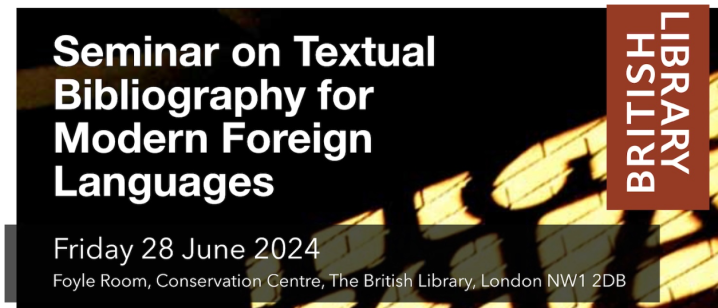
Seminar on Textual Bibliography for Modern Foreign Languages
The British Library, London, 28 June 2024
p r o g r a m m e
11.00 Registration and coffee
11.30 Juan Gomis (Valencia) — Visual Recognition Tools for the Study of Spanish Chapbooks, 18th and 19th Centuries
12.25 Lunch break
1.30 Karima Gaci (Leeds) — French Grammar Textbooks Published in England, 18th and 19th Centuries
2.15 Yuri Cerqueira dos Anjos (Wellington) — French Writing Manuals in the 19th Century
3.00 Tea
3.30 Alexandra Wingate (Indiana) — Reviewing the Systems Approach: A General Model for Book and Information Circulation
4.15 Sarah Pipkin (London) — Two Works by Kepler in University College London, De stella nova (1606) and De cometis libri tres (1619), and Their Provenance
The seminar will end at 5.00pm. Attendance is free, but please pre-register by sending your full name to Barry Taylor at barry.taylor@bl.uk and Susan Reed at susan.reed@bl.uk.
Workshop | Collecting, Growing, and Exploring
From ArtHist.net:
Collecting, Growing, and Exploring in Early Modernity
EPHE Sorbonne, Paris 11 June 2024
Organized by Maddalena Bellavitis and Catherine Powell-Warren
Registration due by 6 June 2024
The last few decades have produced a number of studies devoted to the relationship between collecting and science, highlighting the relationship between a growing interest in botany and the fascination with the collection of naturalia, especially from the mid-sixteenth century onward. These objects of natural origins aroused the admiration of enthusiasts and scientists alike. Underexplored, however, is the extent to which collecting and scientific experimentation and exploration were related in the early modern period. Thus, this workshop aims to focus attention on the collections of naturalia, on the one hand, and on the attempts to grow exotic plants in Europe and the adventurous journeys that the search for tropical plants and animals they encouraged, on the other. To be included in the list of participants, please send an email to maddalena.bellavitis@gmail.com.
p r o g r a m m e
10.00 Morning Session
• Maddalena Bellavitis (Saprat, EPHE) and Catherine Powell-Warren (Ghent University/FWO) — Welcome and Introductions
• Marie Bigotte (Durham University) — Politics and Diplomacy in Early Modern Princely Garden Collections of Naturalia
• Madeline White (University of Oxford) — ‘Indian Maiz…in my Garden at Mitcham’: Global Networks, Local Gardens, and Oxford’s du Bois Herbarium
• Baijayanti Chatterjee (University of Calcutta) — The Foundation and Growth of the Calcutta Botanical Garden: Plant Collecting and Botanical Science under the East India Company, 1786–1815
• Anil Paralkar (Heidelberg Centre for Transcultural Studies, Ruprech-Karls-Universität Heidelberg, WittenLab, Witten/Herdecke University) — The Datura in Gottorf: Botanizing, Ethnographing, and Imagining India in 17th-Century Germany
13.30 Lunch
15.00 Afternoon Session
• Seán Thomas Kane (Binghamton University) — Cosmographic Singularities: André Thevet as a Collector of American Exotica, 1556–1590
• India Cole (Queen Mary University of London) — The Duchess of Beaufort’s Pioneering Collections
• Silvia Papini (Università di Firenze – Pisa – Siena) — Exploring Nature in the Grand Duchy of Tuscany: Mercantile Perspectives in the Late 17th and Early 18th Centuries
• Celia Rodriguez Tejuca (Johns Hopkins University) — Stabilizing Materials across Time and Space: A Natural History Cabinet in 18th-Century Havana
17.15 Discussion and Conclusions
Symposium | Angelica Kauffman

Angelica Kauffman, Self-portrait with Bust of Minerva, detail, ca. 1780–84, oil on canvas, 93 × 76 cm
(Chur: Grisons Museum of Fine Arts, on deposit from the Gottfried Keller Foundation, Federal Office of Culture, Bern)
◊ ◊ ◊ ◊ ◊
From the Royal Academy:
Angelica Kauffman
Royal Academy of Arts, London, 7 June 2024
As part of the Royal Academy’s retrospective exhibition of the work of Angelica Kauffman (1741–1807), this one-day symposium will provide an in-depth look at the work of one of the RA’s founding members. Known for her society portraits and pioneering history paintings, Kauffman painted some of the most influential figures of her day—queens, countesses, actors, and socialites. Her history paintings often focused on female protagonists from classical history and mythology. Organised in partnership with the Paul Mellon Centre for Studies in British Art, this symposium will address Kauffman’s international career and her time in London, her inspirations and subjects, and her place in the art world at the time and her position now in the broader context of art history.
Speakers include Emma Barker, Rosalind Polly Blakesley, Bettina Baumgartel, Rebecca Cypess, Ellen Hanspach-Bernal, Yuriko Jackall, Chi-Chi Nwanoku, Wendy Wassyng Roworth, Jane Simpkiss, and Annette Wickham. The day will conclude with a special artist in-conversation between Sutapa Biswas and Griselda Pollock.
If you have any accessibility needs, please contact public.programmes@royalacademy.org.uk.
p r o g r a m m e
8.30 Private View of the Exhibition
10.00 Welcome and Opening Remarks
• Rebecca Lyons
10.10 Session 1 | Angelica Kauffman and the Royal Academy of Arts
Chair: Rebecca Lyons
• Annette Wickham — Angelica Kauffman at the Royal Academy: From a Face on the Wall to Painting the Walls
• Bettina Baumgärtel — Angelica Kauffman in Context
• Jane Simpkiss — An Artist among Equals: A Comparative Analysis of Angelica Kauffman’s Self-Portraits with Those of Her Male Contemporaries
11.35 Break
12.00 Session 2 | Performance and Self-Fashioning in 18th-Century London
Chair: Marie Tavinor
• Chi-chi Nwanoku — 18th-Century Musical Prodigies
• Rebecca Cypess — Music and the Self-Fashioning of Angelica Kauffman
• Emma Barker — Figuring the Sibyl: Angelica Kauffman and the Image of Female Genius
1.25 Lunch Break
2.40 Session 3 | The International Business of Art
Chair: Sarah Victoria Turner
• Yuriko Jackall and Ellen Hanspach-Bernal — The Connections between Style, Reputation, and Business Acumen
• Rosalind Polly Blakesley — Kauffman in the Reign of Catherine the Great
• Wendy Wassyng Roworth — An Enterprising Artist: Angelica Kauffman and the Business of Art
4.10 Break
4.30 Artist Talk / In-Conversation
• Griselda Pollock and Sutapa Biswas
5.30 Concluding Remarks
• Sarah Victoria Turner
◊ ◊ ◊ ◊ ◊
Note (added 23 May 2024) — The posting was updated to include programme details.
Conference | The First Public Museums, 18th–19th Centuries
From ArtHist.net:
Publics of the First Public Museums: II. Literary Discourses, 18th–19th Centuries
Durham University, 23–24 May 2024
Organized by Carla Mazzarelli and Stefano Cracolici
The workshop Publics of the First Public Museums (18th and 19th Centuries), II. Literary Discourses is an integral part of the research project Visibility Reclaimed: Experiencing Rome’s First Public Museums (1733–1870), An Analysis of Public Audiences in a Transnational Perspective (SNSF 100016_212922). The second of three encounters, this workshop delves into the examination of literary discourses vital to understanding the experiences of early museum-goers. Travel literature has long represented a privileged source for investigating the origins of the first public museums and the practices of access to public and private collections in Europe. However, in the light of recent studies aimed at deepening the material history of the museum and the encounter of the public with the institutions, these sources deserve a closer scrutiny in both methodological and critical terms. Following the inaugural Rome session that focused on institutional sources, the Durham workshop turns its gaze towards the rich literary narratives with the aim of analysing them also in a comparative perspective with the primary sources. As museums sought to define and engage their public, literature often became both a mirror and a mould, reflecting and shaping societal perceptions. With a spotlight on interdisciplinary and transnational approaches, the Durham workshop calls for a deeper probe into the visual and material realms of museums, emphasizing the interplay between literary discourses and artworks, collections, display, space, audiences ‘narrated’ in the museum and the evolving institutional norms of the 18th and 19th centuries. Information and streaming on request: visibilityreclaimed@gmail.com.
Principal investigator
Carla Mazzarelli, Università della Svizzera italiana, Accademia di architettura di Mendrisio, Istituto di storia e teoria dell’arte e dell’architettura
Project Partners
Giovanna Capitelli, Università Roma Tre
Stefano Cracolici, Durham University
David García Cueto, Museo del Prado
Christoph Frank Università della Svizzera Italiana
Daniela Mondini, Università della Svizzera Italiana
Chiara Piva, Sapienza Università di Roma
Organising Secretary
Gaetano Cascino (Università della Svizzera italiana)
Lucia Rossi (Università della Svizzera italiana)
t h u r s d a y , 2 3 ma y
9.00 Welcome by Ita MacCarthy (Durham University, Institute of Medieval and Early Modern Studies, Director)
9.15 1 | Methodological Reflections
This session serves as an introduction to the workshop, providing a shared reflection on the current state of research and the future prospects. It will focus on the comparative, interdisciplinary, and intermedial analysis of literatures within the field of museum studies.
Chair: Christoph Frank (Università della Svizzera italiana)
• Carla Mazzarelli (Università della Svizzera italiana) — Letterature e pubblici del Museo: fonti o modelli?
• Stefano Cracolici (Durham University) — Musei d’Arcadia
• Marco Maggi (Università della Svizzera italiana) — ‘Tutta l’arte del buon governo trastullando imparare in un passeggio’: A Literary Rearrangement of the Duke of Savoy’s Great Gallery
11.15 2 | Museums at Hand
This session will analyse literary genres for museum visitors, like guidebooks, and the role of periodicals in broadening museum audience engagement. Discussions will cover the evolution of these texts and new reading approaches introduced by Digital Humanities.
Chair: Giovanna Capitelli (Università Roma Tre)
• Damiano Delle Fave (Sapienza Università di Roma) — Pubblici dei musei a Roma nelle guide dell’Ottocento
• Gaetano Cascino (Università della Svizzera italiana) — ‘I Romani non frequentano le gallerie di Roma’: discussioni e stereotipi sui visitatori dei musei di Roma nella stampa di secondo Ottocento
• Pietro Costantini (Università di Teramo) — Viaggio in Abruzzo: Vincenzo Bindi e I Monumenti storici ed artistici degli Abruzzi
12.30 Keynote Address
• Carole Paul (University of California, Santa Barbara) — The Museum Going Public in 18th-Century Italy
13.15 Lunch Break
14.15 3 | Museums on the Beaten Track
This session focuses on museum experiences in travel literature, including correspondence, diaries, and travel accounts. Discussions will specifically examine the unique perspectives of visitor-narrators and how published literary accounts of museum visits compare or contrast with unpublished sources.
Chair: Mauro Vincenzo Fontana (Università Roma Tre)
• Rosa Maria Giusto (Napoli, CNR) — La ‘città-museo’ e i resoconti dei viaggiatori: le Notizie di Roma scritte dal Sig.re Aless.o Galilei
• Luca Piccoli (Università della Svizzera italiana) — Reise nach Italien dell’architetto Simon-Louis Du Ry: resoconti pubblici e privati sui musei in Italia a confronto
• Ludovica Scalzo (Università Roma Tre) — ‘The torch, like Promethean fire, makes every statue live’: visite a lume di fiaccola nei musei romani dai resoconti di viaggio della prima metà dell’Ottocento
15.30 Coffee Break
15.45 4 | Varieties of Sightseeing
This session explores the variety of visiting spaces, perspectives, and geographies in the 18th and 19th centuries, including museums, monuments, private palaces, and studios. Discussions will focus on what these diverse viewpoints reveal about sociocultural dynamics.
Chair: David García Cueto (Museo Nacional del Prado)
• Daniel Crespo-Delgado (Universidad Complutense de Madrid) — Los monumentos y las colecciones de arte en la literatura de viajes española (y por España) de la Ilustración
• Victoria Arzhaeva (EPHE-PSL, laboratoire Histara) — Les pensionnaires russes au Vatican: l’expérience muséale à travers la correspondence artistique et les journaux intimes du XIXe siècle
• Michele Amedei (Università di Pisa) — ‘The Studio was a monument of his intelligent taste and æsthetic
culture’: l’atelier dell’artista nei resoconti e diari di viaggio di visitatori nordamericani nella Toscana dell’Ottocento
17.00 Keynote Address
Christoph Frank (Università della Svizzera italiana) — In the Shadow of the Americas: The Humboldts and Schinkel in the Rome of the Early 1800s
f r i d a y , 2 4 m a y
9.00 5 | Literary Landscapes
This session aims to reflect on how literature provides a multifaceted view of the museum experience, extending the analysis to landscape traversal. It will consider the poetic charm of narrative evocations that capture the emotions of a setting and the ekphrastic descriptions that articulate artworks in written words.
Chair: Ita MacCarthy (Durham University)
• Cecilia Paolini (Università di Teramo) — Il Controcanto di Clio: George Sand e l’inascoltata interpretazione del paesaggio italiano tra spazio barocco e romanticismo progressista
• Elizaveta Antashyan (Sapienza Università di Roma) — ‘A Walk through the Hermitage’: Russia’s First Public Museum and Its Reflections in Literature during the Reign of Alexander II (1855–1881)
10.00 6 | Museum Tales
This session is dedicated to literary texts that transform museum visits into narratives. It explores how notions of time and space during such visits compare with the temporal dynamics of literary narration and how the perception of the visited places differs from travel accounts.
Chair: Sara Garau (Università della Svizzera italiana)
• Lucia Rossi (Università della Svizzera italiana) — Il ‘Museo di Roma’ tra esperienza, ricordo e costruzione narrativa: I Miei Ricordi e le Lettere di Massimo d’Azeglio
• Meghan Freeman (Yale University) — The Intimacies of Art Travel in Henry James
• Corinne Pontillo (Università di Catania) — ‘S’arrestò davanti alla Gioconda’: visitare il Museo del Louvre attraverso la letteratura
11.15 Coffee Break
11.30 7 | Sensory Visits
This session explores how the concept of the museum as a space to ‘read’ differs from its traditional perception as a space to ‘visit’. It will examine, from an interdisciplinary perspective, the implications of this distinction in literary and museological discourses, with a special focus on the sensory dimension of navigating through texts and the museum.
Chair: Marco Maggi (Università della Svizzera italiana)
• Isabelle Pichet (UQTR, Trois Rivières) and Dorit Kluge (VICTORIA | International University, Berlin) — Experiencing 18th-Century Art Exhibitions in Paris and Dresden: A Sensory Interplay between Exhibition and Text
• Sofia Bollini (Università Luigi Vanvitelli, Napoli / Università della Svizzera Italiana) — Il preparato anatomico come oggetto museale e letterario nella cultura tardottocentesca
• Laura Stefanescu (Villa I Tatti, Harvard University) — Vernon Lee’s Gallery Diaries: An Aesthetic Bodily Experience of Italian Museums in the Early 20th Century
12.30 Discussion and Conclusion
Mount Vernon Symposium 2024
From Mount Vernon:
On the Eve of Independence: Art and Architecture in the British Empire
Online and in-person, The Washington Presidential Library at Mount Vernon, 31 May — 2 June 2024
In 1774, on the eve of the American Revolution, George Washington began a major expansion of his home, a building whose foundations dated to the 1730s. It was a project that he maintained throughout the war and that he continued after his triumphant return to Mount Vernon. Inspired by the work that began 250 years ago, the 2024 Mount Vernon Symposium will explore the art and architecture of the British Atlantic in the long-eighteenth century, surveying the connections between and comparisons of British and American practices in the years preceding and surrounding the American Revolution.
Speaker biographies and abstracts are available here»
f r i d a y , 3 1 m a y
1.00 Welcome and Introductions
1.15 Afternoon Talks
• Cosmopolitan and Local in Colonial Boston: Copley’s House — Jeffrey Klee
• Britain Over the Blue Ridge: Architectural Impressions on Virginia’s Shenandoah Valley — A. Nicholas Powers
• Between a Handsome Finish and Sorrowful Discouragement: Black Craftsmen and the Making of American Architecture — Tiffany Momon
• Reimagining Hemsley’s Cloverfields — Willie Graham
• George Washington’s Mount Vernon: From Revolution to Revitalization — Susan Schoelwer and Thomas Reinhart
6.30 Reception, Mansion East Lawn / Mansion Open House
7.15 Dinner, Ford Orientation Center
s a t u r d a y , 1 j u n e
9.00 Welcome and Introductions
9.15 Morning Talks
• Free versus Will: Craftspeople in Early Maryland — Brittany Luberda
• Sleuthing Out a Portrait: From Mount Vernon to the British Island of Dominica — Dorinda Evans
• Drawing the Lines of Revolution: Pastel Portraits, Boycotts, and American Independence — Megan Baker
• Disasters in the Eighteenth-Century North Atlantic: Art, Gardens, and Novel — Joseph Litts
12.15 Lunch, Founders’ Terrace
1.45 Afternoon Talks
• The Endless Round: The London Town House, Politics and Society in the 1770s — Jeremy Musson
• Enlightened Eclecticism: The Grand Design of the 1st Duke and Duchess of Northumberland — Adriano Aymonino
• The Transatlantic Design Network: Thomas Jefferson, John Soane, and Agents of Architectural Exchange — Danielle Willkens
5.45 Reception, Mount Vernon Wharf
7.00 Dinner, Mount Vernon Wharf
s u n d a y , 2 j u n e
9.30 Morning Talks
• The Irish War of Independence and Burning the Big House, 1920–21 — Terence Dooley
• Tory, Whig, Empire: The Implications of Classical Style in the Early Modern British Empire — Sarah Hutcheson
• Public Architecture and Imperial Reform on the Eve of the Revolution: Governing the British Atlantic after the Treaty of Paris — Christian Koot
• Educating the Next Generation in Historic Trades and Preservation — Markus Damwerth, Christina Butler, Joseph Zemp, and Steve Fancsali
Study Day | Collecting through the Ages
From The Wallace Collection and the conference programme:
The Wallace Collection is thrilled to announce the relaunch of the History of Collecting as Collecting Past and Present. This new series will take the format of biannual, themed study days, which will include fascinating talks from leading specialists, exploring collecting through the ages. Exclusive interviews with modern-day collectors will also feature, revealing tantalising glimpses into how exceptional objects are brought together. These will be followed by drinks receptions that will act as unique forums for discussion. For those further afield or unable to make it to the museum, the talks can be watched online. And if you are interested in taking part as a speaker at future events, calls for papers will be shared throughout the year.

Bishan Singh, The Court of Maharaja Ranjit Singh (1780–1839), Amritsar or Lahore, 1863–64
(Toor Collection)
◊ ◊ ◊ ◊ ◊
Collecting through the Ages
Online and in-person, The Wallace Collection, London, 5 July 2024
The Wallace Collection and the outstanding artworks it contains were brought together through the 18th and 19th centuries by an extraordinary family of collectors—the marquesses of Hertford and Sir Richard and Lady Wallace. Delve into the history of collecting across the ages at our first Collecting Past and Present event. You’ll hear from leading academics and specialists on a variety of subjects, from the collecting of Shakespearean relics to the houses of Calouste Gulbenkian. Also join us for a conversation with a leading modern-day collector of Sikh, Indian and Islamic art, Davinder Toor, who will offer exclusive insights into his passions and inspirations.
Registration is available here»
p r o g r a m m e
10.15 Welcome
10.30 Verena Suchy — Women as Collectors of 18th-Century Cabinets
In the theory and history of collecting, women collectors have often been absent. Examples of noble women from different German principalities, however, indicate that in the 18th century it was common—if not necessary—for aristocratic women to assemble collections of jewellery, decorative art, and precious objects. Examining these collections with Dr Suchy will shine a light on the collecting practices of women and their political and representative functions.
11.15 Refreshments
11.45 Kirsten Tambling — Shakespearean Relics in the Royal Collection
1816 was the tercentenary of Shakespeare’s death, and, in this year, George, Prince Regent, ordered seven toothpick cases fashioned from ‘Shakespere’s Tree’. He was thus inserting the monarchy into a buoyant contemporary trade in Shakespearean ‘relics’. Focusing on the 18th and 19th centuries, Dr Tambling will investigate Shakespearean relics in the Royal Collection and the significance of royals collecting
Shakespeare.
12.45 Peter Humfrey — Amabel, Countess de Grey, as Collector and Curator in Post-Orléans London
Diarist, practising artist, and commentator on the political events of her time, Amabel was also a well-informed collector, both of Old Masters arriving on the London art market in the wake of the French Revolution, and of the work of her younger contemporaries. Further, she was heir to a distinguished collection of paintings from her family and was active in documenting and rehanging it. Professor Humfrey will take a closer look at this fascinating character.
13.30 Q&A
13.45 Lunch break
14.45 Barbara Bryant — Stephen T. Gooden and the Marketing of Edward Burne-Jones’s Legend of St George and the Dragon Series
In 1894, a series of seven paintings by Burne-Jones came to auction at Christie’s. Dr Bryant will consider the protracted attempts by various dealers to sell the series in the 1890s until the successful sale by the relatively new gallery owner Stephen T. Gooden. Gooden’s achievement will give an insight into how art
dealers of this period marketed the modern masters.
15.45 Vera Mariz — The Making of a House for Calouste Gulbenkian’s Art Collection
Dr Mariz will explore the various residences that housed Calouste Gulbenkian’s art collection, with a primary emphasis on 51 Avenue d’Iéna. While the acquisition process of the latter mirrors that of acquiring artworks, Gulbenkian’s satisfaction remains uncertain. Newly discovered materials and innovative approaches offer fresh interpretations of the hôtel Gulbenkian, which will be presented as an intimate testament to Gulbenkian’s essence as an art collector.
16.30 In Conversation with Davinder Toor
Two centuries ago, Punjab’s Sikh ruling elite lavishly patronised artists and craftsmen to enhance the splendour of their empire. By the mid-19th century, the Sikh empire had met its demise at the hands of the East India Company. Over the following century and a half, Sikh artefacts were dispersed across the globe. Some ended up in British institutional collections, while others were bought and sold by collectors. With Curatorial Assistant Alexander Collins, Davinder will discuss how he has pursued his passion as a collector to create a lasting legacy to the empire of the Sikhs.
17.15 Q&A
17.30 Drinks reception
Conference | Captivity: Assembling Nature’s Histories
From the Center for 17th- and 18th-Century Studies at UCLA:
Captivity: Assembling Nature’s Histories
William Andrews Clark Memorial Library, Los Angeles, 17 May 2024
Conference organized by Anna Chen, Rebecca Fenning Marschall, and Bronwen Wilson
The early modern period was a hothouse for the study of physical things in the natural world, and for the collection and assembly of them in human-made physical spaces. In other periods, botanical samples were preserved by diarists in their journals, such as Poems and Riddles written by Mary Woodyeare Tibbits (ca. 1764–1840), and Pressed specimens of butterflies and moths (1905), compiled by Yasushi Nawa (1857–1926), which are both in the Clark Library’s collections. Nawa’s lepidochromic book showcases the technique of ‘printing butterflies’, or fixing the scales of their wings onto paper. Specimens of all sorts were admired for their variegated colors, curated in collections, and assembled into books. Birds were captured in aviaries for their sounds, or killed and prepared as specimens for display, study, and scientific descriptions. Plants were transported across oceans in terraria, and contained in plots and glasshouses.
Libraries were deeply implicated in these historical pursuits of the collection and classification of the contents of the natural world, as are modern libraries that now grapple with whether and how to preserve the nature that enters their collections. The interior-exterior division of libraries is a highly regulated boundary. Libraries strive tirelessly to seal the building envelope against the environmental conditions of the outdoors, as fluctuating temperature and humidity levels, mold spores, insects, rodents and natural disasters all threaten damage to their holdings. Libraries also capture books about nature on their shelves, as flora and fauna cohabitate on their grounds. At the Clark Library, Cooper hawks nest, feral cats roam, and roots of trees probe the ground in search of water. What might we learn from these efforts to capture and to conserve nature, coupled with its potential to decompose or to invade environments?
The conference is free to attend with advance registration and will be held in-person at the Clark Library and livestreamed on the Center’s YouTube Channel. No registration is required to watch the livestream. In-person registration will close on Monday, May 13 at 5.00pm. Seating is limited at the Clark Library; walk-in registrants are welcome as space permits.
p r o g r a m
9.15 Introduction — Anna Chen, Rebecca Fenning Marschall, and Bronwen Wilson (UCLA)
9.30 Panel 1 | Flight and Containment
Moderator: Rebecca Fenning Marschall (UCLA)
• Cynthia Fang (UCLA) — Containing Sound, Exhibiting Images: An Aviary at the European Palace Complex in Qing China
• V. E. Mandrij (University of Konstanz / University of Amsterdam) — The Lepidochromy Technique: Capturing Colors of Butterflies and Moths in Books and Paintings
• Jennifer Martinez Wormser (Ella Strong Denison Library, Scripps College) — One Hundred Years Later: Ellen Browning Scripps and William Leon Dawson’s Birds of California (1923)
11.00 Coffee break
11:30 Panel 2 | Accretions
Moderator: Anna Chen (UCLA)
• Tori Champion (University of St. Andrews) — Material Afterlives: The Shell Craze in 18th-Century France and the Forgotten Mollusc
• Joy Zhu (UCLA) — Misinterpreting Fossil Evidence: On the Discovery of ’Dragon Fossils‘ in China, 1915–30
• Andrew Weymouth (University of Idaho) — Humanizing Nature Research History with Static Web Design
1.00 Lunch, with a display of Clark Library materials in the North Book Room
2.30 Panel 3 | Unruly Collections
Moderator: Rebecca Fenning Marschall (UCLA)
• David Jones (Northwestern University) — In However Low Degree: Reframing the Role of Silverfish in Louis Fleckenstein’s Photography
• Ashley Cataldo (American Antiquarian Society) — From Weeding to Reseeding: Removing (and Restoring) Botanicals in Library Collections
• Deirdre Madeleine Smith (University of Pittsburgh and Carnegie Museum of Natural History) — Whither ‘Papered Leps’: On Accidental Human Archives at the Carnegie Museum of Natural History
4.00 Coffee break
4.30 Panel 4 | Assembling
Moderator: Bronwen Wilson (UCLA)
• Lindsay Wells (Independent Scholar) — Portrait of a Colonial Botanist: Joseph Dalton Hooker and the Visual Politics of Plant Science
• Frederico Câmara (Independent Scholar) — Views of Paradise: A Photographic Atlas of the Artificial Environments of Zoological Gardens and Aquariums in Oceania
Byron 200 Years after His Death
George Gordon Byron (1788–1824) died 200 years ago on Friday (19 April). Writing this week for The Washington Post, Michael Dirda reviews two new books about the poet (noted below), while Benjamin Markovits, in a New York Times essay, grapples with how (and whether) people still read him. A Byron Festival is being held at Trinity College, Cambridge (yesterday and today) while the Keats-Shelley House presents the exhibition, Byron’s Italy: An Anglo-Italian Romance, along with a series of talks and other events throughout the year. Finally (for now), Liverpool UP has discounted some of its Byron books.
The Byron Festival at Trinity
Trinity College Cambridge 19–20 April 2024
 Trinity College Cambridge will host a two-day festival to coincide with the 200th anniversary of Lord Byron’s death on 19 April 1824, in Missolonghi, Greece. Byron was a student at Trinity College and is one of its most celebrated alumni. While enrolled as an undergraduate, Byron published his collection of poetry, Hours of Idleness, and began the satirical poem that would become English Bards and Scotch Reviewers, a scathing provocation of the literary establishment.
Described by the College’s Senior Tutor of the time as a “young man of tumultuous passions,” Byron became one of the most controversial, celebrated, and influential poets of his age. When Westminster Abbey declined to accept the magnificent statue of Byron, created after his death by the Danish sculptor Thorvaldsen, Trinity gave it a home in the Wren Library, where the poet still stands—an impressive presence for students, scholars, and visitors.
But what kinds of presence does Byron have now? This question is the focus of an exciting programme of talks, readings, music, and exhibited work, which will address, and mediate, the legacy and status of Byron now, within the contexts of today’s culture and scholarship. The Byron Festival Conference programme includes talks about Byron, by academics and writers including Bernard Beatty, Drummond Bone, Clare Bucknell, Will Bowers, Christine Kenyon Jones, Mathelinda Nabugodi, Seamus Perry, Diego Saglia, Dan Sperrin, Jane Stabler, Fiona Stafford, A.E. Stallings, Andrew Stauffer, Corin Throsby, Clara Tuite, Ross Wilson.
◊ ◊ ◊ ◊ ◊
Fiona Stafford, ed., Byron’s Travels: Poems, Letters, and Journals (New York: Everyman’s Library, 2024), 728 pages, ISBN: 978-1101908426, $35.
 George Gordon, Lord Byron, was one of the leading figures of British Romanticism. The Byronic hero he gave his name to—the charming, dashing, rebellious outsider—remains a powerful literary archetype. Byron was known for his unconventional character and his extravagant and flamboyant lifestyle: he had numerous scandalous love affairs, including with his half-sister Augusta Leigh. Lady Caroline Lamb, one of his lovers, famously described him as “mad, bad and dangerous to know.”
His letters and journals were originally published in two volumes; this new one-volume selection includes poems and provides a vivid overview of his dramatic life arranged to reflect his travels through Scotland, Italy, Spain, Turkey, Albania, Switzerland, and of course Greece, where he died. It contains a new introduction by scholar Fiona Stafford highlighting Byron’s enduring significance and the ways in which he was ahead of his time.
Fiona Stafford is a professor of English literature at Oxford University. The author of many books, including a biography of Jane Austen, she also wrote and presented the highly acclaimed The Meaning of Trees for BBC Radio 3’s The Essay. Her book The Long, Long Life of Trees, published in 2017, was a Sunday Times Nature Book of the Year.
◊ ◊ ◊ ◊ ◊
Andrew Stauffer, Byron: A Life in Ten Letters (Cambridge: Cambridge University Press, 2024), 300 pages, ISBN: 978-1009200165, $30.
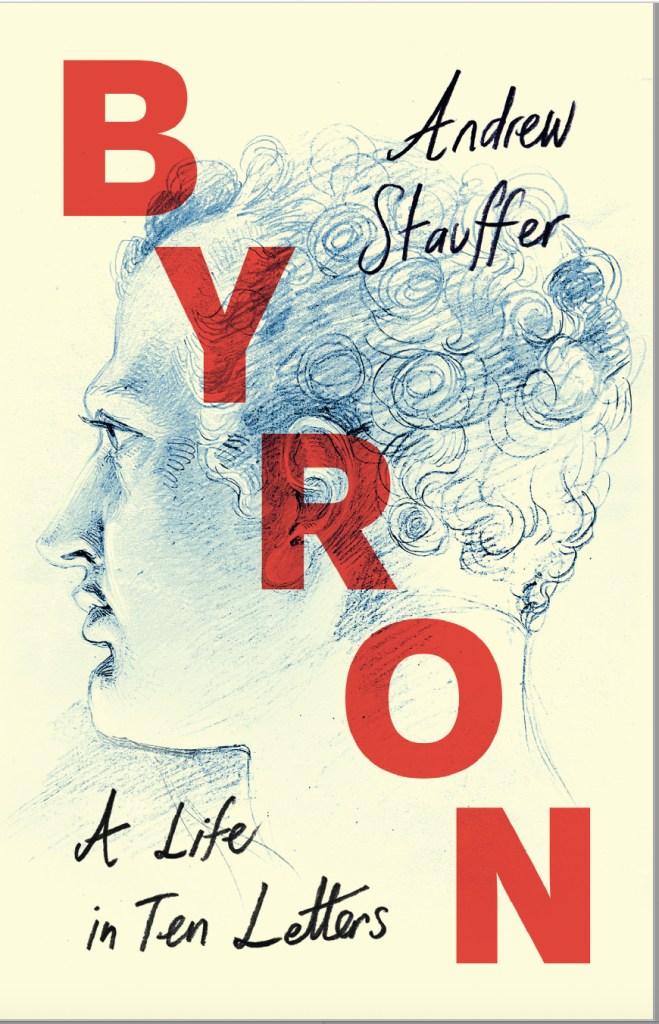
Lord Byron was the most celebrated of all the Romantic poets. Troubled, handsome, sexually fluid, disabled, and transgressive, he wrote his way to international fame—and scandal—before finding a kind of redemption in the Greek Revolution. He also left behind the vast trove of thrilling letters (to friends, relatives, lovers, and more) that form the core of this remarkable biography. Published to coincide with the 200th anniversary of Byron’s death, and adopting a fresh approach, it explores his life and work through some of his best, most resonant correspondence. Each chapter opens with Byron’s own voice—as if we have opened a letter from the poet himself—followed by a vivid account of the emotions and experiences that missive touches. This gripping life traces the meteoric trajectory of a poet whose brilliance shook the world and whose legacy continues to shape art and culture to this day.
Andrew M. Stauffer is a professor in the English Department at the University of Virginia, where he specializes in nineteenth-century literature, especially poetry.
Workshop | The Reception of the Belvedere Torso

William Hogarth, The Analysis of Beauty, Plate 1, detail, 1753.
◊ ◊ ◊ ◊ ◊
From ArtHist.net and the Freie Universität Berlin:
Centre/Pieces: De- and Recentring the Belvedere Torso
Berlin, 25–26 April 2024
Organized by Anna Degler and Katherine Harloe
Registration due by 22 April 2024
This two-day workshop is held as a cooperation between the EXC 2020 project The Travelling Torso by Anna Degler (EXC 2020, Freie Universität Berlin) and Katherine Harloe (Institute of Classical Studies, University of London School of Advanced Study). It is dedicated to the post-antique reception of one of the most canonised and well-known antique sculptures within ‘Western’ culture, the so-called Belvedere Torso, which is kept in the Vatican Museums in Rome. Since at least the early sixteenth century, this larger-than-life marble sculpture has been the centrepiece of a classical canon. It has also at the same time always only been known in its fragmentary state, as a powerful body in pieces.
Exploring scholarly, artistic, and curatorial engagement with this centrepiece of classical Greco-Roman antiquity allows for a deeper insight into complex temporal, normative, and political reference systems that are constitutive of classical receptions. The workshop will focus on the relation of body politics and classical sculpture over the five centuries since the Torso entered the European art historical canon in order to explore the entanglements of these engagements with ideals of freedom, humanity, and gender, as well as racial and ableist discourses.
Following the research agenda of EXC 2020, the reception of the Belvedere Torso serves as one paradigmatic case study of intermediary literary and artistic practices. In the workshop we will discuss how its reception within art, literature, scholarship, and museums have produced or reproduced a variety of (political) temporalities and a set of norms. We will examine collection displays, the history of copies in plaster casts and other media, the Torso’s material transformations, and the many literary and artistic attempts at its completion, as well as comparing its reception with that of other famous antique sculptures (such as Laocoön and Venus of Milo). Invited practitioner Stephe Harrop will engage with the Torso from the perspective of contemporary storytelling with a new piece, to be performed during the workshop.
This two-day workshop—held on split sites between the Cluster Villa and the Abguss-Sammlung Antiker Plastik in Charlottenburg—will bring together international and local guest speakers working at the interface of a variety of disciplines (classics, literary studies, art history, archaeology, and performance studies) to investigate and reflect upon the manifold temporalities and asynchronies that constitute and complicate processes of classical reception. Given the Belvedere Torso’s central position in ‘Western’ canons up until today, the workshop aims at de- and possibly recentring the Torso by self-critically exploring classical reception and canonisation as a powerful practice. The workshop hereby raises the question how those practices actively shape temporal communities. This free event will be conducted in English. Please register with anna.degler@fu-berlin.de before 22 April 2024.
t h u r s d a y , 2 5 a p r i l
Morning at Cluster Villa, Otto-von-Simson Strasse 15
9.30 Registration
9:45 Introduction by Katherine Harloe (London, Institute of Classical Studies) and Anna Degler (Berlin, EXC 2020)
10.15 Morning Presentations
Chair: Anna Degler (Berlin)
• Elisabeth Décultot (Halle) — Winckelmann’s Invention of the Belvedere Torso: Epistemological Foundations and Strategic Interests
• Andrew James Johnston (Berlin, EXC 2020) — Making the Torso Move: The Torso Belvedere, the Uffizi Wrestlers, and Courbet
12.30 Lunch at Clustervilla
Afternoon at the Abguss-Sammlung Antiker Plastik (Greek and Roman Plaster Cast Collection), Freie Universität, Schloss Charlottenburg
2.30 Check-in
3.00 Afternoon Presentations
• Lorenz Winkler-Horaček (Berlin) — The Belvedere Torso in Berlin: Between Display, Distribution, and Disappearance
• Stephe Harrop (Liverpool) — Storytelling Performance Speaking Stone: Broken Stories from the Belvedere Torso
• Leonard Barkan (Princeton) — If the Torso Belvedere Could Talk, What Would It Say?
6.30 Reception
f r i d a y , 2 6 a p r i l
Cluster Villa, Otto-von-Simson Strasse 15
9.15 In conversation with Stephe Harrop
10.00 Morning Presentations
• Allannah Karas (Miami) — Black Artists and ‘White’ Sculptures: Reconfiguring the Classical Tradition
• Ryan Sweet (Swansea) — Prosthesis Narratives: Constructing and Complicating Physical Wholeness in Victorian Literature and Culture
12.15 Lunch
1.00 Afternoon Presentations
• Anna Degler (Berlin) — Modes of Thinking or Thinkers beyond Rodin: The Torso Belvedere in the United States, c. 1853–63
• Closing Discussion
Conference | Immanuel Kant and Hull
Immanuel Kant was born this month 300 years ago (April 22). From the conference registration form:
Immanuel Kant and Hull
Hull History Centre, East Yorkshire, 15 June 2024
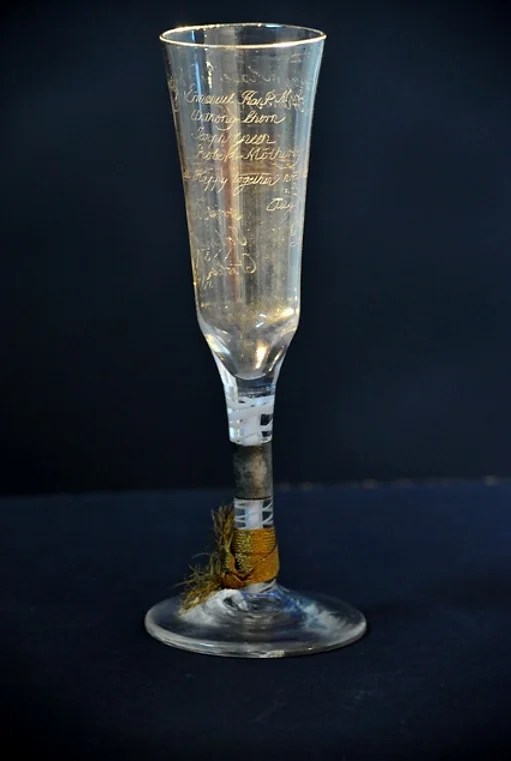
Drinking glass engraved with the names of Immanuel Kant and four men from Hull, 1763 (Lüneburg: East Prussian State Museum).
Presented by the Georgian Society for East Yorkshire and Friends of Kant and Königsberg, in association with Hull History Centre and University of Hull Maritime History Trust
This conference commemorates the tercentenary of the birth of the most important German philosopher, Immanuel Kant (1724–1804), and celebrates his close friendship with Joseph Green and Robert Motherby, merchants from Hull. It has been said that Green’s effect on the philosopher “cannot be overestimated.” The Königsberg firm of Green and Motherby managed Kant’s finances, and Kant had a great influence on the education of Robert Motherby’s children, one of whom, William, founded The Friends of Kant in 1805.
The fee of £30 (Georgian Society for East Yorkshire and Friends of Kant and Königsberg members £25) includes all refreshments. Book early, as places limited. Please direct questions to to Susan Neave, susananeave@gmail.com.
p r o g r a m m e
11.00 Introduction – Gerfried Horst (Chairman, Friends of Kant and Königsberg)
11.15 Morning Session
• Life and Work of Immanuel Kant – Tim Kunze (Curator, Immanuel Kant Department, East Prussian State Museum, Lüneburg)
• Königsberg Kant’s Home – Max Egremont (author of Forgotten Land: Journeys among the Ghosts of East Prussia)
1.00 Lunch
1.45 Afternoon Session
• Kant and Slavery – Judith Spicksley (Wilberforce Institute for the Study of Slavery and Emancipation, University of Hull)
• Hull’s Baltic Trade – Nick Evans (School of Humanties, University of Hull)
• Hull Merchants and Immanuel Kant – David Neave (Georgian Society for East Yorkshire)
• The Motherby Family of Hull and Königsberg – Marianne Motherby (Friends of Kant and Königsberg)
4.00 Tea and Cakes










 Enfilade
leave a comment