Journée d’étude | Le marché de l’art, 1750–1800
From H-ArtHist:
Le marché de l’art dans la seconde moitié du XVIIIe siècle: Expertises, négociations et controverses
Institut national d’histoire de l’art, Paris, 5 June 2019
Les marchands se trouvent au cœur d’un vaste réseau culturel et artistique à cette période et deviennent les premiers intermédiaires entre l’œuvre et l’amateur d’art. Objets de curiosité, arts décoratifs, tableaux, dessins et gravures font tous partie des biens constituant ce négoce. Durant cette époque particulièrement dynamique, tant du point de vue historique que culturel, plusieurs controverses se font jour en lien avec ce commerce florissant. De nombreuses polémiques émergent entre différentes figures de marchands influents, certains qualifiant même leurs confrères de « brocanteurs ». Ces polémiques signalent-elles une volonté de s’imposer dans un secteur devenu fortement concurrentiel ? Où ne sont-elles que la manifestation de l’ambition de voir reconnaître une réelle distinction de compétences entre les marchands ? Des débats éclatent aussi entre les marchands et leur clientèle. Les amateurs, à la recherche constante d’œuvres authentiques, originellement créées par un artiste, sont ainsi confrontés aux problèmes que posent la copie et le faux, et à l’honnêteté parfois contestable des négociants. S’agit-il alors d’un problème de connaissances et de compétences des marchands ou d’un manque manifeste de sincérité au profit d’un désir grandissant d’enrichissement ? Enfin, cette journée s’intéressera aux échanges entre la France et ses pays voisins et, plus particulièrement, à la visibilité des pratiques marchandes contestées et à la manière dont les Français sont perçus à l’étranger durant cette période.
Journée d’étude organisée par le GRHAM (Groupe de Recherche en Histoire de l’Art Moderne)
• Florence Fesneau (université Paris 1 – Panthéon-Sorbonne)
• Barbara Jouves (université Paris 1 – Panthéon-Sorbonne)
• Maxime Georges Métraux (Sorbonne université)
• Alice Ottazzi (université Paris 1 – Panthéon-Sorbonne / Université de Turin), Marine Roberton (université Paris 1 – Panthéon-Sorbonne)
• Maël Tauziède-Espariat (université de Bourgogne)
P R O G R A M M E
9.00 Accueil des participants et du public
9.15 Introduction du GRHAM
9.30 Session 1: Réputation et autorité
Modération: Darius Spieth
• Ginevra Odone (Doctorante en histoire de l’art, Université de Lorraine / Università La Sapienza di Roma), Processus de négociation et renommé des Antiquaires à travers les lettres du comte de Caylus
• Moana Weil-Curiel (Historien de l’art indépendant), De Strasbourg à Paris, ascension et chute de Jean-Henri Eberts (1726–1803): De la banque au négoce, des tableaux au mobilier de la couronne
10.45 Pause
11.00 Session 2: Création de valeurs
Modération: Darius Spieth
• Patrick Michel (Professeur des universités, Université de Lille 3), Les marginalia d’un exemplaire du catalogue de la vente du prince de Conti: Un regard critique sur l’une des grandes ventes publiques de la seconde moitié du XVIIIe siècle
• Vincent Chenal (Chargé d’enseignement pour la Maîtrise d’études avancées en conservation du patrimoine et muséologie, Université de Genève), Établir une « échelle moyenne » de la valeur des œuvres d’art dans la « patrie des fantaisies et de l’inconstance dans les goûts » : Quelques aspects de cette pratique Jean-Baptiste-Pierre Lebrun prêteur sur gages
12.45 Déjeuner
14.00 Session 3: L’objet en question
Modération: Patrick Michel
• Jean-Baptiste Corne (Doctorant, École Pratique des Hautes Etudes /École du Louvre), De bric et de broc: Aux origines du marché de la boiserie
• Darius Spieth (San Diego Alumni Association Chapter Alumni Professor of Art History), Le paradoxe du marché de l’estampe pendant la Révolution française
15.15 Pause
15.30 Session 4: Regards sur le marché de l’art européen
Modération: Patrick Michel
• Bénédicte Miyamoto (Maître de conférences, Université Sorbonne Nouvelle –Paris 3), Visibilité des pratiques marchandes controversées outre-Manche: Intermédiaires polémiques, lots ravalés, et transparence
• Paolo Coen (Professor, Università degli studi di Teramo), The Art Market in Rome in the Second Half of the Eighteenth Century: Some Internal and External Communication Tools
16.45 Conclusion du GRHAM
• Claude Aguttes (Commissaire-priseur), Passé-présent, réflexion sur le marché de l’art
Conference | New Directions in British Art and Architecture, 1550–1850
Next week at Columbia:
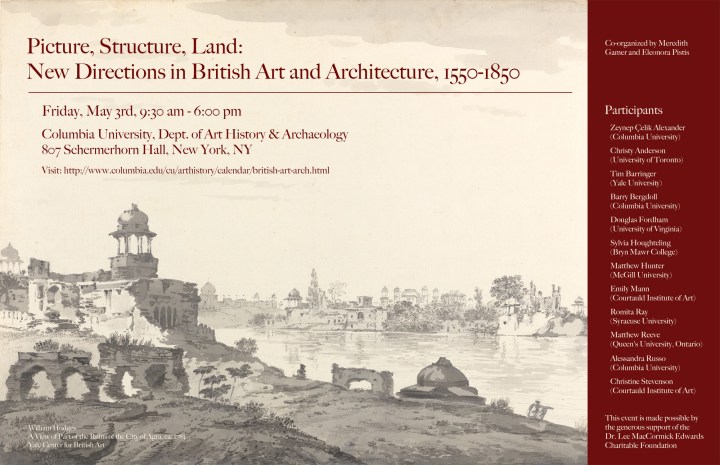
Picture, Structure, Land: New Directions in British Art and Architecture, 1550–1850
Columbia University, New York, 3 May 2019
Organized by Meredith Gamer and Eleonora Pistis
This one-day conference will bring together leading and emerging scholars working in and across the fields of British art and architectural history, broadly defined. Even with the rise of interdisciplinary studies, the study of the visual arts and the built environment in early modern Britain have remained largely separate endeavors. Our aim is to put the two in dialogue and, in doing so, to test, blur, and redraw the boundaries of each. For any questions, please contact britishartarch@gmail.com.
Register here»
P R O G R A M
9:30 Opening Remarks from Meredith Gamer and Eleonora Pistis (Columbia University)
10:00 Fluid Boundaries
Moderator: Alessandra Russo (Columbia University)
• Christy Anderson (University of Toronto), Castles of the Sea: Ships and Architecture in Early Modern England
• Emily Mann (Courtauld Institute of Art), Land, Sea, and the Space in Between: The Visual World of the Overseas Trading Company
11:15 Coffee Break
11:45 Shifting Perspectives
Moderator: Zeynep Celik Alexander (Columbia University)
• Christine Stevenson (Courtauld Institute of Art), Naming Names in Early Modern English Architecture
• Matthew Hunter (McGill University), ‘The Sun is God’: Turner’s Insurance
1:00 Lunch Break
2:30 Performing Identities
Moderator: Barry Bergdoll (Columbia University)
• Matthew Reeve (Queen’s University), Body Politics and Gothic Architecture in the Long Eighteenth Century
• Douglas Fordham (University of Virginia), Discovering Britain in Aquatint: William Daniell’s A Voyage Round Great Britain (1814–25)
3:45 Coffee Break
4:15 Transitional Objects
Moderator: Tim Barringer (Yale University)
• Sylvia Houghteling (Bryn Mawr College), Tapestry between Architecture and Chintz: A Medium in Transition, ca. 1700
• Romita Ray (Syracuse University), China Connections: Tea and Colonial Calcutta
5:30 Refreshments
This event is made possible by the generous support of the Dr. Lee MacCormick Edwards Charitable Foundation, which honors the legacy of Columbia alumna Dr. Lee MacCormick Edwards, GSAS’78, GSAS’81, GSAS’84, an art history scholar, author, and photographer who contributed richly to the cultural and artistic life of both the United States and Australia.
Conference | (Un)Like: Life Writing and Portraiture
From King’s College:
(Un)Like: Life Writing and Portraiture, c.1700–the Present
King’s College London, Strand Campus, 3 May 2019
 Portraiture and life-writing have long been understood as genres that, for all their differences, share key concepts. As both genres are concerned with the individual figure, they rely on particularities and specificities, on telling events and characteristic anecdotes and, most importantly, on a representative depiction of the subject in question which was similar or like. Resemblance, similarity, likeness—these were the terms by which works were judged. A letter to the Daily Gazetteer remarked in 1742: “I think it is agreed on all Hands that in Biography, as it is in Portrait Painting, a Likeness is to be preserved, if we would give satisfaction in either Science.” Importantly (and to complicate the study of likeness), the media concerned with likeness were likewise considered to be alike. The art theorist Jonathan Richardson famously wrote in 1715: “to sit for one’s Portrait is like to have an Abstract of one’s Life written and published, and to have one consigned over to Honour or Infamy.” Richardson referred to the long tradition of inter- or multi-media portraying and life-writing practices, the linking of literary with visual portraits for mutual benefit and the reciprocal bolstering of genres by providing additional information or another perspective. Next to resemblance and medial proximity, Richardson introduces a third aspect: appreciation or emotional response to portraits and biographies. Samuel Johnson would later write in the Idler no. 45 (1759) that “Every man is always present to himself, and has, therefore, little need of his own resemblance; nor can he desire it, but for the sake of those whom he loves, and by whom he hopes to be remembered.” Likeness, it appears, therefore intersects with the representation’s potential to make a person not only like, but also likeable, to have third parties appreciate both the individuals and their representations. This notion of recognition—understood as identification—being closely linked with respect and social approval still shows in such phenomena as Facebook and Instagram, where ‘to like’ equals acceptance, affirmation, or recommendation, signalling approval of the online persona.
This one-day conference explores the different layers of likeness in portraiture and life writing in Europe, from the beginning of the eighteenth century to the present day. Subjects include authors, inventors, painters, self-painters and selfie-takers, robots, realists, surrealists, expressionists, and others, from literature, painting, photography, and film. How does the concept of likeness appear, converge and change across these instances of portraying and portraiture?
Registration information is available here»
P R O G R A M M E
9.00 Welcome and Introduction by Clare Brant
9.15 Panel 1
• Franziska Gygax, Portraying (in) Language: Gertrude Stein’s Literary Portraits
• Max Saunders, Imaginary Portraits: Alfred Cohen and the Rabbi from Dublin
• Alex Belsey, Maintaining Distance: Techniques of Removal and Depersonalisation in the Work of Keith Vaughan
10.30 Panel 2
• Nadja Gernalzick, Queerly (Un)Recognizable: Jerome Hill’s Film Portrait
• Darragh O’Donoghue, Auto/biography in the Work of Disabled Artist Stephen Dwoskin
11.20 Coffee
11.35 Panel 3
• Tim Gorichanaz, Self-Portraiture: A Conceptual Exploration
• Eliza Maureen Altenhof, Describing One’s Self, Depicting One’s Self: The Self-Portrait in Contemporary Literature and Visual Arts in the Context of Illness and Death
• Ksenia Gusarova, Posing as Oneself: Normativity and Individuality in Current Photographic Practice
12.15 Panel 4
• Santiago Gonzales Villajos, Portraying Miguel de Cervantes: An Enlightenment’s Task and Its Factual Deconstruction
• Emrys Jones, The Portrait on the Screen: Film Narrative and Eighteenth-Century Art
• Sofya Dmitrieva, Fancy Picture / Sujet de Caprice: Defining the Genre in the Eighteenth-Century European Painting
1.15 Lunch
2.00 Panel 5
• Claudine van Hensbergen, Behn’s Elusive Likeness, Portraiture’s Place in the Biographical Account
• Olivia Ferguson, ‘The Worst Part of Wordsworth’: Intimacy, Accuracy, and the Author Portrait in the Romantic Period
• Leigh Wetherall Dickson, Painting Celebrity: Capturing the Character of Lady Caroline Lamb
3.15 Panel 6
• Julian North, Portraits for the People: Margaret Gillies’s Portrait of Charles Dickens
• Alba Campo Rosillo, The Medium Makes Publicity: Materiality in The Inventor Portrait by George Peter Alexander Healy
• Ana Belén Martinéz García, Portraying the Activist Likeness as/in Intermedia Practice
4.30 Tea
5.00 Panel 7
• David Veltman, Portraiture as a Mirror: Transcending the Limits of Representativeness in Felix de Boeck’s ‘Double’ Portraits
• Martin Schieder, The Non-Pictorial Portrait: Armani Portrait-robot d’Iris Clert (1960)
• Teresa Bruś, Increase and Excess in Portraiture: S. I. Witkiewicz
6.15 Drinks
6.30 Discussion led by Kerstin Pahl and Kate Retford
Concert and Symposium | Black Music in Eighteenth-Century London
This Thursday at YCBA:
Black Music in Eighteenth-Century London
Yale Center for British Art, New Haven, 25 April 2019

Tunde Jegede (Photo by Yoshitaka Kono).
This concert will feature Tunde Jegede, a renowned cellist and master kora player who specializes in the West African classical music tradition; Robin Jeffrey, a versatile performer on instruments of the lute and guitar families; Corey Shotwell, a celebrated vocalist; and Nathaniel Mander, an exciting young harpsichordist. The performances are free and open to all.
In October 2017, the Yale Center for British Art, Paul Mellon Centre for Studies in British Art (PMC), Historic Royal Palaces (HRP), and Handel & Hendrix in London (HHL) co-hosted a scholarly workshop entitled Black Music: Its Circulation and Impact in Eighteenth-Century London. The program was produced in association with Enlightened Princesses: Caroline, Augusta, Charlotte, and the Shaping of the Modern World, an exhibition that had been co-organized by the Center and HRP, and which then was on display at Kensington Palace. Moderated by Michael Veal (Professor of African Music, African American Studies, and American Studies at Yale) and attended by scholars from around the world, the workshop opened with a series of concerts and performances held throughout HHL, which set the stage for a rich and productive exchange the following day at the PMC. Thanks to the generosity of Laura and James Duncan, Yale BA 1975, Friends of the Center who underwrote the original workshop, this program will be reconstituted for a New Haven audience on Thursday, April 25, at 5:30pm. The performance will be followed on Friday, April 26, by a daylong symposium Black Music: Its Circulation and Impact in Eighteenth-Century London, also at the Center.
This Friday at YCBA:
Black Music: Its Circulation and Impact in Eighteenth-Century London
Yale Center for British Art, New Haven, 26 April 2019
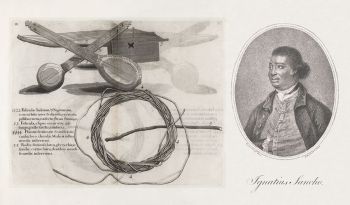 This daylong symposium, which follows the musical performance Black Music in Eighteenth-Century London at the Center on Thursday, April 25, will explore the complex, long-standing relationship between African and Western musical traditions, especially within London metropolitan society, and to recognize the brilliance of black composers and performers who, against great odds, contributed to the musical culture of the age. The program is hosted by the Yale Center for British Art and co-organized with Historic Royal Palaces, Handel & Hendrix in London, and the Paul Mellon Centre for Studies in British Art, with generous support from Laura and James Duncan, Yale BA 1975. Admission is free, though space is limited.
Conference | Stereotypes
This week at The Huntington:
Stereotypes and Stereotyping in the Early Modern World
The Huntington Library, Art Collections, and Botanical Gardens, San Marino, 19–20 April 2019
 The use and abuse of stereotypes is not limited to present-day politics. In this conference, experts in British and American history examine stereotypes related to such vital issues as race, religion, gender, nationality, and occupation. The program explores how stereotyping then, as now, persisted across different spheres of life; how individuals and groups responded; and with what consequences.
Funding provided by The Huntington’s William French Smith Endowment.
F R I D A Y , 1 9 A P R I L 2 0 1 9
8:30 Registration and coffee
9:15 Welcome by Steve Hindle (The Huntington) and opening remarks by Koji Yamamoto (University of Tokyo)
9:30 Session 1: Popery and Religious Stereotypes
Moderator: Koji Yamamoto
• Jennifer Anderson (California State University, San Bernardino), Controversial Figures as Synecdoches: Thomas Nash’s Distorted Snapshots of Puritans and Catholics
• Peter Lake (Vanderbilt University), Puritans and Projectors in the Plays of Ben Jonson
• Abigail Swingen (Texas Tech University), Whigs, Tories, and Jacobites: Stereotypes and the Financial Revolution
12:30 Lunch
1:30 Session 2: Economy, Occupations, and Gender
Moderator: Peter Lake
• Koji Yamamoto, Beyond ‘Keywords’: History Plays, Stereotypes, and the Staging of Political Economy in Late Elizabethan England
• Jane Whittle (University of Exeter), The Early Modern Housewife: A Positive Stereotype of the Working Woman?
• Lisa Cody (Claremont McKenna College), Mind, Body, Soul, and Mirrors: Stereotyping Women in Early Modern England
S A T U R D A Y , 2 0 A P R I L 2 0 1 9
9:00 Registration and coffee
9:30 Session 3: Colonies and Empire
Moderator: Koji Yamamoto
• Kristen Block (University of Tennessee, Knoxville), Creating and Fighting Stereotypes of Sin and Sexual Excess: Leprosy and Race in the Eighteenth-Century Caribbean
• Valerie Forman (New York University), Managing Slave Plantation Labor: Or, How Productivity Became Beautiful and Accumulation Anti-tyrannical. A Study of the Political Economy of Sugar in the Early Modern Transatlantic World
• Sharon Block (University of California, Irvine), Daily Descriptions as Racemaking in Colonial North America
12:30 Lunch
1:30 Session 4: Stereotypes in Archives and on Stage
Moderator: Peter Lake
• Bridget Orr (Vanderbilt University), Re-presenting Character: Dramaturgy Versus Performance in Eighteenth-Century Stereotypes
• Miles Parks Grier (Queens College, City University of New York), Staging the Transferable Stigma of Early Modern Blackness
• Brendan Kane (University of Connecticut), Explicit Bias and the Politics of Difference in Irish-English Encounter
4:30 Closing Remarks
Exhibition | Making Time: The Art of the Kentucky Tall Case Clock
Now on view at the Speed Art Museum:
Making Time: The Art of the Kentucky Tall Case Clock, 1790–1850
Speed Art Museum, Louisville, 2 February — 16 June 2019
Curated by Scott Erbes

Case attributed to Daniel Spencer (American, about 1741–1796), Lexington, Fayette County, Kentucky, Tall Case Clock, 1793–96; cherry, poplar, chestnut, walnut; eight-day brass and steel movement, 98 inches high (Cox Collection).
Making Time: The Art of the Kentucky Tall Case Clock, 1790–1850 is a first-of-its-kind exhibition devoted to early Kentucky tall case, ‘grandfather’ clocks. The exhibition showcases twenty-seven clocks made across a wide swath of Kentucky from the 1790s through the 1840s. The majority of the clocks come from family and private collections and have rarely, if ever, been shared with the public. The exhibition is accompanied by a fully illustrated scholarly catalog that presents significant new research on early Kentucky cabinetmaking and the state’s watch and clock trade.
When shown side-by-side, the clocks reveal the expert hands of many Kentucky artisans; illustrate the hidden world of gears, bells, weights, and pendulums that kept the clocks running and chiming; and record the complex webs of craft, taste, trade, and technology needed to make these practical works of art. Throughout the exhibition, the clock cases illustrate the talents of early Kentucky cabinetmakers, both native-born and those who came to the state in search of success. These artisans transformed local woods like cherry and walnut into towering cases that frequently incorporate flourishes like inlaid decoration, carved ornament, and richly figured veneers. The results range from urbane, Federal-style creations to more idiosyncratic, often boldly inlaid forms. Numerous Kentucky silversmiths are associated with the intricate movements housed within the various clocks.
Just in Time: Exploring Kentucky Tall Case Clocks
Speed Art Museum, Louisville, 18 May, 9:00–3:00
Come join us for a study day exploring the backstories behind early Kentucky tall case clocks with the experts who created the exhibition Making Time: The Art of the Kentucky Tall Case Clock, 1790–1850. Enjoy a morning of presentations focused on the art, history, and technology of these Kentucky treasures; an opportunity to purchase signed copies of the exhibition’s accompanying catalog; and an afternoon tour of the exhibition with its creators. $75.
Scott Erbes (Curator of Decorative Arts and Design, Speed Art Museum), From the Beginning: An Introduction to Kentucky Tall Case Clocks
Early Kentucky tall case clocks tell many stories: of the talented artisans who created them, of local and regional practices, of fashionable taste, of international trade, of the nature of time and timekeeping in Federal America, and of family memory. This overview will touch on these themes and others, setting the stage for the day’s conversations.
Mack Cox (independent researcher and collector), Making the Case for the Art in Kentucky Tall Case Clocks
Kentucky tall case clocks consist of locally made cases mated with clock movements, dials, and other components often made elsewhere. While the latter are often well documented, the Kentucky-made portions and artistic expressions of early Kentucky craftsmen are nearly unknown. Based on over a decade of serious study of Kentucky furniture, this lecture will shed light on the art and Kentucky parts of the Kentucky tall case clock.
Bob Burton (independent researcher and collector), What Makes It Tick: Inside Kentucky Tall Case Clocks
The movements and related parts in Kentucky tall case clocks vary widely in type, materials, and origins. This discussion will reveal these secrets, exploring the time-keeping mechanisms, painted dials, and other components that marked the time in early Kentucky clocks.
Greg Black (independent researcher and collector), Will the Real Elijah Warner Please Stand Up?
Over the past decades, much has been written about Elijah Warner of Lexington, Kentucky, especially that he was a cabinetmaker and clockmaker. The recent discovery of nineteenth-century documents and advertisements cast new light on Warner’s training and occupation and the goods he produced and sold. This presentation will review this information to bring the real Elijah Warner into better focus.
Salon du Dessin 2019
From the press kit:
Salon du Dessin 2019
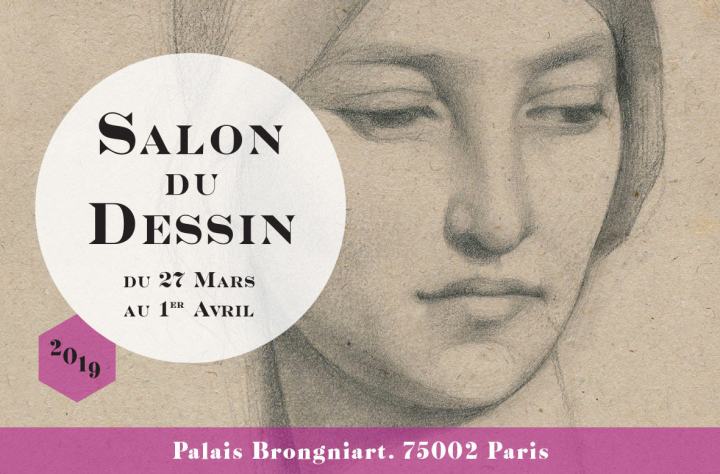
Palais Brongniart, Paris, 27 March — 1 April 2019
The eagerly anticipated Salon du Dessin will take place again this spring under the vaulted roof of Paris’s Palais Brongniart and will once again feature a selection of outstanding works on paper. among the 39 exhibitors from around the world will be four handpicked new galleries and two that are returning after an absence of a few years. Among the treasures on display will be rare drawings by egon schiele and Gustav Klimt, presented by the Austrian gallery Wienerroither & Kohlbacher, and a solo show of the work of contemporary artist Jean-Baptiste Sécheret on the stand of Galerie Jacques Elbaz. The German dealer Martin Moeller will celebrate 100 years of drawings from his country, while the Galerie de la Présidence features drawings by sculptors.

Juan Antonio Conchillos y Falcó, Academic Study, 1703; offered by Artur Ramon Art ($36,000).
The 28th edition of the art fair will also host two museum-level exhibitions. Festivities in Paris will feature drawings from the collection of the Musée Carnavalet-Histoire de Paris (currently closed for renovation until late 2019), while the Maison Chaumet will exhibit drawings of its jewelry in an exhibition on the theme of nature, curated by botanist Marc Jeanson, who worked on the magnificent exhibition Jardins at the Grand Palais in 2017.
Other highlights of the Salon du Dessin will be the presentation of the 12th Daniel and Florence Guerlain Drawing Prize and the return of a program of international symposia, which will focus on the performing arts this year. Drawing Week, a highly popular off-site event organized in partnership with over 20 museums and institutions, will offer access to graphic arts collections that are usually off-limits to the public.
W E D N E S D A Y , 2 7 M A R C H 2 0 1 9
Occupying the Stage: Sets and Costumes
Chair: Jean-Claude Yon (Professor at the University of Saint-Quentin-en-Yvelines)
• Emmanuelle Brugerolles (Curator General at the École Nationale Supérieure des Beaux-Arts, Paris), Georges Focus and the Theater: Sets and Staging
• Rudi Risatti (Curator at the Theatermuseum in Vienna), The Magic Space: Technical and Aesthetic Solutions in Baroque Scenography as Seen in Drawings from the Theatermuseum in Vienna
• Marc-Henri Jordan (independent art historian, doctoral student, University of Lausanne), The Royal Academy of Music in Search of Draftsmen and Painters: Identification of Decorative Drawings and Clothing, ca. 1780
• Catherine Join-Diéterle (Curator General, former director of the Musée Galliera, Paris), Theater Sets in the Romantic Era: A New Approach to the Stage Area
• Marine Kisiel (Painting Curator at the Musée d’Orsay), ‘A Unique System of Lines’: The Body in Space in the Work of Edgar Degas
• Mathias Auclair (Director of the Music Department at the Bibliothèque Nationale de France, Paris), The Stage Seen as a Painting: The Birth of Scenography at the Paris Opera, 1914–1972
T H U R S D A Y , 2 8 M A R C H 2 0 1 9
Occupying the City: Festivities and Ceremonies
Chair: Michel Delon (Professor at the University of Paris-IV Sorbonne)
• Franca Varallo (Professor at the university of Turin), Onorato Tiranti’s Il Laberinto de Groppi and Drawings for Festivities by Tommaso Borgonio
• Jérôme de La Gorce (Emeritus Research Director, CNRS- Centre André Chastel), Collections of Drawings Held in Paris and Madrid Illustrating Important Celebrations of the Marriage of Madame to the Infant of Spain, 1739
• Maria Ida Biggi (Director of the Centro Studi per la Ricerca Documentale sul Teatro Europeo Fondazione Cini, Venice), Le feste sull’acqua: Apparati per Napoleone
• Gaëlle Lafage (Postdoctoral Researcher, Université de Paris Sorbonne), Drawing as a Source of Study of Fireworks
• José de Los Llanos (Chief Curator, Head of the Musée Carnavalet’s Graphic art Department) and David Simonneau (Conservation Assistant, Musée Carnavalet Graphic art department), Festivals and Spectacles in the Collection of the Musée Carnavalet-Histoire de Paris, 17th–19th Centuries
Conference | 1802: Cultural Exchange between Paris and London

Thomas Girtin, View of Pont de la Tournelle and Notre Dame, etching and aquatint, from A Selection of Twenty of the Most Picturesque Views in Paris, and Its Environs (London, 1803), RB 400000, (San Marino: The Huntington Library, Art Collections, and Botanical Gardens).
◊ ◊ ◊ ◊ ◊
From the program for the upcoming conference:
1802: Cultural Exchange between Paris and London during the Peace of Amiens
The Huntington Library, Art Collections, and Botanical Gardens, San Marino, 17–18 May 2019
This interdisciplinary conference illuminates the movement of writers, artists, scientists, and cultural goods between Paris and London during the fourteen months of peace ushered in by the Treaty of Amiens, from March 1802 through May 1803—the first break in hostilities after a decade of Revolutionary warfare. Registration information is available here.
Funding provided by The Dibner History of Science Program at The Huntington
F R I D A Y , 1 7 M A Y 2 0 1 9
9:00 Registration and Coffee
9:30 Welcome by Steve Hindle (The Huntington) and Opening Remarks by Cora Gilroy-Ware (Isaac Julien Studio) and Paris Spies-Gans (Harvard University)
10:00 Session 1: Writers
Moderator: Kevin Gilmartin (California Institute of Technology)
• Susan Lanser (Brandeis University), Helen Maria Williams, Radical Sociability, and the Uneasy Peace of Amiens
• Kelly Summers (MacEwan University), Between Amiens and Amnesty: The Parisian Wanderings of the d’Arblays, c. 1802
12:00 Lunch
1:00 Session 2: Artists
Moderator: Hector Reyes (University of Southern California)
• Cora Gilroy-Ware (Isaac Julien Studio), Inferior Beauty: The (British) Artist’s Gaze on the Streets and in the Louvre
• Catherine Roach (Virginia Commonwealth University), ‘Great National Establishments’: Amiens and the Foundation of the British Institution
3:00 Break
3:15 Session 3: Publication
Moderator: Paula Radisich (Whittier College)
• Melinda McCurdy (The Huntington), Thomas Girtin’s Paris Venture
• Susan Siegfried (University of Michigan), Amelia Opie’s ‘Recollections of a Visit to Paris in 1802’
S A T U R D A Y , 1 8 M A Y 2 0 1 9
9:30 Registration and Coffee
10:00 Session 4: Intellectual Exchanges
Moderator: Alexander Statman (Dibner Long-Term Research Fellow, The Huntington)
• Dena Goodman (University of Michigan), French Scientists Cross the Channel: Peace and the Advancement of Knowledge, Industry, and Agriculture
• Joshua Ehrlich (University of Macau), Alexander Hamilton, Asian Knowledge, and Anglo-French Competition
12:00 Lunch
1:00 Session 5: Material Culture
Moderator: Mary Terrall (University of California, Los Angeles)
• Courtney Wilder (University of Michigan), Revolutions and Rivalries in the Printed Textile Trade before, during, and after the Peace of Amiens
• Renaud Morieux (University of Cambridge), The ‘Obscene’ and ‘Infamous’ Trade between Britain and Europe around the Peace of Amiens
3:00 Break
3:15 Session 6: Shaping the Narrative
Moderator: Nathan Perl-Rosenthal (University of Southern California)
• Simon Macdonald (Queen Mary University of London), The Argus, or London Review’d in Paris: Mediascape between France and Britain during the Peace of Amiens
• Paris Spies-Gans (Harvard University), ‘In this Country the Law is on my Side:’ Marie Tussaud, the Peace of Amiens, and the Formation of a Wax Empire
5:15 Closing Remarks by Cora Gilroy-Ware, Dena Goodman, and Paris Spies-Gans
Workshop | Antiquarian Science in the Scholarly Society
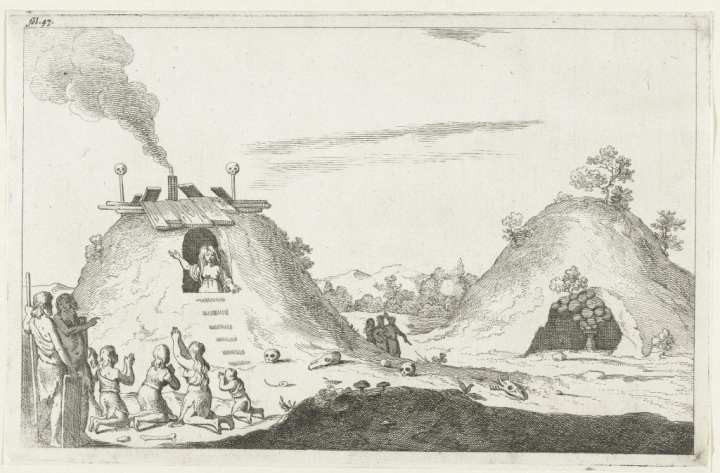
A Priestess Speaking from within a Prehistoric Barrow in Drenthe, from Johan Picardt, Korte beschryvinge van eenige vergetene en verborgene antiquiteten (Amsterdam 1660), f. 47 (Rijksmuseum, RP-P-OB-77.857).
◊ ◊ ◊ ◊ ◊
From the project website:
Antiquarian Science in the Scholarly Society
Society of Antiquaries of London, 1–2 April 2019
Organized by Vera Keller and Anna Marie Roos
This is workshop II of the AHRC International Networking Grant: Collective Wisdom: Collecting in the Early Modern Academy. What was the relationship between archaeological fieldwork or antiquarianism and learned travel or the Grand Tour? What does collecting on tour say about the manner and scale of personal and institutional contacts between London and the scientific world of the Continent? What tools of natural philosophy were utilised to understand buildings and artefacts? What were the implications of the collecting of ethnographic objects for political dominance and Empire?

Ex libris of Z. C. von Uffenbach (Amsterdam: Rijksmuseum, RP-P-2015-26-1860).
Speakers include Philip Beeley (Oxford), Dominik Collet (Oslo), Luke Edgington-Brown (East Anglia), Dustin Frazier Wood (Roehampton), Vera Keller (Oregon), Chantel Grell (Versailles), Clare Hornsby (British School at Rome), Stephanie Moser (Southhampton), Staffan Müller-Wille (Exeter), Cesare Pastorino (Berlin), Anna Marie Roos (Lincoln), Edwin Rose (Cambridge), Martin Rudwick (Cambridge), Kim Sloan (British Museum), Alexander Wragge-Morley (NYU), Elizabeth Yale (Iowa).
A working session using sources from the Society of Antiquaries Library and Museum will also be part of the programme. The Society’s library is Britain’s oldest major research library for archaeology, architectural history, decorative arts (especially medieval), material culture, and the historic environment. It contains books, archives, manuscripts, prints, and drawings. Its Accredited museum collection—which was formed before the introduction of public museums and galleries in the mid-18th century—contains prehistoric, classical and medieval antiquities, seal matrices and impressions, and paintings. Full fee: £100 including lunch. Student/Concessions: £50 including lunch.
M O N D A Y , 1 A P R I L 2 0 1 9
10:00 Registration
10:15 Welcome and Introduction by Vera Keller and Anna Marie Roos
10:20 Plenary Talk
• Stephanie Moser (Southampton) and Christian Hoggard (Aarhus), Visual Testimony: Images and Discipline-Building at the Society of Antiquaries of London
11:15 Egypt and ‘Scientific Antiquarianism’
Chair: Roey Sweet (University of Leicester)
• Chantal Grell (Université de Versailles), Tito Livio Burattini: A Seventeenth-Century Engineer and Egyptologist
• Anna Marie Roos (University of Lincoln), The First Egyptian Society, 1741–43
12:15 Lunch
1:00 The Republic of Letters, Scholarly Societies, and Antiquarianism (Seventeenth Century)
Chair: Lisa Skogh
• Vera Keller (University of Oregon), The Ottoman History of Letters
• Dominik Collet (University of Oslo), Weak Ties, Big Science: Challenges to ‘Blended Learning’ in Early Academic Collections
• Philip Beeley (University of Oxford), ‘The Antiquity, Excellence, and Use of Musick’: Ancient Greek Music and Its Reception in Late Seventeenth-Century Oxford
• Cesare Pastorino (Technische Universität, Berlin), The Features of Early Modern English Antiquarian Metrology
3:00 Coffee Break
3:15 The Republic of Letters, Scholarly Societies, and Antiquarianism (Eighteenth Century)
Chair: Jana Schuster (Cambridge)
• Dustin Frazier Wood (University of Roehampton), Antiquarian Science and Scientific Antiquarianism at the Spalding Gentlemen’s Society, 1710–55
• Clare Hornsby (British School at Rome), Winckelmann, the Descrizione della Villa dell’Em Alessandro Albani, and the Society of Antiquaries of London
4:15 Hands-On Session I
6:00 Reception
T U E S D A Y , 2 A P R I L 2 0 1 9
10:00 Registration
10:30 Plenary Talk
• Kim Sloan (British Museum), Sloane’s Antiquities: Providing a ‘Body of History’ through Beads, Bottles, Brasses, and Busts
11:30 Ruins and Remains
Chair: Caroline Barron (Birkbeck, University of London)
• Alexander Wragge-Morley (NYU), In Search of Lost Design: The Science of Ruins in the Seventeenth Century
• Elizabeth Yale (University of Iowa), Elf-Arrows and Origins: Antiquarian Collections and Human Descent
• Luke Edgington-Brown (University of East Anglia), The 1901 Excavation of Stonehenge and Its Connection to Antiquarian Research in Late Nineteenth-Century Japan
1:00 Lunch
2:00 Eighteenth-Century Natural History and Antiquarianism
Chair: Arthur MacGregor (Oxford)
• Martin Rudwick (University of Cambridge), Volcanoes and Vases: Naturalists, Antiquaries, and the Mobilisation of Images
• Staffan Müller-Wille (University of Exeter), Following Footsteps: Linnaeus in Lapland
• Edwin Rose (University of Cambridge), From Collection to Publication: Joseph Banks, Thomas Pennant, and Defining Natural History and Antiquarianism in Late Eighteenth-Century Britain
3:30 Coffee Break
4:00 Hands-On Session II
Workshop | The Mind in the Matter
From Eventbrite:
The Mind in the Matter: New Approaches to the Psychology of Collecting
Institute of Historical Research, London, 27 March 2019
Organised by the Society for the History of Collecting
Psychology informs us about what drives an individual to collect. In the Enlightenment, the human mind was often analysed and discussed by means of metaphors and analogies borrowed from the world of collecting. In the nineteenth-century, the stereotypes surrounding the monomaniac, eccentric or perverse collector was codified in the art press and through fiction. In the twentieth century, the topic was treated at length by scholars such as Werner Munsterberger, often working in an explicitly psychoanalytic framework. Whilst this Freudian approach has been subject to intense criticism in the past thirty years, many scholars continue to interpret collecting in terms of categories such as ‘lack’, ‘surrogacy’, ‘desire’ and ‘loss’.
Join us for a workshop that investigates the extent to which psychological models are still valid and necessary to understand collecting as a human activity. Is there a tension between the universalising psychological theories and the drive to study collecting historically? What sources are particularly useful or revealing for uncovering the collector’s motivations or relations to his objects? What can recent developments in psychology and neuroscience add to our understanding? How far can or should we enter the interior life of a collector, and what role does imagination play in communicating these insights to new audiences? And what are the meaningful alternatives, apart from opportunistic acquisitions; to a psychological approach of the study of collecting—can we ever escape from this way of thinking?
The workshop brings together six specialists working in different disciplines, who approach the ‘psychology of collecting’ from alternative perspectives, using historical case-studies and scientific models. Confirmed speakers include the pioneering historian of collecting Professor Susan Pearce; neuropsychologist Professor John Harrison; artist, collector and scholar Dr Jane Wildgoose; librarian and heritage expert Dr Tony Burrows; doctoral researcher into the collector Sir William Burrell, Isobel Macdonald; and contemporary art adviser Shaune Arp.
Organising committee: Tom Stammers, Adriana Turpin, Eleni Vassilika










 Enfilade
leave a comment